Introduction
The common beech (Fagus sylvatica L.) is one of the most important broadleaved species in European forestry. Beech is propagated by seeds, but its seed set is irregular, with 5–10 years between good crops (Suszka et al., Reference Suszka, Muller and Bonnet-Masimbert1996). Consequently, it is necessary to store the seeds.
Beechnuts are characterized by a greater sensitivity to drying and storage conditions, compared to seeds of other species (Pukacka and Wójkiewicz, Reference Pukacka and Wójkiewicz2003). They exhibit storage behaviour intermediate between those of orthodox and recalcitrant seeds, the characteristics of which were described by Roberts (Reference Roberts1973). Seeds with orthodox storage behaviour tolerate desiccation to moisture contents below 5%, and reduced storage temperature and moisture content increase their longevity during storage. In contrast, recalcitrant seeds are characterized by an inability to withstand desiccation below a relatively high moisture content (20–40%), and they can be stored only for a short time. Beechnuts were determined as intermediate or suborthodox by Bonner (Reference Bonner1990) and Gosling (Reference Gosling1991). However, Poulsen (Reference Poulsen1993) classified them in the orthodox category. Recently, León-Lobos and Ellis (Reference León-Lobos and Ellis2002), on the basis of investigations of beech seed viability during storage at varied moisture and temperature conditions, established that the optimal temperature and moisture for storage of these seeds is 7.8–11.5% water content and − 10 to − 20°C. Pukacka et al. (Reference Pukacka, Hoffmann, Goslar, Pukacki and Wójkiewicz2003) confirmed these optimal conditions through investigations of glass formation in embryonic axes of beech seeds, and found that water sorption by these organs is greater than in cotyledons. The results suggested that the water relations in beech seeds are the main cause of their sensitivity to storage conditions. Because of the higher amount of water in embryonic axes, it is thought that the molecular mobility, which may be the main parameter enabling ageing (Buitink et al., Reference Buitink, Leprince, Hemminga and Hoekstra2000; Walters et al., Reference Walters, Hill and Wheeler2005), is higher there. So, the processes accompanying seed ageing (mainly free-radical reactions) are more intensive in embryonic axes and, in effect, lead to the loss of germination capacity. This was confirmed in Pukacka and Ratajczak (Reference Pukacka and Ratajczak2005), as well as Ratajczak and Pukacka (Reference Ratajczak and Pukacka2005). Cellular membranes are proposed as some of the primary sites of injury during desiccation and storage of seeds (Pukacka, Reference Pukacka1991; McDonald, Reference McDonald1999; Bailly, Reference Bailly2004). This is mediated by an oxidative attack, which promotes phospholipid degradation and loss of membrane organization (Ratajczak and Pukacka, Reference Ratajczak and Pukacka2005). The crucial role in protection of membranes and other macromolecules of cells in dry seeds is played by the antioxidative system, particularly by low molecular weight antioxidants, which are directly able to detoxify reactive oxygen species (ROS) and free radicals. Important antioxidants in seeds include ascorbic acid (ASA) and glutathione (GSH).
Based upon electron spin resonance (ESR) data, a role of amphiphilic substances, such as phenolic compounds, in membrane protection has been proposed by Hoekstra et al. (Reference Hoekstra, Golovina and Buitink2001). During desiccation, these substances are thought to partition from the cytoplasm to membranes. The advantageous aspects of partitioning are the insertion of antioxidants into membranes, the depression of T m and increase in fluidity to prevent gel-phase formation, and inhibition of phospholipase activities (Rice-Evans et al., Reference Rice-Evans, Miller and Paganga1997; Hoekstra and Golovina, Reference Hoekstra and Golovina2002; Oliver et al., Reference Oliver, Hincha and Crowe2002). Another antioxidant associated with membranes, α-tocopherol, also protects them against ROS attack. Its primary function is to limit non-enzymatic lipid oxidation during seed storage (Sattler et al., Reference Sattler, Gilliland, Magallanes-Lundback, Pollard and Della Penna2004).
The aim of this study was to establish whether any correlations exist between the amounts of low molecular weight antioxidants and the germination capacity of beech seeds stored for different periods under conditions regarded as optimal for maintaining seed viability in this species.
Materials and methods
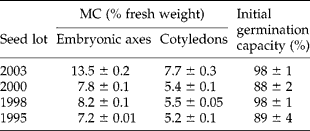
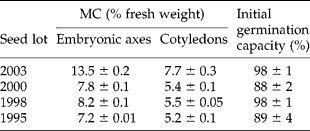
Beach seed lots were obtained from Forest Gene Banks in Bialogard and Kostrzyca (Poland) from the cropping years 1995, 1998, 2000 and 2003. They originated from nearby forest districts in north-west Poland. Their water content reached 8–9% (fresh weight basis), and they were kept at − 10°C in tightly sealed containers. The seeds were transported to our laboratory in plastic bags in a cooling box, and were stored subsequently in laminated aluminium foil bags at − 10°C. Seeds were of good initial quality (Table 1). Experiments reported here were performed in 2005 (i.e. after 2, 5, 7 and 10 years of storage), with the exception of superoxide and hydrogen peroxide determinations, which were analysed a few months later. Except for the conductivity test, all chemical analyses were performed after storage with unimbibed seeds.
Moisture contents (MC) in embryonic axes and cotyledons of beech (Fagus sylvatica) seed lots after storage, and their initial germination capacity prior to storage
Germination test
After hydration at 100% RH for 24 h to prevent imbibitional injury, samples of 4 × 50 seeds from each seed lot were allowed to germinate at 3°C between moist rolled paper towels in separate boxes. Stratification was conducted for 20–26 weeks. A seed was scored as germinated when the radicle protruded to 5 mm. Germination counts were made every week and germinated seeds were removed (ISTA, 1999). All seeds that had not germinated after 26 weeks were considered dead (León-Lobos and Ellis, Reference León-Lobos and Ellis2002).
Electrolyte leakage
Three samples of 20 seeds each were extracted from the pericarp and seed coats and then were placed in 10 ml of deionized water. The conductivity of the solutions was measured after 24 h of incubation at room temperature. The results are expressed in microsiemens (μS).
Superoxide determination
Superoxide content in seeds was assayed using the method of Doke (Reference Doke1983), by the capacity to reduce nitroblue tetrazolium in the dark at room temperature. The absorbance of the end product was measured at 530 nm.  formation was expressed as ΔA530 (g dry weight)− 1 of the sample.
Evaluation of hydrogen peroxide content
Samples of five seeds each were ground to a fine powder in liquid nitrogen and homogenized with 5 ml of 5% trichloroacetic acid (TCA) containing 10 mM EDTA. The homogenate was filtered through two layers of cheesecloth and centrifuged at 12,000 g for 15 min at 4°C. The total amount of supernatant was analysed using the ferrithiocyanate method according to Sagisaka (Reference Sagisaka1976).
Analysis of lipid hydroxyperoxides
The assay of lipid hydroxyperoxides (LHPOs) as products of lipid peroxidation is recommended by some authors (Gay et al., Reference Gay, Collins and Gebicki1999; Griffiths et al., Reference Griffiths, Leverentz, Silkowski, Gill and Sanchez-Serrano2000) if it is not possible to assay malondialdehyde (MDA). LHPOs were determined according to the method of Griffiths et al. (Reference Griffiths, Leverentz, Silkowski, Gill and Sanchez-Serrano2000). Three samples of five embryos (c. 1 g) each were extracted with chloroform : methanol [1 : 2 (v/v)]. All procedures were performed under dim light in a cold room, using chilled solvents and amber vials. Absorbance was determined spectrophotometrically at 560 nm, and the concentration of LHPOs was determined with a molar absorption coefficient derived for standard linoleate hydroperoxide (ɛ = 6.0 × 10⁴ M− 1 cm− 1) (Gay et al., Reference Gay, Collins and Gebicki1999).
Determination of total phenols and ultraviolet-absorbing phenols
Total phenols were determined spectrophotometrically using the Folin–Ciocalteu reagent (Sigma, Poland), as described by Swain and Hillis (Reference Swain and Hillis1959). Samples of 50 embryonic axes or 20 cotyledons each were extracted in 10–20 ml of acidified methanol [79 : 20 : 1 methanol : water : HCl (v/v)] at 80°C. The extracts were clarified by centrifugation (16,000 g) for 10 min at 4°C. The aliquots of supernatant were diluted to 7 ml and mixed with 0.5 ml of Folin–Ciocalteu's phenol reagent; 3 min later, 1 ml of saturated sodium carbonate solution was added, and the mixture was made up to 10 ml. The reaction was left for 1 h, and the absorbance was measured at 725 nm. A standard curve was prepared using chlorogenic acid, and total phenols were expressed as chlorogenic acid equivalents.
A spectral scan of ultraviolet (UV)-absorbing phenols was carried out with ethanolic extracts [ethanol : water, 80 : 20 (v/v)] for embryonic axes and cotyledons obtained according to Lois (Reference Lois1994), using a spectrophotometer. The changes in UV-absorbing phenols were estimated by quantifying absorbance at 265 nm on a gram dry weight (DW) basis.
Lipid extraction and analyses of α-tocopherol and sterols
Samples of 50 embryonic axes or 20 cotyledons each were subjected to lipid extraction using chloroform :methanol [2 : 1 (v/v)] supplemented with 0.05% butylated hydroxytoluene (BHT), according to Allen et al. (Reference Allen, Good, Davis, Chisum and Fowler1966), and as described by Pukacka (Reference Pukacka1983). The α-tocopherol and sterols were determined in aliquots of the total lipid fractions according to Kendall and McKersie (Reference Kendall and McKersie1989), after silylation of samples with BSTFA (N-O-bis-trimethylsilyl-trifluoro-acetamide) and pyridine at room temperature in darkness. Silylated samples and the internal standard, α-cholestane, were separated on the gas chromatograph with a SPB 1 microcapillary column (Supelco, Sigma), and identified by comparing retention times with those of authentic standards. Concentrations of sterols and α-tocopherol were expressed in microgram per gram DW [μg (g DW− 1].
Ascorbic acid assay
Ascorbic acid (ASA) content was assayed according to Kampfenkel et al. (Reference Kampfenkel, Van Montagu and Inzé1995). Samples of 15 embryonic axes and 5 cotyledons each were taken for analyses. The extraction was performed with 6% TCA (w/v) in an ice bath. The assay is based on the reduction of Fe3+ to Fe2+ by ASA in an acidic solution. Fe2+ forms complexes with bipyridyl, giving a pink colour with maximum absorbance at 525 nm.
Glutathione assay
Glutathione in the reduced (GSH) and oxidized (GSSG) forms was assayed according to Smith (Reference Smith1985). The samples of 15 embryonic axes and 5 cotyledons each were homogenized in 5% (w/v) sulphosalicylic acid in an ice bath and centrifuged at 10,000 g for 20 min at 4°C. A 1 ml aliquot of the supernatant was removed and neutralized by adding 1.5 ml of 0.5 M potassium phosphate buffer, pH 7.5. This sample was used for the determination of total glutathione (GSH+GSSG). Another 1 ml of neutralized supernatant was pretreated with 0.2 ml of 2-vinylpyridine for 1.5 h at 25°C to mask GSH and to allow determination of GSSG alone. Both samples were extracted twice with 5 ml of diethylether. The incubation mixture contained: 0.5 ml of 0.1 M sodium phosphate buffer (pH 7.5) containing 5 mM EDTA, 0.2 ml of 6 mM 5,5′-dithiobis-(2-nitrobenzoic acid), 0.1 ml of 2 mM NADPH, 0.1 ml (1 unit) of glutathione reductase type III (Sigma) and 0.1 ml of extract. The change in absorbance at 412 nm was followed at 25°C. A standard curve was prepared by using the GSH standard. The soluble protein content of buffered crude seed extracts was estimated according to Bradford (Reference Bradford1976), using bovine serum albumin (BSA) as a standard.
Statistical analysis
Data are presented as means ± standard deviation of six replicates (two parallel treatments of three replicates). The statistical differences between seed viability after different storage periods and the particular parameters were tested using an analysis of variance (ANOVA). Levels of significance are indicated as *P < 0.1, **P < 0.05 and ***P < 0.01.
Results
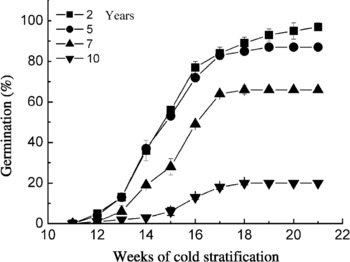
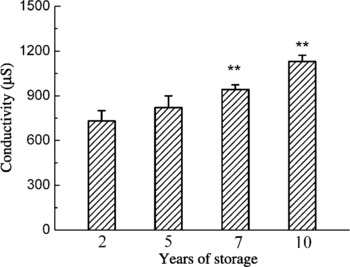
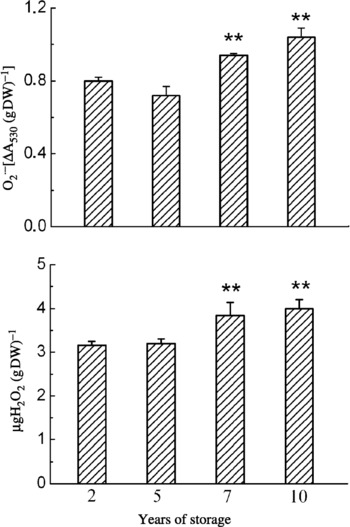
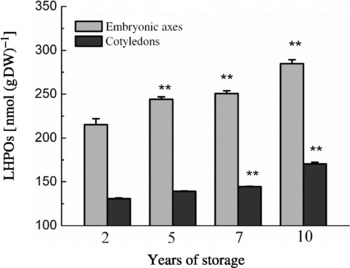
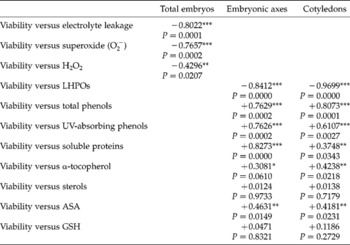
Beech seed viability was assessed on the basis of the ability of the seeds to germinate. Figure 1 shows that seed lots stored for 2 and 5 years exhibited high germination capacity, although the final percentage of germinated seeds was higher in the younger seeds (97 versus 87%). Germination capacity decreased dramatically to 66% in 7-year-old seeds, and to 20% in 10-year-old seeds. The decrease was accompanied by an increase in electrolyte leakage (Fig 2), ROS (superoxide radical and hydrogen peroxide) (Fig 3) and LHPOs (Fig 4). The increase was significant in 7- and 10-year-old seeds compared to 2-year-old seeds, and a strong negative correlation was observed between germination capacity and the levels of ROS and LHPOs (Table 2).
The germination capacity of beech (Fagus sylvatica) seeds at 3°C, after storage for 2, 5, 7 and 10 years at − 10°C.

Electrolyte leakage from beech (Fagus sylvatica) seeds after storage periods of 2, 5, 7 and 10 years at − 10°C.

Reactive oxygen species [superoxide radical (O2· − ) and hydrogen peroxide (H2O2)] in beech (Fagus sylvatica) seeds after storage for 2, 5, 7 and 10 years at − 10°C.

Lipid hydroxyperoxide (LHPO) content of beech (Fagus sylvatica) seeds after storage for 2, 5, 7 and 10 years at − 10°C.

The correlation (r) between viability (germination capacity) and electrolyte leakage, the level of lipid hydroxyperoxides (LHPOs), total phenols, ultraviolet (UV)-absorbing phenols, soluble proteins, α-tocopherol, total sterols, ascorbic acid (ASA) and glutathione (GSH) contents in beech (Fagus sylvatica) seeds stored through 2, 5, 7 and 10 years

Statistically significant relationships: ***P < 0.01, **P < 0.05, *P < 0.1.
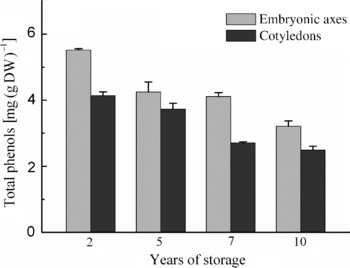
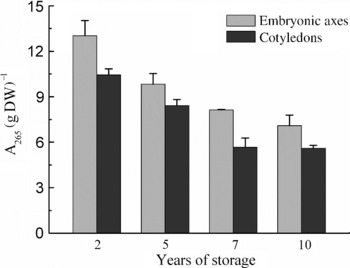
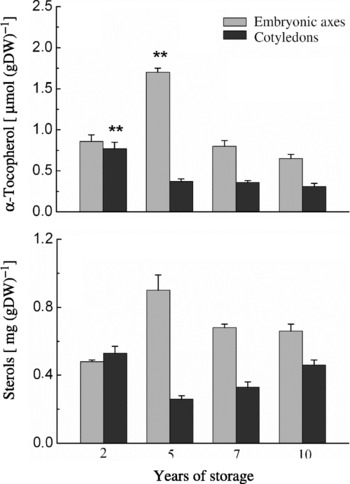
In the course of prolonged seed storage, total phenols decreased both in embryonic axes and in the cotyledons (Fig 5). A decline was also observed in UV-absorbing phenols at 265 nm (Fig 6). Strong positive correlations were noticed between germination capacity and total phenols (r = 0.76, P = 0.0002 for embryonic axes, and r = 0.81, P = 0.0001 for cotyledons) or UV-absorbing phenols (r = 0.76, P = 0.0002; and r = 0.61, P = 0.0027, respectively) (Table 2). Also, α-tocopherol content decreased during prolonged seed storage. The correlation between this factor and germination capacity was statistically significant, but the relationship was moderately strong (r = 0.42, P = 0.0218 for cotyledons; and r = 0.31, P = 0.061 for embryonic axes). A higher amount of α-tocopherol was detected in the embryonic axes of 5-year-old seeds, and in cotyledons of 2-year-old seeds (Fig 7, Table 2). Sterol content was not correlated with germination capacity (Fig 7, Table 2).
Total phenol content of embryonic axes and cotyledons of beech (Fagus sylvatica) seeds after storage for 2, 5, 7 and 10 years at − 10°C. Total phenols are shown as milligrams chlorogenic acid equivalent per gram dry weight.

Ultraviolet (UV)-absorbing phenols [absorbance of ethanolic extracts at 265 nm (g DW)− 1] in embryonic axes and cotyledons of beech (Fagus sylvatica) seeds after storage for 2, 5, 7 and 10 years at − 10°C.

The level of α-tocopherol and total sterols in embryonic axes and cotyledons of beech (Fagus sylvatica) seeds after storage for 2, 5, 7 and 10 years at − 10°C.

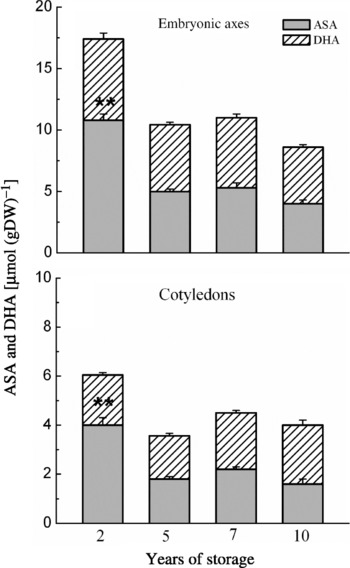
During seed storage, the ASA content of seeds declined. In 2-year-old seeds, ASA was significantly higher than in 5-year-old seeds (Fig 8), both in embryonic axes [10.8 versus 5.1 μmol (g DW)− 1] and in cotyledons [4.0 versus 1.8 μmol (g DW)− 1]. Smaller differences in ASA content were found between older seed lots. The correlation between ASA content and seed viability was statistically significant at P < 0.05 (r = 0.46 and 0.42 for embryonic axes and cotyledons, respectively).
Ascorbate (ASA) and dehydroascorbate (DHA) contents of embryonic axes and cotyledons of beech (Fagus sylvatica) seeds after storage for 2, 5, 7 and 10 years at − 10°C.

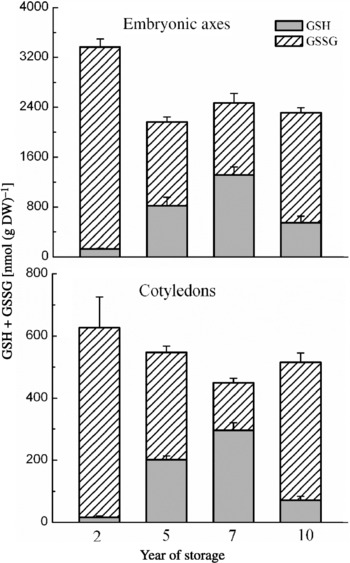
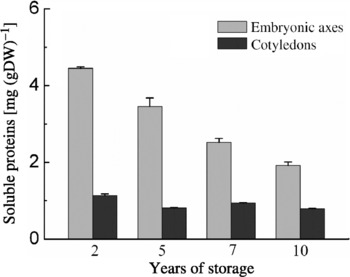
Less defined trends were observed for glutathione content. In 2-year-old seeds, the (GSH+GSSG) pool was the highest, but GSSG was much more abundant than GSH in that seed lot. In 5- and 7-year-old seeds, GSH content was much higher than in 2-year-old seeds, but the total glutathione pool was lower (Fig 9). In the course of seed ageing, soluble proteins decreased gradually, but more strongly in the embryonic axes. Their amounts were positively correlated with germination capacity (Fig 10, Table 2), but more strongly in embryonic axes (r = 0.83, P = 0.0000) than in cotyledons (r = 0.37, P = 0.034).
Reduced (GSH) and oxidized (GSSG) forms of glutathione in embryonic axes and cotyledons of beech (Fagus sylvatica) seeds after storage periods of 2, 5, 7 and 10 years at − 10°C.

Soluble protein content of embryonic axes and cotyledons of beech (Fagus sylvatica) seeds after storage for 2, 5, 7 and 10 years at − 10°C.

Discussion
During storage of seeds, germination capacity and vigour may be affected by ageing. The time after which stored seeds become unable to germinate depends on their genetic properties and storage conditions. Hence, seeds of many species can be stored only for several months, while seeds of other species remain viable for several decades or more (Priestley, Reference Priestley1986; Ponquett et al., Reference Ponquett, Smith and Ross1992; Walters et al., Reference Walters, Hill and Wheeler2005). Despite extensive research, the factors that determine seed longevity are unclear. The present research was concerned with the status of low molecular weight antioxidants, such as ascorbic acid, glutathione, total phenolic compounds and UV-absorbing phenols, as well as α-tocopherol and sterols, in beech seeds stored at 7–9% moisture content and − 10°C for up to 10 years. We expected that these compounds would be associated with the protection of seeds against deteriorative processes during storage in the dry state, because the accumulation of ROS and free radicals is considered as one of the important factors of seed ageing (Hendry, Reference Hendry1993; McDonald, Reference McDonald1999; Bailly, Reference Bailly2004). In our results, a strong negative correlation appeared between seed viability and ROS, LHPOs or electrolyte leakage (Table 2). The results suggested that oxidative reactions and membrane damage occur in beech seeds during storage. The increased LHPO content may indicate peroxidation of fatty acids. LHPOs have a negative effect on membrane function (Leshem, Reference Leshem and Lesham1992). A good positive correlation was obtained for seed viability versus total phenols or UV-absorbing phenols [absorption bands at 217, 265 and 320 nm (data not shown)], which indicated the presence of flavonoids or coumarins (Harborne, Reference Harborne1998). However, the precise identification of these compounds requires further study. Phenolic compounds are abundantly present in dry seeds, where they may play several roles (Oliver et al., Reference Oliver, Hincha, Crowe and Crowe1998; Shirley, Reference Shirley1998), and in vitro they are more effective antioxidants than α-tocopherol and ASA (Rice-Evans et al., Reference Rice-Evans, Miller and Paganga1997). The high correlation between beech seed viability and total phenolics and UV-absorbing phenols could indicate their important role in the prevention of ageing processes.
The low molecular antioxidant α-tocopherol protects membranes against the harmful activity of free radicals. A decrease in α-tocopherol content has been observed in seeds of soybean and Norway maple during ageing (Senaratna et al., Reference Senaratna, Gusse and McKersie1988; Pukacka, Reference Pukacka1991). Zalewski et al. (Reference Zalewski, Widejko and Górecki2000) showed that α-tocopherol-treated seeds of the field bean (Vicia faba var. minor) had much higher viability and vigour, but Merritt et al. (Reference Merritt, Senaratna, Touchell, Dixon and Sivasithamparam2003) did not detect any correlation between seed viability during storage and the α-tocopherol content of seeds of several Australian plant species. However, recent investigations of Sattler et al. (Reference Sattler, Gilliland, Magallanes-Lundback, Pollard and Della Penna2004) with mutants of Arabidopsis thaliana, lacking synthesis of tocopherols in seeds, showed that vitamin E is essential for seed longevity. Our results indicated a statistically significant relationship between α-tocopherol content and viability of seeds during storage. The relationship was stronger in cotyledons than in embryonic axes (P < 0.05 versus P < 0.1). ASA and glutathione are important antioxidants, reacting directly with OH●, and oxygen (Noctor and Foyer, Reference Noctor and Foyer1998), or in the Halliwell–Asada pathway. In our results, we found a statistically significant correlation between ASA content and viability of seeds during storage, but glutathione content did not correlate with germinability of stored beech seeds (Figs. 8 and 9). No correlation was found between seed viability and total sterols, which play an important role in membrane stabilization (Grunwald, Reference Grunwald1978; Navarri-Izzo et al., Reference Navarri-Izzo, Izzo, Bottazzi and Ranieri1988). During the prolonged storage of beech seeds, the amounts of soluble proteins gradually decreased. The decrease was very clear in embryonic axes (Fig. 10) and strongly correlated with viability of seeds. Soluble protein degradation can result from ROS action, which can diminish enzyme activities and the content of late embryogenesis abundant (LEA)-like proteins or small heat shock proteins (sHSP) that play an important role in maintaining a stable glass structure in dry seeds (Wolkers et al., Reference Wolkers, McCready, Brandt, Lindsey and Hoekstra2001). Such disappearance of LEA proteins was observed in beech seeds (Kalemba and Pukacka, Reference Kalemba and Pukacka2005) during long-term storage.
Our results clearly showed that the loss of beech seed viability during storage at − 10°C was accompanied by increased ROS and products of lipid peroxidation. On the other hand, amounts of antioxidative compounds (α-tocopherol, ascorbic acid and phenols), which could play a role in the protection of seed macrostructures against ROS attack, were not sufficient to prevent seed deterioration. The present results, and those obtained earlier (Pukacka and Ratajczak, Reference Pukacka and Ratajczak2005; Ratajczak and Pukacka, Reference Ratajczak and Pukacka2005) on beech seeds stored at higher temperatures (4, 20 and 30°C) and humidity (45 and 75% RH), provide evidence that the mechanisms of seed deterioration are similar, but the time scale for these ageing reactions vary with the storage conditions (temperature and humidity).
Acknowledgements
This study was supported by research funds of the Polish Ministry of Science and Education.