Precursors of literacy
Substantial research evidence has converged on two main precursors of early reading acquisition for children learning to read in alphabetic scripts – phonological awareness (PA) (e.g., Adams, Reference Adams1991; Babayigit & Stainthorp, Reference Babayigit and Stainthorp2011; Melby-Lervåg et al., Reference Melby-Lervåg, Lyster and Hulme2012; Moll et al., Reference Moll, Ramus, Bartling, Bruder, Kunze, Neuhoff, Streiftau, Lyytinen, Leppänen, Lohvansuu, Tóth, Honbolygó, Csépe, Bogliotti, Iannuzzi, Démonet, Longeras, Valdois, George and Landerl2014; Vaessen & Blomert, Reference Vaessen and Blomert2013) and letter knowledge (Byrne & Fielding-Barnsley, Reference Byrne and Fielding-Barnsley1989; Lonigan et al., Reference Lonigan, Burgess and Anthony2000; Pennington & Lefly, Reference Pennington and Lefly2001; Share et al., Reference Share, Jorm, Maclean and Matthews1984).
Despite the consensus regarding the association between these two precursors and early reading acquisition, there remains a lively debate concerning the nature of this relation across different languages and orthographies (Share, Reference Share2008; Verhoeven & Perfetti, Reference Verhoeven and Perfetti2017). It should be remarked that the bulk of reading research has been overwhelmingly dominated by work on English and a handful of other Western European languages written in Roman alphabets; however, most of the world do not learn to read in alphabetic writing systems (Daniels & Share, Reference Daniels and Share2018). Around the globe, a majority of students learn to read and write in non-European, non-alphabetic orthographies such as abjads (e.g., Arabic), abugidas/alphasyllabaries (e.g., Hindi), or morphosyllabaries (e.g., Chinese) (Share, Reference Share2021). Footnote 1 Therefore, understanding the literacy precursors across non-European languages and non-alphabetic orthographies is essential for a complete science of reading.
The present study investigates these two precursors of early literacy in Arabic, a non-European language written in a non-alphabetic, that is, abjadic (consonantal) writing system. The theoretical framework of this study is the phonological-unit-availability or accessibility argument as articulated in the psycholinguistic grain size theory of Ziegler and Goswami (Reference Ziegler and Goswami2005) which claims that not all phonological units are explicitly accessible prior to reading and, furthermore, the accessible phonological units are influenced by language-specific and script-specific factors.
The current study addresses two issues: (1) the accessible phonological unit or units among Arabic-speaking preschoolers living in Israel and (2) the nature of letter knowledge. It is essential to note that in Israel, unlike the US, Kindergarten is part of the preschool education system and formal reading instruction only begins in the first grade. Shedding light on PA and letter knowledge among preliterate Arabic-speaking children is not only essential for a universal science of literacy learning (there are close to 300 million native Arabic speakers worldwide) but also has important pedagogical implications given the low literacy attainments of Arabic speakers around the world (PIRLS, 2016; PISA, 2018).
Language-specific and orthography-specific aspects of Arabic
One prominent feature of Arabic is diglossia which has two dimensions: the first is the linguistic distance between written and oral language and the second concerns socially distinct functions. Whereas standard Arabic (StA) is used for writing and formal speech occasions, spoken Arabic (SpA) vernaculars are used for everyday conversation (Almusa, Reference Almusa2003). Of particular concern in the present study is the phonological distance between the spoken varieties of Arabic (SpA) and standard (written) Arabic (StA) which may affect the accessible phonological unit and the acquisition of letter sounds in early literacy. Several StA phonemes are not present in most spoken dialects and vice versa. For instance, four phonemes in StA (/ð/, /θ/, /ðˁ/, /q/) are absent in the vernacular of Arabic speakers located in northern Israel and studies have demonstrated that these phonemes increase the difficulty of PA tasks (Saiegh-Haddad, Reference Saiegh-Haddad2003, Reference Saiegh-Haddad2004, Reference Saiegh-Haddad2007a; Saiegh-Haddad et al., Reference Saiegh-Haddad, Levin, Hende and Ziv2011).
Furthermore, the phonological distance between spoken and written varieties of Arabic is also reflected in the architecture of the syllable: StA words are typically multi-syllabic with relatively simple syllable structures that all begin with a single consonant or glide followed by a vowel. Vowel–consonant (VC) syllables are not permissible and StA syllables are either open or closed (Holes, Reference Holes2004). Consonant–vowel (CV) (“core”) syllables are by far the most frequent unit in Arabic in both StA and SpA followed by the CVC structure Footnote 2 (Ababneh, Reference Ababneh2000; Al-Shaieb, Reference Al-Shaieb2004). In contrast, the range of syllable types is much greater in SpA. For example, initial consonant clusters are quite frequent in some dialects, for example, tra:b “soil,” but are absent in StA (see Holes, Reference Holes2004). In this context, Saiegh-Haddad and Spolsky (Reference Saiegh-Haddad, Spolsky, Saiegh-Haddad and Joshi2014) explored the phonological distance between StA and SpA by analyzing the spoken corpus of 5-year-old children who speak the central dialect of Arabic speakers living in Israel. Results demonstrated that the predominant syllable structures in StA were CVCC (46%) and CVC (42%). However, in SpA, the most common syllable structures are CVC (52%) and CCVC (27%).
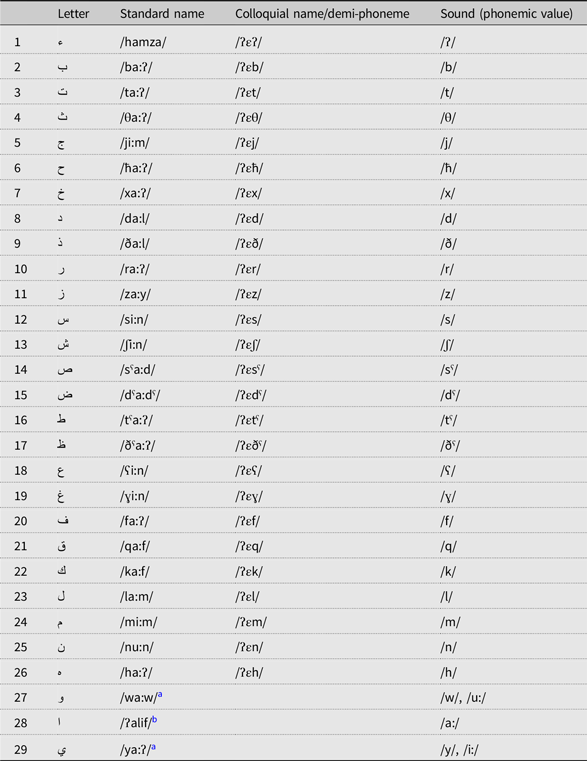
Moreover, linguistic distance is even apparent in the names of the letters (see Levin et al., Reference Levin, Saiegh-Haddad, Hende and Ziv2008). Arabic letters have two names – standard and colloquial. With the exception of /ʔalif/and /hamza/, standard names are tri-phonemic. For example, the letter name /da:l/ which is represented by the letter د maps the phoneme /d/ (see “Appendix” for a complete inventory of Arabic letters and their names and sounds). All standard names are similarly acrophonic with the exception of /hamza/ which maps the glottal stop /ʔ/, /ʔalif/represents the long vowel /a:/ and /wa:w/, /ya:ʔ/ which are dual-purpose letters representing both the glides /w/ and /y/ and the long vowels /u:/ and /i:/ respectively. (These dual-purpose letters are acrophonic only when they represent consonants.)
On the other hand, the so-called colloquial letter names are also tri-phonemic but start with the fixed prefix /ʔε/ and end with the consonant sound that the letter represents both constituting the phonological unit /ʔεC/. For instance, while the standard name of the letter ن is /nu:n/, the colloquial name is /ʔεn/ (see “Appendix”). The colloquial names were first proposed by early Arab linguists such as Al-Khalil ibn Ahmad al-Farahidi (8th century) and then by Ibn-Jana (9th century). Al-Khalil asserted that pronunciation of Arabic consonantal letters as isolated phonemes is too difficult and too abstract, so he proposed adding the prefix /ʔε/to to facilitate the pronunciation. Henceforth, we refer to the colloquial letter name /ʔεC/ as the “demi-phoneme” because this demi phonological unit does not correspond to any single consonantal phoneme or vocalic sound in Arabic.
It seems that some dialects such as north Arabic in Israel use Al-Khalil’s colloquial names to teach the letter sounds (Besher, Reference Besher1972) despite the current curriculum requirement to teach the letter sounds as “isolated” phonemes as in English (Ministry of Education, 2009). Support for this claim can be found in a standard test of reading and writing in Arabic for Grade 1 in Israel. In the sub-test of letter-sound knowledge, a response supplying the demi-phoneme such as (/ʔεb/ for the letter ” ب” representing /b/) is considered a correct response (see [فحص القراءة والكتابة للصفّ الأوّل- مرشد للمعلّم], teacher manual of reading and writing test for the first grade, RAMA & Ministry of Education, 2017, p. 17).
Arabic orthography
The Arabic writing system is an abjad or consonantal writing system (Daniels, Reference Daniels, Downing, Lima and Noonan1992, Reference Daniels2018). Arabic is written from right to left in a cursive script that consists of 29 letters (see Bauer, Reference Bauer, Daniels and Bright1996) and employs two distinct sub-systems: a set of fully fledged letters (the basic Arabic abjad) and a supplementary set of extra-lineal diacritic-like signs. Letters primarily represent consonants with the exception of the letter ʔalif (ا) which represents the long vowel /a:/ as well as the dual-purpose letters و and ي which represent the glides /w/and /y/, respectively, and the long vowels /u:/ and /i:/ (see Saiegh-Haddad & Henkin-Roitfarb, Reference Saiegh-Haddad, Henkin-Roitfarb, Saiegh-Haddad and Joshi2014, pp. 10–11). The system of diacritic-like signs (taʃki:l) may be classified into two classes, one class has been termed by Saiegh-Haddad (Reference Saiegh-Haddad2018) phonemic diacritics and consists of five main diacritical marks: the three short vowels of Arabic fatħa for short /a/, dˁamma for short /u/ which are added above letters, kasra representing the short /i/ added below letters, consonant doubling/lengthening ʃadda and null vocalization suku:n. The second class of diacritic-like signs maps abstract morpho-syntactic properties such as case and mood which has been preserved in StA but has disappeared from all dialects of SpA (Saiegh-Haddad & Henkin-Roitfarb, Reference Saiegh-Haddad, Henkin-Roitfarb, Saiegh-Haddad and Joshi2014, pp. 17–18).
Another important aspect of Arabic orthography is the visual/graphemic complexity of the script. Many studies have concluded that the visual complexity of Arabic letters may slow the early acquisition of letter knowledge (see Asaad & Eviatar, Reference Asaad and Eviatar2013; Dai et al., Reference Dai, Ibrahim and Share2013; Eviatar & Ibrahim, Reference Eviatar, Ibrahim, Saiegh-Haddad and Joshi2014; Tahan et al., Reference Tahan, Cline and Messaoud-Galusi2011). This complexity is typically attributed to multiple factors including (i) ligatured letters (cursivity), (ii) the use of extra lineal diacritics as a supplementary system as mentioned above, (iii) allographic variants of letters that have altered shapes depending on their position in a word (e.g., هـ ، ـهـ ، ـه، ه represent /h/), and (iv) the identical basic letter shapes (rasm) which are distinguished only on the basis of the existence, location, and number of dots (e.g., س ش/ ع غ/ ح خ ج/ ط ظ) (see Saiegh-Haddad & Henkin-Roitfarb, Reference Saiegh-Haddad, Henkin-Roitfarb, Saiegh-Haddad and Joshi2014). Finally, it is noteworthy that Arabic script has two versions: fully vocalized maʃku:l script or partly vocalized non-maʃku:l script in which long vowels are fully and consistently represented by letters but all diacritical marks (taʃki:l) are omitted (see Saiegh-Haddad, Reference Saiegh-Haddad2018). Children learn to read the maʃku:l script before transitioning (around Grade 5) to the standard non-maʃku:l script used for skilled readers.
In sum, the language-specific features of Arabic, in particular the prominent CV unit in both StA and SpA as well as the fact that Arabic letters have both standard and colloquial names, may affect the preferred phonological unit and letter knowledge among Arab preliterate children. Consequently, we expected knowledge of letter names to be greater than letter sounds which would be retrieved as demi-phoneme units /ʔεC/ rather than as single phonemes. Furthermore, in line with the prominent CV in StA and SpA, we also hypothesized that the most accessible phonological unit would be a “large” multi-phonemic CV unit rather than the “small” phoneme.
Letter knowledge in Arabic
In Arabic, research has affirmed the important role of letter knowledge in early reading development. Saiegh-Haddad (Reference Saiegh-Haddad2005) found that letter recoding efficiency (the speed of converting letters to sounds) was the best predictor of word reading fluency at the end of the first grade along with rapid automatized naming (RAN) and working memory but both standard names and phonemes were accepted as correct.
Abu Ahmad et al. (Reference Abu Ahmad, Ibrahim, Share, Saiegh-Haddad and Joshi2014) showed that preschool literacy measures which were assessed with tasks of letter naming, concepts about print, and word-likeness explained 17% of the variance in word recognition among children in early Grade 2 (n = 177). In this study, either the standard name or the demi-phoneme /ʔεC/ was accepted. In addition, Hende (Reference Hende2012) found higher levels of knowledge of letter names than letter sounds in kindergarten. Furthermore, letter sounds were retrieved as a CV more often than as an isolated phoneme, implying that, in early literacy development, Arabic-speaking children retrieve letter sounds as “large” phonological units (CVs) rather than as single phonemes.
Regarding the unique aspects of letter knowledge in Arabic, namely standard versus colloquial names or the demi-phoneme /ʔεC/, a Jordanian study by Al-Hmouz (Reference Al-Hmouz2013) investigated the relationship between letter knowledge and reading achievement in a first-grade sample (100 typically developing readers and 25 with reading difficulties). Letter knowledge was assessed by letter name fluency (standard names) and letter-sound fluency (the demi-phoneme /ʔεC/). Results showed higher performance on letter name than letter-sound knowledge. However, letter-sound knowledge had a higher correlation with reading measures than letter names. Furthermore, children with reading difficulties scored significantly lower on both tasks than typically developing readers.
An Israeli intervention study in Arabic which investigated the effect of intervention on kindergartners’ literacy abilities such as letter knowledge and PA revealed that children used both varieties (standard and colloquial) names when letter knowledge was assessed prior to intervention (Levin et al., Reference Levin, Saiegh-Haddad, Hende and Ziv2008). Results showed superior performance of standard names in the intervention group following intervention which emphasized the standard name in letter instruction. This finding indicates the important role of instruction on letter knowledge.
It is worth noting that there is considerable variation in letter-sound instruction within and across Arabic-speaking countries. As mentioned above, Arabic-speaking teachers living in Israel teach letter sounds via the phonological unit of the colloquial name /ʔεC/ despite the fact that the national curriculum mandates teaching the isolated phoneme. Jordanian teachers teach the same demi-phoneme for letter sounds as reported by Al-Hmouz (Reference Al-Hmouz2013) in spite of the Jordanian curriculum (Ministry of Education, 2018) which specifies that letters have to be taught as CV units, namely the consonants with the long vowels and, later, with short vowels. In Saudi Arabia and Egypt, letter sounds are rarely taught as isolated phonemes and are taught in combination with vowels as integral CV units; thus, the consonant is taught as the standard name with the vowels (i.e., /nu:n/+ /a:/=/na:/, /nu:n/+/u:/=/nu:/, /nu:n/+/i/ =/ni/ and the same with the short vowels) (see Al-Ghanem & Kearns, Reference Al-Ghanem and Kearns2014 p. 2). That is to say that, mostly, letter sounds in Arabic are never taught as isolated phonemes like English.
In line with the literature review of letter knowledge in Arabic, the current study asks: What is the salient phonological unit of Arabic letters among preliterate Arabic speakers? Is it the standard name, the demi-phoneme /ʔεC/or the phoneme? We expected knowledge of letter names to be superior to knowledge of letter sounds. Furthermore, we predicted that letter sounds would be retrieved as demi-phoneme /ʔεC/ rather than as single phonemes.
PA in Arabic
Consistent with English and other Western European studies, most Arabic studies agree that PA is an important factor in reading development in maʃku:l (fully vocalized) script (Abu Ahmad et al., Reference Abu Ahmad, Ibrahim, Share, Saiegh-Haddad and Joshi2014; Abu-Rabia et al., Reference Abu-Rabia, Share and Mansour2003; Saiegh-Haddad, Reference Saiegh-Haddad2005; Saiegh-Haddad & Taha, Reference Saiegh-Haddad and Taha2017; Tibi & Kirby, Reference Tibi and Kirby2018, Reference Tibi and Kirby2019; Verhoeven & Perfetti, Reference Verhoeven and Perfetti2017) and in non-maʃku:l (partially vocalized) script (Elbeheri & Everatt, Reference Elbeheri and Everatt2007; see also Asadi et al., Reference Asadi, Khateb, Ibrahim and Taha2017 and Taibah & Haynes, Reference Taibah and Haynes2011). Nonetheless, questions remain regarding the nature of the reading–PA association in Arabic.
One unresolved issue addressed in the present study concerns the accessible phonological unit size in the pre-literacy years (Ziegler & Goswami’s availability dimension). Taibah and Haynes (Reference Taibah and Haynes2011) found that kindergarten and first-grade children showed mastery only at the syllable or sub-syllabic level (either CV or CVC). Tibi (Reference Tibi2010) also found that children from first to third grades have better phonological skills with larger units (rhyme and syllables) than smaller units (phonemes). Furthermore, Hende (Reference Hende2012) and Saiegh-Haddad (Reference Saiegh-Haddad2003, Reference Saiegh-Haddad2004, Reference Saiegh-Haddad2007a) have demonstrated that the salient unit among Arabic-speaking children in Israeli kindergartens and early grades is a “large” phonological unit – the CV. This may be related, as mentioned before, to the fact that the CV unit (“core syllable”) as a syllabic or sub-syllabic unit is the most prominent phonological unit in Arabic in both written and SpA.
Recently, Saiegh-Haddad et al. (Reference Saiegh-Haddad, Shahbari-Kassem and Schiff2020) investigated the role of phonological distance in a cross-sectional developmental study among Arabic-speaking 2nd, 4th, 6th, 8th, and 10th graders from low versus mid-high socio-economic backgrounds. In regard to phonological unit size, results revealed that syllable awareness was easier than phoneme awareness in both SpA and StA, a finding that underscores the salience of syllables as against phonemes in phonological representation of Arabic words. Furthermore, Tibi and Kirby (Reference Tibi and Kirby2018) examined the prediction of PA and RAN in third-grade reading and then, in 2019 went on to investigate a wider variety of cognitive and linguistic processes including vocabulary, PA, RAN, orthographic processing, morphological awareness, memory, and nonverbal ability. Results in both studies found that PA was the strongest predictor of reading (see also Abu-Rabia et al., Reference Abu-Rabia, Share and Mansour2003). In regard to phonological unit size, the study used a phoneme deletion task, a syllable deletion task, and a phoneme blending task. It is important to note that a composite PA score combining all three tasks was used in the regression analysis to predict reading outcomes, a finding that may imply a role for both units (phoneme and syllable) in Arabic reading. However, a longitudinal study from kindergarten to Grade 2 among native Arabic speakers living in Israel revealed that the strongest predictor of early word reading was isolated phoneme (identification and retrieval) awareness (Abu Ahmad et al., Reference Abu Ahmad, Ibrahim, Share, Saiegh-Haddad and Joshi2014).
Based on the above review, the present study addresses the second question: Which phonological unit (or units) is/are more accessible for Arab preliterate children? Is it a multi-phonemic (syllabic and/or sub-syllabic) unit or (single) phoneme unit? We hypothesized that the most accessible phonological unit among Arabic-speaking preliterate children would be a “large” multi-phonemic CV unit (the “core syllable”) rather than a “small” unit, that is, an isolated segment.
The current study
The current study focuses on letter knowledge and knowledge of phonological units among Arabic-speaking preschoolers. To examine letter knowledge, this study addresses the following question: Are standard letter names more salient than letter sounds, and how do Arab kindergartners children retrieve letters sounds, as a demi-phoneme /ʔεC/or a singleton phoneme?
To examine PA, this study asks: Which phonological unit(s) is(are) more accessible for Arab preliterate children? We investigated knowledge of the standard names and sounds of Arabic letters using retrieval and identification tasks. The second question is investigated by analyzing children responses in our PA tasks in accordance with the size of the phonological unit in order to determine the “phonological profile” (or profiles) of preschool children.
Method
Participants
One hundred and sixty-seven native Arabic-speaking children (72 boys and 95 girls) participated in this study (mean age: 5.06 years, SD: 1.3 months). Children were randomly recruited from six public kindergartens in a large Arabic-speaking city and two nearby villages in the north of Israel in which the spoken vernacular (SpA) was identical for all participants. Inclusion of participants was based on informed written parental consent that was distributed in accordance with the research permit from the Office of the Chief Scientist in the Ministry of Education in Israel. The socio-economic status of this sample was judged to be middle to low as determined by official records of the Ministry of Education. Bilingual children as well as children with documented or apparent sensory, language, psychological, or neurological difficulties were excluded.
The Arabic kindergarten literacy curriculum in Israel
The Arabic kindergarten curriculum in Israel is similar to preschool curricula in other countries and it includes five components: PA, letter knowledge, early reading and writing, print concepts, and linguistic competencies. With respect to PA, the curriculum designates specific goals for each age and states that instruction in PA should explicitly enhance awareness of rhymes, syllables, sub-syllabic units such as the CV unit, and phonemes (consonants) within the context of a variety of activities such as comparison, isolation, segmentation, blending, and deletion.
As regards letter knowledge, the curriculum includes knowledge of standard names, (“alphabetic”) ordering of the letters, letter shapes (and position-dependent variants), and letter-sound (consonantal phoneme) correspondences (البنية الأساسية للقراءة والكتابة في اللغة العربيّة, [basic structure of reading and writing in the Arabic language], Ministry of Education, 2009).
Information regarding the instruction of letters and PA in the six kindergartens participating in the present study was also collected. Teachers were interviewed to determine how they teach letters and PA. Responses revealed that teachers emphasize the standard names of the letters more than the sounds, and they teach the sounds as a demi-phoneme /ʔεC/ rather than the phonemes. As regards PA, only one of the six teachers stated that she explicitly teaches phonemes, while the others emphasized larger phonological units such as rhymes, syllables, and CV units.
Procedure
All assessments were administered individually during the first trimester of the school year (November, December, and January). In addition to PA and letter knowledge, all children were assessed on background cognitive measures assumed to be related to early reading including nonverbal ability, vocabulary, visual processing, working memory, and phonological memory. Testing was carried out in three sessions, each lasting approximately 30 min and was conducted by a team of five testers: the first author, two teachers specialized in special education, and two graduate (MA) students at the Department of Learning Disabilities at the University of Haifa. Test order was counterbalanced according to a Latin square design.
Measures
Raven’s Colored Progressive Matrices (Raven et al., Reference Raven, Raven and Court1998).
This test of nonverbal reasoning consists of 36 items presented in a multiple-choice format with a matrix-like arrangement of figures. Sets A, AB, and B were administered and the child’s score was the sum of the correct answers. Internal consistency (Cronbach’s alpha) in the present sample was .64.
Peabody Picture Vocabulary Test (PPVT-R) English version (Dunn & Dunn, Reference Dunn and Dunn1981) was adapted to Arabic by Abu Ahmad et al. (Reference Abu Ahmad, Ibrahim, Share, Saiegh-Haddad and Joshi2014) with two versions: SpA and StA. Each version of the test was abbreviated by selecting only the odd-numbered items (a total of 55 items) in each version. Split-half reliability for the two versions in this sample was .67.
Working memory: Working memory was tested using the Backward Digit Span sub-test of the Wechsler Intelligence Scale for Children (WISC-R) (Wechsler, Reference Wechsler1974). The test was an Arabic adaptation of the WISC-R (Karayani et al., Reference Karayani, Mousa and Cohen1976). Reported test–retest reliability for a sample of forty 11-year-old children was .80 (Karayani et al., Reference Karayani, Mousa and Cohen1976).
Visual processing: Due to the visual/orthographic complexity of Arabic, a task of visual processing was administered. Hence, the sub-test Visual Spatial-Relationships from the Test of Visual-Perceptual Skills (non-motor) Revised (TVPS-R), was conducted (Gardner, Reference Gardner1996). Administration and scoring adhered to the TVPS-R manual. Children were required to select one of five forms that is distinguished by being oriented differently from the other four. Cronbach’s alpha for 16 items in the present sample was .46.
Phonological processing
Phonological processing refers to representing, storing, and/or retrieving speech information in a wide variety of tasks (Wagner & Torgesen, Reference Wagner and Torgesen1987). Some studies have claimed that PA, phonological short-term memory, and RAN tap a common phonological construct (Jorm & Share, Reference Jorm and Share1983; Wagner et al., Reference Wagner, Torgesen, Rashotte, Hecht, Barker, Burgess, Donahue and Garon1997). However, other authors have argued that at least some of these aspects of phonological processing (e.g., RAN) make unique independent contributions to reading (Norton & Wolf, Reference Norton and Wolf2012). In any case, numerous studies have consistently demonstrated that phonological processing abilities strongly contribute to reading skills including RAN and phonological short-term memory tasks, and not just PA test. We therefore included all three tasks in this study.
Phonological Short-Term Memory: assessment was conducted using Hende’s (Reference Hende2012) Repetition of Word Sequences test. The child is required to repeat a sequence of unrelated words spoken by the examiner (e.g., /tuffa:/“apples”, /daraj/ “stairs”). The task consists of five levels, each including word sequences ranging from 2 to 6 words. Each level included five sequences. If the child succeeded in repeating at least three of the five sequences at each level, s/he moved to the next level. One point was awarded for each correct repetition. The examiner pronounced each item in the sequence separately with intervals of 1 s between words. Two demonstration items were given before the test items, and feedback was given after each sequence. All the words included in the test were disyllabic and familiar to the children. Split-half reliability in current sample was .53.
Rapid automatized naming: RAN objects and colors developed by Denckla and Rudel (Reference Denckla and Rudel1974) were adapted to Arabic by Hende (Reference Hende2012). In the serial naming of objects, the child is presented with a printed sheet depicting five common objects (cat, table, chair, bee, and flower). Before beginning the test, the tester ensured that the child knew the names of the objects. All pictures were named in the child’s SpA vernacular and all names had a di-syllabic CVC.CV structure. There were a total of 50 items randomly arranged in 10 rows of five. The child was asked to name these items as quickly as possible. Naming times in seconds and number of errors were recorded. In the serial naming of colors, children were presented with a series of 50 circles painted in five colors: red, yellow, blue, green, and black randomly arranged in 10 rows of five. Color names were given in the child’s SpA vernacular and were also di-syllabic with a CVC.CVC structure. The speed with which objects and colors were named correlated at .77.
Phonological awareness
Two tasks were adapted to Arabic from Share and Blum study in Hebrew (Reference Share and Blum2005).
Initial Phoneme Isolation: This is an explicit phoneme isolation task requiring the isolation of the initial consonant phoneme in 12 CVC words. All words exist in the SpA vernacular of the sample and did not contain any diglossic phonemes, namely phonemes which are common to both StA and SpA as Saiegh-Haddad (Reference Saiegh-Haddad2019) has argued. All phonemes were consonantal (/t, ʃ, d, m, b, r, dˁ, z, tˁ, sˁ, k, ʕ/) and represented a range of phonetic features: stops, fricatives, emphatics, nasals, and liquids. The task was preceded by four examples explicitly demonstrating the isolation of the initial phoneme with feedback provided by the examiner. For instance, the examiner said the word /raʃ/ “splash,” the child was asked to repeat this word then the examiner said: (قُل الصوت الأوّل في كلمة رَش), “say the first sound of the word /raʃ/ ”. If the child’s response was the phoneme /r/, feedback was given by the tester saying “excellent.” However, if the child’s response was the CV sub-syllabic unit, the examiner explained that /ra/ consisted of two sounds and the first sound is /r/. Four examples explicitly demonstrated that the required response was an isolated phoneme and after any “incorrect” response, the examiner emphasized the “correct” phoneme response. No feedback was given on test trials and responses were categorized according to the sound unit that the child pronounced. For example, for the initial isolation of the word /raʃ/, responses were categorized as “correct” including three types of phonological units: phonemes /r/, the tri-phonemic colloquial name of Arabic consonants /ʔεr/ which has been termed here the demi-phoneme, and the CV unit /ra/. “Incorrect” responses consisted of “don’t know” and mixed error responses such as an incorrect phoneme (any other phoneme than /r/), the standard name of the letter /ra:ʔ/, or simply repeating the word.
Inter-rater agreement for the responses – phonemes, demi-phoneme, CV, “don’t know,” and mixed error responses in initial phoneme isolation task – was high (.98, .97, .98, 1.0, and .95, respectively).
Final Phoneme Isolation: Administration and scoring of this task were identical to the initial task, but here the child was asked to isolate the final consonant of CVC words. Items were the same words as the previous task but with the reverse phoneme order (e.g., /ʃ/ from the word /ʃεx/ “elder” in the initial phoneme task versus /xεʃ/ “sacking” for isolating /ʃ/ in the final task). Inter-rater agreement for the responses – phonemes, demi-phonemes, CVs, “don’t know,” and mixed error responses – was high also (.98, .97, .95, 1.0, and .99, respectively). It is important to note that these two tasks were administered in separate sessions.
Letter knowledge
Four letter knowledge tasks were developed for the present study.
Letter name retrieval: A subset of the 29 Arabic letters in their non-ligatured or cardinal form were presented in random order on 10 × 7 cm cards with the letter size 4 × 5 cm. Each child was asked to pronounce the standard name of the letters. Before testing, two practice sessions and feedback were given by the tester indicating the standard letter name. Having practiced items selected randomly from the set, the experimenter then shuffled the cards and testing began. Responses were scored as correct if the child retrieved the correct standard name of the presented letter for instance, /fa:ʔ/ for the letter ف. Error responses were varied and included: demi-phonemes such as /ʔεf/ for the letter ف, CVs consisting of any combination of the consonant /f/ with one of the long vowels (/a:/, /u:/, /i:/) or the short vowels (/a/, /u/, /i/), an incorrect standard name or demi-phoneme or CV that did not correspond to the presented letter, visual errors (e.g., for the letter ش which denotes the consonant /ʃ/ the child responded /s/ which is the consonant of the letter ,(س and “don’t know” responses. All error responses were combined into a single “error” category. One score was given for the correct standard name and scores were tallied and converted to percent accuracy. Cronbach’s alpha for this sample was .95.
Letter name identification: This task consisted of 29 series of four letters. Randomized series were constructed using a macro application of Visual Basic in Microsoft Excel 2007. Letters in each series were in non-ligatured (cardinal) form and were presented in black on white paper. The target letter of each sequence was chosen randomly. Two practice attempts preceded the performance of the test items; no feedback was provided thereafter. The child was asked to point to one of four letters that matched the standard letter name spoken by the tester. It is important to indicate that only the standard name was supplied by the tester (e.g., /fa:ʔ/ for the letter (ف not the demi-phoneme /ʔεf/ or the phoneme/f/ or CV /fa:/. One point was awarded for each correct item and percent accuracy was calculated. Cronbach’s alpha for this sample was .91.
Letter-sound retrieval: The administration of this task was identical to the Letter name retrieval task except that children were required to say the sounds (not names) at the level of the isolated phoneme. For instance, for the letter ن the child was required to retrieve the phoneme /n/ not the standard name /nu:n/ or the demi-phoneme /ʔεn/. As discussed earlier, teachers in Israel teach the sound of the letter using the demi-phoneme /ʔεC/ of Arabic consonants rather than the phoneme, hence two types of responses were accepted as correct in this task, phoneme and demi-phoneme. Error responses in this task included the correct CV unit or standard name, incorrect standard name/ demi-phoneme/phoneme or CV, a visual error, and “don’t know” response. Scoring was the same as the Letter name retrieval task. Internal consistency of the task for this sample was .95.
Letter-sound identification: The procedure was the same as that used for the letter name identification test with 29 different sets of four letters. The child was asked to point to the letter that corresponded to the letter sound (an isolated phoneme) spoken by the examiner (e.g., /n/ for the letter (ن. Percent accuracy was calculated and Cronbach’s alpha for this sample was .90.
Results
In the following section, we first present our findings on letter knowledge, followed by PA. Next, we examine the distribution of PA profiles followed by comparison between PA profiles on background and cognitive measures and finally, the patterns of association between letter knowledge and PA in the different profiles.
Letter knowledge in kindergarten
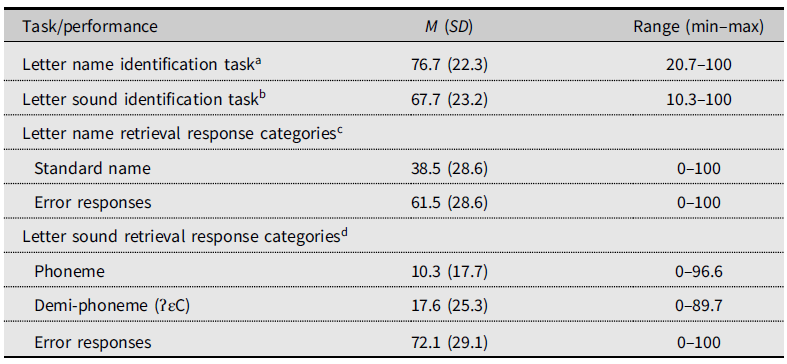
Findings presented in Table 1 confirmed our hypothesis that knowledge of standard name of Arabic letters is higher than knowledge of letter sounds in both types of the tasks, identification and retrieval. In identification tasks, children were able to identify the standard name of the letter (M = 76.7% in letter name identification task) more successfully than the sound as an isolated phoneme (M = 67.7% in letter-sound identification task), and this difference was statistically significant (t (166) = −9.74, p < .001).
Means (in percentages), standard deviations (in parentheses), and ranges (in percentages) in the letter sound and letter name tasks. Response categories (in percentages) in letter sound/name retrieval tasks

a The standard name of the letter was spoken by the examiner, for example (/ra:ʔ/ for the letter ر).
b The isolated phoneme (/r/ for the letter (ر was spoken by the examiner.
c Only the standard name of the letter (e.g., /ra:ʔ/ for the letter ر) was accepted as correct. Error responses included the “correct” demi-phoneme (/ʔεr/ for the letter (ر and “correct” CV (e.g., /ra:/,/ra/,/ru:/, etc.) instead of the standard name, incorrect demi-phoneme/standard name/CV, visual error confusion for similar letters (e.g., (ح، خ، ج، ر، ز or simply the child saying “don’t know,” All error responses were combined and presented in percentages.
d Despite the explicit request for an isolated phoneme, “correct” response included the isolated phoneme for the letter (e.g., /n/ for the letter ن) and also the demi-phoneme (e.g., /ʔεn/ for the letter ن) since some Arabic dialects in Israel use this unit to teach letter sounds (Besher, Reference Besher1972). Any other responses were combined into a general error category, including the standard name of the letter, CVs, incorrect phonemes/demi-phonemes or standard names, visual errors, or “don’t know.”
A similar difference also emerged in the retrieval tasks; children were able to supply the standard name of the letter (M = 38.5% in letter name retrieval task) more often than the isolated phoneme (M = 10.3% in letter-sound retrieval task) t (166) = −12.77, p < .001 and also more than the other “correct” response, namely the demi-phoneme (/ʔεC/) (M = 17.6% in letter-sound retrieval task) t (166) = −11.05, p < .001.
In regard to letter-sound retrieval, we found, as predicted, that children were more successful retrieving the demi-phoneme /ʔεC/ of the letter (M = 17.6) than the phoneme (M = 10.3%) in letter-sound retrieval task t (166) = −2.88, p < .01. Collectively, findings regarding letter sounds demonstrated relatively low performance among preschool children (only 27.9%). This may be related to the fact that the assessment was conducted in the first trimester of the school year.
In sum, letter knowledge outcomes confirmed the first hypothesis and revealed two main findings: (i) the standard name of the letter is the preferred response and (ii) letter sounds are retrieved as a demi-phoneme /ʔεC/ rather than phonemes.
The nature of PA among Arabic-speaking preliterates
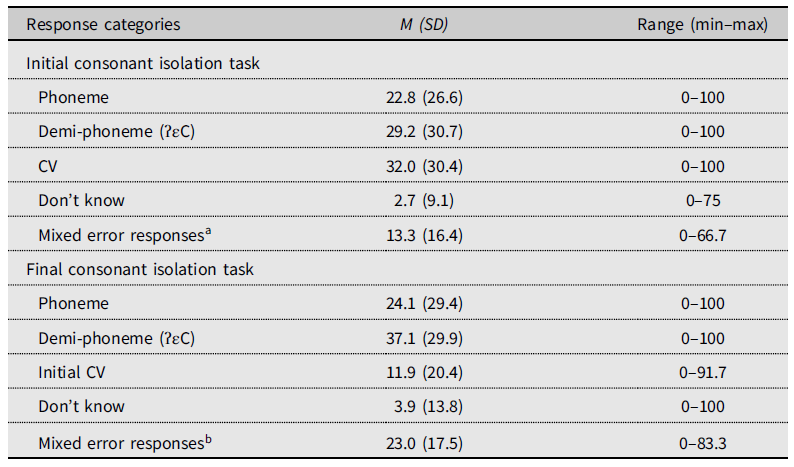
Table 2 displays the performance on the initial and final consonant isolation tasks. As mentioned in the Method section, responses in the PA tasks were categorized according to the phonological unit that the child supplied, resulting in five response categories in each task as shown in the first column of Table 2. Scores were calculated by summing each response category for each task separately. Results are shown in the second and third columns of Table 2.
Means (in percentages), standard deviations (in parentheses), and ranges (in percentages) for initial and final consonant isolation tasks in each response category for 167 Arabic-speaking preschoolers

a Any phonological unit (phoneme or demi-phoneme or CV unit) other than the target phoneme, as well as the standard name of the letter or word repetition.
b Mixed errors in the final task were any phonological unit (phoneme or demi-phoneme) other than the target final phoneme, as well as the standard name of the letter or word repetition.
In both PA tasks, there were three “correct” phonological units; for instance, in the initial task when children were asked to isolate the initial sound from the word /ʃεx/ “elder,” the phoneme response was /ʃ/ (demi-phoneme /ʔεʃ/) and CV unit was /ʃε/. In addition, several types of error emerged in both tasks that were all combined into one measure called “mixed” error responses. Many children found the PA tasks very difficult and most of their responses were “don’t know.”
The overall incidence of the different response categories as seen in Table 2 demonstrated that isolated phonemes were not the most common response – only slightly less than one quarter of all responses were single consonants. In the initial task, both the demi-phoneme and the CV each accounted for close one-third of all responses, with a smaller number of don’t know and mixed error responses. In the final task, the demi-phoneme again accounted for around one-third of the responses, but CV responses were much lower (12%) and replaced by more mixed responses (almost one quarter).
An interesting finding in the final isolation task was that CV responses which understandably “disappeared” (falling from 32% to 1.5%) and stood out to initial (incorrect) CV responses (11.9%) for instance, in the word ʕam “uncle”, children with a CV preference said /ʕa/ instead of the final phoneme /m/. Furthermore, mixed error responses in the final task (without the position error of isolating the initial CV instead of the final phoneme) were more than mixed errors in the initial task 23% versus 13.3%, respectively. This finding may indicate that in final task, the natural CV response is not available as in initial task, so it was replaced by a greater number of mixed error responses such as any phonological unit (phoneme or demi-phoneme) other than the target final phoneme, as well as the standard name of the letter or word repetition.
Children’s performance demonstrated a different pattern between initial and final isolation tasks, mainly in the proportion of demi-phoneme and CV units but not in the phoneme response which did not differ significantly, t (166) = −.75, p = .453, M = 22.8% in the initial task versus M = 24.1% in the final task. In the case of the demi-phoneme, a significant difference was found, t (166) = −3.88, p < .001 between the final task and the initial task 37.1% versus 29.2%, respectively; thus, children tended to isolate the demi-phoneme unit in the final position more successfully than in the initial position. The opposite pattern occurred in the case of CV units where the preference for the CV unit was understandably far greater in the initial task (32%) than in the final task (11.9%), t (166) = 10.77, p < .001. It seems that in the initial task, the dominant response preferred by children was the CV followed by the demi-phoneme and lastly, the isolated phoneme. In the final isolation task, the demi-phoneme was the most common response followed by the phoneme. The CV response was replaced by initial (incorrect) CV responses.
Regardless of position, results showed that in addition to confirming preference for the CV units rather than the “small” phonemes, the novel finding in this study is the awareness of the demi-phoneme unit /ʔεC/.
Up to this point, we have focused on the general pattern of task performance and response types across the entire sample. We now look at patterns of performance at the level of the individual child as well as the prevalence across the sample of these individual profiles.
Designating PA profiles
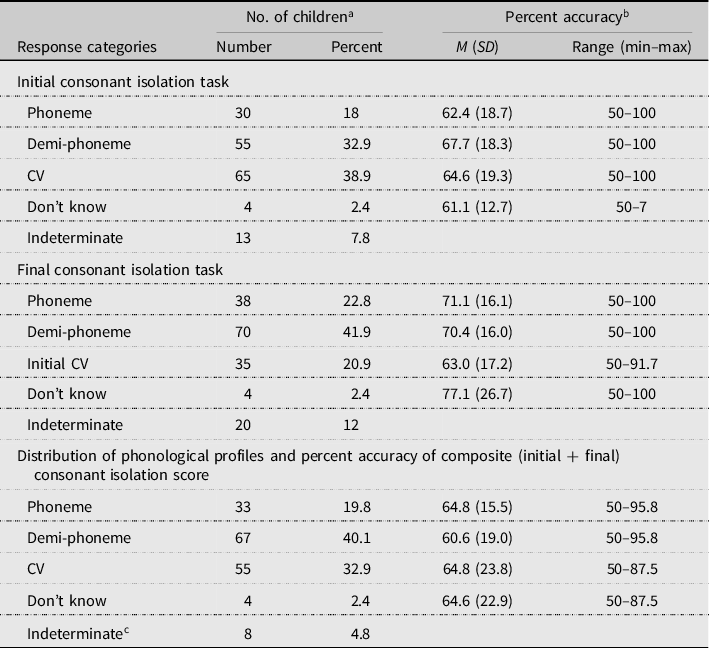
Classification of individual children according to their response pattern was conducted for each task separately by examining the proportion of child’s preference for a specific phonological unit. That is, if the child generated the same response for at least half (6 or more of the 12 items), s/he was classified into that particular category. At the top of Table 3, the distribution of children in each response category in initial and final tasks, respectively, is presented in the second and third columns. Columns 4 and 5 report the percentage for each response category for the two tasks. It is important to note that 13 children in the initial task and 20 in the final isolation task displayed a mixture of responses and no single category accounted for at least 50% of their responses; hence, these children were classified as “indeterminate.”
Distribution of children according to their predominant response in the initial and final tasks (separately) and percent accuracy in each category. The distribution of phonological profiles and percent accuracy for the composite score in 167 Arabic-speaking preschoolers

a In the top panel, these two columns represent the distribution of children whose response in this category accounted for at least 50% of their responses (at least 6/12). In the bottom panel, these columns represent the distribution of the three phonological profiles, with “don’t know” and “indeterminate” children as raw numbers and percentages.
b Means (in percentages), standard deviations (in parentheses), and ranges (in percentages) for each response category of initial and final isolation tasks and for the composite (initial + final) score.
c These eight children had a variety of responses in the two PA tasks and therefore did not meet the threshold criterion (at least 50% accuracy in one category).
As seen in Table 3, the most frequent responses in the two tasks were phonemes, demi-phonemes, and CV phonological units accounting for the overwhelming majority of responses (89.8%) in the initial phoneme isolation task and (85. 6%) in the final task. Significant and substantial correlations were found between the three main responses (phoneme, demi-phoneme, and CV) in the initial and final isolation tasks. These correlations were based on the proportion of responses for each child in each response category. The correlation between phoneme responses in the initial and final tasks was r = .69, p < .01, and r = .62, p < .01 for demi-phonemes. Regarding the CV response, there was also a substantial correlation between CV responses in the initial task and incorrect initial CV response in the final task r = .61, p < .01. Both “don’t know” responses in the two tasks were also highly correlated (r = .83, p < .01). These data also confirm that the two tasks have satisfactory reliability.
Accordingly, a composite score of each of the three main categories (phoneme, demi-phoneme, and CV) was formed by combining the initial and final tasks (and also the “don’t know” responses). Based on the children’s composite scores in the two PA tasks, we then created a phonological “profile” for each individual child on the basis of their most common overall response category. Evaluation of a child’s individual preference was conducted in two ways: first, by comparison of the raw composite scores across the three major response categories. The threshold criterion for phonological profile designation was that, in at least one response category, the child obtained 50% accuracy on the composite score. In situations in which scores for two response categories were identical or near identical, a second criterion was applied based on the percentile rank of the composite scores for each of the three major categories. The distribution of the three phonological profile, as well as the “don’t know” and “indeterminate” categories, is shown at the bottom of Table 3 as raw numbers of children and percentages. The remaining columns present the percent accuracy of the composite score for the three major phonological profile groups and the “don’t know” category.
Table 3 shows that, once again, the main phonological profiles were phonemes, demi-phonemes, and CVs, although the single phoneme was the least common of the “Big 3.” This finding confirms our second hypothesis that the natural availability of the CV unit is the most accessible phonological unit among Arabic-speaking preschoolers, but the most interesting finding is the demi-phoneme profile.
Comparison between profiles on background variables and literacy-related cognitive abilities
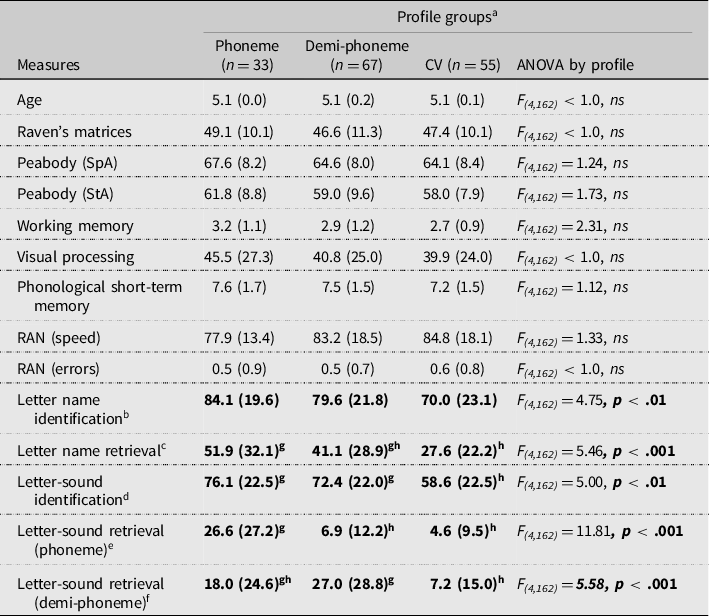
Differences between the three profiles on background (“control”) variables such as age and cognitive abilities are shown in Table 4. The criterion for statistical significance was set at p ≤ .01 to control the type 1 error rate. Pairwise follow-up comparisons were examined using the Scheffe test.
Comparison between profiles on background variables and literacy-related cognitive abilities

a Means (in percentages) for all measures except working memory and phonological short-term memory which are raw scores, standard deviations (in parentheses) for each of phonological profiles, and analysis of variance for profile main effect.
b The overall test for letter name identification task was significant but, none of the individual pairwise comparisons between the three PA profiles were significant.
c Significant differences between phoneme and CV profiles, p<.01 however, none significant differences were found between phoneme-demi-phoneme and between demi-phoneme and CV profiles.
d Significant differences between CV-phoneme and CV-demi-phoneme profiles, p<.05. None significant difference was found between phoneme and demi-phoneme profiles.
e Significant differences between phoneme-demi-phoneme and phoneme-CV profiles, p<.001. None significant difference was found between demi-phoneme and CV profiles.
f Significant differences between demi-phoneme and CV profiles, p<.01 but, none significant differences were found between phoneme-demi-phoneme and between phoneme-CV profiles.
g,h Indicate significant differences between groups.
Chi-square analysis revealed no significant gender differences, but significant differences emerged in the distribution of the profiles across the six Kindergartens, X 2 (20) = 52.62, p < .001. The phoneme-profile children were all from the same kindergarten 18/33 (54.5%), a finding which suggests that PA is directly related to instructional method.
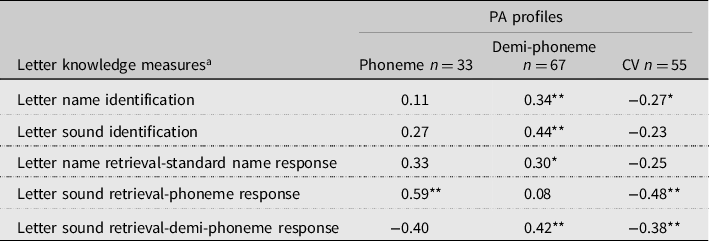
As seen in Table 4, no significant differences emerged between the three profiles on age or any of the literacy-related cognitive abilities. However, significant differences between the profiles were evident on all letter knowledge tasks. A two-way MANOVA showed a significant overall effect of phonological profile across the set of four/five measures of letter knowledge, Pillai’s Trace = .47, F (20, 644) = 4.28, p < .001, η 2 = .12. Univariate follow-up tests with multiple pairwise comparisons revealed that phoneme and demi-phoneme profiles have similar patterns of letter knowledge with the exception of letter-sound retrieval. Understandably, phoneme-profile children tended to retrieve letter-sound correspondence as a single phoneme; the demi-phoneme profile retrieved the sound of the letter as a demi-phoneme. Secondly, the CV-profile group had weaker letter knowledge than either the phoneme or demi-phoneme profiles.
The most salient findings here are that the demi-phoneme profile appears to be underpinned by the same knowledge that underlies the phoneme profile, and that the CV profile has weaker letter knowledge, once again, demonstrating the close connection between letter knowledge and phoneme-level awareness. Furthermore, these profile differences are not confounded by relevant background factors such as age and literacy-related cognitive variables.
Correlations between letter knowledge and PA in the three PA profiles
As seen in Table 5, letter knowledge measures were positively associated with PA performance in both the phoneme-based profiles (phoneme and demi-phoneme). The strongest association was between the ability to retrieve the sound of an Arabic letter as an isolated phoneme in the phoneme profile (r = .59). Likewise, the retrieval of the correct demi-phoneme for a letter was significantly correlated with demi-phoneme PA scores. In addition, the demi-phoneme PA scores were positively associated with knowledge of the standard names of Arabic letters in both identification and retrieval tasks and letter-sound identification. In contrast, there were negative correlations in the CV group between CV-level PA and all measures of letter knowledge, especially the crucial ability to retrieve the letter sound as a phoneme unit (r = −.48) and as a demi-phoneme unit (r = −.38). This finding implies that awareness of “large” CV units is associated with weaker letter knowledge, again confirming the link between letter knowledge and phoneme-level awareness.
Correlations between PA profiles and letter knowledge measures in kindergarten

a For the entire sample (n = 167).
* p < .05, ** p < .01.
Discussion
Letter knowledge
The main goal of this study was to understand the nature of both letter knowledge and PA among Arabic-speaking preliterate children. In regard to letter knowledge, two important findings emerged: first, the native Arabic-speaking preschoolers in our sample clearly knew the standard names better than the sounds. This finding is in accordance with a Jordanian study by Al-Hmouz (Reference Al-Hmouz2013) showing higher performance on letter standard names than letter sounds among first-grade children and with Hende’s longitudinal findings among Arabic-speaking children living in Israel (Hende, Reference Hende2012). The superior performance on letter names compared to letter sounds has also been reported in the US (see Ellefson et al., Reference Ellefson, Treiman and Kessler2009).
The high performance on standard names of Arabic letters in the early literacy appears to be related to instruction. Support for this claim comes from Levin et al.’s (Reference Levin, Saiegh-Haddad, Hende and Ziv2008) intervention study in kindergarten which showed that the two groups (intervention vs. control) retrieved letters in both varieties (standard and colloquial) names at pretest, but following instruction which emphasized standard names in the intervention program, high performance on standard names was found only in the intervention group while the control group retrieved both the standard and colloquial names (Levin et al., Reference Levin, Saiegh-Haddad, Hende and Ziv2008). Also, as mentioned by teachers who had participated in the current study, the standard names of the letters were emphasized in instruction more than the sounds and finally, the emphasis of the standard names is also found in other Arab countries including Saudi Arabia and Egypt (Al-Ghanem & Kearns, Reference Al-Ghanem and Kearns2014).
The second major finding was that preschoolers tended to retrieve the demi-phoneme /ʔεC/ rather than the isolated phoneme in letter-sound tasks. This finding raises the question what is the source of the demi-phoneme /ʔεC/ in letter-sound knowledge? The first explanation suggests that children in this study used the demi-phoneme to facilitate the pronunciation of the abstract phonemes that letters represent, in other words, the demi-phoneme may be the result of difficulty articulating the phonemes in isolation, and because they are abstract and non-intuitive units of representation without a clear auditory perceptual basis (Savin & Bever, Reference Savin and Bever1970). Historical support for this notion comes from Al-Khalil ibn Ahmad al-Farahidi who proposed adding the fixed prefix /ʔε/ to facilitate the pronunciation of Arabic consonantal letters. Another explanation for the prevalence of the demi-phoneme unit is instruction, with letter sounds in Arabic mostly not taught as isolated phonemes like English, but as the standard name with the vowel (i.e., /nu:n/+ /a:/= /na:/) in Saudi Arabia and Egypt or as demi-phonemes in Jordan (Al-Hmouz, Reference Al-Hmouz2013) and Israel (RAMA & Ministry of Education, 2017). Moreover, in the present study teachers indicated that they teach letter sounds as a demi-phoneme unit.
These findings have psycholinguistic and pedagogical implications such as the debate about the relative importance of letter names versus letter sounds. Saiegh-Haddad’s (Reference Saiegh-Haddad2018) MAWRID model of Arabic reading asserts that in early reading acquisition, readers rely heavily on letter by letter phonological recoding (as in pointed Hebrew which is also highly regular in terms of phonological transparency, see Share & Bar-On, Reference Share and Bar-On2017). This suggests that letter names are not sufficient to acquire reading (see Share, Reference Share2004); hence, this claim calls for future research addressing the differential impact of training letter names versus letter sounds on Arabic reading (Foulin, Reference Foulin2005). Regarding the salient demi-phoneme unit, future studies in Arabic will need to investigate the impact of this unit versus the phoneme unit on reading and spelling. Previous studies in Arabic have not always distinguished these two units, for instance, in Saiegh-Haddad (Reference Saiegh-Haddad2005) letter recoding efficiency (speed of converting letters to sounds) was the best predictor of word reading fluency at the end of the first grade, but both standard names and phonemes were accepted as correct responses. Also, Abu Ahmad et al. (Reference Abu Ahmad, Ibrahim, Share, Saiegh-Haddad and Joshi2014) reported a significant correlation between Kindergarten letter knowledge and Grade 2 word recognition (a combined measure of accuracy and rate) but, again, either the standard name or the demi-phoneme /ʔεC/ was accepted.
The accessible/available phonological unit among Arabic-speaking preschool children
The categorization of PA profiles revealed three main profiles: two expected and one unexpected; awareness of phonemes, awareness of CV units, and the unexpected one, awareness of the tri-phonemic /ʔεC/, a unit beginning with the fixed prefix /ʔε/ and ending with the target (consonantal) phoneme which we have termed the demi-phoneme unit. The most common phonological profile was the demi-phoneme (40%), followed by the CV unit (33%), with 20% classified as phoneme profile.
As anticipated, the CV profile was more common than the phoneme profile. This finding replicates prior work in Arabic showing that the CV unit constitutes the natural sub-syllabic unit in Semitic languages. Saiegh-Haddad (Reference Saiegh-Haddad2003, Reference Saiegh-Haddad2004, Reference Saiegh-Haddad2007a) has demonstrated that children in the early grades have greater difficulty isolating initial phonemes compared to final phonemes, a finding that underscores the unique cohesion of the CV unit in Arabic. Saiegh-Haddad (Reference Saiegh-Haddad2007a) suggested that the simple (and universal) structures of (StA) syllables, the dominance of the CV unit in Arabic script as well as instruction emphasizing this unit may explain the preference for CV unit in Arabic. Hende (Reference Hende2012) also found that the accessible phonological unit among kindergarteners is the CV (see also Taibah & Haynes, Reference Taibah and Haynes2011).
The prevalence of the CV unit has also been observed in Hebrew. Share (Reference Share, Verhoeven and Perfetti2017) has argued that this preference is inherent in the spoken phonology of Hebrew, although he asserted that both the CV bodies and individual (consonantal) phonemes (particularly final consonants) are important for Hebrew reading. Other European and Asian languages have also highlighted the salience of the CV unit including Dutch (Geudens & Sandra, Reference Geudens and Sandra2003), Korean (Kim & Petscher, Reference Kim and Petscher2011), Indonesian (Winskel & Widjaja, Reference Winskel and Widjaja2007), Malay (Rickard et al., Reference Rickard Liow and Choo Lee2004), and the family of Indian languages that use Brahmi-derived (akshara) scripts (Nag and Narayanan Reference Nag, Narayanan, Joshi and McBride2019).
The relatively low prevalence of the phoneme profile may stem from the difficulty of becoming aware of phonemes compared to other larger units prior to reading instruction; phonemes are abstract; thus, many scholars have argued that tasks designed to assess awareness of phonemes are understandably difficult for preschoolers (Liberman et al., Reference Liberman, Shankweiler, Fischer and Carter1974; Liberman & Liberman, Reference Liberman, Liberman, Gough, Ehri and Treiman1992; McBride-Chang et al., Reference McBride-Chang, Bialystok, Chong and Li2004). In contrast, syllables are more accessible psychoacoustically than phonemes and hence can be readily extracted from the speech stream (Gleitman & Rozin, Reference Gleitman and Rozin1973). In line with this, Saiegh-Haddad et al., (Reference Saiegh-Haddad, Shahbari-Kassem and Schiff2020) found that syllable awareness is easier for native Arabic speakers than phoneme awareness in both SpA and StA in their cross-sectional study in Grades 2, 4, 6, 8, and 10.
A second factor possibly accounting for the low prevalence of the phoneme profile is instruction. Despite the explicit demand on the Arabic preschool literacy curriculum in Israel to teach phonemes (Ministry of Education, 2009), around half of the phoneme profiles (18/33, 54.5%) clustered in only a single kindergarten. Furthermore, only in this kindergarten the teacher reported teaching phonemes explicitly, while the others emphasize larger phonological units such as rhyme, syllables, and the CV unit. This indicates that phonemic awareness depends on explicit alphabetic instruction as has been demonstrated in English-language studies (Boyer & Ehri, Reference Boyer and Ehri2011; Melby-Lervåg et al., Reference Melby-Lervåg, Lyster and Hulme2012; National Institute for Literacy, 2008; Share, Reference Share2008) and in Arabic (see Layes et al., Reference Layes, Lalonde and Rebai2019).
Another factor that may be related to the low phoneme awareness is the abjadic writing system of Arabic (Daniels, Reference Daniels, Downing, Lima and Noonan1992, Reference Daniels2018) which is first and foremost a consonantal system in both its fully vocalized (maʃku:l) and partly vocalized (non-maʃku:l) versions. The salient units in both maʃku:l and non-maʃku:l Arabic are core (CV) units plus syllable-final consonantal phonemes. This feature may contribute to the CV accessibility and decrease phonemic awareness, especially for vowel phonemes.
One intriguing finding was the prevalence of the demi-phoneme not only in letter-sound ability but also in PA. This raises the question of the source and the nature of this preference/availability. One explanation, as discussed above, derives from the fact that phonemes are abstract and difficult to extract from speech. Therefore, the demi-phoneme may help compensate for the difficulty articulating phonemes in isolation. Support for this interpretation raises from the non-significant differences between phoneme and demi-phoneme profiles in all background and cognitive measures including letter knowledge. This suggests that demi-phonemes have a quasi-phonemic status for Arabic speakers and both phoneme and demi-phoneme profiles are underpinned by the same knowledge. Moreover, the correlations between letter knowledge and phoneme-based profiles (phoneme and demi-phoneme) were both positive. This indicates that both profiles are similarly related to letter-sound knowledge. This finding is in accordance with the well-known reciprocal relationship between PA and letter knowledge (see Bowey, Reference Bowey2005; Ehri et al., Reference Ehri, Nunes, Willows, Schuster, Yaghoub-Zadeh and Shanahan2001; National Early Literacy Panel [NELP], 2008); Share, Reference Share1995; Snowling & Hulme, Reference Snowling and Hulme2005). In addition, the prominent demi-phoneme response in PA may be the product of letter-sound instruction; thus, the current findings revealed high performance in letter-sound retrieval test as a demi-phoneme and not as a phoneme as discussed above.
Finally, yet another important outcome of this study is the negative correlation between the group with the CV profile and letter knowledge, indicating that awareness of “large” CV units is associated with weaker letter knowledge especially in letter-sound correspondences in spite of being well matched to the other two profiles on background and cognitive factors. This suggests that the most “natural” accessible phonological unit (CV) in Arabic, prior to reading instruction, is not sufficient for early literacy and conscious access to single phonemes or the quasi-phonemic unit (demi-phoneme) is needed.
This study has pedagogical implications concerning the foundations of the two precursors of early literacy. On the one hand, CV PA before reading instruction is associated with poor letter knowledge which calls for intervention to enhance both letter knowledge and PA for small phonological units (phoneme/demi-phoneme). On the other hand, phonemic awareness is clearly related to phoneme-based letter knowledge (including the demi-phoneme); therefore, an instructional approach in early literacy is recommended in which phoneme awareness is directly integrated with direct teaching of letter knowledge at the phoneme level or alternatively, via the demi-phoneme (Byrne & Fielding-Barnsley, Reference Byrne and Fielding-Barnsley1989; Ehri, Reference Ehri2005; Elbro & Petersen, Reference Elbro and Petersen2004; National Early Literacy Panel (NELP), 2008).
Finally, one limitation of this study may be related to the structure of the PA task. PA was evaluated with two explicit segment isolation tests, initial and final. This task is considered to be “metalinguistic” according to Gombert (Reference Gombert1992, Reference Gombert2003) who suggests that linguistic knowledge is represented at two distinct cognitive levels: epilinguistic and metalinguistic. A further limitation concerns the syllable structure, all words were (SpA) with CVC structure which has been found to be the most common structure in the spoken vocabulary of 5-year-old Arabic-speaking children (see Saiegh-Haddad & Spolsky, Reference Saiegh-Haddad, Spolsky, Saiegh-Haddad and Joshi2014). Therefore, future research will need to determine if the present phonological profiles are replicated with alternative PA measures.
To conclude, the novel finding emerging from this study is that the accessible phonological unit in Arabic among preschool children is Al-Khalili’s tri-phonemic unit /ʔεC/ that begins with the fixed prefix /ʔε/ and ends with the target (consonantal) phoneme which we have termed the demi-phoneme unit. This prominent unit is reflected in PA and letter-sound knowledge. Future research in Arabic should take into account this phonological unit in the study of letter knowledge and PA, ideally by examining the associations between these two precursors and both reading accuracy and fluency in a longitudinal study. Finally, the current findings revealed that not all phonological units are explicitly accessible prior to reading and this is related to language-specific and script-specific features (Ziegler & Goswami, Reference Ziegler and Goswami2005). Therefore, as argued by Share (Reference Share2021, p. 8), “if the science of reading is to contribute meaningfully to assessment, diagnosis, instruction, and intervention for all readers around the world, then we must extricate our field from entrenched ethnocentrism and embrace global diversity.”
Appendix
Arabic letters in their non-ligatured form, their standard names, colloquial names/demi-phonemes, and sounds (phonemic value)