Introduction
Piglets at weaning are subjected to many stresses due to separation from the sow, mixing with other piglets, and dietary and environmental changes (Kyriakis et al., Reference Kyriakis, Tsiloyiannis, Vlemmas, Sarris, Tsinas, Alexopoulos and Jansegers1999). These abrupt changes disturb the equilibrium of the microflora in the gut, making them susceptible to enteric pathogens (Alexopoulos et al., Reference Alexopoulos, Georgoulakis, Tzivara, Kyriakis, Govaris and Kyriakis2004), decreased feed intake and daily gain (Estrada et al., Reference Estrada, Drew and Van Kessel2001). In an attempt to control some of these problems, there has been widespread use of in-feed antibiotics at both a therapeutic level and sub-therapeutic level (Williams et al., Reference Williams, Verstegen and Tamminga2001). However, due to various public health scares associated with animal product consumption (Williams et al., Reference Williams, Verstegen and Tamminga2001), an in-feed antibiotic ban was implemented in the European Union, which has prompted the search for effective alternatives.
Much research exists regarding the improvements in piglet performance due to lactose supplementation (O’Doherty et al., Reference O’Doherty, Nolan, Callan and McCarthy2004; Pierce et al., Reference Pierce, Callan, McCarthy and O’Doherty2005 and Reference Pierce, Sweeney, Brophy, Callan, Fitzpatrick, McCarthy and O’Doherty2006; Lynch et al., Reference Lynch, Callan and O’Doherty2007). High lactose inclusion (300 g/kg) in starter diets has been shown to increase daily gain and improve feed efficiency and eliminate the necessity for in-feed antibiotics (O’Doherty et al., Reference O’Doherty, Nolan and McCarthy2005). Lactose is among the principal sugars that escapes digestion in the small intestine (Cummings and Macfarlane, Reference Cummings and Macfarlane1991) and a large proportion of the lactose is readily fermented to lactic acid by Lactobacilli (Pierce et al., Reference Pierce, Sweeney, Brophy, Callan, Fitzpatrick, McCarthy and O’Doherty2006). Research has shown that older pigs had only sufficient intestinal lactase activity to digest 40% of lactose ingested, the remainder being available for fermentation (Ekstrom et al., Reference Ekstrom, Benevenga and Grummer1975). This fact, combined with a reduced lactase secretion in the weaned pig, may result in 32% to 35% of lactose reaching the hindgut undigested (Kim et al., Reference Kim, Jewell, Benevenga and Grummer1978; Pierce et al., Reference Pierce, Sweeney, Brophy, Callan, Fitzpatrick, McCarthy and O’Doherty2006). The inclusion of high levels of lactose from whey permeate in weaned pig diets has resulted in improved intestinal health through a reduction in intestinal pH and increases in Lactobacilli and short-chain fatty acids and reductions in coliforms (Pierce et al., Reference Pierce, Sweeney, Brophy, Callan, Fitzpatrick, McCarthy and O’Doherty2006). However, the demand for milk-based products is increasing from alternative markets, which could substantially increase the cost and decrease availability.
Seaweeds or seaweed extracts can potentially be used as feed additives (Gardiner et al., Reference Gardiner, Campbell, O’Doherty, Pierse, Lynch, Leonard, Stanton, Ross and Lawlor2008) for both performance improvement and pathogenic bacteria reduction (Allen et al., Reference Allen, Pond, Saker, Fontenot, Bagley, Ivy, Evans, Schmidt, Fike, Zhang, Ayad, Brown, Miller, Montgomery, Mahan, Wester and Melton2001). The most abundant polysaccharides in brown seaweeds are laminarin, fucoidan and alginic acid (Zvyagintseva et al., Reference Zvyagintseva, Shevchenko, Chizhov, Krupnova, Sundukova and Isakov2003). The term ‘laminarin’ describes a group of reserve, water-soluble (1–3), (1–6)-β-d-glucans with low molecular weight isolated from the seaweeds of Phaeophyta (Zvyagintseva et al., Reference Zvyagintseva, Shevchenko, Popivnich, Isakov, Scobun, Sundukova and Elyakova1999). β-glucans present in barley have been shown to act as a substrate for bifidobacteria and Lactobacilli spp. (O’Connell et al., Reference O’Connell, Sweeney, Callan and O’Doherty2005b) while yeast β-glucans have been shown to improve growth performance, average daily feed intake (ADFI) (Schoenherr et al., Reference Schoenherr, Pollmann and Coalson1994; Dritz et al., Reference Dritz, Shi, Kielian, Goodband, Nelssen, Tokach, Chengappa, Smith and Blecha1995) and food conversion efficiency (Schoenherr et al., Reference Schoenherr, Pollmann and Coalson1994) in nursery pigs. β-glucans isolated from Saccharomyces cerevisiae have been shown to have antibacterial properties (Kogan et al., Reference Kogan, Masler, Šandula, Navarová and Trnovec1989), as well as an ability to stimulate the release of cytokines, such as tumour necrosis factor (TNF)-α from macrophages (Majtán et al., Reference Majtán, Kogan, Kováčová, Bíliková and Šimúth2005). Fucoidans, the family of sulphated heteropolysaccharides, are composed mainly of α-1,3-linked l-fucose residues (Percival and Mc Dowell, 1967). Fucoidans have been shown to have antitumour (Zhuang et al., Reference Zhuang, Itoh, Mizuno and Ito1995), antiviral (Lee et al., Reference Lee, Hayashi, Hashimoto, Nakano and Hayashi2004) and antibacterial (McClure et al., Reference McClure, Moore, Blanc, Scotting, Cook, Keynes, Weber, Davies and Weiss1992) properties.
Reilly et al. (2008) showed that a combination of fucoidan and laminarin increased the volatile fatty acid (VFA) concentration in the colon of weaned pigs, indicating that these fractions were fermented by the microbial population in the colon. Thus, fucoidan and laminarin have a wide spectrum of biological actions that may alleviate the need for high concentrations of lactose (O’Doherty et al., Reference O’Doherty, Nolan, Callan and McCarthy2004) in antibiotic-free diets.
The hypothesis of this study is that the inclusion of a seaweed extract containing laminarin and fucoidan from Laminaria spp. in piglet diets could substitute for lactose as a substrate for microbial fermentation in the large intestine, thereby allowing levels of lactose to be reduced while maintaining post-weaned piglet performance in growth promoter-free diets.
Material and methods
Diets
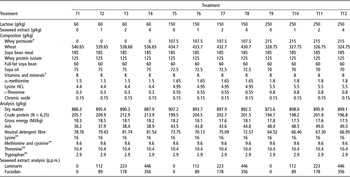
The experiment was designed as a 3 × 4 (3 levels of lactose × 4 levels of seaweed extract) factorial arrangement comprising of 12 dietary treatments. This experiment was carried out over three consecutive periods of 21 days. In all, 384 piglets (progeny of Large White × (Large White × Landrace) pigs) were selected after weaning at 24 days. The pigs in period 1, 2 and 3 had an initial live weight of 7.8, 7.6 and 6.6 kg (s.d. 1 kg), respectively. The pigs were blocked on the basis of live weight and within each block assigned to one of 12 dietary treatments. The dietary treatments consisted of (T1) 60 g/kg lactose with 0 g/kg seaweed extract, (T2) 60 g/kg lactose with 1 g/kg seaweed extract, (T3) 60 g/kg lactose with 2 g/kg seaweed extract, (T4) 60 g/kg lactose with 4 g/kg seaweed extract, (T5) 150 g/kg lactose with 0 g/kg seaweed extract, (T6) 150 g/kg lactose with 1 g/kg seaweed extract, (T7) 150 g/kg lactose with 2 g/kg seaweed extract, (T8) 150 g/kg lactose with 4 g/kg seaweed extract, (T9) 250 g/kg lactose with 0 g/kg seaweed extract, (T10) 250 g/kg lactose with 1 g/kg seaweed extract, (T11) 250 g/kg lactose with 2 g/kg seaweed extract and (T12) 250 g/kg lactose with 4 g/kg seaweed extract. The level of seaweed extracts used are based on previous work by Gardiner et al. (Reference Gardiner, Campbell, O’Doherty, Pierse, Lynch, Leonard, Stanton, Ross and Lawlor2008).
The lactose content of the diets was altered by adjusting the level of whey permeate in the diet at the expense of wheat. The ingredients used in the diets are similar to that reported by Pierce et al. (Reference Pierce, Callan, McCarthy and O’Doherty2005). The diets were offered in meal form for 21 days post weaning. Diets were formulated to have identical concentrations of digestible energy (DE) (16 MJ/kg) and ileal digestible lysine (14 g/kg). All amino acid requirements were met relative to lysine (Close, Reference Close1994). Chromium III oxide was added to the diets at a concentration of 150 p.p.m. at the time of milling for the determination of nutrient digestibilities. The seaweed extract was extracted from Laminaria spp. and substituted for wheat on a weight for weight basis. The seaweed extract contained laminarin (112 g/kg), fucoidan (89 g/kg) and ash (799 g/kg) and was sourced from Bioatlantis Ltd (Tralee, County Kerry, Ireland). The ingredient composition and chemical analysis of the dietary treatments are presented in Table 1.
Composition and chemical analysis of experimental diets (as fed)

1Provided (mg/kg completed diet): Cu 175, Fe 140, Mn 47, Zn 120, I 0.6, Se 0.3, retinol 1.8, cholecalciferol 0.025, alpha-tocopherol 67, phytylmenaquinone 4, cyanocobalamin 0.01, riboflavin 2, nicotinic acid 12, pantothenic acid 10, choline chloride 250, thiamine 2, pyridoxine 0.015. Chromium III oxide included at 150 mg/kg complete diet.
†Lactofeed 70: Volac international Ltd, Orwel, Royston, SG8 5QX, UK. The chemical analysis is as follows (g/kg unless otherwise stated ): dry matter 955, crude protein 125, oil 50, ash 90, fibre 10, gross energy content of 15.5 MJ/kg and a pH of 6.5 to 7.
††Calculated from proximate analysis (Ministry of Agriculture Fisheries and Food, 1991).
Management
Pigs were housed in groups of four (eight replicates per treatment) on fully slatted pens (1.68 m × 1.22 m). House temperature was maintained at 30°C in the first week and then reduced by 2°C per week. Pigs were weighed at the beginning of the experiment (day of weaning = day 0), day 7, day 14 and day 21. The pigs were fed ad libitum from a four-space feeder, with precautions taken to avoid wastage of feed. Water was available ad libitum from nipple drinkers. Food was available up to weighing and then weighed back for the purpose of calculating food conversion efficiency. During the experiment, feed samples were collected at the time of feeding and were retained for chemical analysis. Fresh faecal samples were collected once daily from all pens on days 10 to 15 for the determination of nutrient digestibility. Fresh faecal samples were obtained on day 16 and 20 for pH determination.
Faeces scoring
Pigs were observed for clinical signs of diarrhoea and a scoring system was applied (Pierce et al., Reference Pierce, Callan, McCarthy and O’Doherty2005) to indicate the presence of the severity of this. Faeces scoring began on day 1 and continued to day 21 of the experiment. The following faeces scoring system was used: 1 = hard faeces, 2 = slightly soft faeces, 3 = soft, partially formed faeces, 4 = loose, semi-liquid faeces, 5 = watery, mucous-like faeces.
Laboratory analysis
Both concentrates and faeces were analysed for nitrogen, dry matter, ash, gross energy, neutral detergent fibre (NDF) and chromium concentration. Following collection, the faeces were dried at 103°C for 72 h. Both concentrates and dried faeces were milled through a 1-mm screen (Christy and Norris hammer mill, Christy and Norris Ltd, Ipswich, UK). The dry matter of the concentrates, faeces and seaweed extract was determined after drying overnight at 103°C. Ash was determined after ignition of a known weight of concentrates or faeces in a muffle furnace (Nabertherm, Bremen, Germany) at 550°C for 4 h. The nitrogen content of both concentrates and faeces was determined as N× 6.25 using the LECO FP 528 instrument (Leco instruments, UK Ltd, Cheshire, UK). The NDF was determined using a fibertec extraction unit (Tecator, Hoganans, Sweden). Gross energy of the concentrates and faeces samples was determined using a Parr 1201 oxygen bomb (Parr, Moline, Illinois, USA). Faecal pH was determined using a Mettler Toledo MP220 pH Meter. Chromium concentration was determined using the method of Williams et al. (Reference Williams, David and Iismaa1962). The total laminarin content of the seaweed extract and diets was determined using a Megazyme assay kit (Megazyme, Bray, Ireland). The fucoidans concentration in the seaweed extract and diets was determined using the method of Usov et al. (Reference Usov, Smirnova and Klochkova2001).
Statistical analysis
The experimental data were analysed as a 3 × 4 factorial using the general linear model procedure of the Statistical Analysis System (1985). The statistical model used (for performance, digestibility and faecal scores) included both the linear and quadratic effects of lactose and seaweed extract inclusion, period number and the associated interactions between linear effects of lactose and seaweed extract and the quadratic effects of lactose and seaweed extract. The performance, digestibility and faecal score data were adjusted for initial live weight by covariance analysis. The individual pen was used as the experimental unit. The data in the tables are presented as least-square means (LSM) ± s.e.
Results
Dietary analysis
The concentration of laminarin and fucoidan in T2, T6 and T10 diets was 112 and 89 p.p.m., respectively. The concentration of laminarin and fucoidan in T3, T7 and T11 diets was 223 and 178 p.p.m., respectively, while the concentration of laminarin and fucoidan in T4, T8 and T12 diets was 446 and 356 p.p.m., respectively.
Performance
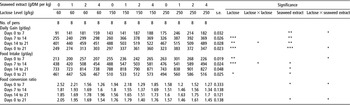
The effects of lactose level and seaweed extract concentration on average daily gain (ADG), ADFI and food conversion ratio (FCR) are presented in Table 2. There was a significant lactose × seaweed extract interaction (P < 0.05) on ADG between days 0 and 7 and during the entire experimental period. At the low and medium levels of lactose, there was an increase in ADG as the level of seaweed extract increased to 2 g/kg (P < 0.05). However, at the high level of lactose there was no further response in ADG above 1 g/kg. There was a linear increase in ADG between days 7 and 14 (273 v. 343 v. 368 g/day, s.e. 13.41; P < 0.001) as the level of lactose increased. There was a quadratic increase (438 v. 508 v. 495 g/day, s.e. 14.31; P < 0.05) in ADG between days 14 and 21 as the level of lactose increased. There was a linear increase in ADG between days 7 and 14 (280 v. 331 v. 356 v. 346 g/day, s.e. 15.42; P < 0.01) and days 14 and 21 (452 v. 486 v. 496 v. 487 g/day, s.e. 16.38; P < 0.01) as the level of seaweed extract increased.
Effect of lactose level and seaweed extract concentration on pig performance post weaning (least square means and s.e.)

DM = dry matter.
*P < 0.05, **P < 0.01, ***P < 0.001.
There was a significant lactose × seaweed extract interaction (P < 0.05) between days 0 and 7 on ADFI. At the low level of lactose, there was an increase in ADFI as the level of seaweed extract increased to 2 g/kg (P < 0.05). However, at the medium and high levels of lactose there was no significant response (P > 0.05) in ADFI as the level of seaweed extract increased. There was a quadratic increase in ADFI to lactose inclusion from days 7 to 14 (P < 0.05) (455 v. 530 v. 525 g/day, s.e. 12.34). There was a linear increase in ADFI (P < 0.05) between days 7 and 14 (467 v. 502 v. 533 v. 510 g/day, s.e. 14.2), days 14 and 21 (754 v. 793 v. 835 v. 812 g/day, s.e. 28) and during the experimental period (days 0 to 21) (488 v. 514 v. 541 v. 518 g/day, s.e. 14.8), respectively, as the level of seaweed extract increased. There was a linear increase in ADFI (P < 0.05) with increasing lactose during the experimental period (days 0 to 21) (475 v. 532 v. 539 g/day, s.e. 12.8).
There was a significant lactose × seaweed extract interaction between days 0 and 7 and during the experimental period (days 0 to 21) (P < 0.05) on FCR. At the low level of lactose, there was a linear improvement in FCR as the levels of seaweed extract increased to 4 g/kg (P < 0.01). At the medium level of lactose, there was a significant improvement in FCR as the level of seaweed extract increased to 2 g/kg. However, there was no significant effect of seaweed extract on FCR at the high level of lactose (P > 0.05).
Digestibility, faecal pH, DM and faecal score
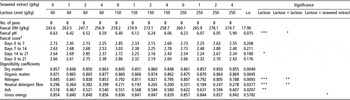
The effects of dietary treatment on faecal pH, faecal dry matter (DM), faecal score and apparent nutrient digestibility of the diets are presented in Table 3. There was a quadratic decrease in faecal pH (P < 0.05) (6.54 v. 6.21 v. 6.06, s.e. 0.037) as the levels of lactose increased during the experimental period (days 0 to 21). There was a linear decrease in faecal score between days 14 and 21 (P < 0.05) as the level of lactose increased (2.64 v. 2.39 v. 2.45, respectively, s.e. 0.090). There was a quadratic decrease in the apparent digestibility of nitrogen (N) (84.41 v. 80.48 v. 79.78, s.e. 0.469) and NDF (36.01 v. 23.34 v. 25.89, s.e. 1.883) as the level of lactose increased (P < 0.01). There was a linear increase in ash digestibility as the level of lactose increased (P < 0.01). There was a significant lactose × seaweed extract interaction in the apparent digestibility of gross energy (P < 0.05). At the high level of lactose, there was a significant decrease in gross energy digestibility (P < 0.05) as the level of seaweed extract increased to 2 g/kg. However, at the low and medium levels of lactose, there was no significant response in digestibility (P > 0.05) as the level of seaweed extract increased.
Effects of dietary treatment on faecal dry matter (DM), faecal pH, faecal score and apparent digestibility coefficients of experimental diets (least square means and s.e.)

*P < 0.05, **P < 0.01, ***P < 0.001.
1 = hard faeces and 5 = watery, mucous-like faeces.
Discussion
In the current study, it was hypothesised that the inclusion of a seaweed extract containing a combination of laminarin and fucoidan in piglet diets could substitute for lactose, thereby allowing levels of lactose to be reduced while maintaining performance post weaning. The use of seaweed extracts in pig diets has given variable responses (Allen et al., Reference Allen, Pond, Saker, Fontenot, Bagley, Ivy, Evans, Schmidt, Fike, Zhang, Ayad, Brown, Miller, Montgomery, Mahan, Wester and Melton2001; Turner et al., Reference Turner, Dritz, Higgins and Minton2002; Gardiner et al., Reference Gardiner, Campbell, O’Doherty, Pierse, Lynch, Leonard, Stanton, Ross and Lawlor2008). Gardiner et al. (Reference Gardiner, Campbell, O’Doherty, Pierse, Lynch, Leonard, Stanton, Ross and Lawlor2008) reported linear decreases in daily gain as the level of an Ascophyllum nodosum extract increased in healthy grower–finisher pigs. However, this extract also contained phenolic compounds and alginates and led the authors to conclude that unless the process of extraction removed these components, its use as a commercial feed additive would be limited. As a result, the seaweed extract used in the current experiment contained only laminarin and fucoidan.
The presence of an interaction between lactose and seaweed extract on ADG and feed efficiency during the experimental period would support our hypothesis that laminarin and fucoidan could substitute for lactose in piglet diets. The results of the experiment indicate that the inclusion of a combination of 223 p.p.m. laminarin and 178 p.p.m. fucoidan in medium-lactose diets could replace the need for high concentrations of dietary lactose without adversely affecting growth rate. The results also indicate that the inclusion of 446 p.p.m. laminarin and 356 p.p.m. fucoidan in low-lactose diets could replace the need for high concentrations of dietary lactose without adversely affecting feed efficiency. This may be due to a number of reasons.
Firstly, Pierce et al. (Reference Pierce, Sweeney, Brophy, Callan, Fitzpatrick, McCarthy and O’Doherty2006) reported that the inclusion of high dietary concentrations of lactose in piglet diets resulted in improved intestinal health through a reduction in gut pH, increases in Lactobacilli populations and short-chain fatty acid production and a reduction in coliform populations. Kogan et al. (Reference Kogan, Masler, Šandula, Navarová and Trnovec1989) showed that β-glucans isolated from S. cerevisiae have antibacterial properties while Reilly et al. (2008) showed that the inclusion of a laminarin and fucoidan extract similar to the one used in the current experiment resulted in a significant reduction in coliform populations in the caecum and colon of piglets post weaning. Similarly, Gardiner et al. (Reference Gardiner, Campbell, O’Doherty, Pierse, Lynch, Leonard, Stanton, Ross and Lawlor2008) demonstrated that the inclusion of an A. nodosum seaweed extract had an inhibitory effect on the Enterobacteria and Bifidobacteria population within the caecum and colon of grower–finisher pigs. Fucoidans from different species of brown algae have been shown to inhibit the attachment of certain bacterial species in the porcine gastrointestinal tract as well as prevent the binding of Enterococci and Streptococci species to the extracellular matrix proteins of animal cells (Shibata et al., Reference Shibata, Limuro, Uchiya, Kawamori, Nagaoka, Ueyama, Hashimoto, Yokokura, Sugimura and Wakabayashi2003), indicating that the fucoidans may be acting as an antimicrobial in reducing the microbial population. Similar properties have been reported with β-glucans isolated from S. cerevisiae (Kogan et al., Reference Kogan, Masler, Šandula, Navarová and Trnovec1989).
Secondly, seaweeds are rich in polysaccharides resistant to hydrolysis in the upper gastrointestinal tract, and thus considered as dietary fibres (Devillé et al., Reference Devillé, Damas, Forget, Dandrifosse and Peulen2004). On reaching the hindgut they may be fermented by microflora, increasing the production of short-chain fatty acids (Reilly et al., 2008) and ultimately reducing gut pH. Reilly et al. (2008) showed that the inclusion of a laminarin and fucoidan extract similar to the one used in the current experiment increased the total VFA concentration in the colon of weaned pigs, indicating that these fractions were fermented by the microbial population in the colon. The quantity of VFA produced in the large intestine depends on the amount and composition of the substrate and on the microflora present (MacFarlane and MacFarlane, Reference Macfarlane and Macfarlane2003).
Thirdly, since there was no effect on nutrient digestibility with laminarin and fucoidan supplementation, the observed increase in piglet daily gain cannot be related to the digestibility of the diets. However, it can be attributed to the increased feed intake of pigs supplemented with the laminarin and fucoidan extract. Increased feed intake was also reported in previous pig-feeding studies (Allen et al., Reference Allen, Pond, Saker, Fontenot, Bagley, Ivy, Evans, Schmidt, Fike, Zhang, Ayad, Brown, Miller, Montgomery, Mahan, Wester and Melton2001; Turner et al., Reference Turner, Dritz, Higgins and Minton2002) to seaweed extract supplementation. Pluske et al. (Reference Pluske, Thompson, Atwood, Bird, Williams and Hartmann1996) demonstrated that villus height and crypt height could be maintained if piglets do not suffer the nutritional stress associated with interrupted feed intake immediately post weaning.
The results of this experiment also agree with the concept that the magnitude of response to feed additives is likely to be related to the nature of the diet, with the greatest benefits evident when diets are formulated with cereals and plant proteins (Estrada et al., Reference Estrada, Drew and Van Kessel2001). At the high level of lactose, there was no improvement in feed efficiency as the level of seaweed extract increased. The results indicate the beneficial effects of using high lactose levels in weaned piglet diets, particularly in the absence of in-feed antibiotics. This may be attributed to a number of reasons. Firstly, this improved performance may be attributable to an observed increase in feed intake. This increase in feed intake may be a result of the direct relationship between the observed increases in feed intake and feed digestibility (Whittemore, Reference Whittemore1993). Lactose also has an effect on feed palatability (Tokach et al., Reference Tokach, Nelssen and Allee1989), which can be related to its contribution to feed sweetness.
Secondly, lactose is a substrate for Lactobacilli spp., that are in abundance post weaning (Pierce et al., Reference Pierce, Sweeney, Brophy, Callan, Fitzpatrick, McCarthy and O’Doherty2006), rapidly converting lactose to lactic acid and short-chain fatty acids (Pierce et al., Reference Pierce, Sweeney, Brophy, Callan, Fitzpatrick, McCarthy and O’Doherty2006) through fermentation in the hindgut. Thirdly, coinciding with the increase in lactose content of the diet, there is a decrease in the anti-nutritive factors such as arabino-xylans present in the diet, as a result of the decrease in wheat levels. Finally, lactose can be efficiently utilised by the newly weaned pig (Tokach et al., Reference Tokach, Nelssen and Allee1989). However, there are economic implications in using high levels of lactose in piglet diets. The results of the current experiment would indicate that the inclusion of a seaweed extract containing laminarin and fucoidan could substitute for lactose in the absence of in-feed antibiotics.
The quadratic decrease in the digestibility of nitrogen (N) resulting from increasing lactose level may be due to an increase in the amount of N voided in the faeces. Pigs offered low-lactose diets had a proportionally higher N digestibility of 0.05 and 0.06 compared with pigs offered the medium- and high-lactose diets, respectively. Previously, O’Connell et al. (Reference O’Connell, Callan and O’Doherty2005a) and Pierce et al. (Reference Pierce, Callan, McCarthy and O’Doherty2005) have reported similar effects on N digestibility when high levels of lactose were offered. The utilisation of lactose as a substrate for microbial fermentation in the large intestine may stimulate bacterial growth. As a result of increased bacterial N excretion, the apparent digestibility of N will be reduced (O’Connell et al., Reference O’Connell, Callan and O’Doherty2005a).
There was a quadratic decrease in faecal pH as the levels of lactose increased while there was a linear increase in ash digestibility as the level of lactose increased. Similar relationships between ash digestibility and lactose inclusion have been reported by O’Doherty et al. (Reference O’Doherty, Nolan and McCarthy2005). Research by Pierce et al. (Reference Pierce, Sweeney, Brophy, Callan, Fitzpatrick, McCarthy and O’Doherty2006) showed that high concentrations of lactose increased the concentration of lactic acid in the large intestine, which would provide favourable conditions for endogenous cereal phytase activity by lowering the pH of the hindgut (Reale et al., Reference Reale, Konietzny, Coppola, Sorrentino and Greiner2007). Increased phytase activity would enhance the phosphorus and mineral uptake in monogastric animals (Lassen et al., Reference Lassen, Breinholt, Ostergaard, Brugger, Bischoff, Wyss and Fuglsang2001).
In conclusion, pigs responded differently to the inclusion levels of laminarin and fucoidan extracts at each level of lactose supplementation. These results would indicate that the inclusion of a laminarin–fucoidan extract from Laminaria spp. in piglet diets may alleviate the use for high-lactose diets and also alleviate some of the common problems that occur post weaning in the absence of in-feed antibiotics.