Introduction
Laboratory animals exposed to cigarette smoke in utero experience structural changes to their serotonin system that are associated with reduced serotonin levels and last through adulthood (Slotkin, Pinkerton, Tate, & Seidler, Reference Slotkin, Pinkerton, Tate and Seidler2006, Reference Slotkin, Skavicus, Levin and Seidler2015). The strength and ubiquity of the inhibitory effect of cigarette smoke on serotonin activity among animals suggest that this effect is likely to also operate among humans exposed to maternal smoking during pregnancy (MSP) with similarly long-lasting consequences. Low serotonin level is a prominent precursor of behaviors that are consistent with depression among animals and with depression among humans (Balfour & Ridley, Reference Balfour and Ridley2000). Thus, suggesting a biologically plausible link between MSP and offspring's elevated risk of depression (Baler, Volkow, Fowler, & Benveniste, Reference Baler, Volkow, Fowler and Benveniste2008).
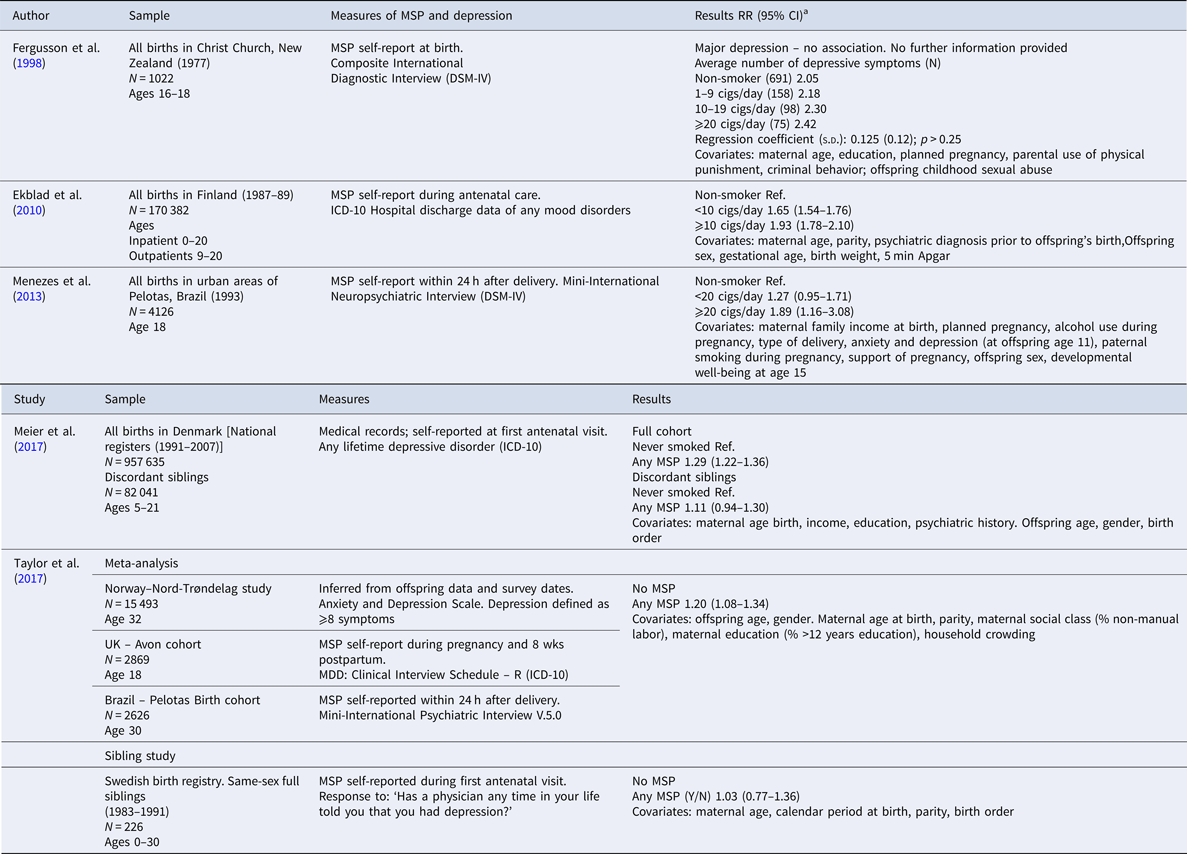
Epidemiologic studies among children (Ashford, Van Lier, Timmermans, Cuijpers, & Koot, Reference Ashford, Van Lier, Timmermans, Cuijpers and Koot2008; Batstra, Hadders-Algra, & Neeleman, Reference Batstra, Hadders-Algra and Neeleman2003; Brion et al., Reference Brion, Victora, Matijasevich, Horta, Anselmi, Steer and Davey Smith2010; Hook, Cederblad, & Berg, Reference Hook, Cederblad and Berg2006; Knopik, Reference Knopik2009; Lavigne et al., Reference Lavigne, Hopkins, Gouze, Bryant, LeBailly, Binns and Lavigne2011; Moylan et al., Reference Moylan, Gustavson, Øverland, Karevold, Jacka, Pasco and Berk2015; Tiesler & Heinrich, Reference Tiesler and Heinrich2014) and adolescents (Albers & Biener, Reference Albers and Biener2002; Ashford et al., Reference Ashford, Van Lier, Timmermans, Cuijpers and Koot2008; Indredavik, Brubakk, Romundstad, & Vik, Reference Indredavik, Brubakk, Romundstad and Vik2007; Monshouwer et al., Reference Monshouwer, Huizink, Harakeh, Raaijmakers, Reijneveld, Oldehinkel and Vollebergh2011) have yielded mixed results. However, because the median age for the onset of depressive disorders is 32 (Kessler et al., Reference Kessler, Berglund, Demler, Jin, Marikangas and Walters2005), studies of adults less than age 32 are likely to under-report lifetime risk of depression. To date, seven epidemiologic studies have examined the association between MSP and risk of depression among adult offspring aged 18+, none included participants over the age of 32 (Table 1). Five studies used standard multivariate methods to control for confounding and two used a sibling design. Among a New Zealand birth cohort, MSP predicted a modest increase in the number of depressive symptoms but this trend did not reach statistical significance (Fergusson, Woodward, & Horwood, Reference Fergusson, Woodward and Horwood1998). Among a Finish birth cohort, a dose–response association was evident between MSP and lifetime risk of any mood disorders (Ekblad, Gissler, Lehtonen, & Korkeila, Reference Ekblad, Gissler, Lehtonen and Korkeila2010). Evidence from a Brazilian birth cohort is suggestive of a linear pattern between MSP and offspring's lifetime risk of depressive disorder at age 18 (Menezes et al., Reference Menezes, Murray, László, Wehrmeister, Hallal, Gonçalves and Barros2013). However, this association was statistically significant only for MSP⩾20 cigarettes/day (Menezes et al., Reference Menezes, Murray, László, Wehrmeister, Hallal, Gonçalves and Barros2013). The two studies with positive results found similar effect sizes for MSP⩾20 cigarettes/day (although with a wider confidence interval for the smaller Brazilian study). The strong and relatively stable effect for MSP⩾20 cigarettes/day is consistent with other studies which have found a linear effect of MSP that reaches statistical significance only at higher doses of MSP (e.g. Buka, Shenassa, & Niaura, Reference Buka, Shenassa and Niaura2003; Stroud et al. Reference Stroud, Paster, Goodwin, Shenassa, Buka, Niaura and Lipsitt2009; Wen, Shenassa, & Paradis, Reference Wen, Shenassa and Paradis2013).
Review of epidemiologic studies of maternal smoking during pregnancy (MSP) and risk of depression among adult offspring (1998–2020)

a Results reported as risk ratios except by Fergusson et al. (Reference Fergusson, Woodward and Horwood1998).
To better control for confounding by the many familial (D'Onofrio, Lahey, Turkheimer, & Lichtenstein, Reference D'Onofrio, Lahey, Turkheimer and Lichtenstein2013) and genetic (Knopik, Reference Knopik2009) differences that distinguish pregnant women who smoke from their non-smoking counterparts, two studies capitalized on variation in smoking between pregnancies by utilizing a sibling comparison design. Taylor et al. (Reference Taylor, Carslake, de Mola, Rydell, Nilsen, Bjørngaard and Munafò2017) conducted a meta-analysis among three birth cohorts, utilized the smoking history of mother's partner as a negative control and conducted a discordant sibling-pair analysis of data from a fourth cohort. The meta-analysis found an independent association between any MSP and offspring's risk of depression that was stronger than the association among negative controls. However, among sibling pairs in the fourth cohort, MSP was not associated with the risk of depression. It is noteworthy that in this study, the sibling pairs were from a birth cohort with a considerably lower prevalence of depression and differing method of assessing depression than the birth cohorts used in the meta-analyses. Among a Danish birth cohort (Meier et al., Reference Meier, Plessen, Verhulst, Mors, Mortensen, Pedersen and Agerbo2017), any MSP predicted offspring's lifetime risk of depression. In contrast, among sibling-pairs, all of whom were exposed to MSP, differences in the amount of maternal smoking between the two pregnancies did not predict offspring's risk of depression. In sum, evidence of a positive association between MSP and risk of depression from conventional studies is countered by evidence from sibling-pair studies that the observed association between MSP and offspring's risk of depression may be due to confounding by unmeasured familial and genetic factors. Thus, establishing the sibling-pair design as the gold standard for studies of intergenerational effects of MSP. However, valid inference regarding the causal effect of MSP is subject to threats inherent to human studies of MSP that are not addressed by the sibling-pair design and biases that are particular to this design (Frisell, Öberg, Kuja-Halkola, & Sjölander, Reference Frisell, Öberg, Kuja-Halkola and Sjölander2012; Shenassa, Reference Shenassa2017).
A challenge inherent to human studies of MSP is that MSP is an imprecise proxy for the biologically relevant exposure: fetal bioavailability of nicotine metabolites (Balfour & Ridley, Reference Balfour and Ridley2000; Slotkin et al., Reference Slotkin, Pinkerton, Tate and Seidler2006). Another challenge pertains to errors in self-reports of MSP, particularly retrospective self-reports (Jaspers, de Meer, Verhulst, Ormel, & Reijneveld, Reference Jaspers, de Meer, Verhulst, Ormel and Reijneveld2010; Simard, Rosner, & Michels, Reference Simard, Rosner and Michels2008). All extant studies utilized self-reported MSP. In prospective studies, these two measurement errors typically occur at random, leading to underestimation of the true effect of MSP on subsequent outcomes. In sibling-pair studies, this random error causes a more severe underestimation in the within-pair estimate than would be the case in the corresponding unpaired associations, even in the absence of confounding (Frisell et al., Reference Frisell, Öberg, Kuja-Halkola and Sjölander2012). Another issue regards the amount of MSP under consideration. The literature on intergenerational effects of MSP includes several examples of linear effects that reach statistical significance only at higher levels of MSP (e.g. ⩾20 cigarettes/day) (Buka et al., Reference Buka, Shenassa and Niaura2003; Stroud et al., Reference Stroud, Paster, Goodwin, Shenassa, Buka, Niaura and Lipsitt2009; Wen et al., Reference Wen, Shenassa and Paradis2013). Given that the relevant exposure is fetal bioavailability of nicotine metabolites and not the act of smoking per se, it is informative to assess the linear effect of MSP. The two extant sibling-pair studies, by utilizing a dichotomous measure of MSP (i.e. none v. any), emphasize the act of smoking over the amount of smoking. Furthermore, as noted above, it is best to study populations that are past the median age for the first onset of depression in order to avoid a large proportion of false-negative assessments. Due to these remaining challenges, we submit that the extant sibling studies have underestimated the true effect of MSP. Finally, a threat to valid inference from any sibling study is confounding by factors that are not shared between siblings (e.g. birth order; loss of a partner). Bias introduced to within-pair estimates by non-shared unmeasured confounders is more severe compared with an analysis of unrelated persons (Frisell et al., Reference Frisell, Öberg, Kuja-Halkola and Sjölander2012).
The effect of non-shared confounders can be controlled by accounting for variables that mediate the association between that confounder and the outcome. For example, the confounding effect of family stressors can be blocked by controlling for offspring-level variables in the regression models, insofar as the confounding effect of the initial family stressors on depression is mediated by the offspring-level variables included in the regression models. Two such offspring-level variables are smoking and experiences of adversity during childhood. Family stressors elevate offspring's risk of becoming a smoker; and regular smoking, through the diminution of serotonin levels (Balfour & Ridley, Reference Balfour and Ridley2000), can trigger the onset of depression among previously asymptomatic individuals (Bakhshaie, Zvolensky, & Goodwin, Reference Bakhshaie, Zvolensky and Goodwin2015; Klungsoyr, Nygard, Sorensen, & Sandanger, Reference Klungsoyr, Nygard, Sorensen and Sandanger2006; Mojtabai & Crum, Reference Mojtabai and Crum2013). Family stressors (during pregnancy) predict a range of later adversity (e.g. Nurius, Logan-Greene, & Green, Reference Nurius, Logan-Greene and Green2012) and childhood adversity predicts later onset of depression (Merrick et al., Reference Merrick, Ford, Ports, Guinn, Chen, Klevens and Mercy2019; Zhou, Yin, Wu, & Li, Reference Zhou, Yin, Wu and Li2020). Therefore, the confounding effect of family-level stressors experienced during one but not the other pregnancy can be partially blocked by controlling for offspring's smoking and experiences of childhood adversity.
Finally, we consider the possibility that the effect of MSP on depression may be mediated by offspring smoking. Animal studies indicate that MSP up-regulates offspring's nicotinic receptors, an effect that can last through adulthood (Slotkin et al., Reference Slotkin, Pinkerton, Tate and Seidler2006, Reference Slotkin, Skavicus, Levin and Seidler2015). Among the offspring who experiment with smoking, those who were exposed to MSP are more likely than others to become regular smokers (Shenassa, Papandonatos, Rogers, & Buka, Reference Shenassa, Papandonatos, Rogers and Buka2015). In turn, regular smoking can trigger the onset of a first episode of depression (Bakhshaie et al., Reference Bakhshaie, Zvolensky and Goodwin2015; Klungsoyr et al., Reference Klungsoyr, Nygard, Sorensen and Sandanger2006; Mojtabai & Crum, Reference Mojtabai and Crum2013).
We report findings from a 40-year longitudinal study of MSP and offspring's risk of depression among adults past the peak period for the onset of depression, utilizing a sibling design and prospectively collected and biologically validated measure of MSP. We control for both offspring's regular smoking and childhood adversities and also examine the potential mediating effect of offspring smoking.
Methods
Data sources
Study participants were offspring of mothers enrolled in the Providence and Boston sites of the Collaborative Perinatal Project (1959–1966). Mothers were interviewed at the time of enrollment and throughout pregnancy (Shenassa, Paradis, Dolan, Wilhelm, & Buka, Reference Shenassa, Paradis, Dolan, Wilhelm and Buka2012). Additional offspring assessments were completed between birth and age 7. We refer to the mothers as ‘Generation 1’ (G1s) and to their offspring as ‘Generation 2’ (G2s).
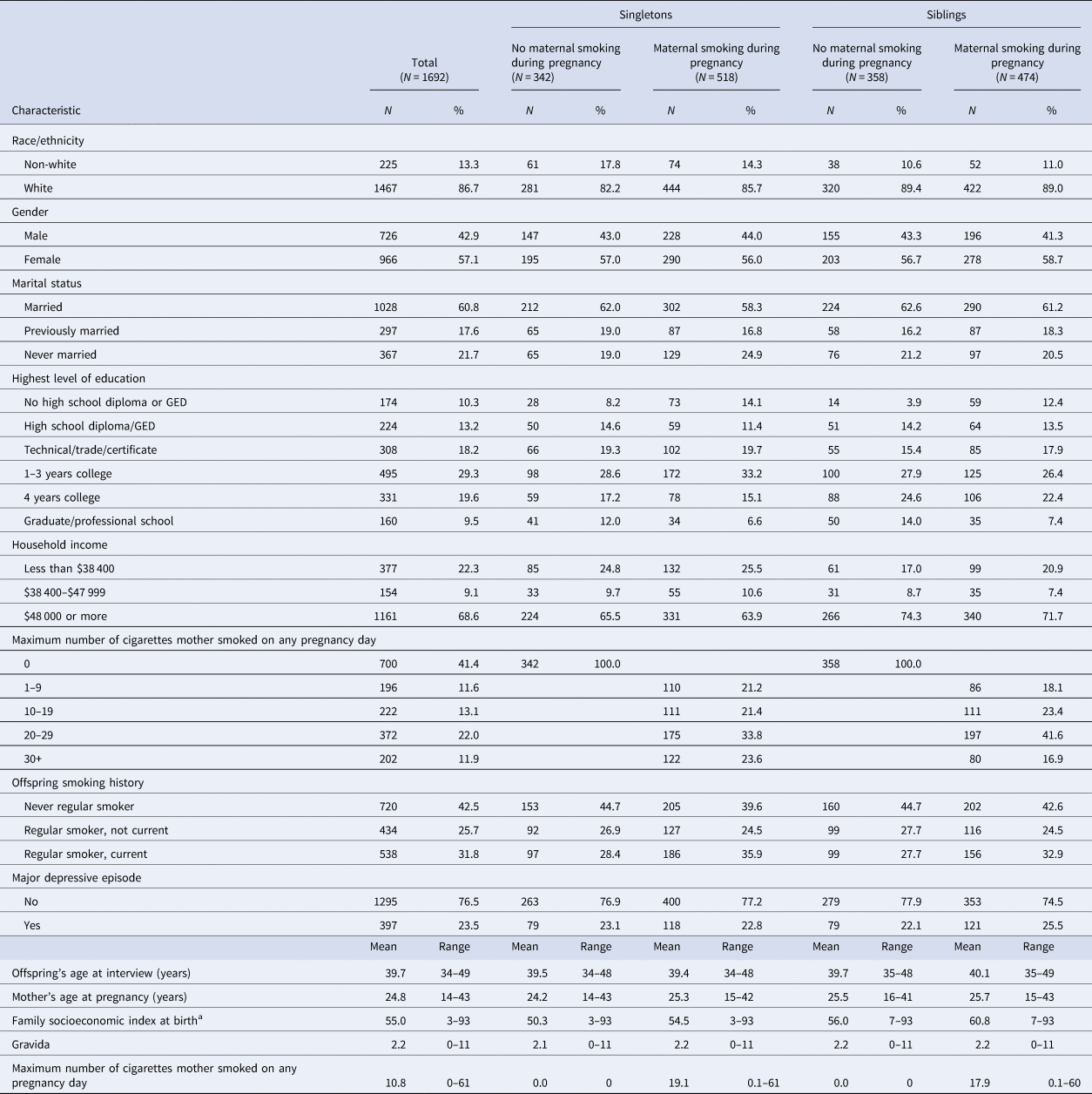
Surviving G2 were enrolled in the New England Family Study between 2001 and 2010, a follow-up study in which participants were selected using a multistage sampling procedure (see the online Supplementary Appendix for details). Of the G2s enrolled in the New England Family Study, 85 respondents were excluded due to missing values for depression or smoking (maternal or offspring), one sibling of each of 12 twin pairs was randomly selected for exclusion, 45 participants who had begun smoking regularly after diagnosis of depression were excluded to reduce the risk of collider bias and 49 were excluded due to interview issues. The final analytic sample included 1692 G2 participants (Table 1) distributed across 1253 families, composed of 860 singletons, 350 sibling pairs, 40 trios (120 dyads), and three quartets (18 dyads). Among these 488 sibling dyads, 184 dyads were discordant for MSP, 174 for MDE, and 79 for both MSP and MDE.
Measures
At each prenatal visit throughout pregnancy, G1 mothers reported whether they were currently smoking and, if so, the number of cigarettes smoked daily. The number of visits varied by pregnancy. From these reports, we determined the maximum number of cigarettes smoked per day at any time during each pregnancy. As in our prior research (Shenassa et al., Reference Shenassa, Papandonatos, Rogers and Buka2015), MSP was re-expressed in terms of maximum cigarette packs per day, leading to more meaningful effect size measures. A prior analysis of these data demonstrated agreement (κ = 0.83) between serum cotinine and maternal reports providing biochemical validation (Klebanoff, Levine, Clemens, DerSimonian, & Wilkins, Reference Klebanoff, Levine, Clemens, DerSimonian and Wilkins1998). At study enrollment, mothers provided information on age, gravida, race/ethnicity, and socioeconomic indicators. For socioeconomic status (SES), participants were assigned percentile ranks derived from 1960 US Census data for education and occupation of the head of household and household income (Myrianthopoulos & French, Reference Myrianthopoulos and French1968). The mean percentile was used as a composite SES index (range = 0–100).
Offspring smoking histories were obtained by the Life Interview of Smoking Trajectories Questionnaire, an instrument with excellent reliability (κ = 0.78–0.92) (Colby et al., Reference Colby, Clark, Rogers, Ramsey, Graham, Boergers and Abrams2012). This instrument obtains detailed information on participants' smoking history. Participants were asked, ‘Did you ever become a weekly smoker (that is, smoke at least once per week for two months or longer)?’ and for those who had, ‘How many days per week (on average) do you CURRENTLY smoke cigarettes?’ Respondents were categorized as never regular smokers (i.e. never became a weekly smoker), current smokers (i.e. currently smoke one or more days per week), or former regular smokers (i.e. currently smoke zero days per week).
The full depression module of the Composite International Diagnostic Interview (CIDI) was used to diagnose lifetime episode of depression according to the Diagnostic and Statistical Manual, Fourth Edition (DSM-IV) criteria (American Psychiatric Association, 2000). The CIDI is a validated structured interview (Haro et al., Reference Haro, Arbabzadeh-Bouchez, Brugha, de Girolamo, Guyer, Jin and Kessler2006) and it was administered by trained interviewers. A DSM-IV diagnosis of major depressive episode (MDE) requires the endorsement of five or more of the following symptoms concurrently for at least 2 weeks: depressed mood, loss of interest or pleasure, weight or appetite changes, sleep disturbance, psychomotor changes, guilt, fatigue, trouble thinking or concentrating, and suicidality. One of the endorsed symptoms must be either depressed mood or loss of interest or pleasure.
Childhood adversity was based upon an index derived by summing the following 10 measures of adverse events (Gilman, Kawachi, Fitzmaurice, & Buka, Reference Gilman, Kawachi, Fitzmaurice and Buka2003): parental marital changes (0 = 0, 1 = 0.5, 2 + = 1), major shift in environment (0 = 0, 1 + = 1), moves (0 = 0, 1 = 0.5, 2 + = 1), parental unemployment at age 7, sibling death (0 = 0, 1 + = 1), household crowding (<1 = 0, 1–1.5 = 0.5, >1.5 = 1), living with a single mother at age 7, living in poverty at age 7 (1.5 × FPL = 0, <1.5 × FPL = 0.5, <1 × FPL = 1), parental occupation at age 7 (non-manual = 0, manual = 0.5, unemployed = 1), and decline in the family's financial situation between birth and age 7. Fifty-five G2s had missing data for all 10 components of the index.
For each G2, the following demographic information was collected at the mean age of 40 (range: 34–49): age, gender, current legal marital status (never married, previously married, currently married), education (no high school diploma/GED, high school diploma, technical/trade/certificate, 1–3 years college, 4 years college, graduate/professional school), and annual household income (<$38 400, $38 400–$47 000, ⩾$48 000).
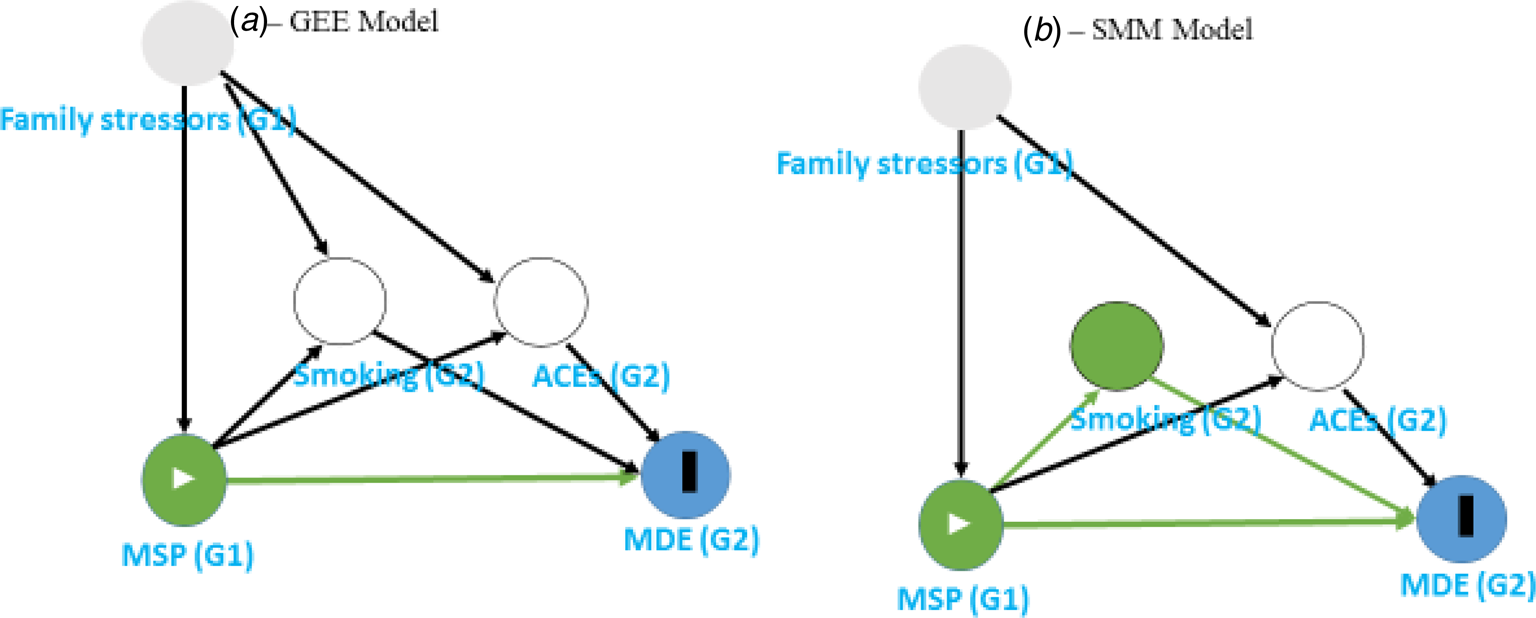
We distinguish between (1) factors that potentially confound MSP and MDE and (2) factors that potentially confound offspring smoking and MDE (Fig. 1). The measured confounder between MSP, offspring smoking, and MDE is gravida. Measured factors that potentially confound offspring smoking and MDE include age, gender, marital status, education, and household income.
Directed acyclic graphs for maternal smoking during pregnancy (MSP G1) causing offspring major depressive disorder (MDE G2). (a) GEE model, offspring regular smoking treated as a confounder. (b) SMM model, offspring regular smoking treated as a mediator.

Statistical analysis
We estimated risk ratios (RR) and associated confidence intervals (CI) by fitting log-binomial regression models using PROC GENMOD (link = log) (Robbins, Chao, & Fonseca, Reference Robbins, Chao and Fonseca2002). Robust standard errors based on a working exchangeable correlation matrix were used to correct for dependence in the risk of depression across multiple pregnancies of the same mother using GEE methodology. Capitalizing on the study's sibling design, we fit decomposition models – for a detailed application, see Shenassa et al. (Reference Shenassa, Papandonatos, Rogers and Buka2015). Briefly, we present four coefficients: the between-pair (RRB) and the within-pair effects (RRW) from the decomposition model, the heterogeneity test statistic for the ratio of these two coefficients (RRR = RRB/RRW) and the total effect (RRT) from a model without decomposition. The RRB is considered the contextual effect and is independent of RRW, which is considered the individual effect, the latter representing the effect of a unit change in MSP from one pregnancy to another. The effect of mother-level factors correlated with MSP is absorbed by RRB, and does not bias the RRW estimates. The RRT is the same estimate that would be obtained from a model without decomposition, it implicitly assumes the three effects to be equal (i.e. RRB = RRW = RRT). However, in practice, when this assumption of equality does not hold, $\widehat{{{\rm RR}}}_{\rm T}$ is proportional to a weighted average of $\widehat{{{\rm RR}}}_{\rm B}$
 and $\widehat{{{\rm RR}}}_{\rm W}$
 .
This implicit assumption of equality can be determined by the heterogeneity test statistic (RRR). When RRR is not meaningfully different from the null value of 1, RRT is an unbiased estimate of the association between exposure and outcome. In contrast, when RRR indicates that RRB and RRW are heterogeneous, then the interpretation of the model must focus on the two separate effects. Finally, to the extent that variation in family size is uninformative about outcome, inclusion of singletons is desirable, in that it improves the precision of the between-sibling estimates without biasing the model intercept.
When inference is based upon within-pair comparisons, there is no need to explicitly control for shared mother-level confounders (e.g. history of psychiatric problems). Given that this is not the case for non-shared confounders that vary across pregnancies, we adjusted models for offspring (i.e. gender, birth order, age) and maternal (i.e. marital status, education, household income) confounders. We further controlled for non-shared confounders by including offspring-level variables for smoking experiences of childhood adversity.
We tested the linearity of MSP effects across the range of observed MSP levels by fitting separate quadratic models for MSP levels across pregnancies of the same mother and the between-pair deviations. Finally, we refitted models with an analytic sample that included the 45 respondents who were excluded from the main analysis because they reported to have begun regular smoking after the onset of depression.
To consider the possibility that offspring smoking mediates the effect of MSP on MDE (Fig. 1), we fit a marginal structural model to estimate controlled direct effect of MSP (measured in packs/day) on MDE that was not mediated by offspring smoking behavior after accounting for potential measured confounder of MSP and MDE (i.e. gravida) and measured potential confounders of offspring smoking and MDE (i.e. age, gender, marital status, education, and household income). We fit a weighted logistic regression and accounted for potential confounding by measured covariates with two stabilized inverse-probability weights, one for measured confounding of the relation between MSP and depression and the other accounting for measured confounding of the relation between offspring smoking and depression. The RR from the adjusted weighted model is an estimate of the direct effect of MSP not mediated by offspring smoking provided that the two sets of measured confounders are sufficient enough to control for (1) confounding between MSP and depression and (2) confounding between offspring smoking and depression (Nandi, Glymour, Kawachi, & VanderWeele, Reference Nandi, Glymour, Kawachi and VanderWeele2012). The mediation model was also fit as a decomposition model yielding the four RR described above. Analyses were conducted using SAS/STAT V9.4.
We also calculated E values to evaluate the likelihood that our findings could be explained away by unmeasured confounding. An E value is the minimum magnitude of an unmeasured confounder that would render an observed association null (VanderWeele & Ding, Reference VanderWeele and Ding2017).
Ethical statement
All procedures contributing to this work comply with the ethical standards of the relevant national and institutional committees on human experimentation.
Results
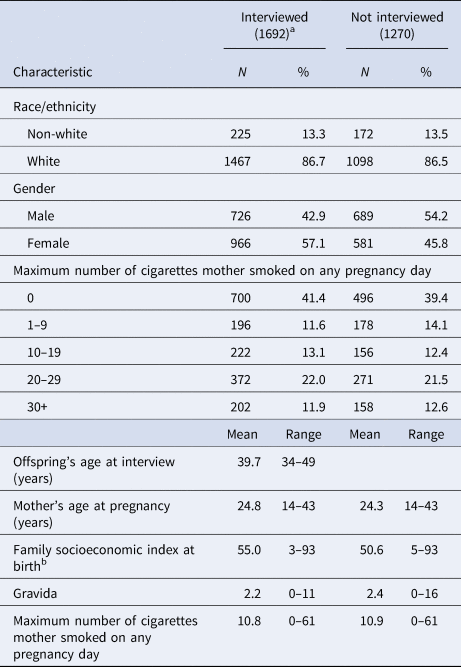
There were few differences between the 1692 G2 included in the current analyses, and the 1270 considered for inclusion in the New England Family Study that were ultimately determined to be ineligible (Table 2). Most notably, female G2s were over-represented in the analytic sample (57.1%) compared with those not interviewed (45.8%). Included G2s were of slightly higher SES than those excluded (mean = 55.0 v. 50.6). However, there were no meaningful differences in the levels of MSP. Prevalence of MDE among G2s was 22.6% among those unexposed to MSP and 24.1% among the exposed (Table 3).
Demographic and smoking characteristics of offspring in the Boston and Providence cohorts of the Collaborative Perinatal Project (N = 3153 screened)

a Data from 191 interviewed G2s were not included in these analyses: 49 were excluded due to interview administration issues, 73 were excluded due to missing data on maternal or offspring smoking or MDE diagnosis, 12 were excluded due to missing on other covariates, and 45 were excluded due to reporting age of regular smoking onset occurring after a diagnosis of depression. Finally, one sibling of 12 twin pairs was randomly selected for inclusion, resulting in a final analytic sample of N = 1692.
b A composite index of socioeconomic status was calculated on the basis of methods developed by the US Census Bureau (possible range = 0–100).
Characteristics of G2 offspring included in the analytic sample according to maternal smoking during pregnancy, stratified by singletons v. siblings (N = 1692)

a A composite index of socioeconomic status was calculated on the basis of methods developed by the US Census Bureau (possible range = 0–100).
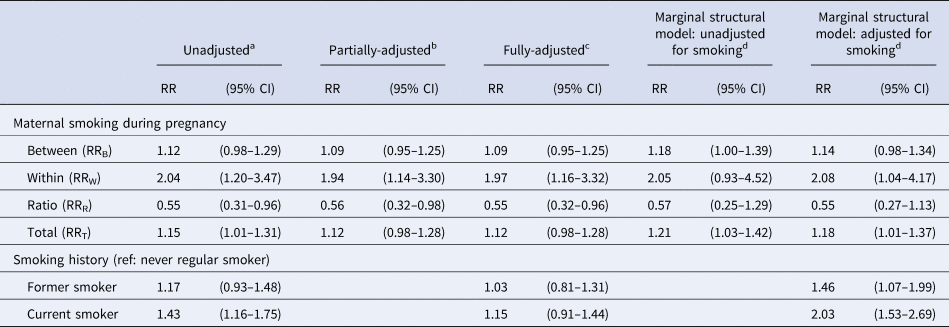
The first three panels of Table 4 present the results of three GEE binomial regression models predicting the risk of lifetime MDE in relation to a single pack increase in MSP. The elevated risk of depression associated with MSP in the unadjusted model (RRT = 1.15, CI 1.01–1.31) is reduced only slightly after controlling for gravida, age, gender, marital status, education, and household income (RRT = 1.12, CI 0.98–1.28) and further addition of offspring smoking in the fully adjusted model had no practical influence on the estimated effect of MSP (RRT = 1.12, CI 0.98–1.28). However, in each of the three GEE models, the range of values of the CI for RRR suggest that RRB and RRW are sufficiently heterogeneous that the interpretation of the models is best focused on the two separate effects. The within-pair (RRW) effect of a single pack increase in maternal smoking from one pregnancy, in the unadjusted (RRB = 2.04, CI 1.20–3.47), partially adjusted (RRW = 1.94, CI 1.14–3.30), and fully adjusted models (RRW = 1.97, CI 1.16–3.32) are similarly consistent with similarly wide and overlapping CI. The between-pair effect for the unadjusted model (RRB = 1.12, CI 0.98–1.29) is not meaningfully different from the estimates from partially adjusted (RRB = 1.09, CI 0.95–1.25) and fully adjusted (RRB = 1.09, CI 0.95–1.25) models, with stable estimate and CI that included the null value but suggest a modest elevation in risk. The E value for this effect (E value RRW 3.35, CI 1.59–6.10) shows the minimum strength of an unmeasured confounder that would have rendered this effect null.
Binomial regression models predicting relative risk of major depressive episode for offspring in the Boston and Providence cohorts of the Collaborative Perinatal Project (N = 1692)

a Models include only the indicated variable.
b Model includes gravida, age, gender, marital status, education, and household income.
c Model includes gravida, age, gender, marital status, education, household income, and smoking history.
d Potential confounding by gravida, age, gender, marital status, education, and household income accounted for by stabilized inverse probability weights.
We tested the linearity of MSP effects across the range of observed MSP levels by fitting separate quadratic models for the between- and within-pair mean MSP levels and deviations across pregnancies. Neither quadratic effect attained significance at the 5% level. Furthermore, we refit the models with the 45 respondents who were excluded from the main analysis because they had begun regular smoking after the onset of depression. Inclusion of these respondents did not alter the results by more than hundredths of a decimal place.
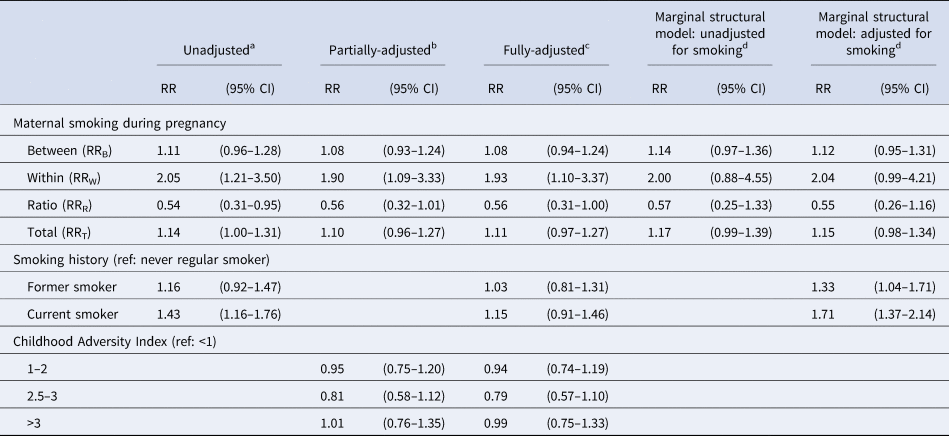
Results of the mediation analysis based on MSM models appear in the fourth and fifth panels of Table 4. The RRR from these models indicates that the between- and within-pair effects are homogenous; and therefore, RRT is an unbiased estimate of the association between MSP and offspring's risk of depression. The unadjusted estimate indicates the existence of a modest controlled direct effect of MSP on MDE (RRT = 1.21, CI 1.03–1.42). Once the mediating effect of offspring's smoking status is accounted for, the controlled direct effect of MSP on offspring's risk of depression remains practically the same (RRT = 1.18, CI 1.01–1.37). The E value for this effect is 1.64 (CI 1.01–2.08). Controlling for the confounding effect of adverse childhood experiences (Table 5) yields results that are qualitatively similar and support the existence of a modest controlled direct effect of MSP on offspring's risk of depression (RRT = 1.15, CI 0.98–1.34).
Binomial regression models predicting relative risk of major depressive episode for offspring in the Boston and Providence cohorts of the Collaborative Perinatal Project, additionally adjusting for childhood adversity (N = 1637)

a Models include only the indicated variable.
b Model includes gravida, age, gender, marital status, education, household income, and childhood adversity.
c Model includes gravida, age, gender, marital status, education, household income, childhood adversity, and smoking history.
d Potential confounding by gravida, age, gender, marital status, education, household income, and childhood adversity accounted for by stabilized inverse probability weights.
Discussion
A biologically plausible association between MSP and offspring's risk of depression (Balfour & Ridley, Reference Balfour and Ridley2000; Slotkin et al., Reference Slotkin, Pinkerton, Tate and Seidler2006, Reference Slotkin, Skavicus, Levin and Seidler2015) has been observed among several birth cohorts (Ekblad et al., Reference Ekblad, Gissler, Lehtonen and Korkeila2010; Fergusson et al., Reference Fergusson, Woodward and Horwood1998; Menezes et al., Reference Menezes, Murray, László, Wehrmeister, Hallal, Gonçalves and Barros2013). However, null findings from two sibling studies suggested that the observed association between MSP and depression may be due to confounding by unmeasured family-level factors (Meier et al., Reference Meier, Plessen, Verhulst, Mors, Mortensen, Pedersen and Agerbo2017; Taylor et al., Reference Taylor, Carslake, de Mola, Rydell, Nilsen, Bjørngaard and Munafò2017). While these two studies further establish the importance of controlling for familial and genetic factors and the importance of sibling design for achieving this goal, challenges to valid inference regarding the health effects of MSP remain even when utilizing a sibling study. We addressed some of these challenges by conducting a sibling study of MSP and the risk of depression among adults past the peak age for onset of depression, utilizing prospectively collected and biologically validated measure of MSP. We blocked the confounding effect of unmeasured and unshared family-level stressors by controlling for offspring's smoking and experiences of adversity during childhood. We also examined the potential mediating effects of offspring's smoking on the association between MSP and depression.
Unlike the previous two family studies, we found a modest elevation in the risk of depression among offspring exposed to MSP. Controlling for offspring's smoking history (and experiences of childhood adversity among a smaller sample) yielded similar results, implicating an independent effect of MSP on the risk of depression. We found this effect of MSP to be linear and hold across the entire observed range of MSP in the study sample. In addition, the mediation models revealed a direct effect of MSP on the risk of depression. The contrast between our positive findings and the earlier sibling studies' null findings may be due to several features of the current study. The prospectively collected and biologically validated measure of MSP rendered a more accurate proxy measure of fetal bioavailability of nicotine metabolites than preceding studies. Our parameterization of MSP as a continuous variable better reflected the amount of smoking rather than the act of smoking as was the case in the previous two sibling studies which dichotomized MSP (yes/no). The current study also benefitted from a diagnostic assessment of depression among cohort members who have all passed the peak age for onset of depression. Finally, the E values associated with the effect estimates among this sample suggest it is unlikely that our findings can be entirely due to confounding by unmeasured factors. On the balance, evidence from this study is consistent with the existence of an independent but modest positive association between MSP and elevated risk of depression, an association that is biologically plausible (Balfour & Ridley, Reference Balfour and Ridley2000; Slotkin et al., Reference Slotkin, Pinkerton, Tate and Seidler2006, Reference Slotkin, Skavicus, Levin and Seidler2015).
We also note that prior studies of unrelated individuals have yielded elevated effect estimates which were reduced after controlling for confounding. In these studies, mothers who smoked during pregnancy also had higher rates of other independent risks for offspring depression (Meier et al., Reference Meier, Plessen, Verhulst, Mors, Mortensen, Pedersen and Agerbo2017; Menezes et al., Reference Menezes, Murray, László, Wehrmeister, Hallal, Gonçalves and Barros2013). In the current study, the between-sibling effects were positive but did not reach conventional significance thresholds. Moreover, compared to the within-sibling effect, the between-sibling effect for MSP is smaller in magnitude. While there is a lower prevalence of depression (22.5%) among siblings concordant for MSP and singletons than among discordant siblings (26.9%), it is unlikely that reduced statistical power to estimate the between-sibling effect fully explains the discrepancy in the within- and between-sibling effects.
There are at least two likely explanations for the relatively weaker between-sibling effects. First, our study population was recruited in the early 1960s when smoking was normative across all socioeconomic and demographic groups within the USA. Second, our sample, although socioeconomically heterogeneous, reflects the ethnically homogenous demography of Boston and Providence in the early 1960s. Consequently, contextual effects, such as socioeconomic factors, do not distinguish women who smoked during their pregnancies from women who did not smoke as sharply as they would today and thus do not yield a strong effect over the life-course. For these reasons, our findings should not be interpreted to negate the importance of contextual factors associated with MSP in the development of depressive disorders over the life-course.
We also acknowledge the shortcomings of the current study. We had no measure of maternal exposure to secondhand smoke. However, our validity study revealed excellent agreement (k = 0.83) between serum cotinine and maternal reports of smoking during pregnancy (Klebanoff et al., Reference Klebanoff, Levine, Clemens, DerSimonian and Wilkins1998). Thus, although a number of G2 respondents classified as unexposed to MSP based on their maternal smoking history may have been in fact exposed to cigarette smoke through maternal exposure to secondhand smoke, any such unreported exposure has not resulted in significant misclassification. Furthermore, secondhand smoke and MSP activate the same biologic pathways. Consequently, confounding by unmeasured exposure to secondhand smoke is not a serious threat to the validity of our findings. Second, low within-mother variation in maternal smoking across pregnancies did not allow us to assess a dose–response association between MSP and offspring's risk of depression. The limited number of discordant pairs led to some imprecision of within-sibling effects and prevented us from examining gender differences. Third, our analytic sample includes only ~10% of the original CPP participants. However, because we found no statistically significant difference in MSP between our analytic sample and the original CPP cohort, differential loss to follow-up as a source of bias may be discounted (online Supplementary Appendix 1). Finally, it is possible that the consequences of MSP are biologically inert in regards to the risk of depression other than through interactions with other biological or social processes (McEwen & Akil, Reference McEwen and Akil2020; Shenassa, Wen, & Braid, Reference Shenassa, Wen and Braid2016). Our models did not account for such interactions. A potential for bias in the within-sibling estimates remains (Zetterqvist, Vansteelandt, Pawitan, & Sjolander, Reference Zetterqvist, Vansteelandt, Pawitan and Sjolander2016).
In conclusion, our study which was designed to discount the role of shared genetic and social vulnerabilities to depression supports a modest independent association between MSP and offspring's lifetime risk of depression. Our findings do not negate earlier studies of MSP and depression. Furthermore, to the extent that biological pathways between MSP and various outcomes are distinct from one another and some remain to be fully illustrated, our findings are of limited generalizability to outcomes other than depression. A final verdict on the causal effects of MSP on health during adulthood in general, and on depression in particular, awaits further evidence. Our findings suggest that a future verdict will be more compelling should it be informed by clear evidence of biologic plausibility, and consideration of issues related to the measurement and parameterization of MSP, which among humans, is only a proxy for the biologically relevant exposure.
Supplementary material
The supplementary material for this article can be found at https://doi.org/10.1017/S0033291721001392
Acknowledgements
We are grateful for comments by two anaonymous reviewers and by Drs. Kari Klungsoyr and Liv Grimstvedt Kvalvik on an early version of this work presented at the University of Bergen, Norway.
Financial support
This work was supported by the National Institute on Aging [R01 AG 023397-02]; a Transdisciplinary Tobacco Use Research Center grant from the National Institutes of Health [P50 CA084719].
Conflict of interest
None.