Introduction
A significant pest of agriculture, the silverleaf whitefly (SLW) Bemisia tabaci biotype B (Gennadius, also known as Bemisia argentifolii), was first detected in Australia in late 1994 (Gunning et al., Reference Gunning, Byrne, Conde, Connelly, Hergstrom and Devonshire1995); it is likely to have first entered the country some time between mid-1992 and mid-1993. Since its arrival in northern New South Wales, it spread through the wholesale commercial ornamental nursery network to Queensland and Northern Territory and from there to the retail nurseries across Australia. Over the past 13 years, it has become an economic problem primarily in Queensland and, to a lesser extent, in coastal northern New South Wales, Northern Territory and Carnarvon in Western Australia. Crops most frequently affected include Brassicaceae, Cucurbitaceae, Solanaceae and Fabaceae vegetables, especially melons, cotton and soybean, as well as commercial ornamental species. Losses occur as a result of reduced yield and reductions in quality as a consequence of physiological changes in colour, loss of even maturation and contamination with honeydew and sooty mould. At present, begomoviruses have yet to cause any serious concerns.
Goolsby et al. (Reference Goolsby, De Barro, Kirk, Sutherst, Canas, Ciomperlik, Ellsworth, Gould, Hartley, Hoelmer, Naranjo, Rose, Roltsch, Ruiz, Pickett and Vacek2005) undertook a review of the USDA biological control program in terms of which of the released species had established in the southwestern USA with a view to identifying potential candidates for introduction into Australia. The USDA program released a total of seven species of Encarsia and five species of Eretmocerus, of which all species of Eretmocerus and one species of Encarsia established (Goolsby et al., Reference Goolsby, De Barro, Kirk, Sutherst, Canas, Ciomperlik, Ellsworth, Gould, Hartley, Hoelmer, Naranjo, Rose, Roltsch, Ruiz, Pickett and Vacek2005). The study used the climate-matching software CLIMEX to produce an index of suitability between the climates of the locations of origin for each of the established Eretmocerus species with climates in each of the four areas in the southwestern USA where releases took place. The resultant index was then used to rank the species. CLIMEX was then used to compare the regions in the USA where the releases took place to Australia. The Lower Rio Grande Valley was identified as having a climate that was most similar to those parts of Australia most affected by the invasion of SLW. Based on the CLIMEX indices and observations on establishment, Eretmocerus hayati Zolnerowich and Rose (Hymenoptera: Aphelinidae) was selected as the only candidate species for introduction.
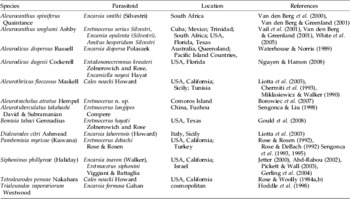
Biological control of whiteflies has had a long history with numerous examples of success (table 1). While most of the examples involve perennial cropping systems, some success has been achieved against whitefly pests of annual crops. This study considers the case for introduction and the results from the first 3.3 years since releases of Er. hayati began and compares them to the period prior to release.
Examples of successful biological control introductions against different species of Aleyrodidae.

Materials and methods
Host specificity testing
The process of importation, evaluation and release of Er. hayati was undertaken in accordance with the requirements under Australian legislation governing the importation and release of exotic biological control agents.
Culturing of E. hayati
Eretmocerus hayati was imported into quarantine at the CSIRO Long Pocket Laboratories, Indooroopilly during September and October 2002 as parasitised mummies of B. tabaci (biotype B) from the Lower Rio Grande Valley, Texas, USA. Parasitoids were identified as E. hayati following Zolnerowich & Rose (Reference Zolnerowich and Rose1998) and comparison of ribosomal ITS1 with material previously obtained and identified at USDA-APHIS Mission, Texas. Cultures of E. hayati were maintained in 3.5-l plastic containers on Hibiscus rosa-sinensis L. var Mrs George Davis ‘plants’ (two ‘plants’ per container). Each ‘plant’ consisted of a single stem and leaf rooted in agar in a 45-ml plastic tube. Each plant had previously been infested with B. tabaci (biotype B) eggs to achieve a density of 20–30 nymphs cm−2. Following egg hatch, the first instars were allowed to settle before parasitoids were added to the cage. The first and second instars are the preferred stages for oviposition by Eretmocerus parasitising B. tabaci (Jones & Greenberg, Reference Jones and Greenberg1998). Parasitism of B. tabaci by E. hayati typically averaged 80–98%.
Culturing of non-target test species
Sustained cultures of each of the test species were maintained under glasshouse conditions on appropriate host plants (potted) (see table 2) and held in mesh screened cages. All whitefly cultures were initiated from field-collected adults. Species identifications were made using morphological characters of 4th instar nymphs following Martin (Reference Martin1999). Voucher material for each test species are held at the ANIC as both slide-mounted and alcohol-preserved nymphs.
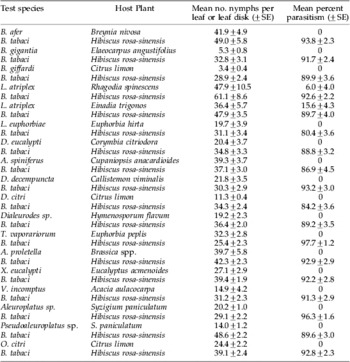
Results of no-choice host specificity tests for Eretmocerus hayati against selected Australian native or exotic whitefly species and Bemisia tabaci.

No-choice experiments
Eretmocerus hayati was assessed for non-target attack using no-choice experiments. All Er. hayati adults were naïve (no prior egg lay) and had been cultured as above. For each test, single age cohorts of settled 1st–2nd instar nymphs of a given non-target species and B. tabaci were exposed separately to Er. hayati adults (n=30 females for each replicate). Nine replicates of the non-target species/host plant combination and nine replicates of B. tabaci (biotype B) on hibiscus were used in each pair test. Parasitoids were 2–3 days post emergence, with females having been held with males to enable mating. In each experiment, parasitoids remained with the test species for the duration of their (parasitoids) lifespan. All tests were carried out in mesh-screened cages. Parasitism rates were assessed by recording either numbers of parasitised nymphs per leaf for small leaved (⩽3 cm in length) host plants or as the number parasitised per 2.27 cm2 leaf disk for plants with leaves longer than 3 cm in length. Development of Er. hayati could be discerned directly through the host cuticle for pale-bodied nymphs. For whitefly species with dark-bodied nymphs, nymphs were allowed to develop either to emergence of the adult whitefly or the adult parasitoid. All observations were made using a stereo dissecting microscope.
Analysis of ribosomal 18s
The 3′ end of the ribosomal DNA 18s gene (Campbell et al., Reference Campbell, Steffen-Campbell, Gill, Gerling and Mayer1996) was used to determine the genetic relatedness of B. tabaci (biotype B) to the non-target species chosen for testing for host specificity testing. A 762–782 bp fragment was obtained using the primers 18sF 5′GACTCAACACGGGAAACCTC3′, 18sR 5′TCCTTCCGCAGGTTCACC3′ and the protocol of Campbell et al. (Reference Campbell, Steffen-Campbell and Gill1994).
A total of four outgroup species from the Aleyrodidae subfamily Aleurodicinae, Aleurodicus destructor Mackie, A. dugesii Cockerell, Lecanoideus floccissimus Martin and Paraleyrodes bondari Peracchi were used to root the analysis. The species Aleurocanthus spiniferus (Quaintance), Aleuroplatus n. sp. (ex Syzygium paniculatum, Brisbane, Indooroopilly) Aleyrodes proletella (L), Bemisia afer (Priesner & Hosny), B. decipiens (Maskell), B. giffardi (Kotinsky), B. gigantea Martin, Lipaleyrodes atriplex (Froggatt), L. euphorbiae David & Subramaniam, Dialeurodes citri (Ashmead), Dialeurodes n. sp. (ex Hymenosporum flavum, Brisbane, Brookfield), Dialeuropora decempuncta (Quaintance & Baker), Dumbletoniella eucalypti (Dumbleton), Orchamoplatus citri (Takahashi), Pseudaleuroplatus n. sp. (ex Syzigium paniculatum, Brisbane, Indooroopilly), Trialeurodes vaporariorum (Westwood), Viennotaleyrodes incomptus Martin and Xenaleyrodes eucalypti (Dumbleton) formed the ingroup. Species were chosen for host specificity testing based on the information in Martin (Reference Martin1999). Two species of Bemisia, B. decipiens and B. subdecipiens Martin, were not found during the time of testing; however, subsequent to the release of Er. hayati, B. decipiens was collected.
The ingroup and outgroup sequences were aligned using clustal w (Thompson et al., Reference Thompson, Higgins and Gibson1994) and required no adjustment by hand. Evolutionary trees were estimated using the distance method with the Kimura 2 parameter model. Analyses incorporating 1000 bootstrap replicates were undertaken using Phylip (Felsenstein, Reference Felsenstein1993).
Pre-release surveys
Surveys to determine the level of apparent parasitism of B. tabaci by Hymenoptera already established in Australia were undertaken between 1995 and 1999. The different parasitoids, all members of the genera Encarsia and Eretmocerus (Hymenoptera: Aphelinidae), found in Australia have been described in De Barro et al. (Reference De Barro, Driver, Naumann, Clarke, Schmidt and Curran2000a) and Schmidt et al. (Reference Schmidt, Naumann and De Barro2001). A total of 2974 collections were made, 1228 from infestations of B and 1746 from AN. At the time of the surveys, both B (Mediterranean/Africa/Asia Minor genetic group) and the indigenous Australia genetic group (AN) co-occurred (genetic groups based on Boykin et al. (Reference Boykin, Shatters, Rosell, McKenzie, Bagnall, De Barro and Frohlich2007) ). For each sample, RAPD-PCR was used to determine which genetic group the B. tabaci belonged to (De Barro & Driver, Reference De Barro and Driver1997). Co-infestations of both genetic groups that persist are uncommon, as B displaces individuals from the indigenous group (Liu et al., Reference Liu, De Barro, Xu, Luan, Zang, Ruan and Wan2007), and any samples where co-infestations occurred were excluded from this study as it is not possible to determine the genetic group of parasitised 4th instars.
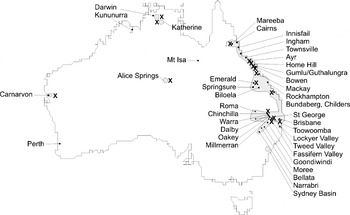
The area covered by the surveys is shown in fig. 1. Leaves infested with 4th instars were collected from Atriplex rhagodioides, Convolvulus arvensis, Cucumis melo (cantalupensis & inodorus), Citrullus lanatus, Datura sp., Emilia sonchifolia, Euphorbia cyathophora, E. pulcherrima, Gossypium hirsutum, Helianthus annuus, Hibiscus rosa-sinensis, Lactuca seriola, Lantana camara, Lycopersicum esculentum, Malva parviflora, Malvastrum coromandellum, Sida cordifolia and Sonchus oleraceus. Numbers of leaves collected varied and ranged from 20 to 100 and were based on the numbers of whitefly-infested leaves collected from plants at a given location in 15 min. The leaves were collected from the part of the plant where a preliminary assessment identified the presence of 4th instars. Throughout the study, only the 4th instar was assessed for parasitism as visual detection of parasitism in younger instars is unreliable and these individuals seldom survive on the collected leaves sufficiently long to enable the parasitoid to complete development. Nymphs were counted within 2.2-cm diameter (3.8 cm2) leaf discs. In the 4th instar, the shape of the parasitoid larva can be clearly seen through the integument as can the presence of meconium pellets in Encarsia; nymphs were determined as being parasitised or unparasitised with the aid of a stereo dissecting microscope. If parasitised, the parasitoid larvae were identified to genus on the basis of its shape and the presence of meconium. The leaves were then placed in emergence chambers until all the parasitoids had emerged. Parasitoids were identified to species using the descriptions in De Barro et al. (Reference De Barro, Driver, Naumann, Clarke, Schmidt and Curran2000a) and Schmidt et al. (Reference Schmidt, Naumann and De Barro2001). Mean parasitism per collection was calculated by dividing the number of 4th instars present by the number that was parasitised.
Map showing location of pre-release surveys, release sites and the area where establishment has been confirmed through post-release surveys (•, pre-release surveys; ×, releases;  , establishment confirmed).

Post-release surveys
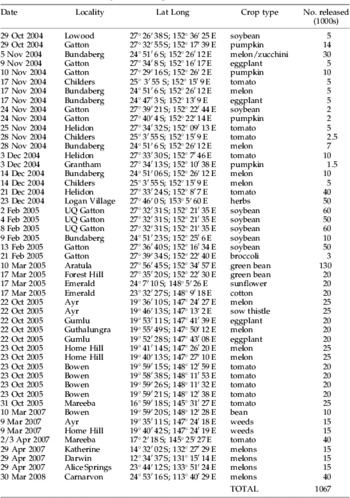
A total of approximately 637,000 Er. hayati were released between October 2004 and March 2005 in the Bundaberg-Childers, Lockyer Valley and Emerald production areas; 390,000 between July 2005 and April 2007 in Alice Springs, Ayr, Bowen, Darwin, Gumlu, Guthalungra, Home Hill, Katherine and Mareeba; and 40,000 on 30 March 2008 in Carnarvon (fig. 1, table 3). By the time the releases of Er. hayati commenced, the indigenous genetic group of B. tabaci (biotype AN) had been displaced from across much of the range of the invader (Liu et al., Reference Liu, De Barro, Xu, Luan, Zang, Ruan and Wan2007), and all B. tabaci collected were assumed to belong to B. A total of 722 collections were made between November 2004 and March 2008. Collections were made primarily from commercial crops of Phaseolus vulgaris, Brassica oleracea (broccoli, cabbage, cauliflower), Gossypium hirsutum, Cucumis sativus, Solanum melongena, Dolichos lablab, Solanum tuberosum, Ipomea batatas, Lycopersicum esculentum, Cucumis melo (cantalupensis & inodorus), Citrullus lanatus, Cucurbita maxima, Cucurbita moschata, Glycine max, the ornamentals Duranta repens, E. pulcherrima, Gerbera sp. and Hibiscus rosa-sinensis and the weeds Sonchus oleraceus, Emilia sonchifolia and Lantana camara. Leaves were collected and assessed as in the pre-release surveys.
A total of 1,067,000 Er. hayati were released between 29 October 2004 and 30 March 2008. The numbers of releases at any location ranged from 1500 to 130,000 individuals.

Bundaberg 1997–2006
The survey data for the Bundaberg production area spans the period prior to the first outbreaks of B. tabaci (biotype B) through to the post-release evaluation period. It provides a good opportunity to compare the changes in whitefly density and parasitism. A total of 372 collections were made prior to the release of Er. hayati and 151 post-release. Collections consisted of 20–100 leaves and followed the protocol outlined above.
Statistical analysis
The results are presented as means±standard error, and all percentage data were arcsine transformed before analysis. Pre-release data were analysed using two sample t-tests, as were the host specificity testing data. The data for the Bundaberg 1997–2006 surveys were analysed using ANOVA, and significant differences between means were identified using LSD.
Results
Host specificity testing
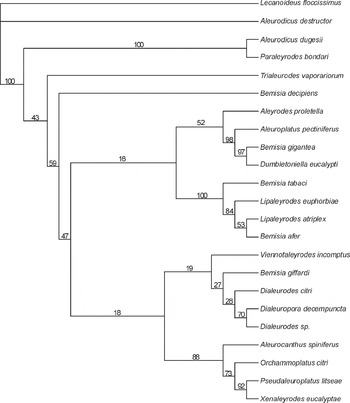
Analysis of rDNA 18s revealed that the genus Bemisia was paraphyletic with two species of Lipaleyrodes falling within the group containing both B. tabaci and B. afer, indicating that they are likely to be congeneric and more closely related to the target B. tabaci than any other of the species tested (fig. 2). In no-choice experiments, E. hayati consistently parasitised 80–98% of B. tabaci (biotype B) nymphs (table 2). Only one non-target species (Lipaleyrodes atriplex) supported development of E. hayati. Parasitisim of L. atriplex averaged 5.9% on Rhagodia spinescens and 15.6% on Einadia trigonos; and, in both cases, parasitism was significantly less (two-sample t-test: t=12.72, P<0.001) than that observed for B. tabaci. All parasitoids successfully emerged from L. atriplex on R. spinescens. However, parasitoid adults emerging from L. atriplex on E. trigonos became immobilized in the waxy coating of the parasitised nymph. Adult parasitoids were observed to groom their body repeatedly, resulting in additional wax particles accumulating on their legs, wings and antennae. All adults eventually died either on the leaf surface or fell to the cage floor and died. None of the other species tested supported the development of E. hayati. Whether eggs were laid or whether larvae failed to penetrate the nymphs is not known.
Neighbour-joining phylogram inferred from a 762 to 782 bp portion of the ribosomal 18s gene. The subfamily Aleurodiciane species Aleurodicus destructor, Lecanoideus floccissimus, A. dugesii and Paraleyrodes bondari are outgroups. The remaining species belong to the subfamily Aleurodinae and form the ingroup. These species, with the exception of B. decipiens, were used to assess the host range of Er. hayati in no-choice tests against the target B. tabaci biotype B.

Pre-release surveys 1995–1999
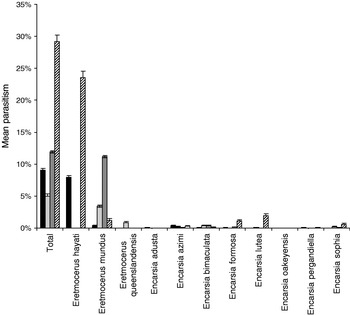
Across all collections made during this period, 9.1±0.3% of 4th instars were observed to be parasitised. Further, 76% of those collections taken from B and 58% from AN infestations had no parasitism (fig. 3). When nymphs were partitioned in regards to their genetic group, there was a 2.4-fold difference in parasitism between B (5.0±0.3%) and AN (12.0±0.2%) (fig. 3; arcsine transformed, t-test: t=12.2, P<0.001). Eretmocerus contributed to 91.5% of the overall observed parasitism, to 83.9% of the parasitism of B and 93.7% of AN. Parasitism by Encarsia was a very minor component of the overall parasitism (fig. 3). In total, eight species contributed 8.5% of the total parasitism, 16.1% for B and 6.3% for AN. Eretmocerus mundus was by far the most abundant species observed (fig. 3), accounting for 87.7% of the total apparent parasitism, 67.3% for B and 93.7% for AN. Eretmocerus queenslandensis contributed 3.8% of the total parasitism and 16.6% for B, but no parasitism of AN was observed. Mean parasitism by Er. mundus on B was 3.4±0.3% and 11.2±0.2% on AN. Further, Er. mundus was represented in 18.1% of the collections.
Percent parasitism for each of the collections made during the pre-release (1995–1999) and post-release (2004–2008) surveys ranked from highest to lowest % parasitism. In the pre-release surveys and post-release, there were 937 and 173 collections, respectively, in which no parasitism was observed (■, pre-release total;  , pre-release B;
 , pre-release AN;
 , post-release).

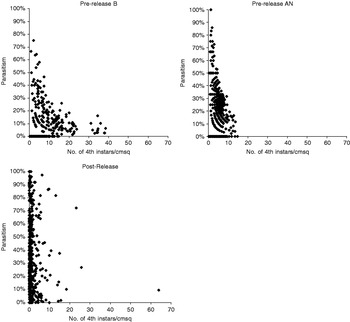
There was a significant difference in the densities of B and AN, with B biotype densities averaging 4.9±0.1 4th instars cm−2 and AN 3.4±0.1 4th instars cm−2; and no AN densities exceeded 15 4th instars cm−2 (t-test: t=11.0, P<0.001), whereas the maximum B densities ranged between 30 and 40 4th instars cm−2. The relationship between the percentage parasitism by Er. mundus and whitefly density for both B and AN is negatively correlated, suggesting a density dependent relationship (fig. 4).
The relationship between percentage parasitism by Er. mundus and B and AN B. tabaci densities and the relationship between percentage parasitism by Er. hayati and the B biotype.

Post-release surveys 2004–2008
There was no relationship between establishment and the number of individuals released as all releases resulted in establishment (table 3). The post-release surveys showed that Er. hayati had spread well beyond the immediate release areas (fig. 1). Mean parasitism across all collections was 29.3±0.1% of 4th instars and 76% of collections had parasitism (fig. 4). Of these, Er. hayati contributed to 23.6±1.0% of the apparent parasitism, or 85.0% of the overall parasitism. Of the collections made, Er. hayati was present in 71.2% while Er. mundus was in 9.8%. Mean parasitism by Er. mundus was 1.2±0.2% and contributed to 5.2% of the apparent parasitism. None of the remaining species contributed to more than 2% of the 4th instars parasitised (fig. 4); of them, E. lutea (Masi) 6.4% and E. formosa 3.7% were the next most commonly observed species. During the sampling period, the average whitefly density was 1.2%±0.2 4th instars cm−2, and there was no density dependent relationship between whitefly density and parasitism by Er. hayati (fig. 4). However, the nymph densities were only a quarter of those observed for B in the pre-release surveys with only three collections exceeding 20 4th instars cm−2.
Bundaberg 1997–2006
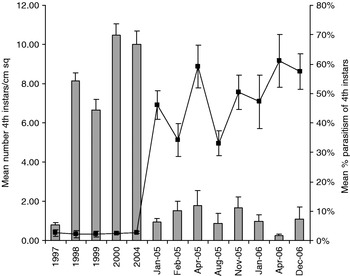
The marked order of magnitude increase in whitefly densities between 1997 and 1998 marks the start of outbreaks in the Bundaberg production area (fig. 5). On 5 November 2004, a total of 30,000 Er. hayati were released in Bundaberg and, by 14 December 2004, a further 27,000 had been released. Prior to the release, levels of parasitism were consistently less than 5% over the period 1997–2000 and again in 2004 just prior to the first release (fig. 5). During the post-release monitoring period, January 2005–December 2006, 152 samples were collected. Over the 24 months following the releases, whitefly densities declined significantly to levels equivalent to that seen in 1997 (fig. 5) (ANOVA, F12,1702=256.3, P<0.001, LSD=4.7). Further, parasitism increased significantly from a maximum average of 2.8±0.3% prior to the first release to a minimum of 33.1±4.2% and an average over the period of 43.7±2.3% (fig. 5) (arcsine transformed, ANOVA, F12,1702=107.5, LSD=18.2). Eretmocerus hayati accounted for 89.9% of the parasitism observed, Er. mundus 3.9%, E. lutea 2.9%, E. formosa 1.5% with E. azimi, E. bimaculata, E. pergandiella and E. sophia contributing 1.8% between them. In addition, only 4.6% of collections recorded no parasitism, whereas between 1997 and 2004 89.2% of the 461 samples from B infestations collected had no parasitism.
The mean number of 4th instar B. tabaci between 1997 and 2006 together with the mean percentage parasitism over the same period. A total of 57,000 Er. hayati were released in Bundaberg between 5 November and 14 December 2004 (, 4th instars/cmsq; -■-, % parasitism).

Host plants and parasitism
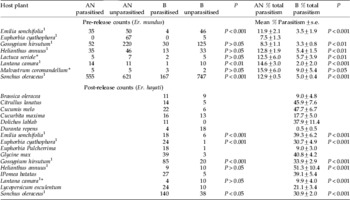
In pre-release surveys, eight host plant species represented >98% of the collections made (table 4). Counts of the number of collections with and without nymphs parasitised by Er. mundus indicated that E. sonchifolia, Eu. cyathophora, L. camara and S. oleraceus all had lower than expected levels of parasitism of B (table 4 for significance values). When the numbers of collections of B for each of these hosts was compared against the same hosts in the post-release surveys, E. sonchifolia, Eu. cyathophora and S. oleraceus all showed an increase in numbers of collections containing Er. hayati parasitised B, while L. camara showed no change (table 4 for significance levels). Further, the collection count for G. hirsutum also increased relative to the pre-release counts while remaining unchanged for H. annuus (table 4). The mean percentage overall parasitism by all sources combined showed significantly more parasitised AN with the exception of Malvastrum coromandellum (table 4). Counts for the numbers of collections with and without B. tabaci parasitised by Er. hayati for a further ten species of host plant, which together with the previous five species made up 87.2% of the post-release collections, are also provided in table 4. All showed more collections with parasitism than without, the exception being D. repens. There was a significant increase in mean parasitism for all host plant species common to both pre- and post-release surveys (table 4).
The pre-release association between host plant and the numbers of collections with parasitism of either B or AN B. tabaci by Er. mundus and the mean percent parasitism from all sources using the eight most commonly collected host plants, which represent 98.2% of collections made during the surveys. The association between counts was analysed using Pearson's Chi Square except for *, where samples sized required Fisher's exact test to be used; means were compared using the t-test. Also, the post-release comparison between host plant and the numbers of collections containing parasitism of B by Er. hayati and mean percent parasitism from all sources in the post-release surveys using the 15 most commonly collected host plants, which represent 87.2% of collections.

Data associated with host plants common to both surveys denoted by 1.
Discussion
A comparison of our pre-release survey data with those from Naranjo (Reference Naranjo2007) supported the conclusion that the pre-release guild of parasitoids in Australia was unlikely to provide the levels of parasitism required to provide useful reductions in whitefly numbers. Further, results from the Lower Rio Grande, Texas, USA (Goolsby et al., Reference Goolsby, De Barro, Kirk, Sutherst, Canas, Ciomperlik, Ellsworth, Gould, Hartley, Hoelmer, Naranjo, Rose, Roltsch, Ruiz, Pickett and Vacek2005; Gould et al., Reference Gould, Hoelmer and Goolsby2008) indicated that the introduction of Er. hayati would contribute to meaningful reductions in SLW abundance by substantially increasing the overall level of parasitism. The no-choice tests demonstrated that Er. hayati had an extremely narrow host range and that the level of non-target attack was considered too low to pose a threat to L. atriplex, and permission to release was granted in September 2004.
In the space of 3.3 years, Er. hayati has spread from 12 release areas along the east coast of Queensland to now covering much of the current distribution of SLW in eastern Australia. There has been a six-fold increase in the average level of parasitism and an overall increase in the frequency of attack, such that 76% of all collections now contain parasitised whitefly whereas previously it was 25%. This suggests that Er. hayati has a superior host-finding capacity when compared with other parasitoids present in Australia. Further, whitefly host plants with either no or reduced levels of parasitism of B prior to the releases showed considerable increases in parasitism, and overall SLW densities have declined by 75% since the releases began. The rapid rate of spread may be due in part to the apparent intrinsic capacity of the parasitoid to disperse widely (N. Schellhorn & P. De Barro, unpublished data), but it is also due to the parasitoid being able to readily parasitise whiteflies infesting commercial ornamental nurseries (P. De Barro, data collected as part of this study). There is certain circularity here, as the same industry which so effectively spread SLW across Australia upon its introduction would now appear to be responsible for spreading its natural enemy.
The majority of parasitism, in the pre- and post-release surveys, was due to Er. mundus in the former and Er. hayati in the latter. Levels of parasitism by Encarsia spp. were only ever a minor contribution and so will not be discussed further. The pre-release surveys showed a marked difference in the levels of parasitism of B and AN with Er. mundus parasitising of a third fewer B. It is important, at this point, to note that while Er. mundus from Australia are morphologically identical to Er. mundus, elsewhere in the world they are genetically distinct (De Barro et al., Reference De Barro, Driver, Naumann, Clarke, Schmidt and Curran2000a) from those in Europe and the USA. Further, Er. mundus has two modes of reproduction, arrhenotoky, where males are produced and thelytoky, where only females are produced. Elsewhere in the world, the arrenokous population is the more common, although there are records of both occurring together in Egypt (Abd-Rabou & Ghahari, Reference Abd-Rabou and Ghahari2005), Iran (Ghahari et al., Reference Ghahari, Huang and Wang2005) and the USA (Powell & Bellows, Reference Powell and Bellows1992). In Australia, the population appears to be entirely thelytokous (De Barro & Hart, Reference De Barro and Hart2001; Ardeh et al., Reference Ardeh, de Jong and van Lenteren2005a,Reference Ardeh, de Jong and van Lenterenb).
There are several possible explanations for the lower level of parasitism in B. Firstly, as indicated earlier, AN and B belong to different genetic groups, and a comparison of mitochondrial CO1 sequences indicates an average divergence of 18% (based on the comparison of sequences used in Boykin et al., Reference Boykin, Shatters, Rosell, McKenzie, Bagnall, De Barro and Frohlich2007). Increasingly, using CO1, species level divergence is associated with levels of divergence ⩽3% (Hebert et al., Reference Hebert, Cywinska, Ball and de Waard2003). The level of divergence suggests that AN has been in Australia for a considerable period of time, and so it is likely that the Australian Er. mundus has had considerable opportunity to co-evolve with AN and may have become physiologically and behaviourally better adapted to AN than B. One difference between B and AN shown by this study is that B forms denser infestations than AN, and so it is possible that the Australian Er. mundus may simply be unable to adapt to the higher population densities of B. De Barro et al. (Reference De Barro, Hart and Morton2000b) also assessed the capacity of Er. mundus to parasitise different densities of B on tomato and rockmelon. They showed no negative effect of density; but, as densities were below six nymphs cm−2, it is not possible to predict the response to the higher densities that were often encountered in our surveys. Further research is, therefore, needed to resolve the role of host density in the performance of the two parasitoids.
Analysis of the post-release survey data showed no evidence for a density-dependent relationship between Er. hayati and B. tabaci. This is unusual as one would normally expect to find such a relationship. The most likely explanation would be that the population, having only recently been introduced, is still in a state of disequilibrium, which is contributing to the lack of evidence for such a relationship.
While physiological differences between AN and B may be contributing to the lower-than-expected levels of parasitism of B, it is more probable that host plant is exerting an effect on the parasitoid, either directly or via the nymph, and this is leading to the reduced parasitism. Three of the most frequently collected hosts, E. sonchifolia, L. camara and S. oleraceus, in the pre-release surveys all showed significantly reduced parasitism of B relative to AN. Of these three hosts, S. oleraceus made up 74% of the collections with only 18% having parasitised nymphs present, an observation which tends to supports the role for a tritrophic interaction leading to reduced parasitism. Such tritrophic interactions are not unexpected in host-parasitoid interactions. Leaf hairs and leaf waxiness have previously been shown to significantly affect parasitism of whiteflies by aphelinids. McAuslane et al. (Reference McAuslane, Simmons and Jackson2000) observed reductions in leaf wax in collards were associated with increased levels of parasitism of B by both Eretmocerus sp. and E. pergandiella. Qui et al. (Reference Qiu, De Barro and Ren2005) demonstrated that performance of Er. sp. nr furuhashii declined as leaf hair density increased. Leaf hairs interfering with movement and host finding and resulting in reduced levels of parasitism have also been shown for E. formosa, Er. eremicus and Er. rui (Li et al., Reference Li, Lammes, van Lenteren, Huisman, van Vianen and de Ponti1987; Headrick et al., Reference Headrick, Bellows and Perring1996a,Reference Headrick, Bellows and Perringb; McAuslane & Nguyen, Reference McAuslane and Nguyen1996). However, E. sonchifolia and S. oleraceus are both glabrous and L. camara is weakly pubescent (http://plantnet.rbgsyd.nsw.gov.au/floraonline.htm). Furthermore, a fourth host from this study, Eu. cyathophora, which is also glabrous, showed no parasitism for Er. mundus and attempts to establish this parasitoid on both AN and B in the laboratory failed (P. De Barro, unpublished data). This suggests that while leaf hairs are responsible for reduced performance in other studies, they do not provide an adequate explanation for our results. In contrast, Er. hayati showed no such inability and readily parasitised B on E. sonchifolia, Eu. cyathophora and S. oleraceus. Further, it markedly increased the frequency of parasitism of B on G. hirsutum. In the post-release surveys, only two hosts, L. camara and D. repens, showed more collections without, than with, parasitism. It would, therefore, appear that part of the success of Er. hayati is its ability to attack B on host plants that Er. mundus was less able to utilize.
Plant community structure can have a significant influence on herbivore and parasitoid population dynamics. Goolsby et al. (Reference Goolsby, Legaspi and Legaspi1996, Reference Goolsby, Ciomperlik, Legaspi, Legaspi and Wendel1998) have shown that parasitism by Er. hayati varies considerably across difference host plant species. Plant characteristics, such as shape, colour and structure, and other plant cues affect the capacity for parasitoids to search plant communities for infested plants and influence the time taken to find prey (Waage, Reference Waage1979; Gingras et al., Reference Gingras, Dutilleul and Boivin2002; Vos & Hemerik, Reference Vos and Hemerik2003; Wang & Keller, Reference Wang and Keller2004; Tentelier et al., Reference Tentelier, Wajnberg and Fauvergue2005). Factors such as these also influence the distribution of parasitoid attacks and can lead to the creation of enemy-free space for hosts on less attractive plants (Bukovinszky et al., Reference Bukovinszky, Gols, Hemerik, van Lenteren and Vet2007). In this case, rather than changing the structure of plant communities, one explanation is that the introduction of a parasitoid that has different searching abilities has greatly reduced the available enemy-free space, thereby exposing a greater portion of the population to attack.
In terms of non-target attack on whiteflies, current surveys have only detected field parasitism in B. tabaci. Whether Er. hayati has had any impact on the indigenous AN B. tabaci is difficult in part because the widespread presence of the invasive SLW has lead to the displacement of the indigenous population (Liu et al., Reference Liu, De Barro, Xu, Luan, Zang, Ruan and Wan2007).
The introduction of Er. hayati appears to have had a considerable impact on SLW. Drought, which has affected much of Australia during the entire release and post-release period covered by this study, may have contributed to the decline in SLW abundance in some areas through the reduction in cropping. However, the decline in SLW numbers in places such as Bundaberg, which have so far escaped drought, are equivalent to those observed in drought-affected areas. In Bundaberg, a recent survey by Growcom (http://www.growcom.com.au/home/default.asp) has shown that growers have modified crop management practices so as to take advantage of the establishment of Er. hayati.
Given the successful establishment and spread of Er. hayati, the key question is whether the levels of parasitism now being achieved are sufficient to make an economic difference in regards to suppression of SLW populations. Naranjo & Ellsworth (Reference Naranjo and Ellsworth2005) and Naranjo (Reference Naranjo2007) considered the Arizona cotton system prior to the establishment of several introduced species, and Horowitz et al. (Reference Horowitz, Podoler and Gerling1984) concluded that in Maricopa, Arizona and Israel parasitoids contributed very little irreplaceable mortality. In the case of Arizona cotton, irreplaceable mortality contributed by parasitism was 1%, with a further 5% of irreplaceable mortality from all sources combined being required to achieve economic suppression, while a long-term key factor analysis of life table studies in the Arizona cotton system between 1997 and 2007 showed no appreciable increase in mortality due to parasitism as a result of the introductions (Naranjo, Reference Naranjo2008). Our study was not a life table study, so the results are not directly comparable. However, in Australia parasitism in pre-release cotton averaged 3.3%; and, since the release, now averages 34%, a tenfold increase. Whether this increase is sufficient to deliver additional irreplaceable mortality is not known and what level of additional mortality is needed is also not known, but the initial results are promising.
Acknowledgements
The Australian nursery, melon, tomato and vegetable producers through Growcom and Horticulture Australia and the Grains and Cotton Research and Development Corporations are thanked for providing funds to support this research. Veronica Brancatini, Shama Khan, Andrew Hulthen, Lynita Howie and Mark Wade are thanked for technical support at various times during the study. Dr John Goolsby, USDA-ARS and Dr Matt Ciomperlik, USDA-APHIS, are thanked for facilitating the export of parasitoids from the Lower Rio Grande Valley. Dr John Goolsby is thanked for sharing his extensive knowledge on E. hayati and on reading an early version of the manuscript. Drs John Goolsby, Nancy Schellhorn and Steve Naranjo are thanked for useful discussions during the drafting of this manuscript.