Introduction
Major depression is a common and often recurrent mood disorder, why pharmacotherapy should be maintained beyond the acute phase to prevent future depressive episodes (Otte et al., Reference Otte, Gold, Penninx, Pariante, Etkin, Fava and Schatzberg2016). However, many patients do not complete the recommended course of medication, with a lack of efficacy and adverse effects representing the two most commonly reported reasons for discontinuation of antidepressants (Otte et al., Reference Otte, Gold, Penninx, Pariante, Etkin, Fava and Schatzberg2016; Uher et al., Reference Uher, Farmer, Maier, Rietschel, Hauser, Marusic and Aitchison2008, Reference Uher, Farmer, Henigsberg, Rietschel, Mors, Maier and Aitchison2009a). Several socio-demographic factors including age, occupation and marital status have been proposed as predictors for treatment response and discontinuation, but with contradictory findings (Otte et al., Reference Otte, Gold, Penninx, Pariante, Etkin, Fava and Schatzberg2016).
Personality traits have been suggested to represent more valid predictors for antidepressant response. Particularly lower neuroticism scores correlated with a better response to SSRIs compared to non-SSRI antidepressants (Quilty, Meusel, & Bagby, Reference Quilty, Meusel and Bagby2008b) and compared to placebo or cognitive therapy (Dermody, Quilty, & Bagby, Reference Dermody, Quilty and Bagby2016; Hengartner, Ajdacic-Gross, Wyss, Angst, & Rössler, Reference Hengartner, Ajdacic-Gross, Wyss, Angst and Rössler2016; Schmidt et al., Reference Schmidt, Sander, Minkwitz, Mergl, Dalton, Holdt and Himmerich2018; Tang et al., Reference Tang, DeRubeis, Hollon, Amsterdam, Shelton and Schalet2009), whereas a more recent trial found that those with higher neuroticism scores showed better response to sertraline compared to placebo (Webb et al., Reference Webb, Trivedi, Cohen, Dillon, Fournier, Goer and Pizzagalli2019). Furthermore, individuals with higher social desirability and extraversion and lower self-esteem showed a better response and lower relapse rates (Aluoja et al., Reference Aluoja, Tõru, Raag, Eller, Võhma and Maron2018; Verhoeven, Wardenaar, Ruhé, Conradi, & de Jonge, Reference Verhoeven, Wardenaar, Ruhé, Conradi and de Jonge2018). Systematic reviews found a large variation between different trials but indicated that particularly higher neuroticism scores correlated with an increased risk for depression relapse (Prieto-Vila, Estupiñá, & Cano-Vindel, Reference Prieto-Vila, Estupiñá and Cano-Vindel2021) and worse response to antidepressants (Mulder, Reference Mulder2002), with lower scores on extraversion and self-esteem also correlating with an increased risk for depression relapse (Prieto-Vila et al., Reference Prieto-Vila, Estupiñá and Cano-Vindel2021).
Treatment response is largely affected and potentially confounded by antidepressant discontinuation, and several trials have studied associations between personality traits and patterns of treatment discontinuation. Already three decades ago, Wingerson et al. reported that patients with high scores on novelty seeking, measured using Cloninger's Tridimensional Personality Questionnaire (TPQ), were significantly more likely to discontinue pharmacotherapy for anxiety (Wingerson et al., Reference Wingerson, Sullivan, Dager, Flick, Dunner and Roy-Byrne1993). Subsequent studies measuring the highly correlated construct of ‘sensation seeking’ (Gutiérrez et al., Reference Gutiérrez, Torrens, Boget, Martín-Santos, Sangorrín, Pérez and Salamero2001) reported similar results for antidepressant (Akerblad, Bengtsson, Holgersson, von Knorring, & Ekselius, Reference Akerblad, Bengtsson, Holgersson, von Knorring and Ekselius2008; Ekselius, Bengtsson, & von Knorring, Reference Ekselius, Bengtsson and von Knorring2000; Liraud & Verdoux, Reference Liraud and Verdoux2001) and antipsychotic (Liraud & Verdoux, Reference Liraud and Verdoux2001) pharmacotherapy. Both neuroticism and aggressiveness scores have also been shown to predict the discontinuation of antidepressants (Akerblad et al., Reference Akerblad, Bengtsson, Holgersson, von Knorring and Ekselius2008).
However, previous studies were limited by small sample sizes and by only including a few personality traits. Furthermore, antidepressant response and discontinuation are clearly interdependent and affected by adverse effects, but previous trials have not included all of these important dimensions in the same study. In addition, both the occurrence of adverse effects and the depression severity can independently predict discontinuation (Uher et al., Reference Uher, Farmer, Henigsberg, Rietschel, Mors, Maier and Aitchison2009a). It is possible that both depression severity and adverse effects are influenced by temperament and character dimensions (Farmer et al., Reference Farmer, Mahmood, Redman, Harris, Sadler and McGuffin2003; Naito, Kijima, & Kitamura, Reference Naito, Kijima and Kitamura2000), but whether personality independently predicts discontinuation (Ashton, Jamerson, & Wagoner, Reference Ashton, Jamerson, W and Wagoner2005; Uher et al., Reference Uher, Farmer, Maier, Rietschel, Hauser, Marusic and Aitchison2008) and the relationship between these factors remains largely unknown. Finally, the Temperament and Character Inventory (TCI-R) is an extended version of the TPQ which measures the three original temperament dimensions of novelty seeking, harm avoidance and reward dependence including another temperament dimension of persistence and three character dimensions of cooperativeness, self-transcendence and self-directedness (Cloninger, Reference Cloninger1999; Cloninger, Svrakic, & Przybeck, Reference Cloninger, Svrakic and Przybeck1993). The influence of the more recently included dimensions on antidepressant discontinuation and response remains unknown.
Therefore, we set out to investigate the correlation between the seven temperament and character dimensions of the TCI-R with antidepressant discontinuation, response and adverse effects within a large cohort of patients with depression. Our overall hypothesis was that several personality traits would correlate with differential rates of discontinuation and treatment response. As for specific personality traits, and in line with previous studies (Akerblad et al., Reference Akerblad, Bengtsson, Holgersson, von Knorring and Ekselius2008; Ekselius et al., Reference Ekselius, Bengtsson and von Knorring2000; Liraud & Verdoux, Reference Liraud and Verdoux2001), we hypothesised that those with higher novelty seeking scores would be more likely to discontinue antidepressant treatment. Neuroticism has been shown to be highly correlated with the TCI-R dimension of harm avoidance (Melke et al., Reference Melke, Westberg, Nilsson, Landen, Soderstrom, Baghaei and Eriksson2003), whereas aggressiveness correlated with low cooperativeness and high novelty seeking (Cloninger, Svrakic, & Przybeck, Reference Cloninger, Svrakic and Przybeck2006). We therefore hypothesised that discontinuation would also be associated with low cooperativeness and high harm avoidance; whereas response would be associated with high cooperativeness and harm avoidance.
Aims
Our aim was to examine the seven temperament and character dimensions of the TCI-R as predictors of antidepressant discontinuation, response and self-reporting of adverse effects among patients with depression.
Methods
Study design
The Genome-based Therapeutic Drugs for Depression (GENDEP) trial was a European multicentre trial designed to identify genetic and clinical determinants of response to two antidepressants with divergent mechanisms of action: escitalopram (a primarily pro-serotonergic drug) and nortriptyline (a primarily pro-noradrenergic drug). Patients with unipolar depression, diagnosed according to ICD-10 or DSM-IV criteria by Schedules for Clinical Assessment in Neuropsychiatry (SCAN), version 2.1 (Wing & Üstun, Reference Wing and Üstun1998), were recruited from nine centres in eight European countries: Belgium, Croatia, Denmark, Germany, Italy, Poland, Slovenia and the UK. Full details of the GENDEP trial are available elsewhere (Uher et al., Reference Uher, Farmer, Maier, Rietschel, Hauser, Marusic and Aitchison2008, Reference Uher, Maier, Hauser, Marusic, Schmael, Mors and McGuffin2009b). GENDEP had broad inclusion and limited exclusion criteria, but participants had to be of European parentage and report no personal or family history of bipolar disorder or schizophrenia. All participants provided a written consent after the procedures were fully explained. GENDEP was registered at EudraCT (No. 2004-001723-38, http://eudract.emea.europa.eu) and ISRCTN (No. 03693000, http://www.controlled-trials.com).
Drug allocation and discontinuation
Participants without contraindications were randomly assigned to receive 12-week treatment with either escitalopram (n = 233) or nortriptyline (n = 235). Those with contraindications for one of the drugs (such as a previous history of intolerance) were non-randomly assigned to receive the alternative (225 were non-randomly allocated to escitalopram and 118 to nortriptyline). Out of the 811 participants, a total of 527 (65%) completed 12 weeks on the originally allocated antidepressant.
Discontinuation was defined as stopping entirely with the study medication or stopping with the allocated drug and switching to the other antidepressant (e.g. from nortriptyline to escitalopram). A total of 284 (35%) discontinued treatment, whereof 108 (38%) switched to the alternative medication and hence remained in the study (Kohler-Forsberg et al., Reference Kohler-Forsberg, Larsen, Buttenschon, Rietschel, Hauser, Souery and Mors2019).
Temperament and character dimensions
Temperament and character dimensions were assessed using the TCI-R, a 240-item self-report questionnaire measuring responses on a five-point Likert scale (Cloninger, Reference Cloninger1999). At the time of initiation of GENDEP, the TCI-R was already available in English, French, German and Italian, but had to be translated to Croatian, Danish, Polish and Slovenian, which was performed under the supervision of the author of the TCI-R, C. Robert Cloninger. Scores for each dimension of the TCI-R were calculated by summing the scores (i.e. from 1 to 5) from each of the corresponding items. The TCI-R was chosen as several of the TCI-R dimensions correlated with different neurobiological mechanisms (Cloninger et al., Reference Cloninger, Svrakic and Przybeck1993). Particularly, novelty seeking, harm avoidance and reward dependence correlated with low basal dopaminergic activity, high serotonergic activity and low basal noradrenergic activity, respectively.
A total of 573 participants completed the TCI-R at baseline and 16 between 1 and 3 weeks after commencement of treatment (up to 3 weeks being permitted owing to the measure being a long self-report questionnaire that was returned by post). Of the total 589 who filled in the TCI-R, item-wise missingness was low (2%). Missing responses were imputed as ‘3’ (neither true nor false) as recommended by Cloninger et al. (Reference Cloninger, Svrakic and Przybeck1993).
Measures of depression severity and adverse effects
Depression severity was measured at baseline and weekly using three established scales: the clinician-rated 10-item Montgomery-Asberg Depression Rating Scale (MADRS) (Montgomery & Asberg, Reference Montgomery and Asberg1979) and the 17-item Hamilton Rating Scale for Depression (HRSD-17) (Hamilton, Reference Hamilton1960) including the self-reported 21-item Beck Depression Inventory (BDI) (Beck, Ward, Mendelson, Mock, & Erbaugh, Reference Beck, Ward, Mendelson, Mock and Erbaugh1961). Consistent with previous analyses of the GENDEP sample, the MADRS scale was used as the primary outcome measure (Uher et al., Reference Uher, Farmer, Maier, Rietschel, Hauser, Marusic and Aitchison2008, Reference Uher, Maier, Hauser, Marusic, Schmael, Mors and McGuffin2009b). In order to be able to adjust for a severity score specifically for mood symptoms that is not influenced by symptoms which could represent side effects to the medication (e.g. somatic symptoms), we included the ‘observed mood and anxiety’ symptom dimension, which has been derived based on the three depression rating scales through item response theory and factor analyses (Uher et al., Reference Uher, Farmer, Maier, Rietschel, Hauser, Marusic and Aitchison2008).
The occurrence of adverse reactions was measured at baseline and weekly using the Antidepressants Side-Effect Checklist (ASEC). The ASEC is a self-report questionnaire designed to measure the occurrence and severity of 21 adverse effects (Uher et al., Reference Uher, Farmer, Henigsberg, Rietschel, Mors, Maier and Aitchison2009a). Participants rated the presence and severity for each symptom on a four-point Likert scale. The ASEC was chosen instead of the clinician-rated UKU because the ASEC was applied weekly, whereas the UKU was only applied at baseline and weeks 8 and 12. In addition, we were interested in the self-perceived side effects, being most important in relation to personality traits and discontinuation. The agreement between the ASEC and the UKU is good (Uher et al., Reference Uher, Farmer, Henigsberg, Rietschel, Mors, Maier and Aitchison2009a).
Statistical analysis
To present sex-specific information on baseline character and temperament dimensions, TCI-R dimension scores among men and women are reported as means with standard deviations (s.d.) and potential sex differences calculated via t tests.
Cox proportional hazard models were used to explore the association between TCI-R scores and time to discontinuation. In previous analyses of GENDEP, it was found that severity of depressed mood, drug, randomisation status and the occurrence of adverse effects predicted discontinuation (Uher et al., Reference Uher, Farmer, Henigsberg, Rietschel, Mors, Maier and Aitchison2009a). Therefore, the models included the covariates of allocated drug and randomisation status as time-invariant covariates and severity on the ‘observed mood and anxiety’ and ASEC scores as time-varying covariates. As age and sex were associated with TCI-R dimensions, these were also included as time-invariant covariates. For graphical purposes, scores in each dimension were divided into high (i.e. above the median score of the specific dimension) and low (i.e. below the median).
Linear regression analyses calculated associations between TCI-R dimensions and depression severity on the MADRS at baseline and at the point of discontinuation. Analyses of baseline depression severity included age, sex and recruitment centre as covariates, while analyses at discontinuation additionally included baseline MADRS score.
Logistic and linear regression analyses, adjusted for age, sex, baseline severity score and recruitment centre, were performed to calculate rates of response (i.e. >50% reduction in MADRS score) and remission (i.e. <10 on the MADRS score). Response and remission were assessed after 8 and 12 weeks of treatment, respectively, and coded dichotomised (e.g. response v. non-response). Logistic regression analyses were performed comparing those with high (i.e. above the median) v. those with low scores on the respective traits. Linear regression analyses were performed on the continuous scores for the specific traits.
Regarding time-varying antidepressant response and adverse effects during the 12-week trial, we performed mixed-effects linear regression models to investigate whether higher scores on the TCI-R dimensions were associated with differential treatment response and adverse effects. We performed these analyses (i) on the overall group, (ii) within the escitalopram and nortriptyline groups, and (iii) among men and women separately. The mixed-effect analyses included adjustment for baseline depression score, recruitment centre, age and sex and are presented as β-coefficients with 95% confidence intervals (95% CI). The models on antidepressant response (measured via the MADRS) were adjusted for baseline MADRS score, whereas the models on adverse effects (measured via the ASEC) were adjusted for baseline mood symptoms specifically, as the MADRS and ASEC scales correlate on several somatic symptoms.
Analyses were performed with STATA 13.0 and 14.0.
Post-hoc analyses
Since we observed differences between personality traits on antidepressant discontinuation and response, we decided to perform additional analyses among the 397 individuals who completed 12 weeks of treatment with the same antidepressant.
Results
Characteristics
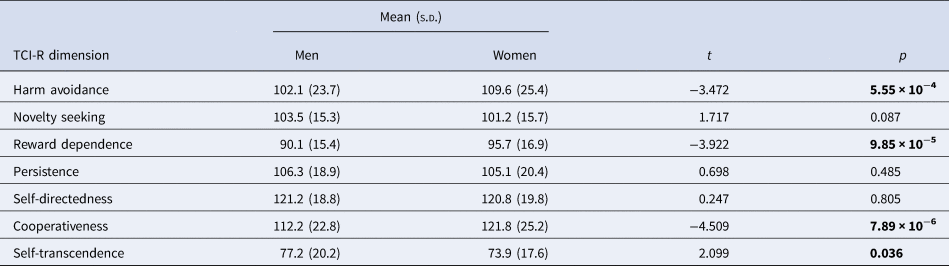
Of 811 patients recruited into the GENDEP study, 589 (73%, 209 males and 380 females) had available TCI-R data. There was no significant difference in baseline MADRS score, age, sex, age of onset, allocated drug, randomisation status or compliance between those with v. without TCI-R data (all p > 0.1). Allocated drug did not differ significantly by any of the TCI-R dimensions (all p > 0.1). Regarding sex differences in personality traits (Table 1), women scored higher than men for harm avoidance, reward dependence and cooperativeness; whereas, men had higher scores for self-transcendence and novelty seeking, with the latter showing a p value of 0.087. Self-directedness and self-transcendence also correlated with age (all p < 0.05).
Sex differencesa in TCI-R scores among 589 patients with unipolar depression

TCI-R, Temperament and Character Inventory Revised; s.d., standard deviation.
a Sex differences were calculated via t tests.
Bold: the significance level was p < 0.05.
Discontinuation
Of the 811 participants who entered the GENDEP study, 284 (35%) discontinued their allocated medication before week 12. Of the 589 with available TCI-R data, rates of discontinuation were similar (n = 192, 32%) and did not differ from the study as a whole (p > 0.05). Of the 192 with TCI-R data who discontinued, 86 switched to the alternative medication and 106 dropped out of the study entirely. The reasons for switching for the 86 individuals were intolerance among 10 (11.0%), inefficacy among 28 (30.8%) and both among 53 (58.2%). These numbers did not differ from those without available TCI-R data.
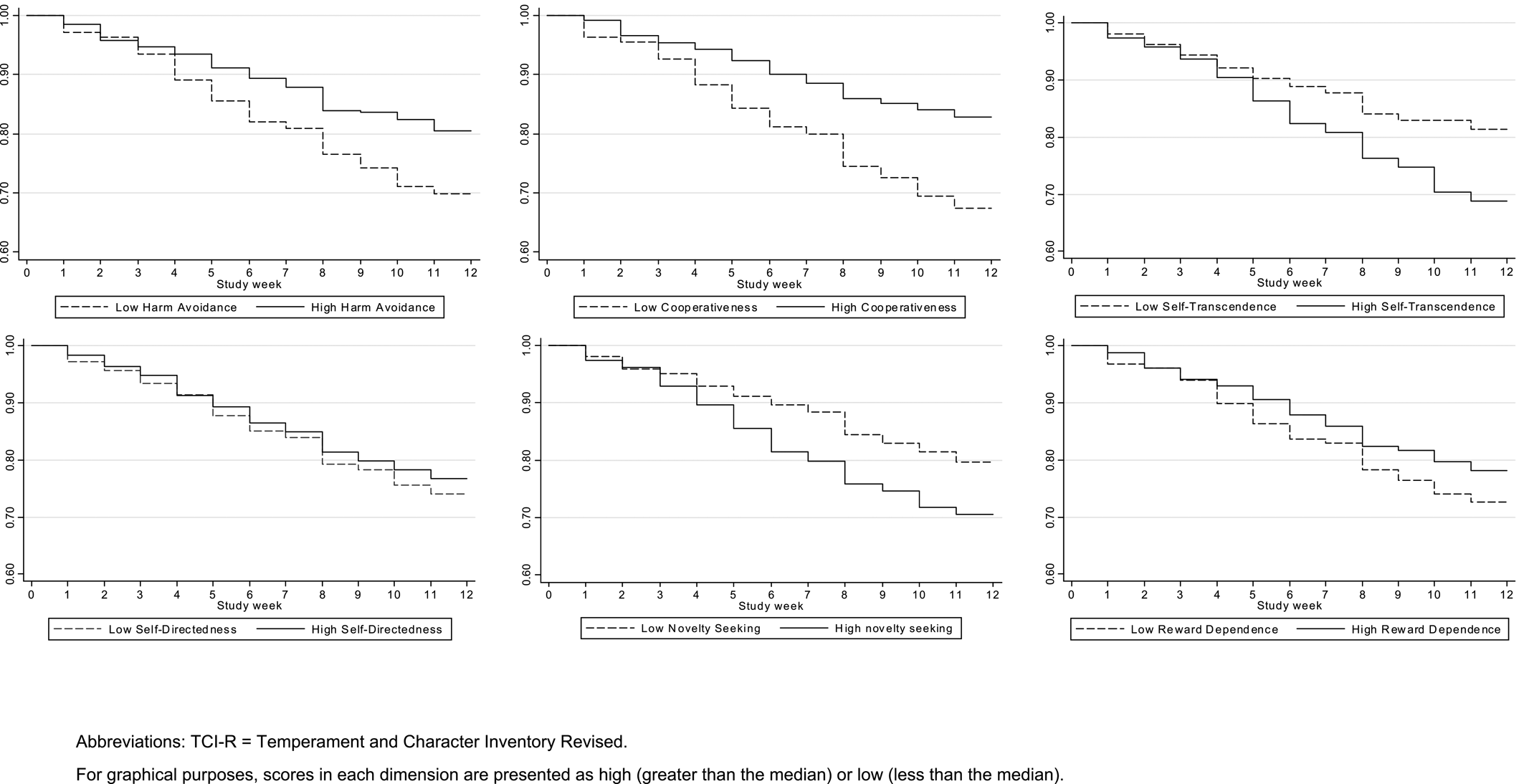
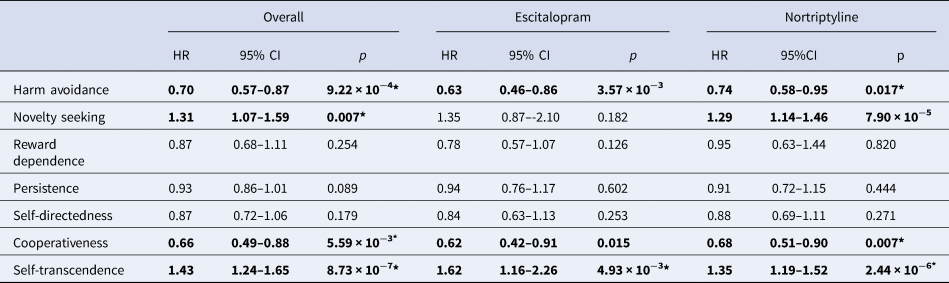
Cox proportional hazard models indicated that four of the seven TCI-R dimensions predicted discontinuation (Table 2 and Fig. 1). Those with lower scores for harm avoidance and cooperativeness were more likely to discontinue treatment as were those with high novelty seeking and self-transcendence scores.
Cox regression models calculating associations between TCI-R dimension scores and time to discontinuation among 589 patients with depression. TCI-R, Temperament and Character Inventory Revised. For graphical purposes, scores in each dimension are presented as high (greater than the median) or low (less than the median).

Cox proportional hazard regression models estimating associations between TCI-R dimensions and antidepressant discontinuation during 12 weeks of treatment with escitalopram or nortriptyline among 589 patients with unipolar depression

TCI-R, Temperament and Character Inventory Revised; HR, hazard ratios; 95% CI, 95% confidence interval.
HRs are estimates from Cox proportional hazards survival models. *Dimensions that remained significant when excluding those who switched medication are marked by asterisks, with the specific results from these analyses being shown in online Supplementary Table S1. The significance level was p < 0.05.
To test drug-specific effects, models were fitted separately for those allocated to escitalopram and nortriptyline. Overall, these results were similar, but the finding on novelty seeking was only significant among those on nortriptyline, while regarding self-transcendence, the HR was higher among those treated with escitalopram (HR = 1.62) than among those treated with nortriptyline (HR = 1.35), although this difference was not significant (Table 2). To test if the effects of personality differed between those switching antidepressant compared to those dropping out of the study, we excluded those who switched medication (online Supplementary Table S1). The overall analyses remained significant, but novelty seeking scores were no longer associated with discontinuation to nortriptyline, suggesting that this effect was affected by those switching medication.
Depression severity and treatment response
We found no relationship between personality traits and depression severity at baseline or at the point of discontinuation except for a small negative relationship between reward dependence and depression severity at baseline (online Supplementary Table S2). These results did not differ by sex (all p > 0.1).
In regression analyses, we found that higher novelty seeking scores were associated with a greater likelihood of response (>50% MADRS reduction; p = 0.02) and remission (MADRS<10; p = 0.03) after 8 weeks, but not after 12 weeks (all p > 0.1). Higher cooperativeness scores were associated with a greater likelihood of response (p = 0.001) and remission (p = 0.01) after 12 weeks. Analyses restricted to completers supported these findings except that the association between cooperativeness scores and remission after 12 weeks became non-significant (p = 0.28).
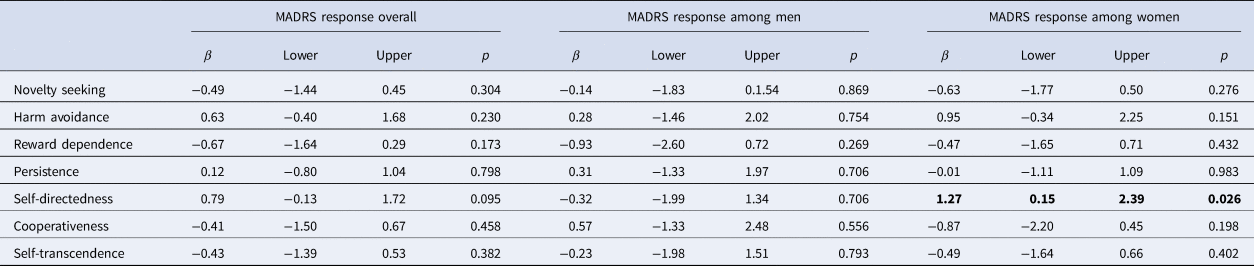
Mixed-effects linear regression analyses adjusted for recruitment centre, age, sex and baseline MADRS scores did not find significant associations between any character dimension and treatment response during the 12-week trial in the overall analyses (Table 3, left column). Among females, we found that higher self-directedness scores were associated with lower treatment response (p = 0.026; Table 3, right column), whereas no significant results were found among men (Table 3, middle column). There were no associations between the character dimensions and treatment response in analyses stratified on treatment arm (all p > 0.1; results not shown). The results were similar in analyses among completers (results not shown).
Association between TCI-R dimensions and antidepressant response during 12 weeks of treatment with escitalopram or nortriptyline

TCI-R, Temperament and Character Inventory Revised; MADRS, Montgomery and Aasberg Depression Rating Scale; HR, hazard ratios; 95% CI, 95% confidence interval.
β-coefficients showing the association between higher scores on the character dimensions and MADRS treatment response based on mixed-effects models, with a negative β-coefficient indicating better response (i.e. greater reduction in MADRS score) based on higher scores of the TCI-R dimension.
Bold: the significance level was p < 0.05.
Adverse drug reactions
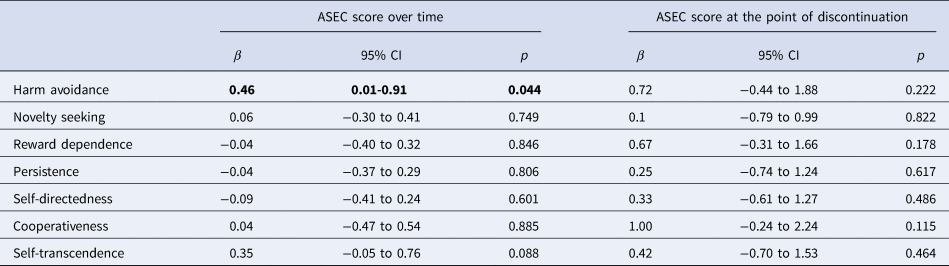
Mixed-effects linear regression analyses showed an association between high harm avoidance and significantly more adverse effects over the 12-week trial but not at the point of discontinuation (Table 4). None of the other dimensions were associated with differences in self-reporting of adverse effects.
Mixed-effects analyses on the association between the TCI-R dimensions and adverse drug reactions measured on the ASEC

TCI-R, Temperament and Character Inventory Revised; ASEC, Antidepressant Side Effect Checklist; 95% CI, 95% confidence interval.
Bold: the significance level was p < 0.05.
Discussion
Among 589 patients with moderate to severe depression treated with escitalopram or nortriptyline for 12 weeks, four of the seven TCI-R dimensions were associated with antidepressant discontinuation, independent of the severity of depressed mood and the occurrence of adverse effects. Higher novelty seeking was associated with a greater likelihood of response and remission after 8 weeks, while higher cooperativeness showed a greater likelihood of response and remission after 12 weeks. However, we found no associations with treatment response in mixed-effects linear regression models except for that higher self-directedness scores among women were associated with lower treatment response. Except for one finding with harm avoidance, we found no correlation between personality traits and self-perceived adverse drug effects. Finally, we found an indication of small drug-specific differences regarding discontinuation for some personality traits, but these findings need to be interpreted cautiously.
This study is the largest trial to date on the association between personality traits with antidepressant treatment course, indicating two main correlations. First, specific personality traits differentially predicted discontinuation. Second, specific personality traits predicted response and remission in the linear and logistic regression models, but not in the mixed-effects models. Overall, this suggests that personality may not be a valid predictor of antidepressant treatment response, and correlations between personality traits and response may be due to the biases caused by the association with discontinuation. The latter aspect needs to be taken into account in future trials studying personality and antidepressant treatment outcomes.
Correlations between temperament and character with discontinuation and response
Consistent with our hypothesis and previous studies (Akerblad et al., Reference Akerblad, Bengtsson, Holgersson, von Knorring and Ekselius2008; Ekselius et al., Reference Ekselius, Bengtsson and von Knorring2000; Liraud & Verdoux, Reference Liraud and Verdoux2001), novelty seeking was associated with a higher rate of discontinuation. Since novelty seeking is associated with impulsivity, disorderliness and exploratory excitability, it is reasonable to suggest that those scoring high on novelty would find adherence both to a daily regime of medication and follow-up appointments more difficult. On the other hand, we also found that higher novelty seeking correlated with better response and remission after 8 weeks but not after 12 weeks. This may indicate that those with higher novelty seeking had no patience to wait for improvement, why this trait was not significant after 12 weeks. Hence, more clinical emphasis helping patients with this trait to stay on their medication might improve their treatment outcomes.
Contrary to our hypothesis, high harm avoidance was associated with less discontinuation. However, harm avoiding individuals are considered to pessimistically worry about future problems (Cloninger et al., Reference Cloninger, Svrakic and Przybeck1993). It is possible, therefore, that those scoring high on harm avoidance are more concerned about the harmful consequences of discontinuation (such as relapse or re-occurrence) and this motivates them to remain in the study. Interestingly, low harm avoidance has been associated with poorer response (Joyce, Mulder, & Cloninger, Reference Joyce, Mulder and Cloninger1994) – our findings suggest that this association may, in part, be the result of early discontinuation. Overall, these findings suggest more clinical focus on depressed individuals with low harm avoidance, as this character trait may affect both compliance and treatment response.
Participants who were more cooperative and less self-transcendent were less likely to discontinue treatment. Furthermore, higher cooperativeness correlated with better response and remission after 12 weeks. Those scoring high on cooperativeness are best described as helpful and agreeable and those with low self-transcendence practical, self-conscious and materialistic (Cloninger et al., Reference Cloninger, Svrakic and Przybeck1993). While it seems intuitive that an agreeable and practical character would tend to be compliant with medication, this study was the first to test these correlations.
Personality, depression severity and the reporting of adverse effects
We found weak associations between reward dependence and lower depression severity at baseline and between harm avoidance and more self-perceived adverse effects. While a small protective effect of reward dependence on depression has been previously reported (Farmer et al., Reference Farmer, Mahmood, Redman, Harris, Sadler and McGuffin2003; Richter, Polak, & Eisemann, Reference Richter, Polak and Eisemann2003), more highly powered studies are required to elucidate the role of this dimension. Furthermore, it seems intuitive that individuals scoring higher on harm avoidance may experience adverse effects more intensively, although this has received little attention in previous studies. Of interest, studies have reported an association between harm avoidance and the occurrence of depression in clinical and community samples (Farmer et al., Reference Farmer, Mahmood, Redman, Harris, Sadler and McGuffin2003; Kusunoki et al., Reference Kusunoki, Sato, Taga, Yoshida, Komori, Narita and Ozaki2000), but not in case-only samples (Quilty et al., Reference Quilty, De Fruyt, Rolland, Kennedy, Rouillon and Bagby2008a). The effects of temperament and character on baseline depression scores may be further limited in the current study given the relatively restrictive inclusion of only those with moderate to severe depression.
Implications
Our results suggest that personality is a predictor of discontinuation of antidepressants. Furthermore, the correlation between personality and discontinuation may explain associations with antidepressant response, suggesting that personality traits may not represent good predictors of antidepressant response. One dimension in particular, novelty seeking, shows considerable promise, having been replicated in studies assessing treatment adherence for anxiety and alcoholism (Kravitz, Fawcett, McGuire, Kravitz, & Whitney, Reference Kravitz, Fawcett, McGuire, Kravitz and Whitney1999). In addition, novelty seeking has been shown to be positively associated with attrition in an epidemiological study of depression (Cloninger et al., Reference Cloninger, Svrakic and Przybeck2006).
Intervention strategies to help counter discontinuation are available, and predictors of discontinuation have the potential to improve the effectiveness of such interventions by allowing at-risk groups to be selectively targeted before treatment commences. Hence, our findings provide both insight into the complex behaviour underlying discontinuation and provide a potential novel target for intervention. Particularly the dimension of novelty seeking might be of clinical relevance. Interventions focusing on improving compliance among patients with high novelty seeking might lead to better treatment outcomes among these patients. This seems particularly relevant when considering our findings showing that patients with higher novelty seeking showed better response and remission after 8 weeks but not 12 weeks. In addition, those with higher cooperativeness correlated with better response and remission after 12 weeks and less discontinuation. This suggests that helping patients with higher cooperativeness to stay on their medication may result in better long-term treatment outcomes.
Limitations
Our findings need to be interpreted in light of the limitations of our study. First, the proportion of participants with missing TCI-R data was relatively high (27%). Although those without TCI-R data did not differ in their clinical characteristics, and missing TCI-R data were not predictive of discontinuation, missing TCI-R data itself may correlate with personality. Second, we only assessed baseline scores on temperament and character dimensions but no follow-up changes in personality scores. Third, several analyses were performed, increasing the risk for by-chance findings. We did not adjust for multiple testing due to the dependency between the different exposures and outcomes, respectively, but our findings have to be interpreted considering this aspect. Fourth, the TCI-R was not available in all languages, why the GENDEP investigators had to translate the TCI-R to Croatian, Danish, Polish and Slovenian. Although this was performed under the supervision of the author of the TCI-R, C. Robert Cloninger, the translations were not studied regarding validity and cross-cultural applicability. Fifth, we had no specific information why patients dropped out of the study and the majority of patients switched medication due to both inefficacy and intolerance, limiting further analyses on this topic.
Conclusion
Within a large cohort of 589 patients with depression, we measured seven dimensions of temperament and character and found that several dimensions differentially predicted antidepressant discontinuation, whereas we only found weak associations with response, depression severity and self-perceived adverse effects. Our findings suggest that correlations between personality traits and antidepressant response may be confounded by differential discontinuation patterns. Hence, studies suggesting correlations between specific personality traits and differential response to antidepressant medications may have been affected by this important aspect. Interventions supporting compliance are available, and future studies should investigate whether interventions helping patients with specific personality traits to be more compliant, for example, those with higher novelty seeking or cooperativeness, also may lead to better antidepressant response.
Supplementary material
The supplementary material for this article can be found at https://doi.org/10.1017/S003329172100444X
Acknowledgments
This paper is dedicated to the memory of Robert Keers, who sadly passed away in July 2020.
Financial support
The GENDEP study was funded by a European Commission Framework 6 grant, EC Contract Ref.: LSHB-CT-2003-503428. Lundbeck provided both nortriptyline and escitalopram free of charge for the GENDEP study. GlaxoSmithKline and the Medical Research Council contributed by funding add-on projects in the London centre. The project also received additional funding at the London centre from the Biomedical Research Centre for Mental Health at the Institute of Psychiatry, King's College London and South London and Maudsley NHS Foundation Trust [grant from the National Institute for Health Research (NIHR), Department of Health, UK]. None of the above had any role in the design and conduct of the study, in data collection, analysis, interpretation nor writing or submission of the paper.
Conflict of interest
Dr Aitchison holds an Alberta Centennial Addiction and Mental Health Research Chair, funded by the Government of Alberta. Dr Aitchison has been a member of various advisory boards, received consultancy fees and honoraria, and has received research grants from various companies including Johnson and Johnson Pharmaceuticals Research and Development and Bristol-Myers Squibb Pharmaceuticals Limited. Dr Köhler-Forsberg reports honoraria for lectures for Lundbeck Pharma A/S. Drs Farmer and McGuffin have received honoraria for participating in expert panels for Lundbeck and GlaxoSmithKline. The other authors report no financial relationships with commercial interests.
Ethical standards
The authors assert that all procedures contributing to this work comply with the ethical standards of the relevant national and institutional committees on human experimentation and with the Helsinki Declaration of 1975, as revised in 2008.