In the United States, approximately 79,000 youths under the age of 21 are held in 2,300 correctional facilities on any given day (Office of Juvenile Justice and Delinquency Prevention, 2010). These youths are a high-risk population with significant levels of psychopathology (Feldmann, Reference Feldmann2008). Upward of 70% of youths in detention meet criteria for a clinically significant mental disorder (Teplin, Abram, McClelland, Dulcan, & Mericle, Reference Teplin, Abram, McClelland, Dulcan and Mericle2002; Teplin, Abram, McClelland, Washburn, & Pikus, Reference Teplin, Abram, McClelland, Washburn and Pikus2005; Wasserman, McReynolds, Schwalbe, Keating, & Jones, Reference Wasserman, McReynolds, Schwalbe, Keating and Jones2010). It is important to underscore that these high rates are not merely due to the presence of disruptive behaviors (Colins et al., Reference Colins, Vermeiren, Vreugdenhil, van den Brink, Doreleijers and Broekaert2010); even after controlling for disruptive disorders, the rate of psychopathology among detained youth remains nearly 60% (Desai et al., Reference Desai, Goulet, Robbins, Chapman, Migdole and Hoge2006; Teplin et al., Reference Teplin, Abram, McClelland, Dulcan and Mericle2002). Effectively treating and preventing mental illness in detained youth is important for reducing recidivism (McReynolds, Schwalbe, & Wasserman, Reference McReynolds, Schwalbe and Wasserman2010) as well as for helping these youth lead happier, more productive lives.
The detention setting provides an opportunity for these high-risk youth to be properly diagnosed and to receive mental health services because their families and communities often do not have the resources needed to help them (American Academy of Pediatrics, Committee on Adolescence, 2011). Unfortunately, most detention facilities are not equipped to meet this need because of several challenges inherent to the detention setting. There is debate within the detention system about the role that facilities should play in evaluating and treating mental health problems. As Desai et al. (Reference Desai, Goulet, Robbins, Chapman, Migdole and Hoge2006) point out, some people involved in the detention system do not believe the purpose of a detention facility is to be a mental health provider. Rather, they believe that the primary purpose of these facilities should be to reduce flight risk and provide basic mandated services until the detainee's legal issues are resolved (Dale, Reference Dale1998; Roush, Reference Roush and Roberts1998). Another challenge for implementing intervention in the detention setting is that youth are detained only for a brief period of time (Office of Juvenile Justice and Delinquency Prevention, 2010). The high turnover rate and short time frames make it difficult to use traditional intervention strategies, which require multiple in-person sessions over long periods of time. Further, in many detention settings, staff are neither hired nor trained as mental health experts. Thus, experts are rarely available to properly diagnose and treat serious mental illness. Finally, there is paucity of research to guide treatment decisions. According to Desai et al. (Reference Desai, Goulet, Robbins, Chapman, Migdole and Hoge2006), there are “virtually no controlled studies of interventions in detention.” This is because it is difficult to conduct rigorous randomized trials in real-world settings. However, randomized trials are sorely needed in order to provide detention administrators with the data needed to make treatment decisions for this unique population. They can help researchers and practitioners identify mental health interventions that are effective, short in duration, and feasible for general detention staff to administer.
The purpose of our study was to help fill this gap in the literature and to provide detention administrators and staff with empirical data about the effectiveness of a social problem-solving training intervention for decreasing depression. In our study, we used a randomized experimental design with an active control condition. The study had a high level of external validity; it was conducted in a real-world detention setting and used detention staff, rather than researchers, to administer the interventions. In addition to determining the effectiveness of the social problem-solving intervention in reducing depression, we also tested a potential moderator that might explain why some detained youth were more or less likely to benefit from the intervention than others.
Social problem-solving training (SPST; Guerra & Slaby, Reference Guerra and Slaby1990; Guerra & Williams, Reference Guerra, Williams and Grigorenko2012) is an intervention designed to help children and adolescents cope with interpersonal stress and conflict. We chose SPST as the intervention because youth with psychopathology typically exhibit deficits in social information processing (e.g., Crick & Dodge, Reference Crick and Dodge1996), and deficits in social information processing have been linked to depression. Research shows that detained youth tend to exhibit a wide array of social deficits relative to nondetained peers (even those matched on age, socioeconomic status, and education attainment) including poorer social skills, difficulty identifying social cues, and problem-solving social dilemmas (Freedman, Rosenthal, Donahoe, Schlundt, & McFall, Reference Freedman, Rosenthal, Donahoe, Schlundt and McFall1978; Lochman & Dodge, Reference Lochman and Dodge1994; Spence, Reference Spence1981).
The basic premise of SPST is that improved social problem-solving strategies should lead to less stress, reduced interpersonal conflict, stronger interpersonal relationships, and improved executive functioning. After receiving SPST, an individual should be less likely to experience symptoms of psychopathology such as conduct problems and depression. Preliminary research suggests that SPST reduces aggressive and violent behavior (Guerra & Williams, Reference Guerra, Williams and Grigorenko2012). However, less work has examined its influence on comorbid symptoms such as depression. Although SPST was not designed to target depressive vulnerabilities (Abramson, Metalsky, & Alloy, Reference Abramson, Metalsky and Alloy1989; Nolen-Hoeksema, Wisco, & Lyubomirsky, Reference Nolen-Hoeksema, Wisco and Lyubomirsky2008) per se, a significant body of research suggests that cognitively based social problem-solving interventions such as SPST can be effective in reducing depression in nondetainees (Gillham et al., Reference Gillham, Relvich, Freres, Chaplin, Shatte, Samuels, Elkon and Litzinger2007; Nezu, Nezu, & D'Zurilla, Reference Nezu, Nezu and D'Zurilla2013; Possel, Horn, Groen, & Hautzinger, Reference Possel, Horn, Groen and Hautzinger2004; Shochet, Whitefield, & Holland, 2001; Stice, Shaw, Bohon, Marti, & Rohde, Reference Stice, Shaw, Bohon, Marti and Rohde2009). These results support a broader body of research showing that a variety of interventions (interpersonal therapy, behavioral activation, and problem-solving focused interventions) are capable of reducing depression. The commonalities among these empirically supported interventions appear to be that they focus on maladaptive behaviors and cognitions and are educational, directive, and short term (Craighead & Dunlop, Reference Craighead and Dunlop2014). SPST may be particularly well suited for reducing an outcome like depression because of its focus on alleviating interpersonal stress, which is a potent predictor of depression in adolescents (Hammen, Reference Hammen2009). SPST also educates youth about negative emotions, teaches basic interpersonal skills, and teaches perspective taking and cognitive flexibility. We hypothesized that detainees randomly assigned to a SPST intervention would exhibit fewer depressive symptoms postintervention than detainees randomly assigned to treatment as usual.
We chose to examine the outcome of depression because of its high prevalence in detained youth and because of its influence on recidivism. Male youth in detention facilities are twice as likely as male youth in the general population to have depression (Fazel, Doll, & Langstrom, Reference Fazel, Doll and Langstrom2008; Kashani et al., Reference Kashani, Manning, McRnew, Cytryn, Simonds and Wooderson1980), and depression is a significant predictor of whether or not juveniles go on to develop persistent conduct problems (Remschmidt & Walter, Reference Remschmidt and Walter2010). This finding supports the well-documented link between depression and future antisocial behavior (Biederman, Faraone, Mick, & Lelon, Reference Biederman, Faraone, Mick and Lelon1995; Harrington, Reference Harrington2001; Harrington, Fudge, Rutter, Pickles, & Hill, Reference Harrington, Fudge, Rutter, Pickles and Hill1991; Meller & Borchardt, Reference Meller and Borchardt1996; Zoccolillo, Reference Zoccolillo1992).
In addition to determining if SPST could reduce depressive symptoms in detained youth relative to treatment as usual, we also sought to understand why it might be more or less effective for some youth. Thus, we investigated a potential moderator of intervention effectiveness. Moderators can shed light on for whom a particular intervention might work best as well as the contexts that lead to optimal outcomes (Baker, McFall, & Shoham, Reference Baker, McFall and Shoham2008; Kazdin, Reference Kazdin and Kazdin2003; Kazdin & Blasé, Reference Kazdin and Blasé2011). In the current study, we examined intelligence. Because problem-solving interventions like SPST require a variety of cognitive skills (e.g., memory, inhibition, identification of patterns and relationships, hypothesis generation, and logical reasoning) to learn and use the skills that are taught (Mohlman & Gorman, Reference Mohlman and Gorman2005), we hypothesized that intelligence would moderate the effectiveness of SPST. Specifically, we expected detainees with higher levels of fluid intelligence to benefit more from SPST than detainees with lower levels of fluid intelligence. We chose to examine fluid intelligence because measures of this construct are designed to reduce, as much as possible, the influence of verbal comprehension, culture, and educational level.
In summary, the detention setting provides a potential opportunity for high-risk youth to access mental health services. However, there are a number of obstacles that prevent detention facilities from providing these services, including high turnover rates, untrained staff, and a lack of empirical evidence to guide treatment decisions. To meet the demand for empirical evidence, we used a randomized experimental design in a real-world setting with detention staff administering the intervention. Thus, this study not only provides important information about the effectiveness of social problem solving interventions in reducing depression but also meets the growing need to enhance the external validity of randomized clinical trials in diverse samples (e.g., Howard, Moras, Brill, Martinovich, & Lutz, Reference Howard, Moras, Brill, Martinovich and Lutz1996).
Method
Participants
Participants were 296 adolescent males recruited through three pretrial state-run detention centers in Connecticut. Juveniles were detained for having committed one or more violent criminal acts (e.g., assault and battery), nonviolent acts (e.g., theft), or status offense (e.g., violation of court order). The mean age of the participants was 14.97 years (SD = 0.95, range = 11.36–16.94). The vast majority of participants (~70%) were from historically underrepresented racial/ethnic backgrounds (African American: 48%, Hispanic: 30%, White: 18%, Other: 2%; Not Reported: 2%). Girls were not included because of their relatively small numbers and placement outside the three main detention centers participating in this study.
The following inclusion and exclusion criteria were used to recruit the sample: Inclusion criteria were (a) a court order to stay in the facility for at least 14 days, (b) the ability to understand and fluently reply in spoken English, (c) parental and youth consent to participate, and (d) a minimum reading proficiency equivalent to Grade 4. Exclusion criteria were (a) prior diagnosis of mental retardation or psychosis; (b) extreme “alarm” scores on the Massachusetts Youth Screening Instrument—Version 2 (Grisso & Barnum, Reference Grisso and Barnum2003), which serves as a triage tool for decisions about the possible need for immediate intervention; and (c) being under the guardianship of child protective services. The study was approved by the proper authorities of all participating institutions and agencies.
Materials
Depressive symptoms
The Child Depression Inventory (CDI; Kovacs, Reference Kovacs1981) is a 27-item self-report questionnaire that measures depressive symptoms occurring during the past 2 weeks. Items consist of clusters of three sentences, and participants must choose the sentence that best describes them. They are scored from 0 to 2 with a higher score indicating greater symptoms severity (Kovacs, Reference Kovacs1983). The coefficient α value for the CDI at baseline in the current study was 0.82.
SPST intervention
We used a 10-session SPST program guided by the Viewpoints manual (Guerra, Moore, & Slaby, Reference Guerra, Moore and Slaby1995; Guerra & Slaby, Reference Guerra and Slaby1990; Guerra & Williams, Reference Guerra, Williams and Grigorenko2012). The basic content of the Viewpoints SPST intervention is representative of most social problem-solving and social skills training interventions. These interventions focus on education about emotions, teaching basic social skills such as cooperation and communication, teaching problem-solving skills and perspective taking, and teaching cognitive self-control. The Viewpoints SPST manual was created by two leading researchers on the topic, originally validated in a randomized controlled trial, and has been specifically recommended for use with juvenile detainees in small group settings. The program is unique because it was “premade” for a detention setting and has a commercially available Viewpoints workbook that is given to each juvenile detainee and a Viewpoints teacher's manual that is used by the group leader. The main techniques used in Viewpoints include didactic education, in-session writing assignments, role-playing, and guided discussion. The participant's manual contains multiple activities and assignments tailored for practice of the eight problem-solving steps: “Is there a problem? Stop and think. Why is there a conflict? What do I want? Think of solutions. Look at the consequences. Choose what to do. Evaluate your results.” Both the participant's manual and the instructor's guide are structured to follow a 10-session format. The 10 lessons address the nature and causes of interpersonal conflict; how problems begin and the concept of stress; how to delay one's response during interpersonal conflict and to stop and think before acting; understanding how preconceived biases and prejudices may influence decision making during conflicts; examining the perspectives of others during interpersonal conflicts; problem identification; stop and think technique, and analysis of causes of conflict; identifying personal goals, and how these goals may be thwarted by stress; generating alternative solutions to a problem; consequential thinking such as cost/benefit analysis of the outcomes of their actions; and evaluation of self-performance in the stressful situation.
This SPST program is a particularly ideal intervention for detention facilities because of the brevity of the sessions and because it can be delivered by trained correctional officers (COs) in the detention facilities rather than professional therapists. The SPST program was also designed with high turnover rate of participants in mind. To this end, it can be delivered in a circular manner, where new participants can join the treatment group at any time and still learn the essence of social problem solving. Each of the 10 1-hr sessions includes a 15-min recap session about the essence of social problem solving, which allows detainees to enter the program at any point during its 10-session run. For participants already in treatment, this recap provides an opportunity to review previously learned material. The main body of the sessions is dedicated to covering a specific step in the social problem-solving process. The intervention is entirely cognitive, involving spoken and written discussion of the material from the manual, events from participants’ lives, and participants’ thoughts. At the end of each session, participants are asked to integrate the detailed discussion of one step with the general sequence of social problem solving. The SPST intervention was administered approximately 70 times during the course of the study, and the number of sessions attended by the juveniles ranged from 1 to 14 with a mean of 5.4, and a mode of 10. Variation in sessions received was due to early release or transfer to another facility.
Treatment as usual (TAU)
The specific content of the TAU was established by the three detention centers. Specifically, during the study, the state detention facilities provided psychoeducational support groups to admitted children and adolescents in the areas of life skills, physical health and hygiene, orientation to detention services, anger management, and substance abuse prevention. It is important to highlight that TAU did not consist of any structured or controlled intervention programs, but rather the content of the daily groups was left to the discretion of the individual correctional officer in charge of TAU that day. Although there was some instruction in management of anger at the time of the study, there was no true social problem solving or cognitive behavioral intervention focused on mental health needs.
Moderator of intervention efficacy (intelligence)
We examined the moderating effect of intelligence on SPST effectiveness. The Cattell Culture Fair Test of g—Form A (Cattell & Cattell, Reference Cattell and Cattell1960) is a widely used and well-validated measure of fluid intelligence (e.g., Cattell & Cattell, Reference Cattell and Cattell1973; Smith, Hays, & Solway, Reference Smith, Hays and Solway1977). This paper and pencil instrument was administered to the participants prior to the intervention. The test consists exclusively of geometric-reasoning items that fall under four subheadings: series completions, classifications, matrix completions, and topology. The coefficient α value for the Cattell at baseline in the current study was 0.88.
Procedures
Detention staff assessed all youth who were ordered by a superior court judge to be detained for 2 weeks for eligibility. A detention staff member then introduced youth who met the inclusion/exclusion criteria to a researcher working at the given facility. The researcher was allowed to speak privately with the child to explain the study and obtain consent. If the child agreed to participate, then the parents/legal guardians were contacted via telephone to obtain verbal consent (written consent was also obtained at a later time). If both parents/legal guardians and youth consented to participate, then the youth was then administered the baseline assessment,Footnote 1 which included measures of fluid intelligence and depressive symptoms. Youth were then randomly assigned to either SPST or TAU. Youth were assigned a study ID number, and all materials generated by this project were marked by the study ID only. All assessment materials were removed from detention centers, and data was entered and processed off-site. If a juvenile or his parent did not agree to participate in the study, the participant was provided TAU with no data collected.
All SPST (n = 118) or TAU (n = 178) groups were delivered by the participating COs, who underwent approximately 8 hr of training in SPST by the research team. As there were at least two participating COs at each detention center, SPST and TAU groups were administered in parallel (i.e., one CO alternated SPST/TAU/SPST/TAU while the other CO alternated TAU/SPST/TAU/SPST). The two COs alternated administering TAU and SPST, so that both groups could be running at the same time and so that both COs had the opportunity to conduct both groups (thus controlling for any group leader effects). Each group was run approximately once every 3 weeks at each detention site, and the groups were conducted once per day. The fidelity of implementation of SPST and TAU was monitored in two ways. First, only COs who demonstrated adequate knowledge of the workshop material, as evaluated by the instructors, were invited to participate in the study. Second, to evaluate adherence to the manual, a random 10% of SPST sessions for each participating CO were audiotaped. The participating COs were given feedback about the kinds of questions they asked and the structure of each session after each fidelity check. All of the COs exhibited a strong degree of fidelity on the 10% of sessions that were checked; no CO was asked to alter how he or she was conducting the SPST group.
Results
Data analytic overview
We tested two primary hypotheses. We hypothesized that SPST would be more effective in reducing depressive symptoms than TAU. This hypothesis was tested using an analysis of covariance with intervention condition as the independent variable and depressive symptoms postintervention as the dependent variable. The depressive symptoms score at baseline was used as the covariate to control for any individual differences in initial levels of depressive symptoms.
In addition to determining the effectiveness of SPST relative to TAU, we also tested a potential moderator (intelligence) that might explain why some detained youth were more or less likely to benefit from the intervention. To examine the moderating effect of fluid intelligence on SPST effectiveness, we used hierarchical multiple regression. Continuous predictor variables were centered and entered into the regression equation in three steps. In Step 1, the baseline depression score was entered to create a residual change score for the same depression measure postintervention (dependent variable). In Step 2, the main effects of fluid intelligence and intervention condition were entered. In Step 3, the interaction of intelligence and condition was entered. Individual variables within a given step were not interpreted unless the set as a whole was significant, thereby reducing Type I errors.
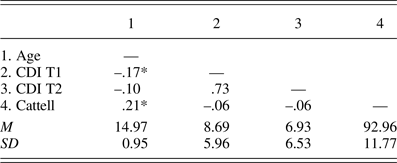
Descriptive statistics and correlations for the primary study variables are in Table 1. If participants did not answer at least 80% of the items on the CDI or Cattell, then a score was not calculated for that individual. As expected given random assignment, there were no significant differences between participants assigned to TAU and participants assigned to SPST on any of the baseline variables (age, ethnicity, CDI score, or fluid intelligence).
Means, standard deviations, and correlations

Note: CDI T1, Child Depression Inventory at admission (Time 1); CDI T2, CDI at postintervention (Time 2); Cattell, Cattell culture fair test of g standard score. Higher scores on the CDI and Cattell indicate greater levels of the construct being measured.
*p < .05.
Hypothesis 1: SPST is more effective than TAU at reducing depressive symptoms
To examine the effectiveness of SPST, we performed an analysis of covariance with intervention condition (0 = TAU, 1 = SPST) as the independent variable and depressive symptoms (CDI scores) postintervention as the dependent variable. CDI score at baseline was used as the covariate. It was no surprise that the CDI at baseline predicted CDI postintervention, F (1, 139) = 186.63, p < .001, η2 p = 0.57 (effect size in the large range). Contrary to the hypotheses, results revealed no main effect of intervention condition, F (1, 139) = 0.02, p = .89, η2 p < 0.01. SPST was not more effective than TAU at reducing depressive symptoms (estimated mean for SPST = 7.10; estimated mean for TAU = 7.01). The average depressive symptom score postintervention for both groups is considered in the average range.
Hypothesis 2: Intelligence will moderate the effectiveness of SPST for reducing depressive symptoms
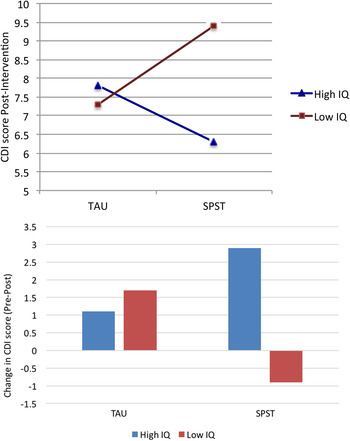
To examine the moderating effect of fluid intelligence on SPST effectiveness, we used hierarchical multiple regression. In Step 1, the baseline depression score (CDI) was entered to create a residual change score for the same depression measure postintervention (dependent variable). In Step 2, the main effects of fluid intelligence (Cattell raw score) and intervention condition (0 = TAU, 1 = SPST) were entered. In Step 3, the interaction of intelligence and condition was entered. As hypothesized, there was a significant Intelligence × Condition interaction (B = –0.34, t = –2.26, p = .03, partial correlation = –.19; change in R 2 = .02; effect sizes are in the small range). There was no main effect of intelligence or condition (both ps > .30). To graphically depict the Intelligence × Condition interaction, we computed depressive symptoms scores by inserting specific values for the predictor variable (i.e., 1 SD above and below the mean) into the regression equation. A simple slope analysis showed that the gradient of the simple slope for those with “higher” and “lower” levels of intelligence was significantly different depending on intervention type (t = –2.11, p = .03, partial correlation = –.27; effect size in the medium range). As can be seen in Figure 1, SPST was more effective than TAU for youth with high levels of intelligence, but led to a worsening of depressive symptoms relative to TAU for those with lower levels of intelligence. Juveniles with high intelligence scores who received SPST reported the lowest levels of depressive symptoms postintervention. The combination of lower intelligence and SPST treatment was the only Intelligence × Condition combination that resulted in an increase in depression. All other combinations (High Intelligence × SPST, High Intelligence × TAU, and Low Intelligence × TAU) led to decreases in depressive symptoms pre- to postintervention. Level of intelligence did not have a differential effect for those receiving TAU (p = .56, partial correlation = 0.07).
(Color online) (Top) Computed level of depressive symptoms postintervention (controlling for baseline depressive symptoms) as a function of intelligence and condition. Depressive symptoms scores were computed by inserting specific values for the predictor variable (i.e., 1 SD above and below the mean) into the regression equation. (Bottom) Change in depressive symptoms from preintervention to postintervention as a function of intelligence and condition. Larger change scores indicate greater reductions in depressive symptoms over the course of the SPST intervention. Negative scores indicate an increase in depressive symptoms over the course of the SPST intervention. CDI, Child Depression Inventory; TAU, treatment as usual; SPST, social problem-solving training.

Discussion
There is a critical need for randomized controlled trials of interventions in detention settings (Desai et al., Reference Desai, Goulet, Robbins, Chapman, Migdole and Hoge2006). Such studies are needed to understand what interventions work best for this unique population and to provide detention administrators with the data needed to make treatment decisions. The purpose of our study was to help fill this gap in the literature. We used a randomized experimental design in a real-world setting with detention staff administering the intervention. This study not only provides important information about the effectiveness of social problem-solving interventions in reducing depression but also meets the growing need to enhance the external validity of randomized clinical trials in diverse samples (e.g., Howard et al., Reference Howard, Moras, Brill, Martinovich and Lutz1996). In addition to determining the effectiveness of the SPST intervention, we also tested a potential moderator (intelligence) that might explain why some detained youth were more or less likely to benefit from the intervention than others.
The present study showed that SPST is not more effective in reducing depressive symptoms than the standard care used in male detention facilities in Connecticut (which was not strongly focused on mental health needs). The results of our moderator analysis, however, indicate that SPST was not merely an inconsequential intervention that was no different than TAU. The null result for the main effect of SPST was not due to it being ineffective across the board for juveniles. Rather, there was a subgroup for which SPST was highly effective relative to TAU (those with high fluid intelligence) and a subgroup for which SPST led to increases in depression relative to TAU (those with low fluid intelligence). Combining these two disparate groups resulted in a net outcome for SPST that was not significantly different from TAU. Intelligence did not affect the outcomes for TAU. These results confirm that SPST was having an effect that was distinguishable from TAU.
It was surprising that SPST led to worse outcomes than TAU for some participants (those with lower intelligence scores). Juveniles with low intelligence scores who received SPST reported the greatest levels of depressive symptoms postintervention. It is unclear why this was the case. For detainees with lower intelligence, it is conceivable that SPST increased depression because it required participants to discuss emotionally charged interpersonal content and engage in more self-focused attention. This likely led to an increase in negative emotions for all participants; however, those with lower intelligence scores might not have been able to learn and use the skills taught by SPST to resolve, and ultimately extinguish, these negative emotional states. Although the increase in level of depressive symptoms might not be considered clinically significant (the increase over TAU was ~3 points on the CDI), it is nonetheless noteworthy because it was the only Intelligence × Intervention combination that resulted in an increase in depression. All other combinations (High Intelligence × SPST, High Intelligence × TAU, Low Intelligence × TAU) led to decreases in depressive symptoms pre- to postintervention.
It is important to note the strengths of the current study. This study contributes to a small body of research that has used randomized trials in a detention setting. Detention staff, rather than trained researchers, were in charge of implementing the study and administering the intervention. Although this means the study was more “messy” than a tightly controlled efficacy study run completely by researchers, it also means the results more closely reflect what happens when these interventions are used in the real world. It is necessary to understand how interventions work when not used under ideal conditions, because this is how therapists in real-world settings will ultimately use them. Using real staff increased the external validity of the study, and filled the critical need for effectiveness data on how best to treat mental illness in this diverse, high-risk sample. Although results did not support SPST as a general intervention for juvenile detainees, the findings provide important data about this type of intervention and suggest that it would be a viable option for reducing depression in detained youth with higher intelligence scores. That said, it is likely not feasible for detention centers to provide intelligence assessments for all of their incoming youth in order to identify those with higher intelligence scores. Finally, by examining the moderating effect of intelligence on intervention effectiveness, our study was able to identify a subgroup of detainees for which they were worse off receiving SPST than TAU. According to Lilienfeld (Reference Lilienfeld2007), identifying conditions that lead to a worsening of symptoms is largely neglected in psychology research despite its real-world importance. Thus, this study provides clues about potential variables that could make a seemingly innocuous intervention lead to worse depressive outcomes than the standard intervention in juvenile detainees. If we had only examined the main effect of intervention, we would have missed identifying two subgroups of detainees (those with high and low intelligence scores) for which SPST led to very different outcomes.
There were also several limitations to the current study. Although effectiveness studies are necessary for determining whether interventions work in the real world, they also have inherent weaknesses. The internal validity of effectiveness studies are not as tightly controlled as in efficacy studies in which all study elements are tightly controlled by the research team. Thus, it is possible that SPST was not implemented as well as it could have been by a trained clinical psychologist; further, the youth likely missed more sessions than if it were implemented in a research setting. Thus, it is possible that SPST could have been more effective in reducing depression if administered in a more idealized fashion and setting. Another limitation is that depressive symptom levels tended to be in the average range at both pre- and postintervention, which might have dampened our ability to detect large changes in symptom outcomes. Finally, the current study examined depressive symptoms, but not clinical diagnoses. Thus, we cannot make conclusions about clinically significant forms of depression. However, given research suggesting that depressive symptoms and depressive syndromes lie on a continuum, we expect that future research will provide evidence that our pattern of results also extends to depressive disorders.
In conclusion, this study helps to fill a critical need for effectiveness data for juvenile detention administrators to make treatment decisions. Within a developmental psychopathology framework, our study provides information about the effectiveness of SPST and standard care in helping detained youth deal with and adapt to symptoms of psychopathology (specifically depression) when in a unique developmental context: a locked-down detention facility where parents and family members are largely absent. The results suggest that SPST should not be widely implemented in detention facilities as a means of reducing depression. According to the current data, it only is superior to TAU for detainees with high levels of fluid intelligence (fluid IQ scores greater than 105 on the Cattell culture fair test of g in the current sample). However, the results showed that SPST has the potential to increase depression relative to TAU in some detainees.