Introduction
It has been estimated that 141,460 people with dementia live alone in the community in the United Kingdom (UK) (Miranda-Castillo et al., Reference Miranda-Castillo, Woods and Orrell2010) and this number is expected now to be doubled in the next 20 years (Alzheimer's Society, 2019). Despite this trend, little is known about the experiences of those who live alone, nor of their relatives and friends who play an important part in supporting their independence and in escalating care as the condition progresses. In this paper, we report the results of a qualitative secondary study that explored in depth one aspect of their experiences: the ways in which they each viewed and approached the future, particularly with regard to the future care and living arrangements of the people with dementia.
Time and future outlook
Time, and the closely connected concept of space, has been studied from many perspectives in the social sciences and humanities. Multiple theories and concepts of time have been discussed by philosophers, sociologists, psychologists, geographers, literary theorists and others. This includes philosophical and social studies on the lived experience of time and how the duration of time is perceived in relation to the ageing process (e.g. Bergson, [1896] Reference Bergson2004, [1903] Reference Bergson1999); on how our understanding of the present is structured by our relations with the past and notions of the future (e.g. Heidegger, [1927] Reference Heidegger1962; Adam, Reference Adam1995); and on images of ‘the future’, such as climate change, and how these shape social practice (e.g. Bell and Mau, Reference Bell and Mau1971; Adam, Reference Adam2008). For these theorists, the concepts of past, present and future (and time-space) are interconnected and indivisible. As Barbara Adam observes:
…during each present the past we have already lived and the future we still expect to live play a central role in the way we experience, plan and act. Not only that, we have a relationship to our past, present and future; we take an attitude to our origin and destiny. (Adam, Reference Adam1995: 23)
Although Alzheimer's disease and other forms of dementia can affect people's temporal and spatial orientation and their ability to plan as the condition progresses, there has been limited research on how people living with dementia perceive and experience time in general, and how this affects their care and wellbeing. The existing literature includes clinical, psycho-social and applied studies of episodic simulation of future events (e.g. Addis et al., Reference Addis, Sacchetti, Ally, Budson and Schacter2009), time distortions in Alzheimer's disease (see El Haj and Kapogiannis, Reference El Haj and Kapogiannis2016), temporality and identity (e.g. Orona, Reference Orona1990), how people living with dementia experience and manage time in everyday life (e.g. Nygård and Johansson, Reference Nygård and Johansson2001) and the factors affecting advance care planning in dementia (e.g. Dening et al., Reference Dening, Jones and Sampson2011).
‘Future outlook’ is a temporal concept that has not been widely studied or precisely defined in the wider literature on time. However, the attitudes of people with dementia to the future has been identified as a key aspect of their experiences of living with the condition in four previous studies, each conducted in different countries. In Canada, de Witt et al. (Reference de Witt, Ploeg and Black2010) carried out a small interpretive phenomenological study of eight women's experiences of living alone with mild to moderate dementia in Ontario. ‘Holding back time’ was identified as a key theme. The women were found to be fearful of their condition becoming worse and saw medication as a way of holding back future time, which they dreaded. They also wanted to stay living as they were for ‘as long as I can’ (de Witt et al., Reference de Witt, Ploeg and Black2010: 1703). Drawing on Heidegger's ([1927] Reference Heidegger1962) concept of ‘now’, the researchers suggested that the women's use of this phrase indicated that they were seeking to hold on to the present and that they understood ‘now’ to have a limited duration, with an end-point. The researchers also indicated that some of the women were able to anticipate the circumstances when they would no longer be able to live alone, such as when they talked about the possibility of becoming a burden on their family or their condition becoming worse.
In the Netherlands, de Boer et al. (Reference de Boer, Dröes, Jonker, Eefsting and Hertogh2012) examined how 24 people with early-stage Alzheimer's disease and living in the community viewed and planned for the future. The study found that their thinking about the future was ‘an ongoing process of balancing hopes and fears’ (de Boer et al., Reference de Boer, Dröes, Jonker, Eefsting and Hertogh2012: 16). They hoped that things would remain as they were or at least not deteriorate, that their memory might improve, that their illness might stabilise and that their family would support them. At the same time, they also feared that they might decline, that they might become dependent on others, that they might have to go into care and that they might not be able to take care of their partner. In contrast to de Witt et al. (Reference de Witt, Ploeg and Black2010), the researchers found that the people living with Alzheimer's disease were generally hopeful and resigned to the future rather than fearful of it; they tended not to think about the future too much, avoided talking about it, had lowered their expectations as they got older and focused on living from one day to the next. These findings led the researchers to conclude that the ways in which people living with early-stage Alzheimer's disease viewed the future could be interpreted from a psycho-social as well as a neurological perspective. For example, the observed reticence and concealment of thoughts about the future, and the dominance of feelings of hope, could be interpreted as strategies for coping with their situation and for protecting the self from the threats that the condition poses.
In Sweden, future outlook was identified as a key theme in research on the experiences of 20 people living with dementia and their spouses by Hellström and Torres (Reference Hellström and Torres2014), which involved a mix of single (N = 12) and joint (N = 8) interviews with the participants. The researchers compared the temporal perspectives of these participants and found some differences. Whereas the people living with dementia tended to operate in what the authors called ‘the not yet horizon’, with a gloomy future as their point of reference, their spouses focused on the horizons already crossed. Like de Witt et al. (Reference de Witt, Ploeg and Black2010), they also found that some of the people with dementia talked about wanting to continue living as they were for ‘as long as I can’. The researchers claimed this could be regarded as recognition by the people with dementia of a future horizon when they anticipated they would ‘no longer be able to do x, y and z’ (Hellström and Torres, Reference Hellström and Torres2014: 4).
Finally, a recent study in Scotland by Ashworth (Reference Ashworth2020) explored the future outlook of 12 people living with Alzheimer's disease (five with early-onset and seven late-onset), along with 11 spouses and three adult children who supported them and two other people who were not themselves interviewed. All the people living with Alzheimer's disease were interviewed jointly with their relative. Two main themes were identified, with examples given from the perspectives of the people living with Alzheimer's disease and their relatives: ‘adjusting to changing futures’ and ‘maintaining positivity one day at a time’ (Ashworth, Reference Ashworth2020). The first theme included making ‘practical changes’ such as moving a bedroom downstairs; a sense of ‘restricted autonomy’ through events such as losing a driving licence; and ‘anticipated retirement’ where participants referred to lost futures. The second theme included ‘embracing [the] unpredictability’ of not knowing what would happen in the future; ‘escapism’ by planning for holidays; and ‘active avoidance’ where they chose not to think about the future, preferring to focus on one day at a time. Ashworth suggested that these were adaptive strategies used by the participants to help manage their fears and stay positive.
The findings of these qualitative studies suggest that future outlook is an important aspect of people's experiences of living with dementia that warrants further research to elaborate the nature of their views and how they compare to others, and to consider the implications for their care and support. In this paper, we aim to contribute to this agenda by examining how people with early-stage dementia living alone in North Wales, UK, and their relatives and friends who support them, view and relate to the future.
Approach
In the analysis, we draw on the human geographer Ben Anderson's (Reference Anderson2010) work on future ideologies and how these are expressed in the form of fears, hopes and anxieties. Using the examples of terrorism, climate change and trans-species epidemics, Anderson described three distinct forms of ‘anticipatory action’ adopted in relation to these perceived threats: precaution, pre-emption and preparedness. Whereas precautionary and pre-emptive strategies are both concerned with stopping a future threat emerging, preparatory acts are concerned with the aftermath of an eventuality and whether people and systems have the necessary capabilities and resilience to respond and adapt to events that are transformative. Building on these ideas, and the findings from the four aforementioned studies on the topic (de Witt et al., Reference de Witt, Ploeg and Black2010; de Boer et al., Reference de Boer, Dröes, Jonker, Eefsting and Hertogh2012; Hellström and Torres, Reference Hellström and Torres2014; Ashworth, Reference Ashworth2020), we examine how people living alone with dementia, and their close relatives and friends, view the future and approach the perceived threats to the former's wish to continue living at home.
Methods
Qualitative secondary analysis
This study is based on a secondary analysis of qualitative data from the Memory Impairment and Dementia Study (MIDAS) conducted in North Wales, UK, between 2007 and 2010. The MIDAS study examined people's awareness of and coping with memory changes from the perspectives of 101 people living with early-stage dementia, and their close relatives or friends who supported them, using mixed methods (Clare et al., Reference Clare, Nelis, Martyr, Roberts, Whitaker, Markova, Roth, Woods and Morris2012a, Reference Clare, Quinn, Jones and Woods2016). The people living with dementia were recruited from 11 memory clinics, with potential participants identified by Clinical Research Network staff. Their relatives or friends were identified by the people living with dementia themselves. Consent to take part in the research was obtained by two trained and experienced researchers, following the framework set out in the Mental Capacity Act 2005. The participants in the dyads were interviewed separately, at baseline and again 12 months later, by the two researchers (AM, SMN) and the interviews were professionally transcribed. Further details of the methods used in the primary study have been reported elsewhere (Clare et al., Reference Clare, Whitaker, Nelis, Martyr, Markova, Roth, Woods and Morris2011, Reference Clare, Nelis, Martyr, Whitaker, Marková, Roth, Woods and Morris2012b). A supplementary secondary analysis (Heaton, Reference Heaton2004) of these qualitative data was subsequently conceived to explore the experiences of the people with dementia who were living at home and their non-resident relatives or friends (24 of the 101 dyads). The NHS Research Ethics Committee which approved the original study agreed to the secondary analysis being carried out by members of the primary research team in collaboration with the first author using anonymised data.
Data analysis
In the early stages of the secondary analysis, it was noticed that several people with dementia expressed the desire to continue living at home for as long as possible and this temporal theme was examined in more depth. All the people with dementia and their supporters had been asked for their views on the future and whether they ever discussed it together. The participants also talked about related topics at other points in the interviews; hence there was sufficient coverage of the subject in the data-set to support a cross-sectional thematic analysis of this aspect of their experiences. A ‘framework’ approach (Ritchie and Spencer, Reference Ritchie, Spencer, Bryman and Burgess1994) was used to scope the views of the people living with dementia concerning their future outlook and the ways in which they and their supporters approached the future. Codes for indexing the transcripts were developed through a mix of inductive (data-driven) and deductive (concept-driven) strategies. The transcripts were uploaded to and coded in MAXQDA software. Coded material was retrieved and manually summarised and arranged in a series of grids to facilitate the specification of the temporal themes of interest, and to enable comparisons of the views of people living with dementia and their supporters.
The secondary analysis was led by the first author and conducted in collaboration with the co-authors, who were all members of the primary research team. The themes identified through the scoping exercise and subsequent data analysis were discussed at intervals with the co-authors. They suggested ways of developing the analysis and provided references to related work; they also provided contextual information on the conduct of the primary study and the interviews.
Results
Sample characteristics
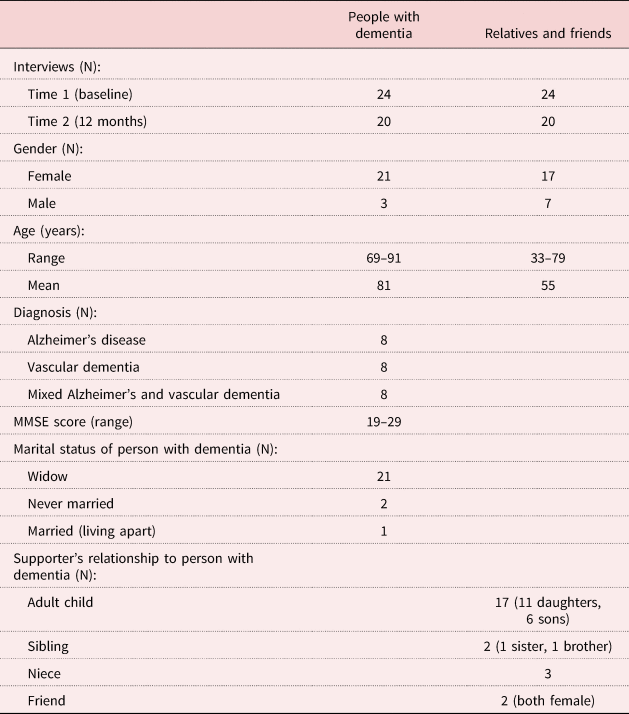
Twenty of the 24 dyads were interviewed twice, at baseline and 12 months later, and four at baseline only. Each member of the dyad was interviewed individually, giving a total of 88 interviews. The people living with dementia had all received an ICD-10 (International Classification of Diseases, 10th revision) diagnosis of Alzheimer's disease, vascular dementia or mixed dementia. They had Mini-Mental State Examination scores ranging from 19 to 29 which, for the purposes of the study, was defined as early-stage dementia (Folstein et al., Reference Folstein, Folstein and McHugh1975). The people who were supporting them included 22 relatives and two friends. Further details of the characteristics of the participants are summarised in Table 1. All the people with dementia were living alone at the time of the first interview, except for one person who was only living alone at the second interview, after his daughter had left home. At follow-up 12 months later, two people with dementia had moved into care homes. Over half the people with dementia lived in villages (N = 14) and the remainder in small towns in semi-rural areas of North Wales. Eight of their relatives and friends who supported them lived under one mile away, six lived under five miles away and six lived over 100 miles away (including two outside Wales).
Summary of dyad characteristics

Notes: N = 24. MMSE: Mini-Mental State Examination (Folstein et al., Reference Folstein, Folstein and McHugh1975).
Overview of themes
We begin by describing the future outlook of the people living alone with dementia in general and then their more specific hopes and fears for their future care and living arrangements, comparing their views to those of their relatives and friends. This is followed by an examination of how the participants approached the future, where we specify two broad temporal orientations: ‘holding on’ and ‘anticipatory acts’. The excerpts used to illustrate the findings have been anonymised and annotated as follows: ‘Per’ refers to a person living with dementia; ‘Rel’ or ‘Fr’ to a non-resident relative or friend; and ‘Int’ to interviewer. The unique identifier for the dyad is also shown after each quote. Material omitted from quotations is indicated by the use of ‘[…]’; ‘…’ is used before and after segments to indicate that the speech follows on from a longer turn or continues afterwards, and also between words to indicate hesitation before the speech runs on.
Future outlook
In general
When the people living alone with dementia were asked how they saw the future, several replied that they did not think about it much or look too far ahead. This view was consonant with the day-to-day approach to life that they also espoused, as the following excerpts illustrate:
Int: And what would you like to see in the future?
Per: (expulsion of air) N- I don't – don't think much from what's happening now, you know. (Person living with dementia, male, dyad 45)
Int: And how do you see the future?
Per: I don't. I live from day to day. (Person living with dementia, female, dyad 68)
Int: …Do you think about the future or do you talk about the future with your daughter?
Per: I don't think about the future, I take one day at a time and I'm enjoying life. (Person living with dementia, female, dyad 51)
When the people living alone with dementia did envision the future, some saw it as the same as (or no different to) the present:
Int: OK and how do you see the future?
Per: How do I see the future?
Int: Yeah.
Per: Yeah, yeah as well as it is now yeah.
Int: OK so you so what kind of things would you like to see in the future?
Per: Same as I see now. (Person living with dementia, female, dyad 5)
Int: OK, and how about the future, how do you see the future?
Per: I can't see much difference. I just carry on, aye. (Person living with dementia, male, dyad 75)
Only one person saw the future becoming worse, because of her condition:
Int: …how do you see the future?
Per: I see the future as being pretty hopeless really.
Int: So you don't think anything good's gonna come in the future?
Per: No. When I just think of things it'll get worse. I'd love to be able to have this new drug that they're talking about to be able to stop Alzheimer's. I would love to take that. (Person living with dementia, female, dyad 77)
When the relatives and friends of the people living with dementia were asked how they themselves saw the future, several also replied that they were taking things one day or one week at a time:
Int: …how you think things will be in the future?
Rel: I try not to think about that, actually. (laughs)
Int: Mm.
Rel: Yes, yes. So, uh, no, I just sort of take each day as it comes. I don't want to start worrying about the future. (laughs)
Int: Yeah.
Rel: I think when it happens then you start worrying. (laughs) (Daughter, dyad 51)
Rel: …I'd hate to think that she would forget who her family were. Uh … I don't know. I don't look to the future.
Int: Mm.
Rel: It's at the moment we take it day by day by day, week by week. And – and take what we've got while we've got it. (Daughter, dyad 64)
Occasionally, and in contrast, a few relatives or friends described possible future scenarios that they hoped or expected might happen. For example, one daughter outlined what she considered to be an ideal course of events:
Int: What kind of things you'd like to see in the future?
Rel: Oh … this is gonna sound horrible but […] so that I could get on with my own life the ideal scenario would be for a rapid deterioration and a funeral and then I could get on with my own life… (Daughter, dyad 3)
Another relative, a niece who lived over 100 miles away from her aunt, talked more expansively about different scenarios on a ‘long slippery slope’ that she had envisaged and their aftermath:
Int: And how do you see the future?
Rel: Um … right … well … I think it'll either go two ways um, either she will carry on here and we'll just – if we need – if she'll accept services in, as, I'm sure she will deteriorate even more. I've no illusions about her being, you know, suddenly getting better or anything like that, I appreciate we're on a long slippery slope type of thing um, as long as she's here – it'll either be she stays here and if we can get service – if she will agree to services coming in and she's safe in the house and every, you know, well within, within the bounds of what she is at the moment, then she will stay here until she dies.
Int: Yeah.
Rel: Or she will, you know, she might have a fall, and if that happens or she becomes unsafe in the house and has to go into care then I will take her into care in [city closer to niece] um, so that I can see her every day and make it easier, and then I would have the job of packing the house and selling the house and … paying the bills for her, but I've got the power of attorney to do that. (Niece, dyad 8)
In general, the relatives and friends were more negative about the future than the participants who were living with dementia, as they envisaged the decline of the latter and things becoming harder for both of them.
Most of the participants reported that they had not discussed the future together, preferring to take things as they came or to keep things ‘low key’:
Int: Good and do you talk about the future with [daughter]?
Per: No we don't, no we don't no, no.
Int: OK, OK.
Per: No. (Person living with dementia, female, dyad 86)
Int: And can I talk a little bit about um, what you see for the future, or do you and [son] ever talk about the future?
Per: No, not much. I don't like to think about the future (laughs). I try and treat things as they … come.
Int: Yeah.
Per: I'm a bit of a worrier so…
Int: OK.
Per: (laughs) I don't want to make it worse for myself. (Person living with dementia, female, dyad 9)
Int: And do you discuss the future with her?
Rel: No, I can't say that I have it's a day-to-day process at the moment.
Int: And how do you think she sees the future?
Rel: I dunno I don't ask them kind of questions. I just take a day-to-day, I don't want to sort of push her into thinking about where she's going. (Brother, dyad 1)
Rel: …we haven't discussed this [diagnosis] to be honest with you so I couldn't say for definite does she have a full realisation of the situation, probably she has um, but I haven't actually – I haven't – we haven't sat down as yet um … and talked about the future in, in any depth if you like, we try and keep it at a low key and try and keep things as normal as possible. […] I don't think she's wanted to discuss it, I don't know, but she hasn't – she hasn't offered any of that, you know and I … I've always been the person that I won't push a person to reveal it – if she wants to talk about it then she – she, you know, let her lead and … so. Because the last thing I'd try and do is put any pressure, just let her go along so … yeah. (Son, dyad 25)
Reflecting on why they did not talk about the future, two relatives said that they had tried but that the people living with dementia were unwilling to engage with them on the topic:
…I've tried broaching the subject that maybe she needs to start thinking about going into a residential home to be told ‘No’. (Son, dyad 54)
…[I have tried to talk to her about this] but she just sort of like wants to shut off, when I start mentioning that she doesn't want to know. (Daughter, dyad 66)
Care and living arrangements
Although the people with dementia spoke of living a day-to-day existence and not looking too far ahead, they also expressed their hopes and fears in the course of the interviews, in this way providing insights into the nature of their future outlook and preferences. Their hopes and fears mainly concerned their future care and living arrangements. A common theme was that they wanted to stay living at home independently and/or did not want to move to a care home and/or hoped they would be able to die at home, as the following excerpts illustrate:
Int: What kind of things would you like to see in the future?
Per: Oh, I'm not particularly bothered now at my age, [I] just take every day as it comes yeah. Only I hope I won't get ill and have to stay in bed or have to go into hospital. I hope I'll be able to finish my days here. If at all possible. Yeah. (Person living with dementia, female, dyad 80)
Int: Yeah. So do you ever think about the future?
Per: Mm … Well, the odd occasions I thin, wonder what would happen, but, uh … I just hope that I die before anything gets too bad and, uh, you know, I don't want to be a nuisance to anybody and I wouldn't want to be, be put away in, in a home or anything like that. As long as I – my main aim is to be independent and, uh, you know, look after myself. (Person living with dementia, female, dyad 51)
Per: …because I said, ‘I never want to go into a home.’ And [daughter] said, ‘Well, it might come to the point where you can't look after yourself, and you'll have to go into a home.’ I said, ‘I never will. I don't want to, and I don't want anybody to put me in a home.’ And I'll be honest, I never said this bit to [daughter], but I'm rather top meself than go into a home.
Int: That's how you feel? Yeah.
Per: I'm adamant I don't want to do that… (Person living with dementia, female, dyad 64)
Int: OK, so I'm guessing you, you don't talk about the future with them or kind of talk about what's, how they're feeling about things?
Per: Oh, we have – I told them in the – I said, ‘When anything happens to me’ no what was it, talking about things weren't they, about mov-, you know, different houses, I said, ‘Eh, the only time you'll get me out of this house’, I said, ‘is in a wooden box.’ I said, ‘I like my house and I am not moving.’ Oh, I love it, I love living here, yeah, yeah… (Person living with dementia, female, dyad 86)
Int: …how you see the future or do you and [daughter] ever talk about the future?
Per: Mmm, well we haven't actually. I – it's just keep hoping that I can stay long enough y'know without going to the stage where I have to go in a home but if it does happen I'll have to go won't I? (Person living with dementia, female, dyad 66)
As in the last case, three other people living with dementia accepted that they might have to move into a care home if they became too ill, although this was not their desire. Three more stated that they would like to move in with, or closer to, their relatives (although it was not always clear if this also meant moving to a care facility or not).
In their interviews, several relatives and friends also described being aware that the people living with dementia did not want to move to a care home, go into hospital or leave their home, for example:
She doesn't want to go into hospital because she doesn't want to … sort of be messed around anymore. And I think she'd hate to be in one of those homes … I think she likes to be independent. But again, she doesn't really say much, too much about it. (Daughter, dyad 14)
…she does get annoyed when the OT [occupational therapist] checks on her and … she doesn't want a home help, she doesn't want to go in a home big time, she does not want to go in a home, but she doesn't want a home help, she doesn't want somebody coming in and cooking a meal for her … she wants to do what she wants to do and she wants to do it when she wants to do it … and she wants to remain independent… (Son, dyad 54)
Rel: She says want to die here, want to stay here.
Int: She wants to stay at home yeah.
Rel: Yeah she says she don't want to lose like her independence. (Son, dyad 80)
An exception was one relative who reported that her father (dyad 45), who was living at home with one of his daughters at the time of his first interview, did not want to live alone when she moved out; he preferred the idea of living in an environment where there was a communal kitchen where he could socialise. However, 12 months later, when he was living alone at home, his relative reported that he was content with the arrangement.
While all the relatives and friends were supporting the desire of those living alone with dementia to stay at home, one thought that her sister should be living in a care home already. Others expressed uncertainty over how long the person with dementia might be able to continue living at home alone, and whether – and when – to intervene and escalate care at home or facilitate a move to another domestic residence or type of care facility. For example, one daughter described her dilemma regarding her father's status thus:
Int: How aware do you think he is of the changes?
Rel: Erm … I think at the moment he's at the stage where he thinks they're just blips … so this incident with the car, for example, the incident with the tablets, he thinks they're just blips and he's hoping that he is just a blip and he can carry on erm … but it's … it's quite a fragile, vulnerable stage really because I don't want to rush in and start taking over too much before he's ready, you know, before he's … he can't do it himself, but I don't want him to get into … I don't want him to hurt himself by having an overdose, I don't want him to have a bad accident or hurt somebody else on the road, so it's a … it's a really vulnerable kind of … difficult state to be really because I don't quite know where to … you know, when to start wading in… (Daughter, dyad 31)
One relative hoped that she would be told by formal carers when the time was right for her aunt to move:
…and so I hope that when the time comes – whenever that's going to be – which is why we've got the carers [i.e. care workers] in – that they will know what they're looking for. She has put – you see she has put the kitchen on fire once, and things like that, so I'm not really sure what point it is where you say right, that's enough but I don't think it's yet … because I don't want to upset her – why would she want to go to an EMI [elderly mentally infirm] unit now? So I don't know what to expect, I think, you know, when she goes wandering around in a nightie or something – I don't know what to expect, I've no idea. I'm hoping these carers [i.e. care workers] will tell her, and the social worker rings me every now and again […] I feel there's the support there and they will tell me – because they're there twice a day – they will tell me … if there's anything I need to worry about … I think. I hope. (Niece, dyad 19)
Similarly, other relatives and friends indicated that the timing of decisions about whether and when to move was critical, because they thought it might become more difficult over time, or the balance of potential gains and losses changes. For example, one daughter accepted her father's decision to stay living alone rather than move to supported accommodation while noting that now might be a better time to move rather than later:
Rel: …He said he's quite happy, he's quite settled at the moment.
Int: Yeah.
Rel: Although in a sense the best time would be to organise things now…
Int: Right, yeah.
Rel: …rather than when he needed it.
Int: Yeah.
Rel: But he says he's quite content with the way things are. (Daughter, dyad 45)
In another case (dyad 8), an aunt and her niece had talked about the possibility of moving to an apartment, but the niece thought it would be ‘a change too much’ for her aunt and of no advantage to them as long as she could continue travelling to visit her. Finally, one son thought that his mother was becoming increasingly unhappy at home and wanted to move. However, he did not think that moving now was a good idea, because he thought his mother would lose her familiarity with her home environment, whereas he believed it would have made sense two or three years ago, but his mother did not want to move then:
…It gets me frustrated, erm, because I can't full-, get her to fully understand the argument of staying here and she's, ’cos she is familiar with her surroundings and everything and it would be foolish for her to even start contemplating. Er, something else, yes, it would make sense had we gone along this road sort of two or three years ago, er, but unfortunately, er, we couldn't at the time. She didn't want at the time and by now I think that's, that's not an option but it is something that is frustrating her, I think it, it does get her down. (Son, dyad 25)
These accounts indicate some of the difficulties that relatives and friends can face in supporting the wishes of those living with dementia to stay living at home, while simultaneously being cognisant of the potential threats to, or precarious state of, their existing arrangements. In the next section, we look at how this was manifest in the different ways in which the participants approached the future.
Temporal orientation
In our further examination of how the participants lived in relation to their future outlook, we found two broad temporal orientations similar to those previously outlined by de Witt et al. (Reference de Witt, Ploeg and Black2010) and Anderson (Reference Anderson2010), respectively. In the first, as we show below, the emphasis is on ‘holding on’ to the present and extending it into the future, by keeping continuity. In the second, different ‘anticipatory’ strategies are adopted to either prolong existing living arrangements by making adaptations to forestall bigger changes, or to prepare for and facilitate future change that is more transformative.
Holding on
The people living with dementia tended to adopt a holding orientation to time. As we have seen, they approached life on a day-to-day basis, not looking too far ahead, occupied with now. They also talked about wanting to keep managing on their own for ‘as long as’ they could, often adding a modifier to this phrase indicating what it was – a rule or condition of some sort – that justified them continuing as they were. For example, as we show below, the people living with dementia suggested that they would be able to manage ‘as long as…’ they were healthy enough, their memory was good enough, they could manage with activities of daily living, their family stayed in touch and things were going along alright:
Int: And how do you think you've reacted to your changing memory?
Per: Well … I feel quite happy with myself because I can still do the things that I want to do and um, as long as I've got my list that I know I've done them then I know … that I've done them… (Person living with dementia, female, dyad 8)
But I'm coping, and that's the main thing, as long as I can cope. I'm, uh, I don't sort of give in to it and say, oh, you know, I can't do this, and I can't… (Person living with dementia, female, dyad 51)
…as long as they keep in touch that's all that matters but… (Person living with dementia, female, dyad 68)
As long as I've got my books. (Person living with dementia, female, dyad 1)
As long as I remember what day it is. (Person living with dementia, female, dyad 4)
Int: How do you describe your memory problems, what do you think causes it?
Per: I honestly don't know, I've no idea and I'm not really worried about it as long as everything is going alright. (Person living with dementia, female, dyad 86)
Some of the relatives and friends adopted a similar holding approach to time. For example, they talked about how they were planning to maintain those they supported in their own home, and/or wanting them to have a normal life, for ‘as long as possible’:
Yeah, me and my sisters, we've decided that as long as possible we're going to keep her in her own home. (Daughter, dyad 3)
Because I keep saying to her, I don't want you not to go out during the day, if you just, kind of listen and go for the right bus and you know, ’cause you want her to try and have as normal a life as possible really don't you for as long as she can. (Daughter, dyad 5)
I come and stay occasionally, I'm, I'm, I'm loathe to do it on a regular basis because, erm, I'm trying to keep things as normal as possible as long as possible. (Son, dyad 25)
The relatives and friends also used modified versions of the ‘as long as’ expression. They referred to the same kinds of rules and conditions as the people living with dementia, as well as adding others. These concerned the safety of the person they supported and others, the nature of their relationship, and their own capacity to continue visiting and providing the level of support that enabled the people with dementia to keep living alone:
I don't know what I'm expecting actually but I know that she's going to end up going to a home, she'll have to, but as far as I'm concerned if she can manage to stay where she is and she's happy in her own world, and so long as she – she's not harming anybody else and as long as she doesn't come into any harm herself its best that she stays there as long as possible… (Niece, dyad 19)
She's fine. She's f- she's a very stubborn person. As long as we do what she wants to do (laugh) come what may (joint laughter). (Female friend, dyad 77)
…and it [aunt moving closer to her niece] wouldn't – it wouldn't be an advantage so as long as I can get here, she's better here. (Niece, dyad 8)
The relatives’ and friends’ holding orientation to time was also evident in the watchful waiting approach that some of them described. This was where they were monitoring the situation of the person living alone, ready to react to events and intervene if the need or opportunity arose:
Rel: …I'd like to try and get her to have some help in the house, because I'm not here and I can't see her every day, but she won't have it and I can't force that and I do respect … she still has her own views and feelings and I, I guess I'm going along the lines of … when something happens then that's when I can actually do something–
Int: Make…
Rel: –make a decision and do it, if, if things are moving along as – as they are, touch wood, things are kind of moving OK, and she's managing at home, and I see her about once a fortnight – I speak to her every day, I can tell on the phone whether she's up or down–
Int: Yeah.
Rel: –um, and if she's not very good I'll ring her two or three times, you know, to sort of stay in touch um, so I try and monitor it kind of as much as I can and when – if something happens and she – she fall – say for example she falls, then in a way that gives me the opportunity to say right we need to do this now–
Int: Yeah.
Rel: –and I'm doing it because something's happened not because I'm just telling her I want it to be done. (Niece, dyad 8)
Rel: And so, if I felt she was really struggling, I'd say, you know, ‘Do you think you're finding it very difficult?’
Int: Mm.
Rel: But I think I'll just wait until I think that's happened.
Int: Yeah, exactly, yeah. Engage at the time.
Rel: Yeah. I think we're just going to go along, see how things go. I mean, we can build up, you know – when she came out of hospital, we cut down the help after a bit.
Int: Yeah.
Rel: We could build it up again. (Niece, dyad 37)
The relatives and friends also provided further information on the attitudes and strategies of the people living with dementia, including their resistance to further help or change, which was consistent with a holding orientation to time. For example, they reported that the person they supported was refusing home help or had initially been reluctant to go to day care. Another relative described how his mother was self-limiting her behaviour by not having weekend breaks away at her son's house, in order not to lose her independence.
Anticipatory acts
While a holding orientation to time was predominant among both the people living with dementia and their relatives and friends, we also found some evidence of alternative ‘anticipatory’ strategies being espoused by them which, following Anderson (Reference Anderson2010), we refer to as ‘pre-emptive’ and ‘preparatory’ approaches.
Unlike the more conservative ‘holding’ orientation to time, where the emphasis is on maintaining continuity, regularity and stability in existing arrangements in order to preserve the status quo, pre-emptive acts are a more adaptive approach to sustaining arrangements. Small changes may be made in order to forestall bigger and less-desired change, such as a move to a care home. Examples of this approach were described by several relatives and friends in our study and have been previously observed in other work (e.g. Ashworth, Reference Ashworth2020). They included increasing levels of care at home and taking measures to help those with dementia retain their independence and skills. Relatives and friends also described making or planning adaptations to the home, such as having an alarm installed to alert them to any night-time wandering, getting sensors fitted in the kitchen for safety, introducing memory aids and getting the person with dementia to wear a pendant alarm. One relative also talked about taking precautions, such as removing cheque books and bank cards from the person with dementia to reduce the risk of them being lost, stolen or misused. A few had also altered the frequency and duration of their visits or were sleeping over on occasions (or considering this), although not too often so as to keep things ‘normal’.
In contrast, preparatory acts involve planning for future eventualities and their aftermath. We found much less evidence of this approach being adopted. As we have already seen, most participants reported that they had not talked about the future together, although some of the relatives (but none of the people living with dementia) mentioned in passing that they had power of attorney, so it was unclear to what extent they had made any plans jointly. However, two people living alone with dementia referred to conversations that they had had with their relatives about their future care and living arrangements. For example, one person described how she had anticipated her future reaction to being told she needed to go into a care home and had attempted to make the decision easier for her relations:
Int: And do you think erm do you think living by – living on your own is a disadvantage of it?
Per: Not living on my own no. But will I ever be able to go on living on my own? I've always said to my children don't take any notice of what I say when I'm old, take notice of what I'm saying now and that is if ever I get to the stage where you think I should be in a nursing home put me into one. No matter how much I might say don't put me into a nursing home ’cos I don't want them to have to be worried about what I'm doing and where I'm going. Whether I'm going out and getting lost and things like that. (Person living with dementia, female, dyad 77)
Similarly, another person living alone with dementia reported that her family was aware of her views about the future, while intimating that she did not want to worry them about it:
Per: And they just – it must be quite frustrating for the family as well, but I just worry about what is going to happen to me because I don't think it's right to go and live with your family if you're in need. ’Cos as I said I looked after my aunt and my mother and it's not easy. So I, I do think about what could happen and I've always said, you know, right from the word go, never have me to live with you because – so it's whatever happens.
Int: So say, do…
Per: Just keep managing on my own as long as I can.
Int: And do you – do you discuss the future with your sons?
Per: Oh well they know. Oh no I haven't (huh). I don't – I try not to worry them about it because it's difficult for sons, they have wives to look after and it's, it is hard. (Person living with dementia, female, dyad 68)
Only one relative, a niece, reported having discussed and planned her aunt's future care and living arrangements with her in depth:
Int: How does she see the future, and do you talk to each other about the future?
Rel: We do. We talk – we talk about – I talk, she doesn't talk about it that – that stage of the relationship has kind of gone in a way, that's where she doesn't have conversation. Previous to – when she first made the power of attorney, and we've talked before she's got … to this sort of stage that – we've always said that if ever she was unable to look after herself I would take her from here and … take her to where – [city]…
Int: To [city], yeah.
Rel: …um, and she was always happy – and her reaction to that was well if I haven't got my marbles anyway, I won't know where I am – whether I'm here or there.
Int: Right.
Rel: Which is, you know – and she's very practical, she has got a sense of humour – she does have a sense of humour, um, she's um … so we have talked about it and even, you know, sort of today she'll say ‘Oh I wish you were a bit nearer’ and I've said to her ‘If you want to move I will move you’, its daunting but I would move her… (Niece, dyad 8)
Finally, another example of preparatory thinking was provided by two relatives who described how they had made some plans surreptitiously, having looked at care facilities without telling the person they supported. A third was also secretly preparing her sister for such a move by sending her to a care home for respite, while at the same time continuing to help provide care workers at home, so that her sister could remain there until she became unaware of where she was, implying this would be less distressing for her.
Discussion
This study has provided some rare insights into the future outlook and temporal orientation of people living alone with early-stage dementia and their non-resident relatives and friends. We have added to previous work by describing a holding orientation to time espoused by both people living alone with dementia and their relatives and friends. We also found Anderson's (Reference Anderson2010) work on anticipatory acts to be useful for specifying some of the alternative ways in which those supporting people living with dementia also approached the future in this study. These findings are likely to have wider relevance to people with early-stage dementia who live with a spouse or other relatives in the community. The future outlook of those who do and do not live alone is likely to depend on a number of factors, not just residential status, although as we have seen, this is important to the latter. Whether they share the same hopes and fears, or have others relating to their particular circumstances, they and their relatives and friends are likely to approach the future in broadly similar ways, by holding on to aspects of the present that are valued, and by holding off anticipated threats and/or planning to mitigate the threats. People living with dementia and their relatives and friends may need support to facilitate the future they wish for, and to adapt to changes that they may or may not anticipate or desire.
The people living alone with dementia in our sample were not as negative or fearful in their outlook as reported in previous studies of those who either live alone (de Witt et al., Reference de Witt, Ploeg and Black2010) or with a spouse (Hellström and Torres, Reference Hellström and Torres2014). While the people living with dementia were reticent about the future, they nonetheless shared their hopes and fears in the course of the interviews. These findings were similar to those of de Boer et al. (Reference de Boer, Dröes, Jonker, Eefsting and Hertogh2012), except that the people with dementia in our study talked more about their wish to stay living at home, possibly reflecting their vulnerable residential status in living alone rather than with a spouse or other relative, and desire to maintain their associated level of independence and autonomy. Other factors may also have contributed to the perceived vulnerability and independence of the people living with dementia in our sample, such as 21 having been widowed; a number of their relatives were adult children or nieces, some of whom had young families of their own who they also cared for; and six were being supported by a relative living over 100 miles away.
There were some notable commonalities in the future outlook of people living alone with dementia and their relatives and friends who supported them. In their separate interviews, they both claimed to be living a day-to-day existence and making the most of now. They did not tend to look too far ahead or to talk about the future together. Also they both justified the person with dementia continuing to live at home ‘as long as’ certain key conditions prevailed. These findings add some support to the case made by de Boer et al. (Reference de Boer, Dröes, Jonker, Eefsting and Hertogh2012) and Ashworth (Reference Ashworth2020) that the tendency for people with dementia to focus on the present and to take things one day at a time can be partly interpreted as a response to the perceived threats posed by dementia and a way of coping with them, and not just due to neurological changes that can affect their ability to imagine the future. The participants also commonly focused on continuity rather than change in the living arrangements of the people living with dementia. This may be related to their mutual desire to maintain the autonomy and identity of the people living with dementia, for example, through staying connected with known places, routines and recognisable things in a familiar environment. It may also reflect a reluctance on either part to countenance or engage much with undesired scenarios that might induce distress in the present order. However, this way of coping in the here and now may also make it more difficult for some people living with dementia and their relatives and close friends to subsequently adapt and upscale care arrangements when the condition progresses or other factors change (such as a deterioration in any other conditions the person with dementia may have that affect their ability to stay living in their current home, or decline in the capacity of the people supporting them to continue to help them to live there).
There were also some important variations in the future outlook and temporal orientation of the participants. The relatives and friends of the people living with dementia tended to be more negative in their outlook. Occasionally, they depicted future scenarios that they had imagined, which were absent from the accounts of the people living with dementia. They were also more likely to describe taking anticipatory actions in the form of pre-emptive measures to escalate care at home, although they also expressed a holding orientation to time, e.g. taking a day-by-day approach and watchfully waiting from a distance. Some relatives and friends appeared to be caught on the cusp of these different approaches, unsure when to switch from a predominantly holding position to one of escalating care at home or facilitating a move away from home (acts which were at odds with the common outlook and orientation of the people living with dementia). These tensions may well contribute to the stress and poor outcomes known to be experienced by those who support people living with dementia (see Gilhooly et al., Reference Gilhooly, Gilhooly, Sullivan, McIntyre, Wilson, Harding, Woodbridge and Crutch2016).
These findings raise questions for policy and practice about how people with early-stage dementia who live alone can be supported to stay living at home, in accordance with their wishes, while simultaneously enabling them and their non-resident relatives and friends to plan for and make changes to their care and living arrangements, if and when required. Thus, on the one hand, people living alone with dementia may need support to maintain and sustain existing arrangements, for example, developing habits and routines, and preserving continuity and familiarity by keeping things constant. On the other hand, they may also need help to develop their adaptive capacity and resilience to better cope with alterations to their care at home, and with any planned and unplanned changes in schedules and environments, such as moving to live closer to relatives or friends, going to day care, being admitted to hospital for scheduled or unscheduled care, and subsequent discharge back home or to another location. These different approaches may be difficult for people living with dementia to reconcile and for their relatives and friends to promote. More generally, the findings highlight a need for policy and practice to be cognisant of the complex and dynamic relations between time and space that may influence people's individual care and support needs across the lifecourse and generations.
Our study has some limitations as well as strengths. The findings are based on a secondary analysis of qualitative data from a study where future outlook was not the primary topic of interest, and so we had to work within the boundaries of the given data. The data-set did, however, have the advantage of being comprised of separate interviews with people living with dementia and their relatives or close friends, whereas the findings from previous related research have often been based on the analysis of joint interviews, where there is potential for one participant's views to dominate or mirror the other's in this context. We also chose to focus on people with dementia who lived alone and their non-resident relatives and friends, whose hopes and fears mostly concerned the former's future care and living arrangements, which may be different to those in other circumstances. It is, however, important that the experiences of this growing and under-researched population are better understood. The views and strategies adopted by the participants in our study are also likely to reflect in part the organisation and culture of care for older people, and public attitudes to where people want to live as they age and die, and to advance care planning, where the sample lived. Finally, the study was strengthened by being a collaboration between members of the primary study team and an independent researcher, combining the inside knowledge of the former with the distance and additional disciplinary and methodological expertise of the latter (Mason, Reference Mason2007).
Further multi-disciplinary and longitudinal research is required to specify the nature of the future outlook and temporal orientation of people living with dementia at various stages, in different residential contexts, and how these compare to their relatives and friends, as well as to people with other conditions and the general population across the lifecourse. This could include a focus on how the future outlook of different groups of people living with dementia relates to their present sense of wellbeing, how it changes over time, and the advantages and limitations of different types of holding and anticipatory strategies. A better understanding of these matters is needed to inform the development of health and social care interventions for people with dementia who live alone in the community, to promote their independence, care and wellbeing by respecting their wishes and mitigating their fears as far as possible, and to support their non-resident relatives and friends in this quest.
Data
For ethical reasons, the research data supporting this publication are not publicly available.
Author contributions
JH conceived and carried out the secondary analysis and was not involved in the original study. LC led the original study, which was carried out with the other co-authors. AM and SMN carried out the interviews and provided socio-demographic information on the sub-sample. All the authors commented on earlier drafts of the analysis and reviewed and approved the final manuscript prior to submission.
Financial support
The collection of the original MIDAS data-set was funded by the Economic and Social Research Council (grant number RES-062-23-0371). This secondary study received no additional funding.
Conflict of interest
The authors declare no conflicts of interest.
Ethical standards
Ethical approval for the original data collection was granted by Wales REC 5 (Ref 05/WNo0145) and the same REC agreed to the secondary work being carried out by the team and the new investigator using anonymised data.