Implications
Tunisian consumers prefer traditionally the native Barbarine lambs fattened on pastures of arid and semi-arid regions. Meat could be different and healthier than other products obtained especially from the indoor system. Therefore, it can be classified among traditional products that can have a quality certificate. Delivering a quality sign for Barbarine lamb fattened on pasture could promote this production system and motivate breeders to maintain it. In fact, changes in agricultural practices and overgrazing have caused natural pasture degradation and farmers to increasingly adopt the indoor system.
Introduction
Fattening lambs on concentrate is known to increase carcass yield (Papi et al., Reference Papi, Mostafa-Tehrani, Amanlou and Memarian2011) and also carcass fatness (Papi et al., Reference Papi, Mostafa-Tehrani, Amanlou and Memarian2011; Majdoub-Mathlouthi et al., Reference Maiorano, Ciarlariello, Cianciullo, Roychoudhury and Manchisi2013). In addition, meat of lambs fattened intensively have a low polyunsaturated fatty acids/saturated fatty acids ratio (PUFA/SFA) and high n-6/n-3 ratios (Wood et al., Reference Wood, Richardson, Nute, Fisher, Campo, Kasapidou, Sheard and Enser2008). In contrast, fattening lambs on grass was actually recognized as having beneficial effects on nutritive and sensorial meat quality (Wood et al., Reference Wood, Richardson, Nute, Fisher, Campo, Kasapidou, Sheard and Enser2008; Shingfield et al., Reference Shingfield, Bonnet and Scollan2013). In fact, grazing seemed to increase the supply of PUFA, particularly n-3 fatty acids and longs n-3PUFA. EPA, DPA and DHA are considered as essential nutrients for normal growth. They contribute to the development of infant brain and liver and prevention of certain diseases, in particular cardiovascular disease risks and cancer (McAfee et al., Reference Majdoub-Mathlouthi, Saïd, Say and Kraiem2010). The improvement of carcass fatness and nutritional meat quality when using grass can be associated with lower energy supply and average daily gain (ADG) of grazing lambs compared with lambs reared indoors on concentrate (Aurousseau et al., Reference Aurousseau, Bauchart, Calichon, Micol and Priolo2004). In several studies, it has been difficult to discriminate between the effect of the feeding system and those of energy intake level and ADG (Murphy et al., Reference Murphy, Lorech, McClure and Solomon1994; Borton et al., Reference Borton, Loerch, McClure and Wulf2005; Karim et al., Reference Karim, Kuldeep, Suresh and Singh2007; Maiorano et al., Reference McAfee, McSorley, Cuskelly, Moss, Wallace, Bonhan and Fearson2009). Only few studies have reported the strict effect of the feeding system on carcass quality (Priolo et al., Reference Priolo, Micol, Agabriel, Prache and Dransfield2002) and fatty acid composition (Aurousseau et al., Reference Aurousseau, Bauchart, Calichon, Micol and Priolo2004). Irrespective of growth level, Aurousseau et al. (Reference Aurousseau, Bauchart, Calichon, Micol and Priolo2004) reported that composition of fatty acids was better for lambs reared on pasture than those fattened on concentrate. Moreover, the effect of pasture on fatty acid composition could be associated with the pasture floristic composition and with their richness in secondary compounds (Vasta et al., Reference Vasta, Mele, Serra, Scerra, Luciano, Lanza and Priolo2009; Lourenço et al., Reference Lourenço, Ramos-Morales and Wallace2010). Shingfield et al. (Reference Shingfield, Bonnet and Scollan2013) reported an effect of both forage species and conservation method on fatty acid composition. Some studies have reported the effects of some fodder shrubs such as Acacia or Atriplex used to improve rangeland (Ben Salem et al., Reference Barcelo-Coblijn and Murphy2008). However, no studies exist on the effects of natural Mediterranean dry rangeland and natural shrubs on the meat quality and the fatty acid composition in Barbarine lambs.
Thus, in this present study, we aimed to compare carcass traits and meat quality of Barbarine lambs reared on a rangeland of the semi-arid region with those reared indoors and fed hay and concentrate.
Material and methods
The animal experiment was conducted in accordance with the principles and specific guidelines presented in Tunisian law no 2005-95 (18 October 2005) concerning breeding and slaughtering.
Experimental design and animal management
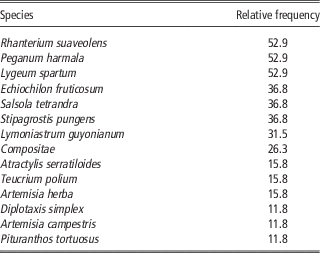
The trial was carried out in the farm of Touila, Sidi Bouzid, located in the center of Tunisia, where the climate is semi-arid to arid (200 to 300 mm). A total of 24, 6-month-old, weaned male Barbarine lambs of an average BW of 23.2±0.38 kg were randomly selected from a herd of 150 heads. Before weaning, lambs grazed with their mothers on natural pasture. They were then allotted into two groups. The first group (GS) grazed natural pasture from March to October and was supplemented with 100 g of a commercial concentrate composed of 53.5% corn grain, 16.5% soybean, 25% wheat bran and 5% mineral–vitamin supplement. The concentrate supplied 185.6 g of CP, 52 g of crude fiber (CF) and 2.91 Mcal of metabolizable energy (ME) per kg of dry matter (DM). During the spring (March to June), a total of 14 range species are observed, and among those Rhanterium suaveolens, Peganum harmala, Lygeum spartum, Echiochilon fruticosum, Salsola Tetrandra, Stipagrostis pungens and Lymoniastrum guyonianum are the most dominating species (Table 1). Species frequency was determined according to the method of Gillet (Reference Gillet2000). No annual herbaceous species were found due to scarce rainfall. During the summer period (July to August), lambs had also access to barley stubble, in addition to the natural pasture. During September and October, lambs had only access to natural pasture with the concentrate supplement. The second group (HS) was housed indoors and received chopped oat hay (37.5 g CP/kg DM; 369.8 g CF/kg DM; 1.71 Mcal ME/kg DM) ad libitum and the same commercial concentrate. Concentrate supply was limited and adjusted every 15 days in order to obtain the same ADG as the first group. Concentrate supply for this group was from 200 to 300 g/day. Lambs had free access to water. Lambs were individually weighed before receiving the meal of the morning, at the beginning of the trial and every 15 days during the trial. At the end of the trial, the lambs were 14 months old and had approximately an average final BW of 40 kg.
Floristic composition of the natural pasture

Slaughter procedure, carcass measurements and dissection
The day before slaughtering, six lambs from each group, randomly identified at the beginning of the trial, were weighed. They were then fasted for 12 h with free access to water and transported to a commercial slaughterhouse. The slaughterhouse was located 190 km away from the farm. Just before slaughtering, they were re-weighed. Lambs were slaughtered according to the Muslim practice and under veterinarian supervision. Hot carcass, offals (liver, heart, lungs and empty digestive tract) and gastrointestinal content were weighed. Dressing percentage was determined as the rate of hot carcass weight over empty BW. Viscera proportions were expressed in relation to pre-slaughter BW. Carcasses were chilled at 4°C for 24 h and then re-weighed. Kidney, perirenal fat, testis and tail were removed and weighed. Carcasses were split along the midline. The left sides were separated into seven cuts (Fisher and De Boer, Reference Fisher and De Boer1994). Proportion of higher-priced joints (leg+shoulder+loin) was determined. All the joints were de-boned to evaluate carcass meat yield; shoulder was dissected into fat, bone and muscle. Fat thickness was measured as described by Fisher and De Boer (Reference Fisher and De Boer1994). Leg and carcass compactness was determined as described by Majdoub-Mathlouthi et al. (Reference Maiorano, Ciarlariello, Cianciullo, Roychoudhury and Manchisi2013).
Meat quality
The pH of the longissimus thoracis muscle was measured 24 h postmortem using a pH meter WTW-340 (WTW, Weilheim, Germany), equipped with a penetrating electrode (pH senTix 6, sp). The color of the longissimus lumborum muscle was determined 24 h after slaughter by a chromameter (CR-401, Minolta Ltd, Japan) using the CIE L* a* b* system (Commission internationale de l’Eclairage, 1986) and the D65 illuminant. Muscles were maintained at 4°C and exposed to air for 10 min before determining the color (Kirchofer et al., Reference Kirchofer, Calkins, Burson and Eskridge2002). Subcutaneous fat color was determined over the lumbar region just on the surface.
Longissimus lumborum was dissected to eliminate subcutaneous fat, ground and frozen at −20°C for chemical analyses. DM, CP and total ash were determined according to Association of Official Analytical Chemist (1995) methods. Fat and fatty acid composition were determined as described by Majdoub-Mathlouthi et al. (Reference Maiorano, Ciarlariello, Cianciullo, Roychoudhury and Manchisi2013). Thrombogenic index (TI) and atherogenic index (AI) were calculated as reported by Ulbricht and Southgate (Reference Ulbricht and Southgate1991):
 $$\eqalignno{ & {\rm TI}=({\rm C14}\!:\!0{\plus}{\rm C16}\!:\!0{\plus}{\rm C18}\!:\!0)/(0.{\rm 5}\,{\times}{\rm MUFA}{\plus}\atop0.{\rm 5}\,{\times}\,{\rm n}{\hbox{-}}{\rm 6}{\plus}0.{\rm 5}\,{\times}\,{\rm n}{\hbox{-}}{\rm 3}{\plus}{\rm n}{\hbox{-}}{\rm 3}/{\rm n}{\hbox{-}}{\rm 6}) \cr & {\rm AI}=({\rm C12}\!:\!0{\plus}{\rm 4}\,{\times}\,{\rm C14}\!:\!0{\plus}{\rm C16}\!:\!0)/\atop\quad\quad\quad\quad({\rm MUFA}{\plus}{\rm n}{\hbox{-}}{\rm 6}{\plus}{\rm n}{\hbox{-}}{\rm 3}) $$
The activity of Δ5 desaturase plus Δ6 desaturase, enzymes implicated in the formation of long PUFAs from C18:2n-6 and from C18:3n-3, was estimated according to the equation proposed by Dal Bosco et al. (Reference Dal Bosco, Mugnai, Roscini, Mattioli, Ruggeri and Castellini2014):
 $$\Delta ^{5} \,{\rm desaturase}\,{\rm and}\,\Delta ^{6} \,{\rm desaturase}\,{\rm index}=\left[\hskip-2pt \matrix{ ({\rm C}20\!:\!2{\rm n}{\hbox{-}}6{\plus}{\rm C}20\!:\!4{\rm n}{\hbox{-}}6{\plus}\cr{\rm C}20\!:\!5{\rm n}{\hbox{-}}3{\plus}{\rm C}22\!:\!5{\rm n}{\hbox{-}}3{\plus}\cr\ {\rm C}22\!:\!6{\rm n}{\hbox{-}}3) /({\rm C}18\!:\!2{\rm n}{\hbox{-}}6{\plus}\cr{\rm C}18\!:\!3{\rm n}{\hbox{-}}3{\plus}{\rm C}20\!:\!2{\rm n}{\hbox{-}}6{\plus}\cr{\rm C}20\!:\!4{\rm n}{\hbox{-}}6{\plus}{\rm C}20\!:\!5{\rm n}{\hbox{-}}3{\plus}\cr\ {\rm C}22\!:\!5{\rm n}{\hbox{-}}3{\plus}{\rm C}22\!:\!6{\rm n}{\hbox{-}}3) \hfill \cr} \hskip-2pt\right]{\times}100$$
Statistical analyses
The GLM procedure of Statistica (version 5.5, StatSoft, Tulsa, OK, USA) was used. The model included the feeding system as the fixed factor. Individual lamb was considered as the experimental unit. Values are given as means. SEM was used as the error term. Differences among means were determined using the Fisher test and were considered to be significant when P⩽0.05.
Results and discussion
Growth performances, carcass and offals composition
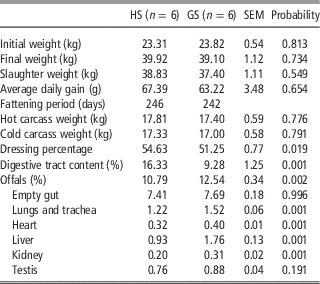
Lambs reared indoors and those reared on pastures had similar (P>0.05) ADG and slaughter weight after a 244-day fattening period (Table 2). The ADG averaged 65 g/day, which was relatively low due to the pasture quality and due to the low concentrate supplementation. In this trial, we limited concentrate supply to the indoor lambs in order to obtain similar ADG between lambs reared on pasture and indoor. Differences noted for carcass and meat quality can be mainly explained by only the effect of feeding system. Feeding system did not affect hot and cold carcass weights. However, dressing percentage was 3.4% lower (P<0.01) for lambs reared on dry pasture, because of a lower gut content (P<0.001). Offals percentage of the GS group was 1.7% higher (P<0.01). The GS group had higher (P<0.001) lungs, heart, liver and kidney percentages. In fact, grazing lambs had greater physical activity, and probably higher respiratory activity, which could explain the higher percentage of lungs and trachea and heart. Liver and kidney activity was probably higher for animals grazing on natural plants, of which some could contain undesirable compounds. Karim et al. (Reference Karim, Kuldeep, Suresh and Singh2007) also reported a higher liver percentage for grazing lambs than that for the stall lambs.
Effects of the feeding system on growth and slaughter performances in Barbarine lambs

HS=hay supplemented with 200 to 300 g of concentrate; GS=grazing supplemented with 100 g of concentrate.
Carcass fatness, conformation and tissue composition
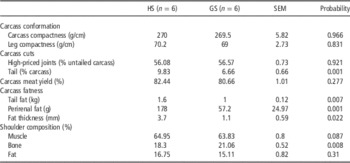
The feeding system (indoors v. grazing) did not affect (P>0.05) high-priced joints percentage (Table 3) and the meat proportion in the untailed carcass. Carcass meat yield averaged 81.55%. Moreover, carcass and leg compactness were not affected (P>0.05). However, the tail percentage for the GS group was 3.1% lower (P<0.001) compared with HS. Fat deposition in the tail was lower (P<0.01) for lambs grazed on rangelands than those reared indoors. In addition, perirenal fat was 67.9% lower (P<0.001) for the GS group. Subcutaneous fat thickness was 70.3% lower (P<0.05) for the GS group (Table 3). In general, the lower carcass fat content for lambs reared on pasture was associated with lower energy intake and ADG (Borton et al., Reference Borton, Loerch, McClure and Wulf2005; Karim et al., Reference Karim, Kuldeep, Suresh and Singh2007). In this trial, even with the same ADG, lambs grazing on rangelands seemed to be less fatty than those reared indoors. Priolo et al. (Reference Priolo, Micol, Agabriel, Prache and Dransfield2002) reported similar results as well. This could be explained by the higher physical activity of lambs reared outdoors. Moreover, lambs reared indoors were not so fatty due to the concentrate and energy restriction. When the energy intake of lambs reared on concentrate is similar to that of grazing lambs, carcass fatness and tissue composition are not affected (Murphy et al., Reference Murphy, Lorech, McClure and Solomon1994). The feeding system did not modify (P>0.05) muscle and fat percentages in the shoulder. However, bone percentage was higher (P<0.01) for the GS group. Borton et al. (Reference Borton, Loerch, McClure and Wulf2005) reported a greater femur and backbone length in grazing lambs than in concentrate-fed lambs. Priolo et al. (Reference Priolo, Micol, Agabriel, Prache and Dransfield2002) reported that the shoulder fat content was lower in grazing lambs than in those reared indoors. In this trial, additional energy expenditure due to physical activity of lambs on pasture seems to affect more the caudal fat and subcutaneous fat than intermuscular fat. Fat-tailed breeds (Barbarine) have the ability to deposit and mobilize caudal reserves as necessary (Atti and Mahouachi, Reference Atti, Bocquier and Khaldi2011). In addition, in case of energy restriction, adipose tissues for the Barbarine breed are mobilized in this order: subcutaneous, caudal and perirenal, intermuscular and intramuscular (Atti et al., Reference Atti and Mahouachi2004).
Effect of the feeding system on some carcass traits of Barbarine lambs

HS=hay supplemented with 200 to 300 g of concentrate; GS=grazing supplemented with 100 g of concentrate; high-priced joints=leg+shoulder+loin.
Meat pH, meat and fat color
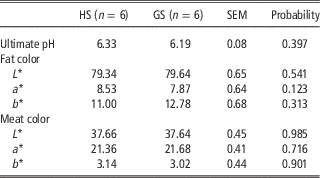
The feeding system did not affect (P>0.05) the ultimate pH (Table 4). It averaged 6.26 and was considered as slightly high, probably due to low muscle glycogen reserve associated with low energy supply (Vestergaard et al., Reference Vestergaard, Oksbjerg and Henckel2000). In addition, Immonen et al. (Reference Immonen, Ruusunen, Hissa and Puolanne2000) reported that providing high-energy diets during finishing protect animals from potential glycogen-depleting stressors such as transportation. Diaz et al. (Reference Diaz, Velasco, Caneque, Lauzurica, Ruiz de Huidobro, Perez, Gonzalez and Manzanares2002), Priolo et al. (Reference Priolo, Micol, Agabriel, Prache and Dransfield2002) and Maiorano et al. (Reference McAfee, McSorley, Cuskelly, Moss, Wallace, Bonhan and Fearson2009) also did not show an effect of the feeding system on meat pH. In the loin region, the feeding system did not alter fat and meat color (P>0.05). The short blooming period (10 min) can explain the lack of differences between the two groups with respect to meat color. Priolo et al. (Reference Priolo, Micol, Agabriel, Prache and Dransfield2002) did not measure any change of fat color with feeding system, but the meat was darker in lambs reared on grass. In the trial of Diaz et al. (Reference Diaz, Velasco, Caneque, Lauzurica, Ruiz de Huidobro, Perez, Gonzalez and Manzanares2002), only fat and meat lightness were affected by the feeding system. Luciano et al. (Reference Luciano, Monahan, Vasta, Pennisi, Bella and Priolo2009) also did not report an effect of the feeding system on meat color, and attributed this to the fact that lambs had the same growth rate.
Effects of the feeding system on muscle pH and meat and fat color in the loin region of Barbarine lambs

HS=hay supplemented with 200 to 300 g of concentrate; GS=grazing supplemented with 100 g of concentrate.
Lean chemical composition and fatty acid composition
The production system did not affect the chemical composition of the longissimus lumborum muscle. DM, CP and total ash averaged 26.28%, SEM=0.44, 80.13%, SEM=0.56 and 5.31%, SEM=0.20, respectively.
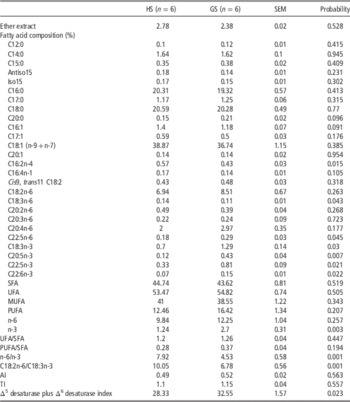
Intramuscular fatty acid composition is reported in Table 5. Intramuscular fat was not (P>0.05) affected by the feeding system and averaged 2.58%. The feeding system did not modify (P>0.05) the percentages of SFA, monounsaturated fatty acids and PUFA and they averaged 44.18%, 39.77% and 14.36%, respectively. The PUFA/SFA ratio was not altered (P>0.05) and averaged 0.32. It was within the values reported by Diaz et al. (Reference Diaz, Alvarez, De la Fuente, Sanudo, Campo, Oliver, Font I Furnols, Montossi, San Julian, Nute and Caneque2005) for Spanish and Uruguayan lambs and was higher than the value reported by Wood et al. (Reference Wood, Richardson, Nute, Fisher, Campo, Kasapidou, Sheard and Enser2008) for sheep. The proportion of n-6 fatty acids was not modified (P>0.05) and averaged 10.92%. This percentage was also similar to values reported by Diaz et al. (Reference Diaz, Alvarez, De la Fuente, Sanudo, Campo, Oliver, Font I Furnols, Montossi, San Julian, Nute and Caneque2005), but was higher than those reported by Wood et al. (Reference Wood, Enser, Fisher, Nute, Sheard, Richardson, Hughes and Whittington2003) and Aurousseau et al. (Reference Aurousseau, Bauchart, Calichon, Micol and Priolo2004). Percentages of linoleic acid (C18:2n-6) and of arachidonic acid (C20:2n-6) were not modified by the feeding system and averaged 7.72% and 2.48%, respectively. Intramuscular fat of the GS group was characterized essentially by a higher (P<0.01) level of n-3 fatty acids. As a result, the n-6/n-3 ratio was lower (P<0.001) for grazing lambs and was within values recommended for human nutrition (six, Williamson et al., Reference Williamson, Foster, Stanner and Buttriss2005) and higher than the optimal value (four) reported by Wood et al. (Reference Wood, Enser, Fisher, Nute, Sheard, Richardson, Hughes and Whittington2003). It was frequently observed that the n-6/n-3 ratio was lower for lambs grazing on pasture compared with those reared indoors (Diaz et al., Reference Diaz, Velasco, Caneque, Lauzurica, Ruiz de Huidobro, Perez, Gonzalez and Manzanares2002; Nuernberg et al., Reference Nuernberg, Fischer, Nuernberg, Ender and Dannenberger2008). However, the effects were partially explained by a higher feeding level and higher carcass fatness of lambs reared indoors. In this trial, the effect was probably linked to the fatty acid composition of pastoral shrubs (Aurousseau et al., Reference Aurousseau, Bauchart, Calichon, Micol and Priolo2004) and to the possible presence of secondary metabolites in pasture shrubs (Bouaziz et al., Reference Bouaziz, Dhouib, Loukil, Boukhris and Sayadi2009) that protected PUFA from ruminal biohydrogenation (Khiaosa-Ard et al., Reference Khiaosa-Ard, Bryner, Scheeder, Wettstein, Leiber, Kreuzer and Soliva2009; Vasta et al., Reference Vasta, Mele, Serra, Scerra, Luciano, Lanza and Priolo2009; Lourenço et al., Reference Lourenço, Ramos-Morales and Wallace2010). Percentage of α-linolenic acid (C18:3n-3), the principal n-3 fatty acid, was higher (P<0.05) by 0.59% in grazing lambs. The C18:2n-6/C18:3n-3 ratio was higher (P<0.001) for the HS group. Grazing increased (P<0.05) percentages of long n-3PUFAs (EPA, DPA and DHA). Shingfield et al. (Reference Shingfield, Bonnet and Scollan2013) also reported that the levels of long n-3PUFAs (EPA, DPA and DHA) were higher in animals fed grass diet. α-linolenic acid is generally converted to EPA and DPA and to a lesser degree to DHA (Barcelo-Coblijn and Murphy, Reference Ben Salem, Priolo and Morand-Fehr2009). A supply of α-linolenic acid in the diet increased EPA and DPA in the plasma and tissues of animals. Elongation of C18:2n-6 and C18:3n-3 in the muscle depends, in part, on the activity of Δ5 desaturase plus Δ6 desaturase. The Δ5 desaturase plus Δ6 desaturase index was higher (P<0.01) in lambs grazing on pasture, probably because there is a higher supply of C18:3n-3, which affects the activity of enzymes implicated in the elongation of C18:3n-3 and C18:2n-6 to long PUFAs (Dal Bosco et al., Reference Dal Bosco, Mugnai, Roscini, Mattioli, Ruggeri and Castellini2014). Generally, C18:3n-3 is preferred to C18:2n-6 for the desaturation and elongation pathway (Dal Bosco et al., Reference Dal Bosco, Mugnai, Roscini, Mattioli, Ruggeri and Castellini2014).
Effects of the feeding system on intramuscular fat (g/100 g of muscle) and fatty acid composition (% identified fatty acids) of longissimus lumborum in Barbarine lambs

HS=hay supplemented with 200 to 300 g of concentrate; GS=grazing supplemented with 100 g of concentrate; SFA=saturated fatty acid; UFA=unsaturated fatty acid; MUFA=monounsaturated fatty acids; PUFA=polyunsaturated fatty acid; n-3 (C18:3n-3+C20:5n-3+C22:5n-3+C22:6n-3); n-6 (C18:2n-6+C20:2n-6+C20:3n-6+C20:4n-6+C22:5n-6); AI=atherogenic index; TI=thrombogenic index.
TI and AI were not affected (P>0.05) by the feeding system and averaged 1.11 and 0.50, respectively. Knock (Reference Knock2007) did not report an AI difference between steers reared on pasture and those reared indoors. An AI<1 is acceptable for human health (Knock, Reference Knock2007). In this trial, the AI was lower than values reported previously in other studies (Ulbricht and Southgate, Reference Ulbricht and Southgate1991; Zapletal et al., Reference Zapletal, Kuchtik and Dobes2010) for lamb meat, but similar to values reported by Nasri et al. (Reference Nasri, Ben Salem, Vasta, Abidi, Makkar and Priolo2011) for Barbarine lambs. Therefore, this difference could be associated with a genotype effect (Zapletal et al., Reference Zapletal, Kuchtik and Dobes2010; Nasri et al., Reference Nasri, Ben Salem, Vasta, Abidi, Makkar and Priolo2011).
Conclusion
In conclusion, when maintaining the same growth rate and same slaughter weight for lambs reared on pasture or indoors, meat yield and carcass compactness are kept similar. Nevertheless, grazing lamb carcasses are less fatty and the meat is healthier, with a higher supply in n-3 and long PUFA. Difference in meat fatty acid composition was probably associated with the high level of α-linolenic acid and the presence of secondary metabolites in shrubs in the natural pasture.
Acknowledgments
The authors thank the World Bank for financial support and the company ‘Général Viandes’ for the technical support in slaughtering and preparing carcasses.