Goodwill means giving people reasons to think well of us, so that they will prefer to do business with us. Our Goodwill Division is the biggest thing in Reynolds Metals, and each of us is part of it. Goodwill is our most precious possession.… It needs constant, daily entries or the ink will fade. Let’s take a good look at this thing that controls our jobs, our future, and our security. Let’s look at our most precious asset.Footnote 1
In March 1949, Keen Johnson, the vice president of Reynolds Metals Company (RMC), wrote to company president Richard S. Reynolds Jr. (hereafter RSR Jr.), and enclosed the booklet from which this extract is drawn. Johnson informed his boss that the rationale for This Thing Called Goodwill “is that we can improve our public relations and build up good will [sic] only by impressing upon each member of the Reynolds Metals organization the fact that we all have a responsibility to work daily at this important task.”Footnote 2 While the booklet was intended to instruct all employees on customer relations, it understated RMC’s most significant deployment of goodwill: its cultivation of political networks, especially in Washington, D.C. Johnson, one of the foremost agents of the company’s political activity, was being modest about the company’s achievements. Johnson’s previous experience as Kentucky’s former governor (1939–1943) and lieutenant governor (1935–1939) were important to his being recruited to work at RMC.
This article examines the Reynolds Metals Company’s political networking in Washington, D.C., in the 1940s and 1950s, and sets this against the context of “wartime” and the legacy of growing state intervention since the early twentieth century. It examines the company’s development of its public affairs capabilities through the recruitment of former federal and state officials, nurturing of networks in government departments and among legislators on Capitol Hill, and deployment of regional identity and key policy rhetoric (i.e., antitrust, regional development, and national security) to cement relationships and gain influence and competitive advantages.
It was RMC’s capability in building and deploying these political connections in Washington, D.C.—as well as in state capitals of the south—that allowed it to break into primary aluminum production during World War II. Founded in 1928 to produce aluminum foil for cigarette packaging, RMC owned no primary aluminum production facilities and had limited downstream capacity. By 1944 it controlled primary aluminum smelters and downstream extrusion plants and rolling mills, as well as had access to upstream supplies, which allowed its share of global aluminum production to reach 7 percent. By 1946 RMC accounted for 30 percent of global output.Footnote 3 The political goodwill the company accrued by the end of World War II afforded it sufficient competitive advantage to become the second-largest U.S. primary aluminum producer and a major competitor to the Aluminum Company of America (Alcoa), which had hitherto monopolized aluminum production in the United States and been one of the two first movers (and dominant players) in the global industry. Alcoa had enjoyed considerable political patronage starting with World War I, especially under U.S. presidents Harding, Coolidge, and Hoover.Footnote 4 As late as 1937, and testament to Alcoa’s continued market dominance and influence, and with support from the War Department, it blocked the Justice Department’s antitrust investigations; it also managed to successfully evade charges of acting as a trust in 1941. However, by the close of World War II, with political support, Reynolds (and Kaiser Aluminum) had gained control of Alcoa’s alumina refineries in Hurricane Creek, Florida, and Baton Rouge, Louisiana; its smelters in Spokane, Tacoma, and Troutdale, Oregon; its Jones Mill, in Arkansas; and its patents.Footnote 5 In such a highly integrated and capital-intensive industry, Reynold’s political connections also allowed it to secure access to upstream supplies of bauxite and production facilities for alumina (aluminum oxide) so that by 1955, RMC had extended its control within the global aluminum supply chain to 16.4 percent and 16.9 percent, respectively, of global bauxite and alumina output.Footnote 6
The company’s success was such that by December 1946, the J. Walter Thompson (JWT) Agency, handling RMC’s public relations, reported to RSR Jr. that Bache & Co., RMC’s brokers, “are pretty high on Reynolds.”Footnote 7 JWT’s and Bache’s confidence stemmed in large part from the political patronage that RMC was perceived to enjoy: “The Government’s large investment in Reynolds…may serve as a sort of reinsurance against unlikely attempts by others to ‘throttle’ Reynolds.”Footnote 8 The value of the company’s investment in its public affairs capabilities and political networks was demonstrated again in the battles of the late 1940s and 1950s both when Alcoa sought to reassert itself and the Aluminium Company of Canada (Alcan) sought import tariffs reductions on Canadian aluminum and additional U.S. government contracts. RMC’s ascendancy in the global industry was crowned in 1959, when, with the UK’s Tube Investments, it took control of another of the first movers in the global industry: the British Aluminium Company Ltd. (BACo). The latter still monopolized aluminum smelting in the United Kingdom and throughout the British Empire, as well as held the exclusive British rights for smelting.Footnote 9 RMC’s rise from a modest and largely regional producer and supplier of aluminum foil to the tobacco industry to a dominant force in the North American and global aluminum industry, over just a decade, was nothing short of meteoric. Recently Mark Wilson downplayed both RMC’s and Kaiser Aluminum’s gains, suggesting that they did not realize their success in aluminum production until the mid-1950s. This fails to appreciate the considerable barriers to entry into this capital-intensive and closed industry, and especially the full magnitude of RMC’s achievement.Footnote 10 That achievement was built on investment in and deployment of political connections.
RMC’s success was initiated by its founder Richard S. Reynolds Sr. (hereafter RSR Sr.), who demonstrated considerable prescience and political acumen in his recruitment of well-connected and highly capable former public servants, such as Keen Johnson, to senior RMC management positions. RSR Sr. also understood from experience the importance of timing and of deploying key salient political themes (e.g., antitrust and regional development) and recognizing sectional interests. He used his family’s pedigree, his connections to the Democratic National Committee (DNC), and RMC’s position as a southern firm to the company’s advantage at a time when both the Senate and House of Representatives were dominated by senior Southern Democrats.Footnote 11
However, this success was equally contingent on historical context. The success of RSR Sr.’s and RMC’s transactions with executive and legislative branches (and the receptiveness of its approach and rhetoric) were reliant on a long tradition of Southern Democratic patronage of business from the early twentieth century onward, and Southern Democrats dominance of Capitol Hill by this period. It was also directly aided by the legacy of government intervention under both the Hoover administration—notably the Reconstruction Finance Corporation (RFC)—and the Roosevelt administration—especially the New Deal, the Tennessee Valley Authority (TVA), and Bonneville Power Administration (BPA). RMC was also aided by the war economy.
For much of the 1940s and 1950s, the United States was legally and politically overshadowed by what Mary Dudziak has referred to as “Wartime.”Footnote 12 This did not end with World War II but continued into the Cold War and the Korean War, accompanied by an infrastructure for financing, producing, and distributing matériel. Between 1931 and 1961, U.S. government purchases of goods and services rose from 12.1 percent to 20.6 percent (reaching a peak in 1944 of 46.3 percent), and budgetary expenditures rose from 10.6 percent in 1927 to 29.6 percent in 1961.Footnote 13 As James Sparrow observed: “As the larger trajectory of federal spending, revenue, debt, employment, and military deployment in the twentieth century makes clear, the Second World War, building on but also superseding the New Deal, was a critical turning point for the growth of federal government within American society.”Footnote 14 The United States, or “the Arsenal of Democracy” as FDR described it, produced two-thirds of Allied munitions.Footnote 15 Aluminum was a key strategic metal; its consumption and production grew dramatically during World War II and the Korean War, driven by the demand for it in military aircraft manufacture. As Dewey Anderson, of the U.S. Public Affairs Institute, observed in 1951: “Aluminum has become the most important single bulk material of modern warfare. No fighting is possible, and no war can be carried to a successful conclusion today, without using and destroying large quantities of aluminum.”Footnote 16 As Mats Ingulstad has noted for aluminum, and Paul Tiffany for steel, this dramatic demand for both metals in wartime resulted in mounting government pressure for increased production and an expansion of industrial capacity, which advantaged smaller producers.Footnote 17
Equally crucial for RMC were the opportunities arising out of state intervention under Hoover’s RFC and Roosevelt’s New Deal, in terms of the recruitment of key personnel and the politics of antitrust and expansion of regional development. While FDR’s wartime accommodation with business saw a cooling of antitrust action—as it had for Woodrow Wilson’s administration in World War I—key members of the administration, notably Secretary of the Interior Harold Ickes, remained ardent advocates and were closely tied to younger New Dealers who continued to pursue issues like antitrust.Footnote 18 The recession of October 1937 and (more specifically where monopolies were concerned) Thurman Arnold’s tenure at the Anti Trust Division (ATD) of the Department of Justice (1938–1943) reignited arguments over government intervention in the economy, notably on expanding production, increasing efficiency gains for consumers, and changing productivity priorities for the war effort. These proved advantageous for RMC, which readily exploited these arguments.Footnote 19 When former small businessman Harry Truman took office as president in April 1945, antitrust policy was renewed, aided by the changes effected by Arnold at the ATD, exemplified by the cases against both Alcoa and U.S. Steel.Footnote 20
Moreover, the commitments to regional development and industrialization arising from both the Hoover and Roosevelt administrations continued to advantage the south; and were further enabled by the warfare state, not least given the control of the key committees of both the Senate and House of Representatives by powerful Southern Democrats who dominated Capitol Hill at this time. RSR Sr., and his successors and company officers, proved highly adept in exploiting the opportunities offered by that context and in demonstrating their regional, patriotic, and antitrust credentials. Together, these factors built organizational capabilities and sustainable competitive advantages. RSR Sr. and RMC were able to do this because of their networks and social capital in the south and their prudent recruitment of the key personnel. Both of these increased the company’s legitimacy with pivotal political actors in Washington, D.C., as well as in southern state capitals.
This article first locates the wider relevance of Reynolds Metals Company’s story, then considers the role of the company’s founder before analyzing his recruitment of key personnel who were pivotal in the success of the company’s networking. The article then outlines the company’s coalition-building with politicians and officials, and how these connections were deployed. The last two sections observe the family’s political convictions and offer conclusions.
Reynolds and U.S. Business–Government Relations
There is broader significance within debates in scholarly literature on U.S. business–government relations that goes beyond the intrinsic worth of companies like RMC’s to national and global business histories: notably, the overdevelopment of an “organizational society” in the twentieth century.Footnote 21 Specifically, following the important work of Brian Balogh and Alan Brinkley, the literature notes the legacy of the New Deal, as well as reforms of the Hoover administration, in relation to the importance of the repositories of knowledge and skills within federal agencies and their transfer to the private sector. This is illustrated most prominently by figures such as David E. Lilienthal and Tommy “the Cork” Corcoran.Footnote 22 However, this article also underlines the importance of a longer trajectory of progressive reformism. It adds detail to the voluminous history of the U.S. warfare state of this period, as well as to that of regional industrialization.Footnote 23 More broadly, the article contributes a historical case study to the social science literature on the importance of networks and social capital to family business survival, firm performance, and corporate political activity.Footnote 24 Reynolds Metals Company’s sophisticated development of its public affairs machinery took place at a time when lobbyists were relatively scarce in Washington, D.C.: as late as 1956, there were 615 registered lobbyists; by 2016, this had risen to 10,462. This was also before Lester Milbrath’s definition of lobbyists in his paradigm-shifting 1963 book.Footnote 25
The Reynolds Metals Company’s story, like that of the infinitely better-known account of Henry J. Kaiser, provides valuable insights into the nature of U.S. business–government relations and corporate political activity. Like Reynolds, Kaiser exploited the opportunities presented by World War II—as well as the opportunities presented by the Hoover and Roosevelt administrations—to expand his business empire from construction into shipbuilding, aircraft manufacture, and light metals production. Henry J. Kaiser also built his empire by political networking at state and federal levels, famously declaring to journalists in July 1942:
Every time I take anybody to a shipyard, they want to see the ways and they think that is the shipyard. Well, that isn’t the shipyard at all, and when you go to an aircraft plant, you want to see the garage they keep the planes in or build them in. That isn’t the aircraft plant. I will tell you where the aircraft plant is and where the shipyard is: it starts in Washington.Footnote 26
As Stephen Adams has observed of Henry Kaiser: “[He] could not have achieved his success in shipbuilding, steel, dam building, or aluminum without a healthy relationship with the executive branch.”Footnote 27
Similarly, RMC would not have achieved its success without considerable political backing and substantial federal finance. The dividends from the federal government included an initial RFC loan of $15.3 million to construct the Listerhill smelter in Alabama, which was named after Alabama Senator Lister Hill in recognition of his central part in securing its construction. It received another $2.5 million from the RFC’s subsidiary, the Defense Plant Corporation (DPC), for a new extrusion plant in Louisville, Kentucky. RMC’s loans from RFC and DPC conservatively totaled around 30 percent of that disbursed by the two public bodies. Some historians of aluminum have accepted RSR Sr.’s version of events related to his personal mortgaging of assets, along with his far-sighted recognition of the threat posed by Nazi Germany and the need for aluminum. Accepting that his was a lone voice in the wilderness means not recognizing it as a well-rehearsed corporate narrative that portrays the paterfamilias of the company as a national savior.Footnote 28
This was a familiar trope among businessmen who had benefited from federal support. They perpetuated their self-made myths and portrayed themselves as hampered by and in conflict with government. Adams noted that similarly “Kaiser got a lot of mileage from portraying himself in conflict with the bureaucracy.”Footnote 29 Adams recounts the story of a U.S. Chamber of Commerce dinner in 1934, at which successive businessmen demanded that the government be kept out of business, while RFC Chief Jesse Jones penciled down how much each had been loaned by the corporation. As Adams noted: “Businessmen are traditionally mute about opportunities government presents to them. At the same time, they loudly bemoan restrictions on their activities, such as those accompanying the federal government’s rapid growth since the 1930s.”Footnote 30
RMC’s RFC and DPC loans were offered at favorable rates. Moreover, in a highly energy-intensive process like aluminum smelting, it is questionable whether a newcomer like Reynolds would have fared as well without the subsidized power rates for their Listerhill Plant from the TVA or BPA, which provided power to their Washington state and Oregon smelters at Spokane, Tacoma, and Troutdale. Despite RMC’s predictable complaints about power rates—partly as a negotiating position and partly to mythologize the vision of its founder—TVA rates were half those paid by industrial customers in the U.S. northeast. Between 1940 and 1944, RMC, its subsidiaries, and its affiliates secured an additional $600 million in government contracts. They also benefited from tax breaks at state levels, such as for their bauxite mining operations in Arkansas.Footnote 31 As Mark Wilson has recently emphasized, it was such state and labor union support, and not just business cooperation, that played crucial roles in the prosecution of the war and the growth of these aluminum companies.Footnote 32
Reynolds and Kaiser bear comparison for several other reasons, too. Both used their locations, respectively as southern and western businesses, to build political connections and elicit support in a sympathetic political climate. Just as Kaiser profited from promoting himself as the “Builder of the American West,” so too did RSR Sr. profit from playing his role as an industrial leader in the “New South.”Footnote 33 RSR Sr.’s family connections to the DNC in the south were invaluable in a period when the U.S. legislature was dominated by senior Southern Democrats. As Richard Bensel observed in 1984: “Deep South constituencies were over-represented within the Democratic Party and even more concentrated in the higher seniority of the separate committees.”Footnote 34 This had a direct effect on the “deflection of federal spending toward the South.”Footnote 35
RSR Sr., his sons, and key company executives made it their business to court those senior legislators, as well as acquire allies within FDR’s administration. Equally, both firms, while not active participants in the Department of Justice’s and Federal Trade Commission’s cases against Alcoa, used antitrust sentiments to elicit support from key, prominent Democrats. Paying close attention to the cases against Alcoa was based on RSR Sr.’s experiences while working for his uncle, Richard J. (“R. J.”) Reynolds, at Reynolds Tobacco, where the former had witnessed bitter antitrust cases over tobacco.Footnote 36
Reynolds (and Kaiser Aluminum) provides an example of the transfer of organizational capabilities—in the forms of bureaucratic expertise and networks—from the public to private sectors through the shrewd recruitment of politicians and officials from governmental departments and agencies. In RMC’s case, as noted above, it involved cannily recruiting figures such as Keen Johnson, but also Walter L. Rice, Marion Caskie, and Irving Lipkowitz, who are discussed below.
If anything, RMC’s political machinery was much more sophisticated than that of Kaiser. RMC avoided the controversy that later enveloped Kaiser, which resulted from the latter’s high-profile association with prominent New Deal lawyer, and renowned lobbyist, Tommy “the Cork” Corcoran. RMC managed its political engagement in-house; additionally, the scale of Henry Kaiser’s enterprises and the brief consideration of him as a presidential prospect for the DNC made him more of a political target than RSR Sr.Footnote 37
The RMC story contributes to wider debates among historians and political scientists about the character of business–government relations in the United States between the Progressive Era and the Cold War: specifically, the emergence of what Louis Galambos and Joseph Pratt characterized as a “corporate commonwealth,” which manifested increasingly in the dynamics of U.S. managerial capitalism, as first identified by Alfred Chandler. Galambos and Pratt’s Rise of the Corporate Commonwealth, published in 1988, advanced the idea that U.S. business and government reached a comfortable accommodation between the early twentieth century and the late 1970s.Footnote 38 The Rise of the Corporate Commonwealth provided a popular outing for ideas that Galambos had advanced in his seminal article in Business History Review in 1970, which sparked a debate among historians and political scientists.Footnote 39 In this, and subsequent related work, he advanced the notion that an “organizational society” emerged in the United States in the twentieth century out of widespread managerial corporatism, in both business and government, that led to a more professionalized society and greater consensus between business and government.Footnote 40 This was contiguous to a body of work from Ellis Hawley through to Michael Hogan that charted the emergence of “corporate liberalism”; a corporatism defined both on ideological and organizational grounds that sought “a ‘middle way’ between the laissez-faire of a bygone day and the paternalistic statism of an Orwellian nightmare.… In this system, partisan politics would give way to managerial expertise, public legislatures would yield some of their functions to private forums, and redistributive battles would dissolve in a material abundance in which all could share.”Footnote 41
While such arguments attracted considerable support—and to some degree coalesced with Chandler’s Parsonian-influenced work, even though the doyen of business history never made such claims—it was challenged on a number of grounds by historians and political scientists alike.
Among the most profound charges against an organizational society were those leveled by Michael McGerr, who questioned whether it ever existed in the United States. In the case of Galambos, more widespread was the charge that he was advancing a presentist and ahistorical argument. The limitations of the historical period under current analysis—and the changes over time that relied heavily on an interpretation of the Progressive Era—led some, notably Brian Balogh in 1991, to ask why the New Deal and World War II had not been more carefully considered. Since Balogh identified this lacuna, a considerable literature has emerged around the nature of public–private engagement in the United States during World War II and the question of the existence of a military-industrial complex.Footnote 42
Brian Balogh’s cautioning against imposing “ironclad laws that governed organizational development” are born out in Reynolds’ story, and in extant sectoral studies by business historians that have helped to shed light on this periodization, including meaningful comparisons as well as distinctions.Footnote 43 In particular, a key feature of this research has focused on the importance of contests over monopolies and antitrust action. Most apposite, and intrinsically related to RMC, is George Smith’s deft discussions of the U.S. government’s antitrust actions against Alcoa. Alcoa was subject to ongoing antitrust actions brought against it by the Department of Justice (DOJ; in 1911–1912, 1924–1930, and 1937–1945) and the Federal Trade Commission (FTC; during the 1920s), as well as being the subject of inquiries of the Temporary National Economic Committee in the late 1930s.Footnote 44 Paul Tiffany’s outlining of the long-running battles and accommodations between U.S. steel producers and government over antitrust—with actions taken both by the DOJ and the FTC under the presidencies of Taft, FDR, and Truman—also bears some comparison. There are synergies too with Richard John’s study of U.S. telecommunications, emergence of the Bell System, antitrust interventions by the Interstate Commerce Commission, and temporary change of bringing telephone and telegraph services under public control. Such studies underline the importance of understanding the implications of ongoing concerns over monopolies, and how battles and accommodations between business and government shaped the outlook and strategic decisions of those businesses. As John has observed of the Bell System: “[It] was sustained in a corporate culture that had been nurtured by a distinctive configuration of governmental institutions and civic ideals. This corporate culture was not free-floating: rather, it was the organizational response to the structuring of a progressive political economy.”Footnote 45
Two RMC contributions to this understanding of complexity around the organizational society is in multilevel governance: (1) by adding to the historiography on regional aspects of the relationship between business and government; and (2) via the personal politics of business leaders that affected these interactions with government.Footnote 46
Reynolds Metals Company’s meteoric rise within the global aluminum industry was extraordinary given the high capital costs, geographically extended and vulnerable supply chains, and associational barriers to entry. Historians of global aluminum have recognized RMC’s ascendancy within the global industry as remarkable also because of the operation of an oligopoly and long-running cartels throughout much of the first half of the twentieth century.Footnote 47 Other new entrants to this industry did so either as a subsidiary of one of the first movers—or at the very least with a major share owned by one of them—or as a state-sponsored corporation. The growing strategic importance of aluminum meant that the national industries were proximate to government—both as a major customer and to manage political risk—and subject to state intervention.Footnote 48 The close ties between the first movers and barriers to new entrants was underlined by hostility from the established order of the global industry, for example, and as noted earlier, when Reynolds (with the UK’s Tube Investments) gained control of BACo after a bitter takeover during 1958 and 1959.Footnote 49
To further clarify RMC’s organizational behaviors and strategies, the article explores these two factors in conjunction with understanding elite networks and social and cultural capital, notably through the nurturing of trust. The elaboration of these points is also important in seeking to engage with social scientists working in the fields of corporate political activity, business–government relations, and international business and strategy (including nonmarket varieties), which often lack all-important historical contextualization and case studies, as increasingly noted by scholars in the field.Footnote 50 While this is principally a historical article, explicit reference to this literature is important to encourage interdisciplinary dialogue. In a recent example of a historically informed organization study, that of the Hilton hotel group, Maclean and colleagues write of the importance of “skilled social actors of rhetorically intense argumentation, elite political networking, coalition-building and cultivating officialdom enabled them to interact to good effect in selected localities.”Footnote 51 In Hilton’s case, this involved linking the expansion of the hotel chain to promoting U.S. Cold War policy agendas. RSR Sr., the company officers he recruited, and their successors demonstrated all of the behaviors identified for the Hilton group. Their nurturing of elite networks of politicians and officials unlocked benefits and proved invaluable for achieving and maintaining competitive advantage. French sociologist Pierre Bourdieu described social and cultural capital as “the aggregate of the actual or potential resources which are linked to possession of a durable network of more or less institutionalized relationships of mutual acquaintance and recognition.”Footnote 52 Alejandro Portes similarly described social capital as accrued trust and arising benefits from membership of social networks.Footnote 53 RSR Sr. benefited from these “aces in a game of cards,” as Bourdieu put it, “that define the chances of profit in a particular field.”Footnote 54 The trust implicit in this social capital, as a number of scholars have observed, is critical to beneficial relationships with government.Footnote 55 This article draws on understandings of trust as deployed by Sherylynne Haggerty in her study of transatlantic business networks in the eighteenth and nineteenth centuries, in particular the notions of “ascribed trust” (i.e., trust assumed from membership of certain networks and groups and assumed characteristics) and “process-based trust” (i.e., confidence built up over time by competency and goodwill).Footnote 56 As the article demonstrates, RSR Sr.’s background and his membership in key social networks afforded him ascribed trust. His recruitment of former New Deal officials for their accrued knowledge and skills, and his nurturing of politicians both opened up new networks and won the company process-based trust, as did its coalition-building and political rhetoric.
Any discussion of RMC’s success in political networking needs to start with RSR Sr.: his background, social milieu, and relationships with key staff. It was his legacy that would pay dividends in establishing the organizational capabilities necessary for the company to succeed in Washington, D.C., and in southern state capitals. He was particularly astute in selecting and nurturing of key staff. These same staff would then mentor his own sons in public affairs. However, it is important to state that the depth of trust that RSR Sr. and the company garnered was founded on an understanding that his family, location, and personal politics were based on common values with political allies. Therefore, his support of certain policy platforms was not simply transactional. As Phillips-Fein and Zelizer observed, RSR Sr. and other U.S. businessmen of this generation made careful decisions: “Far from being concerned only with their individual firms and companies, business people consistently sought to shape political life throughout the post-World War II years.”Footnote 57
Richard S. Reynolds, Senior: Architect of Success
A senior executive of an RMC subsidiary, writing in 1945, described RSR Sr. as having “a very certain undefinable characteristic awareness or subconscious intuition which leads him to act decisively before other people, including his own organization, are aware of approaching circumstances.”Footnote 58 This description of his legendary foresight reflected, in part, a potent organizational narrative about being the father of the company and having considerable business experience. Nonetheless, it was also a well-placed observation that RSR Sr. built on the advantages afforded by his family’s reputation and political connections in the Deep South.
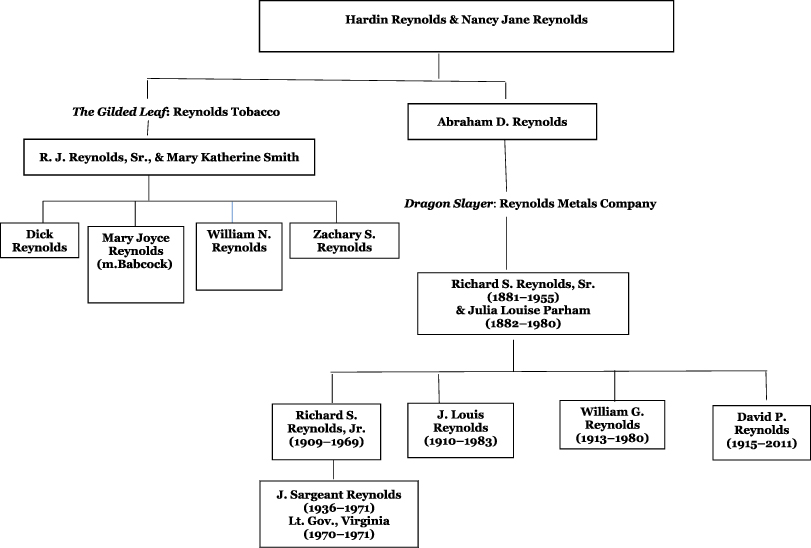
The favorite nephew of R. J. Reynolds, RSR Sr. acquired political acumen through his years spent working at Reynolds Tobacco between 1903 and 1912. Through the Reynolds family connections (Figure 1), he was initiated into social networks that included leading Democratic Party figures in the south, such as Josephus Daniels, an old friend and business associate of R. J.’s, who was also Woodrow Wilson’s secretary of the navy; and James B. (“Buck”) Duke, of the American Tobacco Company, who was a prominent businessman. As an indication of the Reynolds’ family’s place in the DNC machinery of the Deep South, RSR Sr.’s cousin Dick Reynolds was attributed with financing FDR’s second successful presidential campaign.Footnote 59
Reynolds family tree.
Source: Author’s compilation based on Reynolds and Shachtman, Gilded Leaf; Gillespie, Katherine and R. J. Reynolds; various papers, RMCA, VMHC.

It was also while working for R. J. that he witnessed firsthand the DOJ’s successful antitrust action against American Tobacco in 1911—the same year the agency won an even more famous victory against Standard Oil—against mounting federal and state actions against monopolies. This was accomplished through two acts. The first was the Interstate Commerce Act of 1887, which was in direct response to Rockefeller’s trust and led to the formation of the Interstate Commerce Commission. The second was the Sherman Antitrust Act of 1890. As Tony Freyer observed, 1911 was an auspicious year for federal antitrust actions and an intense period for lawsuits. The following year, 1912, saw two more important milestones in U.S. antitrust action: the creation of the FTC and passing of the Clayton Antitrust Act.Footnote 60 Along with absorbing the lessons of these antitrust actions, RSR Sr.’s association with public enterprise enthusiast Josephus Daniels means it is also possible that he was conversant about the details of Daniels’s actions as navy secretary in setting up of a government-owned and -operated armor plate plant, and transferring Guglielmo Marconi’s Italian patents for the radio to be under American control.Footnote 61 It is also likely that through Daniels, RSR Sr. met RMC’s longest-running senatorial ally, Lister Hill, for whom the former navy secretary was a mentor.Footnote 62
Aside from his connections through R. J. to Southern Democratic circles, the Reynolds name carried considerable cultural, social, and symbolic capital in the Deep South and evoked economic development in the “New South” after Reconstruction. These lent him considerable ascribed trust, based on assumptions carried with that lineage, which was crucial to smoothing his way in these circles.Footnote 63 RSR Sr. was also able to link to the old South on his own: his father, Abraham D. Reynolds, had enlisted with the Confederate army as a seventeen-year-old Virginia Military Institute cadet, and had ended the war as a cavalry major.Footnote 64 This was a social and geographical distinction (between the “Old South” and the “Deep South”) too for a family that viewed itself as aristocratic and enjoyed associated pursuits such as fox hunting.Footnote 65 This location within an identifiable southern family was crucial to admitting RSR Sr. to social networks and unlocking social capital. It was exhibited both by the circles in which he moved and the cultural symbolism of practices in this social milieu. He understood the value of his power base in the south and how to deploy it to desired effect.
He also learned valuable lessons about social networks, trust, and loyalty—and, conversely, the risks when these were breeched—from bitter personal experiences with his business endeavors during World War I, with U.S. Foils, and ultimately with Reynolds Metals Company. He had cofounded U.S. Foils with his father and R. J. Reynolds, but he subsequently fell out with the latter over rights to the company.Footnote 66 As a result, RSR Sr. placed great stock in loyalty, vesting considerable power and responsibility in professional managers, in whom he entrusted both the success of the company and the career development of his sons. This bonding of “family” was replicated in the bridging of social networks with trusted company officials and political allies.Footnote 67 The success of this bonding and bridging is observable from family succession within the company and the loyalty of its key officers. It was also evident in RMC’s long-lasting political relationships. For RMC, the close familial relationship that RSR Sr. nurtured with his five sons, all of whom served in senior roles in the company, and with other leading officers was key to uncontested succession. RMC was characterized by close integration of family ownership and management into the 1970s. The Reynolds family continued to maintain ties between ownership and management of the company up until its merger with Alcoa in 2000; RSR Sr.’s youngest son, David, stepped down as president in 1995 but continued as chairman of the board. RSR Sr.’s great-grandson Richard Samuel Reynolds IV served as a group marketing manager for RMC and managing director of the Reynolds Trust.Footnote 68
As discussed above, RSR Sr.’s acuity was evident in his shrewd selection of key company personnel from the late 1930s onward. He recognized the social networks, knowledge, and managerial skills that former political officials brought with them. His memory of past business battles not only informed his recruitment strategy but also his coalition-building and use of political rhetoric. His, and the family’s, loyalty to key RMC officers was reciprocated, as all would remain with the company for their entire careers, with only brief periods away and mostly for senior government service.
While RMC’s success was undoubtedly contingent on the context of more recent New Deal politics and the warfare state, as argued earlier, RSR Sr.’s social networks and observations of earlier antitrust battles cast a long shadow over his approach. As the next section indicates, his persuasiveness in political circles relied on his personal credibility in coalition-building. However, while this was partially transactional, it also reflected the personal politics of the Reynolds family and its early company officers.
Building Organizational Capabilities
The perspicacious recruitment of important senior personnel demonstrated RMC’s capabilities to succeed in the political climate in which it was operating. These men brought with them years of experience and skills of operating in the political arena or government service, as well as valuable networks that could open doors for the company in Washington D.C., as well as in parts of the south. As such, they represented some of the wider transfer of valuable skills and knowledge between the public and private sectors, which was a legacy of their increased role in the economy.Footnote 69 In this, RMC, and other companies, was also aided by the dominance of Southern Democrats in the executive and legislative branches throughout much of this period. Highly situated and brilliant public servants departed for the private sector; some of them frustrated at the lack of progress they had been able to make in government agencies to thwart monopolies or aid in regional development. The most prominent person of this exodus was lawyer David E. Lilienthal, who as a director, vice chairman, and chairman of the TVA played a crucial role in advancing New Deal policies, and subsequently served as chairman of the United States Atomic Energy Authority, leaving government work in 1950. Lilienthal had served under both FDR and Truman.Footnote 70
As Ken Lipartito wrote of American business: “From its earliest years, big business has needed lawyers.”Footnote 71 More specifically, as Peter Irons observed, the New Deal was a “lawyer’s deal.”Footnote 72 Ironically, Uncle R. J. had counseled his nephew to abandon his legal studies at the University of Virginia and instead join him in business. However, RSR Sr. quickly recognized lawyers as an asset, not least having witnessed the antitrust case against Buck Duke, and R. J.’s battles against Duke and American Tobacco.Footnote 73 He would also have been closely acquainted with the DOJ’s well-publicized cases against U.S. Steel (1911–1920) and, of course, against Alcoa (noted earlier).Footnote 74
Among his shrewdest appointments was former ATD lawyer Walter Lyman Rice, who had served as special assistant to the attorney general on the antitrust action against Alcoa. Rice had extensive experience leading antitrust cases, having joined ATD straight out of Harvard Law School in 1928. Unusual for most of RSR Sr.’s hires, Rice was a lifelong Republican, but he was marked as a talented young lawyer in the Staff News of the Antitrust Division in 1936: “When a person wins praise on the pages of ‘The Nine Old Men’ [the U.S. Supreme Court]…it is time to sit up and take notice. But those who know him were not surprised when they read the flattering tribute given to Walter L. Rice.”Footnote 75 In appealing to Rice, Reynolds Sr. was not only speaking to a supremely talented ATD lawyer who had close familiarity with the Alcoa antitrust case but also as someone who believed in breaking up monopolies. Replying in 1938 to Texas Congressman Wright Patman, an antitrust campaigner, Rice declared: “I am sympathetic with the work you are doing and I am anxious to help you in any way that I can.”Footnote 76
Rice was subsequently joined by fellow ATD refugee Irving Lipkowitz, who had also worked on the Alcoa case. Lipkowitz was a passionate New Deal liberal and antitrust advocate who joined the DOJ after graduating in 1934 from New York University, with a degree in economics. Lipkowitz’s and Rice’s motivation for joining Reynolds may have stemmed from the humiliation that the ATD suffered at the hands of Alcoa and its counsel.Footnote 77 While Smith speculates that it was this experience that may have prompted Lipkowitz to join RMC in the early 1940s, another explanation may lie in the state of the ATD. Despite renewed interest from the White House in antitrust matters, by 1937 and 1938 the ATD “simply had too much to do and too few resources,” although after the arrival of Thurman Arnold, it saw a renewed sense of purpose and change in antitrust philosophy. According to Tony Freyer, this renewed sense—from moral objections to monopolies to arguments on economic efficiency—came to a head in the Alcoa case after 1945.Footnote 78 Meanwhile, FDR was encouraging cooperation between business and government. Equally important factors were very probably RSR Sr.’s persuasiveness and adroitness, and his own views on monopolies.
Another example of a shrewd appointment to the company was Alabamian Marion M. Caskie in 1940. Caskie had just stepped down as chairman of the powerful Interstate Commerce Commission (ICC) and from FDR’s National Emergency Council (NEC). He was a former assistant federal coordinator of transportation (i.e., director of state docks in Mobile).Footnote 79 RSR Sr.’s recruitment of Caskie exhibited considerable cleverness on a number of levels, given Caskie’s (1) position at the ICC, (2) experiences in controlling freight rates and regulating telecommunications and the railways, and (3) responsibility for the integrated supply chain required for aluminum production with plants spread over the United States. Caskie’s work on FDR’s NEC (reformed in 1935 to oversee the delivery of the New Deal programs) also provided RMC with valuable political connections in the White House.Footnote 80 Caskie had worked on ICC with RMC’s most enduring political ally on Capitol Hill, and fellow Alabamian, Senator Lister Hill, in attempting to secure more preferential freight rates for southern businesses, which was aimed to animate regional industrialization.Footnote 81
A sagacious short-term engagement was with Frenchman Louis Marlio, who was stranded in wartime Washington, D.C., by the Nazi occupation of his country. The former head of the international aluminum cartel, and the senior figure in the French aluminum industry, Marlio helped RMC in brokering aluminum contracts with the British Purchasing Commission. Bertilorenzi argues that Marlio planned RMC’s postwar strategy. This was quite possible from a commercial standpoint, given his extensive knowledge and connections in the global industry. However, this overlooks the importance of the political environment to RMC’s ascendancy.Footnote 82
Marion Caskie, Keen Johnson, Irving Lipkowitz, and Walter Rice, with the exception of brief periods of public service that may have served to renew the company’s political influence, would remain with RMC for the remainder of their careers. Caskie, as RMC vice president, ran the Washington, D.C., office from 1940 until his retirement in 1956. Keen Johnson remained a vice president with the company from 1944 until his retirement in 1961—with a brief interlude, as noted above, in 1946–1947 to work as Truman’s undersecretary of labor. Johnson provided invaluable political knowledge. Similarly, Rice remained with the company except for a brief interlude as U.S. ambassador to Australia from 1969–1973; Lipkowitz too spent his career at RMC, remaining an authority on monopolies. Their attraction to join Reynolds Metals Company owed much to the possibilities of continuing their antitrust ideals and regional development through the company. RSR Sr.’s commitment to issues such as antitrust, southern industrialization, and regional development retained these men’s trust and loyalty. In turn, his confidence in them, as well as his financial generosity and care for their well-being, ensured their long service. This is demonstrated by correspondence with his son, RSR Jr., who succeeded his father to lead the company.Footnote 83 In a letter addressed to both father and son while serving in the Truman administration, Johnson declared: “I shall always be eager to demonstrate my appreciation.… I miss you and the zest of being a member of the great Company you have builded [sic].”Footnote 84 Caskie also declared in a letter to RSR Sr. in 1949: “As you must know, there is nothing I wouldn’t do for you. In fact, I would hate to be tempted as I might be inclined to even scuttle a ship if by doing so I could aid you personally in any way.” This is a delicious irony given Caskie’s role in helping RMC win defense contracts.Footnote 85
This coterie of most trusted advisors not only brought specific valuable knowledge and tutorage for RSR Sr.’s sons to lead the business but also extended political influence by offering continued access to power brokers in Washington, D.C. For example, when Caskie retired, he recommended as his replacement Edd Hyde, who had worked as staff for Alabama Southern Democratic Representative William Bankhead (who was subsequently House Speaker), and had also worked for Alabama Senator John Sparkman. Senator Lister Hill underlined the value of Hyde’s appointment in a letter to RSR Jr., while informing him about the progress of a project before the Senate Appropriations Committee in which RMC had an interest:
I want to tell you…that you are really to be congratulated on getting Edd.… [I] have known Edd for many years, including the years he served in the office of Speaker Bankhead, with Congressman Carter Manasco and with Senator Sparkman. He is extremely able and a wonderful fellow.… We will certainly miss Edd on Capitol Hill, but our loss is your gain.Footnote 86
Like his predecessors, Hyde remained with the company for the rest of his career, as did his wife.
Along with RSR Sr.’s experience and acumen, his investment in his brain trust of Caskie, Johnson, Lipkowitz, and Rice would pay enormous dividends for years in building political networks and cultivating officialdom in the Capitol and the south.
Capitol Allies: Building Networks and Coalitions
These networks ultimately allowed RMC to consolidate its position as a national (and international) aluminum producer. If RMC could rely on ascribed trust based on family connections and regional location, then its employment of respected, erstwhile public servants could build a process-based trust founded on competency.Footnote 87 RMC carefully nurtured relationships with powerful senior Southern Democrats who dominated Congress from the mid-1930s into the 1960s, including: Lyndon Baines Johnson (Texas); Richard B. Russell (Georgia); John Sparkman (Alabama); Carl Vinson (Georgia); John L. McClellan (Arkansas); Estes Kefauver (Tennessee); J. William Fulbright (Arkansas); and above all, Lister Hill (Alabama), the “Statesman from the South.”Footnote 88 Similarly, RMC cultivated strong links in the state capitals where it operated plants.
This political support was reciprocated with endorsements and campaign finance from Reynolds.Footnote 89 RMC’s rhetorical appeal to these politicians, on issues of antitrust, regional development, and national security, was also, in part, revealed by these Southern Democrats’ platform and overlapping interests: “The success of these issue-orientated politicians was founded on a number of factors.… These include infrastructure politics, a common-man popular appeal, the relative prosperity of southern states and their newfound ability to match New Deal spending.”Footnote 90 The company’s contacts and links were cemented at events like the DNC’s Jefferson-Jackson dinners (an influential forum at which presidential hopes have been made or broken), of which RSR Sr. and his sons were major backers. At the 1952 dinner for Adlai Stevenson’s presidential campaign, for example, Lister Hill, RSR Jr., Keen Johnson, and Marion Caskie shared a table with congressmen and governors from Alabama, Arkansas, Kentucky, Mississippi, and Virginia.Footnote 91
RMC’s public espousal of antitrust and regional development also won them the support of FDR’s powerful Secretary of the Interior Harold L. Ickes (1933–1946). Ickes was an invaluable ally to RMC, as he oversaw the Public Works Administration and was the most prominent and powerful New Dealer in FDR’s administration by 1940. He welcomed RMC’s entry to U.S. aluminum production, not least through his support of advantageous power contracts to the company. As Ickes reminded RSR Jr. in 1950 of his greatest favor to the company:
I would like to reminisce a bit with you about your company and the progress that you have made since you and I agreed upon a contract for power generated at Bonneville. Much water was gone over the dam—not necessarily Bonneville—since that day and I gather that your company has greatly prospered, which, of course, gives me a feeling of satisfaction in that it justified my judgment that your company could turn out aluminum if given the opportunity which, in the particular instance referred to, meant hydroelectric power at a reasonable rate.Footnote 92
With aluminum production being an energy-intensive process, the negotiation of favorable BPA contracts ensured the profitability of RMC’s Washington state and Oregon smelters. Ickes’s continued support for RMC arose because of its support, as noted above, for antitrust and regional development, as well as for the New Deal legacy. RMC and Ikes supported each other’s reputations during public attacks, even after Ickes left office. Ickes, through his column in the New York Post, continued to be influential and saw himself as a defender of that legacy,Footnote 93 and also tried to protect his own personal reputation and legacy from attacks from columnist Drew Pearson.Footnote 94 When Pearson slighted RMC in January 1951, Caskie enlisted Ickes to rebut Pearson’s misrepresentation. Caskie confirmed RSR Sr.’s, RMC’s, and the New Deal’s patriotic credentials, while highlighting Ickes’s own important role.Footnote 95 The timing of this could not have been more important to RMC from a reputational perspective, as it was seeking to defend its domain in discussions over government contracts and resisting Alcan’s encroachment into U.S. markets.
RMC’s competency, and Johnson’s, Caskie’s, and Rice’s knowledge and skills, were crucial in building networks with the supply departments of different branches of the armed services. As RMC’s network and reputation increased, more contacts came its way. A memo from RMC’s office in Washington, D.C., to the company’s headquarters in Richmond, Virginia, in June 1944, explains its methodical approach to the board:
Your Washington Staff is soliciting business, through project development, from the armed services and the services of supply. In terms of the footworking: Each small “unit” in the Navy, just as the Army, handles its business “through channels.” As we follow our subject from unit to unit we find that [we] have to tell our story over again in each unit, that is, we must introduce the Company, prove its financial responsibility, demonstrate capacity and “know how,” explain the nature and location of plant equipment and generally build up confidence in our ability to do what we say we can. If you inadvertently miss one unit in the sequence you will have delay and trouble in your project.Footnote 96
By June 1944, RMC’s official networks included over fifty prominent officials. Their employment of former War Production Board (WPB) official Henry M. Scott is illustrative of the benefits arising from their strategy of recruiting specialists from government. Scott was able to negotiate substantially increased tax amortization savings from the WPB for RMC ($140,000 instead of the $35,000 they had originally been quoted) and expedite contracts that had been held up.Footnote 97 RMC’s methodical approach also paid off when, in July 1944, a member of the U.S. Army provided them with contact details for all of the key figures in the army, navy, marine corps, and United States Army Air Forces.Footnote 98 RMC’s attention to detail was also visible in its headhunting of well-placed military personnel who were close to retirement. At an Army Ordnance dinner in Philadelphia in February 1945, attended both by RSR Jr. and Johnson—who was speaking along with the U.S. Army’s Chief of Ordnance—Johnson scribbled next to the name of fellow diner Brigadier General D. N. Hauseman, who was responsible for equipping the army for readjustment: “in contract termination (Pentagon).”Footnote 99
To smooth discussions with the armed services, RMC ensured that it enlisted the support of congressmen whose districts might benefit from new plants. In September 1944, after a meeting with Brigadier General Augustus Minton to discuss approval by the combined chiefs of the rubber development program, in which RMC had a stake, the RMC office in Washington, D.C., reported:
Congressman Charles R. Clason represents the Springfield, Massachusetts District in the House. In view of the establishment of the Reynolds Casting Plant at Springfield, Governor Johnson thought it wise that Reynolds representatives formally pay their respects to Mr. Clason. By appointment, therefore, the Governor and I called at the New House Office Building and enjoyed a most cordial reception and a most helpful visit.Footnote 100
RMC’s attention to detail in cultivating networks recalls Henry Kaiser’s famous reproach to one of his managers, who was complaining about naval supply departments. It underlines the importance of careful attention to identifying the correct personnel and building relationships of trust: “You know there is no such things as the U.S. Navy! It’s just a bunch of guys down there in Washington. Now which one is your problem?”Footnote 101
This mastery of procurement processes and of courting defense and supply officials and Washington committees demonstrated competency, but it was also facilitated by trading goodwill with other industry contacts. While Reynolds and Kaiser Aluminum competed over market share and segment, their coalition-building in the late 1940s and early 1950s would become invaluable in battles with Alcoa and attempts to block Alcan in seizing government contracts. Similarly, Donald A. White, of the Aluminum Association, shared his knowledge of changing defense machinery with Reynolds and Kaiser when they sought to persuade the U.S. government of the need to stockpile materials. White, noting that they had close contacts with Vannevar Bush, chairman of the Research and Development Board of the Organization for National Security, suggested: “If you have any difficulty in your bauxite plans [, I] urge you call in for help.”Footnote 102
Rhetorical Platforms and Deploying Assets
How Reynolds conducted its dealings with politicians on Capitol Hill and in state capitals, and with fellow industry figures; how the language it used garnered political support and forged coalitions; and how these political assets were deployed are set out in the following discussions. The modus operandi RMC employed included, as discussed above, judicious targeting of key legislators on Capitol Hill; deployment of political rhetoric on antitrust, regional development, and national security; and using their southern credentials. However, it has been observed that this approach was not unique among southern businesses in the immediate postwar period.Footnote 103
In 1945 RMC solicited senior southern legislators when it sought to purchase from the navy the Milledgeville Naval Ordnance Plant in Georgia, while maintaining a good relationship with the navy. RSR Sr. used go-to language in a letter to senior Georgia Senator Richard B. Russell:
Our Company undertook this task because the Navy felt it was necessary to build a pool of skilled workers where they did not exist and the War effort would be benefited by this program. As a corollary, it has always been the desire of our organization and of our family over several generations to assist in every possibly [sic] way the industrialization of the South as it a cause very dear to our hearts.Footnote 104
Along with representing Georgia, Russell was also a powerful figure on the Senate Naval Affairs Committee.Footnote 105 Over a thirty-year period, Russell’s influence on Capitol Hill was arguably unparalleled, not least on matters of defense spending. He was responsible both for securing contracts for his native Georgia and distributing military spending to southern allies. As George Reedy, Lyndon Johnson’s White House press secretary, put it in 1986: “In terms of legislative achievement, it would be impossible to find a national leader of greater stature than Richard B. Russell of Georgia. With Russell’s blessing, almost any measure could pass the Senate. Against his determined opposition, it was doomed.… He was recognized on both sides of the aisle as the preeminent Senator.”Footnote 106 Dean Rusk, Kennedy’s and Johnson’s secretary of state, considered Russell “the second most powerful man in Washington” for twenty years.Footnote 107
In March 1945, Keen Johnson had visited Congressman Carl Vinson, the distinguished former chairman of the congressional Naval Affairs Committee, with a gift of a tailor-made walking cane with a handle of an aluminum battleship. An appreciative Vinson introduced Johnson to the naval liaison officer at Milledgeville and assured him that the award they had been awaiting would be made.Footnote 108
RMC also used the topics of regional development and national security to great effect in the state capitals of the south. When the Arkansas state legislature and newly elected governor, Sid McGrath, threatened a severance tax on bauxite in early 1949, Johnson mobilized local political networks to delay the threat, citing regional development: “I repeatedly asserted that the future expansion of Reynolds Metals Company had been pointed toward Arkansas and that an increase in the bauxite tax at this time would preclude such expansion within Arkansas.”Footnote 109
However, the greatest marshaling of RMC’s political networks and coalition-building were displayed in its campaign to prevent a U.S. government stockpiling of Canadian aluminum and a reduction in tariffs on imported aluminum, while conversely supporting tariffs for bauxite imports. Senators Lester Hill, Stuart Symington, and William Fulbright were critical to these negotiations throughout the 1940s and 1950s. Symington initially came into contact with RMC in 1945 while he was chairman of the Surplus Property Board (SPB), which was responsible for selling off government war plants. Symington’s experiences at the SPB, specifically his clashes with Alcoa and Arthur Vining Davis, its chairman, made him a sympathetic audience. In Symington’s subsequent roles, he promoted the importance of aluminum to military aircraft production and helped broker the deal awarding government contracts to Kaiser and Reynolds, as well as to Alcoa.Footnote 110 Fulbright had first served as an ATD attorney. Fulbright also served as the senator for Arkansas (1945–1974), and chaired the Senate Committee on Banking and Finance (1955–1959) and the Senate Committee on Foreign Relations (1959–1974).Footnote 111
Alcoa saw an opportunity to eliminate the new competition: Reynolds Metals Company, Kaiser Aluminum, and the much smaller Fairmont Aluminum. In building its coalition, RMC defended its position by promoting the imperative of an expanded U.S. aluminum industry to meet defense requirements and the need for an aluminum stockpile. Writing to RSR Jr. in May 1947, Walter Rice proposed an unequivocal statement on these lines: “We should make it clear ‘that we are advocating, first and above all else, the necessity for national security and preservation of the aluminum industry, which means a Government stockpile of aluminum pig.’”Footnote 112 RMC circulated this proposal to political allies but couched what it wanted in the rhetoric of national security and antitrust. Eventually, this was circulated to every member of Aluminum and Magnesium Industry Advisory Committee of the Army-Navy Munitions Board. Alcoa, meanwhile, vehemently opposed RMC’s proposals, arguing instead for a bauxite stockpile, recognizing that this would aid new entrants to the market. RMC responded by consolidating support for its plan among other smaller aluminum producers.Footnote 113 Rice had already secured the support of the Aluminum Association by deploying the same arguments around monopoly and national security.Footnote 114 Alcoa’s president, Irving (“Chief”) Wilson, held out despite the majority of the committee supporting RMC’s position. RSR Jr. replied to the committee with a letter, written by Rice and Lipkowitz, which targeted national defense priorities and highlighted concerns about Canadian imports.Footnote 115 By directing attention to Alcan, RMC implicitly drew a link to Alcoa’s continued connection to its erstwhile Canadian subsidiary. This joint approach was further cemented at meeting between RMC and Kaiser Aluminum in July 1947, attended by RSR Jr., Caskie, Kaiser, and Chad Calhoun; the latter was Henry Kaiser’s main political aide and manager of Kaiser Aluminum’s office in Washington, D.C. Kaiser Aluminum agreed to support RMC’s strategy for blocking lower tariffs (below those fixed by the 1930 Tariff Act) on imports of Canadian aluminum.Footnote 116 Ultimately, Wilson was left isolated on the committee.Footnote 117 As these negotiations reveal, RMC was not only effective in protecting its own position but also in building consensus among other aluminum companies to block Alcoa and Alcan.
Reynolds deployed the same tactics in responding to the opportunities arising from the passing of the Strategic and Critical Materials Stockpiling Act of 1946, which sought to reduce dependency on foreign nations for strategic raw materials. However, this posed significant new threats from closer integration of raw materials supply and war production during World War II, through bodies such as the U.S.–Canada Material Board and the Combined Production and Resources Board. This collaboration continued into the Cold War through the Defense Production Administration (DPA), the Economic Cooperation Administration (ECA), and the Defense Materials Procurement Agency.Footnote 118 This afforded the Canadian Alcan even greater opportunities to compete in U.S. markets.Footnote 119 Alcan had enjoyed a “good war,” and received tax breaks and substantial loans from the Canadian government, and also benefited from generous loan rates and contracts from the British government. Alcan enjoyed the active support of the Canadian “Minister for Everything” Clarence Howe in its lobbying of three international cities: Ottawa, London, and Washington, D.C.Footnote 120
In the late 1940s and into the 1950s, RMC campaigned against the awarding of government supply contracts to Alcan through the DPA and ECA, using its various political networks and familiar language of economic nationalism. This is illustrated by Keen Johnson’s appearance in September 1949 before the powerful Appropriations Committee to discuss the Senate Foreign Air Appropriations Bill. The committee was chaired by Tennessee Senator Kenneth McKellar, a Democrat who was a fervent opponent of the New Deal and therefore could be expected to look unfavorably on Reynolds. Johnson met in advance with Lister Hill, who also sat on the committee, to agree on a series of leading questions that would allow Johnson to legitimately portray Reynolds as a patriot, defender of U.S. jobs and regional economies, and guardian against monopolies. After this set up, Johnson would request that the “Appropriation Bill for the E.C.A be amended so as to require that the aluminum purchased by participating companies be purchased in the United States.”Footnote 121
In 1951 RMC again deployed the subjects of antitrust and economic nationalism to enlist Robert P. Patterson, former U.S. secretary of war and president of the Council on Foreign Relations, and Senator Fulbright to block Alcan’s lobbying for Canadian imports to meet U.S. defense requirements. Awarding defense procurement contracts to Alcan would be the equivalent, as Patterson stated, of “financing the Canadian Company’s expansion.”Footnote 122 Fulbright used similar arguments against Canadian imports in the hearings of the Joint Defense Production Committee in May 1952. In March 1958 RSR Jr. again sought to exploit Fulbright’s position on the Senate Foreign Relations Committee by reiterating the Arkansas senator’s previous arguments against U.S. government purchases of Canadian aluminum imports by the DPC.Footnote 123 Ironically, by this time, Reynolds was already planning its own foreign interventions with the hostile takeover of “first mover” British Aluminium (BACo) in 1959, primarily to seize BACo’s Canadian subsidiary. For this, and interventions in Jamaica and the newly independent Ghana in the 1950s and 1960s, RMC relied on the political support of former Illinois governor Adlai Stevenson, whose presidential campaigns had received RMC contributions in 1952 and 1956.Footnote 124
RMC’s astute activities through the late 1940s and into the 1950s is seen in all of the foregoing, and summarized here: its targeting and deployment of key political actors in Washington, D.C., and in the south, its use of political rhetoric to build coalitions, its move to secure the Midgeville Naval Station, its battles with Alcoa to protect its gains, and its resistance to Alcan’s greater penetration of U.S. markets.
Conviction Politics?
RMC’s success in sustaining its ties to the DNC, to senior figures on Capitol Hill, and in government administrations hinged not only on its location, rhetoric, and transactions but also on its firm commitment to certain political platforms. Allegiances to the Reynolds family by vital company officers, such as Caskie and Johnson, and by political allies like Lister Hill, were cemented by shared political values. The family were ardent supporters of FDR. Interviewed as part of a panel canvassing business views ahead of the 1944 presidential election, RMC vice president J. Louis Reynolds (RSR Sr.’s son) concluded his robust advocacy of FDR’s presidency: “We have had our experience with a great engineer [FDR]; this is not a job for the great prosecutor [a reference to the Republican New York governor Thomas E. Dewey]. What we need is the continued direction of the greatest salesman American business has ever had.”Footnote 125 They remained loyal New Deal Democrats despite divergences in the DNC into the 1950s. As Caskie remarked in a letter to RSR Jr. about the 1951 Jefferson-Jackson dinner: “The only new dealers or fair dealers will be Commissioner Aldridge, Wilson Wyatt, Arthur Grafton, Bob Jones, and myself, unless you can attend which will make it fifty-fifty.”Footnote 126
Throughout the 1960s, RMC retained close ties with the DNC by providing considerable support to Kennedy’s and Johnson’s presidential campaigns, and enjoyed especially close access to LBJ as president.Footnote 127 This did not prevent RMC and Kaiser Aluminum from being reprimanded by Johnson and his staff in 1965 over their attempts to raise aluminum prices against the backdrop of the escalation of the Vietnam War.Footnote 128 As late as 1968, RSR Jr. signaled his commitment to New Deal-style policies when writing to LBJ of his support for the Great Society.Footnote 129 However, by 1972, while supporting Democratic candidates on Capitol Hill and in Virginia, RSR Jr. declared himself opposed to Democratic presidential hopeful George McGovern: “I’m agin’ McGovern,” he remarked in a New York Times interview.Footnote 130 His comment may well have reflected his personal views, but for a firm with strong links to the military, it was likely also to be a calculated business decision informed by McGovern’s opposition to the Vietnam War and therefore a clear tactic to distance themselves from him but not the DNC.
What is striking, notwithstanding the transactional character of many of his discussions with political allies, is that RSR Sr.’s sons continued to identify publicly with DNC New Dealers. This was in contrast to the “conservative businessmen and their allies” in the Deep South of the 1950s and 1960s, who were pursuing a “conservative segregationist” agenda.Footnote 131 Many of RMC’s Senate allies supported segregation (in most cases enthusiastically; in others for political expediency), while swimming against the tide in their commitment to New Deal institutions. RSR Jr. even donated funds to the NAACP Legal Defense and Educational Fund in the early 1950s.Footnote 132 Both of RSR Jr.’s sons entered Virginia Democratic politics, most famously J. Sargeant (“Sarge”) Reynolds, a vice president of RMC, who became lieutenant governor in 1970 at age thirty-four after a landslide victory, only to die six months later. “Sarge” Reynolds had substantial support from the Virginia Black Caucus because of his progressive views on race. Richard S. (“Major”) Reynolds III, RSR Jr.’s other son, was also elected to the Commonwealth’s legislature and ran in the Democratic primary for lieutenant governor in 1977.Footnote 133 Without evidence of shared values in these networks, it is questionable whether the Reynolds family would have cemented such strong political relationships.
Conclusion
In his 1956 address to the Newcomen Society, after the death of his father, RSR Jr. declared: “Our company is the product of my father’s vision, his willingness to fight for what he knew was right, and…his peculiar ability to make opportunity out of crisis.”Footnote 134 RSR Sr. and his sons indubitably knew good press when they saw it. Nevertheless, the eulogizing was not far from the truth in emphasizing his father’s acuity of vision. His father had identified the opportunity afforded by the context of wartime and revived state intervention in the 1930s, under Hoover and FDR, to break into aluminum production within a short span of time.
There was no little irony in “Major” Reynolds’ declaration during the Democratic primary in 1977 that the benefit of having 80 percent to 90 percent of his campaign funded by his family “is the independence it gives a candidate. You’re not beholden to special interests.”Footnote 135 As RMC’s success in breaking into U.S. aluminum production was built on careful recruitment of former politicians and officials, methodical construction of networks in Washington, D.C., and deployment of both of these to manage threats first to its infant business and then to build that business. As brokers Tucker, Anthony & Co. recognized in July 1946: “The Reynolds management is resourceful and aggressive and in our view the industry is entering upon a period of favorable years.”Footnote 136 The building of coalitions with legislators and administrators was cemented by its effective use of political rhetoric around antitrust, regional development, and national security. RMC was aided by its well-placed key staff and the language it deployed related to the legacy of the New Deal and the context of wartime.
The lessons that RSR Sr. learned at Reynolds Tobacco, U.S. Foils, and RMC, and the social networks that he developed, were key to his success. He understood the importance of extending the principles of family business to bridge social networks and build loyalty through shared values; and to developing strong, proactive, relational political strategies. RMC was well served by its power base in the south and its founder’s pedigree. RSR Sr. and his sons accrued considerable social and cultural capital that helped to build political networks. Reynolds Sr. recruited company officers who could tutor his sons in the art of politics. This acumen was clear in RSR Sr.’s identification of formidable, impressive managers with government experience in negotiations in both Washington, D.C., and state capitals. The recruitment of Keen Johnson, Marion Caskie, Walter Rice, and Irving Lipkowitz was pivotal in building RMC’s political machinery in Washington, D.C. Business opportunities were contingent on historical context and a supportive state experienced with the long politics of the New Deal and wartime. As such, RMC’s story provides an illustration of the organizational society and the transference of knowledge and skills from New Deal administration to the private sector.
This article demonstrates the importance of RMC cultivating its political and official networks, nurturing coalitions, and deploying specific language in cementing its success. As Mary Rose has observed, contacts, goodwill, loyalty, and trust play integral roles in the survival of family firms.Footnote 137 Certainly, they illustrate the value that can extend from family ties into wider social networks to underpin proactive political strategies. However, in RMC’s case, its strength was firmly rooted in its ability to demonstrate shared alliances and values that were cemented over time with officials and political allies who shared those commitments, and who trusted and were loyal to the company.