Introduction
In the context of a lack of empirical research on the topic, a widely held position amongst many social and scholarly commentators is that there has been an increase in the frequency and intensity of sexual content in media over the past decade, and that sexual images and messages are unavoidable in public spaces (Andsager & Roe, Reference Andsager and Roe2003; Buckingham, Willett, Bragg, & Russell, Reference Buckingham, Willett, Bragg and Russell2010; Burke, Gridley, & Pham, Reference Burke, Gridley and Pham2008; Casciani, Reference Casciani2010; Flood, Reference Flood2009; Levin & Kilbourne, Reference Levin and Kilbourne2008; Papadopoulos, Reference Papadopoulos2010; Rush & La Nauze, Reference Rush and Nauze2006a, Reference Rush and Nauze2006b; Silmalis, Reference Silmalis2010; Villani, Reference Villani2001; Zurbriggen et al., Reference Zurbriggen, Collins, Lamb, Roberts, Tolman, Ward and Blake2007). There is ambiguity in the use of the terms ‘sexual’ and ‘sexualised’ in the literature (Duschinsky, Reference Duschinsky2013). In this article, the authors define sexual as conduct (including dress and behaviour) related to the expression of adult sexuality. Sexualised refers to conduct which reflects stereotypical conduct that would be considered as sexual expression when involving adults. The key issue around sexualisation refers to whether children are displaying stereotypical sexualised behaviours prematurely, that is, well before the onset of puberty promotes such conduct (Briggs, Reference Briggs2012). As part of a wider investigation of the relationship between music media and sexualised behaviour in children, this study documented children's conduct in a primary school disco context, where such influence by sexualised media might be expected to manifest.
Sexual content in music media
One area where sexual content has been evidenced as rapidly increasing is music media. Many argue, at both scholarly and populist levels, that most popular artists incorporate sexuality into their persona, lyrics and videos (Andsager & Roe, Reference Andsager and Roe2003; Gale, Reference Gale2010; Hamilton, Reference Hamilton2009; Kelton, Reference Kelton2010; Papadopoulos, Reference Papadopoulos2010; Rush & La Nauze, Reference Rush and Nauze2006a, Reference Rush and Nauze2006b; Villani, Reference Villani2001; Walter, Reference Walter2010). Arnett (Reference Arnett, Brown, Steele and Walsh-Childers2004) claims that over time the portrayal of sexuality in popular music has become more explicit. Extensive database and Internet exploration has found many studies that have evidenced high levels of sexual associations in music videos, some of which are discussed below. Although conducted in the United States of America, these studies have been widely referenced in comparable countries such as Australia and the United Kingdom because the globalisation of popular culture affords access to the same music media.
Baxter, De Riemer, Landini, Leslie and Singletary (Reference Baxter, De Riemer, Landini, Leslie and Singletary1985) showed that 60 per cent of music videos analysed included portrayals of sexual feelings or impulses. Sherman and Dominick (Reference Sherman and Dominick1986) found that sexual behaviour could be found in more than 75 per cent of music videos, with an average of 4.78 sexual acts per video. Somers-Flanagan, Somers-Flanagan and Davis’ (Reference Somers-Flanagan, Somers-Flanagan and Davis1993) analysis of music videos found not only high levels of sexual content, but that women were featured more frequently and as more explicitly sexual than men, and were often the object of sexual aggression.
Pardun and McKee's (Reference Pardun and McKee1995) 1992 analysis of MTV videos found that 63 per cent contained sexual imagery and movement. Analysis of the top ten selling CDs conducted by the National Institute on Media in 1999 found that all included at least one song with sexual content and 42 per cent of the songs contained very explicit sexual content (Gonzalez de Rivas et al., Reference Gonzalez de Rivas, Fuld, Mulligan, Altmann, Brown, Christakis and Wilcox2009).
More recent studies include an analysis of sexual content in music video genres that found 26 per cent of all genres studied (Rap, Hip-hop, Rock, RnB and Country) had females dancing sexually, 18.6 per cent showed ‘heavy cleavage’ [sic], and 13.8 per cent had simulated intercourse (Strasburger, Reference Strasburger2005). The American Psychological Association (APA) cites multiple content analyses of music video across all genres, and concludes that between 44 and 81 per cent of music videos contain sexual imagery (Zurbriggen et al., Reference Zurbriggen, Collins, Lamb, Roberts, Tolman, Ward and Blake2007). Walter (Reference Walter2010) refers to research claiming 84 per cent of videos viewed contained sexual imagery and dance. Papadopoulos (Reference Papadopoulos2010) states that over 75 per cent of music videos show visual presentations with sexual overtones. Finally, a study that analysed popular US music video programmes found that offensive adult themes, sexually charged images, explicit language, violence, drug use and criminal activity appeared at least once every 38 seconds (Urie, Reference Urie2008).
In view of these quantitative studies, and despite the variation in actual percentages reflecting differing methodologies, it is evident that many music videos have high levels of sexual content. This evidence of both frequency and explicitness of sexual content over the past couple of decades is consistent with the claims of Somers-Flanagan, Somers-Flanagan and Davis’ (Reference Somers-Flanagan, Somers-Flanagan and Davis1993), Pardun and McKee's (Reference Pardun and McKee1995) and Strasburger (Reference Strasburger2005). Considering that many music artists, including Britney Spears and Christine Aguilera, employ directors of pornography to produce their videos (Levin & Kilbourne, Reference Levin and Kilbourne2008), consistent with the noted phenomenon of ‘pornographication’ of popular culture (McNair, Reference McNair2002), it may be argued that sexual content has the potential to become even more explicit in the future.
Expressed concerns about music media
Popular culture has consistently been seen by some commentators as corrupting the young, particularly girls; with visual media being considered the most influential (Cunningham, Reference Cunningham2005; Darian-Smith, Reference Darian-Smith2010; Rideout, Foehr, & Roberts, Reference Rideout, Foehr and Roberts2010). Recently, concerns have been expressed about sexual display in music media and the perceived impact this could have on children and young people. From the earliest days of commercial music, ‘particular genres and youth subcultures have attracted controversy and opposition, upon their emergence’ (Shuker, Reference Shuker2005, p. 167). ‘Each new wave of pop style and artist has been greeted by the outcry of those who fear for the consequences’ (Street, Reference Street, Frith, Straw and Street2001, p. 243). Shuker (Reference Shuker2005) suggests that the sexual, violent and negative themes depicted in music media have generated apprehensions around the impact these may have on ‘youthful values, attitudes and behaviours’ (p. 167). One of the main issues with the sexual content in music media is that the primary target audience is adolescents, young adults, and more recently, ‘tweens’, commonly defined as children between the ages of 8–12 years (Andsager & Roe, Reference Andsager and Roe2003; Cummins, Reference Cummins2007; Gale, Reference Gale2010; Greenfield et al., Reference Greenfield, Bruzzone, Koyamatsu, Satuloff, Nixon, Brodie and Kingsdale1987; Hamilton, Reference Hamilton2009; Levin & Kilbourne, Reference Levin and Kilbourne2008; Papadopoulos, Reference Papadopoulos2010; Rush & La Nauze, Reference Rush and Nauze2006a, Reference Rush and Nauze2006b; Shuker, Reference Shuker2005; Wall, Reference Wall2003). Areas considered problematic for children's healthy development include potential impacts upon their self-perception, attitudes toward the opposite sex, negative gender stereotypes, premature interest in sex, overt sexual behaviour, receipt of unwanted sexual attention, sexual aggression and psychological conditions, such as eating disorders, depression, anxiety, body image dissatisfaction and low self-esteem (Department for Children Schools and Families, 2009; Doherty, Reference Doherty2011; McDonald, Reference McDonald2007; McManus, Reference McManus2009; Papadopoulos, Reference Papadopoulos2010; Rush & La Nauze, Reference Rush and Nauze2006b; Silmalis, Reference Silmalis2010; Villani, Reference Villani2001; Zurbriggen et al., Reference Zurbriggen, Collins, Lamb, Roberts, Tolman, Ward and Blake2007).
Others argue, however, that many of these concerns are based on presumptions and there is a lack of research to support such consternation. Rather, such concerns are a form of ‘moral panic’ (Egan & Hawkes, Reference Egan and Hawkes2008; Young, Reference Young2010). The lack of research is problematic because there is neither conclusive support nor rebuttal of claims about negative effects of sexualisation in music media. At this point, both sides in this debate base their arguments on conjecture. Egan and Hawkes (Reference Egan and Hawkes2008) dispute that children are vulnerable to sexual media and claim that such ‘romanticism style’ thinking views children as passive receivers of media and underestimates their autonomy. However, there is a significant amount of research in other areas of media that suggests media does influence children's behaviour and attitudes. For example, a number of studies have found a relationship between violent media and aggression in children (Anderson & Warburton, Reference Anderson, Warburton, Warburton and Braunstein2011; Barlett, Anderson, & Swing, Reference Barlett, Anderson and Swing2010; Villani, Reference Villani2001), which suggests children are not merely passive receivers of media, but are actively influenced by it. Moreover, the very process of advertising to children suggests that marketers understand that children are open to media influence.
Children and media
That media is influential in children's lives seems self-evident. Psychologist, Steve Biddulph (Reference Biddulph and Tankard-Reist2009) claims that ‘media is more present, more persuasive, more consistent, and more prominent than friends or family’ (p. 166). Considering that from an early age children spend a great deal of time interacting with media, particularly visual media such as television and movies (Australian Bureau of Statistics, 2009; Australian Communications and Media Authority, 2010) appropriate media content is important.
Music media is easily accessible via radio, television, recordings, the Internet and new technologies, allowing children and young people to hear or view music in diverse settings and situations, alone or shared (Gonzalez de Rivas et al., Reference Gonzalez de Rivas, Fuld, Mulligan, Altmann, Brown, Christakis and Wilcox2009; Timmerman et al., Reference Timmerman, Allen, Jorgensen, Herrett-Skjellum, Kramer and Ryan2008). It has been demonstrated that children in the United States, Europe and Australia interact heavily with music media and that interaction increases with age (Australian Communications and Media Authority, 2010; Gonzalez de Rivas et al., Reference Gonzalez de Rivas, Fuld, Mulligan, Altmann, Brown, Christakis and Wilcox2009). For example, Gonzalez de Rivas et al. (Reference Gonzalez de Rivas, Fuld, Mulligan, Altmann, Brown, Christakis and Wilcox2009) indicate that, on various technologies, 72 per cent of fourth to sixth graders listen to music for approximately one hour per day and adolescents for approximately two and a half hours. These studies provide evidence that children have substantial exposure to both visual and music media. It follows that if children were to adopt music artists as role models, they have ready access to them.
Children develop an understanding of what society accepts from them through role models and children often internalise these role models’ behaviours (Papadopoulos, Reference Papadopoulos2010; Zurbriggen et al., Reference Zurbriggen, Collins, Lamb, Roberts, Tolman, Ward and Blake2007). ‘Internalisation’ is the process through which a person adopts what they see as social norms and uses them as guiding principles to inform and modify their behaviours and decisions (Thompson, van den Berg, Roehrig, Guarda, & Heinberg, Reference Thompson, van den Berg, Roehrig, Guarda and Heinberg2004). Zurbriggen et al. (Reference Zurbriggen, Collins, Lamb, Roberts, Tolman, Ward and Blake2007) say that media characters and personalities, such as Spiderman or Katy Perry, are amongst influential role models such as parents, peers, teachers, and adult associates (e.g. scout leaders or dance instructors). Children learn by observing and imitating role models presented in the media and these learned behaviours are then internalised as part of children's cognitive structure and behavioural repertoire (Hall, West, & Hill, Reference Hall, West and Hill2011; Sanson et al., Reference Sanson, Duck, Cupit, Ungerer, Scuderi and Sutton2000).
Shuker (Reference Shuker2005), amongst others, suggests that music is associated with gender and sexuality and that ‘pop’ music is mainly directed at young girls. As the primary audience, the influence of such music may be expected to be more effective in modelling behaviour for girls to imitate than it is for boys. The research evidence that women in music media present in overtly sexual ways (Somers-Flanagan et al., Reference Somers-Flanagan, Somers-Flanagan and Davis1993; Strasburger, Reference Strasburger2005), and that imitation is a powerful driver of learning (Bandura, Reference Bandura1986), demands consideration of whether young girls present themselves in ways which reflect imitation of such sexual modelling.
There is strong evidence that children learn through observation, internalise the messages and construct their own conventions and codes of behaviour (Papadopoulos, Reference Papadopoulos2010). Whilst Martino et al. (Reference Martino, Collins, Kanouse, Elliott and Berry2005) concur that media exposure to a particular behaviour is likely to increase imitation of the behaviour, they argue that this is not conclusive in relation to sexual behaviours. They suggest that ‘in contrast to violent and aggressive behaviour, sex is not directly observable on most network TV portrayals’ (p. 915), rather it is discussed or implied. However, they do concede that if the sexual behaviour portrayed on TV is perceived as the norm, and particular outcomes are regularly viewed; for example women who present sexually achieve a valued status, then it is more likely children and adolescents will imitate the behaviour. With the level of visual sexual overtones observable in contemporary music videos, sexual dress, dance and movement are more likely to be established as socially acceptable and thus imitated by child viewers.
Sexualisation in childhood
Sexualised conduct for children is characterised by children dressing or acting in a manner that draws attention to sexual characteristics, whether deliberately or inadvertently. This may involve significant exposure of skin; directing attention to and emphasising sexual attributes (for females, breasts, hips, buttocks or vaginal area, and for males, muscles, buttocks, pelvis or penis), or flirtatious behaviours which involve physical touch or invasion of personal space to gain the attention of others. Non-sexualised conduct is identified as dress and behaviours that do not draw attention to gender characteristics, and behaviours that do not specifically seek the attention of another person.
There has been minimal research published on sexualised conduct of children under the age of 13 years. However, research on the impact of music videos on adolescents and young adults has found associations between viewing music videos and body dissatisfaction, sexually permissive behaviours, acceptance of date rape, and dysfunctional and sexist attitudes (Dittmar, Bell, & Lawton, Reference Dittmar, Bell and Lawton2007; Gonzalez de Rivas et al., Reference Gonzalez de Rivas, Fuld, Mulligan, Altmann, Brown, Christakis and Wilcox2009; Kalof, Reference Kalof1999; Papadopoulos, Reference Papadopoulos2010; West, Reference West and Olfman2009). While there is no current research on younger children, it is plausible that they will be affected by sexual content in music videos in similar ways to older viewers.
The research
Considering that children interact with sexual music media, it is important to explore whether it influences their sexual conduct. Whilst song lyrics have been evidenced as containing frequent sexual components, this research focuses on children's imitation of the visual aspects of music media rather than the aural. It used non-participant observation to ascertain whether, in a primary school disco context, children demonstrated sexualised conduct which imitated contemporary music artists, with a focus on dress, dance and movement.
The researchers wanted to ensure the research was conducted with appropriate ethical constraints. Given the need to collect naturalistic data in the field, gaining consent from parents and children created particular difficulties. Within the chaos of a disco situation it would be impossible to observe, and especially to video, only a sub-group whose parents had given consent. It was seen as unethical to only allow children with consent to attend a school disco event. Children were informed that their behaviour in a disco context was being observed. Parents had been informed of the general purpose of the study and this could potentially have led some to dress their children more conservatively. With the consent of the schools, individual consent was not sought. This was in accordance with the Australian National Statement of Ethical Conduct in Human Research 2.3.6 which justifies research without consent on the basis that:
(a) involvement in the research carries no more than low risk (. . .);
(b) the benefits from the research justify any risks of harm associated with not seeking consent;
(c) it is impracticable to obtain consent (. . .);
(d) there is no known or likely reason for thinking that participants would not have consented if they had been asked;
(e) there is sufficient protection of their privacy; and
(f) there is an adequate plan to protect the confidentiality of data’(National Health and Medical Research Council, Australian Research Council, & Australian Vice-Chancellors’ Committee, 2007, p. 24).
On this basis, it was approved by the University of South Australia Research Ethics Committee, the South Australian Department of Education and Children Services and each school's Ethics Process.
Ideally, observational ratings of the kind required by this topic would be carried out by multiple researchers, but this was constrained by requirements of the schools that the observation be conducted unobtrusively with a single researcher carrying no obvious observational tools and dressed and placed to avoid calling attention to themselves. To ameliorate the negative impact of this restriction, and to maintain consistency within the wider investigation, a scale of sexualised behaviour was adapted from Baxter et al. (Reference Baxter, De Riemer, Landini, Leslie and Singletary1985). This scale had been previously used to assess the degree of sexualised conduct in music videos and had demonstrated inter-rater reliability of 0.98 for frequency and 0.87 for duration of sexual activity.
The hypotheses that guided this study were: that primary school aged children would display sexualised conduct at a primary school disco; that some of this conduct would mirror performances of contemporary popular music artists; and that the effect would be more noticeable with girls than with boys.
Methodology
Design
Non-participant observation using a simple checklist and descriptive field notes was employed.
Participants
A convenience sample of two primary schools, one government, one private, was selected within the metropolitan area of Adelaide. All of the 366 children (aged 5–14 years) who attended their school discos were observed on arrival to evaluate their dress. There were 190 children in Grades R–2 and 176 in Grades 3–7. Subsequently, a purposive sample of 84 females and 35 males were identified as presenting in a sexualised manner in dress and behaviour as specified by the Baxter et al. (Reference Baxter, De Riemer, Landini, Leslie and Singletary1985) scale. Most children within the sample were at most only experiencing very early puberty. To document children's conduct, they were observed individually, or in groups if the activity was shared.
Apparatus
All data was recorded directly onto a computer tablet which was pre-organised to allow easy completion of the checklist. Adapted from Baxter et al. (Reference Baxter, De Riemer, Landini, Leslie and Singletary1985), the checklist identified sexualised dress for girls as attire that revealed significant flesh or drew attention to secondary sexual characteristics. Examples included gaping necklines, low slung shorts or jeans and micro mini shorts or skirts, heeled shoes, heavy make-up or large quantities of jewellery. Attire that drew attention to masculinity or emulated hip-hop artists general sexual demeanour, such as muscle tops, tank tops with gaping sides which revealed the torso, sunglasses worn indoors, bulky jewellery or low slung jeans with visible underwear, was identified as sexualised dress for boys. Field notes were recorded, guided by Baxter et al.’s (Reference Baxter, De Riemer, Landini, Leslie and Singletary1985) categories of sexualised dance and movement. Sexualised dance consisted of movements that drew attention to secondary sexual features such as gyrating hips, pulsating crotches or breasts, or slowly rotated shoulders. Sexualised movement included stroking their own thighs, neck or breasts, moving the body slowly upwards or downwards, opening and closing legs in a lateral way to draw attention to the crotch, seductive looks; such as licking lips slowly or mouth open not to sing, or emphasising hair through flicking it around or running hands through it slowly.
Procedure
In one school, the disco was conducted as three separate consecutive cohorts; Grades R–2, 3–5, and 6–7. The two younger cohorts had one hour in attendance, whereas the oldest lasted for two hours. The second school had two cohorts (R–2 and 3–7) which lasted for one hour and one and a half hours, respectively, with a half hour overlap. Children were observed in their natural environment as they entered the disco and while dancing; allowing the researcher, who was situated unobtrusively next to the DJ, to focus on the natural flow of behaviour. Although children had been informed that the researcher was present at the disco, they were unaware of who the researcher was (some assuming she was assisting the DJ) or when they were being observed. Children's attire was observed and categorised as sexualised or not, guided by Baxter's indicators, as they entered the disco in each cohort. Focused observations of children who were adjudged as presenting in a sexualised manner in dress, movement and/or dance, as indicated above, were recorded as they occurred for each cohort using detailed field notes.
Analysis of Data
Children's attire was tabulated by gender and grade cohort using the pre-hoc broad categories ‘sexualised’ and ‘non-sexualised’. Field notes were also categorised by gender and grade cohort, but more specifically into sexualised dress, sexualised dance and sexualised movement based on Baxter's work. During interpretation of observations a post-hoc category, ‘flirtatious behaviour’, was added. Conduct considered flirtatious included behaviours that sought the attention of another person such as dancing sexually in another person's personal space or engaging in behaviour that sought touch.
Gender and grade cohort differences were tested for significance using Fisher's exact probability test (FEP). Field notes were also used to illustrate quantitative data and document examples of enacted sexualised conduct.
Results
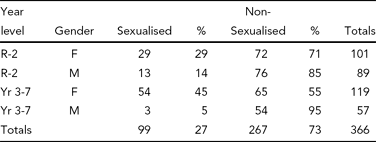
Of the 366 students observed, 27 per cent were classified as dressed in a sexualised way, of whom 11 per cent were in Grades R–2 and 16 per cent were in Grades 3–7. Of the 99 children who that were so classified, 84 per cent were girls and 16 per cent were boys (Table 1).
Sexualisation of children's dress in a school disco context.
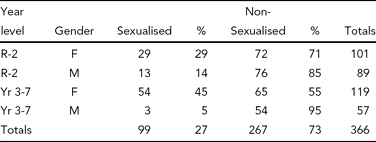
Data from Table 1 was tested for significance of differences relating to gender and grade differences. More girls (83) were identified as dressed sexually than boys (16), whereas numbers were almost identical for non-sexualised dress. The difference was highly significant (FEP = 0.0001). Similar findings were made for gender at each grade cohort, though the prevalence of female sexualised dress was less for Grades R–2 (FEP = 0.01) than for Grades 3–7 (FEP = 0.0001). Even though sexualised dress differed significantly between grade cohorts, this was less pronounced than the gender difference, and was largely due to a preponderance of Grade R–2 (148) children dressed non-sexually (FEP = 0.02). Finer analysis demonstrated that this grade difference was restricted to the girls (FEP = 0.008) with no significant difference for boys (FEP = 0.06). Examples of children's dress classified as sexualised included:
• (R–2 female) silver sparkly halter neck, backless short dress with tassels at the bottom, matching silver bag, silver sandals;
• (R–2 female) micro-shorts, t-shirt, make-up, sequin headband, bracelets, necklace, hat, flat shoes, black chain across body;
• (3–7 male) shorts, tank top with gaping sides, ribbon tied around his head;
• (3–7 female) micro-shorts, gaping neckline top with midriff showing, heavy make-up;
• (3–7 male) army cargo shorts, black t-shirt with rolled up sleeves to expose muscles, army bandana.
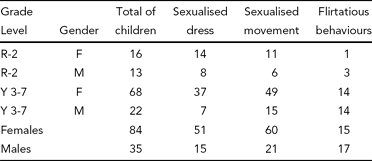
Twenty-nine children in Grades R–2 (16 females; 13 males) and 90 children in Grades 3–7 (68 females; 22 males) were identified as displaying one or more examples of sexualised dress, dancing in sexualised ways, or displaying flirtatious behaviours. More girls were identified as presenting in a sexualised way than boys in their attire and movement in both age groups, and the older age group more than the younger group (Table 2).
A comparison between genders and grade cohorts of children's sexualised dress and movement and flirtatious behaviours in a school disco context.
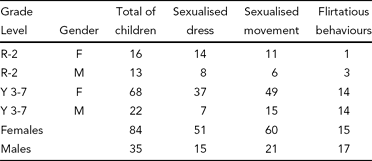
The data in Table 2 was separately tested for significance of gender and grade cohort differences for each of the rated categories using Fisher's Exact Probability test. The comparisons indicated that there was no gender effect for dress or movement (Dress FEP = 0.06; Movement FEP = 0.16). However, contrary to expectations, boys showed flirtatious behaviour more often than would be expected (FEP = 0.0008). The results were unchanged when separate age cohorts were considered. The numbers for flirtatious behaviour at R–2 were too small to be meaningful. For grade cohort, only dress showed a significant change (FEP = 0.02) movement and flirtatiousness showing no discernible change (FEP = 0.25 and 0.09 respectively). While these results were replicated for girls when analysed separately, the boys’ results were more complex with no grade difference in dress (FEP = 0.16), paralleling the findings on entry, but with a significant increase in flirtatious behaviours (FEP = 0.04).
Descriptive records of children's conduct included:
• (R–2 female) dressed in mini skirt, t-shirt and wearing make-up, movements included rotating hips and shoulders, pulsating crotch and pouting lips;
• (3–7 male) long shorts, t-shirt, legs spread apart in crouching position, dancing up and down, pulsating hips forward, crotch vigorously thrusted once;
• (3–7 female) micro-shorts, gaping top with no sides (tied up with shoe string straps), pulsating crotch, thrusting breasts;
• (3–7 seven males and eight females) lined up across from each other, many girls had their hands behind heads or on hips, all were thrusting crotch forwards – boys thrusting crotches forwards with most keeping their hands to side, a couple of boys had their hands at chest level – dancing to ‘Sexy and I know it’ by LMFAO.
Thirty-two flirtatious behaviours were observed, for example:
• (R–2 male) approached a female of the same age, danced directly in front of her (approximately 50 centimetres away from her) for a few seconds before moving on;
• (3–7 female) stealing the cap of a male student, wearing it, giving it back, then crouching down in front of the boy with legs apart pushing bust and bottom out;
• (3–7 two males) shimmied with each other leaning back and forth into one another in front of girls – girls were looking and laughing;
• (3–7 female and male) dancing together to the song ‘Baby’ by Justin Bieber emulating Bieber's heart symbol with their hands toward each other, the male then thrust his crotch toward the girl.
Direct imitation of contemporary music artists included;
• four males (three R–2 and one 3–7) were wearing Bruno Mars’ trade mark hat, sunglasses and tight jeans;
• (R–2 male) wearing black trousers, white t-shirt, black dress shoes, white socks, black hat and a white sequin glove (emulating Michael Jackson);
• (3–7 male and female) imitating Justin Biebers’ heart symbol from his video ‘Baby’.
• many children of both genders in both venues pulsated their crotches forwards very fast at the same time that the members of the group LMFAO do in their video clip ‘Sexy and I know it’;
• many females and three males in one of the discos imitated the hand movements made by Beyoncé in her video clip ‘Single ladies’ at the time she does this in her video clip;
Discussion
There are two fundamental conclusions to be drawn from this research. Firstly, within the context of a school disco, some children, particularly girls, present in a sexualised manner from a young age; and, secondly, that even though girls were sexualised in their dress more often than boys, boys showed relatively more flirtatious behaviours. The first hypothesis was confirmed in that over a quarter of the children arrived wearing sexualised dress and sexualised conduct was described involving 119 children. Specific instances were recorded of dress and dance movements directly imitating contemporary popular music artists, validating the second hypothesis. The third hypothesis rendered ambiguous results in that, while significantly more girls arrived in sexualised clothing, there was no greater involvement in sexual conduct observed during the dancing, except in flirting, which was engaged in by boys to a disproportionate level. Of course, the quantitative results from purposive sampling are also subject to the observer's choice of who to observe in a very full venue. In particular, an effort was made to maintain gender balance in the divide of children which may inflate the level of male involvement in sexualised conduct.
This research demonstrates that apprehension about the influence of popular music and music artists on youthful values, attitudes and behaviour (Shuker, Reference Shuker2005; Street, Reference Street, Frith, Straw and Street2001) is not unwarranted. While most children did not dress or behave in sexualised ways at the school disco, approximately one third of these primary school children did. It could be contended that their attire was not actually ‘sexualised’, but merely reflected gender stereotypes, but that is to misunderstand the nature of sexualisation. It is not that individual children chose to dress in this fashion because they thought it made them appear sexual. Rather, music media, along with other societal factors such as availability of sexualised clothing and parental permissiveness, creates a social norm through which particular forms of dress, which would normally be related to sexuality in adults, are seen as suitable for young children.
Even though they were not a majority, the presence of so many primary school children dressing in a sexualised manner is disquieting, particularly when 42 per cent of those children were in the group aged 5–7 years. This indicates that many children, and their parents, have come to see it as appropriate to dress in a way that mimics adult sexuality at an early age. That the majority of children wearing sexualised attire were females might be due, in part, to sexualised clothing being more easily obtained by females. But it is also likely to reflect the permeation of female sexual imagery into popular media, particularly music media that promotes sexualised dress as unexceptional, even for young females. The extent to which girls were more sexualised in their dress is consistent with Cunningham's (Reference Cunningham2005) and Darian-Smith's (Reference Darian-Smith2010) references to girls being more vulnerable to the influence of popular culture, and Shuker's (Reference Shuker2005) proposal that music is associated with gender and sexuality. It is also consistent with findings that female artists are portrayed more sexually attired than males (Strasburger, Reference Strasburger2005)
Because the pop musical genre is mainly directed towards young girls, it is understandable that 99 girls arrived in sexualised dress and 84 were observed engaging in sexualised conduct during the discos. However, girls were not observed as substantially more likely to display sexualised movements than boys despite the greater sexualisation of female music artists (Somers-Flanagan et al., Reference Somers-Flanagan, Somers-Flanagan and Davis1993; Strasburger, Reference Strasburger2005). This requires further exploration, but may reflect factors in parents’ attitudes to clothing children, or differences in the relative availability of sexualised clothing for boys and girls. Even though less affected in their dress, boys are equally likely to emulate the sexualised movements of music artists.
It might be claimed that the conduct observed may not be sourced from media, but from social interactions between peers. This does not vitiate the basic argument, but merely indicates that media influences are reinforced by peer interactions. This is well attested in parallel phenomena such as superhero and fairy play (Cupit, Reference Cupit1989).
That boys engaged in flirtatious behaviours more than girls was not predicted. This may be explained by Hamilton's (Reference Hamilton2010) proposal that boys respond to girls’ sexualised presentation, and this is shown in behaviours which are pertinent to the sexualised nature of the interaction. This, too, requires further research. This is not to suggest that girls are trying to allure boys sexually. It is likely that girls are unaware of the significance of the sexual messages they are conveying. Nor does it mean that boys are acting as sexual predators. However, boys do show that they are aware of, and can respond relevantly to, girls’ sexualised presentation. They do so by initiating various forms of sexuality associated behaviour identified in the study as ‘flirting’. This is congruent with claims in previous research with adolescents (Gonzalez de Rivas et al., Reference Gonzalez de Rivas, Fuld, Mulligan, Altmann, Brown, Christakis and Wilcox2009; Kalof, Reference Kalof1999; Olfman, Reference Olfman2009; Papadopoulos, Reference Papadopoulos2010) that the foundations for sexually permissive behaviours are laid by exposure to sexually explicit popular music.
Although there are many variables, such as peer influence or attending dance classes that may influence how children conduct themselves in a disco context, some styles of dress and movements observed were directly attributable to particular music artists. Some children were watching music videos produced by these artists and imitating them, as shown by their ability, when merely listening to the music, to emulate distinctive movements made by LMFAO, Beyoncé and Justin Bieber at the exact time the artist performed these movements on their music videos. Although Justin Bieber's love heart symbol is far from sexual, its context is often romantic, and its use evidences that children were copying what music artists do. This was not unexpected considering the evidence that children learn through imitation (Bandura, Reference Bandura1986, Reference Bandura1977; Papadopoulos, Reference Papadopoulos2010). These findings are coherent with Hall et al. (Reference Hall, West and Hill2011), Sanson et al. (Reference Sanson, Duck, Cupit, Ungerer, Scuderi and Sutton2000), Zurbriggen et al. (Reference Zurbriggen, Collins, Lamb, Roberts, Tolman, Ward and Blake2007) and Papadopoulos (Reference Papadopoulos2010) in that they suggest that some children choose to use media figures as role models and internalise their behaviours. These can become guiding principles to inform children's behaviour and choices. Martino et al. (Reference Martino, Collins, Kanouse, Elliott and Berry2005) are inaccurate in their claim that sexual behaviours in music media are only implied and not directly displayed, unless they are restricting their meaning of ‘sexual behaviours’ to actual coition. Children in this study were imitating aspects of sexual dress and behaviour because they were exhibited clearly enough to be salient to them.
Although this study only observed a school disco context, given that many children appeared to be comfortable in their displays of sexualised conduct, it reasonable to argue that such dress and behaviour may also occur within these age groups beyond this context. This is consistent with anecdotal reports by teachers, within these schools, who claim children, particularly girls, act out sexualised behaviours in the school yard, imitating and practicing contemporary artists’ dance movements during their recess and lunch breaks.
The prospect of children adopting the stereotypical sexist attitudes displayed in contemporary music would impact upon efforts at gender equity education. Commentators’ apprehension about children's healthy psychological, physical and social and emotional development should not be dismissed as mere moral panic, despite its occasionally hysterical edge. That children as young as those in this study are imitating and potentially internalising the sexual presentation of an industry which employs pornographic producers to direct their videos (Levin & Kilbourne, Reference Levin and Kilbourne2008) justifies their disquiet. The frequency and overtness of sexual content in music videos revealed by previous research (Andsager & Roe, Reference Andsager and Roe2003; Baxter et al., Reference Baxter, De Riemer, Landini, Leslie and Singletary1985; Papadopoulos, Reference Papadopoulos2010; Sherman & Dominick, Reference Sherman and Dominick1986; Somers-Flanagan et al., Reference Somers-Flanagan, Somers-Flanagan and Davis1993; Steingraber, Reference Steingraber and Olfman2009; Urie, Reference Urie2008; Walter, Reference Walter2010; Zurbriggen et al., Reference Zurbriggen, Collins, Lamb, Roberts, Tolman, Ward and Blake2007) implies that children will continue to imitate these behaviours and this may become progressively more sexualised. It is implausible that this will only be expressed at school discos and not be reflected in their wider self-presentation and conduct.
Future directions
In future studies, more specific results would be gained from age data on individual children rather than from cohort groups across age ranges. It is also important to explore the differences between the majority of children who did not demonstrate identifiable sexualisation, and those who did. Did this larger group have less exposure to music media, counteractive family values, or were there other reasons that made sexual imagery not salient to them?
In this study institutional requirements meant that the evaluation of sexualised aspects of children's behaviour was based on a single observer and, while they used clear criteria for such classification, replication using other researchers and methodologies is recommended. While there is no evidence that the observer's gender influenced the results, especially as the other researcher was male, such replication might well use male observers. The study also indicates a need to investigate the ‘meaning’ children attribute to dress, dance and movement and to the sexualised aspects they display.
Conclusion
From the findings of this study it may be concluded that a significant number of young children are viewing music videos and imitating the sexual conduct of contemporary music artists in a common social context. It is unclear to what degree children identify their presentation in sexual terms or whether they are intentionally trying to present in a sexual manner. It remains possible that they are merely adopting sexualised conduct as adherence to a social norm, though that social norm may still provide a foundation for their later sexual attitudes. Further research needs to be conducted to investigate children's and parents’ reasoning for their choice of clothing, and what children believe their dance and movement reflects. This is necessary to fully flesh out our understanding of how children develop or resist sexualised attitudes and behaviours.