Introduction
Recent research shows a strong connection between bipolar disorder (BD) and obsessive-compulsive disorder (OCD), a link that is potentially stronger than that established between OCD and major depression (Reference Chen and Dilsaver1–Reference Dilsaver, Akiskal, Akiskal and Benazzi3). A reanalysis of the Epidemiological Catchment Area Study data set showed that lifetime rates of OCD in patients with BD and major depression were 21 and 12.2%, respectively, and that BD patients were 1.7 times more likely to have OCD than were patients with major depression Reference Chen and Dilsaver(1). As Angst and colleagues Reference Angst, Gamma and Endrass(2) pointed out, a National Comorbidity Survey replication study also found lifetime OCD to be more prevalent in patients with BD (OR = 9.0) than in those with major depression (OR = 3.4). In clinical settings, patients with BD are reported to have 5.1-fold greater chance of having OCD than do patients with major depression Reference Dilsaver, Akiskal, Akiskal and Benazzi(3). Similarly, Grabe and colleagues Reference Grabe, Meyer and Hapke(4) reported in a group of female patients with OCD that the odds ratio for the risk of comorbid BD was 30, compared with 5.3 for the risk of comorbid major depression. Finally, a recent prospective cohort study, using a broad definition of bipolar II disorder (having had a major depressive episode plus hypomania or hypomanic symptoms), showed significant OCD-BD comorbidity, whereas there was no clear association between OCD and major depression Reference Angst, Gamma and Endrass(2).
Although OCD-BD comorbidity is now considered highly prevalent, very few controlled studies have examined the impact of comorbid OCD on the course and treatment of BD. Krüger and colleagues Reference Krüger, Braunig and Cooke(5) examined 143 subjects with BD I and II, and found a current OCD diagnosis only in male BD II patients (n = 10). The authors reported that these patients, in comparison with BD patients without OCD, presented fewer previous affective episodes but a higher incidence of prior suicide attempts, although there was no significant difference between the two groups in terms of substance abuse, comorbidity with other anxiety disorders, somatization disorder or binge eating. Another study, in which follow-up assessments of functional status were carried out in patients with BD I and OCD (64% male) for 1.5–7.5 years after discharge, showed the suicide attempt rates to be no higher among those patients than among patients with BD only or OCD only Reference Centorrino, Hennen, Mallya, Egli, Clark and Baldessarini(6). However, as expected, patients with OCD-BD comorbidity were rehospitalised 2.9 times more frequently than those with OCD only.
In this study, we investigated the clinical characteristics and the expression of comorbid disorders in female BD patients with OCD, comparing the findings with those we obtained for female BD patients without OCD. We used standard clinical instruments to evaluate the course of BD, together with semi-structured interviews encompassing other lifetime Diagnostic and Statistical Manual, Fourth Edition (DSM-IV) psychiatric diagnoses, such as anxiety and impulse control disorders. To the best of our knowledge, this is the first study assessing impulse control disorders in OCD-BD comorbidity.
Material and methods
Sample
The study sample consisted of 30 clinically stable female outpatients with BD (25 with BP-I and 5 with BP-II), divided into two groups: BD+OCD, consisting of 15 patients (12 with BP-I and 3 with BP-II) with comorbid OCD; and BD/no-OCD, consisting of 15 patients (13 with BP-I and 2 with BP-II) without OCD. The groups were matched for age, ethnicity, education and socioeconomic status. Patients were recruited consecutively from among those seeking treatment at the outpatient units of the Institute of Psychiatry of the University of São Paulo School of Medicine. All assessments were made by the first author. Because only 3 of the first 15 patients enrolled were male, the decision was made to exclude males and thereby select a more homogeneous sample. Of the 15 patients in the BD+OCD group, 12 had sought treatment for BD symptoms, and 3 had sought treatment for OCD symptoms. However, careful diagnostic evaluation revealed BD to be the primary diagnosis in those three patients as well. A detailed analysis of the clinical characteristics of OCD in these patients is published elsewhere Reference Issler, Amaral and Tamada(7). The inclusion criterion was having been diagnosed with BP-I or BP-II, with and without comorbid OCD, as determined using the Structured Clinical Interview for DSM-IV Disorders – patient version (SCID/P) Reference First, Spitzer and Gibson(8). Patients presenting concurrent organic brain disease or schizoaffective disorder were excluded. The Institutional Review Board of the University of Sao Paulo approved this study, and, after having been given a complete description of the study, all participants gave written informed consent.
Materials
Diagnostic assessments were conducted using the SCID/P Reference First, Spitzer and Gibson(8). The Yale-Brown Obsessive-Compulsive Scale (Y-BOCS) was administered to assess the severity of obsessive-compulsive symptoms Reference Goodman, Price and Rasmussen(9). For the diagnosis of kleptomania, trichotillomania, pathological gambling, onychophagia and skin picking, specific modules were administered Reference First(10). Chronic motor and vocal tics were assessed using the Yale Global Tic Severity Scale Reference Leckman, Riddle and Hardin(11). The specific module of the Kiddie Schedule for Affective Disorders and Schizophrenia, epidemiological edition Reference Orvaschel and Pui̇g-Anti̇ch(12) was applied to identify attention deficit hyperactivity disorder. Clinical information was obtained through the use of a retrospective mood chart Reference Sachs(13), together with data from psychiatric interviews and medical records.
Patients requiring antidepressant medication for at least 3 days per week in the 2 weeks preceding a manic episode, as defined by Stoll and colleagues Reference Stoll, Mayer and Kolbrener(14), were considered to have treatment-emergent manic symptoms. Age at onset of BD was defined as the age at which the patient first met the DSM-IV criteria for a major mood episode, and age at onset of OCD was defined as the age at which the first obsessive or compulsive symptoms appeared. In accordance with the criteria adopted by Rosário-Campos and colleagues Reference Rosari̇o-Campos, Leckman and Mercadante(15), onset of OCD before the age of 10 years was classified as early-onset OCD. An episode was considered to be chronic if all criteria for a major mood episode were met continuously for at least 2 years. When symptoms of an episode continued, but all criteria for BD were no longer met, the patient was classified as having residual symptoms.
Statistical analysis
All statistical analyses were conducted using the Statistical Package for the Social Sciences, version 14 (SPSS Inc., Chicago, IL), and two-tailed tests. The level of statistical significance was set at p < .05. We used a chi-squared test for categorical variables and the Student's t-test for continuous variables. All of the continuous variables showed normal distribution.
Results
Sociodemographic data
There was no significant difference between the two groups in terms of marital status or employment (p > .05 for both). The proportions of single patients, patients who were married/living with a steady partner and divorced/separated patients were 40, 40 and 20%, respectively, for the BD+OCD group, compared with 26.7, 26.7 and 46.7%, respectively, for the BD/no-OCD group. In the BD+OCD group, 13% of the patients were unemployed, as were 26.7% of those in the BD/no-OCD group, although the difference between the two groups did not reach statistical significance for this variable.
Clinical characteristics
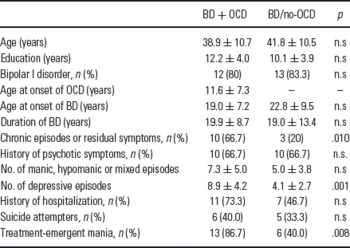
Clinical characteristics of both patient groups are shown in Table 1. Mean Yale-Brown Obsessive-Compulsive Scale (Y-BOCS) score in the BD+OCD group was 26.1 ± 6.9. All patients in the BD+OCD group and 13 patients in the BD/no-OCD group were receiving drug treatment. There were 28 patients using mood stabilizers (15 in the BD+OCD group; 13 in the BD/no-OCD group), 14 using antipsychotics (9 in the BD+OCD group; 5 in the BD/no-OCD group) and 12 using antidepressants (8 in the BD+OCD group; 4 in the BD/no-OCD group).
Clinical and demographic characteristics of the patients*

BD, bipolar disorder; OCD, obsessive-compulsive disorder.
* Unless otherwise noted, all values are expressed as mean ± SD.
The age at onset of BD was numerically lower in the BD+OCD group, although the difference between the two groups did not reach statistical significance. Of the 15 patients in the BD+OCD group, 9 (60%) had early-onset OCD (age at onset, <10 y). Patients in the BD+OCD group had more chronic episodes, residual symptoms and previous depressive episodes than the BD/no-OCD group. The number of manic/hypomanic/mixed episodes did not differ between the two groups. Although the number of previous psychiatric hospitalisations, as well as the number of suicide attempts, was higher in the BD+OCD group than in the BD/no-OCD group, no significant difference was found for either of these variables. Of the 15 patients in the BD+OCD group, 13 (86%) had a history of treatment-emergent manic symptoms, compared with only 6 (40%) of the BD patients in the BD/no-OCD group, and this difference was significant (Table 1).
Coexisting psychiatric disorders
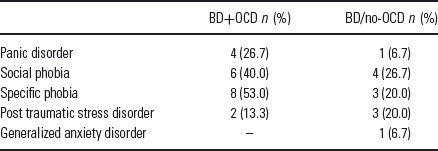
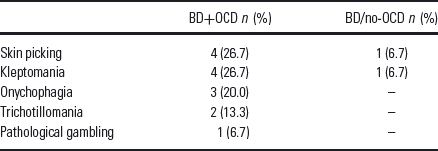
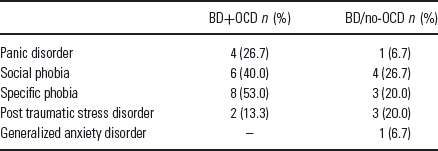
The following disorders were more prevalent in the BD+OCD patients than in the group without OCD: any anxiety disorder other than OCD, as shown in Table 2 (93.3 vs. 53.3%, p = .035); impulse control disorders, as shown in Table 3 (60 vs. 13.3%, p = .008); eating disorders (33.3 vs. 0%, p = .042); and tic disorder (33.3 vs. 0%, p = .042). Of the five patients with tic disorder, two had Tourette syndrome. There was no difference between the groups in terms of substance abuse or dependence (26.7% for both groups). Few of the patients in either group had attention deficit hyperactivity disorder (13.3 and 6.7%, respectively, in the BD+OCD and BD/no-OCD groups, p > .05).
Frequencies of comorbid anxiety disorders
Frequencies of impulse control disorders
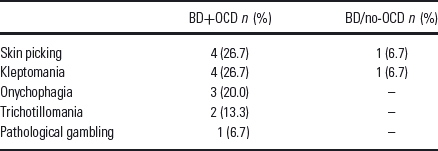
BD, bipolar disorder; OCD, obsessive-compulsive disorder.
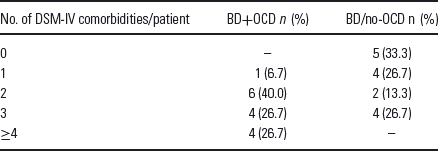
Excluding OCD, the number of Axis I comorbidities per patient was significantly higher in the BD+OCD group than the BD/no-OCD group (p = .009), with all the patients in this group having one or more comorbidity. This difference remained significant after the exclusion of tic disorders and impulse control disorders (p = .05). More than 95% of the patients in the BD+OCD group had at least two comorbidities other than OCD (Table 4).
Number of comorbidities per patient
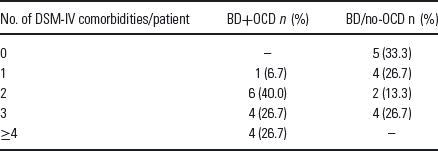
BD, bipolar disorder; OCD, obsessive-compulsive disorder.
Discussion
In comparison with those in the BD/no-OCD group, the patients in the BD+OCD group had a greater number of previous depressive episodes, chronic episodes and residual symptoms, as well as higher rates of treatment-emergent affective switch. In addition, patients in the BD+OCD group had more coexisting psychiatric disorders, 93.3% having another anxiety disorder and 60% having impulse control disorders. Taken together, these findings suggest that, in comparison with their non-OCD counterparts, bipolar patients with OCD comorbidity suffer from a more severe form of disorder, as also suggested by Hantouche and colleagues Reference Hantouche, Angst, Demonfaucon, Perugi, Lancrenon and Akiskal(16).
The emergence of antidepressant-associated mania has been previously documented in patients with OCD Reference Perugi̇, Toni̇, Frare, Travi̇erso, Hantouche and Aki̇skal(17,Reference Berk, Koopowitz and Szabo18). In addition, Perugi and colleagues Reference Perugi̇, Toni̇, Frare, Travi̇erso, Hantouche and Aki̇skal(17) showed that patients with BD and OCD have a greater number of concurrent major depressive episodes and treatment-emergent affective switches than do OCD patients without comorbid BD. Despite the early appearance of OCD symptoms, most of our patients sought treatment for BD symptoms, highlighting the importance of inquiring about obsessions and compulsions when evaluating BD patients, as recommended by Chen and Dilsaver Reference Chen and Dilsaver(1). The inverse is also true for patients with OCD, because three patients in this cohort sought treatment for obsessive-compulsive symptoms and were unaware of having BD. In addition to the mood stabilizer resistance previously documented Reference Boylan, Bieling, Marriott, Begin, Young and MacQueen(19), comorbid OCD can render patients with BD more prone to treatment-emergent mania.
In our sample, the age at onset of BD did not differ between the two groups, despite the fact that the age at onset of BD was numerically lower in the BD+OCD group. Also, in our BD+OCD group, we found the onset of OCD to be much earlier than that of BD. This is in accordance with the findings of two previous studies Reference Hantouche, Angst, Demonfaucon, Perugi, Lancrenon and Akiskal(16,Reference Masi̇, Perugi̇ and Toni̇20) showing that the manifestation of obsessive-compulsive symptoms occurs early (before age 16) in OCD patients with comorbid BDs. Chen and Dilsaver Reference Chen and Dilsaver(1) hypothesised that concurrence and same age at onset of BD and OCD can be interpreted as these two disorders having the same underlying diathesis. In our study, age at onset of BD was defined as the age at which the patient first met the DSM-IV criteria for a major mood episode, whereas age at onset of OCD was defined as the age at which the first obsessive or compulsive symptoms appeared. OCD research provides evidence for the existence of an early-onset subtype distinct from the other forms of the disorder, and our data also suggest that BD is associated with the early-onset OCD subtype Reference Mi̇guel, Leckman and Rauch(21,Reference De Mathis, Diniz and Do Rosário22). Although further studies are needed to confirm this finding, it might have some etiologic implications, as suggested by Chen and Dilsaver (Reference Chen and Dilsaver1,Reference Mi̇guel, Leckman and Rauch21,Reference De Mathis, Diniz and Do Rosário22).
Although 40% of the patients in our BD+OCD group reported one or more prior suicide attempts, this was not significantly different from the BD/no-OCD group (33.3%). This is in accordance with Centorrino and colleagues' finding of no significant differences in suicide attempts between BD patients with comorbid OCD and those with BD only Reference Centorrino, Hennen, Mallya, Egli, Clark and Baldessarini(6). However, in this study, this result may reflect a possible type II error because of the small size of our sample. In contrast, Krüger and colleagues Reference Krüger, Braunig and Cooke(5) reported a higher incidence of prior suicide attempts in a group of male BD type II patients with OCD (n = 10) compared to BD patients without OCD, and all of the patients evaluated had been diagnosed with comorbid dysthymia, a condition that might explain the elevated suicide attempt rates. Chen and Dilsaver Reference Chen and Dilsaver(1) also reported elevated suicidality in patients with OCD-BD comorbidity, although they explained this as being a function of the higher number of patients with comorbid panic disorder in their sample. Suicide attempt rates in OCD patients have been reported to be around 10–27% Reference Torres, De Abreu Ramos-Cerqueira, Torresan, De Souza Domi̇ngues, Hercos and Gui̇marães(23,Reference Kamath, Reddy and Kandavel24), and anxiety disorders are known independent risk factors for suicide attempts Reference Norton, Temple and Petti̇t(25,Reference Bolton, Cox, Afi̇fi̇, Enns, Bi̇envenu and Sareen26). Therefore, the elevated suicide rates observed in the BD+OCD patients may be attributable to OCD and other concurrent anxiety disorders.
In this study, 93% of the patients in the BD+OCD group had another comorbid anxiety disorder; panic disorder, specific phobias and social phobia being the most prevalent. Chen and Dilsaver Reference Chen and Dilsaver(1) reported a similar finding: increased rates of comorbid panic disorder in subjects with OCD-BD comorbidity. Masi and colleagues Reference Masi̇, Perugi̇ and Toni̇(20) found that the rate of panic disorder was higher among youths with OCD-BD comorbidity than among those with BD and no OCD. Finally, Dilsaver and colleagues Reference Dilsaver, Akiskal, Akiskal and Benazzi(3) examined the question of ‘cumulative anxiety disorder comorbidity’ in juvenile patients with OCD-BD comorbidity and found that comorbid OCD resulted in a 10-fold increase in the odds of having panic disorder, whereas having OCD and panic disorder was associated with social phobia. Our finding of the cumulative presence of anxiety disorders in the BD+OCD group also supports the notion that the presence of one comorbid anxiety disorder can increase the chances of having another, as suggested by Dilsaver and colleagues Reference Dilsaver, Akiskal, Akiskal and Benazzi(3).
To the best of our knowledge, this is the first study to use specific modules to investigate impulse control disorders in BD patients with OCD. Of the 15 patients in the BD+OCD group, 9 (60%) had an impulse control disorder, compared with only 2 (13%) of those in the BD/no-OCD group. Although it is well established that anxiety and impulsivity are common characteristics of BD, the interplay between the two in BD is a topic that has rarely been investigated. One recent study Reference Taylor, Hi̇rshfeld-Becker and Ostacher(27) showed that BD patients with a comorbid anxiety disorder displayed significantly higher levels of impulsivity (as assessed using the Barratt Impulsiveness Scale) than did those without an anxiety disorder. Hantouche and colleagues Reference Hantouche, Angst, Demonfaucon, Perugi, Lancrenon and Akiskal(16) stated that a higher prevalence of concurrent disorders (panic disorder, phobias, anger attacks, impulsive disorders and eating disorders) is presumptive of bipolar OCD. However, the DSM-IV impulse control disorders comprise heterogeneous disorders, including different subgroups with some common features among them. For instance, skin picking, onychophagia and trichotillomania, along with tic disorders and body dysmorphic disorder, are now conceptualised as obsessive-compulsive spectrum disorders, based on common psychopathological features and genetic background Reference Mi̇guel, Leckman and Rauch(21,Reference Bi̇envenu, Samuels and Ri̇ddle28). Such disorders were more common in the BD+OCD group in our sample; however, based on the ‘obsessive-compulsive spectrum disorders' conceptualisation, one might also argue that it is expected to see more of these disorders in any population of patients with OCD. Additional research is needed to examine the complex interplay between impulse controls disorders, OCD and BD.
By including only female patients, we were able to control for possible confounding factors related to gender. However, the small sample size constitutes a significant limitation of our study. Although the exclusion of males made our sample more homogeneous, it also reduced the external validity of our findings. Therefore, future studies on this theme should include larger patient samples, composed of both genders, to validate the findings described here. A major strength of this work is that our data were collected using structured interviews and well-established assessment scales. Our findings complement and enhance those of previous studies, showing that OCD-BD comorbidity is linked with greater illness severity. Patients with OCD-BD comorbidity present a higher number of depressive episodes, have more residual symptoms and are at a greater risk of treatment-emergent mania. These findings could have significant clinical implications. For instance, in view of research favouring atypical antipsychotic augmentation for OCD that is refractory to selective serotonin uptake inhibitors Reference Jacobsen(29,Reference Koran, Ringold and Elliott30), the choice of atypical antipsychotics should be considered in patients with OCD-BD comorbidity, because it might help prevent antidepressant-associated manic switch Reference Hantouche, Angst, Demonfaucon, Perugi, Lancrenon and Akiskal(16,Reference Raja and Azzoni̇31) and could improve the symptoms related to both disorders. Clinicians should also be aware of the higher rates of anxiety disorders and impulse control disorders commonly seen in this subgroup of patients and should establish comprehensive therapeutic strategies for treating these patients. Finally, although the data available are insufficient to allow us to define OCD-BD comorbidity as a distinct entity, future research examining the familial-genetic and neurobiological aspects of this comorbidity will further the understanding of its exact nature.
Acknowledgements
This research was supported in part by a generous donation from the Thompson Motta Family. Dr Lafer has received speaker's honoraria from AstraZeneca in 2007. Dr Monkul is an employee of Eli Lilly Brazil. Address of the department to which the work should be attributed is Department of Psychiatry, University of São Paulo School of Medicine, São Paulo, Brazil. The authors do not have any affiliation with or financial interest in any organisation that might pose a conflict of interest.