INTRODUCTION
There has been a great deal of recent research in Aztec studies concerning Tezcatlipoca (Baquedano Reference Baquedano2015; Olivier Reference Olivier and Besson2008). This ambivalent deity was the archsorcerer, the master of destiny, but also the tutelary god of kings of Late Postclassic central Mexico. Described by Nicholson (Reference Nicholson, Bernal and Ekholm1971:412) as an “omnipotent, omnipresent, omniscient deity,” he is the embodiment of chaos and matter, associated with darkness and sorcery under the name of Yohualli Ehecatl, “Night Wind.” One of his avatars, Tepeyollotl, “Heart of the Mountain,” expresses his animal alter ego, the jaguar, and his association with the underworld and fertility (Olivier Reference Olivier and Besson2008:92–107). In the same way, Tezcatlipoca is associated with the moon as indicated by his calendrical names, 1 Death (Ce Miquiztli) and 2 Reed (Ome Acatl). Other names such as Telpochtli, “Young,” make a link to warriors and with the schools for youth (telpochcalli). As Necoc Yaotl (“Enemy of the Two Sides”), this capricious god stirred up discord among men and provoked conflicts on earth (Olivier Reference Olivier and Besson2008:25–32). The relationship to both warriors and divination explains the close ties to power. The Mexica king identified with a representative of Tezcatlipoca who was sacrificed during the veintena of Toxcatl. Also, after his enthronement, the new king invoked the benevolence of Tezcatlipoca, who, by the gifts of his divinatory mirror and his flute (a myth attributed the origin of music to Tezcatlipoca), would guide the king's future acts and speak through him (Olivier Reference Olivier and Keber2002).
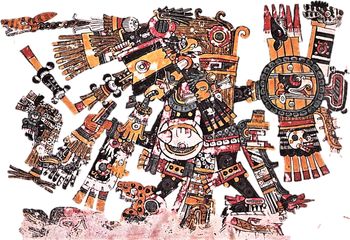
The most ancient representations of Tezcatlipoca date from the tenth to eleventh centuries a.d. in Tula (Hidalgo), Ixtapantongo (Estado de México), and Chichen Itza (Yucatán); in all cases, he appears as a war god (Olivier Reference Olivier and Besson2008:85–92). In murals, bas-relief sculpture, and codices, he is seldom depicted without his primary diagnostic attribute, a smoking mirror that often appears in place of his foot or as an element attached to his head (Figure 1; Olivier Reference Olivier and Besson2008:231–268). The name Tezcatlipoca is generally translated as “Smoking Mirror,” with “Shining” or “Brilliant Mirror” being other possibilities (Olivier Reference Olivier and Besson2008:14–15; Zantwijk Reference Zantwijk1985:315, n7, Reference Zantwijk1994:44). The Franciscan historian Fray Juan de Torquemada (Reference Torquemada1944:vol. 2, p. 38) accords with the latter translation, when he calls the god “Espejo resplandeciente,” referring to him as second to none of the gods in his Monarquia indiana (1615).
Tezcatlipoca, from the Codex Borgia (Anders et al. Reference Anders, Jansen, García, Anders, Jansen and García1993:17).

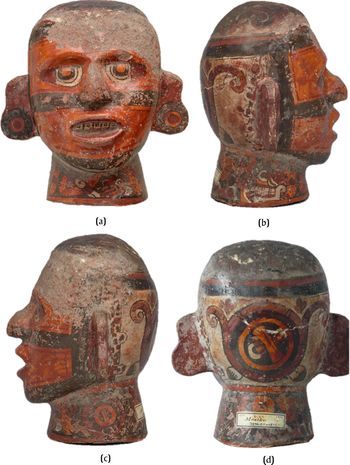
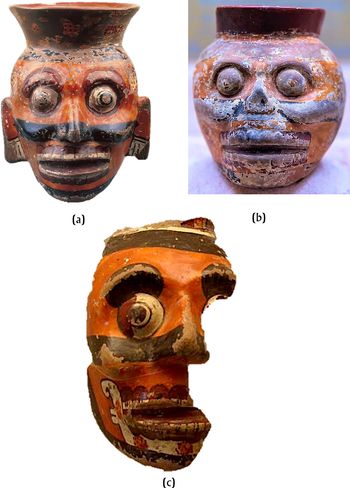
In the most comprehensive study to date of Tezcatlipoca, Olivier (Reference Olivier and Besson2008:63–64) mentions several ceramic representations of this deity that fall into an Eastern Nahua subset of the Mixteca-Puebla artistic style. Another such representation (Figures 2a–2d) is from the Bilimek Collection in the Weltmuseum Wien (formerly Museum für Völkerkunde/Museum of Ethnology, Vienna; Catalog No. 6.106). This discussion will focus on this example and relate it to several other ceramic representations of this deity in the Colección Fundación Televisa in Mexico City, the Museo Regional de Cholula, and the Museo del Valle de Tehuacán (Figures 3a–3c). It will be shown that this effigy head belongs to an Eastern Nahua artistic style that is best exemplified in Catalina Polychrome from Cholula as well as the painted benches from the sites of Tizatlan and Ocotelulco in Tlaxcala. These vessels became ritually active when they contained beverages and invoked the supreme deity of Late Postclassic central Mexico.
The Tezcatlipoca ceramic effigy head from the Bilimek Collection in the Weltmuseum Wien, Vienna: (a) front, (b) right side, (c) left side, and (d) back of effigy. Photographs by Christian Mendez, ©KHM-Museumsverband Vienna.

Tezcatlipoca effigy heads. (a) Effigy from the Colección Fundación Televisa in Mexico City. (b) Effigy from the Museo del Valle de Tehuacán. (c) Effigy from the Museo Regional de Cholula. All photographs courtesy of the Instituto Nacional de Antropología e Historia.

FATHER DOMINIK BILIMEK
Before its acquisition by the museum, the ceramic effigy in Vienna was in the possession of Father Dominik Bilimek (1813–1884), a Cistercian friar from Austria. Bilimek was born on February 23, 1813 in Nový Jičín (Neutitschein) in Moravia, in the present-day Czech Republic, which was then part of the Austrian Empire. Archduke Ferdinand Maximilian of Austria (1832–1867) invited Bilimek to Mexico, after the Archduke himself had accepted the imperial crown of the Second Mexican Empire (1864–1867). Bilimek's knowledge of the natural sciences and his experience in collecting convinced the Emperor to appoint him curator of botany and entomology at the newly established Mexican National Museum on January 15, 1865, an engagement officially confirmed on May 1, 1866 (Neue Freie Presse, January 26, 1865).
Despite the Mexican Civil War preventing extensive travel in the interior of the country, Bilimek nevertheless was able to assemble large collections, occasionally being accompanied by the Emperor on his explorations. Apart from his zoological and botanical acquisitions, Bilimek acquired over 900 archaeological and ethnographical specimens. He carefully recorded the locations where he found the natural specimens. Regarding the archaeological objects, Bilimek states he himself found a few in a cave near Orizaba and at Chapultepec. The vast majority of the archaeological artifacts, including the effigy, have no provenance. In a letter, Bilimek mentions that these latter objects had been assembled over a period of 40 years (Bilimek Reference Bilimek1878; Riedl-Dorn Reference Riedl-Dorn and Seipel2001:331). This implies that most of the archaeological artifacts were obtained from one or more private collectors.
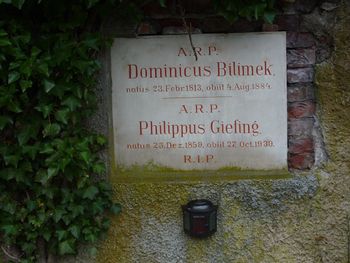
Following the end of Maximillan's Mexican experiment and the closing of the National Museum in Mexico City, Bilimek's collection was stored in private households and at the castle of Chapultepec before being shipped to Europe in July 1867. Upon his return to Vienna in September 1867, Bilimek was received by Emperor Franz Joseph I of Austria, brother of Maximilian, to inform him about the last days of the Mexican Empire (Neue Freie Presse, September 22, 1867). Bilimek received a confirmation of his appointment in Miramar by December 30, 1867. In 1878, Dominik Bilimek parted with the majority of his collections. The natural history specimens were mainly distributed to collections in Vienna, London, Paris, St. Petersburg, and to a newly created museum in his hometown, which also received an ethnographic collection from Mexico. The archaeological objects were transferred to the Imperial and Royal Court Museum of Natural History in Vienna, where they were allocated to the Anthropological-Ethnographical Department, the predecessor institution to the present Weltmuseum Wien. Supplementary Bilimek artifacts were acquired by the same museum in 1882. Ever since then, Bilimek's collection constitutes one of the core Mexican collections of this institution (Heger Reference Heger1908:18–19; van Bussel Reference van Bussel, Krumrine and Scott2001:306, 309). In return, Bilimek received an annuity of 600 Austrian guilders. At the time, the value of the collection was registered as 6,250 guilders. Upon his death in August 1884, Bilimek had been paid 4,050 guilders, making a total of approximately €45,000 as the actual price of acquisition. On August 4, 1884, Dominik Bilimek passed away and two days later was laid to rest at the cemetery of the Heiligenkreuz (Holy Cross) Abbey, Lower Austria (Figure 4).
Headstone of Dominik Bilimek, cemetery of the Heiligenkreuz (Holy Cross) Abbey, Lower Austria. Photograph by van Bussel.

THE VIENNA EFFIGY
The Vienna effigy has a height of 20.4 cm and a width of 19.4 cm. The object was remodeled and repainted before entering the museum's collection (Becker-Donner Reference Becker-Donner1965:23, Plate VII; Feest and Kann Reference Feest and Kann1992:202; van Bussel Reference van Bussel2010). Fractures on the surface show patches used for remodeling. The added and newly painted areas appear partly dull in comparison to the vivid colors of the original decoration. Exposure to ultraviolet light shows remodeled additions on the top of the effigy, the right ear and earflare, and parts of the back of both the head and pedestal. There are no ventholes in the original ceramic. The present condition of the effigy, which completely seals off the head, was not possible originally for, without ventholes, heated air could not escape during firing, causing the object to break. The effigy, therefore, was most likely open at the top and originally a vessel. This makes it comparable to the other effigies in the Fundación Televisa, Museo Regional de Cholula, and the Museo del Valle de Tehuacán that show certain similarities as well as slightly different facial decoration (Figures 3a–3c).
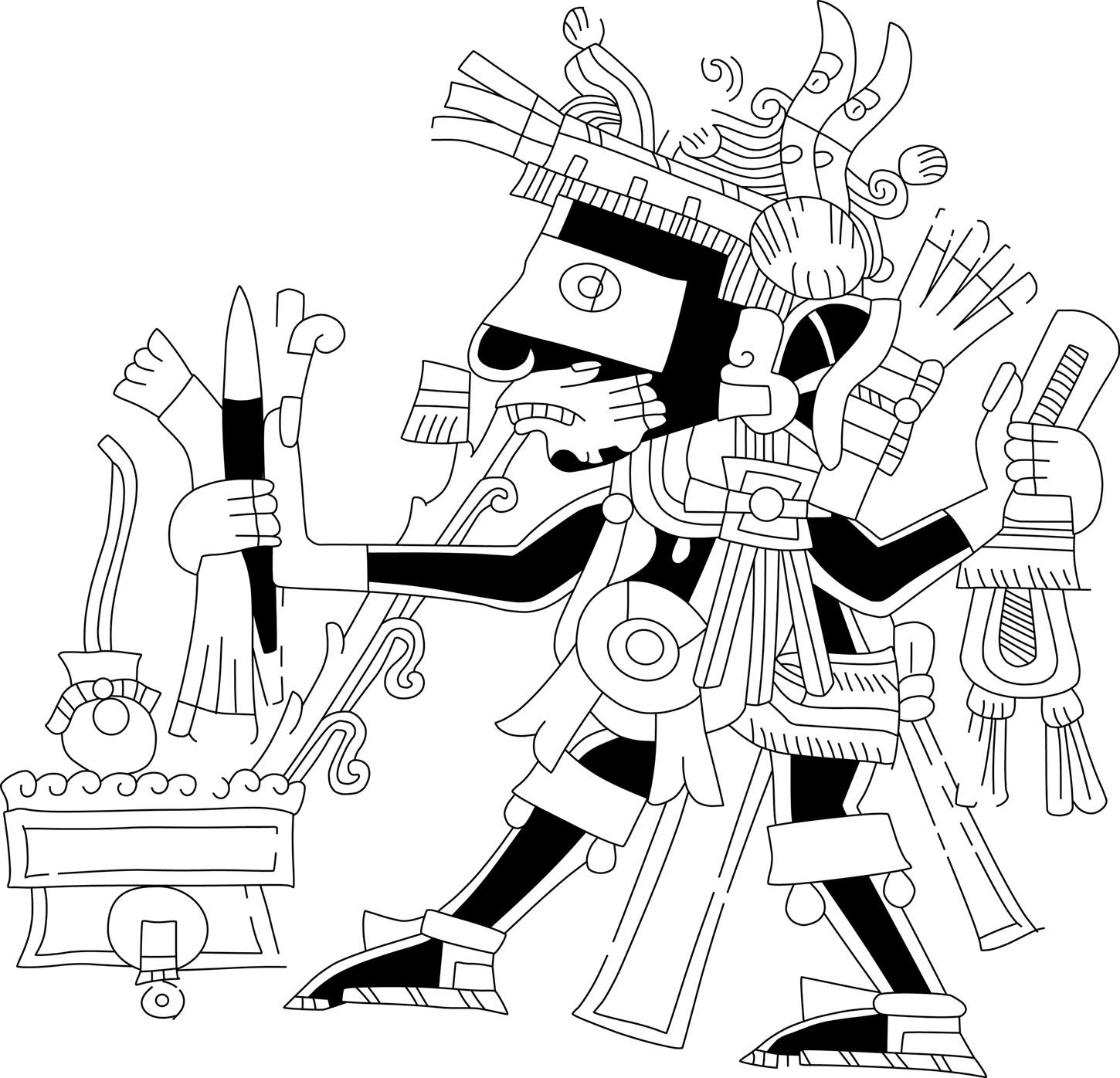
The effigy in Vienna, made by an Eastern Nahua artisan, dates from the Late Postclassic, with an estimated date around a.d. 1500. The effigy and pedestal are decorated in a Catalina Polychrome codex-style that forms an Eastern Nahua subset of the more inclusive Mixteca-Puebla artistic style (Lind Reference Lind, Nicholson and Keber1994; Nicholson and Quiñones Keber Reference Nicholson and Keber1983; Noguera Reference Noguera1954; Pohl et al. Reference Pohl, Fields, Lyall, Fields, Pohl and Lyall2012). The face is black with two orange (i.e., shining, golden) transverse areas across the eyes, the upper part of the nose and the temples, and one across the mouth and cheeks, both covering the black surface of the head (Figure 2a). This orange overpainting implies that these areas are the actual facial decoration of the deity, if not in fact implying the deity's inner radiance instead of just a decoration of the face. Although often stated, the transverse black bands are not facial decoration but rather the visual parts of the actual, underlying, undecorated, obsidian body of the deity. In fact, Durán (Reference Durán, Horcasitas and Heyden1971:98, Reference Durán, Romero and Camelo1995:vol. 2, p. 47) affirms that the statue of Tezcatlipoca in the city of Tenochtitlan “was made of a shining stone, black as jet, the same stone of which sharp blades and knives are fashioned (era de una piedra muy relumbrante y negra como açauache piedra de que ellos hacen nauajas y cuchillos para cortar”; translation by the authors). An effigy vessel from the Colección Fundación Televisa in Mexico City and an additional ceramic vessel found in Cholula at the site museum demonstrate comparable facial decorations as the effigy in Vienna (Figures 3a and 3b). These Mexican effigy ceramics have been regarded as images of Tezcatlipoca or of his earthly impersonators (Matos Moctezuma and Solís Olguín Reference Matos Moctezuma and Olguín2002:266–267; Solís et al. Reference Solís2004:200, No. 98, Reference Solís, Uruñuela, Plunket, Cruz and Rodríguez2006:124–125). According to Pohl (Reference Pohl2007:43–44), however, the effigy vessel at the Fundación Televisa represents the head of a Macuiltonal, a member of a group of five spiritual beings known as Macuiltonaleque, primarily revered by diviners. According to Seler (Reference Seler1963:vol. 2, p. 74), these gods were known as Ahuiateteo, “Gods of Pleasure”; instead Nowotny (Reference Nowotny, Everett and Sisson2005:276–279) calls them Tonaleque, taking inspiration from a passage in the Histoyre du Mechique by Thévet (Reference Thévet and de Jonghe1905:22), which describes them as inhabitants of the fifth heaven: “five gods, each one of different colors, because of it called Tonaleq (cinc dieux chascung de diverse coleur, à cause de cela dits Tonaleq).” This group of supernaturals did indeed share several iconographic characteristics with Tezcatlipoca (Mikulska Reference Mikulska2015:155; Miller and Taube Reference Miller and Taube1993:40; Seler Reference Seler1963:vol. 2, pp. 81–82; Spranz Reference Spranz1964:98, 510–511). The primary characteristic shared between the two is in the black facial banding. One of the primary diagnostic characteristics of the Macuiltonaleque, however, is a hand that covers their mouth, a feature these vessels clearly lack (Figure 5).
Macuiltonal from the Codex Borgia (Anders et al. Reference Anders, Jansen, García, Anders, Jansen and García1993:47). Drawing courtesy of Elbis Domínguez.

Despite certain similarities, the effigy vessels in the Fundación Televisa and Museo Regional de Cholula differ in one major detail from the one in Vienna. The Vienna effigy is clearly meant to represent a more human aspect of the deity while the others represent the deity as skeletal. Indeed, the effigy vessel of the Fundación Televisa has the prominent teeth without the lip and at the height of the temples has bone-colored circles that correspond to the holes that would be used to place the skulls in the famous Tzompantli. Another notable iconographic element in the effigies of the Fundación Televisa and the Museo Regional de Cholula, but absent in the Vienna effigy, is the large size of the eyebrows, a characteristic feature of Mictlantecuhtli, the deity of death in central Mexico (see, for example, Anders et al. Reference Anders, Jansen, García, Anders, Jansen and García1993:13–16). While Tezcatlipoca does not appear skeletal in the codices, however, he does appear with a fleshless face in Aztec-Mexica stone sculpture reliefs such as the inside of a stone jaguar cuauhxicalli representing Huitzilopochtli letting blood (Nicholson and Quiñones Keber Reference Nicholson and Keber1983:30–31; Olivier Reference Olivier and Besson2008:68–69; Seler Reference Seler and Bowditch1990–1998:vol. 3, pp. 188–189). Let us remember that one of the calendric names of Tezcatlipoca was 1 Death (Ce Miquiztli; Sahagún Reference Sahagún, Dibble and Anderson1950–1982:vol. 4, pp. 33–36), which appears embodied in various Mexica monuments in the form of a skull with a smoking mirror in the temple, as can be seen on the Teocalli de la guerra sagrada (Figure 6a; Caso Reference Caso1927b). We can also add that in the Tonalamatl Aubin (Reference Tonalamatl and Seler1900–1901:10), Tezcatlipoca is represented instead of Mictlantecuhtli as god of the number 13 that begins with the date 1 Flint (Ce Tecpatl). It is striking that in this image Tezcatlipoca wears folded paper rosettes in the headdress, a characteristic in the attire of Mictlantecuhtli, the god of death. In fact, among the deities of the underworld pictured in the Codex Vaticano-Latino 3738 (Anders and Jansen Reference Anders, Jansen, Anders and Jansen1996b:f. 3r), we find Ixpuztzeque, which can be reconstructed as Icxipuztequi, “Broken Foot or Fractured Foot,” “the lame devil who appeared on the roads, with the foot of a rooster (il diavolo zoppo che li appareva per le strade con piedi di gallo”; translation by the authors), a probable avatar of Tezcatlipoca (Olivier Reference Olivier and Besson2008:236). Finally, Alvarado Tezozómoc (Reference Alvarado Tezozómoc and Berra1980:312) designates Tezcatlipoca as “Señor del infierno.” These examples show that Tezcatlipoca had much in common with the death gods and explains some of the grittier characteristics of the effigies in the Fundación Televisa and the Museo Regional de Cholula.
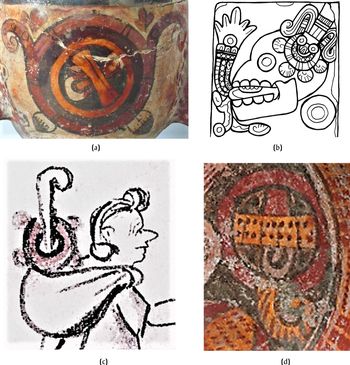
Mirrors in Late Postclassic Mexican art. (a) Detail of large mirror on the back of the effigy. Photograph by Christian Mendez, ©KHM-Museumsverband Vienna. (b) The date 1 Death, a name for Tezcatlipoca, depicted as a skull with a smoking mirror. Drawing courtesy of Emily Umberger. (c) Smoking mirror bundle detail from Codex Azcatitlan. Note four down elements. From Barlow and Graulich (Reference Barlow and Graulich1995:7). (d) Detail of mirror on the Vienna plate. Note curled protuberance. Photographs by Christian Mendez, ©KHM-Museumsverband Vienna.

THE MIRROR
One of Tezcatlipoca's main icons is the obsidian divining mirror. A large circular disk is painted on the back of the head of the effigy (Figure 6b). The mirror is framed on the right and left by two vertical bands depicting bone, with red, brown, and black spots denoting rotting. This mirror is composed of three concentric circles, one red on the outside, black in the middle, and orange in the center. Two down icons are attached to the disk's lower rim and two curled
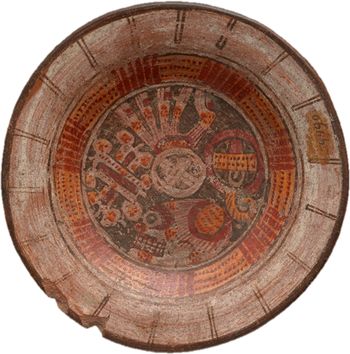
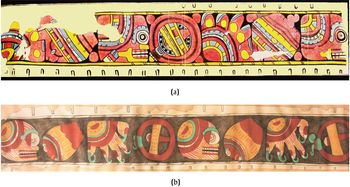
protuberances are attached to the upper rim of the disk. Two trilobed motifs appear on the inner side of the two curled protuberances. The center of the disk on the back of the effigy shows two crossed components on a black surface. There is a slightly longer yellow band on the extremity—perhaps in the form of a bone—with a black stripe inside and what resembles an encircled and extruded eyeball from its socket (Hernández Sánchez Reference Hernández Sánchez2005:54, Reference Hernández Sánchez2010:264; Pohl et al. Reference Pohl, Fields, Lyall, Fields, Pohl and Lyall2012:31). This disk on the back of the head is comparable to icons on cylindrical vessels such as those from the National Museum of the American Indian in Washington, DC. (Catalog No. 16/3394; Pohl Reference Pohl2007:13; Pohl et al. Reference Pohl, Fields, Lyall, Fields, Pohl and Lyall2012:29, Catalog No. 90; Ramsey Reference Ramsey, Brown and Wyllys Andrews V1982:Figure 10; Solís et al. Reference Solís, Uruñuela, Plunket, Cruz and Rodríguez2006:121), the Los Angeles County Natural History Museum (Catalog No. P.655.67-4; Nicholson and Quiñones Keber Reference Nicholson and Keber1983:166), the National Museum of Ethnology in Leiden (Catalog No. 2971-125; Eggebrecht Reference Eggebrecht1986:No. 240), and a plate from Cholula at the Weltmuseum Wien (Figure 7; Catalog No. 59.490). Finally, these motifs appear on the murals and altars of Tizatlan and Ocotelulco, in which various deities were depicted—in particular Tezcatlipoca— in a style very close to that of the Codex Borgia (Figures 8a and 8b; Caso Reference Caso1927a; Contreras Martínez Reference Martínez, Eduardo, Nicholson and Keber1994; Peperstraete Reference Peperstraete2006).
A ceramic plate from Cholula depicting skull, crossbones, hand, and mirror motif. Weltmuseum Wien, Vienna. Photograph by Christian Mendez, ©KHM-Museumsverband Vienna.

Eastern Nahua painted altars from Tlaxcala. (a) Altar A from Tizatlan, Tlaxcala. Drawing by John Pohl. (b) Altar from Ocotelolco. Modified from photograph of mural reproduction at on-site museum by John Pohl.

The identification of this type of disk has been mired by controversy, especially the “encircled eye motif” in the center. As Boone and Collins (Reference Boone and Collins2013:231) note, this motif has been interpreted by various researchers as a shield (Caso Reference Caso1927a:153; Nicholson and Quiñones Keber Reference Nicholson and Keber1983:166; Pohl Reference Pohl2007:13, 43), large chalchihuitl (Solís Reference Solís1995:32), bulging eye (Hernández Sánchez Reference Hernández Sánchez2005:21, 28), and mirror (Peperstraete Reference Peperstraete2006:27–28). Boone and Collins (Reference Boone and Collins2013:231) confess that they “are unsure of its precise meaning.”
Several arguments will now be presented that show this motif is a mirror and that this black and circular head decoration is particularly indicative of the mirror attached to the back of the head of Tezcatlipoca, as found in the Codex Borgia (Anders et al. Reference Anders, Jansen, Anders and Jansen1993:21) and the Codex Fejérváry-Mayer (Anders et al. Reference Anders, Jansen, Pérez Jiménez, Anders, Jansen and Pérez Jiménez1994:44).
The vast majority of the representations of mirrors in the codices present an external red circle (Olivier Reference Olivier and Besson2008:242). The outer red circle of our Vienna effigy is divided into sections by seven double stripes, a motif that we find in some representations of mirrors in bas-reliefs (Caso Reference Caso1927b:15, 26; Matos Moctezuma Reference Matos Moctezuma1995:102) and in the representations of Tlachialoni, the apparatus of vision of Tezcatlipoca, identified with a mirror (Codex Magliabechiano; Anders and Jansen Reference Anders, Jansen, Anders and Jansen1996a:f. 33r). In the Codex Borgia (Anders et al. Reference Anders, Jansen, García, Anders, Jansen and García1993:17, 69) and the Codex Borbonicus (Anders et al. Reference Anders, Jansen, García, Anders, Jansen and García1991:3), we find Tezcatlipoca with a mirror composed of two concentric circles, one red on the outside and one yellow, which surround the central red or black disc. Even in the Codex Borbonicus (Anders et al. Reference Anders, Jansen, García, Anders, Jansen and García1991:3), Xipe Totec in Tezcatlipoca regalia boasts a mirror with three concentric circles—yellow, red, and yellow—the same number of circles as in the Effigy of Vienna (Figure 9). Moreover, the Museum am Rothenbaum Kulturen und Künste der Welt, Hamburg (formerly known as the Hamburgisches Museum für Völkerkunde) shelters an extraordinary stone head representing Xipe Totec with a magnificent smoky mirror placed on the back of his head (Burland and Forman Reference Burland and Forman1976:56; Haberland Reference Haberland1984).
Xipe Totec with Tezcatlipoca regalia in the Codex Borbonicus (Anders et al. Reference Anders, Jansen, García, Anders, Jansen and García1991:14). Note mirror with three concentric circles, the same as the Vienna effigy. Drawing courtesy of Elbis Domínguez.

Xipe Totec was also known as Tlatlauhqui Tezcatlipoca, “Red Tezcatlipoca” (Durán Reference Durán, Romero and Camelo1995:vol. 2, p. 103) and in the codices the representation of the black Tezcatlipoca and the Red Tezcatlipoca are almost identical, except for the color (Vié-Wohrer Reference Vié-Wohrer1999:vol. 1, p. 62). Alva Ixtlilxóchitl (Reference Alva Ixtlilxóchitl and O'Gorman1985:vol. 1, p. 277) mentions
two brothers, Lords of various parts, who were very courageous and great necromancers, who were said, the eldest, Tezcatlipuca and the lesser Tlatlauhquitezcatelpuca, who then the Tultecas placed them by gods (dos hermanos señores de diversas partes, muy valerosos y grandes nigrománticos, que se decían, el mayor, Tezcatlipuca y el menor Tlatlauhquitezcatelpuca, que después los tultecas los colocaron por dioses; translation by the authors).
Without a doubt, the head statue of Xipe Totec in Hamburg with a smoking mirror on the back of the head constitutes an important example in identifying the mirror placed in the same position of the Vienna effigy. Furthermore, according to Haberland (Reference Haberland1984:95), the stone head of Xipe Totec comes from Tlalmanalco (Estado de México), near Chalco. Interestingly, Serna (Reference Serna and Benítez1987:280) affirms that Tezcatlipoca was originally the god of the inhabitants of Tlalmanalco and that the Mexicas adopted that deity through contact with them. Moreover, we know that the inhabitants of Chalco, in particular the Tlacochcalca and the Nonoalca, venerated Tezcatlipoca (Chimalpahin Cuauhtlehuanitzin Reference Cuauhtlehuanitzine and Muñón1997:82–83, 162–163, Reference Cuauhtlehuanitzine, Muñón and Quintana2003:28–29, 46–49, 122–123).
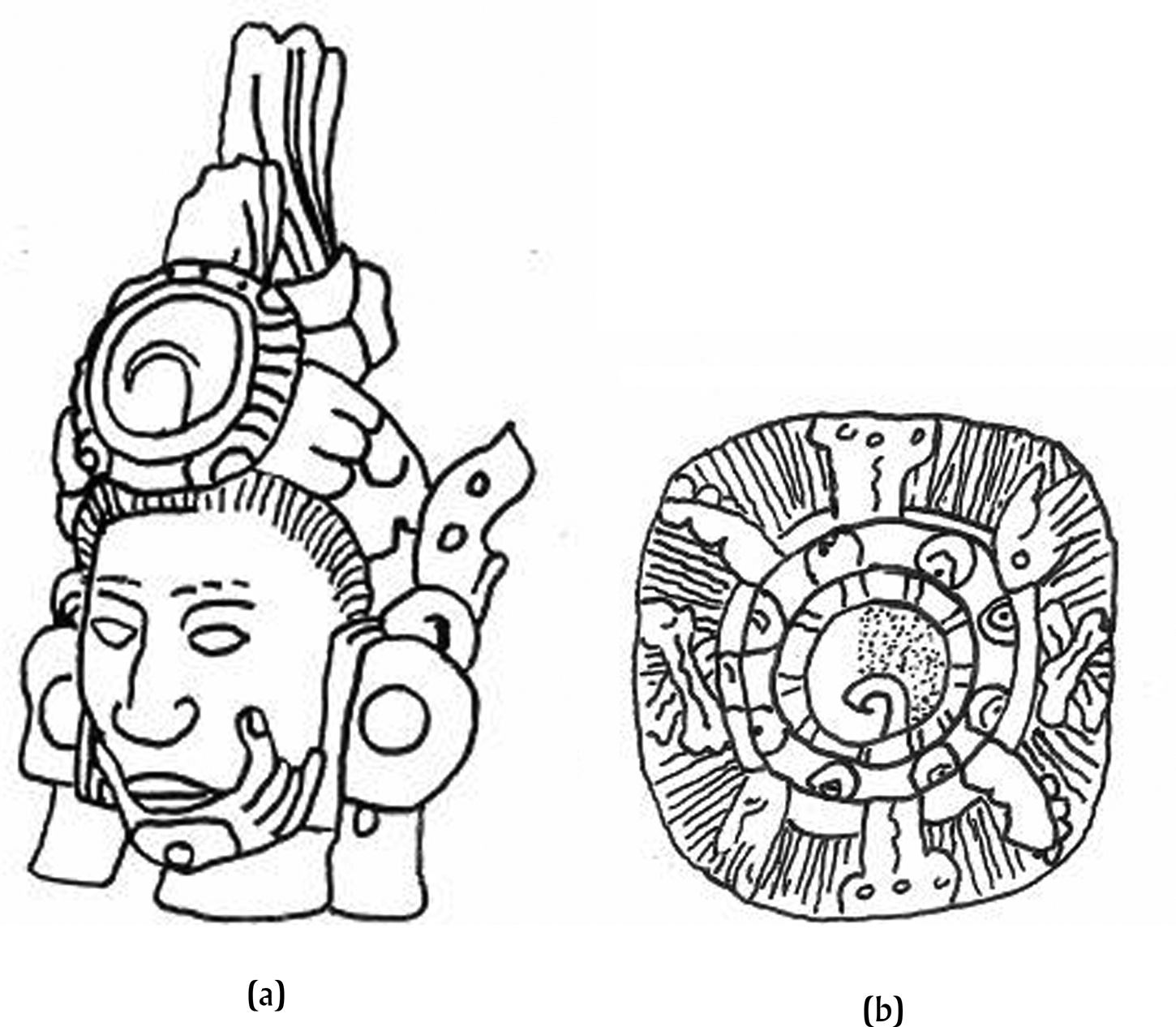
Going back to the extruded eyeball inside the mirror, an argument can be made that sight and mirrors go hand-in-hand in ancient Mesoamerican art and lore (Olivier Reference Olivier and Besson2008:248–262). In Classic Maya art, mirrors appearing with beings of night and darkness have a spiral element denoting an eye in the center. This spiral is similar to aquatic emblems and likely symbolizes bodies of water (Houston and Taube Reference Houston and Taube2000:284–285). The same spiral appears as the eye of the Jaguar God of the Underworld and as a stylized mirror appears fixed to the headdress of God Zero, a poorly understood deity who may have been an antecedent to the Macuiltonaleque (Figure 10a; Coltman Reference Coltman, Coltman and Pohl2020). As noted by Houston and Taube (Reference Houston and Taube2000:283–284), this central element on God Zero's forehead symbolizes a mirror denoting darkness. Furthermore, this same motif is also known to occur with crossbones and disembodied eyeballs. In one example, the spiral eye mirror motif appears on a parasol that is also decorated with hands, feet, eyes, and bones (Figure 10b). In Eastern Nahua ceramics, hands, eyeballs, and cross bones can appear within the bowl or plate as if they were the actual offering, recalling Classic Maya scenes of bowls filled with hands, eyeballs, and bones held by way creatures (Kerr Reference Kerr2019:Kerr Nos. 1080, 1181, 1203, 1228, 1259). In Nahuatl texts compiled by Sahagún (Reference Sahagún, Dibble and Anderson1950–1982:vol. 6, p. 238) and Ruiz de Alarcón, the eye is likened to a mirror (Olivier Reference Olivier and Besson2008:354, n86). Its association with the preeminent sorcerer of central Mexico seems to indicate its role as an object of reflective darkness and divination. If this effigy is indeed an image of Tezcatlipoca, this could make the deity not just a possible supernatural personification of obsidian, the material used for divining mirrors, but also of its radiance (see other studies by Olivier [Reference Olivier and Besson2008:258–259], Saunders [Reference Saunders2001:226], and Zantwijk [Reference Zantwijk1985:127, Reference Zantwijk1994:44–45]). In the Nahuatl text of the Historia tolteca-chichimeca (Kirchoff et al. Reference Kirchoff1976:166), another name for Tezcatlipoca appears, Tezcatlanextia, meaning “He Who or That Which, Causes The Mirror To Shine Brightly.”
The spiral-eye mirror motif in ancient Maya art. (a) Sculpture depicting God Zero. Note spiral eye mirror in center of headdress. (b) Maya parasol or fan depicting spiral eye mirror in center surrounded by hands, feet, and cross bones (after Taube Reference Taube, Vail and Hernandez2010:Figure 6e). Drawings by Coltman.

The two down icons attached to the disk's lower rim have been associated with sacrifices (Anders et al. Reference Anders, Jansen, Anders and Jansen1993:150; Olivier Reference Olivier2015:493–499). Other images of Tezcatlipoca also feature such down ornaments on his head, as do illustrations of smoking mirrors, both in codices and bas-reliefs (Olivier Reference Olivier and Besson2008:54–55, 242–245; Paddock Reference Paddock1985:319). The down elements appear with this same mirror motif on Late Postclassic ceramics from Cerro de Las Mesas, Veracruz (Drucker Reference Drucker1943:Figures 152 and 153). One well-published vase in the National Museum of the American Indian at the Smithsonian Institution is decorated with these mirrors with the four down balls, as well as skulls, hearts, eyeballs, and hands (Westheim et al. Reference Westheim1972:241, Figures 243, 278, 280). Black vertical lines and stripes decorate the exterior rim. Black and white stripes on vessels may be associated with Tezcatlipoca and perhaps even prayers that invoked this deity (Boone and Collins Reference Boone and Collins2013; Hernández Sánchez Reference Hernández Sánchez2010). Furthermore, the iconography of this vessel is a similar visual complex to the one found on the altars of Tizatlan and Ocotelulco (Pohl Reference Pohl1998). In the Codex Azcatitlan, a smoking mirror appears as part of a probable Tezcatlipoca bundle, or perhaps as a sign for the deity himself, and has four down balls framing it like these earlier examples (Figure 6c; Barlow and Graulich Reference Barlow and Graulich1995:7). A toponym for Tezcatepec in the Codex Mendoza depicts an obsidian mirror with the four down balls framing it (Berdan and Anawalt Reference Berdan and Anawalt1992:f. 27r).
A curled protuberance is attached to the upper rim of the black disk. It demonstrates some affinities with the smoking-mirror design in the Codex Telleriano-Remensis (Quiñones Keber Reference Quiñones Keber and Queber1995:f. 23r) and Codex Vaticanus A 3738 (Anders and Jansen Reference Anders, Jansen, Anders and Jansen1996b:f. 44v). The mirror on the Vienna plate also has a curled protuberance, though in this case it is only one instead of two (Figure 6d). We ignore the meaning of the two trilobed, floral-looking motifs that appear on the inner side of the two curled protuberances on the Vienna effigy.
It is also worth describing the earrings of the deity embodied in the effigy of Vienna. In fact, they are composed of a red disc surrounded by a yellow circle and another black circle, inside of which are painted wavy stripes and four chalchihuites (jades), together representing water. While most of Tezcatlipoca's earrings tend to be square, we find some representations of this god with circular earrings. For example, in the representation of Iztli-Tezcatlipoca in the Codex Borgia (Anders et al. Reference Anders, Jansen, García, Anders, Jansen and García1993:14), the earrings are composed of a red disc surrounded by two blue or green circles; likewise, we found an earring identical with Tezcatlipoca in Codex Zouche-Nuttall (Anders et al. Reference Anders, Jansen, Pérez Jiménez, Anders, Jansen and Pérez Jiménez1992:14). In the case of the Vienna effigy, however, it would appear that the earrings represent mirrors. We can compare this mirror—with the circle of water on the outside—with an example from the Codex Borgia (Anders et al. Reference Anders, Jansen, García, Anders, Jansen and García1993:17) in which the mirror over the headdress of Tezcatlipoca has a disc of water in its center.
Although the fragmentary state of the effigy in the Museo Regional de Cholula does not indicate what type of earrings it wore, the effigy in the Fundación Televisa wears earrings in the form of a strip of unspun cotton. As far as we know, Tezcatlipoca never wears this type of earring, except in the case of one of his avatars, Itztlacoliuhqui, “Cuchillo Curvo de Obsidiana” in the Codex Borbonicus (Anders et al. Reference Anders, Jansen, García, Anders, Jansen and García1991:12). We found the same earrings with Mictlantecuhtli and with Mixtec death deities (Codex Vaticanus 3773 [Anders and Jansen Reference Anders, Jansen, Anders and Jansen1993:20, 21, 22]; Codex Vindobonensis Mexicanus I [Anders and Jansen Reference Anders, Jansen, Anders and Jansen1992:14]). This attire also appears as the earrings of Tlazolteotl, the goddess of women who died in childbirth, equivalent to the warriors who died on the battlefield or the sacrificial stone (Olivier Reference Olivier2014–2015:58–59). In another work, one of us interpreted this type of earring as a symbol of those destined to be sacrificed, which is based on Maya iconography (Olivier Reference Olivier2014–2015:58–59). In fact, specialists regard these bands of cotton that hang from the ears as a mark of impending sacrifice for the unfortunate individuals wearing them (Baudez and Mathews Reference Baudez, Mathews and Trejo1997:511–512). But this motif “is the most visible element of glyph T 570, which is equivalent to B'AK or BAAK, which means both captive and bone. Therefore, it is simultaneously a sign of capture and of death” (Baudez Reference Baudez and Nalda2004:61). It is significant that we find cotton earrings precisely with this image of Tezcatlipoca, which, as previously shown, has skeletal features and large eyebrows that are iconographic elements related to Mictlantecuhtli.
THE PEDESTAL
The pedestal or neck of the effigy has a diameter of 10.2 cm. On a black background, a disk—a mirror jewel—resembling the one on the back of the head of the effigy is painted on the left side of the pedestal. While we consider this to be a mirror, it should be noted that this motif looks similar to shields in the Codex Selden (Caso Reference Caso and Caso1964:6, 12). In fact, mirrors may have also been related to shields. At Teotihuacan, mirrors are identified with war shields so closely that it is difficult to distinguish the two (Taube Reference Taube and Berlo1992:192). In the disk's center, a rectangular orange band resembles the transverse bands on the effigy's face, as well as the one in the disk on the back of the effigy's head. A skull is depicted on the right side of the pedestal: in addition to the jaw, the teeth, and the eye—all characteristic of skulls in Mixteca-Puebla iconography—the orange part of the skull located between the eye and the jaw and the red coloring extending to the back of the skull is unique. There are, however, representations of Mictlantecuhtli in red in the Codex Borgia (Anders et al. Reference Anders, Jansen, García, Anders, Jansen and García1993:22, 49). The image in the Codex Borgia depicts two irregularly shaped spots of orange with red dots on the back of the skull, which represent rotten skin and flesh, a very common motif in the representations of bones in Mixteca-Puebla iconography. In one of these spots appears a small black circle, perhaps the hole in which the stick was strung to hang the skulls in the famous Tzompantli. A hand of orange color and with similar spots to which we describe for the skull, with white fingertips, a human heart, and a possible internal organ (Berger Reference Berger2004:107, Figure 2) or an oval shape with a transverse bow of sacrificial paper or cloth are additional emblems on the pedestal's dark, ground surface.
The use of these specific iconographic elements was widespread. They are present on several ceramics, like those mentioned above. The center of the plate in Vienna (Figure 7) is decorated with a hand, crossbones, a skull, and once again a black disk with two crossed elements and a curly attachment, similar to the icon on the back of the head of the Vienna effigy. All four emblems in the center of the plate are partly painted in orange with red dots. The same colors and dot design appear in the border encircling the inner area of the plate in Vienna.
The hand is a motif that appears widely in Eastern Nahua art. A plate from Cholula depicts this hand as the sole motif (Fields et al. Reference Fields, Pohl and Lyall2012:116). As previously mentioned, the hand is a diagnostic feature of the Macuiltonaleque. Mendieta (Reference De Mendieta and Jay1997:vol. 1, p. 475) mentions a temple in Tizatlan: “a demon, who was worshipped there, called Macuiltonal, in a frightful form” (see also Torquemada Reference Torquemada1944:vol. 3, p. 201). These five gods, who appear in the Codex Borgia (Anders et al. Reference Anders, Jansen, García, Anders, Jansen and García1993:47–48) and in the Codex Vaticanus 3773 (Anders and Jansen Reference Anders, Jansen, Anders and Jansen1993:77–79), were closely related to both Tezcatlipoca and enchanted mirrors, and were invoked by diviners (macuiltonalleque; Ruiz de Alarcón Reference Ruiz de Alarcón, Coe and Whittaker1982:148, 203, 243; see also Mönnich Reference Mönnich1973; Zantwijk Reference Zantwijk1994:46). The faces of the Macuiltonaleque are black, and they have an orange band across the eyes. They are of different colors (one is black), and the stripe in the face looks yellow, but none on the lower part of the face, as is the case with images of Tezcatlipoca. Instead of the lower band, they feature a white hand or mote[n]macpalhuiticac. According to Sahagún (Reference Sahagún, Dibble and Anderson1950–1982:vol. 1, Plate 14), this hand covering the mouth was a distinguishing iconographic element of Macuiltochtli and of Macuilxochitl, the prototypes of the Macuiltonaleque (“around his lips he has the painting of a hand”; Seler Reference Seler1927:47; see also Seler Reference Seler1904:vol. 2, p. 491). The whiteness of the hand calls to mind the sorcerer's practice of dusting the hands with powered lime to be able to invoke the Macuiltonaleque through their own fingers. The white fingertips of the hand, depicted on the pedestal of the effigy, seem to illustrate this practice (Pohl Reference Pohl2007:24–25; Ruiz de Alarcón Reference Ruiz de Alarcón, Coe and Whittaker1982:202–204, 210). As a symbol of five, however, the hand can also be related to the capture of a captive (Dehouve Reference Dehouve2011:164–165). Furthermore, the symbol of five is also associated with excess and drunkenness, as illustrated in the origin myth of the agave wine, pulque: after its creation, the men gathered to consume it in Tamoanchan but Cuextecatl, the leader of the Huaxtecos took a fifth drink and became drunk (Sahagún Reference Sahagún, Dibble and Anderson1950–1982:vol. 10, p. 193). Also, when Tezcatlipoca drank with Quetzalcoatl in Tollan, the latter took five cups of pulque, an episode with which we will return to at the end of this work (Bierhorst Reference Bierhorst and Bierhorst1992a:10–11, Reference Bierhorst and Bierhorst1992b:33–34).
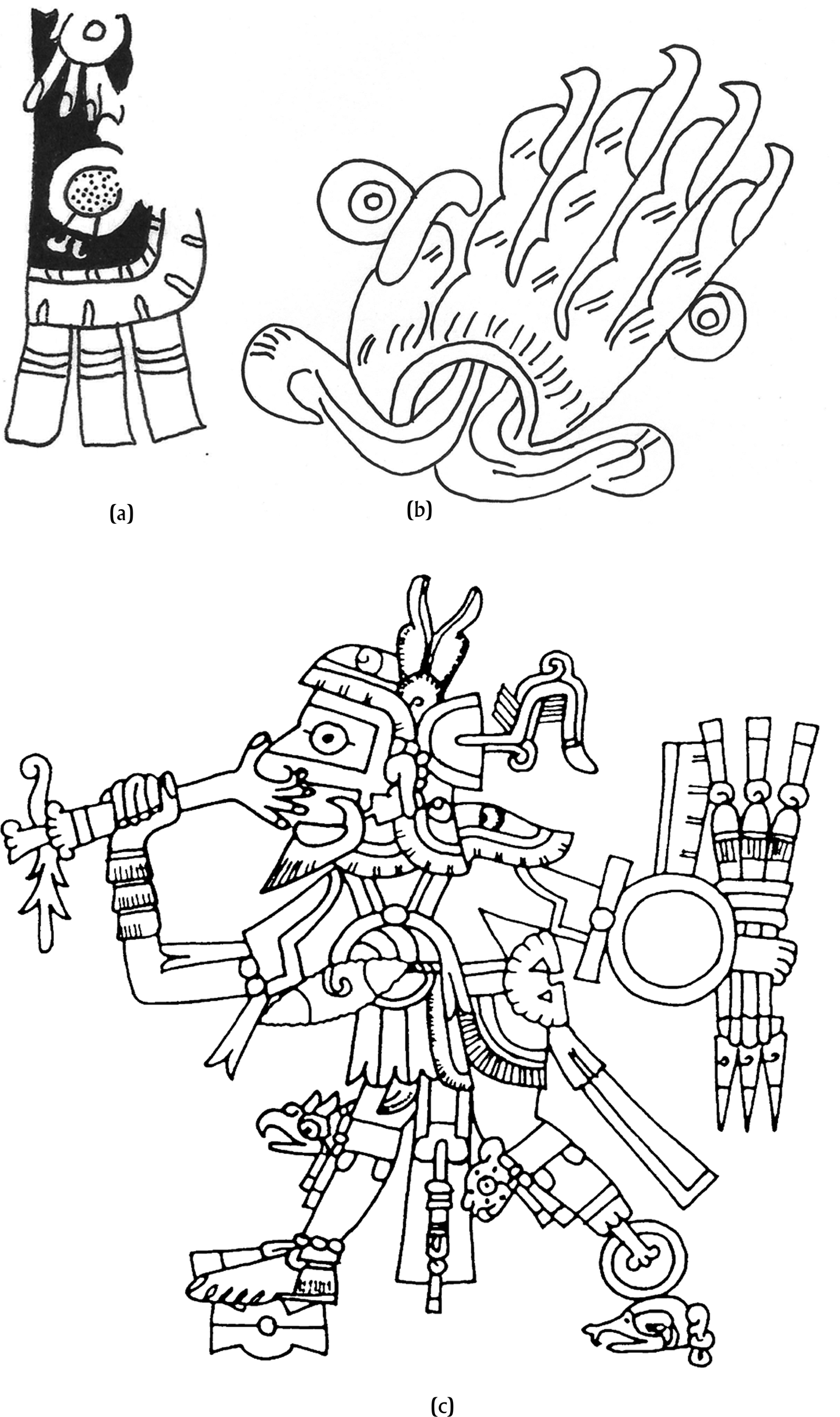
Much like the Macuiltonaleque, Tezcatlipoca also appears with hand symbolism. In the Codex Borgia (Anders et al. Reference Anders, Jansen, García, Anders, Jansen and García1993:17), a textile dangles from Tezcatlipoca's arm and is decorated with a smoking mirror and a disembodied hand (Figure 11a; Taube Reference Taube, Vail and Hernandez2010:153). A hand attached to a smoking mirror motif appears on a basin attributed to Veracruz that is currently housed at the Los Angeles County Museum of Art (Figure 11b). On page 44 of the Codex Fejérváry-Mayer (Anders et al. Reference Anders, Jansen, Pérez Jiménez, Anders, Jansen and Pérez Jiménez1994), Tezcatlipoca holds a severed arm with the palm placed directly over his mouth as if he is somehow invoking this diagnostic attribute of the Macuiltonaleque (Figure 11c). In its aspect of Tlatlauhqui Tezcatlipoca, this deity holds also a forearm to the height of the mouth in the Codex Borgia (Anders et al. Reference Anders, Jansen, García, Anders, Jansen and García1993:11) and in the Codex Vaticanus 3773 (Anders and Jansen Reference Anders, Jansen, Anders and Jansen1993:30). This forearm may correspond to the forearm of a woman who died in childbirth, which had the power to immobilize people and was used by the thieves known as temacpalitotique, devotees of Quetzalcoatl who would rob houses and violate women (Sahagún Reference Sahagún, Dibble and Anderson1950–1982:vol. 4, pp. 102–106; Seler Reference Seler1901–1902:206–207). The iconography of the pedestal or neck does not only appear on other Mixteca-Puebla ceramics, but is reminiscent of the paintings on genuine masonry walls in pre-Columbian architecture, like those found on benches in Tizatlan and Ocotelulco in Tlaxcala, displaying skulls, hands, human hearts and the same circular eye mirror found on the back of the effigy (Figures 8a and 8b). Following Hernández Sánchez's (Reference Hernández Sánchez2005:21–33) interpretation of specific bands on polychrome representing the gods of death, the underworld, and even composing a prayer to the dead, Boone and Collins (Reference Boone and Collins2013:233) argue that a prayer to Tezcatlipoca can be found on Motecuhzoma Iluicamina's Sun Stone. The authors focus on the two bands framing the conquest scenes on the top and bottom sides of the monument and argue that this set of motifs is a prayer specifically associated with Tezcatlipoca. Boone and Collins (Reference Boone and Collins2013:230) correctly note that this arrangement of motifs is found on the murals at Ocotelulco and Tizatlan, Tlaxcala, as well as on ceramics in the Mixteca-Puebla style found in the states of Veracruz, Puebla, Tlaxcala, and Oaxaca. The sites of Tizatlan and Ocotelulco provide the closest parallel to Motecuhzoma Iluicamina's Sun Stone. These sites depict altar murals decorated with skulls, hearts, hands, and a stylized encircled eyeball motif (Caso Reference Caso1927a; Pohl Reference Pohl1998). Aside from the large mirror on the back of the head, the pedestal provides the best evidence linking this effigy to the Late Postclassic artistic traditions of the Eastern Nahua of Cholula and Tlaxcala with this combination of hearts, skulls, and mirrors. Furthermore, the textile garment Tezcatlipoca wears hanging from his arm depicts several motifs that can clearly be identified as a hand and a smoking mirror (Figure 11a). The fact that these appear on a fringed textile is important since the altars of Tizatlan and Ocotelulco are both painted with crenellated edging as if they were meant to be permanent renderings of textiles. This same convention also occurs on many Eastern Nahua ceramics as if the ceramics themselves were meant to invoke the fabric of textiles. The fact that Tezcatlipoca appears with this textile as well as the same set of motifs on the Vienna effigy suggests that these altars may have been used to invoke or propitiate this deity.
Tezcatlipoca and hand symbolism in eastern Nahua art. (a) Detail from the Codex Borgia (Anders et al. Reference Anders, Jansen, García, Anders, Jansen and García1993:17) of a textile hanging from Tezcatlipoca's arm decorated with a smoking mirror and a disembodied hand. Drawing by Coltman after Taube (Reference Taube, Vail and Hernandez2010:Figure 6a). (b) Detail of hand attached to a smoking mirror on large basin attributed to Veracruz from Los Angeles County Museum of Art. Drawing by Coltman. (c) Tezcatlipoca holding a severed arm with the palm placed directly over his mouth, possibly invoking the Macuiltonaleque (Codex Fejérváry-Mayer; Anders et al. Reference Anders, Jansen, Pérez Jiménez, Anders, Jansen and Pérez Jiménez1994:44). Drawing courtesy of Elbis Domínguez.

These standardized emblems reflect a visual language, a system of communication that has been associated with war, sacrifice, death, and divination. In Tizatlan and Ocotelulco, they are related to Tezcatlipoca but are also associated with the Tzitzimime, the fearsome spirits of the dark, the underworld, and patrons of diviners (Boone Reference Boone1999:198–205, Reference Boone2007:222; Contreras Martínez Reference Martínez, Eduardo, Nicholson and Keber1994:16, 17; Fargher et al. Reference Fargher, Blanton and Heredia Espinoza2010:233, 242; Hernández Sánchez Reference Hernández Sánchez2005:18, 162, 167; Klein Reference Klein2000:6; Nowotny Reference Nowotny and Kutscher1961:15, 27, 201; Olivier Reference Olivier and Besson2008:63, 88, 244; Pohl Reference Pohl, Smith and Berdan2003:203, Reference Boone2007:13–14).
DRINKING RITUALS
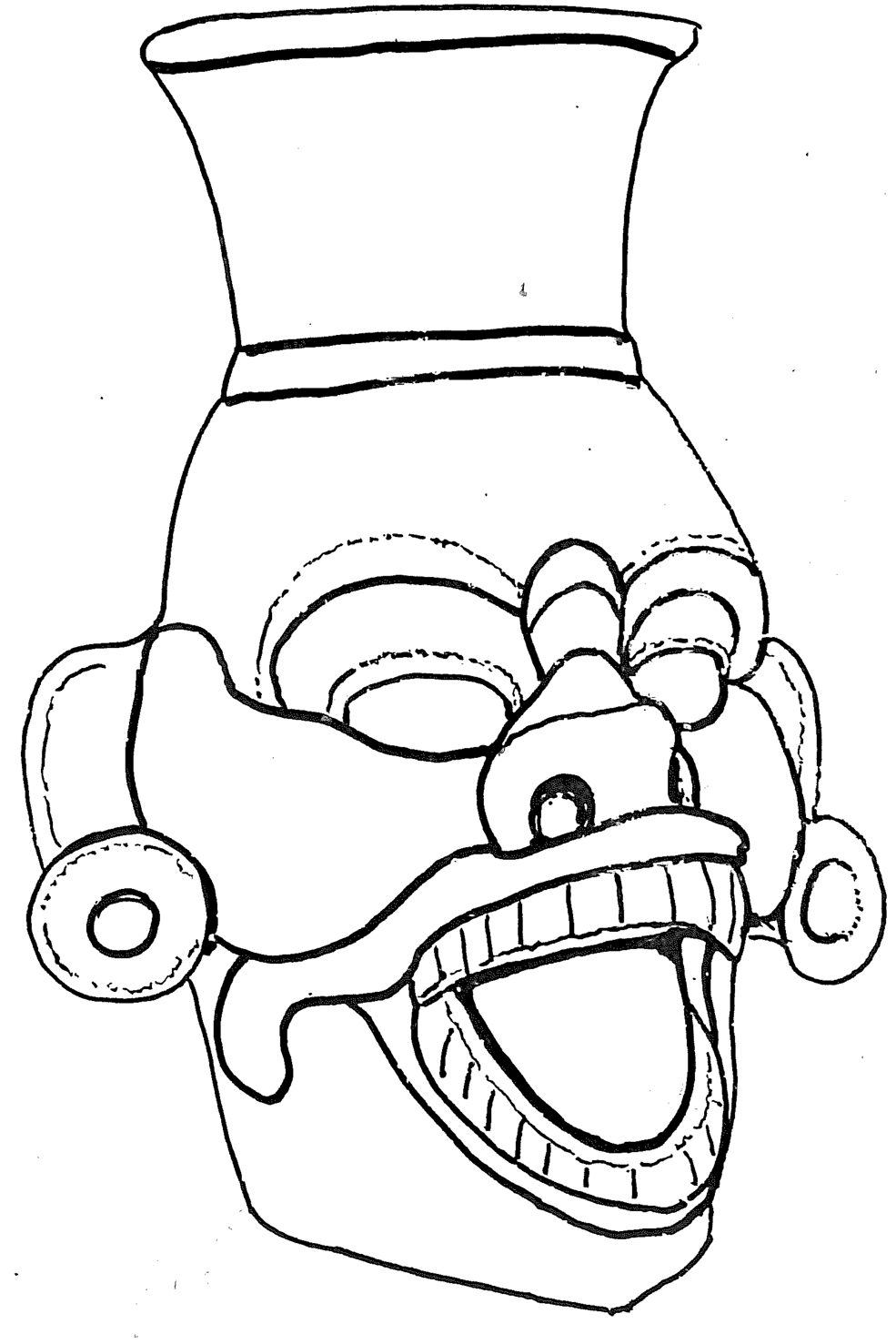
The iconography of the Vienna effigy may provide a connection with ritual bouts of drinking. The vessel was probably ritually active when it contained beverages or offerings and was likely used in drinking rituals to invoke this deity and was but one manifestation of ancient Mesoamerican drinking cults. Effigy vessels used for drinking intoxicating beverages are of incredible antiquity in Mesoamerica. One Late Preclassic vessel from Izapa depicts a partially skeletal individual who may be an antecedent to the Maya god of drunkenness and inebriation in a fit of intoxicated laughter (Figure 12; Taube Reference Taube2018:34). Known as Ahkan, this figure embodied more of a complex than a single individual and, along with the closely related God Zero, may have been a precursor to the Late Postclassic Macuiltonaleque (Coltman Reference Coltman, Coltman and Pohl2020; Grube Reference Grube, Behrens, Grube, Prager, Sachse, Teufel and Wagner2004:70). Among the Classic Maya, dangerous and powerful spirit beings known as way were invoked through the imagery on drinking vessels and were conjured up through the inebriating effects of the beverage contained within. A well-published effigy vessel from Tomb 1 at Zaachila, Oaxaca, depicts Xochipilli, the god of pleasure, dance, and music, with a design around his mouth indicating the froth from drinking pulque (Solís Reference Solís2004:296). In Late Postclassic central Mexico, although there were deities related to pulque (Nicholson Reference Nicholson and Carrasco1991), there are also notable links between Tezcatlipoca and this beverage (Olivier Reference Olivier, Navarrete and Olivier2000). Indeed, a myth explains how Tezcatlipoca sacrificed the god of pulque, Ome Tochtli, so that this drink could be consumed by men. Pulque was a deadly poison and only through the sacrifice and revival of Ome Tochtli was its consumption made possible (Relación de Meztitlan; Acuña Reference Acuña1986:62). Within the framework of the cosmogonic myths, we also find Tezcatlipoca drunk at the end of the era of Tamoanchan, one of the manifestations of his transgressive character (Olivier Reference Olivier, Navarrete and Olivier2000:104–106). Following the logic of alternation of Quetzalcoatl and Tezcatlipoca as the Sun of the Eras, Quetzalcoatl appears as the Sun of Tollan (Graulich Reference Graulich1988). In the context of the fall of Tollan, Tezcatlipoca offers pulque to Quetzalcoatl and the latter gets drunk and has to leave the prestigious Toltec capital (Bierhorst Reference Bierhorst and Bierhorst1992a:10–11, Reference Bierhorst and Bierhorst1992b:33–34; Sahagún Reference Sahagún, Dibble and Anderson1950–1982:vol. 3, pp. 17–18). Tezcatlipoca (assimilated with Huizilopochtli) dominates the Mexica era, the fifth Sun, so that the arrival of the Spaniards was logically associated with the return of Quetzalcoatl (Nicholson Reference Nicholson2001). In this context, we naturally find Tezcatlipoca in a state of drunkenness, such as Quetzalcoatl at the end of the previous Toltec era. Indeed, when the Spaniards approached Tenochtitlan, King Motecuhzoma II sent some soothsayers, magicians and fire priests to stop the invaders; on the way they ran into Tezcatlipoca under the appearance of a drunken Chalca that represses them. The Nahua collaborators of Sahagún (Reference Sahagún, Dibble and Anderson1950–1982:vol. 12, pp. 33–34) report how, after pointing out the pride and faults of Motecuhzoma, a drunken Tezcatlipoca announced:
‘No longer will there be a Mexico; it is gone forever. Go hence; it no more existeth. Turn about; look at what befalleth Mexico—what thus already cometh to pass!’ Then they looked there; they quickly turned there to see. They beheld that already all the temples, the tribal temples, the priest’ dwellings, and all the houses in Mexico burned; and it looked as if already there were fighting (aoqujc iez in Mexico, ie ic cēmāia, nepa xivia, aocmo vncā, tlaxommocuepacan, tlaxontlachiacan in Mexico, tlein ic mochioa: in juh ie mochioa. Nimā ic oallachixque, oallachxtivetzque, in qujoalitta ie tlatlā in jxqujch teucalli, in calpulli, in calmecatl, yoan in jxqujch mexico calli, yoan iuhqujn ma ie cuel necaliva; translation by the authors).
Late Preclassic vessel from Izapa, possibly depicting an early version of Ahkan, the ancient Maya god of inebriation. Drawing from Taube (Reference Taube2018:34, Figure 15).

As previously noted, the Tezcatlipoca effigy was most likely a drinking vessel, similar to those in the Fundación Televisa and the Museo Regional de Cholula. We were struck, however, by the gritty aspects of the last two representations of Tezcatlipoca, a trait that we have also encountered with a representation of this god on the jaguar-shaped cuauhxicalli (supra). This skeletal aspect of Tezcatlipoca can be generally related to the symbolism and use of skulls in Mesoamerica.
A myth related by Thévet (Reference Thévet and de Jonghe1905) narrates the struggle between Quetzalcoatl and his brothers who wanted to kill him, and even killed his brother, Mixcoatl. Quetzalcoatl manages to kill his brothers with arrows:
That being done, his vassals [Quetzalcoatl's] who loved him much, came to fetch him honorably, and took the heads of his brothers and emptying them of the brains, in them made cups to drink, and got immediately drunk (ce que faict, ses vasaulx, qui l'aimoynt fort, le vindrent quérir honorablement, et prindrent les testes de ses frères et luy ostant le cerveau, de dans firent des coupes à boire, et s'enivrèrent incontinent) (Thévet Reference Thévet and de Jonghe1905:35).
This singular use of skulls is attested among the Purepechas of Michoacan and also among the Maya of Guatemala (Rabinal Achi Reference Achi and Breton1994:292–295; Relación de Michoacán Reference Tudela and Núñez1977:63–64). Taube (Reference Taube, Faust and Richter2015:119–120) also notes the existence of “Huastec effigy vessels of human heads. Such vessels probably represent trophy heads, thereby relating war and sacrifice to the drinking of pulque in the Huasteca.” One can also mention two Mixteca-Puebla terracotta goblets, each one with a skull in relief, and framed between two bands with stellar eyes (Matos Moctezuma and Solís Reference Matos Moctezuma and Olguín2002:213, Figure 134). Going back to Tezcatlipoca, he could appear in the guise of a skull to try the courage of men on earth (Sahagún Reference Sahagún, Dibble and Anderson1950–1982:vol. 5, pp. 179–180). Let us also remember that one of his calendar names, 1 Death, Ce Miquiztli, relates to the moon, which is represented in the codices as a vessel of bone (Olivier Reference Olivier and Besson2008:36–38; Sahagún Reference Sahagún, Dibble and Anderson1950–1982:vol. 4, pp. 33–36).
CONCLUSION
The Late Postclassic Eastern Nahua style of Puebla and Tlaxcala is one of the major artistic traditions of ancient Mesoamerica and part of the broader Mixteca-Puebla style and more widespread and inclusive International Artistic Style of the Late Postclassic period (Pohl Reference Pohl1998, Reference Pohl, Smith and Berdan2003). The Codex Borgia, Catalina Polychrome, and the murals from Tizatlan and Ocotelulco are among the finest examples of Eastern Nahua art (Boone Reference Boone2007; Lind Reference Lind, Nicholson and Keber1994). The ceramic Tezcatlipoca effigy heads add another dimension to this striking artistic style. While the effigy vessels in the Colección Fundación Televisa in Mexico City and in Cholula have a flaring opening on top and represent a skeletal Tezcatlipoca, the Vienna image rather shows the image of a young, living person, either a portrait of a deity, an aspect of its numen or representing an impersonator of a god. The impersonating individual would then embody a vessel in his own right, as a recipient or conduit of the deity's entity. The effigy in Vienna might in fact be a synecdoche of an actual full-bodied sculpture of a deity, with the neck of the effigy actually representing a pedestal, an architectural bench, or platform on which such sculptures of deities were displayed like those from Tizatlan and Ocotelulco. According to Pohl (Reference Pohl1998, Reference Pohl2007), the painted benches and altars of Tizatlan and Ocotelulco were meant to hold multiple ritual objects including codices, statuary, and vessels and plates. The Vienna effigy could have been one such object placed on the altar.
While the young warrior who represented Tezcatlipoca during the principal feast of the twentieth veintena of Toxcatl did not consume pulque, in other celebrations related to this deity such as the mobile celebration of the day name, Ome Acatl, his calendar name, and lunar sign, pulque was ritually consumed (Olivier Reference Olivier2003:39–40, 194–196). It should be pointed out that this corresponds to the city of Mexico-Tenochtitlan and that the rites dedicated to Tezcatlipoca in other geographical areas are poorly documented and may have included the consumption of pulque. Be that as it may, the Vienna effigy depicting the archsorcerer Tezcatlipoca was invoked using this vessel and was conjured up using the same iconographic complex found on the altars of Ocotelulco and Tizatlan as well as a great many ceramics from Puebla and Tlaxcala. During rituals related to Tezcatlipoca such as Toxcatl, the mobile feasts in Ce Miquiztli and Ome Acatl, or in rites related to the end of the cosmic eras, it is possible that, with the participant becoming inebriated, the effigy was a mirror in and of itself. Without doubt, this astonishing piece of Eastern Nahua art belongs among the finest effigy heads depicting the most feared and revered deity of central Mexico.
RESUMEN
La mayoría de las representaciones de Tezcatlipoca—el hechicero supremo del posclásico tardío en el centro de México—que nos han llegado, proceden de los códices de la tradición Mixteca-Puebla. Sin embargo, esta importante deidad también fue representada en estatuas, pinturas murales, bajorrelieves, así como en piezas de cerámica en forma de cabeza, estas últimas poco conocidas y estudiadas. En este estudio ofrecemos un análisis detallado de uno de los mejores ejemplos de piezas de cerámica en forma de cabeza de Tezcatlipoca resguardada en la Colección Bilimek en el Weltmuseum de Viena. Se proporcionan informaciones inéditas sobre el coleccionista austriaco Dominik Bilimek y sobre la historia de su importante colección arqueológica. Comparamos el Tezcatlipoca de Viena con piezas semejantes procedentes de la Colección Fundación Televisa en la Ciudad de México, del Museo Regional de Cholula y del Museo del Valle de Tehuacán, representaciones que forman parte de la tradición artística nahua oriental. Se destacan las semejanzas entre la iconografía en el pedestal del Tezcatlipoca de Viena y la que aparece en los murales de Ocotelolco y de Tizatlán, Tlaxcala. Comparten notablemente la representación de cráneos, manos y, sobre todo, un motivo que hemos identificado con un espejo, asociado con Tezcatlipoca. También analizamos detalladamente los nexos entre la iconografía de Tezcatlipoca, la de los Macuiltonaleque y la de los dioses de la muerte. Finalmente, planteamos la posibilidad de un uso ritual de estas vasijas de cerámica, asociadas con la ingestión de pulque en el marco de un culto a Tezcatlipoca.
ACKNOWLEDGMENTS
First, we would like to thank John Pohl for his many insightful conversations over the years regarding Eastern Nahua art and ritual. We would also like to thank Elbis Domínguez, John Pohl, and Karl Taube, who kindly gave permission to use their artwork. The Weltmuseum Wien and Instituto Nacional de Antropología e Historia kindly granted permission to publish photos of the effigy heads. Finally, we thank the three reviewers of this article.