Introduction
The minerals of the bastnäsite group (hereafter bastnäsites) are carbonates of rare-earth elements (REE) with the general formula REE 3+(CO3)X – in which species-defining REE = La, Ce, Nd, or Y and X = F or OH. The root names of F-dominant members are based on the term ‘bastnäsite’ whereas OH-dominant members are based on the term ‘hydroxylbastnäsite’, and the Levinson’s modifier indicates the prevailing REE. Bastnäsite-(Ce), ideally Ce(CO3)F, is one of the most widespread rare-earth minerals, an important (in some deposits the major) ore mineral of REE. It has been known for two centuries being first described by Berzelius (Reference Berzelius1825) as Basisk flusspatssyradt Cerium. Other members of the group have been defined as individual, valid mineral species since the 1960s, i.e. after the establishment of the International Mineralogical Association (IMA) Commission on New Minerals and Mineral Names in 1959, and they are: hydroxylbastnäsite-(Ce) (Kirillov, Reference Kirillov1964); bastnäsite-(La) (Levinson, Reference Levinson1966); bastnäsite-(Y) (Mineev et al., Reference Mineev, Lavrishcheva and Bykova1970); hydroxylbastnäsite-(Nd) (Maksimović and Pantó, Reference Maksimović and Pantó1985); bastnäsite-(Nd) (Miyawaki et al., Reference Miyawaki, Yokoyama and Husdal2013); and the mineral described in the present paper, hydroxylbastnäsite-(La) (Pekov et al., Reference Pekov, Zubkova, Kasatkin, Chukanov, Koshlyakova, Ksenofontov, Škoda, Britvin, Kirillov, Zaitsev, Kuznetsov and Pushcharovsky2021). It should be noted that the histories of the definition of hydroxylbastnäsite-(Ce), bastnäsite-(La), bastnäsite-(Y) and hydroxylbastnäsite-(La) as mineral species are not very simple; for the three formers, a historical overview is reported by Pekov (Reference Pekov1998), while for hydroxylbastnäsite-(La), which is first described as a valid mineral species in the present paper, it is given in the next paragraph.
Hydroxylbastnäsite-(La) is in fact ‘an old new’ mineral. Probably, the first recorded locality for this mineral species is the Mochalin Log REE deposit in South Urals, Russia. A bastnäsite-group mineral was first described from Mochalin Log in 1861 by Fedor Korovaev as ‘kyshtymoparisite’, or ‘Kischtim-Parisit’ (Korovaev, Reference Korovaev1861; Korovaeff, Reference Korovaeff1862); some time later this name was modified to ‘kischtimite’ by Brush (Reference Brush1863). In the 20th Century, this mineral collected from Mochalin Log was systematically studied and reported as bastnäsite by Lacroix (Reference Lacroix1912), Silberminz (Reference Silberminz1929), Alimarin (Reference Alimarin1930) and Svyazhin (Reference Svyazhin1965). The bastnäsite chemically analysed by Alimarin was La-rich and contained 2.24 wt.% F and 1.83 wt.% H2O (Alimarin, Reference Alimarin1930) that corresponds to the OH/(OH+F) ratio equal to 0.63. Based on these data, Strunz (Reference Strunz1962) concluded that “kischtimite is bastnäsite with OH instead of F and relatively high La content”. Svyazhin (Reference Svyazhin1965) found that bastnäsite from Mochalin Log contains comparable amounts of Ce and La and also suggested preserving the name ‘kyshtymite’ (modified as ‘kischtimite’, in accordance with common English transliteration of Russian geographical names) for a La-rich and F-depleted variety of bastnäsite. The first quantitative electron-microprobe analyses of bastnäsite-group minerals from Mochalin Log were published by us in 2002: bastnäsite-(Ce), bastnäsite-(La), hydroxylbastnäsite-(Ce) and a potential mineral species ‘hydroxylbastnäsite-(La)’ were identified here (Pekov et al., Reference Pekov, Alimova, Kononkova and Kanonerov2002). The latter mineral was also found at several other localities. Chemical data for its supergene Ce-depleted variety from bauxite deposits of Hungary, Greece and the former Yugoslavia were reported by Maksimović and Pantó (Reference Maksimović and Pantó1983) and Pantó and Maksimović (Reference Pantó and Maksimović2001) (see also: Hawthorne et al., Reference Hawthorne, Fleischer, Grew, Grice, Jambor, Puziewicz, Roberts, Vanko and Zilczer1986; Jambor and Roberts, Reference Jambor and Roberts2002). The mineral chemically corresponding to hydroxylbastnäsite-(La) was reported from rhyolites near Tisovec-Rejkovo, Slovakia (Ondrejka et al., Reference Ondrejka, Uher, Pršek, Ozdín and Putiš2005).
However, despite the use of the name ‘hydroxylbastnäsite-(La)’ in the literature and databases, the natural OH- and La-dominant member of the bastnäsite group was not studied in detail and had never been formally accepted by the IMA as valid mineral species. To fill this lacuna, we examined hydroxylbastnäsite-(La) on the specimens from two localities and submitted the proposal on this mineral as a new species to the IMA Commission on New Minerals, Nomenclature and Classification (CNMNC). The specimen considered as the holotype (most studied) originates from the Vuoriyarvi (another spelling: Vuorijärvi) alkaline-ultrabasic complex, Northern (Polar) Karelia (near the border with the Kola Peninsula), Murmansk Oblast, Russia. The cotype material originates from the Mochalin Log REE deposit located in the valley of the Mochalin Log stream, a left tributary of the Borzovka river, in Potaniny Mts, 14 km N of the city of Kyshtym, Chelyabinsk Oblast’, South Urals, Russia. Note, both these localities are also the co-type localities of hydroxylbastnäsite-(Ce) (see Pekov, Reference Pekov1998).
Both the mineral and its name, which is obvious for OH- and the La-dominant member of the bastnäsite group, have been approved by the IMA–CNMNC, IMA2021–001 (Pekov et al., Reference Pekov, Zubkova, Kasatkin, Chukanov, Koshlyakova, Ksenofontov, Škoda, Britvin, Kirillov, Zaitsev, Kuznetsov and Pushcharovsky2021). The type specimens of hydroxylbastnäsite-(La) are deposited in the systematic collection of the Fersman Mineralogical Museum of the Russian Academy of Sciences, Moscow, Russia with the catalogue numbers 97514 (holotype material from Vuoriyarvi) and 97515 (cotype from Mochalin Log). The symbol for this mineral is Hbsn-La (Warr, Reference Warr2021; updated March 2023 version at http://cnmnc.units.it/).
Occurrence and general appearance
At the Vuoriyarvi alkaline-ultrabasic complex (for its description see e.g.: Kukharenko et al., Reference Kukharenko, Orlova, Bulakh, Bagdasarov, Rimskaya-Korsakova, Nefedov, Ilinskiy, Sergeev and Abakumova1965; Karchevsky and Moutte, Reference Karchevsky, Moutte, Wall and Zaitsev2004 and references therein), hydroxylbastnäsite-(La) was identified in the material collected by one of the authors (A.S.K.) in the late 1950s. This mineral forms well-shaped hexagonal tabular to short-prismatic crystals up to 0.15 mm in size. The pinacoid {001} and the hexagonal prism {100} are their main forms, the narrow faces {103} and {201} were observed on some crystals. The crystals are typically combined in dense, sometimes spherical clusters (Fig. 1) up to 1 mm across. Some crystals consist completely of hydroxylbastnäsite-(La) whereas the others contain a core composed of hydroxylbastnäsite-(Ce), with Ce > La. Hydroxylbastnäsites together with fluorite and ancylite-(Ce) occur in cavities of calcite–dolomite carbonatites. We consider this mineral assemblage as formed during a late, low-temperature hydrothermal stage of the carbonatite evolution.
Clusters of hydroxylbastnäsite-(La) crystals from Vuoriyarvi. Holotype specimen number 97514. SEM (secondary electron) images.

Mochalin Log is a classic, historical locality of Ce- and La-dominant bastnäsites including the hydroxyl-prevailing species (Korovaev, Reference Korovaev1861; Korovaeff, Reference Korovaeff1862; Silberminz, Reference Silberminz1929; Alimarin, Reference Alimarin1930; Svyazhin, Reference Svyazhin1965; Pekov et al., Reference Pekov, Alimova, Kononkova and Kanonerov2002). Here they are part of a rich and diverse assemblage of light REE (LREE) minerals, which has a contact metasomatic origin. Most probably, it was formed during the fenitisation of granitic pegmatites located within granite–gneisses in the southern exocontact zone of the Vishnevogorskiy alkaline intrusive complex mainly consisting of syenites and miaskites. For the general data on the Mochalin Log deposit see recent summarising paper by Kasatkin et al. (Reference Kasatkin, Zubkova, Pekov, Chukanov, Škoda, Polekhovsky, Agakhanov, Belakovskiy, Kuznetsov, Britvin and Pushcharovsky2020) and references therein. At Mochalin Log, hydroxylbastnäsite-(La) occurs as anhedral grains up to 0.1 × 0.2 mm included in massive aggregates of other LREE minerals (Fig. 2). In different samples, it is associated with bastnäsite-(Ce), bastnäsite-(La), percleveite-(Ce), percleveite-(La), biraite-(Ce), biraite-(La), törnebohmite-(La), ferriperbøeite-(Ce), allanite-(Ce), allanite-(La), ferriallanite-(La), alexkuznetsovite-(Ce), alexkuznetsovite-(La), perrierite-(Ce), perrierite-(La), fluorbritholite-(Ce), stillwellite-(Ce), thorianite, and quartz.
Hydroxylbastnäsite-(La) (Hbsn-La) grains in an aggregate of other LREE minerals and quartz (black areas) from Mochalin Log. Prc – percleveite-(Ce)/percleveite-(La), Bsn-Ce – Ca-enriched variety of bastnäsite-(Ce), Bia-Ce – biraite-(Ce). Cotype specimen, number 97515. Polished section, SEM (back-scattered electron) image.

Physical properties and optical data
Hydroxylbastnäsite-(La) from both type localities is transparent to translucent and typically has a light brown colour. Some crystals from Vuoriyarvi are light honey-yellow or colourless. The streak is white. The lustre is strong vitreous on crystal faces and greasy on a broken surface. The mineral is brittle, no cleavage or parting was observed. The fracture is uneven. The Mohs hardness is ca. 4. The density, measured by microvolumetric method for the holotype, is 4.75(2) g cm–3. The density calculated for the holotype using the empirical formula and unit-cell volume found from powder X-ray diffraction (XRD) data is 4.778 g cm–3.
Optical data were obtained for the holotype specimen. Hydroxylbastnäsite-(La) is optically uniaxial (+), ω = 1.76(1) and ε = 1.86(1) (589 nm). In plane polarised transmitted light, it is colourless and non-pleochroic.
Infrared spectroscopy
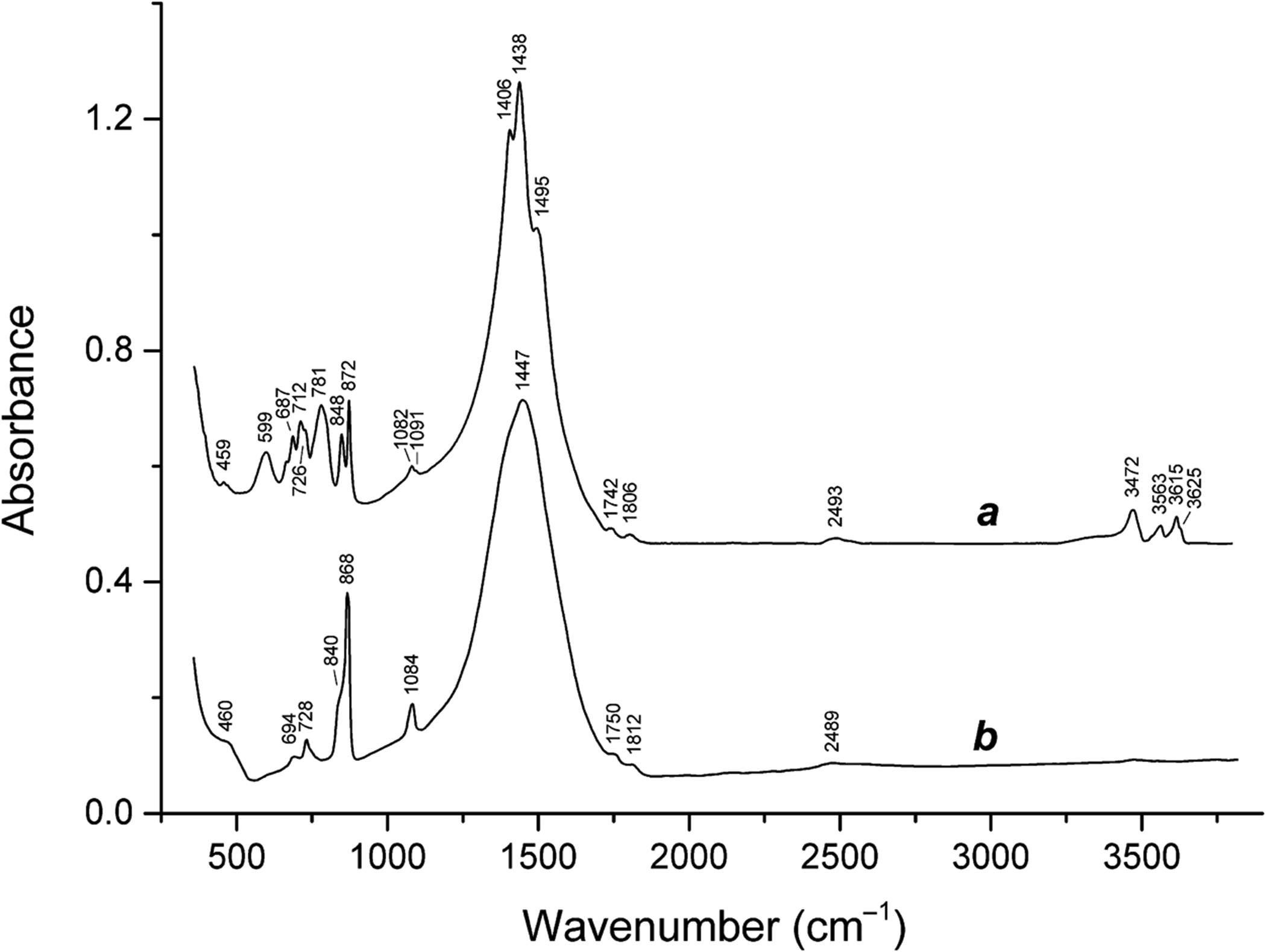
In order to obtain an infrared (IR) absorption spectrum, a powdered sample of the holotype hydroxylbastnäsite-(La) (curve a in Fig. 3) was mixed with anhydrous KBr, pelletised, and analysed using an ALPHA FTIR spectrometer (Bruker Optics) at a resolution of 4 cm–1. A total of 16 scans were accumulated. The IR spectrum of an analogous pellet of pure KBr was used as a reference. The typical sample of bastnäsite-(Ce) involved for comparison (curve b in Fig. 3) was prepared and studied using the same procedures.
Powder infrared absorption spectra of (a) holotype hydroxylbastnäsite-(La) from Vuoriyarvi and (b) bastnäsite-(Ce) with the composition (Ce0.54La0.26Nd0.12Pr0.06Sm0.01Ca0.01)Σ1(CO3)F0.98(OH)0.01 from Mt. Ploskaya, Western Keivy, Kola Peninsula, Russia.

The assignment of absorption bands observed in different wavenumber ranges is as follows: 3400–3700 cm–1 are O–H stretching vibrations; 1400–1500 cm–1 are assigned to degenerate asymmetric stretching vibrations of (CO3)2–. 1080–1100 cm–1 are assigned to nondegenerate symmetric stretching vibrations of (CO3)2–; 840–880 cm–1 to out-of-plane bending vibrations of (CO3)2– (a nondegenerate mode); 781 cm–1 to LREE···O–H in-plane bending vibrations (broad band, possibly, superposition of several bands); 680–730 cm–1 to in-plane bending vibrations of (CO3)2– (a degenerate mode); and 599 cm–1 to LREE···O–H out-of-plane bending vibrations (rotation around the LREE···O ionic bond) – broad band, possibly, superposition of several bands. Below 500 cm–1 bands are assigned to lattice modes involving LREE···O and (CO3)2– librational vibrations.
The intrinsic fundamental modes of the (CO3)2– and (OH)– anions were assigned in accordance with Nakamoto (Reference Nakamoto2008).
The remaining absorption bands with maxima at 599 and 781 cm–1 were assigned by analogy with numerous oxysalts with additional (OH)– anions in which M···O–H bending vibrations are usually observed in the range of 580 – 830 cm–1 (see the reference books Chukanov and Chervonnyi, Reference Chukanov and Chervonnyi2016; Chukanov and Vigasina, Reference Chukanov and Vigasina2020 and references therein). Note that in the IR spectra of F-dominant members of the bastnäsite group these bands are absent or are very weak.
Weak bands in the range of 1700–1500 cm–1 correspond to overtones and combination modes.
The IR spectrum of hydroxylbastnäsite-(La) differs from that of bastnäsite-(Ce) by the presence of multiple bands of O–H stretching vibrations and LREE···O–H bending and libration bands as well as splitting of all bands related to the (CO3)2– groups. The band of nondegenerate symmetric stretching vibrations of (CO3)2– (i.e. mode which would be inactive in the IR spectrum of a mineral with undistorted CO3 triangles) at 1082 with the shoulder at 1091 cm–1 as well as splitting of the nondegenerate band of out-of-plane bending vibrations of (CO3)2– indicate the presence of non-equivalent distorted CO3 triangles in the structure of hydroxylbastnäsite-(La).
Four bands in the O–H stretching region correspond to at least four non-equivalent OH groups, but taking into account asymmetry of the bands at 3472 and 3563, one can suppose that the number of non-equivalent OH groups is > 4.
Chemical composition
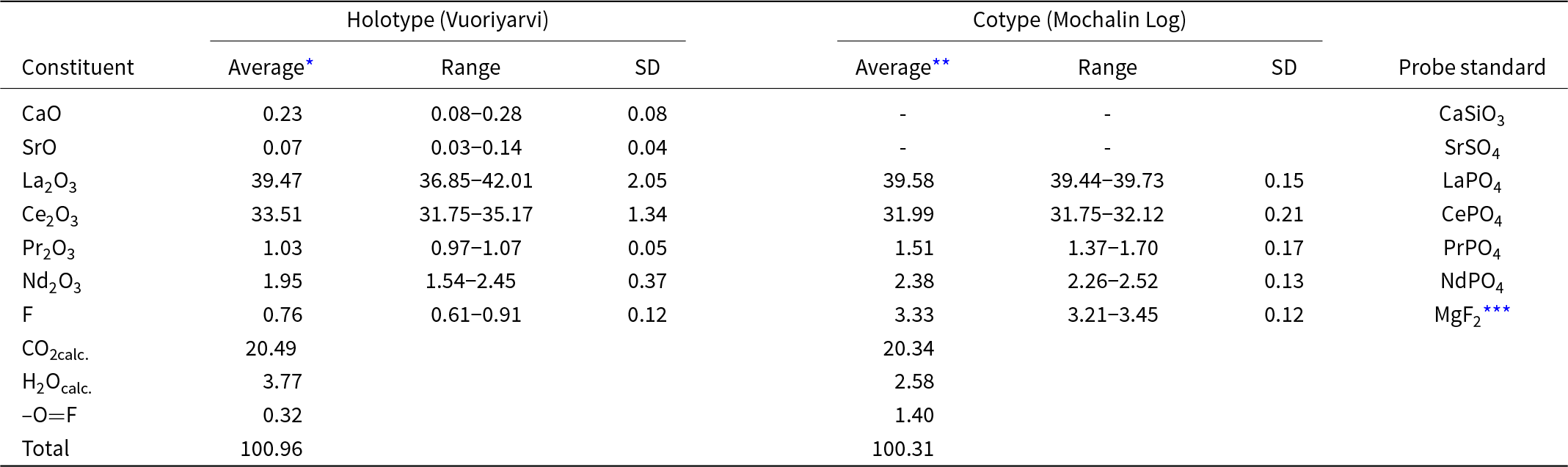
The chemical composition of hydroxylbastnäsite-(La) was studied by electron microprobe in two laboratories. The holotype was investigated in the Laboratory of Analytical Techniques of High Spatial Resolution, Department of Petrology, Moscow State University, using a Jeol JSM-6480LV scanning electron microscope equipped with an INCA-Wave 500 wavelength-dispersive spectrometer, with an acceleration voltage of 20 kV and a beam current of 10 nA; the electron beam was rastered to the 5 × 5 μm area. The cotype was analysed in the Laboratory of Electron Microscopy and Microanalysis, Department of Geological Sciences, Masaryk University, Brno, using a Cameca SX-100 electron microprobe (WDS mode, acceleration voltage of 15 kV, a beam current of 10 nA, and a 5 μm beam diameter). The chemical data in wt.% are given in Table 1, as well as the probe standards. Contents of other elements with atomic numbers > 4 were below detection limits. Special attention was paid to the correctness of quantitative determination of fluorine due to an overlap of the K line of F with the M line of Ce.
Chemical composition (in wt.%) of hydroxylbastnäsite-(La)

* For five spot analyses; **for three spot analyses; ***for the cotype specimen, topaz was used as probe standard for F. SD – standard deviation. Dash means that the content is below detection limit.
The amounts of H2O and CO2 could not be determined directly because of the paucity of pure material. The presence of both (CO3)2– and (OH)– groups as species-defining constituents in hydroxylbastnäsite-(La) is undoubtedly shown by the crystal structure data (see below) and the IR spectrum. The presence of (CO3)2– (as in all other bastnäsite-group carbonates) is also confirmed by a common chemical test: the mineral dissolves in warm HCl aqueous solution or in cold dilute H2SO4 with effervescence (CO2 gas bubbling release).
The empirical formulae, calculated on the basis of the sum of metal cations of one atom per formula unit (apfu) and one CO3 group pfu, are as follows: holotype (Vuoriyarvi) is (La0.52Ce0.44Nd0.02Pr0.01Ca0.01)Σ1.00(CO3)[(OH)0.90F0.09]Σ0.99;cotype (Mochalin Log) is (La0.53Ce0.42Nd0.03Pr0.02)Σ1.00(CO3)[(OH)0.62F0.38]Σ1.00.
The simplified formula is (La,Ce)(CO3)(OH,F). The idealised, end-member formula is La(CO3)(OH) which requires La2O3 75.45, CO2 20.38, H2O 4.17, total 100 wt.%.
The values of the Gladstone–Dale compatibility index 1 – (K p/K c) (Mandarino, Reference Mandarino1981) for the holotype hydroxylbastnäsite-(La) calculated with D meas and D calc are –0.009 and –0.003, respectively (both rated as superior).
X-ray crystallography and crystal structure determination details
Single-crystal XRD studies of the holotype sample of hydroxylbastnäsite-(La) were carried out at room temperature using an Xcalibur S diffractometer equipped with a CCD detector (MoKα-radiation). The mineral is hexagonal, a = 12.562(2), c = 10.015(2) Å and V = 1368(1) Å3.
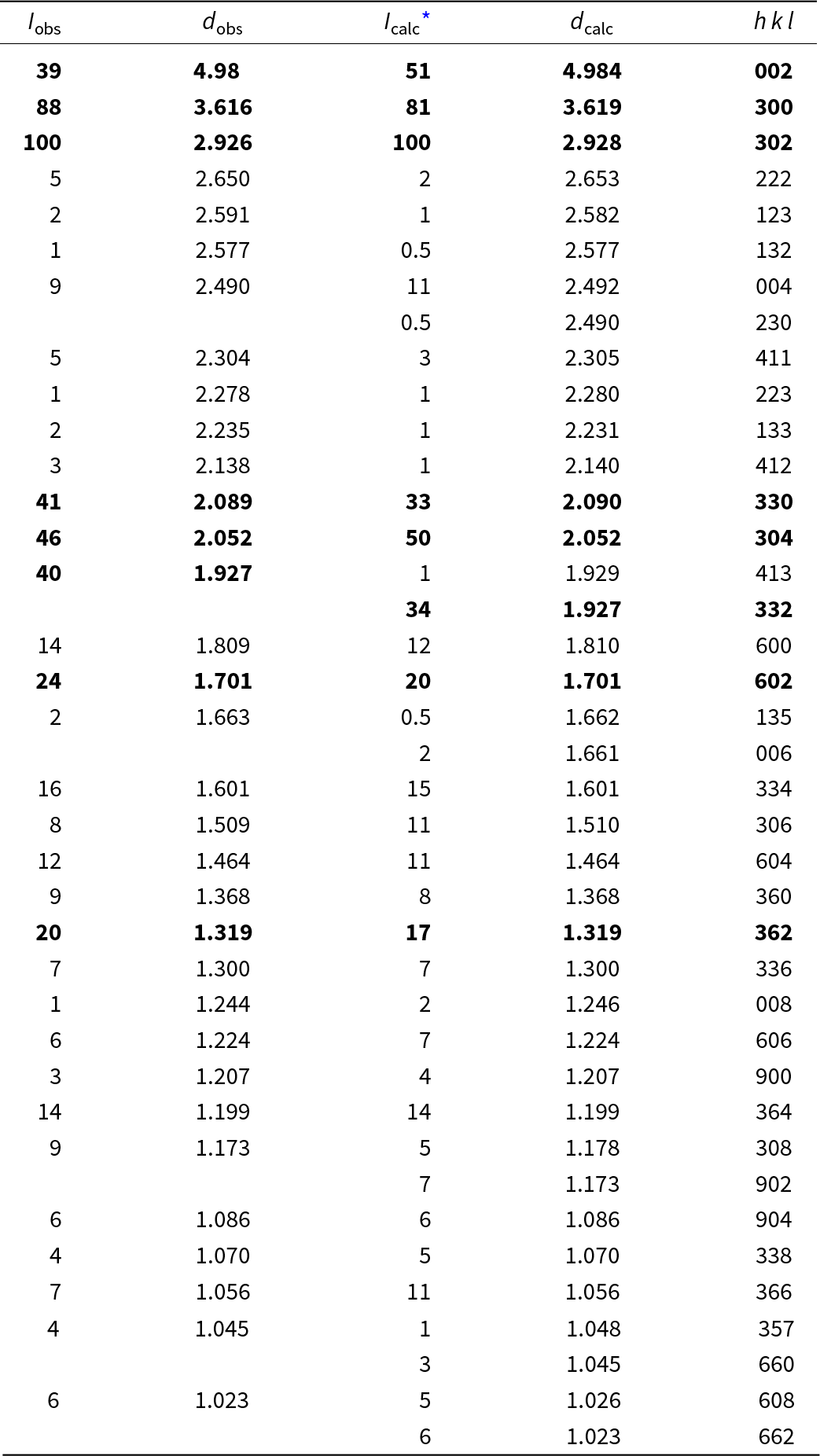
Powder XRD data for both holotype and cotype samples were collected with a Rigaku R-AXIS Rapid II single-crystal diffractometer equipped with a cylindrical image plate detector (radius 127.4 mm) using Debye-Scherrer geometry, CoKα radiation (rotating anode with VariMAX microfocus optics), 40 kV, 15 mA and exposure 15 min. Angular resolution of the detector is 0.045° (2θ; pixel size 0.1 mm). The data were integrated using the software package Osc2Tab (Britvin et al., Reference Britvin, Dolivo-Dobrovolsky and Krzhizhanovskaya2017). Powder XRD data for the holotype are given in Table 2, the powder XRD pattern of the cotype shows no significant differences. The hexagonal unit cell parameters calculated from powder data for holotype/cotype are: a = 12.537(3)/12.533(1), c = 9.968(2)/9.908(1) Å, V = 1356.8(5)/1347.9(3) Å3 and Z = 18.
Powder X-ray diffraction data (d in Å) of holotype hydroxylbastnäsite-(La)

* For the calculated pattern, only reflections with intensities ≥0.5 are given; the strongest reflections are marked in boldtype.
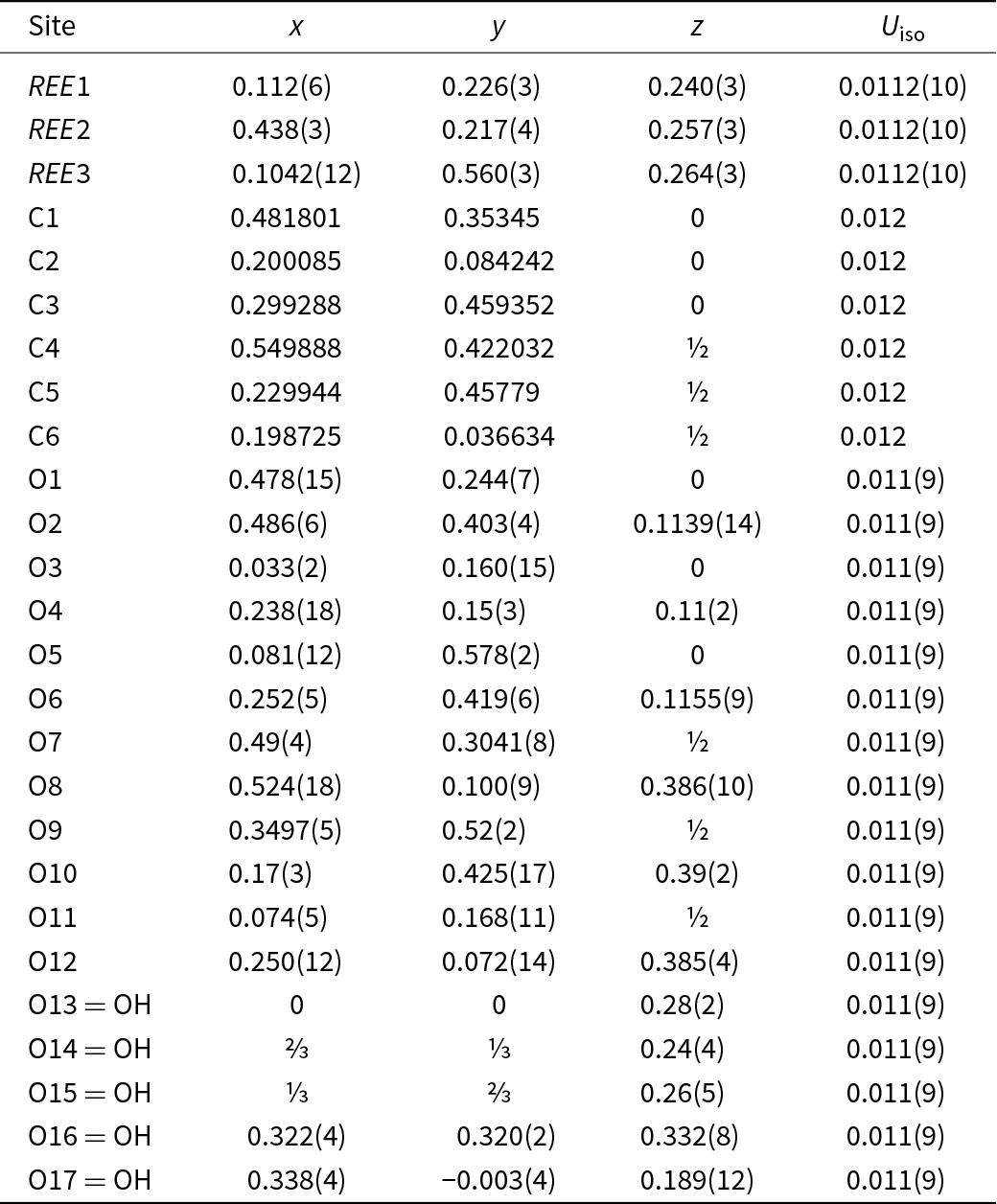
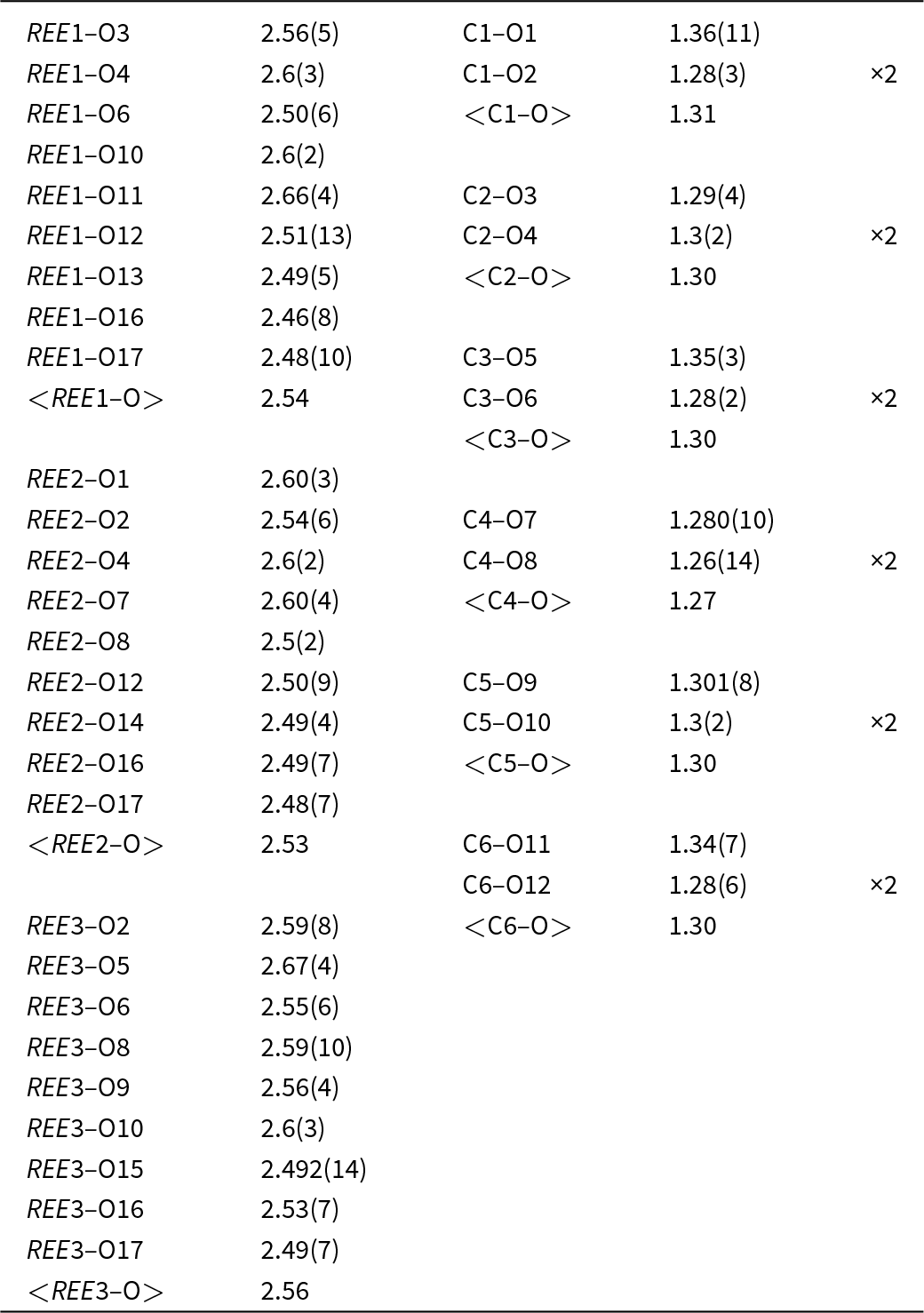
All the single crystals of hydroxylbastnäsite-(La) tested were not very high in quality: even though they appeared to be perfect (Fig. 1), in fact they have a mosaic character in the inner structure and consist of blocks slightly disoriented with respect to each other. The crystal structure of holotype hydroxylbastnäsite-(La) was refined with the powder XRD data (for the data collecting details see above) using the Rietveld method. Data treatment and the Rietveld structure analysis were carried out using the JANA2006 program package (Petříček et al., Reference Petříček, Dušek and Palatinus2006). The structure model of hydroxylbastnäsite-(Ce) (Yang et al., Reference Yang, Dembowski, Conrad and Downs2008) was taken as the starting one. The scattering curve of Ce was used for the REE sites. The profiles were modelled using a pseudo-Voigt function. The structure was refined in isotropic approximation of atomic displacements, the values of U iso for all atoms of each sort were restricted to be equal, atomic coordinates and U iso of C atoms were fixed on the last stages of the refinement. The cation–anion interatomic distances were restricted nearby the values of the starting structure model. The space group is P  $\bar 6$, for the refined unit-cell parameters see above. Final agreement factors are: Rw p = 0.0071, R p = 0.0050 and R obs = 0.0466. The observed and calculated powder XRD diagrams demonstrate a very good agreement (Fig. 4). Coordinates and displacement parameters of atoms are given in Table 3 and selected interatomic distances in Table 4. The crystallographic information file has been deposited with the Principal Editor of Mineralogical Magazine and is available as Supplementary material (see below).
Observed and calculated powder X-ray diffraction patterns of hydroxylbastnäsite-(La). The solid line corresponds to calculated data, the crosses correspond to the observed pattern, vertical bars mark all possible Bragg reflections. The difference between the observed and calculated patterns is shown by curve at the bottom.

Coordinates and isotropic displacement parameters (U iso, in Å2) of atoms for holotype hydroxylbastnäsite-(La)

Selected interatomic distances (Å) in the structure of holotype hydroxylbastnäsite-(La)

Discussion
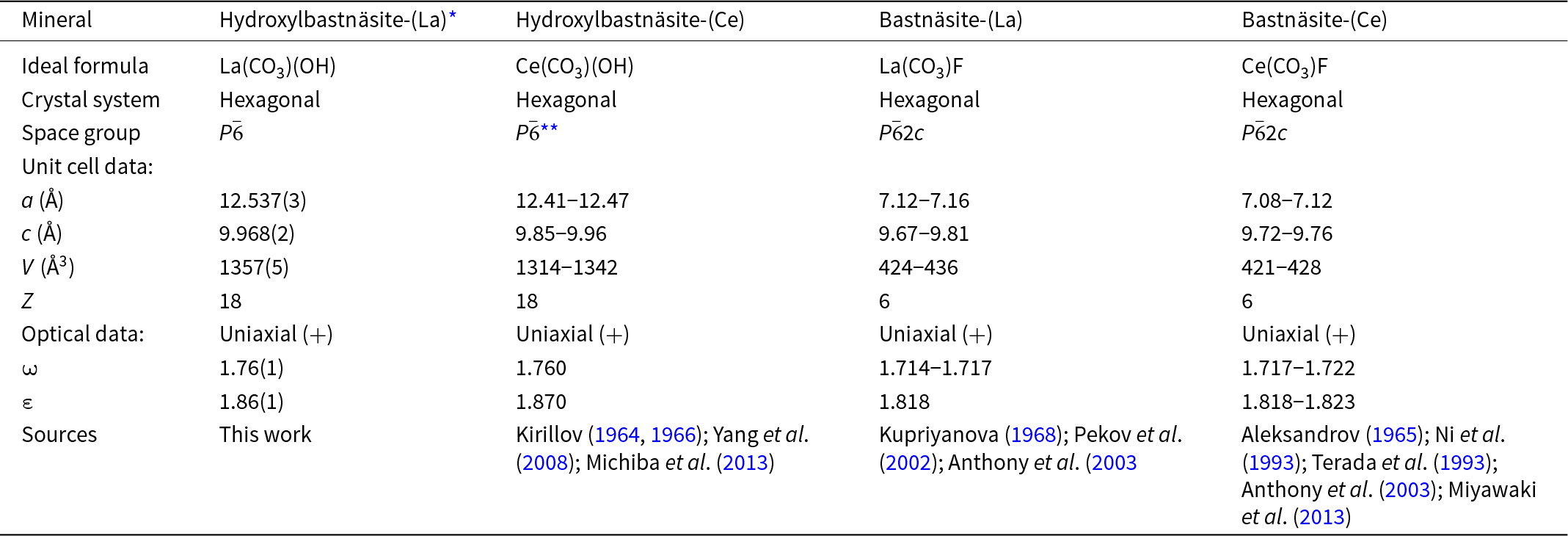
Fluorine- and hydroxyl-dominant members of the bastnäsite group are structurally close but not isostructural. Fluorine-dominant minerals of the bastnäsite-(Ce) – bastnäsite-(La) series and bastnäsite-(Nd) adopt the space group P  $\bar 6$2c and are characterised by a unit cell with the following parameters: a = 7.1–7.2, c = 9.7–9.8 Å and V = 422–436 Å3 (Z = 6) (Oftedal, Reference Oftedal1931; Donnay and Donnay, Reference Donnay and Donnay1953; Ni et al., Reference Ni, Hughes and Mariano1993; Terada et al., Reference Terada, Nakai and Kawashima1993; Mi et al., Reference Mi, Shen, Pan and Liang1996; Miyawaki et al., Reference Miyawaki, Yokoyama and Husdal2013). The crystal structure of bastnäsite-(Y) was not studied. Among hydroxyl-dominant minerals of the group, only hydroxylbastnäsite-(Ce) was structurally studied earlier, on samples from Trimouns, Luzenac, France and Kamihouri, Miyazaki Prefecture, Japan. It crystallises in the space group P
 $\bar 6$ and has a unit cell with the following parameters: a = 12.41–12.47, c = 9.85–9.96 Å and V = 1314–1342 Å3 (Z = 18) (Yang et al., Reference Yang, Dembowski, Conrad and Downs2008; Michiba et al., Reference Michiba, Miyawaki, Minakawa, Terada, Nakai and Matsubara2013): see Table 5. Synthetic bastnäsite-like hydroxyl-carbonates REE 3+(CO3)(OH) with REE = La, Pr, Nd, Sm, Eu, Gd, Tb, Dy, Ho and Er demonstrate the same space group P
 $\bar 6$ and unit-cell metrics as hydroxylbastnäsite-(Ce) (Christensen, Reference Christensen1973; Kutlu and Meyer, Reference Kutlu and Meyer1999; Michiba et al., Reference Michiba, Tahara, Nakai, Miyawaki and Matsubara2011). Note, synthetic bastnäsite-like La(CO3)(OH), an analogue of the end-member hydroxylbastnäsite-(La) is known (Hsu et al., Reference Hsu1992; Michiba et al., Reference Michiba, Tahara, Nakai, Miyawaki and Matsubara2011). The relationship between unit cells of F- and OH-dominant bastnäsites is as follows: a hydroxylbastnäsite ≈ a bastnäsite
 $\sqrt3$, c hydroxylbastnäsite ≈ c bastnäsite. The difference between F- and OH-dominant bastnäsites is in their atomic arrangement (Figs 5 and 6). In particular, there are 6, 3 and 5 symmetrically non-equivalent CO3 groups, REE 3+ cations, and X -– anions, respectively, in hydroxylbastnäsites as distinct to 1, 1 and 2, respectively in F-dominant bastnäsites (see references above). However, the crystal structures of the bastnäsite-like compounds crystallised in the space groups P
 $\bar 6$ and P
 $\bar 6$2c exhibit many common features: they are based on the layers of REE and F/OH alternating with the layers of CO3 groups (Fig. 6).
The crystal structure of hydroxylbastnäsite-(La) projected along the a axis (a) and the layer of REE-centred polyhedra in it (b). The unit cell is outlined. Drawn using Diamond Version 3.2k.

The crystal structures of hydroxylbastnäsite-(La) (projected along [120]; (a) and bastnäsite-(Ce) (projected along [110]; (b: drawn after Donnay and Donnay, Reference Donnay and Donnay1953). For legend see Figure 5; fluorine atoms in bastnäsite-(Ce) are shown as small reddish-pink circles. The unit cells are outlined.

Comparative data for hydroxylbastnäsite-(La), hydroxylbastnäsite-(Ce), bastnäsite-(La) and bastnäsite-(Ce)

* Data for holotype. **Both natural samples of hydroxylbastnäsite-(Ce) with determined crystal structure possess the space group P  $\bar 6$ and unit-cell parameters a = 12.41–12.47 and c = 9.85–9.96 Å (Z = 18) (Yang et al., Reference Yang, Dembowski, Conrad and Downs2008; Michiba et al., Reference Michiba, Miyawaki, Minakawa, Terada, Nakai and Matsubara2013) [synthetic bastnäsite-like hydroxyl-carbonates REE(CO3)(OH) with REE = trivalent La, Pr, Nd, Sm, Eu, Gd, Tb, Dy, Ho, Er have the same space group and unit-cell metrics: Christensen, Reference Christensen1973; Kutlu and Meyer, Reference Kutlu and Meyer1999; Michiba et al., Reference Michiba, Tahara, Nakai, Miyawaki and Matsubara2011], whereas in older publications, hydroxylbastnäsite-(Ce) and hydroxylbastnäsite-(Nd) were reported, by analogy with a fluorine-rich bastnäsites, with the hexagonal unit cell with parameters a = 7.19–7.23 and c = 9.92–9.98 Å (Z = 6) (Kirillov, Reference Kirillov1964, Reference Kirillov1966; Aleksandrov, Reference Aleksandrov, Ivanov and Sin’kova1965; Maksimović and Pantó, Reference Maksimović and Pantó1985; Minakawa et al., Reference Minakawa, Adachi and Matsuda1992), and the space group P
 $\bar 6$2c, found for the structurally studied F-rich members of the bastnäsite-(Ce) – bastnäsite-(La) series (Oftedal, Reference Oftedal1931; Donnay and Donnay, Reference Donnay and Donnay1953), was also suggested in this period for hydroxylbastnäsites (Anthony et al., Reference Anthony, Bideaux, Bladh and Nichols2003).
As our data show, hydroxylbastnäsite-(La) is isostructural to hydroxylbastnäsite-(Ce) (Yang et al., Reference Yang, Dembowski, Conrad and Downs2008; Michiba et al., Reference Michiba, Miyawaki, Minakawa, Terada, Nakai and Matsubara2013) and synthetic bastnäsite-like hydroxyl-carbonates REE 3+(CO3)(OH) with REE = La–Er (Michiba et al., Reference Michiba, Tahara, Nakai, Miyawaki and Matsubara2011 and references therein) rather than F-dominant bastnäsites. The crystal structure of hydroxylbastnäsite-(La) (Fig. 5a) is based upon the (001) layers of REE 3+ cations and (OH)– anions interspersed with carbonate layers in a 1:1 ratio. Three crystallographically non-equivalent REE sites occupy nine-fold polyhedra REEO6(OH)3. Hydroxyl groups are located inside REE layers where REE-centred polyhedra are connected via common O–OH edges and OH vertices (Fig. 5b). Neighbouring REE layers are connected via CO3 groups and one common O vertex of REE-centred polyhedra. As well as in hydroxylbastnäsite-(Ce), the coordination of REE 3+ cations is formed by three (OH)– anions and five (CO3)2– anions four of which are monodentate ligands and one is a bidentate ligand in contrast with F-dominant bastnäsites crystallising in space group P  $\bar 6$2c where REE sites are coordinated by three F– anions and six monodentate (CO3)2– anions. The comparison of the atomic arrangements in the structures of bastnäsite-(Ce) and hydroxylbastnäsite-(La) is given in Fig. 6.
The difference in symmetry causes the difference (not too strong but distinct) in powder XRD patterns of F- and OH-dominant bastnäsites, at the first instance, due to additional systematic absences in the patterns of F-dominant bastnäsites (space group P  $\bar 6$2c) in comparison with the patterns of hydroxylbastnäsites (P
 $\bar 6$). The powder XRD pattern of hydroxylbastnäsite-(La) (Table 2) shows the similarity with the calculated pattern of REE 3+(CO3)(OH) with the space group P
 $\bar 6$. In particular, hydroxylbastnäsite-(La) demonstrates three reflections in the region 2.7–2.5 Å in which the calculated powder XRD pattern of hydroxylbastnäsites (P
 $\bar 6$) also contains three reflections with I ≥ 0.5%, whereas the calculated pattern of F-dominant bastnäsites (P
 $\bar 6$2c) contains only one reflection. A distinct reflection with d = 2.235 Å is present in both measured and calculated powder XRD patterns of hydroxylbastnäsite-(La) but is absent in the patterns of F-dominant bastnäsites (P
 $\bar 6$2c). These and some other features of the powder XRD pattern causes the choice of the space group P
 $\bar 6$ and corresponding unit-cell metrics for hydroxylbastnäsite-(La).
The IR spectrum of hydroxylbastnäsite-(La) (curve a in Fig. 3), unlike the IR spectra of F-dominant bastnäsite-group minerals (see, e.g. curve b in Fig. 3), clearly demonstrates the presence of several non-equivalent (CO3)2– and (OH)– groups (see above) that confirms its lower symmetry in comparison with F-dominant bastnäsites.
Hydroxylbastnäsite-(La) and hydroxylbastnäsite-(Ce) have distinctly higher values of unit-cell dimensions and volume (easily comparable in the same setting) and refractive indices in comparison with their F-dominant analogues (Table 5). The triple unit-cell volumes of bastnäsite-(Ce)–bastnäsite-(La) series minerals (Z = 18) varies from 1266 to 1308 Å3 whereas minerals of the hydroxylbastnäsite-(Ce)–hydroxylbastnäsite-(La) series have a unit-cell volume from 1314 to 1357 Å3. Unit-cell dimensions of two samples of hydroxylbastnäsite-(La), from Vuoriyarvi and Mochalin Log (see above), are in agreement with the OH:F ratio. The refractive indices of hydroxylbastnäsites are higher than corresponding values of F-dominant bastnäsites, with the significant difference of 0.04–0.05 (Table 5). The distinct increase of unit-cell dimensions with the substitution of F– by (OH)– is typical in such pairs of isotypic or structurally close compounds [e.g. the fluorapatite Ca5(PO4)3F – hydroxylapatite Ca5(PO4)3(OH) (White et al., Reference White, Ferraris, Kim, Srinivasan, Ferraris and Merlino2005) or fluoborite Mg3(BO3)F3 – hydroxylborite Mg3(BO3)(OH)3 series (Cámara and Ottolini, Reference Cámara and Ottolini2000; Rudnev et al., Reference Rudnev, Chukanov, Nechelyustov and Yamnova2007)], as well as refractive indices. These characteristics can be used as good indicators of the prevailing of F– or (OH)– in rare-earth minerals of the bastnäsite group. The correctness of determination of chemical and crystal data and density of hydroxylbastnäsite-(La) is confirmed by the very low (superior) value of the Gladstone–Dale compatibility index.
In terms of end-member compositions, hydroxylbastnäsite-(La) is dimorphous with kozoite-(La), ideally La(CO3)(OH), a member of the ancylite supergroup (Miyawaki et al., Reference Miyawaki, Matsubara, Yokoyama, Iwano, Hamasaki and Yukinorii2003; Wang et al., Reference Wang, Nestola, Hou, Miyawaki, Pekov, Gu, Dong and Qu2024).
Supplementary material
The supplementary material for this article can be found at https://doi.org/10.1180/mgm.2024.65.
Acknowledgements
We thank three anonymous referees for their valuable comments. The mineralogical and crystal chemical studies of hydroxylbastnäsite-(La) from Vuoriyarvi was performed in accordance with the State Task of the RF No. 121061600049-4. The IR spectra were obtained and interpreted in accordance with the State Task of the RF No. 124013100858-3. Powder XRD study was done at the Center for X-ray Diffraction Studies of the Research Park of St. Petersburg State University within the project No. AAAA-A19-119091190094-6.
Competing interests
The authors declare none.