Introduction
UK public management reforms since the 1990s have been characterised by the ‘three Ms’: marketisation, managerialisation and the measurement of performance (Ferlie, Reference Ferlie2017). Central to these developments has been a concern that corporate governance, in terms of the ability of governing bodies to effectively hold managers and professionals to account for going ‘beyond the law’, should encompass corporate social responsibility for the wider economic, ethical and discretionary expectations of society (Parker, Reference Parker, McBarnet, Voiculescu and Campbell2007).
In England, these developments are most evident in the policy arenas of education and health care, with notable examples including school governors (Wilkins, Reference Wilkins2015; Baxter, Reference Baxter2017) and the creation of governors in NHS Foundation Trust (FT) hospitals. In relation to the latter, FT hospitals are constituted as independent public benefit corporations owned by – and accountable to – staff, patients and members of the public. Their status is intended to increase the influence of patients and staff on service provision through the addition of governors charged collectively with holding the executive board to account (Dixon et al., Reference Dixon, Storey and Alvarez-Rosete2010; Wright et al., Reference Wright, Dempster, Keen, Allen and Hutchings2012; Ocloo et al., Reference Ocloo, O'Shea and Fulop2014).
Governors have been lauded as potentially able to understand and represent the experiences of patients and staff (Ham and Hunt, Reference Ham and Hunt2008), as well as providing an alternative source of service knowledge and expertise (Allen et al., Reference Allen, Townsend, Dempster, Wright, Hutchings and Keen2012). Furthermore, governors have the potential to fill in key intelligence gaps not picked up by external healthcare regulators or by existing internal governance mechanisms often characterised by continuous restructuring and staff turnover. In this sense, governors have the potential to act as a ‘meta-regulator’, able to steer the internal governance of FT hospitals towards wider regulatory goals alongside the promotion of deliberative values and public interest goals (Wright et al., Reference Wright, Dempster, Keen, Allen and Hutchings2012).
Despite this potential, much of the evidence suggests that the governance arrangements of FTs have largely failed to deliver the anticipated benefits of accountability and social ownership (Wright et al., Reference Wright, Dempster, Keen, Allen and Hutchings2012). Governors are frequently unable to perform their statutory duties adequately due to a lack of influence and limited means – in terms of time, knowledge and technical skills - to interpret and act on hospital performance indicators (Allen et al., Reference Allen, Townsend, Dempster, Wright, Hutchings and Keen2012). While governors hold the formal authority to remove under-performing executive board members, in practice they may lack the ability and/or confidence to exert control and hold executive board members to account (Dixon et al., Reference Dixon, Storey and Alvarez-Rosete2010; Day and Klein, Reference Day and Klein2005).
Thus while the case has been made for the meta-regulatory potential of governors, we currently lack a detailed understanding of the extent to which this role can be enacted. Recent studies have explored either the role and experience of FT governors (Allen et al., Reference Allen, Townsend, Dempster, Wright, Hutchings and Keen2012; MacDonald et al., Reference MacDonald, Barnes, Crawford, Omeni, Wilson and Diana2014; Ocloo et al., Reference Ocloo, O'Shea and Fulop2014) or the role of FT hospital boards (Mannion et al., Reference Mannion, Freeman, Millar and Davies2016, Reference Mannion, Davies, Jacobs, Kasteridis, Millar and Freeman2017; Freeman et al., Reference Freeman, Millar, Mannion and Davies2016; Jones et al., Reference Jones, Pomeroy, Robert, Burnett, Anderson and Fulop2017), yet these studies have treated executive boards and governors as separate units of analysis without careful study of the interactions between these two groups. The dynamics and deliberations within such meta-regulation are yet to be fully articulated.
The purpose of our paper is to explore empirically the dynamics of governor meta-regulation within FT hospitals. It does so by drawing on deliberative theory to analyse how these interactions initiate and proceed. Specifically, we consider how governors become informed about governance issues, how they engage with the executive board and the extent to which these deliberations create a space for the development of shared understandings of hospital governance (Hendriks, Reference Hendriks2009; Dryzek, Reference Dryzek2000; Degeling et al., Reference Degeling, Carter and Rychetnik2015; Abelson et al., Reference Abelson, Forest, Eyles, Smith, Martin and Gauvin2003). Our analysis offers key insights into the deliberative dimensions of a meta-regulatory role for governors and is intended to inform future development of this area and contribute to wider understandings of deliberation (Ercan et al., Reference Ercan, Hendriks and Boswell2017; Braithwaite, Reference Braithwaite2016), the interactions of hospital governance (Kulhmann et al., 2016; Duran and Saltman, Reference Duran, Saltman, Kuhlmann, Blank, Bourgeault and Wendt2015; Millar et al., Reference Millar, Mannion, Freeman and Davies2013), and public governance more widely.
In the following sections we set out the formal structures of FT hospital governance, the meta-regulatory potential of governors, and the deliberative perspective from which we frame our analysis of empirical data on FT hospital governor interactions. We conclude by considering the extent to which the deliberative potential of FT governance is realised in practice and explore the implications of our findings for developing useful insights into contemporary hospital governance.
Governing NHS Foundation Hospital Trusts
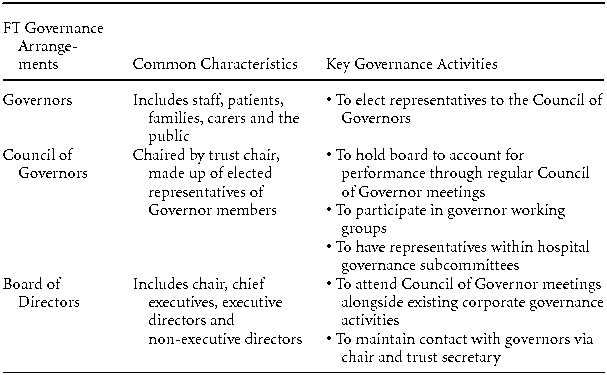
The introduction of Foundation Trust (FT) hospital status in 2004 signalled a myriad of structural and cultural changes to hospital governance in the English NHS (Allen et al., Reference Allen, Wright, Keen, Dempster, Hutchings, Townsend, Street and Verzulli2010). As with existing NHS hospital governance arrangements, corporate governance of FT hospitals is centred on a board of directors (usually around 10–12 members) comprising a non-executive chair, additional non-executive directors, a chief executive and executive directors (Chambers, Reference Chambers2012). In addition, FT hospitals contain governors comprising people elected from the local community and staff representatives. They also include a Council of Governors intended to provide a forum to oversee and engage with the executive board across a range of hospital governance issues (Ocloo et al., Reference Ocloo, O'Shea and Fulop2014; Allen et al., Reference Allen, Townsend, Dempster, Wright, Hutchings and Keen2012). The Council has legal statutory duties for appointing or removal of the chair and other non-executive directors, appointment of the trust's auditor and receipt of annual accounts and reports (Table 1).
Governing NHS Foundation Trust Hospitals

The latest available data shows that FT hospital trusts have an average of 13,500 governor members, with Councils of Governors consisting of around 30 members made up of public governors (53 per cent), appointed governors (23 per cent), staff governors (19 per cent), and patient/service user and carer governors (5 per cent). The majority of trusts have four Council of Governor meetings a year (NHS Providers, Reference Providers2015).
Governor roles and responsibilities form part of wider developments in contemporary governance that seek to encourage – and also to force corporations to put in place – internal governance structures, management practices and corporate cultures with the aim of achieving socially responsible outcomes (Parker, Reference Parker, McBarnet, Voiculescu and Campbell2007). Combining legal statutory powers and non-legal methods of regulating internal corporate self-regulation and management, governors represent a corporate ‘conscience’ (Selznick, Reference Selznick2002) to encourage FTs to go beyond merely legal compliance towards outputs or actions. They are ‘meta-regulators’ in the sense that they represent a tier of governance promoting internal self-regulation (Parker et al., Reference Parker, Scott, Lacey and Braithwaite2004), focusing on internal responsibility processes rather than exclusively on external accountability outcomes which may fail to recognise and protect rights and interests of patients and public. The approach has approval from those advocating responsive regulatory approaches in healthcare that ‘transcend the polarised choice between punishment and persuasion’ (Healy and Braithwaite, Reference Healy and Braithwaite2006: 56) as well as some similarities with ‘hybrid’ governance perspectives capturing the interactions between different regulatory forms and requirements promoting autonomy and responsiveness, while simultaneously achieving performance measures set by national regulators (McDermott et al., Reference McDermott, Hamel, Steel, Flood and McKee2015; Furnival et al., Reference Furnival, Walshe and Boaden2017; Wright, Reference Wright2009; Maybin et al., Reference Maybin, Addicott, Dixon and Storey2011).
Within such a context, the meta-regulatory techniques at the governors’ disposal include calls for increased transparency and social responsibility (Wright et al., Reference Wright, Dempster, Keen, Allen and Hutchings2012). The promotion of deliberative values also features within governors’ repertoire as they look to actively encourage discussion and participation across various tiers of FT governance. Relationships with the executive are crucial in this regard in terms of holding them to account for what Parker (Reference Parker, McBarnet, Voiculescu and Campbell2007) describes as the meta-regulatory values that transcend ‘narrow self-interest’, are built into the practice and structure of core internal governance processes, and provide sufficient space and flexibility to ensure goals align with social responsibility values (Parker, Reference Parker, McBarnet, Voiculescu and Campbell2007: 215).
These techniques are presented as an effective means to respond to a range of issues, yet very little empirical work has been carried out on the deliberative interface between experts such as executive boards and local stakeholders within such meta-regulatory contexts (Braithwaite, Reference Braithwaite2016). Boldly stated, the meta-regulation literature provides an effective rationale for FT governors, yet the perspective fails to develop and refine how meta-regulatory techniques are translated into practice – the dynamics of what goes on ‘in the room’ of FT governance.
Further clarification is needed regarding the techniques of meta-regulation and how internal and external governance processes work together to facilitate, enforce, regulate or supplant governance networks (Parker, Reference Parker, McBarnet, Voiculescu and Campbell2007). In this case, Parker (Reference Parker, McBarnet, Voiculescu and Campbell2007) calls for research into corporate responsibility processes and how these are negotiated within particular contexts, particularly in the light of research showing the potential for ‘morally thin’ techniques for meta-regulation aimed solely at internal compliance systems and policing agents at the expense of corporate social responsibility.
Our contribution directly addresses this issue, drawing on deliberative theory to inform an empirical analysis of how FT governors interact with a wide range of actors across multiple governance tiers. In the next section we introduce deliberative perspectives and explore their potential in the context of meta-regulation, before introducing an empirical study of such deliberations within a series of FT governance case studies.
From meta-regulation to deliberation: analysing Foundation Trust hospital governance
With roots in the tradition of deliberative democracy, a deliberative approach explores the communicative processes by which actors are informed about a policy issue, consider its complexities and reach a consensus on a particular issue or concern (Hendriks, Reference Hendriks2005, Reference Hendriks2009; Abelson et al., Reference Abelson, Blacksher, Li, Boesveld and Goold2013, Reference Abelson, Forest, Eyles, Smith, Martin and Gauvin2003; Dryzek, Reference Dryzek2000). It implies commitment to the understanding that, in order to be considered legitimate, policy decisions should involve those affected by a decision (Dryzek, Reference Dryzek2001) – not just specialists or elites – and that deliberation promotes a collective communicative power which counteracts domination and strategic manipulation (Hendriks, Reference Hendriks2009).
Underpinned by republican notions of restorative justice that seek to ‘defend non-domination as a normative foundation for governance’, judicial and educational branches of governance provide citizens or ‘primary groups’ with opportunities for participation (Braithwaite, Reference Braithwaite2015: 33–34). The essence of democratic legitimacy is the capacity of those affected by a collective decision to deliberate in the production of that decision (Michels, Reference Michels2011) through discussion and the exchange of arguments in which individuals justify their opinions, discuss problems and solutions and show themselves willing to change their preferences.
Citizen participation through deliberative forums, such as expert forums and citizen panels, has positive effects on the knowledge, skills and attitudes of those involved in the process (Michels, Reference Michels2011). Yet, there are clearly limits to these endeavours. Deliberative methods may have only limited influence on decisions and may serve largely symbolic purposes as legitimation for internal political expediency (Hendricks, Reference Hendriks2009; Harrison and Mort, 1998), i.e. function as ‘technologies of legitimation’ (Harrison et al., 1997) in securing compliance with decisions. A review of deliberative methods in healthcare suggests that policies formed through public participation in deliberative processes can be considered more legitimate, justifiable and feasible compared to hierarchical modes of governance (Degeling et al., Reference Degeling, Carter and Rychetnik2015). However, despite frequent application of deliberative methods to healthcare issues (Street et al., Reference Street, Duszynski, Krawczyk and Braunack-Mayer2014), results are often disappointing (Mitton et al., Reference Mitton, Smith, Peacock, Evoy and Abelson2009). In order to explore the extent to which the deliberative potential of FT hospital governors as meta-regulators is realised, we apply a deliberative systems approach (Ercan et al., Reference Ercan, Hendriks and Boswell2017) to the sites, spaces and actors involved in FT governance in a series of case studies. Our concern is to understand how deliberative processes are shaped by the experiences and perspectives of actors and observers (Yanow, 2006; Dryzek, Reference Dryzek1982), and to explore the contingent nature of such processes (Parkinson, Reference Parkinson2006; Hendriks, Reference Hendriks2011). In the context of FT hospital governance, the role of FT governors is based on the premise that lay citizens – defined here as patients and the public – are valued and capable of contributing to discussions and debate regarding hospital governance. The role of executive boards is based on the premise that they are willing to present and defend their perspectives before a public forum, encouraging dialogue and understanding about hospital performance and governance proceedings.
Our particular interest lies in the extent to which governors are informed about an issue, how they deliberate with the board and the extent to which, through these deliberations, both parties achieve shared ownership of hospital governance. Our analysis is thus informed by a systems perspective of public deliberation, in which we endeavour to gain a detailed understanding of the actors, sites and activities in FT governance – the forms of communication used and their effects.
Methods
Our study formed part of a three-year national evaluation of FT hospital Board governance in England (Mannion et al., Reference Mannion, Freeman, Millar and Davies2016). In studying the oversight arrangements of FT hospitals, one specific aim was to explore the interactions between executive hospital board members and the Council of Governors to better understand how these dynamics affect the quality and safety of care. The fieldwork was carried out by the co-authors between March 2012 and June 2014. The research was approved by the national research ethics and research governance service (IRAS). Informed consent was provided along with assurances that anonymity would be maintained. As a result, all interviewee quotations have been anonymised.
Qualitative case studies of four FT hospital Trusts were undertaken in order to explore these interactions in a range of different contexts (Wright et al., Reference Wright, Dempster, Keen, Allen and Hutchings2014; Stake, Reference Stake2006). The case study sites in this article are also anonymised and renamed after Scottish islands: Islay, Arran, Lewis, and Skye (see Freeman et al., Reference Freeman, Millar, Mannion and Davies2016). Three sources of data were collected to explore governor-board interactions at each of the four case study sites. Firstly, overt non-participant observation was made of nine Council of Governor meetings totalling over 21 hours of observation. At each meeting, descriptive free-text field notes were taken by two observers, supplemented with documentary data including the agenda, supporting papers and (retrospectively upon their completion) the minutes of each meeting. Secondly, in-depth qualitative interviews were undertaken with public governors (n = 8). These governors were often described as lead governors in acting as key representatives within the Council of Governors. They were white, a mixture of males and females, retired and often had some previous affiliation with healthcare either as a practitioner, a patient or carer. The interviews explored governors’ roles and experiences within the hospital and specifically in relation to their experience of interactions with the executive board and the extent to which they could influence board decisions.
Finally, in-depth qualitative interviews were carried out with a range of executive and non-executive board members at each site (n = 57). Topics explored in the interviews included the experience of being a board member as well as their experience of overseeing the quality and safety of care within their hospital. Additionally, interviewees were asked to reflect on their interactions with governors as part of day-to-day hospital governance. The NVivo software programme was used to support the coding of both sets of interview data. Coding and analysis focused on text describing the role of governors and interactions between governors and board members.
Our analysis of governors and boards revealed participatory storylines associated with hospital governance, particularly narratives associated with the functioning and legitimacy of a deliberative forum (Hendriks, Reference Hendriks2005). These narratives might, for example, refer to who constitutes ‘the public,’ and whether or not ‘the public’ so defined should participate in the governance process. While multiple participatory storylines may be associated with a given policy issue, the dominant storyline typically determines how ‘the public’ are engaged in the policy process (Hendricks, Reference Hendriks2005). The eventual dominant storyline might be challenged but is ultimately likely to promote and legitimise different formal and informal participatory processes related to an issue.
Drawing on this approach, our analysis of the participatory storylines within FT hospital governance (re)interprets the interviews and observations in the light of the deliberative perspective outlined previously above. Coding of governor interview data focused on ‘roles’, ‘experiences’, and ‘board relationships’, while the coding of board-level interviews focused on any passages of text referring to ‘governors’. Data analysis was undertaken to translate these codes, together with the descriptive free-text field notes and documentary data obtained from the observations, into participatory storylines (Hendriks, Reference Hendriks2005). Data from governor and board interviews regarding the governor role were clustered into a ‘governor contribution’ storyline. A second storyline paid particular attention to observation data obtained from Council of Governor meetings and how board members presented and framed their actions before the public forum. A third storyline combined observation, reflections and interview data from both governors and board members to consider the nature and impact of these deliberative interactions as well as the extent to which they facilitated collective reasoning and / or achieved consensual decision making. Discussions ensued within the research team regarding these storylines, which were subsequently developed and refined in an iterative process.
Findings
We identified a range of interactions between governors and boards within the governance of FT hospitals. The following section presents findings clustered into participatory storylines (Hendriks, Reference Hendriks2005). First, we consider the nature of governor contributions to hospital governance and the extent to which their input was deemed valuable. We then explore ways in which board members, as the dominant interest group, were willing to present and defend their actions before the public forum of Council of Governor meetings. Finally, we detail the extent to which these deliberative interactions facilitated collective reasoning and achieved consensual decision-making.
Governor contributions to hospital governance
Public governors described their role as representing patients and the public within hospital governance structures and activities. Often motivated to ‘make a difference’ or ‘give something back’, many governors had prior experience of healthcare services either as a member of staff, patient or carer. Their aim was to oversee and improve hospital standards as an independent and critical voice outside of ‘the establishment’:
From my point of view as a governor we tackle patients head on. . . We're talking to patients to see how they feel. And my pretext is always, ‘Well, I'm a governor: I represent the public. I'm not employed by or paid by the hospital so you can tell me the truth,’ and frequently it works and so you get the truth. [Public Governor]
Governors reported involvement in a variety of governance structures and activities. They participated as observers in hospital subcommittees related to finance, quality and safety, and patient experience, as well as the nominations committee involved in the appointment of the chair and non-executive directors. They joined hospital ‘walk round teams’ that included non-executive Board members, clinical staff and corporate services. Governors also had their own internal working groups, which brought governors with particular interests together to carry out patient surveys as well as formal and informal visits to wards and departments.
We go and ask the patients if they feel safe, if they feel well looked after, if the cleanliness of the ward is satisfactory. And during those visits we'll take a look at toilets and bathrooms and side rooms and behind the scenes stuff and, you know, pass comment. . . [Public Governor]
Many Board members shared this view of the governors’ role. They welcomed the extra pair of eyes in the way governors ‘were able to see things in a different way’ as their work in documenting patient experience got them closer to a patient perspective:
I think they're a good kind of source of conscience really. They're asking difficult questions. [Medical Director]
While the governor role was supported, questions were raised about the ability of governors to represent the public. Some governors expressed difficulties in working with the general public who were often reluctant to come forward or unable to provide relevant information.
We can't properly fulfil the role of governors. . . it can only be so far because we aren't in possession of sufficient information from the public to help them. [Public Governor]
The problem is that with some patients. . . they're afraid to say because they think if they upset anybody they're not going to get the right treatment. [Public Governor]
Board members also raised concerns about the representativeness of governors. As predominately older, white and retired, there was still much work to be done to engage other parts of the community as well as involving staff governors.
When you look around the governors all tend to be of a certain age and the open day – the AGM we had last Thursday – I don't think there was anybody in the audience that was under 55. I'm not saying just because you are above that age you've got no opinion but there's not much diversity in that governor population. [HR Director]
Concerns regarding representativeness were also reported by governors themselves who questioned the motivations and calibre of many of the governor membership.
We do have governors, and I've seen them elsewhere just the same, who are professional committee sitters. They will sit on a committee and they'll drink the tea, they'll eat the biscuits and then they'll go home, and they'll do nothing to either contribute or otherwise to the work of that particular committee. [Public Governor]
Our on-site observations also supported the view that the membership of Councils of Governors lacked diversity. While attendees included both men and women, the vast majority were white and retired.
Executive Board presentation and defence before a public forum
Our observations of governor meetings challenged the assumption that governors can influence and hold boards to account. While settings of the meetings differed (Skye toured across the area while other sites tended to take place in the education or learning centre building), the composition was similar with lead governors in attendance with a range of executive and non-executive board members meeting in ‘lecture’ style (executive board members at a top table) or ‘cabaret’ style (executives and governors sitting together on tables). Agendas were also largely similar in the way meetings would proceed around a series of updates led by executive board members.
Across the sites the meetings tended to centre on the executive board and members of staff presenting particular case studies of quality and safety performance. At Lewis, examples included governors being shown a ‘patient experience DVD’ about how the hospital was responding to the Francis Inquiry (Francis, Reference Francis2013) and a presentation by the director of infection control regarding the prevention and spread of e-coli.
Time was spent by the chair and chief executive updating governors with ‘progress reports’ on specific developments. The ‘chair's report’ often contained items about how the board was working with governors to improve governor education and awareness. The ‘chief executive report’ would often draw the governor's attention to key performance ratings related to waiting times, finance and infection control. These would be summarised in line with regulator risk ratings, drawing attention to particular red amber green (RAG) ratings of performance.
Central to these presentations and reports was the way Board members would defend current performance. Thus at Arran, clostridium difficile (C.Diff) rates consistent with poor performance were presented and explained as the result of patients bringing in C.Diff from the community (i.e. the problem lies elsewhere). At Lewis, mid-table performance ratings were criticised for failing to take into consideration the effect of complex case-mix on lengths of stay, particularly for elderly patients. Board members also used reports to draw attention to the politics and conflict associated with proposed policy changes. A siege mentality was depicted by the chief executive and chair to lobby and mobilise governors to encourage the public to use the hospital over their local rivals who were accused of colluding and encouraging ambulance services to deliver elsewhere. At Islay, proposals set out by the chief executive in relation to hospital reconfiguration also led to calls for governors to lobby the local population ‘to help us communicate. . . what we're trying to do’.
Our observations indicate that the chair tended to be the most visible of the board members in ‘orchestrating the debate’, summarising key points and steering questions following the reports and presentations. In some instances, chairs used the meetings as an opportunity to pursue their own queries, positioned as in governors’ own interests, and using the opportunity to question the executive. At Skye, the chair responded to poor performance in relation to C.Diff using the opportunity to press the director of nursing for more details about compliance with C.Diff performance targets, mobilising governors to respond:
Chair: ‘My problem is we're above [C.Diff infection rate] last year which is unacceptable.’
Governor: ‘yes, the figures don't look good . . .’
Director of Nursing: ‘In response to the question, we're going to look at this. We will drill down and look at particular cases and particular wards. . .’ (Fieldnote Extract)
With the majority of meeting time taken up by board performance updates, governors played a relatively minor role in the proceedings. On occasions there were questions of clarification (‘Can you catch e-coli through hands or through medicines?’) as well as support and gratitude to the board for particular reports and presentations. There were, however, some instances of challenge to the reports, in which governors highlighted irregularities and breaches of performance targets. More critical voices were also occasionally heard. Governors at Lewis called for more up-to-date information and challenged the chair's assertion that the existing ‘induction programme’ provided enough information. At Skye, governors challenged chief executive accounts that the board was developing an inclusive trust strategy:
Governor: ‘Do we own this? We're not really part of it, we don't own it.’
Chief Executive: ‘Well, you do absolutely own it. This is your strategy as well so it's up to you to shape it. . . What we have here is a strategic directive, strategic details.’ (Fieldnote Extract)
When faced with challenges, board members navigated them with non-responses or counter arguments. Most often chairs initially deflected critical questions by simply thanking governors or with quite general reassurances: for example, ‘[name] is looking into that’ or ‘there's an action plan’. There was generally little evidence of actions and, instead, formulaic reiterations of the need to improve, e.g. ‘We have to continuously improve, keep training and keep driving standards.’
Collective reasoning and consensual decision making
Our observations above support the view that FT governance can provide opportunities for collective reasoning and consensual decision-making. Governors described gaining insights into executive board activities through involvement in hospital governance structures. Through participant observation in board appraisals, attendance of board and governor meetings and subcommittees, access to board papers and contributing to annual reports, governors described being assured that the board was fulfilling its duties. They expressed confidence in their ability to hold the board to account through access to information and scrutiny of information presented to them, e.g. questioning the chief executive report and asking questions. On this basis, there was a high degree of praise and respect for boards often ‘doing as much as possible’ to improve performance.
Without actually seeing them perform and the questioning, I don't think I'm in a position to say as a governor, ‘I'm holding this Non-Exec to account’ . . . that's why it is important to see Non-Execs in their actions so to speak. [Public Governor]
Some board members reported that they were held to account by governors. Through membership of committees, subgroups, and Council of Governor meetings, governors were described as a ‘critical friend’ in being able to ask pertinent questions, request information and ask for changes to be made.
If a governor came in here and said, ‘Look, I think there's something terrible going on in that ward’, there is no chance that that wouldn't get followed through and addressed. Because they have access directly to the chairman and it's a one-stop. There is no chance of that being dropped. [Director of Finance]
However, some board members raised concerns about governors assuming non-executive powers. Non-executive directors were particularly concerned that some governors ‘thought they were directors’ in holding the executive to account:
Working with governors is a bit like a love/hate relationship. You understand and take on their views but you need to be careful that they don't think they are directors. These are the general public. [Non-Executive Director]
Board members also raised concerns about how informed and considered the input from governors actually was. Board members described ‘underwhelming’ experiences of conversations, suggesting that governors tended to lack insight and understanding of current issues. Central to these concerns were notions of governor inability to take a system or organisational perspective on hospital performance, focusing instead on specific personal issues (‘hobby horses’).
I've got some very committed governors who work very hard and are very loyal to the organisation. I'm not sure they all have the insight and knowledge into what we do necessarily, to challenge. And I'm not sure that they all are clear about the difference between holding the organisation to account and holding individual practitioners to account. [Director of Nursing]
Such complaints and frustrations were also expressed by governors, who suggested some were often focused on single objectives and personal issues rather than pursuing strategic approaches to analysing any organisational issues:
A lot of governors when they first come think that they can involve themselves in operational [matters] – you know they come because, ‘Mum's had a bad episode and I want to change that’ and it's got to be much broader than that if that makes sense. [Public Governor]
Gaps in governor knowledge and expertise with regard to performance information were also evident, with many governors suggesting that they did not understand the data, leading to missed opportunities to further scrutinise the board.
Governor: ‘There's all this information, could we have a nice sheet of paper summarising it all?’ (Fieldwork Extract)
We also identified a preference for governors to draw on personal experiences. At Lewis, a governor described how on a walkabout they identified transport difficulties as a key feedback, which challenged the board's list of priorities, supposedly built on the patient perspective. At Arran, governors described how car parking continues to be a problem along with improvements to department signs, problems with lifts and the price of food and drink. In response to such expressed concerns, the chair or chief executive would typically draw attention to the challenges of responding to such issues (‘you're talking about a massive agenda there’) or pointing to how the hospital was resolving the issue (‘we are working with the health and well-being board around this issue’).
In order to improve collective reasoning and decision making, both governors and board members emphasised education and training to raise the current standards of analytical expertise. Governors were particularly supportive of chairs who allocated time for feedback to governors about board meetings, and provided governors with an opportunity to ask questions and probe particular points. As a way to improve governor awareness and standards, Islay introduced a complaints register to collate complaints and look for emerging themes. The initiative was seen as successful in focusing attention on patterns of complaints within data, rather than individual governors ‘raising individual issues and complaints’.
Governors also raised the need for more time to gain sufficient knowledge and understanding beyond their current three-year tenure. Given the time and energy needed by governors to understand the ‘jargon’, it was felt that governors were not given enough time to settle into the role. This explained why governors were often timid and hesitated to contribute, particularly in the first two years as new governors needed time to ‘get up to speed’. With experienced governors asked to leave, loss of organisational memory was apparent.
. . . we're getting to this sort of period now because we are coming up to nine years after becoming a Foundation Trust. . . you're losing all those people that have the background knowledge. [Public Governor]
Discussion
Our deliberative analysis provides a range of insights into how and where governors are situated within FT hospital governance. While some differences were identified in terms of setting and composition of FT governance, overall these storylines capture a shared experience across the case study sites. Governors, and to a lesser degree board members, supported the view that governors were involved and able to influence hospital governance processes. Based on their observations and the ability to ask questions regarding board performance, hospital governance structures and interactions were deemed legitimate by governors. In support of their meta-regulatory potential, a successful deliberation between governors and board members was taking place where governors provided both a conscience and contribution to internal and external governance arrangements.
Yet, despite these positive views, our observations of Council of Governor meetings provide alternative accounts of FT hospital governance. These observations revealed that board members use these meetings to pursue their own interests in relation to hospital performance. The meta-regulatory role was limited to one of compliance and legitimating executive actions. On this view, governors were involved in practices that symbolised deliberative involvement but resulted in further opportunities for legitimising executive decisions.
Such a contrasting perspective to the deliberative assumptions of FT hospital governance appear to be supported by the questions raised by governors and boards about the extent to which collective reasoning and consensual decision-making were achieved. Both governors and board members raised questions and concerns about the knowledge and expertise required to fully achieve participation in deliberative processes. Concerns over governor representation of the public as well as their lack of strategic perspective suggests more work is required in order to achieve the ‘informed and considered input’ (Hendriks, Reference Hendriks2009) required of deliberative governance arrangements.
These findings suggest that governors offer the meta-regulatory promise of supporting FT hospitals with a range of insights – or ‘learning loops’ – into hospital life that would otherwise be lost from the existing hospital structures (Healy and Braithwaite, Reference Healy and Braithwaite2006; Allen et al., Reference Allen, Townsend, Dempster, Wright, Hutchings and Keen2012; Wright et al., Reference Wright, Dempster, Keen, Allen and Hutchings2012; Ocloo et al., Reference Ocloo, O'Shea and Fulop2014). In this sense, governors may provide vital soft intelligence, which is increasingly being associated with the delivery of high-quality healthcare (Goddard et al., Reference Goddard, Mannion and Smith1999; Martin et al., Reference Martin, McKee and Dixon-Woods2015; Millar et al., Reference Millar, Freeman and Mannion2015). Yet, our findings draw attention to the challenges and apparent inabilities of FT hospital structures to integrate this governor perspective. While the meta-regulatory ‘architecture’ for involving governors within the organisation is considered effective, soft intelligence gleaned and operationalised within the architecture may be obscured by ‘hard’ performance metrics that dominate processes and priority-setting.
Based on the results of our deliberative analysis, adjustments to the architecture of meta-regulation are needed to enable governors to engage and contest with Board members about governance issues. Our empirical exploration provides a range of insights into the deliberative spaces where a meta-regulatory role for governors can be achieved. These suggest that, while the goals of meta-regulation and deliberative approaches are distinct, they are potentially reconcilable e.g. the pursuit of consensus between governors and boards alongside the meta-regulatory arrangements of holding the boards to account for hospital performance. Deliberative theory can provide meta-regulation with a range of techniques for understanding and improving corporate social responsibility.
By revealing the deliberative dynamics of FT governance, we are able to provide a number of recommendations for improving the meta-regulatory potential of governors. In the light of board member frustrations with governors over their apparent lack of understanding regarding the key performance issues, further work is needed to educate and inform governors about external regulatory requirements, particularly the performance ratings that FTs and the executive board are required to fulfil. Current healthcare regulators can play a crucial role in providing training and development opportunities with regards to external accountability performance information.
Further education is needed at executive board levels regarding the nature and significance of the governor role to promote patient and public interests. The evidence presented here is of executive boards focusing on narrow self-interest to fulfil external regulatory requirements. To promote a shared understanding of governance issues, boards, along with the regulatory frameworks surrounding them, need to better understand and synthesise the soft intelligence being gathered by governors. The initiative being developed at Islay to document individual governor stories, and then analyse for particular themes emerging from the data, represents a promising development in this regard.
Our deliberative analysis highlights several limitations in the practice and structure of core internal governance processes, particularly the ways in which Council of Governor meetings are staged. The creation of more flexible and responsive spaces is needed for governor voices to be raised and heard. Changing the current agenda and dynamic of Council of Governor meetings could provide a positive change in relation to the scripting, setting, staging and performance (Hajer, Reference Hajer2005; Freeman et al., Reference Freeman, Millar, Mannion and Davies2016) of such meetings, allowing for a stronger presence of governors in shaping the agenda and in showcasing work being carried out by governor groups and committees.
To improve internal responsibility processes, changes are required to ensure greater inclusion and diversity of governor voices. The marketing of public roles such as FT governors could be improved by seeking to encourage under-represented sub-groups of the population to participate. Central to this will be the challenge in making governor roles more accessible in terms of availability, improving access to information and exploring different ways to summarise key areas being covered by hospital governance structures. Incentive and reward schemes could be explored to engage staff groups to become more involved in governance activities.
Concluding remarks
Meta-regulation, and its emphasis on corporate social responsibility, provides a valuable contribution to debates regarding how to interact with and improve FT governance. Yet in and of itself the perspective is limited to the extent that its values of increased transparency and social responsibility are translated into practice. While deliberative theory provides valuable insights into the sites, spaces and actors that contribute to FT hospital governance, our analysis identifies a range of insights into the communicative processes by which such meta-regulatory governance can take place.
Our observational and interview data situated governors within FT deliberative systems and facilitated an analysis of the impact of meta-regulatory contexts on these deliberative sites and the entire deliberative system. These findings show the possibilities and limitations of governors charged with influencing collective decisions within FT governance. Our research supports the positive effects of such participation on the knowledge, skills and attitudes of those involved in the process. Yet, there are clearly limits to these endeavours, with governor input often serving largely symbolic purposes in legitimising the interests of executive board members.
Clearly, further and more sustained work is needed to achieve the deliberative ideal of collective reasoning and decision making between public and corporate tiers of governance within NHS FT hospitals. Our research also draws attention to a need for better theoretical integration of meta-regulation and deliberative processes. More fine-grained empirical work in this area can support such an agenda, with multiple case study designs and interpretive research methods providing the basis for studying these deliberative systems.
Acknowledgments
The authors would like to thank the reviewers for their helpful comments and suggestions in developing this article. The research was funded by the National Institute for Health Research (NIHR) Health Services and Delivery Research (HS&DR) programme (grant number 10/1007/02; project title ‘Effective Board Governance of Safe Care’; Co-applicants Mannion, R., Freeman, T., Millar, R. and Davies, H. T. O.). The views and opinions expressed therein are those of the authors and do not necessarily reflect those of the HS&DR programme.