Introduction
Olfactory dysfunction is a common and cardinal symptom of chronic rhinosinusitis that greatly impacts quality of life and has a prevalence of up to 80 per cent.Reference Fokkens, Lund, Mullol, Bachert, Alobid and Baroody1 Different aspects of olfactory function are affected, including odour threshold, odour discrimination and odour identification.Reference Soler, Kohli, Storck and Schlosser2 Consistent with this relationship with poor olfactory function across these modalities, olfactory bulb volume is smaller in patients with more severe chronic rhinosinusitis as measured by higher sinonasal disease scores.Reference Rombaux, Potier, Bertrand, Duprez and Hummel3 Chronic rhinosinusitis patients with severe olfactory loss also present with grey matter reduction in olfactory brain regions.Reference Han, Whitcroft, Fischer, Gerber, Cuevas and Andrews4 Moreover, Whitcroft et al. have also showed that chronic rhinosinusitis has differential effects on different domains of olfactory function. In one cross-sectional study, chronic rhinosinusitis patients exhibited relatively poor olfactory sensitivity but showed preserved odour discrimination and odour identification compared with patients with non-sinonasal olfactory loss.Reference Whitcroft, Cuevas, Haehner and Hummel5 In another study with longitudinal testing, odour discrimination but not odour threshold seemed to best reflect overall changes in chronic rhinosinusitis associated olfactory function.Reference Whitcroft, Cuevas, Andrews and Hummel6 Therefore, odour discrimination appears to be sensitive to disease severity in chronic rhinosinusitis.
Nitric oxide is a non-invasive marker of airway inflammation. Interestingly, both nasal nitric oxide levels and olfactory function decrease in some upper airway diseases such as primary ciliary dyskinesia (which has chronic rhinosinusitis as one component) and chronic rhinosinusitis with nasal polyps.Reference Pifferi, Bush, Rizzo, Tonacci, Cicco and Piras7 However, the association between nasal nitric oxide and olfactory function in chronic rhinosinusitis remains controversial. One study showed that higher nasal nitric oxide is correlated with worse odour threshold scores in Sniffin’ Sticks® testing.Reference Elsherif, Landis, Hamad, Hugentobler, Bahig and Gamaa8 In contrast, another study showed that higher nasal nitric oxide levels correlate with better overall olfactory function, especially with odour discrimination and odour identification, which to some degree may reflect central nervous olfactory function more closely.
The aim of the present study was to determine the association between nasal nitric oxide and olfactory function across these modalities in patients with chronic rhinosinusitis and controls in order to clarify whether nasal nitric oxide is related to overall olfactory function or specific subdomains of olfactory information processing.
Materials and methods
Study design
This was a cross-sectional study performed in the Department of ENT at Beijing Anzhen Hospital, an academic medical centre in Beijing, China. This study was approved by the Ethics Committee of Beijing Anzhen Hospital (number: 2017032X), and all participants signed written informed consent.
Patients who met standard clinical criteria for chronic rhinosinusitis (nasal congestion or nasal discharge for three months or more and confirmatory examinations (see below)) were recruited and assessed between May 2018 and October 2019.
Exclusion criteria were: acute upper or lower respiratory illnesses, history of endoscopic sinus surgery, and use of medications known to affect olfactory function (e.g. systemic or topical steroids, antibiotics, antileukotrienes, decongestants, vasodilators, lidocaine, nitric oxide synthase inhibitors and L-arginine administration). In addition, patients younger than 18 years or older than 65 years, those with fungal sinusitis, sinonasal tumours, nasal trauma, primary ciliary dyskinesia, cystic fibrosis, and significant medical diseases (e.g., complicated diabetes) were excluded from the study.
During their out-patient visits, patients underwent endoscopy and sinus computed tomography examination, nasal nitric oxide and fractional exhaled nitric oxide measurements, serum allergen screening testing, olfactory testing, rhinomanometry, and acoustic rhinometry; 117 patients including 91 chronic rhinosinusitis patients and 26 healthy controls met the criteria and were enrolled.
Nitric oxide measurement
Both nasal nitric oxide and fractional exhaled nitric oxide were measured using a chemiluminescence analyser with the Eco Physics CLD 88 SP system (Durnten, Switzerland) and levels were calculated using the automated ‘online’ software installed in the instrument.9
Briefly, participants were required to inhale through the mouth using a mouthpiece to or close to total lung capacity and then immediately exhale through the mouth into a flow head providing resistance for palatal closure. Meanwhile, nasal gas was aspirated through a sample tube combined with a disposable foam olive which was inserted into one nostril at a time. The default setting for the nitric oxide plateau was 4 seconds with a 10 per cent variance; tests were automatically stopped and the nasal nitric oxide plateau was analysed.
The mean value for each nostril was calculated based on three reproducible manoeuvres (with less than 10 per cent difference). Finally, the average of nasal nitric oxide (mean nasal nitric oxide) levels collected from the right and left nostril for each participant was used for analysis. The process of fractional exhaled nitric oxide examination was similar.9 The mean value (mean fractional exhaled nitric oxide) was also calculated by 3 reproducible manoeuvres (with less than 10 per cent difference) and used for analysis.
Sniffin’ Sticks olfactory function test
Bilateral olfactory testing using Sniffin’ Sticks olfactory battery was performed. Briefly, we began with the odour threshold task in which the pen containing phenyl-ethyl alcohol had to be distinguished from two odourless pens (three-alternatives forced choice task). Then, we performed the odour discrimination test where all odours were presented at suprathreshold level, and the participants had to discriminate one odour from two other identical odours. Finally, the odour identification task was performed using 16 pens with different odours. When participants smelled a certain odour pen, they had to identify a correct answer from four reference labels or pictures corresponding to the odour. The scores for odour discrimination and odour identification ranged from 0 to 16 and from 1 to 16 for odour threshold. The sum of odour threshold, odour discrimination and odour identification scores constituted the threshold, discrimination and identification score with a total range of 1–48, per standard scoring.Reference Hummel, Sekinger, Wolf, Pauli and Kobal10
Serum total and special immunoglobulin E test
Blood was collected by standard venipuncture and immediately centrifuged to yield separated sera for assay of total immunoglobulin E (IgE) antibodies and specific IgE antibodies using the Pharmacia ImmunoCap system (Thermo Fisher Scientific, Uppsala, Sweden).Reference Ewan and Coote11 Via the manufacturer's instructions, undiluted sera were used to detect 35 common allergens in China, including 23 aeroallergens and 12 food allergens. The results were reported in kU/l. A specific IgE level equal to or more than 0.35 kU/l was considered positive. Finally, the sum of total specific IgE corresponding to positive allergen for each participant was calculated and used for further analysis (the sum of total specific IgE corresponding to positive allergen); in participants with a negative for all allergens, this number was expressed as 0 kU/l.
Acoustic rhinometry and anterior rhinomanometry
Acoustic rhinometry (GM Instruments A1, GM Instruments, Kilwinning, UK) and anterior rhinomanometry (GM Instruments NR6, GM Instruments) tests were performed in accordance with standards from the manufacturer.Reference Clement and Gordts12 For acoustic rhinometry, each participant performed three consecutive measurements and then the average of the three was analysed. Finally, a total of the results from the left and right nasal cavities expressed as total minimal cross-sectional area, total cross-sectional area and total nasal volume were used for analysis. For anterior rhinomanometry, data were acquired by adjusting participants’ breath according to an online flow or pressure display, and 3–5 regular breaths were included. Using the Naris software (GM Instruments), total inspiratory nasal resistance and total expiratory nasal resistance were obtained for analysis.
Statistical analyses
Results were presented as mean ± standard deviation when continuous variables met normal distribution, and abnormally distributed data were expressed as medians (P25, P75). Normal distribution was determined by the Kolmogorov–Smirnov test. Categorical variables were listed as numerals (percentages).
Furthermore, whenever appropriate, we used the independent student's t-test, the Wilcoxon rank sum test and the chi-square test. The association between mean nasal nitric oxide levels and abnormal odour discrimination, abnormal odour threshold, abnormal odour identification, or abnormal threshold, discrimination and identification was determined by binary logistic regression analysis. We used receiver operating characteristic curves (e.g. the associated area under the curve) to evaluate the predictive power of the identified predictors of abnormal odour discrimination. Statistical analyses were performed using SPSS®. A probability value of less than 0.05 in a two-sided test was considered statistically significant in all analyses.
Results
Mean nasal nitric oxide and olfactory function
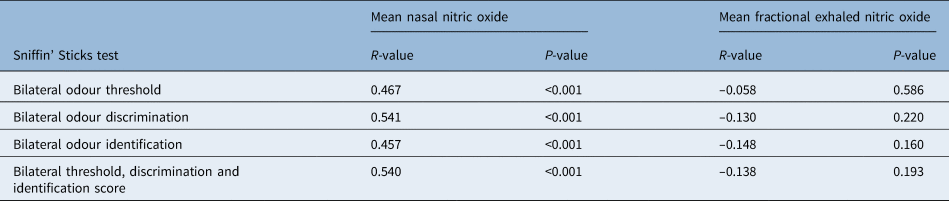
Higher mean nasal nitric oxide levels were significantly associated with better odour threshold (r = 0.467, p < 0.001), odour discrimination (r = 0.541, p < 0.001), odour identification (r = 0.457, p < 0.001), and threshold, discrimination and identification scores (r = 0.540, p < 0.001). Nasal nitric oxide had the strongest correlation with odour discrimination among all subdomains of olfactory information processing. In contrast, mean fractional exhaled nitric oxide levels were not related to any of these measured domains of olfaction (p > 0.05 for all). These results are presented in Table 1 and Figure 1.
Scatter plots of correlation between mean nasal nitric oxide levels and Sniffin’ Sticks olfactory test scores. (a) Mean nasal nitric oxide and bilateral odour threshold score. (b) Mean nasal nitric oxide and bilateral odour discrimination score. (c) Mean nasal nitric oxide and bilateral odour identification score. (d) Mean nasal nitric oxide and bilateral threshold, discrimination and identification score. TDI = threshold, discrimination and identification

Correlation between nasal nitric oxide or fractional exhaled nitric oxide and Sniffin’ sticks test scores

Mean nasal nitric oxide: average of nasal nitric oxide from left and right nostrils
Baseline clinical characteristics
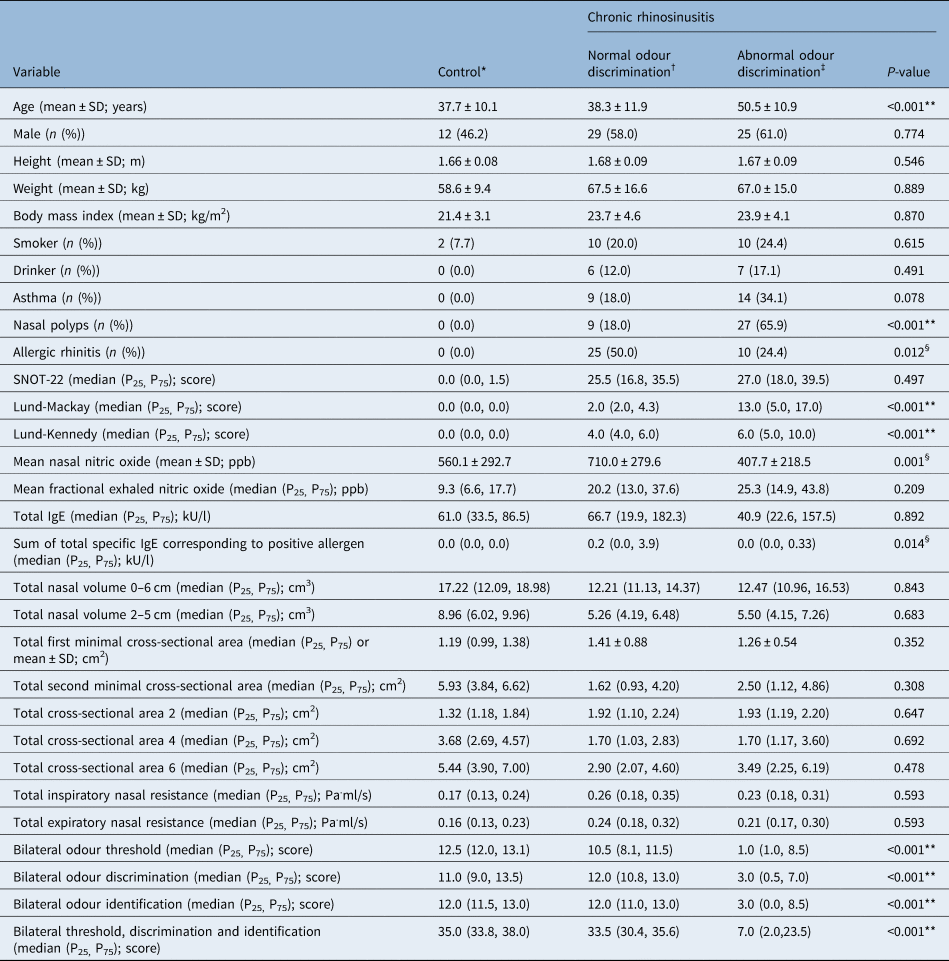
We focused on the association between nasal nitric oxide and odour discrimination: chronic rhinosinusitis patients were divided into two groups. According to odour discrimination scores by the Sniffin’ Sticks test, chronic rhinosinusitis patients with odour discrimination scores of 10 or greater were defined as normal odour discrimination. Conversely, those with odour discrimination scores less than 10 were classified as abnormal odour discrimination,Reference Oleszkiewicz, Schriever, Croy, Hähner and Hummel13–Reference Delgado-Losada, Delgado-Lima and Bouhaben15 according to standard cut-off levels validated in the literature.Reference Schlosser, Desiato, Storck, Nguyen, Hill and Washington14,Reference Delgado-Losada, Delgado-Lima and Bouhaben15 For this comparison, we included 26 healthy controls, 50 chronic rhinosinusitis patients with normal odour discrimination and 41 chronic rhinosinusitis patients with abnormal odour discrimination. The basic demographic and clinical characteristics of the patients are shown in Table 2.
Baseline clinical characteristics of the study population

*n = 26; †n = 50; ‡n = 41; **p < 0.001; §p < 0.05. Differences between abnormal and normal odour discrimination groups were analysed by the independent Student t-test, chi-square test or Kruskal–Wallis test. SD = standard deviation; SNOT-22 = 22-item Sino-Nasal Outcomes Test; Ig = immunoglobulin
In the same way, we also set criteria for odour threshold (normal: score more than 5.5), odour identification (normal: score more than 11), and threshold, discrimination and identification (normal: more than 30.5) and divided the chronic rhinosinusitis patients into the same categories (normal or abnormal olfactory function by modality) in order to examine the correlation between nasal nitric oxide and odour threshold, odour identification, or threshold, discrimination and identification, again using standard criteria.Reference Oleszkiewicz, Schriever, Croy, Hähner and Hummel13–Reference Delgado-Losada, Delgado-Lima and Bouhaben15 Nasal nitric oxide levels were significantly different between normal and abnormal odour threshold groups (681.4 ± 267.9 and 393.4 ± 247.1, respectively; p < 0.001), and normal and abnormal threshold, discrimination and identification groups (716.7 ± 251.1 and 456.7 ± 276.9, respectively; p < 0.001). However, there was no difference between normal and abnormal odour identification groups (646.1 ± 235.9 and 534.6 ± 316.7, respectively; p > 0.05).
Correlations
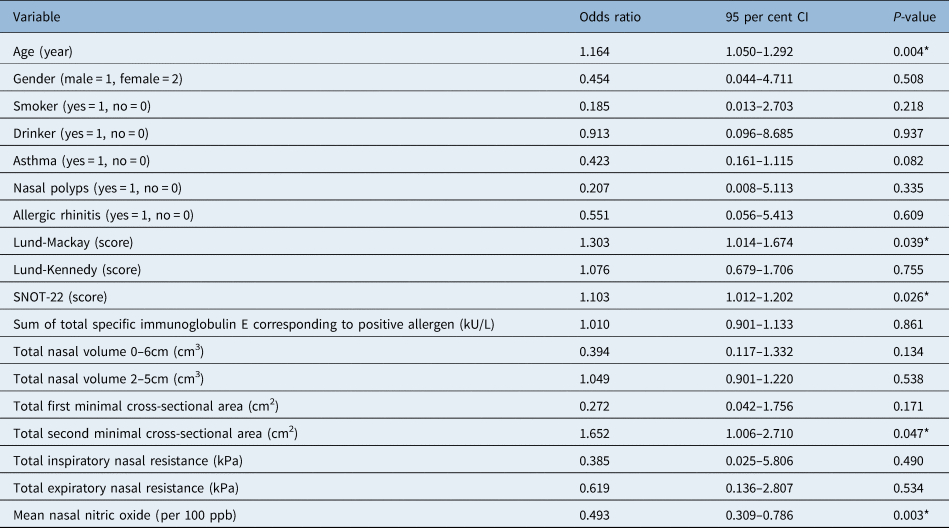
Older age (odds ratio = 1.164/1 year, 95 per cent confidence interval (CI) = 1.050–1.292; p = 0.004), Lund–Mackay score (odds ratio = 1.303/1 point, 95 per cent CI = 1.014–1.674; p = 0.039), 22-item Sino-Nasal Outcomes Test (SNOT-22) (odds ratio = 1.103/1 point, 95 per cent CI = 1.012–1.202; p = 0.026), the second minimal cross-sectional area from left and right (odds ratio = 1.652/1 cm2, 95 per cent CI = 1.006–2.710; p = 0.047) were risk factors for abnormal odour discrimination while higher mean nasal nitric oxide levels (odds ratio = 0.493/100 ppb, 95 per cent CI = 0.309–0.786; p = 0.003) were protective factors for abnormal odour discrimination (Table 3).
Association between clinical or inflammatory parameters and abnormal odour discrimination

*P < 0.05. Dependent variable: abnormal odour discrimination. Total nasal volume = total nasal volume from left and right nostrils. Total first minimal cross-sectional area = the first minimal cross-sectional area from left and right nostrils. Total second minimal cross-sectional area = the second minimal cross-sectional area from left and right nostrils. Mean nasal nitric oxide = average of nasal nitric oxide from left and right. CI = confidence interval; SNOT-22 = 22-item Sino-Nasal Outcomes Test
The association between mean nasal nitric oxide levels and abnormal odour discrimination was tested using models of logistic regression which are presented in Table 4. Patients with higher mean nasal nitric oxide levels had lower odds of having abnormal odour discrimination (odds ratio = 0.609/100 ppb mean nasal nitric oxide, 95 per cent CI = 0.488–0.761; p < 0.001). After adjusting risk factors such as age, gender, drinking, smoking, SNOT-22 score, Lund–Mackay score, Lund-Kennedy score, sum of total specific IgE corresponding to positive allergen, second minimal cross-sectional area, increasing mean nasal nitric oxide levels also showed a roughly consistently lower odds of having abnormal odour discrimination (odds ratio = 0.615/100 ppb mean nasal nitric oxide, 95 per cent CI = 0.446–0.849; p = 0.003).
Binary logistic regression analyses of mean nasal nitric oxide levels and abnormal odour discrimination

*P < 0.001 in binary logistic regression analyses, †p < 0.05 in binary logistic regression analyses. Dependent variable: abnormal odour discrimination. Model 1: adjusted for age, gender, drinking and smoking. Model 2: adjusted for model 1 + 22-item Sino-Nasal Outcomes Test, Lund-Mackay score and Lund-Kennedy score. Model 3: adjusted for model 2 + sum of total specific immunoglobulin E corresponding to positive allergen and second minimal cross-sectional area. OR = odds ratio; CI = confidence interval
Moreover, we also found that nasal nitric oxide was also an independent protective factor for odour threshold (odds ratio = 0.747/100 ppb nasal nitric oxide, 95 per cent CI = 0.584–0.957; p = 0.021) after adjusting for confounding; this was not true for threshold, discrimination and identification (p = 0.118). In addition, the effect of nasal nitric oxide on odour discrimination was greater than that on odour threshold.
Receiver operating characteristics curves analysis
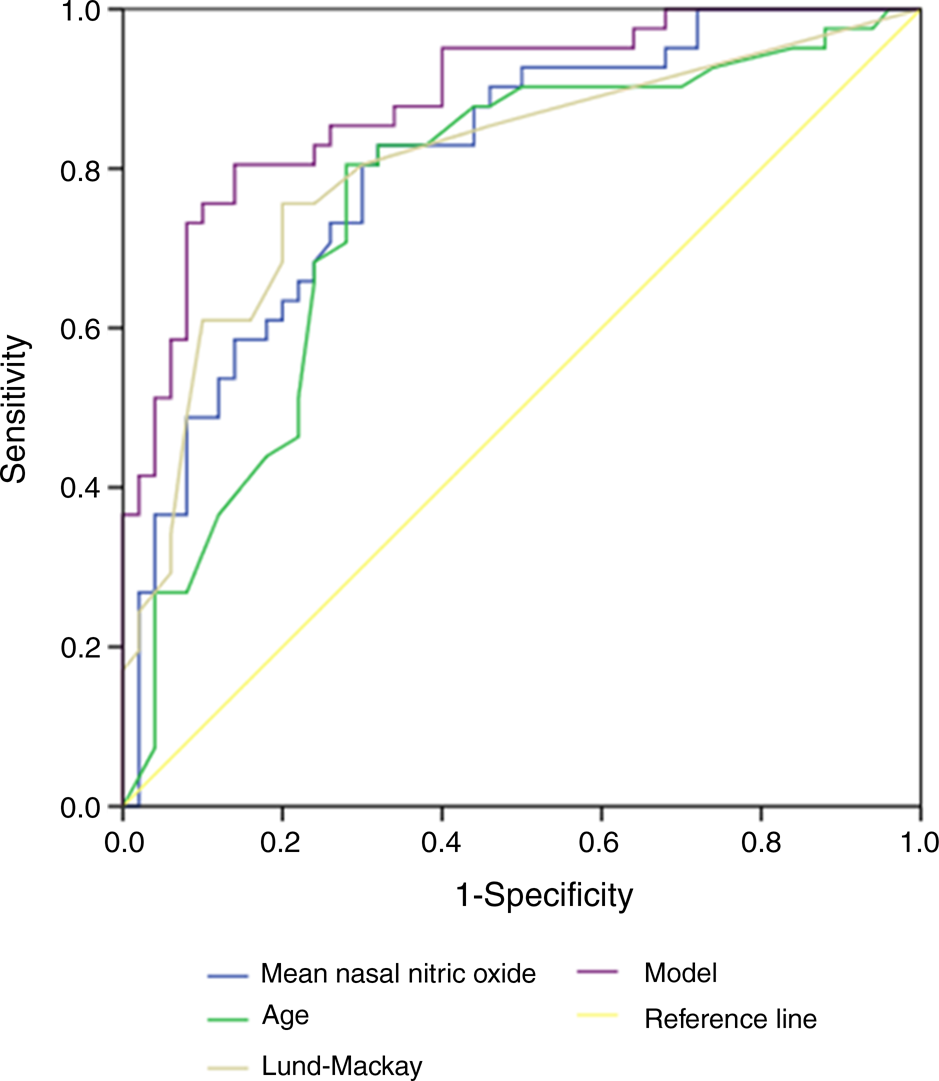
The optimum mean nasal nitric oxide levels cut-off point for chronic rhinosinusitis patients with abnormal odour discrimination was 558.5 ppb by receiver operating characteristics curve analysis, responding to a sensitivity and specificity of predicting normal olfactory function of 80.5 per cent and 70.0 per cent, respectively (area under the curve = 0.809, 95 per cent CI = 0.721–0.897; p < 0.001). The model that included mean nasal nitric oxide, age and Lund-Mackay score had a relatively higher predictive power (area under the curve = 0.888, 95 per cent CI = 0.821–0.955; p < 0.001; Figure 2).
Receiver operating characteristics curve of mean nasal nitric oxide, age, Lund-Mackay score and the model for predicting abnormal odour discrimination in chronic rhinosinusitis. The model including mean nasal nitric oxide, age and Lund-Mackay score has the highest accuracy (area under the curve = 0.888) for predicting abnormal odour discrimination in chronic rhinosinusitis, followed by mean nasal nitric oxide (area under the curve = 0.809; cut-off, 558.50 ppb; sensitivity, 80.5 per cent; specificity, 70.0 per cent; Youden index, 0.505), Lund-Mackay score (area under the curve = 0.806) and age (area under the curve = 0.760).

Mean nasal nitric oxide and other variables
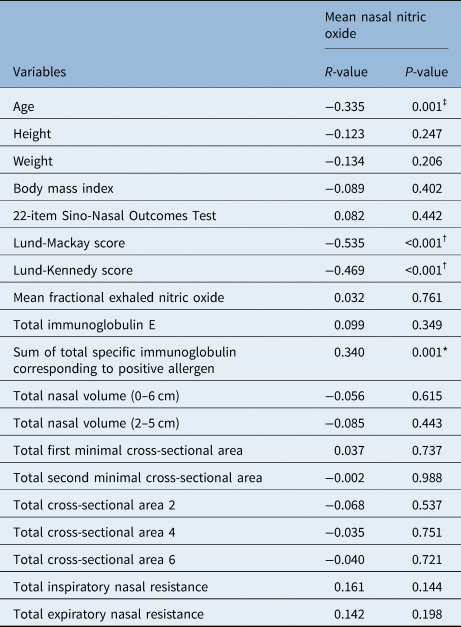
Mean nasal nitric oxide levels were lower in those of older age (r = −0.335, p = 0.001) while there was no correlation with height, weight and body mass index (p > 0.05 for all). Higher mean nasal nitric oxide levels were associated with lower (better) Lund-Mackay scores (r = −0.535, p < 0.001) and lower Lund-Kennedy scores (r = −0.469, p < 0.001) but higher levels of sum of total specific IgE corresponding to positive allergen (r = 0.340, p = 0.001). There were no significant correlations with the other variables (p > 0.05) (Table 5).
Association between mean nasal nitric oxide levels and clinical variables, inflammatory factors or nasal ventilation parameters

*p < 0.05 in spearman correlation analysis, †p < 0.001 in spearman correlation analysis, ‡p < 0.05 in Pearson correlation analysis
Discussion
The major findings of our study are that: (1) higher nasal nitric oxide (but not fractional exhaled nitric oxide) levels in chronic rhinosinusitis patients were significantly associated with better olfactory function and (2) higher nasal nitric oxide levels were associated with both better odour discrimination and odour threshold after adjusting for confounding factors such as clinical, inflammatory and nasal ventilation parameters. Moreover, the relationship between nasal nitric oxide levels and odour discrimination was stronger than that between nasal nitric oxide levels and odour threshold, consistent with prior results with odds ratios.Reference Elsherif, Landis, Hamad, Hugentobler, Bahig and Gamaa8 As we know, nitric oxide is a significant messenger in the olfactory signalling pathway. However, in patients with chronic rhinosinusitis, nasal nitric oxide levels are decreased. These results inform the physiology of how inflammation affects olfaction in chronic rhinosinusitis.
The current study is the first to show the independent correlation between nasal nitric oxide levels and odour discrimination in chronic rhinosinusitis patients consistent with prior work that did not adjust for relevant covariates showing that nasal nitric oxide was also associated with odour discrimination and odour identification.Reference Gupta, Drusch, Landis and Hummel16 Generally, odour threshold reflects peripheral olfactory processing to a relatively higher degree than odour discrimination and odour identification, while odour discrimination and odour identification reflect central olfactory processing.Reference Hedner, Larsson, Arnold, Zucco and Hummel17 Thus, the current study points towards a significant role of nasal nitric oxide in olfactory processing in the central nervous system. Recently, imaging studies found that in some chronic rhinosinusitis patients with severe olfactory dysfunction, the olfactory bulb and olfactory-related brain regions showed significant changes.Reference Rombaux, Potier, Bertrand, Duprez and Hummel3,Reference Han, Whitcroft, Fischer, Gerber, Cuevas and Andrews4 However, the neural mechanisms underlying odour discrimination are complex. Both peripheral and central olfactory structures are involved in odour discrimination. Interestingly, in honeybees, desynchronisation of odour-encoding neural assemblies results in odour discrimination loss,Reference Stopfer, Bhagavan, Smith and Laurent18 and odour discrimination is also decreased when nitric oxide activity is blocked.Reference Hosler, Buxton and Smith19 Furthermore, nitric oxide activation is accompanied by a rise in cyclic guanosine monophosphate in the entire olfactory neuron range from cilia to growth cone, which indicates that nitric oxide participates in the process of olfactory signal transduction.Reference Pietrobon, Zamparo, Maritan, Franchi, Pozzan and Lodovichi20 Nitric oxide also appears to play a crucial role in odour discrimination by regulating oscillatory activity in the prefrontal lobe.Reference Teyke and Gelperin21 Our study is broadly consistent with these findings and supports the role of nitric oxide in the basic mechanisms of odour discrimination.
In our study, we also found older age, higher Lund-Mackay score, higher SNOT-22 score and larger total second minimal cross-sectional area to be correlated with decreased odour discrimination. Age-associated olfactory dysfunction has been reported in previous studies. Both Lund-Mackay score and SNOT-22 score reflect the severity of chronic rhinosinusitis, which is known to be related to olfactory function.Reference Gupta, Gulati, Singh and Tekur22 In the present study we also found the total second minimal cross-sectional area to be correlated with odour discrimination in chronic rhinosinusitis patients, although no significant correlation was observed between minimal cross-sectional area and odour threshold in healthy individuals.Reference Li, Jiang, Kim, Otto, Farag and Cowart23 Inflammatory state changes in the second minimal cross-sectional area may impact nasal airflow and therefore affect sense of smell. In addition, sex, drinking and smoking have been frequently shown to be related to olfactory dysfunction.Reference Hummel, Whitcroft, Andrews, Altundag, Cinghi and Costanzo24 Considering the possible effects of these confounding factors, we adjusted for age, sex, drinking and smoking to investigate the correlation between nasal nitric oxide levels and odour discrimination. We also adjusted for SNOT-22 score, Lund-Mackay score, Lund-Kennedy score, total second minimal cross-sectional area and sum of total specific IgE corresponding to positive allergen, all of which reflect the severity of chronic rhinosinusitis. The most salient result of this analysis was that the relationship of nasal nitric oxide levels and odour discrimination remained significant, independent of clinical and inflammatory variables.
The lower airway offers a sharp contrast. Fractional exhaled nitric oxide was not related to any aspect of olfactory processing in chronic rhinosinusitis patients. Only one study in asthmatic patients indicated a correlation between increased fractional exhaled nitric oxide levels and loss of smell.Reference Ishizuka, Hisada, Kamide, Aoki, Seki and Honjo25 Here, in patients with chronic rhinosinusitis, this relationship was not found, perhaps due to fractional exhaled nitric oxide being an inflammatory marker of lower airway.
Here, nasal nitric oxide levels were positively correlated with sum of total specific IgE corresponding to positive allergen. This contradicts findings in patients with allergic rhinitis. Kharitonov et al., in a study of only five patients, observed that an allergy challenge resulted in a decrease of nasal nitric oxide concentrations in seasonal allergic rhinitis patients outside of the pollen season.Reference Kharitonov, Rajakulasingam, O'Connor, Durham and Barnes26 This may be because of a large difference in sample size.
Nasal nitric oxide levels were also affected by the severity of chronic rhinosinusitis. In other work, nasal nitric oxide had a negative correlation with Lund-Mackay scoreReference Oliver, Lim and O'Brien27 and Lund-Kennedy scoreReference Lee, McKnight, Aves, Yip, Grewal and Gupta28 in chronic rhinosinusitis patients. These results could be attributed to the blockage of the sinuses with less nitric oxide getting into the main nasal cavity.Reference Colantonio, Brouillette, Parikh and Scadding29 These results reflect the complexity of nasal nitric oxide in sinonasal physiology.
• Higher nasal nitric oxide is associated with better odour discrimination in chronic rhinosinusitis
• Nasal nitric oxide independently predicted impaired odour discrimination in chronic rhinosinusitis in adjusted analyses
• Nasal nitric oxide is also modulated by age, degree of allergy and severity of chronic rhinosinusitis
In order to avoid bias, each measurement was strictly conducted according to the manufacturer's instructions by professionally trained staff who were blind to participants’ clinical data. Furthermore, considering the effect of confounding factors, adjustment was made for risk factors affecting both nasal nitric oxide levels and olfactory function. However, there were still some limitations in our study. One was that as a cross-sectional study, this study could only illustrate association instead of causality. Another was that since we chose the chronic rhinosinusitis patients who were not on medication and who had not had endoscopic sinus surgery, which could affect the relationship between nasal nitric oxide and olfaction, we may be unable to determine whether the correlation between nasal nitric oxide and olfaction in chronic rhinosinusitis was independent of drugs or endoscopic sinus surgery. Lastly, eosinophils and cytokines from the olfactory cleft were not tested in this study; previous studies showed they could affect olfactory function in chronic rhinosinusitis. Further prospective studies in larger samples are needed to verify the diagnostic value of nasal nitric oxide for odour discrimination in the context of various inflammatory cytokines and to focus on the association of nasal nitric oxide and central nervous olfactory processing.
Conclusion
In conclusion, higher nasal nitric oxide levels were independently correlated with better odour discrimination in patients with chronic rhinosinusitis. Moreover, nasal nitric oxide was associated with decreasing age, the severity of sinusitis, and increasing total specific IgE concentration. These findings may be useful for translational assessment of odour discrimination as a biomarker of mucosal inflammation in upper airway disease.
Acknowledgements
We appreciate the comments of Thomas Hummel, Dresden, Germany, and Jayant M Pinto, The University of Chicago, Chicago, USA, on this manuscript. This study was supported by the Natural Science Foundation of China (number: 81670903).
Competing interests
None declared