

INTRODUCTION
Partly because of their limited aesthetic value, the musical activities connected with the teaching of Christian doctrine in the early modern era have failed to attract substantial scholarly attention. The topic falls, typically, in a grey area between the main interests of different disciplines. If musicologists have sometimes taken this phenomenon into consideration, and found traces of a surprisingly wide dissemination,Footnote 1 the use of versified and sung catechisms still tends to be regarded as little more than a curiosity: entire handbooks on the history of catechism ignore this aspect or dedicate to it a couple of footnotes, or at most a brief diversion.
In fact, as I came to realise in the course of a research project on ‘The Soundscape of Early Modern Catholicism’, sung catechism was one of the most ubiquitous and characteristic elements of Catholic sonic cultures in the period 1550–1800. Even though the various methods that used singing and music to teach doctrine, conceived as alternatives to more intellectual catechetical approaches, were aimed especially at children, women and simple people, they often had an impact on a more diverse audience: in rural areas, for instance, and in general in every context where sound worked particularly well as a didactic and pastoral tool.
Interconnected as these practices are with many different aspects of early modern culture, their study can raise questions and offer insights not only on musical issues, but on problems of interdisciplinary relevance. In the present essay, I will discuss their role in the pastoral work of early modern Jesuits and, conversely, the role of the Society of Jesus in the development of this tradition. I will focus in succession on three different moments and settings:
1. An early phase, around the third quarter of the sixteenth century, when Spanish Jesuits exported these methods from the Iberian Peninsula to Italy. This period culminated in the publication of Diego de Ledesma’s influential Modo per insegnar la dottrina christiana (1573).
2. A later phase, in the early seventeenth century, when French Jesuits such as Michel Coyssard and Guillaume Marc adapted the method in various ways, interacting with the surrounding musical environment and facing the challenges of secular culture and interconfessional confrontation.
3. Finally, we will see how, in the mid- and late seventeenth-century golden age of popular missions, Italian Jesuits such as Paolo Segneri senior and Innocenzo Innocenzi continued this tradition and maximised its influence on popular strata.
FROM SPAIN TO ITALY
The use of vernacular poetry and singing as tools for the teaching of the catechism has roots that stretch back to the late fifteenth century. The main source of these practices was Spain.Footnote 2 Since the Middle Ages, Spanish councils, synods and individual bishops enjoined clerics to teach the fundamental principles of Christian doctrine to their flock, and especially to children. Beginning at the end of the fifteenth century this task was implemented with renewed impetus and new methods. This initiative often led to the establishment of regular weekly lessons, usually taking place on Sundays, that comprised not only catechism, but a basic form of schooling, focused on reading and writing (the former rather more than the latter). In documents of this period we find the first mentions of singing in this connection,Footnote 3 and around 1526 there appeared in Toledo, under the imprint of Miguel de Eguía, the Cartilla para mostrar a leer a los moços. Con la dotrina christiana que se canta amados hermanos (A primer to teach children to read. With the sung Christian doctrine [entitled] ‘Amados hermanos’):Footnote 4 it is the first printed document relative to this practice. It is beyond the scope of this essay to analyse the ‘Amados hermanos’ and other early examples of sung doctrine.Footnote 5 Suffice it to mention some relevant characteristics: the association of singing with concise formulae (hence with the process of memorisation); the adoption of metrical or quasi-metrical verse, with occasional rhymes; the use of the first person plural, which highlights the collective character of this activity.
If the roots of this phenomenon are distinctly Spanish, the contribution of the Jesuits was to be decisive for its international dissemination and its inclusion in a systematic pedagogical strategy. Let us see how.
Among the most distinguished and influential catechists of the period was John of Ávila (Juan de Ávila, 1500–69),Footnote 6 a preacher and founder of schools and colleges across Andalucía. The oldest extant edition of his catechism dates back to the mid-1550s (Doctrina christiana que se canta. Oydnos vos por amor de Dios (Valencia, 1554)), but it is more than probable that previous versions existed and circulated.Footnote 7 As the title itself makes clear, Ávila’s methods too involved singing. Among the sections in (not always metrical) verse, presumably meant for singing, there is a preliminary exhortation, ‘Oydnos vos / por amor de Dios’ (‘Listen to us, for the sake of God’s love’),Footnote 8 featured also in the title of the whole work, to which we will return shortly.
Ávila’s numerous disciples apparently made free use of his materials and disseminated them in multiple ways. If some of his followers continued and developed his work in Spain, others had broader horizons. As is well known, Ávila played a fostering role in the nascent phase of the Society of Jesus, and many of his former pupils became Jesuits (among them, Francisco de Borja, Diego de Guzmán and Gaspar Loarte). It has been proposed that the very 1554 edition of the Doctrina was a Jesuit enterprise. If that supposition rests mainly on the presence of the monogram ‘IHS’ in the title page, a later edition issued in 1574 was indisputably promoted by the Jesuits: its colophon reads ‘Esta doctrina fue ordenada por los Padres de la Compañia de Jesus’ (‘This doctrine was edited by the Fathers of the Society of Jesus’).Footnote 9 Of more consequence for our narrative, however, is Ávila’s Jesuit reception outside Spain: the export of his catechetical legacy to Italy marked a turning point in the diffusion of these practices.Footnote 10
Copies of Ávila’s Doctrina of 1554 were soon sent to the Jesuit headquarters in Rome. The book was immediately judged worthy to be translated into Italian. The translation was then sent to Naples, to be printed there, as explained in a letter from Rome to Cristóbal de Mendoza, rector in Naples, of 15 September 1555: ‘Here attached is a Christian doctrine, that we would like to be printed in Naples: it is the one by Master Ávila, in verse, in Italian, for the children, so that they can learn it better.’Footnote 11 A companion letter sent on the same date from the Roman headquarters to Jerónimo Vignes, then in Naples, gives further practical details:
We are sending there to Fr Mendoza a Christian doctrine, made by a friend of the Society, known to the said Fr Mendoza, so that it be printed. Your Lordship should see if it is possible to help him, making some arrangements. This booklet was judged good for the children; therefore a student of ours translated it into Italian, and there will be no need to indicate the name of the author. We will take 200 or 300 copies, paying for them, or otherwise we will pay for 500 copies and take them all; but it would be better if those there would consider using it; if some of them do not agree, it would be enough to print the 200 or 300 copies I have mentioned.Footnote 12
The project did not come to fruition, as explained in a letter from Rome to Diego de Guzmán (then in Florence) of November 1555:Footnote 13 Giulio Pavesi, the vicar-general of Naples, had not authorised the publication, judging the verse to be clumsy (‘perché le rime le parsino un poco goffe’). Then, another Jesuit, Jerónimo Doménech, brought the manuscript of the translation to Sicily, in order to have it printed there. On 20 December 1555, Doménech wrote to Ignatius from Messina:
The Christian doctrine is being printed, and I hope it will be useful, because His Excellency [the Bishop] ordered that all the children, in every parish, should gather on Sundays and other feasts, and that one of ours should teach them the Christian doctrine. So we are thinking of having them learn this one, which is in verse. Once it is printed, we will send up to ten or twelve copies. I hope the result will be satisfying: a well-printed booklet for the children.Footnote 14
As documented in other two letters sent from Rome to Diego de Guzmán,Footnote 15 in February 1556 the book, now unfortunately lost, was printed. Some copies were sent from Sicily to Rome, and at least one of them, probably with some annotations added, was forwarded to the same Guzmán in Florence.Footnote 16 A letter by Fr Giovanni Filippo Casini to the new General of the Jesuits, Diego Laínez, of 11 January 1557 attests the diffusion of this practice in another Sicilian city, Siracusa: ‘The most distinguished children, the children of barons and gentlemen, attend our schools: they learn the doctrine in Italian verse and go around the city singing it in public, instead of other idle songs.’Footnote 17 (Notice two aspects, to which we will return repeatedly: the public repercussion of this teaching method (‘they go around the city singing it in public’) and the role of the doctrinal songs as substitutes for secular ones (‘instead of other idle songs’).)
In less than two years, thanks to the dynamism of the Jesuit network, the versified doctrine travelled from Spain to Rome, was translated into Italian, was sent to Naples and then to Sicily, was printed there, sent back to Rome, and forwarded to Florence.
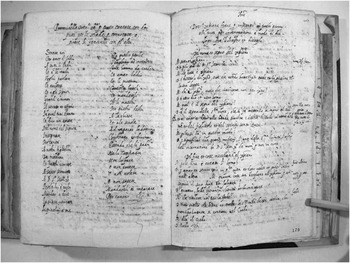
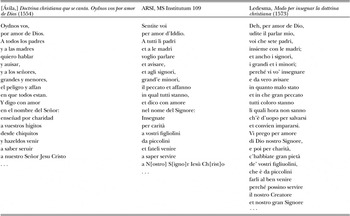
MS Institutum 109 of the Archivum Romanum Societatis Iesu (ARSI)Footnote 18 is a crucial testimony to the process of appropriation of Ávila’s methods by the Jesuits – a process that involved, characteristically, a more advanced pedagogical reflection and a careful adaptation to local needs. The relevant section of the miscellaneous manuscript (dating mostly mid-1560s–early 1570s) contains two texts that represent some stage of the translation of Ávila’s Doctrina made by Italian-based Jesuits. The two texts are the ‘Preamble to the Christian Doctrine’ (‘Proemio della Dottrina christiana’; fol. 169v) (see Figure 1) and a series of ‘Advice for teaching Christian Doctrine’ (‘Avisi per insegnar la Dottrina christiana’; starting at fol. 166r); the second title has a significant addition: ‘derived from a Doctrine brought from Spain, that I think is by Fr Ávila’ (‘cavati da una Dottrina portata di Spagna, la qual penso essere del P. Avila’). The ‘Preamble to the Christian Doctrine, to be sung in the streets with two children, in order to call the kids together, or draw them with the others’ (‘Proemio della Dottrina christiana per poter cantare con doi putti per le strade per convocare o tirare li fanciulli con gl’altri’) is a faithful translation of the above-mentioned ‘Oydnos vos / por amor de Dios’ (see the comparison in Table 1), and the Italian translation of Ávila’s avisos is as literal.Footnote 19
MS ARSI, Institutum 109, fols. 169v–170r: Proemio della Dottrina christiana and Dottrina christiana breve (Courtesy of the Society of Jesus – Archivum Romanum Societatis Iesu)

The Preamble of Ávila’s Doctrina christiana que se canta and its Italian translations

It is noteworthy that in MS Institutum 109 the two translations from Ávila are framed by other materials, a separate series of notices (‘Avisi per li nostri prencipalmente. Del modo de insegnare la dottrina christiana alli nostri scolari et al popolo’), put before those derived from Ávila (fols. 163r–165v);Footnote 20 and a brief Christian doctrine in dialogue form (‘Dottrina christiana breve . . . a modo di dialogo’, fols. 170r–174v).Footnote 21 The importance of this transmission and adaptation of texts and methods from Spain to Italy becomes fully evident when we realise that these very materials will form the basis for two of the most influential Jesuit catechetical works of the sixteenth century. This section of MS Institutum 109 is nothing but an advanced (and anonymous) draft of what will become Diego de Ledesma’s Modo per insegnar la dottrina christiana (Rome: Heirs of Antonio Blado, 1573) and his widespread and frequently translated Dottrina breve.Footnote 22
Ledesma included the Preamble as ‘Some lines that are sung in the street, to invite people to come and hear the Christian Doctrine’ (‘Alcuni versetti che si cantano per la strada, invitando a venir a sentire la Dottrina Christiana’; Modo per insegnar la dottrina, §31, pp. 51ff.). A comparison shows that he revised and improved the previous translation, expanding it and giving it a more regular metrical construction.Footnote 23 Besides revising the preamble, and even more importantly, Ledesma developed the advice already sketched in MS Institutum 109. A further revised and enlarged version of Ávila’s avisos came, thus, to form the basis for chapters 12–14 in Ledesma’s Modo per insegnar la dottrina, which are among the most substantial and pedagogically sensible sections of the treatise (some ideas derived from Ávila’s avisos appear in other chapters as well).
Ledesma’s Modo is invaluable reading for those interested in sixteenth-century catechism – this is no novelty, at least since Giancarlo Rostirolla’s essay of 1986,Footnote 24 although we still lack a systematic study of the text as well as of Ledesma’s other catechetical writings. What needs to be emphasised here, pending further research, is that Ledesma did not invent the ‘method for teaching Christian doctrine’ from scratch: he reworked an existing tradition, improving and integrating it with a distinctive pedagogical attentiveness.Footnote 25
Let us now briefly examine the actual sonic practices that Ledesma describes in his Modo. He makes clear that catechism classes featured a combination of reading, asking questions, making exhortations, repeating and singing:
The method that we consider the most convenient to teach especially . . . youngsters, children, ignorant and unrefined people, countrymen, women and common people, and the populace, which needs it the most, and at the same time to give spiritual food to all the others who have greater capacity . . . will be reading, asking questions, exhorting, repeating, singing, and so on.Footnote 26
The alternation of singing songs, versets, or incisive formulae and commenting on them was the essence of the whole method.Footnote 27 According to §§7.4–7.6, the teacher
will have the children repeat the same words all together: first, he will speak, then he will have them repeat the same all together; then he could ask one or two of them to say it aloud, with a clear voice, so that everybody can hear. Then he will instruct his listeners to repeat what he says, singing word by word, or line by line: and starting with the Creed or the Lord’s Prayer, they will answer him on the same tone; then he will have someone repeat aloud what was sung before; and it will also be useful that the first time two specially instructed children sing the entire prayer together, without any repetition. In case there should be no children, he should sing it himself, so that they learn the tone; and if they make mistakes with the tone, he himself should correct them. After singing, he will repeat the lesson once more, in short form, and the children will answer all together.Footnote 28
On the basis of Ledesma’s Modo, but also considering the Spanish-Italian tradition and its successive developments as a whole, we realise that there was an entire range of possibilities, not always distinguishable: from formulaic patterns to regular pieces,Footnote 29 from quasi-psalmodic recitation to polyphonic singing,Footnote 30 from an alternatim of sung versets and spoken explanations to other forms of individual and collective vocal interaction.
‘Songs’ (and I use this term in the most general sense) could fulfil different functions within the catechetical activities and have different contents:
1. Some songs were an integral part of the process of teaching, but their texts did not convey, strictly speaking, a doctrinal content. The ‘Proemio della Dottrina christiana’, for instance, that, as we have seen, Ledesma had derived from the previous tradition, framed the didactic activities: it was sung (unfortunately, Ledesma does not explain how) not only in the classroom, at the beginning of each class, but also in the streets before and after classes, marking the public character of the whole enterprise.
2. Other songs were conceived as veritable didactic tools. In this case, what was sung could be either one of the prayers used as a foundation for teaching (Credo, Pater Noster, Salve Regina, Ave Maria),Footnote 31 often in vernacular translation and sometimes in a metrical paraphrase; or any other text that conveyed a doctrinal content. The songs could be used as a basis on which to comment (as suggested in Ledesma’s chapter 7), or vice versa as a summary of what had been previously explained. Regarding the latter case, Ledesma (p. 62) explains that there are ‘other kinds of poems . . . regarding Christian doctrine’ (‘altre sorti di rime . . . a proposito della Dottrina Christiana’), and these rhymes are of two kinds. Those of the first kind ‘contain the same substance as the previous teaching’ (‘contengono la sostanza istessa di quel che all’hora s’ha insegnato’). For example, ‘after explaining the articles that regard the Son according to his humanity, you can sing’ (‘esplicato gli articoli che s’apertengono al Figliuolo secondo la humanità, si potrà cantar’):
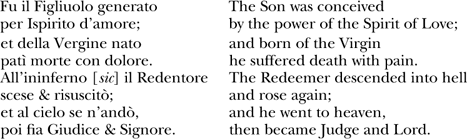
Those of the second kind do not contain, strictly speaking, the substance of the teaching, but ‘something else, but apropos of it’ (‘altra cosa, a proposito però di quello’). They belong to the next category.
3. Other songs, as is often the case with the Italian laude published in countless Jesuit-inspired collections,Footnote 32 did not fulfil a primarily didactic function. Ledesma, for instance, suggests that ‘after explaining the Sacrament of Eucharist, and exhorting to adore it and receive it’ (‘havendo esplicato il Sacramento della Eucharistia, & essortato ad adorarlo, et pigliarlo’) the class could sing:
Christo vero huomo e Dio, Christ, true man and God,
sotto specie di pane t’adoro io . . . Footnote 33 I adore you under the species of bread . . .
In this case, the song works as a bridge between the catechetical explanation of the Eucharist and the acts of adoration that the Sacrament requires. More generally, songs could be introduced for the sake of communal prayer and pious entertainment, or to give voice to other aspects of Christian experience, of interior life and community life. Consequently, their texts could have a spiritual content of virtually any sort.
As T. Frank Kennedy has observed, ‘Part of the Society’s success was in the method of borrowing and redefining in practical ways the apostolic initiatives from earlier traditions’.Footnote 34 The fact that Ledesma’s Avvisi derive from Ávila’s doctrine highlights a remarkable continuity, in method and substance, between the earliest Spanish tradition and the Jesuit practices of the late sixteenth century. Ledesma’s clever pedagogical reworking of this imported tradition paved the way for its subsequent multi-directional diffusion.
IN FRANCE
Fr Michel Coyssard, SJ (Besse-en-Chandesse, 1547–Lyons, 1623) was a key figure in the adoption of poetry and singing as catechetical tools in France.Footnote 35 He occupied important positions in Jesuit colleges first in Paris, then in Avignon, Lyons and other minor centres of southern France. He was also in Antwerp for a certain period between 1594 and 1603, during the temporary banishment of the Jesuits from the French kingdom. His innovative methods as a catechist and educator, in which music, as Kate van Orden has shown,Footnote 36 ‘was part of an educational technology linking print, sacred texts, reading and memory’,Footnote 37 are reflected in a long list of publications, dating from the early 1590s on, some of them frequently reprinted in the following decades.Footnote 38
Coyssard’s most substantial methodological reflection on the subject is his Traicté du profit que toute Personne tire de chanter en la Doctrine Chrestienne, & ailleurs, les Hymnes, & Chansons spirituelles en vulgaire: & du Mal qu’apportent les Lascives, & Heretiques, controuvees de Satan (Treatise of the profit that everyone derives from singing, in the [classes of] Christian doctrine and elsewhere, hymns and spiritual songs in vernacular; and of the damage produced by the lascivious and heretical songs fabricated by Satan).Footnote 39 The treatise was printed at the end of his Sommaire de la Doctrine chrestienne . . . avec les Hymnes & Odes spirituelles (Lyons: Jean Pillehotte, 1608).
Coyssard’s aim in the treatise (some fifty pages long in the original edition) was to defend himself and the use of singing in catechism classes against ‘the enemies of the singing of Christian Doctrine’, the ‘Ennemis du chant de la Doctrine Chrestienne’ (TP, 51). In countries such as Italy and Spain, the introduction of metrical versions of the catechism and the recourse to singing during classes apparently did not meet with much overt criticism. When the problem of the appropriateness of this practice had been examined during the First General Congregation of the Jesuits, in 1558, General Laínez, invited to define the question, had answered Solomonically that ‘it was indeed appropriate wherever it seemed to work’.Footnote 40 This answer was almost literally in line with the precepts that can be read in Ávila’s advice and in its first Jesuit translation in MS Institutum 109;Footnote 41 Ledesma, however, added a penetrating remark in his treatise of 1573:
although, where the heretics sing similar things, and it is forbidden by the superiors to sing them, it is necessary that Catholic singing be done for the edification of Catholics and with the superiors’ permission, so that they do not seem to side with the heretics.Footnote 42
In France – as is well known – vernacular spiritual songs had been extensively used by the Protestants as a doctrinal vehicle and a sonic sign of belonging. In the long-term perspective of harsh inter-confessional confrontation, every pastoral method vaguely similar to Huguenot practices was deemed suspect. The question foreseen by Ledesma continued to be a delicate one, and Coyssard was well aware that satisfactory justifications for his enterprise were indispensable. He explicitly advertised his role as a pioneer in this field, but putting it under the aegis of his fellow Jesuit Antonio Possevino, a diplomat and respected theologian, whose recommendation for the 1592 version of Coyssard’s book is placed at the beginning of the Sommaire. Possevino praises Coyssard’s ‘catechismus gallice tetrastichis dispositus’ (‘catechism in French quatrains’) by which its author has opportunely introduced in France (‘in Gallias opportune invexit’) a most useful method of teaching the Catholic catechism (‘perutilem docendi Catholici catechismi rationem’), worthy of imitation by other nations as well.Footnote 43
Not only was Coyssard adequately informed about the current pastoral practices implemented by various orders in different European countries (in a typically Jesuit cosmopolitan fashion), but he knew the historical precedents remarkably well. This enabled him to sketch, here and there in the treatise, a surprisingly accurate retrospective, in which he referred to Spain, to Italy and to Francis Xavier’s missions in Asia. His competence often rested on a first-hand knowledge of the sources: in his prolific career as a translator and lexicographer,Footnote 44 he would revise the French version of Torsellini’s biography of Xavier (Lyons, 1611)Footnote 45 and translate Roberto Bellarmino’s Dottrina cristiana breve – a standard brief catechism that, after its publication in 1597 and the official endorsement by Clement VIII in 1598, went through countless editions and translations.Footnote 46 And of course he read his Ledesma too (quoted in the marginalia to TP, 8).
Leaving aside other aspects of Coyssard’s self-defence and self-promotion, it is worth examining here his treatment of the specific utility of music in the catechetical enterprise. Coyssard makes ample use of old and recent auctoritates in delineating it, and is remarkably consistent with the tradition of previous apologists of these practices.Footnote 47 According to him, music is useful for the teaching of Christian doctrine basically for four reasons:
1. Music makes the process of learning, memorising and retaining the doctrine in memory easier. (‘Ainsi chante l’on és Assemblées de la Doctrine Chrestienne . . . pour beaucoup de raisons pertinentes . . . L’un desquelles est affin que les Auditeurs apprennent plus facilement par coeur, et retiennent mieux’; TP, 8.)
2. Music entices the children to participate, encourages them to stay in the class and offers delight. (‘Item pour faire que les Enfants demeurent plus ioyeusement en la Doctrine durant le temps qu’ils sont convieés à ioüer les Festes’; TP, 8.)
3. Music enhances the public dimension of catechism and is a powerful tool for the diffusion of the doctrine in informal contexts, reaching out to those who do not attend classes. (‘Tiercement, à celle fin que ceux qui ne peuvent ou ne veulent venir à la Doctrine l’entendans chanter par les rues, ou par les boutiques & maisons, la puissent apprendre; ce qu’il feront plus aisement que s’il la lisoient en leur particulier’; TP, 9.)
4. The fourth reason is the function of Catholic songs as antidotes against the poison spread by the Protestants (with their heretical songs) and libertines (with their lascivious ones). If the devil inspired the Protestants to teach their dogmas by means of songs (‘Le mesme Ennemi de Nature a instigué les Heresiarques à mettre leurs dogmes en Chansons, pour les mieux faire apprendre’; TP, 37), Catholics must react, as shown by Artus Desiré with his pioneering Contrepoison de cinquante-deux chansons de Marot (TP, 39–40).Footnote 48 The same can be said of unchaste songs: they must be replaced (‘If the Council of Trent . . . prohibits the reading of erotic books, should we listen without scruples to indecent songs, [that are] a hundred times more dangerous, as one can see from what we have said about the power of music?’).Footnote 49 Coyssard reports a laudatory letter from his fellow Jesuit Giles Schoondonck of 6 February 1601:Footnote 50
Your Reverence’s elegant hymns are so appreciated here that noble young men and maidens, discarding erotic and amatory songs, started singing them, with voices and string instruments, in various family houses here in Antwerp, with the utmost pleasure for the ears and for the souls. What will happen, then, there in Besançon, and elsewhere in France, where [French] is the native language?Footnote 51
Thus, for Coyssard music helps learning and memory, and offers enticement and delight (in other words, it serves the purposes of instruction and consolation: TP, 13–14); it enhances the public dimension of catechism and facilitates its diffusion; moreover, it works as an antidote against ‘bad’ songs.
In order to build up a repertory that could serve these purposes, early modern catechists implemented two solutions: creating (or commissioning) new compositions, and recycling pre-existing musical structures, in the long-established fashion of parody, contrafactum, cantasi come (sing to the tune of another piece), etc. Coyssard – invoking the endorsement of none other than Louis de Granada, the Dominican author of many sixteenth-century spiritual best-sellers – fully approved the practice of spiritual parody, defining it ‘a true way to win to God both the depraved libertines and the least stubborn heretics, hiding the true and supreme remedy of Salvation under the tasty bait of what they like most’.Footnote 52 The image of music as a bait to capture souls was another topos of early modern writings on this subject, famously used by the Oratorians of Philip Neri, for instance in the dedication of the Terzo libro delle laudi spirituali (‘quest’esca del canto’).Footnote 53 Such a bait could, of course, hide the hook of God, but also that of the Devil, as suggested in a famous letter by another Jesuit catechist, Edmond Auger (on which below).
The solution of retexting pre-existing songs had its own risks and problems, but it presented at least three major advantages: (a) if famous tunes were chosen, they not only added to the allurement of the school, but were also easier to learn, being already known to many; (b) there was no need to print the music in the catechism books (which saved money and labour); (c) the author could suggest which tunes to use, but ultimately left the choice open, bypassing the problem of changes in musical fashion and allowing for a broader (and lasting) circulation and use of the texts themselves.
Coyssard’s own approach was apparently a mixed one, relying now on original compositions, now on reworkings and spiritual parodies: his Traité, frustratingly, does not provide concrete details on this subject, but we can gain an insight by indirect means.
First of all, what is the function of songs in Coyssard’s method? The texts of his Sommaire de la Doctrine chrestienne (the first part of the diptych of 1608) belong to the second of the categories described in the previous section of this essay: their content is the doctrine. The different units are organised in dialogic form: the short questions of the Master are written in prose, while the answers of the Pupil are in quatrains. The Hymnes & Odes spirituelles, on the other hand, fall somewhere in the middle between our categories number 1 and 3: the title page makes it clear that the songs have a ‘structural’ function, to be sung before and after catechism (‘pour chanter devant & apres la Leçon du Catechisme’), and some of them paraphrase the profession of faith and the fundamental prayers, thus providing useful didactic material. But they are also meant to connect the teaching of the doctrine with the unfolding of the liturgical year, and to convey other spiritual contents: ‘Thus we should sing at the beginning of the Doctrine’ – declares Coyssard in TP, 48 – ‘and also at the end, in order to thank God for the favours He will have done to us and to our listeners’ (‘Ainsi faut-il chanter au commencement de la Doctrine comme à la fin aussi, pour remercier Dieu des faveurs qu’il nous aura faictes, & à nos Auditeurs’). Kate van Orden has remarked upon the didactic significance of this practice: ‘Singing before and after catechism was a double-impression method that reinforced memorised Latin prayers with French paraphrases and used music to help students learn to read long printed texts.’Footnote 54
As to the concrete sonic realisation of the songs, the Sommaire . . . avec les Hymnes & Odes spirituelles contains neither notated pieces nor cantasi come indications. However, in his letter Au devot lecteur, placed before the Hymnes & Odes spirituelles, Coyssard suggests that one could use the airs included in his previous publications: the Paraphrase des Hymnes et Cantiques of 1592 and Les Hymnes sacrez et Odes spirituelles of 1600 (Au devot lecteur, p. 5). Those books presented four-voice homorhythmic settings of hymns and other songs, some of which paraphrased the corresponding plainchant melodies in the top voice.Footnote 55 But Coyssard leaves open the possibility of using other ‘beaux airs’.
It is clear, thus, what to do with the hymns and odes, but what about the Sommaire and its torrent of doctrine-filled quatrains? In spite of its title, this ‘compendium’ is indeed prolix (it occupies roughly 350 pages in the 1608 print) and it does not resemble other ‘short catechisms’ set to verse and music during the early modern era. It was probably meant as a flexible tool, a repertory of resources for the catechists, who could choose and decide what the pupils should read, recite by heart, or sing.
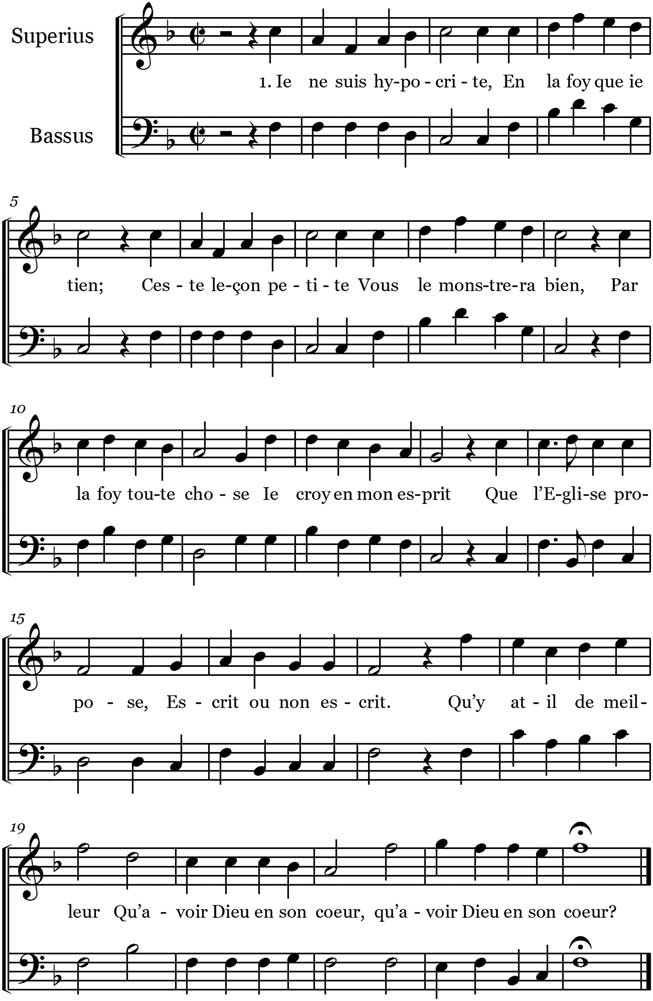
An example from a slightly later collection, featuring doctrine-related French songs with text and music, may help us to envisage the sonic realisation of Coyssard’s method. Les Rossignols spirituels (1616)Footnote 56 was conceived by another Jesuit catechist, Fr Guillaume Marc (or Marci; 1574–1637 or 1638), who availed himself of the musical collaboration of Peter Philips, an English priest, composer and organist based at Brussels.Footnote 57 Immediately after a short Christian doctrine in versified dialogue (but without music; pp. 16–19), the Rossignols spirituels presents a piece on the three theological virtues (‘De la Foy, Esperance et Charité’; from the lower part of p. 18 to p. 23) and the commandments of God and of the Church. As in Coyssard’s Sommaire, the short questions posed by the teacher are in prose, while the answers are in verse. The questions have no music, while the answers are set to a tuneful, and in all likelihood pre-existing, melody (with a bass line added by Philips).Footnote 58
The following dialogue, to be sung on the same melody, comes after the text included in Example 1:
Qu’est-ce que tout Chrestien doit croire & sçavoir?
Ie croy en trois personne,
Une Divinité:
Iesus vray Dieu, vray homme,
Qui nous a racheté.
Iesus fils de Marie,
Mort et resuscité,
Qui iuge nostre vie,
Comme elle a merité.
Qu’y at-il de meilleur, &c.
Qui est vray Chrestien & Catholique?
Celuy est Catholique
Qui baptizé estant
Ne suyt nul heretique,
Nul erreur pestilent:
Mais en mesme doctrine
Et en un mesme esprit
En l’Eglise Romaine
Professe Iesus Christ.
Qu’y at-il de meilleur, &c.
Ie croy en trois personne from Rossignols spirituels, 1616

Then, after further questions on the Church, Hope and Charity:
Dites les Commandemens de Dieu.
1. Un seul vray Dieu adore,
2. Ne iure vainement;
3. Feste & Dimanche honore,
4. Sois pere & mere aimant;
5. Tu ne tu[e]ras personne,
6. Tu n’adultereras,
7. A larcin ne t’addonne,
8. Faux tesmoing ne seras;
9. Ne convoite le femme,
10. Ny les biens du prochain.
Qui garde ainsi son ame
Viendra à bonne fin.
Somme tout.
Aymer Dieu plus que soy,
Son prochain comme soy,
Voylà toute la Loy.
The text is similar to many others in contemporary catechisms, and it is not difficult to find parallel passages in Coyssard. See, for instance, the following excerpts from Sommaire, pp. 27–8 and 35–6:
CHAPITRE PREMIER, DE LA FOY
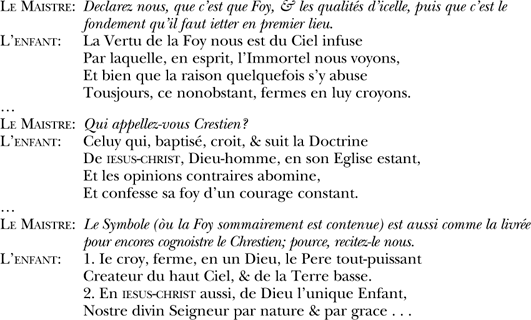
Or this rendition of ‘Les Commandemens de Dieu’:
1. Adore un Dieu souverain,
2. Son sainct Nom ne iure en vain,
3. Au iour de Feste repose,
a pies oeuvres vacquant,
Ton Createur invoquant,
Et louant sur toute chose.
4. Honore, recognoissant,
Pere & mere en bon Enfant,
Et la celeste Iustice
Te secourira tousiours.
Et prolongera tes iours
Sur terre pour tel service …
The French urban contexts in which Coyssard and Marc operated as catechists and for which they conceived their works posed specific challenges. They could not avoid the competition and confrontation with the psalms of the Huguenots, nor with the fashionable love songs of ‘libertine’ inspiration: indeed, they embraced it as an opportunity.Footnote 59 As early as 1563 the French Jesuit Edmond Auger had envisaged this necessity. In an often quoted letter, he wrote to General Laínez from Lyons about a French translation of the psalms for the Catholics, that he wished to be done by Pierre Ronsard:
for singing at home, in shops and while traveling – against those which the adversaries go around mumbling. For the French love singing very much (a li francesi il canto piace molto), and with this bait (con questa amorza) the devil has deceived a whole world of them . . . Everyone who sees the situation of the times judges it necessary to cure opposites with opposites (ut contraria contrariis curarentur). . . . It is not fitting that these be sung in church, or anywhere except in private places – as other songs are sung.Footnote 60
Since Auger’s time, the huge success of Italian laude (of which Coyssard was well awareFootnote 61) had demonstrated that it was possible to build a repertory of spiritual songs that combined artistic simplicity, solid doctrine and pastoral versatility. These contextual elements help explain why Coyssard’s and Marc’s efforts were aimed not exclusively at children, women and simple people, but also at adults, provided sometimes with a certain degree of musical literacy and gusto.Footnote 62 During the seventeenth century (and beyond), French Jesuits made abundant use of songs even in rural areas: the blessed Julien Maunoir is probably the most interesting case.Footnote 63 But in order to study how the Jesuits used catechetical songs during their itinerant missions in the countryside, we will now return to Italy.
IN ITALIAN POPULAR MISSIONS
As I have already mentioned, although many Jesuit-inspired and catechism-related collections of laude were published in late sixteenth- and early seventeenth-century Italy, the new ‘spiritual songs’ (an ever expanding repertory) were not necessarily meant to convey the contents of the doctrine, but rather to fulfil complementary functions. The tendency to include songs whose subjects covered the feasts of the liturgical year in a systematic way (as in Lode e canzoni spirituali, accomodate a tutte le feste & domeniche dell’anno . . . per cantar insieme con la Dottrina Christiana: Turin, 1579) and songs that featured dialogic and quasi-representative interaction reflects a progressive institutionalisation of the system, based on the activities of urban schools, often connected with Jesuit colleges. The renewed emphasis on rural missions during the seventeenth century, however, apparently revived the methods that were deemed suitable especially for ‘i putti . . . i rozi d’ingegno, rustici, & le donne’ (to quote again from Ledesma). In the works of two Jesuit missionaries active in Italy in the second half of the seventeenth century we find versified compendia of the catechism which continue the tradition outlined above.
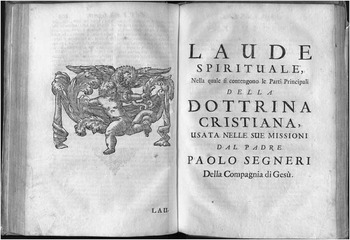
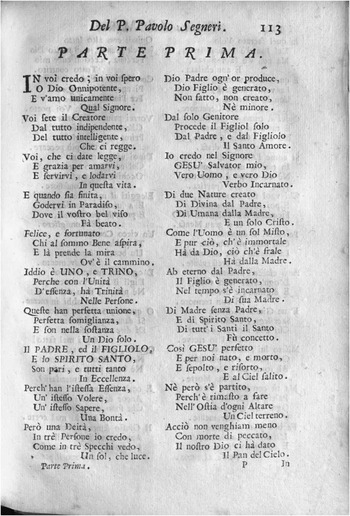
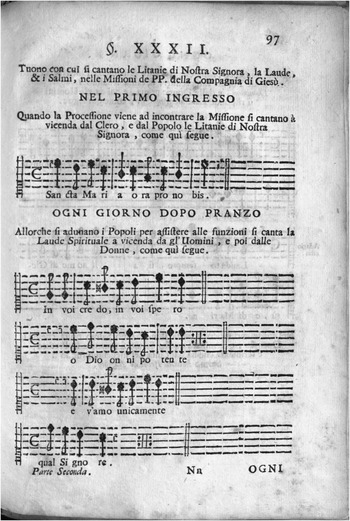
Paolo SegneriFootnote 64senior (1624–94) was one of the most famous and indefatigable missionaries of the early modern era.Footnote 65 His methods are described in detail in a book published in Venice in 1714: Pratica delle missioni del padre Paolo Segneri della Compagnia di Gesù . . . continuata dal P. Fulvio Fontana, edited by M. A. Franchini, a former collaborator of Segneri and Fontana. In this remarkable manual, which gives us a sort of ‘behind the scenes’ view of a mission by Segneri and his fellows, we find the oldest extant printed version of the Laude spirituale, nella quale si contengono le parti principali della Dottrina cristiana, usata nelle sue missioni dal Padre Paolo Segneri della Compagnia di Gesù (Spiritual lauda, which contains the principal parts of Christian Doctrine, used by Fr Paolo Segneri of the Society of Jesus in his missions):Footnote 66 a compendium of the doctrine consisting of a long series of quatrains, to be sung with a simple melody (given in the appendix to the manual). See Figures 2–4.
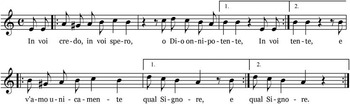
The text of the Laude spirituale is divided into two sections: the first one deals with fundamental Christian truths (God as creator, the Trinity and Unity of God, etc.) and the Sacraments of Eucharist and Confession; the second one with the characteristics of sin and the Four Last Things, plus a Marian coda. The metrical structure of the about a hundred stanzas follows a scheme that is not uncommon in Italian popular lyric: three seven-syllable lines rhymed abb plus a closing five-syllable (sometimes four-syllable) line that rhymes with the first line of the following quatrain (abbc 5 – cdde 5, etc.).Footnote 67 The first stanzas are transcribed below, and Example 2 reproduces the melody printed in 1714.Footnote 68
In voi credo, in voi spero,
O Dio onnipotente,
E v’amo unicamente
Qual Signore.
Voi sete il Creatore
Dal tutto indipendente,
Del tutto intelligente,
Che ci regge.
Voi, che ci date legge
E grazia per amarvi,
E servirvi, e lodarvi
In questa vita.
E quando sia finita . . .
Laude spirituale, title page, from Pratica delle missioni, 1714, i, pp. 110–11 (Jesuitica Collection, John J. Burns Library, Boston College)

Laude spirituale, first page, from Pratica delle missioni, 1714, i, p. 113 (Jesuitica Collection, John J. Burns Library, Boston College)

Laude spirituale, music, from Pratica delle missioni, 1714, ii, p. 97 (Jesuitica Collection, John J. Burns Library, Boston College)

In voi credo, in voi spero from Pratica delle missioni, 1714

As explained in the Pratica, the missionaries made sure that some people ‘with a good voice and a good ear’ would learn the song in advance, in order to support the communal singing. Every day the congregation sang the lauda while the different groups gathered for the daily instruction. Since most of the people could not read, the missionaries adopted a very practical performing technique, having different choirs alternate: the men sang the first stanza, then the women repeated it (while a secular priest gave out the words line by line), and so on.Footnote 69 Despite, however, the low literacy rate, Segneri handed out booklets with the Laude spirituale, literally in thousands, if contemporary accounts are to be trusted:
So many copies of these laude were given out, that besides those distributed for free by the Fathers, a young layman said that he had sold no fewer than fifteen thousand copies. This song, gracefully arranged in verse, was being learnt by heart by almost everybody, in spite of having about a hundred stanzas. It was sung with great joy by the women at the cauldron for silk production, at their looms, on the threshing floor, or while they led the cattle to pasture, and during their other duties. The same song was sung by the men, young and adult, at home, in the streets, and in the fields. In this way they put those fundamental truths into their hearts: otherwise, they would never have thought of it.Footnote 70
The metrical structure (with short lines and intertwined rhymes) and the simple and catchy melody all helped memorisation. It was an easy, entertaining and community-building way of learning or reviewing the contents of the doctrine. Moreover, as suggested by Segneri’s biographer in the quotation above,Footnote 71 the song entered the ‘popular’ repertory, and the people sang it in the streets, in their homes, in the fields, assimilating the doctrine and spreading it further in the informal context of daily life.
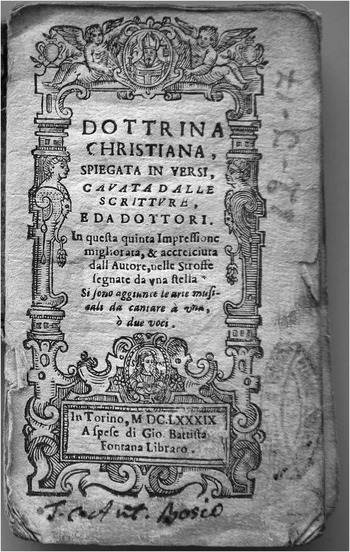
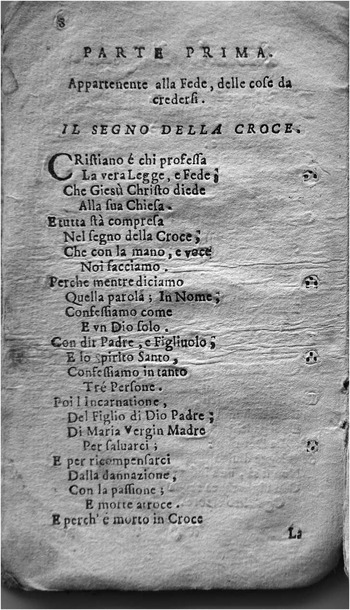
Another Jesuit missionary, Fr Innocenzo Innocenzi (1624–97), was the author of a widespread Dottrina christiana spiegata in versi (Christian doctrine explained in verse; see Figures 5–6).Footnote 72 First published as an anonymous booklet probably in the 1660s, Innocenzi’s versified doctrine went into many editions in the following decades.Footnote 73 It was sometimes included in larger works, as in the case of his fellow Jesuit Pietro Maria Ferreri’s Istruzioni in forma di catechismo per la pratica della dottrina cristiana spiegate nel Gesù di Palermo,Footnote 74 where we find an explicit attribution (‘dalFootnote 75 P[adre] Innocenzio Innocenzi della Compagnia di Gesù’; p. 597) and a revealing complement to the title: ‘Per utile delle Scuole della Dottrina, e delle sante Missioni, etc.’ (‘For the benefit of the Schools of Christian doctrine and of the holy Missions, etc.’).
Dottrina christiana spiegata in versi, 1689, title page (Courtesy Biblioteca Patetta – Università degli Studi di Torino – Fondo Patetta)

Dottrina christiana spiegata in versi, 1689, p. 8 (Courtesy Biblioteca Patetta – Università degli Studi di Torino – Fondo Patetta)

As an eighteenth-century chronicler reports:
For the benefit of the holy Missions and the good of all the schools of Christian doctrine, [Fr Innocenzi] started to compose a Christian doctrine, explaining it in verse, in an easy and popular style, so that he could make it, by its simple style, at the same time palatable to everybody and fruitful for every disposition . . . To make it more singable, he gave it a metrical structure very easy to memorise . . . I can testify myself that I heard this Doctrine sung in the fields, around the countryside. To see how popular it has been and still is, suffice it to mention that its newest edition, recently printed in Piacenza, is the twentieth.Footnote 76
Some elements of this contemporary account deserve our consideration: it underscores the simplicity of style as a key factor in making the doctrine palatable for everybody (notice the gustatory metaphor, another ubiquitous topos in this literature); it links almost automatically singability, metrical structure and memorisation; and, interestingly, while it takes up the locus communis of the songs resounding ‘in the fields’, emphasising it with the immediacy of personal testimony, it assesses the editorial success of Innocenzi’s work in a very concrete way.
The most remarkable aspect of Innocenzi’s Dottrina is that it follows almost exactly the content, structure and internal division of Bellarmino’s Dottrina cristiana breve:Footnote 77 if Coyssard, as mentioned above, translated Bellarmino’s doctrine into French, Innocenzi rendered it in Italian verse.Footnote 78 Thus, following the model of his fellow Jesuit and future saint, Innocenzi organised his versified Dottrina in six sections, preceded by a preamble; the following topics are covered:
1. Faith (Delle cose da credersi)
2. Hope (Delle cose da sperarsi, e da domandarsi da Dio)
3. Charity (Delle cose da farsi)
4. The Holy Sacraments (Che son mezi per acquistare la grazia, e per osservare i precetti di Dio)
5. Virtues and vices
6. The Four Last Things
In fact, Innocenzi adds a seventh section, not present in Bellarmino’s doctrine, entitled ‘Delle occasioni de’ peccati che han da fuggirsi’ (On the occasions for sin that one should avoid): it features lengthy warnings, some of them in dialogic form, against the moral dangers of bad company, of licentious love affairs, of balls and parties and of card games. This last section differs from the preceding six in its theme, metre and its moralising rather than doctrinal approach, and is less stable in the different editions. Other prayers or devotional materials are added in some editions (for instance in Turin 1672 and 1689).
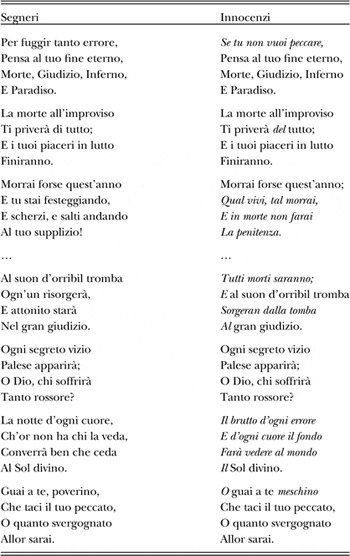
As a result of its following in detail the model of Bellarmino, Innocenzi’s doctrine is far longer than Segneri’s Laude spirituale, but more systematic and more clearly organised. Both adopt, however, the same metrical form (except for Innocenzi’s seventh section in octosyllables) and interestingly some quatrains recur in identical or slightly modified form in both works, in sections whose content is similar. Table 2 gives an example of these intertextual relationships (italics highlight the differences).
Comparison of two excerpts from Segneri’s Laude spirituale and Innocenzi’s Dottrina christiana

It is possible, as proposed by Barbera in 1943,Footnote 79 that Innocenzi was inspired by Segneri’s Laude and decided to rework it substantially and systematise its doctrinal content. Other intertextual connections are evident: the paraphrase of the Salve Regina incorporated in Innocenzi’s doctrine (Dio vi salvi, Regina) has been attributed, apparently on a firm basis, to another contemporary Jesuit, the Neapolitan-based saint Francesco di Geronimo (1642–1716).Footnote 80 The systematic character of Innocenzi’s project makes it likely that he could have reorganised pre-existent materials, while the opposite process seems less probable; only further research and new documents will clarify the relationship between these texts. It is also noticeable that Innocenzi’s ‘Proemio all’opera’ contains echoes of the ‘functional’ and introductory texts of previous sung doctrines: the appeal to fathers and children, for instance (‘Do your duty: you, children, learn the Doctrine; you, fathers, teach the Doctrine’; ‘Fate l’offizio vostro, / E voi figli imparate, / E voi padri insegnate, / La Dottrina’) recalls to one’s mind Ledesma’s own ‘Proemio’. This aspect does not derive from Bellarmino: it belongs specifically to the tradition of sung doctrine, where the performative and the public were crucial elements.
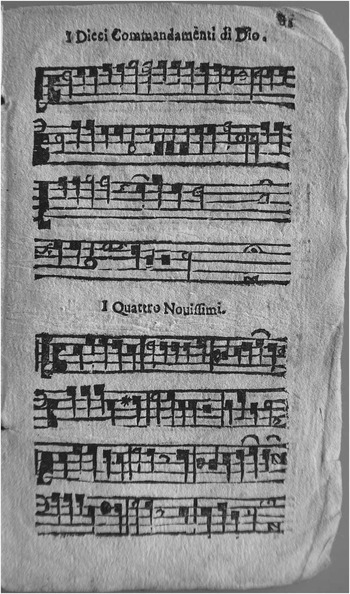
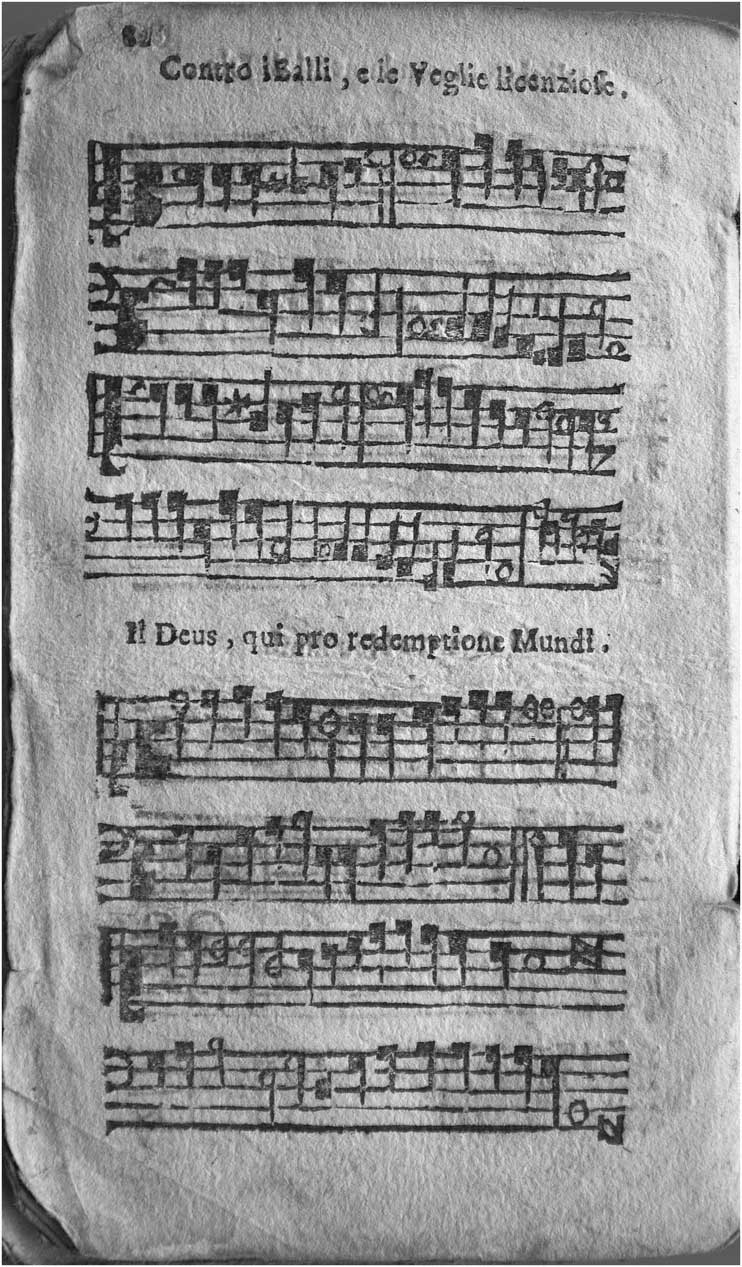
We do not possess any ‘complete’ set of notated music for singing Innocenzi’s Dottrina. Some of the editions, however, include ‘arie musicali da cantare’ for one or two voices. The editions printed in Turin in 1672 and 1689 have four ‘arie’,Footnote 81 in rudimentary woodcuts, each one with a caption that points to a specific section of the text:Footnote 82
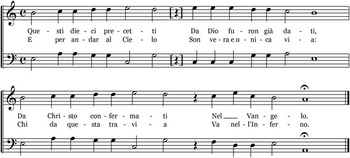
∙ ‘I Dieci Comandamenti di Dio’ (‘The Ten Commandments of God’; see Figure 7, from 1689, upper half; transcribed in Example 3)
Figure 7Dottrina christiana spiegata in versi, 1689, p. 81 (Courtesy Biblioteca Patetta – Università degli Studi di Torino – Fondo Patetta)
 Example 3
Recitation formula from Dottrina christiana spiegata in versi, 1689
∙ ‘I Quattro Novissimi’ (‘The Four Last Things’; see Figure 7, lower half)
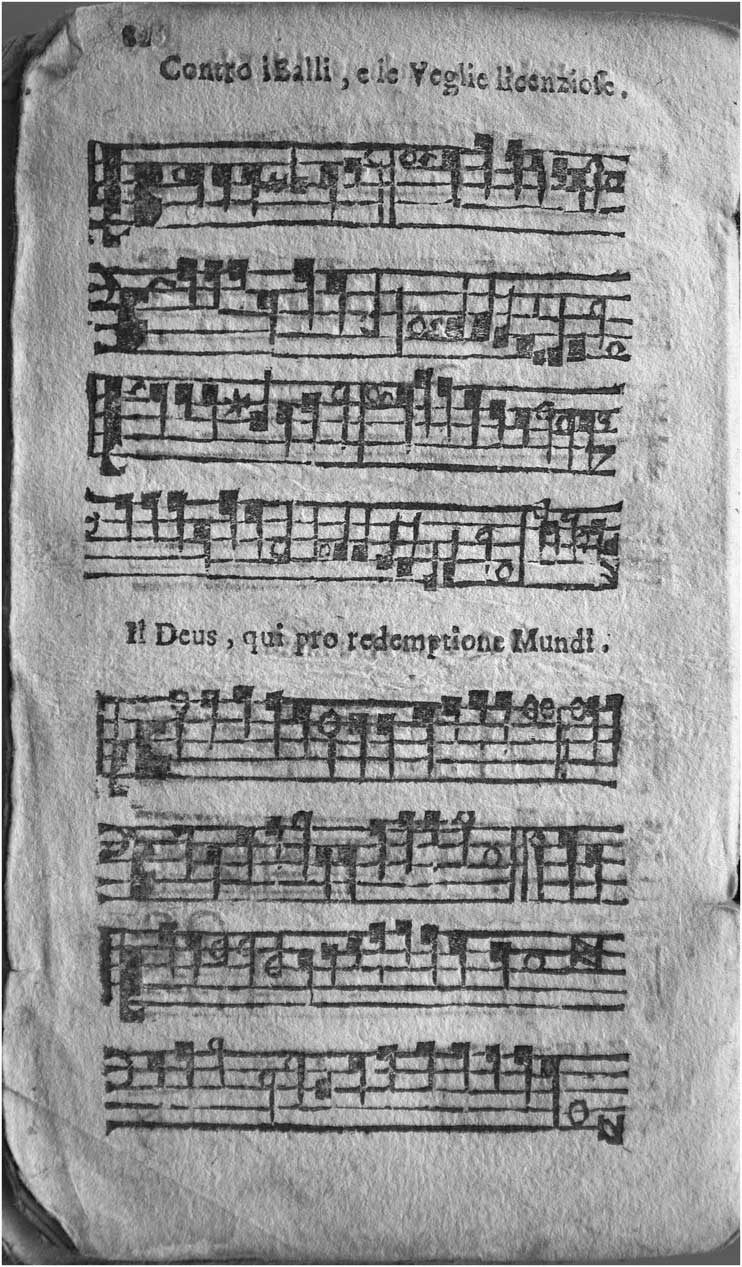
∙ ‘Contro i Balli, e le Veglie licenziose’ (‘Against Dances and licentious Parties’; see Figure 8, from 1689, upper half)
Figure 8Dottrina christiana spiegata in versi, 1689, p. 82 (Courtesy Biblioteca Patetta – Università degli Studi di Torino – Fondo Patetta)
∙ ‘Il Deus, qui pro redemptione Mundi’ (see Figure 8, lower half)Footnote 83


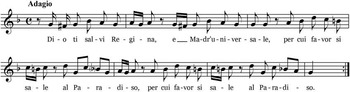
In Ferreri’s Istruzioni, only the Dio vi salvi, Regina Footnote 84 is notated, within the description of the order of catechism classes at the Church of the Gesù in Palermo (p. 591; see Example 4).
Dio ti salvi, Regina from Istruzioni in forma di catechismo, 1737

Considering also the length of Innocenzi’s Dottrina, it seems plausible that an alternation of reciting and singing was implemented, and that different melodies were used for the sake of variety (as well as to accommodate the different metre of the last section). It also seems likely that other melodic formulae similar to that of Segneri’s Laude spirituale (or even the same, given the identical metre) could be used. It is worth noting another point, which helps clarify the fluid nature of this repertory: the fourth ‘aria’ in the 1672 and 1689 editions is nothing but a two-voice version of the music usually associated with the ancient lauda Spirito Santo amore. The melody in the top voice is faithful to the one first published in Lodi e canzoni spirituali per cantar insieme con la Dottrina Christiana (Milan: P. da Ponte, 1576) and then reprinted in the Turinese Lode e canzoni of 1579 (quoted above) as well as in many other collections of laude promoted by the Jesuits.Footnote 85 Melodies travelled in time and space and, despite a privileged but by no means exclusive association with a text, they could revert to the status of mere recitative formulae one century after their first appearance in print. This further confirms that the borders between apparently distinct practices such as the singing of laude and the intoned recitation of catechetical texts were often blurred.
The preface in prose to Innocenzi’s Dottrina cristiana spiegata in versi presents once again a justification for the use of verse and singing in catechesis. Although well established and never perceived as particularly problematic (at least outside the areas at risk of Protestant influence), these practices still required some kind of official explanation, even if a perfunctory one. As late as the eighteenth century the Holy Office was censoring some versified catechisms, blaming simplifications and doctrinal errors that indirectly derived from the constraints of the literary form.Footnote 86 The tone of Innocenzi’s text is more confident and less polemical than that of Coyssard, and the argumentation much more concise: but its topoi clearly indicate that it belongs to a coherent literary tradition, entwined in the tradition of sung doctrine itself.
The combination of solid doctrine with easy and sweet singing (‘La necessità e sodezza della Dottrina, unita con la facilità e dolcezza del canto’) produces a good alloy and a suave harmony (‘fa una lega sì buona e un’armonia sì soave . . .’). That is why the idea of seasoning the truth in pleasant verse (‘condire il vero in molli versi’) was adopted in the Judaeo-Christian tradition: the subsequent mention of the Psalms of David and the ecclesiastical hymns is de rigueur. A quotation from St Basil, extolling the didactic and mnemotechnical merits of verse and music, introduces a reference to the patristic habit of countering the poison of paganism (‘il veleno del Gentilesimo’), spread through mellifluent verse, by means of hymns and songs, as in the case of St Gregory of Nazianzus, who gave to his spiritual children the bread of Christian doctrine broken in song and sweetened in the milk of sacred rhymes (‘il pane della Dottrina Cristiana . . . spezzato in canto e raddolcito in latte di sagre rime’). Edmond Auger had made a similar reference to the Church Fathers in another sentence of the letter to Laínez I quoted above, and parallel passages for all these points are to be found in Coyssard’s treatise.Footnote 87
The mention of the Horatian precept ‘Omne tulit punctum, qui miscuit utile dulci’ is also remarkable: the ideal of miscere utile dulci, mixing the sweet with the useful, was often invoked in this connection during the early modern era, most notably by the Oratorians of St Philip Neri.Footnote 88 The final point touches on another topos: if in these lodi dottrinali the sweetness and seasoning of art (‘la dolcezza e’l condimento dell’arte’) are scant, the spiritual hunger and devotion of the people and the didactic zeal of their curates and teachers will compensate for them. For this aspect too, there is no lack of precedents among early modern authors of doctrinal or devotional poesia per musica:Footnote 89 to put it with Coyssard,
La chose ne veut estre ornée,
se contentant d’estre enseigné.Footnote 90
Clearly, the modest musical and literary quality of much of this corpus is the result of a conscious (if sometimes inevitable) aesthetic choice.
CONCLUSIONS
This survey suggests that the noteworthy and by no means obvious association between singing and the teaching of the catechism is a longue durée phenomenon of the early modern era, and needs to be studied as such.
The Jesuits played a unique role in the development and diffusion of these practices. Other groups and organisations devoted themselves to the teaching of the catechism and (more or less formally) established local or national networks: for instance, the Colegios de Niños de la Doctrina in Spain,Footnote 91 the confraternities of Christian doctrine in Italy,Footnote 92 the Doctrinaires in France.Footnote 93 What distinguished the Jesuits was the international nature of their network. It is to a large degree thanks to the peculiar dynamism of the Jesuit network – owing to the interchange of experiences and the historical awareness it promoted – that these practices found a large-scale and long-lasting diffusion, with a remarkable mix of tradition and innovation. Thus, they became standard both in Europe and in the extra-European missions. (The latter, not discussed here, deserves further study:Footnote 94 in fact, the catechetical methods that involved dialogues, recitation and singing were worked out within a fruitful interaction between experiences on European soil and experiences in the extra-European missions. The Jesuit missionary par excellence, Francis Xavier, had already exported these practices from the Iberian peninsula to the Asian missions in the early 1540s, and became in turn a model for European catechists.)
The reasons why Jesuit catechists adopted singing or other sonic practices as preferred methods in certain contexts are clearly stated in treatises and paratexts, with notable consistency: the didactic and mnemotechnical value of songs; the delight caused by music, in the perspective of miscere utile dulci; the enhancement of the collective and public dimension of the catechism; the role of doctrinal songs as antidotes against ‘bad’ songs, part of an ongoing campaign against immoral entertainments, but which in areas exposed to Protestant influence took on a distinct anti-heretical hue. Moreover, the songs often served as a hinge between doctrine and prayer, and provided a connection between the fixed content of the catechism and the specific character of the different moments in the liturgical year.
If the motivating principles remained substantially constant, the method was flexible enough to adjust to different situations: in rural areas it could be based mainly on formulaic recitative tones and insistent strophic repetitions, while in urban contexts it could produce a more elaborate repertory, open to diverse performing solutions (involving polyphonic rendition and instrumental accompaniment), and not immune from a sense of competition with the other songs on the market.
The study of this tradition spotlights aspects of the often debated relationship between the Jesuits and musicFootnote 95 that have not yet received enough scholarly attention. The members of the Society realised, for instance, the importance of communal singing and its effectiveness for expressing participation and shaping collective identities; thus, also in consideration of its utility as a disciplining tool, they carefully designed methods for implementing it. As the case of French Jesuits makes clear, besides recognising the powers of music (or, on a more generic and less sophisticated level, of sonic stimuli), they sensed that the rise of musical amateurism and the private or semi-private consumption of songs fuelled by music printing were phenomena that anybody interested in moulding mentalities and guiding behaviours (to use modern terms) should take into serious consideration: those media had a huge potential for the diffusion of ideas, doctrines and behavioural codes. Future research will have to situate these practices more precisely in the thriving scene of early modern devotional singing: apart from a few case studies and sometimes vague general inferences, the role of the Jesuits and their network in this field (from popular genres to the loftiest forms of the spiritual madrigal)Footnote 96 is still far from assessed.
More generally, the non-conventional repertory associated with the teaching of Christian doctrine needs to be studied in the context of the early modern Catholic soundscape. The participation in (or at least the exposure to) these practices was one of the most characteristic sonic experiences available in the everyday life of Catholics, and it helped shape personal as well as collective beliefs and identities. Even though some of these sonic phenomena may seem almost pre-musical when compared to the highest products of early modern musical culture, they are nevertheless part of a spectrum. A significant part indeed, whose interplay with different aspects of that soundscape, that culture and that society has much to reveal not only on ‘musical’ matters, but on other relevant historical issues of the early modern era: the mass diffusion of catechesis, of course, but also the problem of children’s and adult education, the impact of performative media, the role of religious networks, the interaction between the European scene and world missions.