







1. Introduction
Baumslag–Solitar groups are groups that admit a presentation of the form
 \begin{equation*} \mathrm{BS}(m,n)=\langle a, t \mid t^{-1}a^{m}t = a^{n}\rangle, \end{equation*}
where  $m, n$ are non-zero integers. They were introduced in [Reference Baumslag and Solitar2] as examples of two-generator one-relator groups with proper quotients isomorphic to the group itself (that is, the groups do not satisfy the Hopf property). Since then, Baumslag–Solitar groups and their properties have been extensively studied by various authors, and they have been the test bed for various conjectures and theories.
Our work is mainly concerned with the residual nilpotence of these groups. A survey about the residual properties of these groups is given in [Reference Moldavanskii11]. In [Reference Bardakov and Neshchadim1], Bardakov and Neschadim studied the lower central series of Baumslag–Solitar groups and computed the intersection of all terms of the lower central series for some special cases of the non-residually nilpotent Baumslag–Solitar groups. Let G be any Baumslag–Solitar group and denote by  $\gamma_c(G)$,
 $c\in\mathbb N$, the terms of the lower central series of G. In the present paper, one of our aims is to compute explicitly the intersection
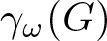
 $\gamma_w(G)=\bigcap_c\gamma_c(G)$ for the non-residually nilpotent Baumslag–Solitar groups.
Throughout this paper, a Baumslag–Solitar group is denoted by  $\mathrm{BS}(m, n)$. Since
 $\mathrm{BS}(m, n)$,
 $\mathrm{BS}(n, m)$ and
 $\mathrm{BS}(-m, -n)$ are pairwise isomorphic, we may assume, without loss of generality, that the integers m and n in the presentation of
 $\mathrm{BS}(m, n)$ satisfy the condition
 $0 \lt m \leq |n|$.
One of our main results is the following.
Theorem 1. Let  $G=\mathrm{BS}(m,n)$, with
 $0 \lt m \leq |n|$,
 ${\rm gcd}(m,n)=d \geq 1$,
 $m=dm_1$ and
 $n=dn_1$.
(1) If
 $n_1\not\equiv m_1 \pmod p$ for every prime number p, then $\gamma_{\omega}(G)$ is the normal closure of the set $\{a^{d}, [t^{-k}a^{\mu}t^{k},a^{\nu}]\mid k\in\mathbb Z, \mu,\nu \in \mathbb{N}, {\rm gcd}(\mu, \nu) = 1 ~{\rm and}~\mu \nu = d\}$ in G.
(2) If there is a prime number p such that
$n_1\equiv m_1\pmod p$, then $\gamma_{\omega}(G)$ is the normal closure of the set $\{[t^{-k}a^{\mu}t^{k},a^{\nu}]\mid k\in\mathbb Z, \mu,\nu \in \mathbb{N}, {\rm gcd}(\mu, \nu) = 1 ~{\rm and}~\mu \nu = d\}$ in G.


Next, we are concerned with the following question of [Reference Bardakov and Neshchadim1]. Let  $G={\rm BS}(m,n)$, with
 $0 \lt m\le |n|$. Is it true that
 $\gamma_{\omega}(G) = [\gamma_{\omega}(G), G]$? In fact, we are able to answer the above question affirmatively.
Theorem 2. Let  $G={\rm BS}(m,n)$, with
 $0 \lt m \leq |n|$. Then
 $[\gamma_{\omega}(G),G]=\gamma_{\omega}(G)$.
In  $\S$ 5, by using Lie algebra methods, we show that for a Baumslag–Solitar group G, the quotient groups
 $\gamma_c(G)/\gamma_{c+1}(G)$, with
 $c \geq 2$, of the lower central series of G are finite.
2. Auxiliary results
Let G be a group. For elements  $a, b$ of G, we write
 $[a, b]$ for the commutator of a and b, that is
 $[a, b] = a^{-1}b^{-1}ab$. We denote
 $\langle g_{1}, \ldots, g_{c} \rangle$ the subgroup of G generated by the elements
 $g_{1}, \ldots, g_{c}$. For subgroups A and B of G, we write
 $[A, B] = \langle [a, b], a \in A, b \in B \rangle$. For a positive integer c, let
 $\gamma_1(G)=G$ and, for
 $c\ge 2$, let
 $\gamma_c(G)=[\gamma_{c-1}(G),G]$ be the c-th term of the lower central series of G. We point out that
 $\gamma_{2}(G) = [G,G] = G^{\prime}$, that is, the derived group of G. We write
 $\gamma_{\omega}(G)$ for the intersection of all terms of the lower central series of G, that is,
 $\gamma_{\omega}(G) = \bigcap_{c\geq 1}\gamma_{c}(G)$. We say G is a residually
 $\mathcal{P}$ group if for every element
 $1 \neq g \in G$, there is a normal subgroup Ng of G not containing g such that
 $G/N_{g}$ has the property
 $\mathcal{P}$. In case
 ${\mathcal P}$ is nilpotency, we say that the group is residually nilpotent. Equivalently, we say that G is a residually nilpotent group if
 $\gamma_{\omega}(G) = \{1\}$. For the rest of the paper, Nω denotes the intersection of all finite index normal subgroups of G and
 $(Np)_{w}$ denotes the intersection of all finite index normal subgroups of G with some index power of a fixed prime number p.
The following proposition summarizes some residual properties concerning Baumslag–Solitar groups.
Proposition 1. Let G be the Baumslag–Solitar group with presentation
 \begin{equation*}G=\mathrm{BS}(m,n)=\langle t,a \mid t^{-1}a^mt=a^n\rangle ,\end{equation*}
with  $0 \lt m \leq |n|$. Then,
(1) The group G is residually finite if and only if m = 1 or
$|n|=m$.(2) The group G is residually nilpotent if and only if m = 1 and n ≠ 2 or
$|n|=m=p^r$, r > 0 for some prime number p.(3) The group G is residually finite p-group for some prime number p if and only if m = 1 and
$n\equiv 1\pmod p$ or n = m and $m=p^r$ or $n=-m$, p = 2 and $m=2^r$, $r\ge 1$.


(1) The residual finiteness of the Baumslag–Solitar groups was originally studied in [Reference Baumslag and Solitar2] and completed in [Reference Meskin8]. Recently, Moldavanskii in [Reference Moldavanskii10] calculated Nω for Baumslag–Solitar groups.
(2) In [Reference Raptis and Varsos12], Raptis and Varsos gave necessary conditions for the residual nilpotence of HNN-extensions with base group a finitely generated abelian group. Proposition 1 (2) follows from [Reference Raptis and Varsos12]: it is a special case of [Reference Raptis and Varsos12, Corollary 2.7].
(3) Proposition 1 (3) follows from the study of Kim and McCarron in certain one relator groups (see [Reference Kim and McCarron5, Main Theorem]). Also, Moldavanskii in [Reference Moldavanskii9] (see also [Reference Moldavanskii11]) calculated
$(N_p)_{\omega}$ for $\mathrm{BS}(m,n)$.


Lemma 1. Let G be a group and N be a normal subgroup of G. Let  $x, y \in G$ such that
 $[x, y] \in N$.
(1) Then for all
$\kappa\in\mathbb N$, $[x^{\kappa}, y], [x,y^{\kappa}] \in N$ and $[x^{\kappa}, y] \equiv [x,y^{\kappa}] \equiv [x,y]^{\kappa} ~({\rm mod}~[N,G])$.(2) If
$[x, y^{m}] \in [N, G]$ for some $m \in \mathbb{N}$, then $[x, y]^{m} \in [N, G]$.(3) If
$[x^{m}, y] \in [N, G]$ for some $m \in \mathbb{N}$, then $[x, y]^{m} \in [N, G]$.


(1) This is straightforward.
(2) Let
$[x,y^{m}] \in [N,G]$ for some $m \in \mathbb{N}$. By Lemma 1 (1) (for $\kappa = m$), we have $[x,y^{m}] = [x,y]^{m}w$, with $w \in [N,G]$, and so $[x,y]^{m} \in [N,G]$.(3) Let
$[x^{m},y] \in [N,G]$. By Lemma 1 (1) (for $\kappa = m$), we have $[x^{m},y] = [x,y]^{m}w_{1}$, with $w_{1} \in [N,G]$, and so $[x,y]^{m} \in [N,G]$.


The following result gives us a relation among residually finite, residually nilpotent and residually finite p-group for some prime number p.
Lemma 2. Let G be a finitely generated group. Then  $N_{\omega}\le\gamma_{\omega}(G)\le (Np)_{w}$. Moreover,
 $\bigcap\limits_{p\ {\rm prime}}(Np)_{w}= \gamma_{\omega}(G)$.
Proof. Since a finite p-group is nilpotent, we have every residually finite p-group is also residually nilpotent. Hence,  $G/(Np)_{\omega}$ is residually nilpotent and so
 $\gamma_{\omega}(G)\le (Np)_{\omega}$. Since G is finitely generated and
 $G/\gamma_{\omega}(G)$ is residually nilpotent, we have
 $G/\gamma_{\omega}(G)$ is residually finite. We claim that
 $N_{\omega}\le \gamma_{\omega}(G)$. Let
 $g \in N_{\omega}$ and
 $g \notin \gamma_{\omega}(G)$. Since
 $G/\gamma_{\omega}(G)$ is residually finite, there exists a normal subgroup Ng of G such that
 $g \notin N_{g}$,
 $\gamma_{\omega}(G) \subseteq N_{g}$ and
 $G/N_{g}$ is finite, which is a contradiction since
 $g \in N_{\omega}$.
Write  $B = \bigcap\limits_{p\ {\rm prime}}(Np)_{\omega}$. To get a contradiction, we assume that
 $g \in B$ and
 $g \notin \gamma_{\omega}(G)$. In the next few lines, let
 $\widetilde{G}=G/\gamma_{\omega}(G)$. Since G is finitely generated and
 $\widetilde{G}$ is residually nilpotent, there exists an epimorphism ϕ from
 $\widetilde{G}$ onto a finitely generated nilpotent group H with
 $\phi(g\gamma_{\omega}(G)) \neq 1$. Since H is polycyclic, we have H is residually finite. Thus, there exists a finite nilpotent group
 $\hat{H}$ and an epimorphism
 $\hat{\phi}: \widetilde{G} \rightarrow \hat{H}$ with
 $\hat{\phi}(g \gamma_{\omega}(G)) \neq 1$. Since
 $\hat{H}$ is the direct product of its Sylow p-subgroups, there exist a prime number p and a Sylow p-subgroup Sp of
 $\hat{H}$ such that
 $\hat{\phi}(g \gamma_{\omega}(G)) \in S_{p} \setminus \{1\}$. Since Sp is a finite p-group, we have
 $g \notin (Np)_{\omega}$, and so
 $g\not\in B$, which is a contradiction.
Lemma 3. Let
 \begin{equation*}G=\langle t,x_1,\ldots, x_n\mid x_i^{p_i^{r_i}}=1, i=1,\ldots, n, [x_i,x_j]=1 \rangle \cong \mathbb Z* \left(\mathbb Z_{p_1^{r_1}}\times\dots\times\mathbb Z_{p_n^{r_n}}\right),\end{equation*}
where  $n\ge 2$,
 $p_{1}, \ldots, p_{n}$ are distinct prime numbers. Then
 $\gamma_{\omega}(G)$ is the normal closure of the set
 $\{[t^{-k} x_it^{k}, x_j]: i,j\in\{1,\ldots, n\}; i\neq j; k\in\mathbb Z\}$ in G.
Proof. The elements xi have orders  $p_i^{r_i}$, and so the orders of xi and xj are coprime for every i ≠ j. We write
 $\widetilde{G} = G/\gamma_{\omega}(G)$. By the definition of residual nilpotence, for every non-trivial element
 $\tilde{g}\in\tilde{G},$ there exist a finite nilpotent group
 $\hat{H}$ and an epimorphism
 $\hat{\phi}: \widetilde{G}\rightarrow\hat{H}$ such that
 $\hat{\phi}(\tilde{g})\neq 1$. On the other hand,
 $\hat{H}$ is the direct product of finite Sylow p-subgroups Sp. But since the orders of
 $t^{-k}x_it^k$ and xj are also coprime,
 $t^{-k}x_it^k$ and xj belong to different direct factors Sp of
 $\hat{H}$. So if
 $[t^{-k}x_it^{k},x_j]$ are non-trivial in
 $\tilde{G},$ they always vanish under any
 $\hat{\phi}$, a contradiction. Therefore,
 $[t^{-k}x_{i}t^{k},x_{j}] \in \gamma_{\omega}(G)$ for all
 $k \in \mathbb{Z}$ and
 $i, j \in \{1, \ldots, n\}$, with i ≠ j.
For the converse, we will show that  $G/N$ is residually nilpotent, where N is the normal closure of the set
 $\{[t^{-k}x_it^{k},x_j]: i,j\in\{1,\ldots, n\}; i\neq j; k\in\mathbb Z\}$ in G. Let
 $g\in G/N$ with g ≠ 1. If the exponent sum of t in g is non-zero, then we can take the homomorphism
 $\phi : G/N \rightarrow \mathbb Z$ with
 $x_i\mapsto 0$ and
 $t\mapsto 1$. Then
 $\phi(g)\neq 1,$ and since
 $\mathbb Z$ is residually nilpotent, the result follows. On the other hand, assume that the exponent sum of t in g is zero. Notice that the relations
 $[t^{-k}x_it^{k},x_j]$ are equivalent to
 $[t^{-s}x_it^{s},t^lx_jt^{-l}]$ for every
 $s,l\in\mathbb Z$. Using these relations, g can be written as
 \begin{equation*}
g=(t^{-s_1}x_1^{w_1}t^{s_1}\cdots t^{-s_{m_1}}x_1^{w_{m_1}}t^{s_{m_1}}) \cdots (t^{-q_1}x_k^{z_1}t^{q_1}\cdots t^{-q_{m_k}}x_k^{z_{m_k}}t^{q_{m_k}}),
\end{equation*}
where the words
 \begin{equation*}
(t^{-s_1}x_1^{w_1}t^{s_1}\cdots t^{-s_{m_1}}x_1^{w_{m_1}}t^{s_{m_1}}), \ldots, (t^{-q_1}x_k^{z_1}t^{q_1}\cdots t^{-q_{m_k}}x_k^{z_{m_k}}t^{q_{m_k}})
\end{equation*}
are reduced. Since  $g\neq 1,$ at least one of the
 $w_1,\ldots, w_{m_1},\ldots, z_1,\ldots, z_{m_k}\neq 0$. Then we take the homomorphism
 $\phi : G/N\rightarrow \mathbb Z*\mathbb Z_{p_i^{r_i}}$ with
 $\phi(\langle t\rangle )=\mathbb Z$,
 $\phi(\langle x_i\rangle )=\mathbb Z_{p_i^{r_i}}$ and
 $\phi(x_j)=0$ for all j ≠ i. Since
 $\mathbb Z*\mathbb Z_{p_i^{r_i}}$ are residually nilpotent (see [Reference Gruenberg4, Theorem 4.1]), the result follows.
Lemma 4. For a positive integer m, with  $m \geq 2$, let
 $G=\langle t,a\mid a^m=1\rangle $. Then
 $\gamma_{\omega}(G)$ is the normal closure of the set
 $\{[t^{-k}a^{\mu}t^{k},a^{\nu}]: k \in \mathbb{Z}; \mu, \nu \in \mathbb{N}; {\rm gcd}(\mu, \nu) = 1; \mu \nu = m\}$ in G.
Proof. Let  $m=p_1^{r_1}\cdots p_n^{r_n}$, with
 $n\ge 2$ be the prime number decomposition of m. For
 $i \in \{1, \ldots, n\}$, let
 $q_{i} = \frac{m}{p^{r_{i}}_{i}}$. Since
 ${\rm gcd}(q_{1}, \ldots, q_{n}) = 1$, there are
 $d_{i} \in \mathbb{Z}$ such that
 $q_{1}d_{1} + \cdots + q_{n}d_{n} = 1$. For
 $i \in \{1, \ldots, n\}$, let
 $u_{i} = a^{q_{i}d_{i}}$. Then, for any
 $i \in \{1, \ldots, n\}$, the order of ui is
 $p^{r_{i}}_{i}$ and
 $a = u_{1}u_{2} \cdots u_{n}$. Since
 $G\cong \mathbb Z*(\mathbb Z_{p_1^{r_1}}\times\cdots\times\mathbb Z_{p_n^{r_n}})$, G admits a presentation as in Lemma 3, and the isomorphism between the two presentations implies that each xi maps to ui.
Let  $\mathcal{M}=\{[t^{-k}u_it^k,u_j] ; i,j\in \{1,\ldots,n\}; i\neq j; k\in\mathbb Z\}$ be the generating set of
 $\gamma_{\omega}(G)$ described in Lemma 3 and
 $\mathcal{K} = \{[t^{-k}a^{\mu}t^{k},a^{\nu}]: k \in \mathbb{Z}; \mu, \nu \in \mathbb{N}; {\rm gcd}(\mu, \nu) = 1; \mu \nu = m\}$. Write K for the normal closure of the set
 $\mathcal{K}$ in G. We claim that
 $\gamma_{\omega}(G) = K$. We first show that
 $\gamma_{\omega}(G) \subseteq K$. Let
 $[t^{-k}u_{i}t^{k},u_{j}] \in {\mathcal{M}}$, and without loss of generality, we assume that i < j. Write
 $s_{1} = p^{r_{i+1}}_{i+1} \cdots p^{r_{j-1}}_{j-1}p^{r_{j+1}}_{j+1} \cdots p^{r_{n}}_{n}$ and
 $s_{2} = p^{r_{1}}_{1} \cdots p^{r_{i-1}}_{i-1}$. Then
 \begin{align*}
\left[t^{-k}u_{i}t^{k},u_{j}\right] & = \left[t^{-k}a^{q_{i}d_{i}}t^{k},a^{q_{j}d_{j}}\right] = \left[t^{-k}\left(a^{p_1^{r_1}\ldots p_{i-1}^{r_{i-1}}p_j^{r_j}}\right)^{d_i s_1}t^{k},\right.\nonumber \\ & \qquad \left.\left(a^{p_i^{r_i}\cdots p_{j-1}^{r_{j-1}}p_{j+1}^{r_{j+1}}\cdots p_n^{r_n}}\right)^{d_j s_2}\right].
\end{align*}
Working in  $G/K$,
 \begin{equation*}
\left[t^{-k}\left(a^{p_1^{r_1}\cdots p_{i-1}^{r_{i-1}}p_j^{r_j}}\right)t^{k}, \left(a^{p_i^{r_i}\cdots p_{j-1}^{r_{j-1}}p_{j+1}^{r_{j+1}}\cdots p_n^{r_n}}\right)\right]=1
\end{equation*}
for all  $k \in \mathbb{Z}$. By using the commutator identities
 $[xy,z]=[x,z]^y[y,z]$,
 $[x,yz]=[x,z][x,y]^z$,
 $[x^{-1},y] = ([x,y]^{-1})^{x^{-1}}$ and
 $[x,y^{-1}] = ([x,y]^{-1})^{y^{-1}}$ repeatedly, we get
 \begin{equation*}
\left[t^{-k}\left(a^{p_1^{r_1}\cdots p_{i-1}^{r_{i-1}}p_j^{r_j}}\right)^{d_i s_1}t^{k}, \left(a^{p_i^{r_i}\cdots p_{j-1}^{r_{j-1}}p_{j+1}^{r_{j+1}}\ldots p_n^{r_n}}\right)^{d_j s_2}\right]=1
\end{equation*}
for all  $k \in \mathbb{Z}$. Hence,
 $[t^{-k}u_{i}t^{k},u_{j}] \in K$ for i < j. Applying similar arguments as above, we have, for
i > j,  $[t^{-k}u_{i}t^{k},u_{j}] \in K$. Consequently,
 $\gamma_{\omega}(G)\subseteq K$.
For the converse, since  $a = u_{1}u_{2} \cdots u_{n}$,
 ${\rm gcd}(\mu,\nu) = 1$ and
 $\mu \nu = m$, the elements of
 $\mathcal{K}$ are
 \begin{equation*}
[t^{-k}a^{\mu}t^{k},a^{\nu}] = [t^{-k}(u_1\cdots u_n)^{\mu}t^{k},(u_1\cdots u_n)^{\nu}]=[t^{-k} (u_{i_1}\cdots u_{i_{l}})^{\mu}t^{k}, (u_{j_1}\cdots u_{j_{n-l}})^{\nu}],
\end{equation*}
with  $\{u_{i_1},\ldots, u_{i_l}\}\bigcup \{u_{j_1},\ldots, u_{j_{n-l}}\}=\{u_1,\ldots, u_n\}$ and
 $\{u_{i_1},\ldots, u_{i_{l}}\}\bigcap \{u_{j_1},\ldots, u_{j_{n-l}}\}=\emptyset.$ Now one can easily show by using the commutator identities
 $[xy,z]=[x,z]^y[y,z]$ and
 $[x,yz]=[x,z][x,y]^z$ repeatedly that the elements of K belong to
 $\gamma_{\omega}(G)$. Therefore,
 $K \subseteq \gamma_{\omega}(G)$ and so
 $\gamma_{\omega}(G) = K$.
2.1. Known results on Baumslag–Solitar groups
Moldavanskii in [Reference Moldavanskii10] has shown the following.
Proposition 2. [Reference Moldavanskii10, Theorem 1]
Let  $G=\mathrm{BS}(m,n)$, with
 $0 \lt m \leq |n|$ and
 $d={\rm gcd}(m,n)$. Then Nω coincides with the normal closure of the set
 $\{[t^ka^dt^{-k},a]: k \in \mathbb{Z}\}$ in G.
By Proposition 2 and Lemma 2, we get the following result, which we will use repeatedly in the following.
Corollary 1. Let  $G=\mathrm{BS}(m,n)$, with
 $0 \lt m \leq |n|$ and
 $d= {\rm gcd}(m,n)$. Then for all
 $k, x, y \in \mathbb{Z}$,
 $[(t^{-k}a^{d}t^k)^{x}, a^y] \in \gamma_{\omega}(G)$ and
 $[(t^{-k}at^k)^{y}, (a^{d})^{x}] \in \gamma_{\omega}(G)$.
Proof. Since  $[t^{-k}a^{y}t^k, a^{dx}] = [a^y, (a^{dx})^{t^{-k}}]^{t^{k}}$ and
 $\gamma_{\omega}(G)$ is normal in G, it suffices to prove that
 $[t^{-k}a^{dx}t^k, a^y] \in \gamma_{\omega}(G)$ for all
 $k, x, y \in \mathbb{Z}$. By Proposition 2 and Lemma 2, we get
 $[t^{-k}a^{d}t^k, a] \in \gamma_{\omega}(G)$ for all
 $k \in \mathbb{Z}$. By using a double induction argument on x and y, we obtain the desired result.
Moreover, Moldavanskii in [Reference Moldavanskii9] (see also [Reference Moldavanskii11]) has shown the following.
Proposition 3. Let  $G=\mathrm{BS}(m,n)$, p be a prime number and let
 $m=p^rm_1$ and
 $n=p^sn_1,$ where
 $r,s\ge 0$ and
 $m_1,n_1$ are not divisible by p. Let also
 $d={\rm gcd}(m_1,n_1)$,
 $m_1=du$ and
 $n_1=dv$. Then
(1) if r ≠ s or if
$m_1\not\equiv n_1 \pmod p$, then $(Np)_{w}$ coincides with the normal closure of $a^{p^\xi}$ in G, where $\xi=\min\{r,s\}$.(2) if r = s and
$m_1\equiv n_1 \pmod p$, then $(Np)_{w}$ coincides with the normal closure of the set $\{t^{-1}a^{p^ru}ta^{-p^{r}v}, [t^ka^{p^r}t^{-k},a]: k\in{\mathbb Z}\}$ in G.


3. Calculation of $\gamma_{\omega}(\mathrm{BS}(m,n))$

Proposition 4. Let  $G=\mathrm{BS}(m,n)$, with
 $0 \lt m \leq |n|$ and
 ${\rm gcd}(m,n)=1$. Then
(1) If there is a prime p such that
$n\equiv m \pmod p$, then $\gamma_{\omega}(G)$ is the normal closure of the set $\{[t^{-k}at^{k},a]: k\in\mathbb Z\}$ in G.(2) If
$n\not\equiv m \pmod p$ for any prime integer p, then $\gamma_{\omega}(G)$ is the normal closure of a in G.


(1) Assume that there is a prime number p such that
$n\equiv m \pmod p$. Since ${\rm gcd}(m,n)=1$, we have p divides neither m nor n and so m and n satisfy the conditions of Proposition 3 (2). Therefore, we have $(Np)_{w}$ is the normal closure in G of $[t^{-k}at^k,a]$. On the other hand, by Proposition 2, we have Nω is the normal closure in G of the set $\{[t^{-k}at^{k},a]: k\in\mathbb Z\}$. Hence, the description of $\gamma_{\omega}(G)$ is an immediate consequence of Lemma 2.(2) Assume that
$m\not\equiv n \pmod p$ for every prime number p. Since $\gcd(m,n)=1$, we have by Proposition 3 (1), $(Np)_{\omega}$ is the normal closure of a in G. So $a \in \bigcap\limits_{p\ {\rm prime}}(Np)_{w}$. By Lemma 2, we obtain the required result.


Remark 2. Notice that in the above Proposition, when m = 1 and n ≠ 2, then the commutators  $[t^{-k}at^k,a]$ are trivial and hence
 $\gamma_{\omega}(G)=\{1\}$. On the other hand, for m = 1,
 $n=2,$ we have
 $[a, t]=a$ and therefore
 $\gamma_w(G)$ is the normal closure of a.
Lemma 5. Let  $G=\mathrm{BS}(m,n)$, with
 $0 \lt m \leq |n|$, let
 ${\rm gcd}(m,n)=d$ and let
 $\mu,\nu$ be positive integers such that
 $1\le\mu,\nu\le d$,
 ${\rm gcd}(\mu,\nu)=1$ and
 $\mu\nu=d$. Then
 $[t^{-k}a^{\mu}t^{k},a^{\nu}] \in \gamma_{\omega}(G)$ for all
 $k \in \mathbb{Z}$.
Proof. By Corollary 1, we have  $[t^{-k}a^{d}t^{k}, a] \in \gamma_{\omega}(G)$. Hence, in the case d is a power of a prime number, that is, µ = 1 or ν = 1, the required result follows. Thus, in what follows, we may assume that
 $\mu, \nu \gt 1$. Fix some
 $k \in \mathbb{Z}$ and let us denote
 $u=t^{-k}a^{\mu}t^{k}$. Assume that
 $[u, a^{\nu}] \in \gamma_{i}(G)$ for some
 $i \geq 2$. Since
 $[u^{\nu}, a^{\nu}] = [t^{-k}a^{\mu\nu}t^{k}, a^{\nu}]=[t^{-k}a^dt^{k}, a^{\nu}]$, it follows from Corollary 1 that
 $[u^{\nu}, a^{\nu}] \in\gamma_{\omega}(G)$ and hence,
 $[u^{\nu}, a^{\nu}] \in \gamma_j(G)$ for all
 $j \in {\mathbb N}$. In particular, we have
 $[u^{\nu}, a^{\nu}] \in \gamma_{i+1}(G)$. Since
 $[u, a^{\nu}] \in \gamma_{i}(G)$ and
 $[u^{\nu}, a^{\nu}] \in \gamma_{i+1}(G) = [\gamma_{i}(G),G]$, we get, by Lemma 1 (3) (for
 $N = \gamma_{i}(G)$),
 $[u, a^{\nu}]^{\nu} \in \gamma_{i+1}(G)$. Similarly, since
 $[u, a^{\mu\nu}] = [u, a^{d}] = [a^{\mu}, t^{k}a^{d}t^{-k}]^{t^{k}}$ and
 $\gamma_{\omega}(G)$ is normal in G, it follows from Corollary 1 that
 $[u, a^{\mu\nu}] \in \gamma_{\omega}(G)$. In particular, we have
 $[u, a^{\mu\nu}] \in\gamma_{i+1}(G)$. As before, by Lemma 1 (2), we get
 $[u, a^{\nu}]^{\mu} \in \gamma_{i+1}(G)$. Thus,
 $[u, a^{\nu}]^{\nu}, [u, a^{\nu}]^{\mu} \in \gamma_{i+1}(G)$. Since
 ${\rm gcd}(\mu, \nu) = 1$, we have
 $[u, a^{\nu}] \in \gamma_{i+1}(G)$. We carry on this process, and we obtain the required result.
We are now able to give the proof of our main theorem.
Theorem 1. Let  $G=\mathrm{BS}(m,n)$, with
 $0 \lt m \leq |n|$,
 ${\rm gcd}(m,n)=d \geq 2$,
 $m=dm_1$ and
 $n=dn_1$. Then
(1) If
$n_1\not\equiv m_1 \pmod p$ for every prime number p, then $\gamma_{\omega}(G)$ is the normal closure of the set $\{a^{d}, [t^{-k}a^{\mu}t^{k},a^{\nu}]: k\in\mathbb Z, \mu,\nu \in \mathbb{N}, {\rm gcd}(\mu, \nu) = 1 ~{\rm and}~\mu \nu = d\}$ in G.(2) If there is a prime number p such that
$n_1\equiv m_1\pmod p$, then $\gamma_{\omega}(G)$ is the normal closure of the set $\{[t^{-k}a^{\mu}t^{k},a^{\nu}]: k\in\mathbb Z, \mu,\nu \in \mathbb{N}, {\rm gcd}(\mu, \nu) = 1 ~{\rm and}~\mu \nu = d\}$ in G.


Remark 3. Notice that if  $n_1\not\equiv m_1\pmod p$ for every prime p, then
 $n_1-m_1\not\equiv 0 \pmod p$ for every prime p; therefore,
 $n_1-m_1=\pm 1$. Hence, the two possibilities of Theorem 1 can be simplified as to whether
 $m_1=n_1\pm 1$ or not.
(1) Let T be the normal closure of the set
$\{a^{d}, [t^{-k}a^{\mu}t^{k},a^{\nu}]: k\in\mathbb Z, \mu,\nu \in \mathbb{N}, {\rm gcd}(\mu, \nu) = 1 ~{\rm and}~\mu \nu = d\}$ in G. We first show that $T \subseteq \gamma_{\omega}(G)$. By Lemma 5, it is enough to show that $a^{d} \in \gamma_{\omega}(G)$. Let $d = p^{r_{1}}_{1} \cdots p^{r_{\kappa}}_{\kappa}$ be the prime number decomposition of d. For $i \in \{1, \ldots, \kappa\}$, we write $m = p^{r_{i}}_{i} m^{\prime}_{1i}$ and $n = p^{r_{i}}_{i} n^{\prime}_{1i}$ where $m^{\prime}_{1i} = \frac{d}{p^{r_{i}}_{i}}m_{1}$ and $n^{\prime}_{1i} = \frac{d}{p^{r_{i}}_{i}}n_{1}$. Now, $n^{\prime}_{1i} - m^{\prime}_{1i} = \frac{d}{p^{r_{i}}_{i}}(n_{1} - m_{1})$. Since $p_{i} \nmid (n_{1}-m_{1})$, we obtain $p_{i} \nmid (n^{\prime}_{1i}-m^{\prime}_{1i})$. By Proposition 3 (1), we have $a^{p^{r_{i}}_{i}} \in (Np_{i})_{\omega}$ for every $i \in \{1, \ldots, \kappa\}$ and so $a^{d} \in (Np_{i})_{\omega}$ for any $i \in \{1, \ldots, \kappa\}$. By Proposition 3 (1), for every $q \notin \{p_{1}, \ldots, p_{\kappa}\}$, we have $a \in (Nq)_{\omega}$, which again implies that $a^{d} \in (Nq)_{\omega}$. Therefore, $a^{d} \in \bigcap\limits_{p\ {\rm prime}}(Np)_{w}$. By Lemma 2, we have $a^{d} \in \gamma_{\omega}(G)$ and so $T \subseteq \gamma_{\omega}(G)$. On the other hand, by Lemma 4, $G/T\cong (\mathbb Z*\mathbb Z_d)/\gamma_{\omega}(\mathbb Z*\mathbb Z_d),$ which is residually nilpotent. Hence, $\gamma_{\omega}(G)\subseteq T$. Therefore, $\gamma_{\omega}(G)=T,$ and we obtain the required result.(2) Assume that there is some prime p such that
$n_1\equiv m_1 \pmod p$ and let M be the normal closure of the set $\{[t^{-k}a^{\mu}t^{k},a^{\nu}]: k\in\mathbb Z, \mu,\nu \in \mathbb{N},\ {\rm gcd}(\mu, \nu) = 1 ~{\rm and}~\mu \nu = d\}$ in G. By Lemma 5, we have $M \subseteq \gamma_{\omega}(G)$. We claim that $G/M$ is residually nilpotent. Notice that $G/M$ has a presentation of the form
with\begin{equation*}G/M=\langle a,t\mid t^{-1}a^mt=a^n, [t^{-k}a^{\mu}t^{k},a^{\nu}]=1, \ k\in\mathbb Z\rangle \end{equation*}$ \mu,\nu \in \mathbb{N},\ {\rm gcd}(\mu, \nu) = 1 ~{\rm and}~\mu \nu = d.$ Let g be an element in $G/M$. Then g is a word in $a,t$.
Assume first that the exponent sum of t in g is non-zero. Then there is a map
$\phi:G/M\rightarrow \mathbb Z$ such that $a\mapsto 0$ and $t\mapsto 1$. It can easily be seen that ϕ is a homomorphism and that $\phi(g)\neq 1$. Since $\mathbb Z$ is nilpotent, the result follows.Assume now that the exponent sum of t in g is zero. Then g can be written in reduced form
(3.1)with\begin{align}
g & = a^{\rho_0}\left(t^{\varepsilon_{1}}a^{\rho_1}t^{-\varepsilon_{1}}\right)\left(t^{\varepsilon_{1}+\varepsilon_{2}}a^{\rho_2}t^{-(\varepsilon_{1}+\varepsilon_{2})}\right) \cdots\nonumber \\ & \qquad \left(t^{\varepsilon_{1}+ \cdots +\varepsilon_{\kappa-1}}a^{\rho_{\kappa-1}}t^{-(\varepsilon_{1}+ \cdots + \varepsilon_{\kappa-1})}\right)a^{\rho_{\kappa}},
\end{align}$|\rho_i| \lt m,$ if $\varepsilon_1+\cdots+\varepsilon_i\le-1$ and $|\rho_i| \lt n$ if $\varepsilon_1+\cdots+\varepsilon_i\ge1$. Write each $a^{\rho_i} = a^{d \lambda_i} a^{r_i}$, with $r_i \in \{0, \ldots, d-1\}$, $t^{-k} a^{\rho_i}t^{k} = (t^{-k}(a^{d})^{\lambda_i}t^{k})(t^{-k}a^{r_i}t^{k})$. Using the identity $t^{-k}a^{\zeta}t^{k} = a^{\zeta}[a^{\zeta},t^{k}]$, we rewrite all the above and replace them in the expression (3.1). Then, using the identity $ab=ba[a,b]$ as many times as needed and the identities
g has an expression of the form(3.2)\begin{equation}
[ab,c] = [a,c]~[[a,c],b]~[b,c],
\end{equation}(3.3)\begin{equation}
[a,bc] = [a,c]~[a,b]~[[a,b],c],
\end{equation}where\begin{equation*}
g=a^{\lambda}~[(a^{d})^{\lambda_{1}},t^{k_1}] \cdots [(a^{d})^{\lambda_{s}},t^{k_s}]\cdot w,
\end{equation*}$\lambda_{1}, \ldots, \lambda_{s} \in \mathbb{N}$ and w is a product of group commutators of the form $[h_{1}, \ldots, h_{r}]$, with $r \geq 2$ and $h_{1}, \ldots, h_{r} \in \{a, \ldots, a^{d-1}\} \cup \{t^{k}: k \in \mathbb{Z} \setminus \{0\}\}$. Note that $d\lambda_{1}, \ldots, d\lambda_{s} \lt m_{1}, n_{1}$. Next, we separate two cases.
(a) Let w = 1. For the next few lines, let
$G_{1} = {\rm BS}(m_{1},n_{1}) = \langle \bar{t}, \bar{a}: (\bar{t})^{-1}(\bar{a})^{m_{1}}\bar{t} = (\bar{a})^{n_{1}} \rangle$. Since ${\rm gcd}(m_{1}, n_{1}) = 1$ and $n_{1} \equiv m_{1} \pmod p$ for a prime integer p, we have, by Proposition 4 (1) and (3.2), $\gamma_{\omega}(G_{1})$ is the normal closure of the set $\{[\bar{t}^{-k}\bar{a}\bar{t}^{k}, \bar{a}]: k \in \mathbb{Z}\}$ in G 1. Then there is a natural homomorphism $\psi: G/M\rightarrow G_1/\gamma_{\omega}(G_1)$ with $a\mapsto \bar{a}$ and $t\mapsto\bar{t}$ such that $\psi(g)\neq 1$. Since $G_1/\gamma_{\omega}(G_1)$ is residually nilpotent, the result follows.(b) Let w ≠ 1. Then it suffices to map
$G/M$ to $(G/M)/\langle a^d\rangle \cong (\mathbb Z*\mathbb Z_d)/\gamma_{\omega}(\mathbb Z*\mathbb Z_d)$. The image of g is $w\neq 1,$ which is reduced. The result follows from that fact that $(G/H)/\langle a^d\rangle \cong (\mathbb Z*\mathbb Z_d)/\gamma_{\omega}(\mathbb Z*\mathbb Z_d)$ is residually nilpotent.


4. The group $[\gamma_{\omega}(G),G]$

Lemma 6. Let  $G = {\rm BS}(m, n)$, with
 $0 \lt m \leq |n|$, and let
 $d = {\rm gcd}(m, n)$. Then
(1)
$[t^{-k}a^{d}t^{k}, a^{d}] \in [\gamma_{\omega}(G), G]$ for all $k \in \mathbb{Z}$.(2)
$[t^{-k}a^{d}t^{k}, a]^{d} \in [\gamma_{\omega}(G), G]$ for all $k \in \mathbb{Z}$.(3)
$[t^{-k}at^{k}, a^{d}]^{d} \in [\gamma_{\omega}(G), G]$ for all $k \in \mathbb{Z}$.


Proof. Throughout the proof, we write  $u_k = t^{-k}a^dt^k$, with
 $k \in \mathbb{Z}$. By Corollary 1,
 $[u_k, a^{d}] \in \gamma_{\omega}(G)$ for all
 $k \in \mathbb{Z}$. Furthermore, we write
 $m = dm_{1}$ and
 $n = dn_{1}$, where
 $\gcd(m_{1}, n_{1}) = 1$.
(1) Since
$[u_k ,a^d]=([u_{-k}, a^d]^{-1})^{t^k}$ and $[\gamma_{\omega}(G),G]$ is normal in G, it suffices to show that $[u_k, a^{d}] \in [\gamma_{\omega}(G), G]$ for all $k \in \mathbb{N}$. We use induction on k. Assume at first that k = 1. Since, as aforementioned, $[u_1, a^{d}] \in \gamma_{\omega}(G)$ and since $[u_{1}^{m_{1}}, a^{d}] = [t^{-1}a^{m}t, a^{d}] = [a^{n},a^{d}] = 1$, it follows from Lemma 1 (3) (for $N=\gamma_{\omega}(G)$) that $[u_1, a^{d}]^{m_{1}} \in [\gamma_{\omega}(G), G]$. Since $[u_1, a^{dn_{1}}] = [a^{d}, ta^{n}t^{-1}]^{t} = [a^{d}, a^{m}]^{t} = 1\ in\ [\gamma_{\omega}(G),G]$, by Lemma 1 (2) (for $N=\gamma_{\omega}(G)$), we get $[u_1, a^{d}]^{n_{1}} \in [\gamma_{\omega}(G), G]$. But $\gcd(m_{1}, n_{1}) = 1$, and so the result follows for k = 1.Assume that
$[u_k, a^{d}] \in [\gamma_{\omega}(G), G]$ for some $k \in \mathbb{N}$. Then, by Lemma 1 (1) (for $N=[\gamma_{\omega}(G),G]$), we have $[u_k^x,a^d]\in [\gamma_{\omega}(G),G]$ for any $x\in\mathbb N$. Hence,
\begin{equation*}
\left[u_{k+1}^{m_{1}}, a^{d}\right] = \left[t^{-(k+1)}a^mt^{k+1},a^d\right] = \left[t^{-k}(t^{-1}a^{m}t)t^{k}, a^{d}\right] = \left[u_k^{n_{1}},a^d\right] \in [\gamma_{\omega}(G),G].
\end{equation*}Since
$[u_{k+1},a^d]\in\gamma_{\omega}(G)$, it follows from Lemma 1 (2) (for $N=\gamma_{\omega}(G)$) that $[u_{k+1}, a^d]^{m_1}\in [\gamma_{\omega}(G),G]$.As above, since
$[u_k,a^d]\in[\gamma_{\omega}(G),G]$, we have, by Lemma 1 (1) (for $N=[\gamma_{\omega}(G),G])$ that $[u_k,a^{dm_1}]\in [\gamma_{\omega}(G),G]$ and therefore
\begin{align*}
\left[u_{k+1}, a^{dn_{1}}\right]^{t^{-1}} & = \left[t^{-(k+1)}a^{d}t^{k+1},a^n\right]^{t^{-1}} = [u_{k}, ta^{n}t^{-1}] = [u_{k}, a^{m}]\nonumber \\ & \qquad = [u_k, a^{dm_{1}}] \in [\gamma_{\omega}(G),G].
\end{align*}But
$[\gamma_{\omega}(G),G]$ is normal in G, so $[u_{k+1}, a^{dn_{1}}] \in [\gamma_{\omega}(G),G]$. Again, by Lemma 1 (2) (for $N=\gamma_{\omega}(G)$), $[u_{k+1}, a^{d}] ^{n_1}\in [\gamma_{\omega}(G),G]$. Since $\gcd(m_{1}, n_{1}) = 1,$ we obtain the required result.(2) By Corollary 1,
$[u_k, a] \in \gamma_{\omega}(G)$, and by Lemma 6 (1), $[u_k, a^d] \in [\gamma_{\omega}(G), G]$ for all $k \in \mathbb{Z}$, the result follows from Lemma 1 (2) (for $N=\gamma_{\omega}(G)$.(3) By Corollary 1,
$[t^{-k}at^{k}, a^{d}] \in \gamma_{\omega}(G)$. Since $[t^{-k}at^{k}, a^{d}] = ([t^{k}a^{d}t^{-k}, a]^{-1})^{t^{k}}$, the result follows from Lemma 6 (2).


Proposition 5. Let  $G = {\rm BS}(m, n)$, with
 $0 \lt m \leq |n|$ and let
 $d = \gcd(m, n)$ be a power of a prime integer p. Then
 $[t^{-k}a^{d}t^{k}, a], [t^{-k}at^{k}, a^{d}] \in [\gamma_{\omega}(G), G]$ for all
 $k \in \mathbb{N}$.
Proof. Let  $d = p^{\mu}$, with
 $\mu \geq 1$. Thus, we may write
 $m = p^{r}m_{1}$ and
 $n = p^{s}n_{1}$, where
 $\mu = \min\{r, s\}$ and
 $\gcd(p, m_{1}) = \gcd(p, n_{1}) = 1$. Throughout the proof, we write
 $u_k = t^{-k}a^{d}t^k$ and
 $v_{k} = t^{-k}at^{k}$. By Corollary 1, we have
 $[u_{k}, a], [v_k, a^d] \in \gamma_{\omega}(G)$ for all
 $k \in \mathbb{N}$. We separate several cases. In the following, we repeatedly use the fact that
 $[\gamma_{\omega}(G),G]$ is normal in G.
(1) Let r = s. In this case, we have
$d = p^{r}$. At first, we show that $[u_k, a] \in [\gamma_{\omega}(G), G]$ for all $k \in \mathbb{N}$. We use induction on k. Let k = 1. Since
and\begin{equation*}[u_{1}^{m_{1}}, a] = [t^{-1}a^{m}t, a] = [a^{n},a] = 1 \in [\gamma_{\omega}(G),G]\end{equation*}$[u_{1},a] \in \gamma_{\omega}(G)$, we have from Lemma 1 (3) (for $N=\gamma_{\omega}(G))$ that $[u_1, a]^{m_{1}} \in [\gamma_{\omega}(G), G]$. Furthermore, by Lemma 6 (2), $[u_1, a]^{p^{r}} \in [\gamma_{\omega}(G), G]$. But $\gcd(m_{1}, p^{r}) = 1$ and so we have $[u_1, a] \in [\gamma_{\omega}(G), G]$. Thus, our claim is valid for k = 1.
Assume that
$[u_k, a] \in [\gamma_{\omega}(G), G]$ for some $k \in \mathbb{N}$. Using Equation (3.2) as many times as needed and since $[u_k, a] \in [\gamma_{\omega}(G), G]$, we get $[u_{k}^{n_{1}}, a] \in [\gamma_{\omega}(G), G]$. Since
and\begin{equation*}\left[u_{k+1}^{m_{1}}, a\right] = \left[t^{-(k+1)}a^{m}t^{k+1}, a\right] = \left[t^{-k}a^{n}t^{k}, a\right] = \left[u_{k}^{n_{1}}, a\right] \in \left[\gamma_{\omega}(G), G\right]\end{equation*}$[u_{k+1},a] \in \gamma_{\omega}(G)$, it follows from Lemma 1 (3) (for $N=\gamma_{\omega}(G))$ that $[u_{k+1}, a]^{m_{1}} \in [\gamma_{\omega}(G), G]$. Furthermore, by Lemma 6 (2), $[u_{k+1}, a]^{p^{r}} \in [\gamma_{\omega}(G), G]$. But $\gcd(m_{1}, p^{r}) = 1$ and so we have $[u_{k+1}, a] \in [\gamma_{\omega}(G), G]$. Therefore, $[u_{k}, a] \in [\gamma_{\omega}(G),G]$ for all $k \in \mathbb{N}$. By Equation (3.2), we get
for all\begin{equation*}[u_{k}, a] = \left[a^{p^{r}}, t^{k}, a\right] \in [\gamma_{\omega}(G),G]\end{equation*}$k \in \mathbb{N}$.
Next we show that
$[v_k, a^{p^{r}}] \in [\gamma_{\omega}(G), G]$ for all $k \in \mathbb N$. As before, we use induction on k. Let k = 1. Since
and\begin{equation*} [v_1, a^{p^{r}n_{1}}] = [v_1, a^{n}] = [a,ta^{n}t^{-1}]^{t} = [a,a^{m}]^{t} =1 \in [\gamma_{\omega}(G),G]\end{equation*}$[v_{1}, a^{p^{r}}] \in \gamma_{\omega}(G)$, it follows from Lemma 1 (2) (for $N=\gamma_{\omega}(G))$ that $[v_1, a^{p^{r}}]^{n_{1}} \in [\gamma_{\omega}(G), G]$. Furthermore, by Lemma 6 (3), $[v_1, a^{p^{r}}]^{p^{r}} \in [\gamma_{\omega}(G), G]$. But $\gcd(p^{r}, n_{1}) = 1,$ and so we have $[v_1, a^{p^{r}}] \in [\gamma_{\omega}(G), G]$. Thus, our claim is true for k = 1.
Assume that
$[v_k, a^{p^{r}}] \in [\gamma_{\omega}(G), G]$ for some $k \in \mathbb{N}$. Using Equation (3.3) as many times as needed and since $[v_{k},a] \in [\gamma_{\omega}(G),G]$, we get $[v_{k},(a^{p^{r}})^{m_{1}}] = [v_{k}, a^{m}] \in [\gamma_{\omega}(G), G]$. Since
and\begin{equation*}[t^{-(k+1)}at^{k+1}, a^{n}] = [t^{-k}at^{k}, a^{m}]^{t} = [v_{k},a^{m}]^{t}\end{equation*}$[\gamma_{\omega}(G),G]$ is normal in G, we get $[v_{k+1}, a^{n}] = [v_{k+1},(a^{p^{r}})^{n_{1}}] \in [\gamma_{\omega}(G), G]$. Since $[v_{k+1},a^{p^{r}}] \in \gamma_{\omega}(G)$, we have from Lemma 1 (1) (for $N=\gamma_{\omega}(G))$ that $[v_{k+1}, a^{p^{r}}]^{n_{1}} \in [\gamma_{\omega}(G), G]$. Furthermore, by Lemma 6 (3), $[v_{k+1}, a^{p^{r}}]^{p^{r}} \in [\gamma_{\omega}(G), G]$. But $\gcd(n_{1}, p^{r}) = 1$ and so we have $[v_{k+1}, a^{p^{r}}] \in [\gamma_{\omega}(G), G]$. Therefore $[v_{k},a^{p^{r}}] \in [\gamma_{\omega}(G),G]$ for all $k \in \mathbb{N}$. By (3.2), we get
for all\begin{equation*}[v_{k},a^{p^{r}}] = [a, t^{k}, a^{p^{r}}] \in [\gamma_{\omega}(G), G]\end{equation*}$k \in \mathbb{N}$.
(2) Let r < s. In this case, we have
$d = p^{r}$. By similar arguments as in case (1), we get $[u_k, a] \in [\gamma_{\omega}(G), G]$ for all $k \in \mathbb{N}$. Thus, it remains to show that $[v_k, a^{p^{r}}] \in [\gamma_{\omega}(G), G]$ for all $k \in \mathbb{N}$. By Corollary 1 (for $y = x = 1$ and $d = p^{r}$), $[v_{k}, a^{p^{r}}] \in \gamma_{\omega}(G)$ for all $k \in \mathbb{N}$. By Lemma 6 (3) (for $d = p^{r}$), $[v_{k}, a^{p^{r}}]^{p^{r}} \in [\gamma_{\omega}(G),G]$ for all $k \in \mathbb{N}$. We separate two cases.


(a) Let
$2r \leq s$ and fix a positive integer $k \geq 1$. By Lemma 1 (1) (for $N = \gamma_{\omega}(G)$, $x = v_{k+1}$, $y = a^{p^{r}}$, $\kappa = p^{r} p^{s-2r}n_{1}$), we have
(4.1)\begin{equation}
\left[v_{k+1}, \left(a^{p^{r}}\right)^{p^{r}p^{s-2r}n_{1}}\right] \equiv \left[v_{k+1},a^{p^{r}}\right]^{p^{r} p^{s-2r}n_{1}}~({\rm mod}~[\gamma_{\omega}(G),G]).
\end{equation}Since
$[v_{k+1},a^{p^{r}}]^{p^{r}} \in [\gamma_{\omega}(G),G]$, we get $[v_{k+1},a^{p^{r}}]^{p^{r} p^{s-2r}n_{1}} \in [\gamma_{\omega}(G),G],$ and so by Equation (4.1), we have $[v_{k+1},a^{p^{s}n_{1}}] \in [\gamma_{\omega}(G),G]$. But $[v_{k+1},a^{p^{s}n_{1}}] = [v_{k},ta^{p^{s}n_{1}}t^{-1}]^{t} = [v_{k},a^{p^{r}m_{1}}]^{t}$. Since $[\gamma_{\omega}(G),G]$ is normal in G, we get
(4.2)\begin{equation}
\left[v_{k},a^{p^{r}m_{1}}\right] \in [\gamma_{\omega}(G),G].
\end{equation}Since
$[v_{k}, a^{p^{r}}] \in \gamma_{\omega}(G)$, it follows from Lemma 1 (1) (for $N = \gamma_{\omega}(G)$, $x = v_{k}$, $y = a^{p^{r}}$, $\kappa = m_{1}$) that
\begin{equation*}
\left[v_{k}, a^{p^{r}m_{1}}\right] \equiv \left[v_{k},a^{p^{r}}\right]^{m_{1}} ~({\rm mod}~[\gamma_{\omega}(G),G]).
\end{equation*}By Equation (4.2), we obtain
$[v_{k},a^{p^{r}}]^{m_{1}} \in [\gamma_{\omega}(G),G]$. Since $[v_{k},a^{p^{r}}]^{p^{r}} \in [\gamma_{\omega}(G),G]$ and ${\rm gcd}(m_{1}, p^{r}) = 1$, we have $[v_{k},a^{p^{r}}] = [t^{-k}at^{k},a^{d}] \in [\gamma_{\omega}(G),G]$.(b) Let
$2r \gt s$ and fix a positive integer $k \geq 1$. Since $[v_{k},a^{p^{r}}] \in \gamma_{\omega}(G)$, it follows from Lemma 1 (1) (for $x = v_{k}$, $y = a^{p^{r}}$, $\kappa = m_{1}$) that $[v_{k}, a^{p^{r}m_{1}}] \in \gamma_{\omega}(G)$ and
\begin{equation*}
\left[v_{k},a^{p^{r}m_{1}}\right] \equiv \left[v_{k}, a^{p^{r}}\right]^{m_{1}}~({\rm mod}~[\gamma_{\omega}(G),G]).
\end{equation*}Since
$[\gamma_{\omega}(G),G]$ is normal in G,
(4.3)\begin{equation}
\left[v_{k}, a^{p^{r}m_{1}}\right]^{p^{2r-s}} \equiv \left[v_{k},a^{p^{r}}\right]^{p^{2r-s}m_{1}}~({\rm mod}~[\gamma_{\omega}(G),G]).
\end{equation}Since
$[v_{k+1}, a^{p^{s}n_{1}}] = [v_{k}, ta^{p^{s}n_{1}}t^{-1}]^{t} = [v_{k}, a^{p^{r}m_{1}}]^{t}$ and $[v_{k}, a^{p^{r}m_{1}}] \in \gamma_{\omega}(G)$, we have
\begin{equation*}
\left[v_{k+1}, a^{p^{s}n_{1}}\right] \equiv \left[v_{k}, a^{p^{r}m_{1}}\right]~({\rm mod}~[\gamma_{\omega}(G),G]).
\end{equation*}By Equation (4.3), we get
(4.4)\begin{equation}
\left[v_{k+1}, a^{p^{s}n_{1}}\right]^{p^{2r-s}} \equiv \left[v_{k}, a^{p^{r}}\right]^{p^{2r-s}m_{1}}~({\rm mod}~[\gamma_{\omega}(G),G]).
\end{equation}Since
$[v_{k+1}, a^{p^{r}}] \in \gamma_{\omega}(G)$ and r < s, it follows from Lemma 1 (1) (for $x = v_{k+1}$, $y = a^{p^{r}}$, $\kappa = p^{s-r}n_{1}$) that
(4.5)\begin{equation}
\left[v_{k+1}, a^{p^{s}n_{1}}\right] \equiv \left[v_{k+1}, a^{p^{r}}\right]^{p^{s-r}n_{1}}~({\rm mod}~[\gamma_{\omega}(G),G]).
\end{equation}By Equations (4.4) and (4.5), we have
(4.6)\begin{equation}
\left[v_{k}, a^{p^{r}}\right]^{p^{2r-s}m_{1}} \equiv \left[v_{k+1}, a^{p^{r}}\right]^{p^{r}}~({\rm mod}~[\gamma_{\omega}(G),G]).
\end{equation}Since
$[v_{k+1},a^{p^{r}}]^{p^{r}} \in [\gamma_{\omega}(G),G]$, we obtain by Equation (4.6) that $[v_{k}, a^{p^{r}}]^{p^{2r-s}m_{1}} \in [\gamma_{\omega}(G),G]$. Since ${\rm gcd}(p^{r}, p^{2r-s}m_{1}) = p^{2r-s}$, we get $[v_{k}, a^{p^{r}}]^{p^{2r-s}} \in [\gamma_{\omega}(G),G]$. If $3r \leq 2s$, then, by applying similar arguments as in case $2r \leq s$, we have $[v_{k}, a^{p^{r}}] \in [\gamma_{\omega}(G),G]$. If $3r \gt 2s$, then, by applying similar arguments as in case $2r \gt s$, we get $[v_{k},a^{p^{r}}]^{p^{3r-2s}} \in [\gamma_{\omega}(G),G]$. Since $2r-s \gt 3r-2s \gt \cdots$ and since there is y such that $(y+1)r \leq ys$ (for $\frac{r}{s-r} \in \mathbb{N}$, let $y = \frac{r}{s-r},$ and for $\frac{r}{s-r} \notin \mathbb{N}$, let y be the integral part of $\frac{r}{s-r}$), by continuing this process, we obtain $[v_{k}, a^{p^{r}}] \in [\gamma_{\omega}(G),G]$.


(3) Let s < r. By applying similar arguments as in case (2), we obtain the required result.
By cases (1), (2) and (3), we get the desired result.
Proposition 6. Let  $G = {\rm BS}(m, n)$, with
 $0 \lt m \leq |n|,$ and let Nω be the intersection of all finite index subgroups of G. Then
 $N_{\omega} \leq [\gamma_{\omega}(G), G]$.
Proof. Let  $d = \gcd(m, n)$. Since, by Lemma 2,
 $N_{\omega} \leq \gamma_{\omega}(G),$ and by Proposition 2, Nω coincides with the normal closure of the set
 $\{[t^{-k}a^{d}t^{k}, a]: k \in \mathbb{Z}\}$ in G, it suffices to show that
 $[t^{-k}a^{d}t^{k}, a] \in [\gamma_{\omega}(G), G]$ for all
 $k \in \mathbb{Z}$. Furthermore, since
 $[t^{-k}a^xt^k,a^y]=([t^{k}a^yt^{-k},a^x]^{-1})^{t^k}$ and
 $[\gamma_{\omega}(G),G]$ is normal in G, it is enough to show that
 $[t^{-k}a^{d}t^{k}, a], [t^{-k}at^{k}, a^{d}] \in [\gamma_{\omega}(G), G]$ for all
 $k \in \mathbb{N}$. For d = 1, the required result follows from Lemma 6 (1) and so, from now on, we may assume that d > 1. Let
 $d = p_{1}^{\mu_{1}}\ldots p_{\lambda}^{\mu_{\lambda}}$ be the prime factor decomposition of d. To prove the result, we use induction on λ. For λ = 1, the required result follows from Proposition 5. Assume that the result is true for some
 $\lambda \geq 1$ and let
 $d = p_{1}^{\mu_{1}}\ldots p_{\lambda+1}^{\mu_{\lambda+1}}$. Thus, we may write
 $m = p_{1}^{r_{1}}\ldots p_{\lambda+1}^{r_{\lambda+1}}\mu$ and
 $n = p_{1}^{s_{1}}\ldots p_{\lambda+1}^{s_{\lambda+1}}\nu$, where
 $\mu_{i} = \min\{r_{i}, s_{i}\}$ and
 $\gcd(p_{i}, \mu) = \gcd(p_{i}, \nu) = 1$, with
 $i = 1, \ldots, \lambda+1$. For
 $j \in \{1, \ldots, \lambda+1\}$, let
 $u = a^{p_{j}^{\mu_{j}}}$ and let Kj be the subgroup of G generated by the set
 $\{u, t\}$. For convenience, we write
 $m_{j} = m/({p_{j}^{\mu_{j}}})$,
 $n_{j} = n/({p_{j}^{\mu_{j}}})$ and
 $d_{j} = d/({p_{j}^{\mu_{j}}})$. We point out that
 $K_{j} = {\rm BS}(m_{j}, n_{j})$ (see [Reference Levitt7, Lemma 7.10]). Since
 $\gcd(m_{j}, n_{j}) = p_{1}^{\mu_{1}}\ldots p_{j-1}^{\mu_{j-1}}p_{j+1}^{\mu_{j+1}} \ldots p_{\lambda+1}^{\mu_{\lambda+1}}$, by our inductive argument, we get
 $[t^{-k}u^{d_{j}}t^{k}, u] \in [\gamma_{\omega}(K_{j}), K_{j}] \subseteq [\gamma_{\omega}(G), G]$, that is,
 $\left[t^{-k}a^{p_{j}^{\mu_{j}}d_{j}}t^{k}, a^{p_{j}^{\mu_{j}}}\right] \in [\gamma_{\omega}(G), G]$ and so
 $\left[t^{-k}a^{d}t^{k}, a^{p_{j}^{\mu_{j}}}\right] \in [\gamma_{\omega}(G), G]$. Since
 $[t^{-k}a^{d}t^{k}, a] \in \gamma_{\omega}(G)$, it follows that
 $[t^{-k}a^{d}t^{k}, a]^{p_{j}^{\mu_{j}}} \in [\gamma_{\omega}(G), G]$. Therefore, for
 $j_{1}, j_{2} \in \{1, \ldots, \lambda+1\}$, with
 $j_{1} \neq j_{2}$, we have
 $[t^{-k}a^{d}t^{k}, a]^{p_{j_{1}}^{\mu_{j_{1}}}}, [t^{-k}a^{d}t^{k}, a]^{p_{j_{2}}^{\mu_{j_{2}}}} \in [\gamma_{\omega}(G), G]$. Since
 ${\rm gcd}\left(p_{j_{1}}^{\mu_{j_{1}}}, p_{j_{2}}^{\mu_{j_{2}}}\right) = 1$, we get
 $[t^{-k}a^{d}t^{k}, a] \in [\gamma_{\omega}(G), G]$ and the result follows.
Corollary 2. Let  $G=\mathrm{BS}(m,n)$, with
 $0 \lt m \leq |n|$ and
 ${\rm gcd}(m,n)=1$. Then
 $[\gamma_{\omega}(G),G]=\gamma_{\omega}(G)$.
Proof. Let us assume first that there is some prime number p such that  $m\equiv n\pmod p$. Then by Proposition 4 (1),
 $\gamma_{\omega}(G)=N_{\omega},$ and so by Proposition 6,
 $\gamma_{\omega}(G)=[\gamma_{\omega}(G),G]$. On the other hand, if
 $m\not\equiv n\pmod p$ for every prime integer p, then
 $m-n=\pm 1$ and so the relation
 $t^{-1}a^mt=a^n$ becomes
 $t^{-1}a^{n\pm 1}t=a^n$ or equivalently
 $t^{-1}a^{n\pm 1}ta^{-(n\pm 1)}=a^{\mp 1}$ or
 $[t,a^{-(n\pm 1)}]=a^{\mp 1}$. By Proposition 4 (2), we have
 $a\in \gamma_{\omega}(G)$. Since
 $[t,a^{-(n\pm 1)}]=a^{\mp 1}$, we obtain
 $a\in[\gamma_{\omega}(G),G]$. By Proposition 4 (2),
 $\gamma_{\omega}(G) \subseteq [\gamma_{\omega}(G),G]$ and the result follows.
Proposition 7. Let  $G = {\rm BS}(m, n)$, with
 $0 \lt m \leq |n|$, let
 $d = \gcd(m, n)$ and let µ, ν be positive integers, with
 $1 \leq \mu,$
 $\nu \leq d$, such that
 $\gcd(\mu, \nu) = 1$ and
 $d = \mu\nu$. Then
 $[t^{-k}a^{\mu}t^{k}, a^{\nu}] \in [\gamma_{\omega}(G), G]$ for all
 $k \in \mathbb{Z}$.
Proof. Fix some  $k \in \mathbb{Z}$. By Proposition 2,
 $[t^{-k}a^{d}t^{k}, a] \in N_{\omega}$ and so by Proposition 6, we have
 $[t^{-k}a^{d}t^{k}, a] = [t^{-k}a^{\mu \nu}t^{k},a] \in [\gamma_{\omega}(G), G]$. Using Equation (3.3) as many times as needed and since
 $[\gamma_{\omega}(G),G]$ is a normal subgroup of G, we obtain
 $[t^{-k}a^{\mu\nu}t^{k}, a^{\nu}] \in [\gamma_{\omega}(G), G]$. By Lemma 5,
 $[t^{-k}a^{\mu}t^{k}, a^{\nu}] \in \gamma_{\omega}(G)$ and so by Lemma 1 (3) (for
 $N=\gamma_{\omega}(G))$,
 $[t^{-k}a^{\mu}t^{k}, a^{\nu}]^{\nu} \in [\gamma_{\omega}(G), G]$. By Proposition 2, Proposition 6 and since Nω is a normal subgroup of G, we get
 $[t^{-k}at^{k}, a^{d}] \in [\gamma_{\omega}(G), G]$. Using Equation (3.2) as many times as needed and since
 $[\gamma_{\omega}(G),G]$ is a normal subgroup of G, we obtain
 $[(t^{-k}at^{k})^{\mu}, a^{\mu\nu}] = [t^{-k}a^{\mu}t^{k}, a^{\mu \nu}] \in [\gamma_{\omega}(G), G]$. By Lemma 5,
 $[t^{-k}a^{\mu}t^{k}, a^{\nu}] \in \gamma_{\omega}(G)$ and so by Lemma 1 (2) (for
 $N=\gamma_{\omega}(G))$, we have
 $[t^{-k}a^{\mu}t^{k}, a^{\nu}]^{\mu} \in [\gamma_{\omega}(G), G]$. But
 $\gcd(\mu, \nu) = 1$; therefore, we get the result.
So now we may give an answer to the question of Bardakov and Neschadim.
Theorem 1. Let  $G={\rm BS}(m,n)$, with
 $0 \lt m \leq |n|$. Then
 $[\gamma_{\omega}(G),G]=\gamma_{\omega}(G)$.
Proof. Let  $d={\rm gcd}(m,n)$, with
 $m=dm_1$,
 $n=dn_1$ and
 ${\rm gcd}(m_1,n_1)=1$. Let n = m. By Theorem 1 (1), Proposition 7 and
 $[\gamma_{\omega}(G),G] \leq \gamma_{\omega}(G)$, we have
 $[\gamma_{\omega}(G),G] = \gamma_{\omega}(G)$. If there is a prime number p such that
 $m_1\equiv n_1\pmod p$, then by Theorem 1 (2), Proposition 7 and
 $[\gamma_{\omega}(G),G] \leq \gamma_{\omega}(G)$, we have the required result. Finally, let
 $m_1\not\equiv n_1 \pmod p$ for every prime number p. By Proposition 7 and Theorem 1 (2), it is sufficient to show that
 $a^d\in [\gamma_{\omega}(G),G]$. Since
 $m_1\not\equiv n_1 \pmod p$ for every prime number p, we have
 $m_1-n_1=\pm 1$. Hence, the relation
 $t^{-1}a^mt=a^n$ implies that
 $t^{-1}a^{d(n_1 \pm 1)}t=a^{dn_1}$ or equivalently
 $t^{-1}a^{d(n_1\pm 1)}t=a^{d(n_1\pm 1)}a^{\mp d}$ or
 $[a^{d(n_1\pm 1)}, t]=a^{\mp d}$. By Theorem 1 (2),
 $a^d\in\gamma_{\omega}(G)$ and so we obtain the required result.
5. Quotient groups
Our purpose in this section is to show by means of a Lie algebra method that each quotient group  $\gamma_{c}(G)/\gamma_{c+1}(G)$ is finite for any Baumslag–Solitar group G. Throughout this section, for any group G, we write
 ${\rm gr}_{c}(G) = \gamma_{c}(G)/\gamma_{c+1}(G)$, with
 $c \in \mathbb{N}$. Also, by a Lie algebra we mean a Lie algebra over
 $\mathbb{Z}$. Let
 ${\rm gr}(G)$ denote the (restricted) direct sum of the abelian groups
 ${\rm gr}_{c}(G)$. It is well known that
 ${\rm gr}(G)$ has the structure of a Lie algebra by defining a Lie multiplication
 $[a\gamma_{r+1}(G),b\gamma_{s+1}(G)]$
 $ = [a,b]\gamma_{r+s+1}(G)$, where
 $a \gamma_{r+1}(G)$ and
 $b\gamma_{s+1}(G)$ are the images of the elements
 $a \in \gamma_{r}(G)$ and
 $b \in \gamma_{s}(G)$ in the quotient groups
 ${\rm gr}_{r}(G)$ and
 ${\rm gr}_{s}(G)$, respectively, and
 $[a,b]\gamma_{r+s+1}(G)$ is the image of the group commutator
 $[a,b]$ in the quotient group
 ${\rm gr}_{r+s}(G)$. Multiplication is then extended to
 ${\rm gr}(G)$ by linearity.
Let F be a free group of finite rank  $n \geq 2$. It is well known that
 ${\rm gr}(F)$ is a free Lie algebra of rank n. Let N be a normal subgroup of F. For
 $c \in \mathbb{N}$, let
 $N_{c} = N \cap \gamma_{c}(F)$. Note that
 $N_{1} = N$. Furthermore, for all
 $c \in \mathbb{N}$, we write
 ${\rm I}_{c}(N) = N_{c}\gamma_{c+1}(F)/\gamma_{c+1}(F)$. Form the (restricted) direct sum
 ${\mathcal{L}}(N)$ of the abelian groups
 ${\rm I}_{c}(N)$. Since N is normal in F,
 ${\mathcal{L}}(N)$ is an ideal of
 ${\rm gr}(F)$ (see [Reference Lazard6]).
The following result is probably known, but we give a proof for completeness.
Lemma 7. Let F be a free group of finite rank n, with  $n \geq 2$, and N be a normal subgroup of F. Then, for all
 $c \in \mathbb{N}$,
 ${\rm gr}_{c}(F/N) \cong {\rm gr}_{c}(F)/{\rm I}_{c}(N)$.
Proof. For all  $c \in \mathbb{N}$,
 $\gamma_{c}(F/N) = \gamma_{c}(F)N/N$. We have the following natural isomorphisms as abelian groups
 \begin{equation*}
\begin{array}{rll}
{\rm gr}_{c}(F/N) & \cong & \frac{\gamma_{c}(F)N}{\gamma_{c+1}(F)N} = \frac{\gamma_{c}(F)(\gamma_{c+1}(F)N)}{\gamma_{c+1}(F)N} \\
& \cong & \frac{\gamma_{c}(F)}{\gamma_{c}(F) \cap (\gamma_{c+1}(F)N)}.
\end{array}
\end{equation*}
Since  $\gamma_{c+1}(F) \subseteq \gamma_{c}(F)$, by the modular law, we have
 $\gamma_{c}(F) \cap (\gamma_{c+1}(F) N) = \gamma_{c+1}(F)(\gamma_{c}(F) \cap N)$. Therefore, for all
 $c \in \mathbb{N}$,
 \begin{equation*}
{\rm gr}_{c}(F/N) \cong \frac{\gamma_{c}(F)}{\gamma_{c+1}(F)(\gamma_{c}(F) \cap N)} \cong \frac{{\rm gr}_{c}(F)}{\frac{\gamma_{c+1}(F)N_{c}}{\gamma_{c+1}(F)}} = \frac{{\rm gr}_{c}(F)}{{\rm I}_{c}(N)}
\end{equation*}
as abelian groups in a natural way.
For the rest of this section, let F be a free group of rank 2, with a free generating set  $\{x, y\}$.
Proposition 8. For a non-zero integer κ, let  ${\mathcal{R}}_{\kappa} = \{x\gamma_{2}(F),$
 $\kappa(y\gamma_{2}(F))\}$ and let
 ${\mathcal{L}}_{\mathcal{R}_{\kappa}}$ be the Lie subalgebra of
 ${\rm gr}(F)$ generated by
 $\mathcal{R}_{\kappa}$. Then
 ${\mathcal{L}}_{\mathcal{R}_{\kappa}}$ is free on
 ${\mathcal{R}}_{\kappa}$ and, for any
 $c \in \mathbb{N}$,
 ${\mathcal{L}}_{\mathcal{R}_{\kappa}} \cap {\rm gr}_{c}(F)$ has finite index in
 ${\rm gr}_{c}(F)$.
Proof. Write  $\overline{x} = x\gamma_{2}(F)$ and
 $\overline{y} = y\gamma_{2}(F)$. Let
 ${\rm gr}_{1,R}(F)$ be the subgroup of
 ${\rm gr}_{1}(F)$ generated by
 ${\mathcal{R}}_{\kappa} = \{\overline{x}, \kappa \overline{y}\}$. It is a free abelian group of rank 2 and has a finite index
 $|\kappa|$ in
 ${\rm gr}_{1}(F)$. For a positive integer c, let
 ${\mathcal{L}}_{c, \mathcal{R}_{\kappa}} = {\mathcal{L}}_{\mathcal{R}_{\kappa}} \cap {\rm gr}_{c}(F)$. That is,
 ${\mathcal{L}}_{c,{\mathcal{R}}_{\kappa}}$ is spanned by all Lie commutators of the form
 $[y_{i_{1}}, \ldots, y_{i_{c}}]$ with
 $y_{i_{j}} \in {\mathcal{R}}_{\kappa}$,
 $j = 1, \ldots, c$. Clearly,
 ${\mathcal{L}}_{\mathcal{R}_{\kappa}} = \bigoplus_{c \geq 1}{\mathcal{L}}_{c, \mathcal{R}_{\kappa}}$. Let
 $w(\overline{x}, \overline{y})$ be a non-zero Lie commutator in
 ${\rm gr}_{c}(F)$ and let r be the number of occurrences of
 $\overline{y}$ in
 $w(\overline{x}, \overline{y})$. By the linearity of Lie bracket, we have
 $\kappa^{r} w(\overline{x}, \overline{y}) = w(\overline{x}, \kappa \overline{y})$. Since
 ${\rm gr}_{c}(F)$ is an abelian group generated by the basic Lie commutators
 $v(\overline{x}, \overline{y})$ (of length c) and since for each
 $v(\overline{x}, \overline{y})$ there exists a non-zero power of κ, say κ r, depending on the number of occurrences of
 $\overline{y}$, such that
 $\kappa^r v(\overline{x}, \overline{y}) = v(\overline{x}, \kappa \overline{y}) \in {\mathcal{L}}_{c, \mathcal{R}_{\kappa}}$, we get
 ${\mathcal{L}}_{c, \mathcal{R}_{\kappa}}$ has a finite index in
 ${\rm gr}_{c}(F)$. So rank
 $({\mathcal{L}}_{c, \mathcal{R}_{\kappa}}) = {\rm rank}({\rm gr}_{c}(F))$.
Since  ${\rm gr}(F)$ is a free Lie algebra on the set
 $\{\overline{x}, \overline{y}\}$ and
 ${\mathcal{L}}_{\mathcal{R}_{\kappa}}$ is generated as a Lie algebra by the set
 $\{\overline{x}, \kappa \overline{y}\}$, the natural Lie homomorphism ψ from
 ${\rm gr}(F)$ into
 ${\mathcal{L}}_{\mathcal{R}_{\kappa}}$, with
 $\psi(\overline{x}) = \overline{x}$ and
 $\psi(\overline{y}) = \kappa \overline{y}$, is surjective. It is easily verified that, for any positive integer c, ψ induces a
 $\mathbb{Z}$-linear mapping ψc from
 ${\rm gr}_{c}(F)$ onto
 ${\mathcal{L}}_{c,{\mathcal{R}}_{\kappa}}$. Namely,
 $\psi_{c}(u(\overline{x}, \overline{y})) = u(\overline{x}, \kappa \overline{y})$ for all
 $u(\overline{x}, \overline{y}) \in {\rm gr}_{c}(F)$. Since
 ${\mathcal{L}}_{c,{\mathcal{R}}_{\kappa}}$ has finite index in
 ${\rm gr}_{c}(F)$ and
 ${\rm gr}_{c}(F)$ is a free abelian group of finite rank, we obtain ψc is an isomorphism of abelian groups. Let
 $\overline{w} \in {\rm Ker}\psi$. Since
 ${\rm gr}(F)$ is graded, without loss of generality, we may assume that
 $\overline{w} = w\gamma_{c+1}(F) \in {\rm gr}_{c}(F)$ for some
 $w \in \gamma_{c}(F)$ and
 $c \in \mathbb{N}$. To get a contradiction, we assume that
 $w = w(x,y) \in \gamma_{c}(F) \setminus \gamma_{c+1}(F)$. Then
 \begin{equation*}0=\psi(\overline{w}) = \psi(w(\overline{x}, \overline{y})) = \psi_{c}(w(\overline{x}, \overline{y})).\end{equation*}
Since ψc is an isomorphism, we have  $w(\overline{x},\overline{y})=0$ in
 ${\rm gr}_{c}(F)$. This implies that
 $w(x,y) \in\gamma_{c+1}(F)$, a contradiction. By the above, ψ is an isomorphism of Lie algebras. Hence,
 ${\mathcal{L}}_{\mathcal{R}_{\kappa}}$ is a free Lie algebra with a free generating set
 $\mathcal{R}_{\kappa}$. By the elimination theorem (see, for example, [Reference Bourbaki3, Chapter 2, Section 2.9, Proposition 10]),
 ${\mathcal{L}}_{\mathcal{R}_{\kappa}} = \langle \overline{x} \rangle \oplus L(\{\kappa \overline{y}\} \wr \{\overline{x}\})$, where the free Lie algebra
 $L(\{\kappa \overline{y}\} \wr \{\overline{x}\})$ is the ideal in
 ${\mathcal{L}}_{\mathcal{R}_{\kappa}}$ generated by
 $\kappa \overline{y}$. Clearly,
 $L(\{\kappa \overline{y}\} \wr \{\overline{x}\}) = \langle \kappa \overline{y} \rangle \oplus \left(\bigoplus_{c \geq 2} {\mathcal{L}}_{c,{\mathcal{R}}_{\kappa}}\right)$.
Remark 4. The fact that ψc is an isomorphism in the above proof can also be shown as follows. Since  ${\rm gr}_{c}(F)$ is a free abelian group of finite rank, we have
 ${\mathbb{Q}} \otimes_{\mathbb{Z}} {\rm gr}_{c}(F)$ is a finite-dimensional vector space over
 $\mathbb{Q}$, and any
 $\mathbb{Z}$-basis of
 ${\rm gr}_{c}(F)$ may be regarded as a
 $\mathbb{Q}$-basis of
 ${\mathbb{Q}} \otimes_{\mathbb{Z}} {\rm gr}_{c}(F)$. Thus, ψc may be extended to a
 $\mathbb{Q}$-linear mapping
 $\overline{\psi}_{c}$ from
 ${\mathbb{Q}} \otimes_{\mathbb{Z}} {\rm gr}_{c}(F)$ onto
 ${\mathbb{Q}} \otimes_{\mathbb{Z}} {\mathcal{L}}_{c, \mathcal{R}_{\kappa}}$. Since
 ${\rm rank}({\mathcal{L}}_{c,\mathcal{R}_{\kappa}}) = {\rm rank}({\rm gr}_{c}(F)),$ we obtain
 $\overline{\psi}_{c}$ is an isomorphism of vector spaces and so ψc is an isomorphism of abelian groups.
Proposition 9. For  $m, n \in \mathbb{Z} \setminus \{0\}$, let N be the normal closure of the element
 $r = y^{n-m}[x,y^{m}]$ in F. Then, for any
 $c \in \mathbb{N}$, with
 $c \geq 2$,
 ${\rm gr}_{c}(F/N)$ is a finite abelian group.
Proof. Write  $\delta = n-m$,
 $\overline{x} = x\gamma_{2}(F)$ and
 $\overline{y} = y \gamma_{2}(F)$. Assume that δ ≠ 0 and let
 ${\mathcal{R}}_{\delta} = \{\overline{x}, \delta \overline{y}\}$. By Proposition 8,
 ${\mathcal{L}}_{\mathcal{R}_{\delta}}$ is a free Lie algebra on the set
 ${\mathcal{R}}_{\delta}$. Note that
 ${\rm I}_{1}(N) = \langle \delta \overline{y} \rangle$. Since
 ${\mathcal{L}}(N)$ is an ideal in
 ${\rm gr}(F)$, we have
 $L(\{\delta \overline{y}\} \wr \{\overline{x}\}) \subseteq {\mathcal{L}}(N)$. Hence, for all
 $c \geq 2$,
 ${\mathcal{L}}_{c,{\mathcal{R}}_{\delta}} \subseteq {\rm I}_{c}(N)$. By Proposition 8, for any
 $c \geq 2$,
 ${\mathcal{L}}_{c,{\mathcal{R}}_{\delta}}$ has finite index in
 ${\rm gr}_{c}(F)$ and so
 ${\rm I}_{c}(N)$ has finite index in
 ${\rm gr}_{c}(F)$. By Lemma 7, we obtain, for any
 $c \geq 2$,
 ${\rm gr}_{c}(F/N)$ is a finite abelian group.
Thus, we may assume that δ = 0. In this case, let  ${\mathcal{R}}_{m} = \{\overline{x}, m \overline{y}\}$. Then
 ${\rm I}_{1}(N) = \{0\}$. We use similar arguments as before. By Proposition 8,
 ${\mathcal{L}}_{\mathcal{R}_{m}}$ is a free Lie algebra on the set
 ${\mathcal{R}}_{\delta}$. Note that
 ${\rm I}_{2}(N) = \langle [\overline{x}, m \overline{y}] \rangle$. Since
 ${\mathcal{L}}(N)$ is an ideal in
 ${\rm gr}(F)$, we have
 $\bigoplus_{c \geq 2}\mathcal{L}_{c,{\mathcal{R}}_{m}} \subseteq {\mathcal{L}}(N)$. Hence, for all
 $c \geq 2$,
 ${\mathcal{L}}_{c,{\mathcal{R}}_{m}} \subseteq {\rm I}_{c}(N)$. By Proposition 8, for any
 $c \geq 2$,
 ${\mathcal{L}}_{c,{\mathcal{R}}_{m}}$ has finite index in
 ${\rm gr}_{c}(F)$ and so
 ${\rm I}_{c}(N)$ has finite index in
 ${\rm gr}_{c}(F)$. By Lemma 7, we obtain, for any
 $c \geq 2$,
 ${\rm gr}_{c}(F/N)$ is a finite abelian group.
Corollary 3. For  $m, n \in \mathbb{Z} \setminus \{0\}$, let
 $G = {\rm BS}(m,n) = \langle t, a \mid a^{n-m} [t,a^{m}] = 1\rangle$. Then, for any
 $c \in \mathbb{N}$, with
 $c \geq 2$,
 ${\rm gr}_{c}(G)$ is a finite abelian group.
Proof. For  $m, n \in \mathbb{Z} \setminus \{0\}$, let N be the normal closure of the element
 $r = y^{n-m}[x,y^{m}]$ in F. Write t = xN and a = yN. Clearly, the quotient group
 $F/N$ has a presentation
 $\langle t, a \mid a^{n-m} [t,a^{m}] = 1\rangle$. So, by Proposition 9, we obtain the desired result.
Competing Interests
The authors declare none.


