1 Introduction
A pretzel link
$ P(q_1, q_2, \ldots , q_n) $
 is a link obtained by connecting
$ n $
 twisted bands, where each band has
$ q_i $
 half-twists. The sign of
$ q_i $
 determines the direction of the ith twist region. A pretzel link is a knot if and only if either precisely one
$ q_i $
 is even, or all
$ q_i $
 are odd and
$ n $
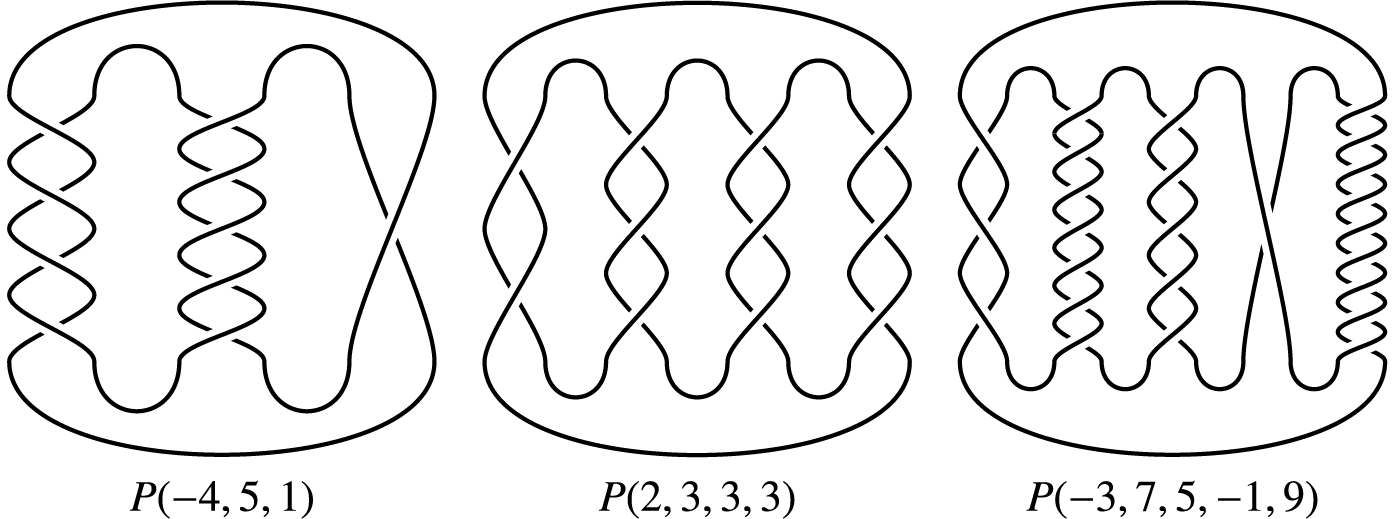
 is odd (see Figure 1 for examples).
Pretzel links were introduced by Reidemeister in [Reference Reidemeister20] and have been thoroughly studied since then. The Alexander polynomial [Reference Alexander1] of these knots has also been studied before (see, for example, [Reference Bae and Lee2, Reference Hironaka10, Reference Lecuona14, Reference Mironov, Morozov and Sleptsov17, Reference Nakagawa19]) and explicit formulae for some special cases were found. Kim and Lee [Reference Kim and Lee12, Theorem 3.1] also found explicit formulae for the Conway polynomial for several classes of pretzel links with at least one even parameter.
Nevertheless, general formulae for the Alexander polynomial of pretzel knots have not appeared in the literature. In this note, we fill this gap (see Theorem 1.1).
1.1 Conventions and notation
-
• If $K = P(q_1,q_2, \ldots , q_n)$
 is a pretzel knot with exactly one even
$ q_i $
, we may assume, without loss of generality, that
$q_1$
is even.Figure 1
Examples of pretzel knots.
Figure 1 Long description
A multi-panel diagram showing three examples of pretzel knots.
* The first knot on the left is labeled P(-4, 5, 1). It consists of three vertical tangles connected in a circular loop. The first tangle has four left-handed twists, the second has five right-handed twists, and the third is a single untwisted strand.
* The middle knot is labeled P(2, 3, 3, 3). It features four vertical tangles. The first has two right-handed twists, and the remaining three each contain three right-handed twists.
* The third knot on the right is labeled P(-3, 7, 5, -1, 9). It contains five vertical tangles. From left to right, they consist of three left-handed twists, seven right-handed twists, five right-handed twists, one left-handed twist, and nine right-handed twists.
-
• We denote the Alexander polynomial of a link L by $\Delta _L(t)$
. -
• We write $f(t)\doteq g(t)$
to indicate that the Laurent polynomials
$f(t)$
and
$g(t)$
are equal up to multiplication by
$\pm t^k$
for some
$k \in \mathbb {Z}$
. -
• We denote by $\sigma _k(q_1, q_2, \ldots , q_n)$
the elementary symmetric polynomial of degree
$ k $
, that is, the sum of all products of
$ k $
distinct variables among
$ q_1, q_2, \ldots , q_n $
. We set
$\sigma _0(q_1, q_2, \ldots , q_n) = 1$
and for
$ k < 0 $
, we set
$\sigma _k(q_1, q_2, \ldots , q_n) = 0$
.


Theorem 1.1. Let
$K=P(q_1, q_2, \ldots , q_n)$
 be a pretzel knot. Then, the Alexander polynomial
$\Delta _K(t)$
 is given by the following cases.
-
(1) If $ n $
is odd,
$ q_1 $
is even and
$ q_2, \ldots , q_n $
are odd, then $$ \begin{align*} \Delta_K(t) \doteq \bigg(\!\prod_{i=2}^n \frac{1+t^{q_i}}{1+t} \bigg) \bigg(1 + \frac{q_1}{2} (t^{-1} - t) \bigg(\!\sum_{i=2}^n\frac{t^{q_i}}{1+t^{q_i}} - \frac{n-1}{2}\bigg) \bigg). \end{align*} $$
-
(2) If $ n $
is even,
$ q_1 $
is even and
$ q_2, \ldots , q_n $
are odd, then $$ \begin{align*} \Delta_K(t) \doteq \bigg(\!\prod_{i=2}^n \frac{1+t^{q_i}}{1+t} \bigg) \bigg(t^{q_1/2} + (t^{q_1/2} - t^{-q_1/2}) \bigg(\!\sum_{i=2}^n\frac{t^{q_i}}{1+t^{q_i}} - \frac{n}{2}\bigg) \bigg). \end{align*} $$
-
(3) If both $ n $
and all
$ q_i $
are odd, then $$ \begin{align*} \Delta_K(t) \doteq \frac{1}{2^{n-1}}\sum_{k=0}^{(n-1)/2} (t-1)^{2k}(t+1)^{n-1-2k} \sigma_{2k}(q_1, q_2, \ldots, q_n). \end{align*} $$


1.2 Structure of the paper
In Section 2, we provide an elementary proof of the explicit formulae, relying on the skein relation. In Section 3, we derive some straightforward corollaries, including the characterisation of pretzel knots with a trivial Alexander polynomial and a formula for the knot determinant.
2 Proof of Theorem 1.1
Recall that the symmetrised Alexander polynomial of a link
$ L $
 (also referred to as the Alexander–Conway polynomial due to Conway’s normalisation [Reference Conway and Leech6, Section 6]) is a well-defined normalisation of the Alexander polynomial, given as a Laurent polynomial in
$ t^{1/2} $
 and characterised by the following properties: (1)
$\Delta _L(t) = \Delta _L(t^{-1})$
 and (2) if
$ L $
 is a knot, then
$\Delta _L(1) = 1$
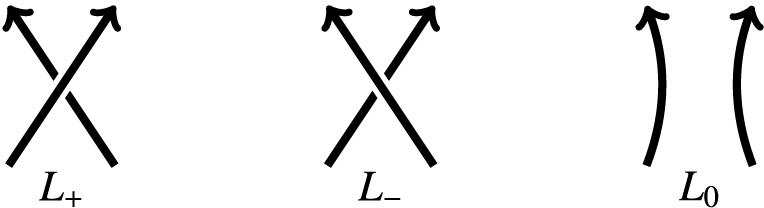
 . The symmetrised Alexander polynomial for links is uniquely determined by the skein relation:

where links
$L_+$
 ,
$L_-$
 and
$L_0$
 differ by the local operation shown in Figure 2.
Illustration of the skein relation.

To apply the skein relation, we also need explicit formulae for a special case of two-component pretzel links. The following lemma will be proved simultaneously with Theorem 1.1.
Lemma 2.1. Let
$L=P(q_1, q_2, \ldots , q_n)$
 be an oriented two-component pretzel link, where
$ n $
 is even and all
$ q_i $
 are odd. Then, the Alexander polynomial
$\Delta _L(t)$
 is given by the following cases.
-
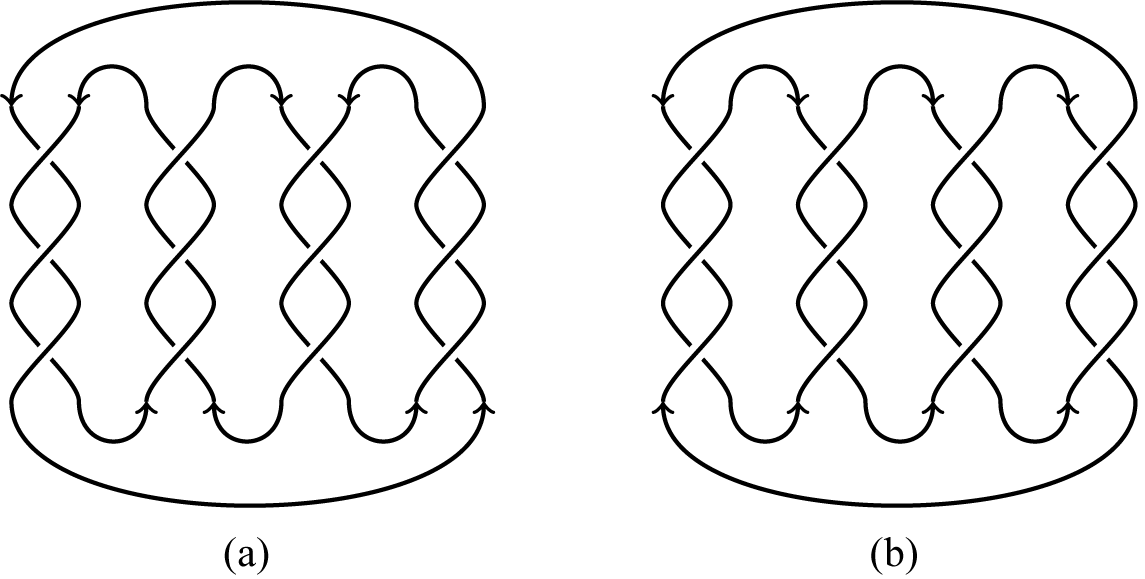
(1) If the strands in each twist of L are co-directed (as in Figure 3(a)), then
$$ \begin{align*} \Delta_L(t) \doteq \frac{1}{(1+t)^{n-1}}\prod_{i=1}^n (1+t^{q_i}) \bigg(\!\sum_{i=1}^n\frac{t^{q_i}}{1+t^{q_i}} - \frac{n}{2}\bigg). \end{align*} $$
Figure 3Example of two-component pretzel link $P(3,3,3,3)$
with different orientations. -
(2) If the strands in each twist of L are oppositely directed (as in Figure 3(b)), then
$$ \begin{align*} \Delta_L(t) \doteq \frac{1}{2^{n-1}}\sum_{k=1}^{n/2} (t-1)^{2k-1}(t+1)^{n-2k} \sigma_{2k-1}(q_1, q_2, \ldots, q_n). \end{align*} $$


2.1 Case (3) of Theorem 1.1 and Case (2) of Lemma 2.1
Let
$L = P(q_1, q_2,\ldots , q_n)$
 be a pretzel link (or a knot) where all
$q_i$
 are odd. We will use the following notation:


First, observe that

A similar argument holds for
$f_e(t;q_1,\ldots , q_n)$
 .
We argue by induction on
$\sum _{i=1}^n {(|q_i|-1)}/{2}$
 . Thus, the base case is
$0$
 , that is, when all
$|q_i|=1$
 .
If all
$|q_i| = 1$
 and
$m = |\sum _{i=1}^n q_i|$
 , then L is the
$(2, m)$
 -torus link (or knot) and

By an analogous calculation,

These are the standard formulae for the symmetrised Alexander polynomial of the
$(2,m)$
 -torus knot/link (see, for example, [Reference Kawauchi11, Ch. 7]), confirming our induction base.
Now, assume n is odd and that the induction hypothesis holds for the links
${K_1 = P(q_1, q_2, \ldots , q_n)}$
 and
${K_0 = P(q_2, \ldots , q_n)}$
 , that is,
$\Delta _{K_1}(t) = f_o(t; q_1, q_2, \ldots ,q_n)$
 and
$\Delta _{K_0}(t) = f_e(t; q_2, \ldots , q_n)$
 . We can apply the skein relation to compute
$\Delta _{K}(t)$
 for
${K = P(q_1\pm 2, q_2, \ldots , q_n)}$
 . We consider the case
$q_1+2$
 ; the argument for
$q_1-2$
 is analogous. Applying the induction hypothesis, for odd n,

Similarly, for even n,

Since

this confirms that
$ f_o $
 and
$ f_e $
 satisfy the desired recursion, completing the proof.
2.2 Cases (1) and (2) of Theorem 1.1 and Case (1) of Lemma 2.1
The proofs of these cases share a similar approach.
The base case of the induction for Case (1) of Lemma 2.1 corresponds to the link
$ P(\pm 1, \pm 1, \ldots , \pm 1) $
 , which is, once again, a two-component
$ (2, m) $
 -torus link, though with a different orientation (see [Reference Kawauchi11, Ch. 7]). The base case of the induction for Cases (1) and (2) of Theorem 1.1 corresponds to the knot
$ P(0, q_2, \ldots , q_n) $
 , which is a connected sum of
$(2, q_i)$
 -torus knots for each
$ q_i $
 , regardless of the parity of
$ n $
 . Recall that the Alexander polynomial of a connected sum is the product of the Alexander polynomials of its summands.
For the induction step, we apply the skein relation at a crossing in the first twist box, exactly as above. Note that to obtain the symmetrised Alexander polynomials, we need to multiply the formulae in the statement by an additional factor. This factor is
$t^{{(n-1-\sum _{i=2}^n q_i)}/{2}}$
 for Cases (1) and (2) of Theorem 1.1, and
$-t^{{(n-1-\sum _{i=1}^n q_i)}/{2}}$
 for Case (1) of Lemma 2.1. The exact calculations here are straightforward (though a bit cumbersome), so we present only Case (1) of Theorem 1.1; the other ones are completely analogous. For Case (1) of Theorem 1.1, the skein relation reduces
$\Delta _{P(q_1+ 2, q_2, \ldots , q_n)}(t)$
 to
$\Delta _{P(q_1, q_2, \ldots , q_n)}(t)$
 and
$\Delta _{P(q_2, \ldots , q_n)}(t)$
 :

The first equality is the skein relation, the second uses the induction hypothesis and the last is obtained by collecting terms.
Remark 2.2. The explicit formulae were originally conjectured based on symbolic experiments. We first noticed that for a two-component link with odd parameters and co-directed strands (Case (1) in Lemma 2.1), the Alexander polynomial has the form

We then rewrote this expression in the form presented in Lemma 2.1, and applied the skein relation to derive the formulae for Cases (1) and (2) in Theorem 1.1. For Case (3) in Theorem 1.1, we observed that the coefficients in the Alexander polynomial consistently corresponded to elementary symmetric polynomials. These observations guided the formulation of the theorem. We also validated our conjectures by comparison with known data from KnotInfo [Reference Livingston and Moore15].
3 Corollaries
3.1 Determinant of pretzel knots
The determinant of a pretzel knot follows directly from Theorem 1.1. This result reproduces the formula obtained by Kolay in [Reference Kolay13, Theorem 17].
Corollary 3.1. The determinant of the pretzel knot
$ K = P(q_1, q_2, \ldots , q_n) $
 is given by

Proof. Recall that
$\det (K) = |\Delta _K(-1)|$
 . Thus, to calculate the determinant of a pretzel knot, we need to consider the three cases in Theorem 1.1.
In Case (3), the result follows by direct substitution. Cases (1) and (2) involve routine calculus computations. We perform the computation for Case (1); the argument for Case (2) is completely analogous.
The formula for Case (1) in Theorem 1.1 consists of two factors. For the first one,

For the second factor, using the expansion at
$ t = -1 $
 , we obtain the limits

Combining these results, we obtain
$ \sigma _{n-1}(q_1,q_2, \ldots , q_n) $
 , as stated.
3.2 Degree of the Alexander polynomial of pretzel knots
For pretzel knots with at least one even parameter, the genus was completely determined in [Reference Kim and Lee12, Section 4] using the formulae for the Conway polynomial. The case where all parameters are odd is more subtle (except for alternating knots; see Corollary 3.2). In this case, the degree of the Alexander polynomial can take any even value from
$ 0 $
 to
$ n-1 $
 and its dependence on the parameters is not straightforward.
In this section, we examine two cases: when the Alexander polynomial of such knots has degree
$ n-1 $
 (the maximal possible) and when it is trivial. Before analysing the general case, we first examine the special case of alternating pretzel knots, where the degree of the Alexander polynomial directly determines the genus.
Corollary 3.2. Let
$ K = P(q_1, q_2, \ldots , q_n) $
 be a pretzel knot with all
$ q_i $
 odd and of the same sign. Then, its genus satisfies
$ g(K) = \frac {1}{2}(n-1) $
 .
Proof. Assume all
$q_i$
 have the same sign.
-
(1) Then, the knot is alternating, so $ g(K) = \frac {1}{2}\deg \Delta _K(t) $
. This follows from a classical result of Murasugi [Reference Murasugi18, Theorem 4.1] and Crowell [Reference Crowell7, Theorem 3.5]. -
(2) Since $ \sigma _{2k}(q_1, q_2, \ldots , q_n) $
is positive for
$ 0 \leq k \leq \frac {1}{2}(n-1) $
, it follows that
$ \deg \Delta _K(t) = n-1 $
.


Corollary 3.3. Let
$K = P(q_1, q_2, \ldots , q_n)$
 be a pretzel knot where all
$q_i$
 are odd.
-
(1) The Alexander polynomial satisfies $ \deg \Delta _K(t) = n - 1 $
if and only if $$ \begin{align*} \sum_{k=0}^{(n-1)/2} \sigma_{2k}(q_1, q_2, \ldots, q_n) \neq 0. \end{align*} $$
-
(2) The Alexander polynomial is trivial, that is, $ \Delta _K(t) \doteq 1 $
, if and only if (3.1) $$ \begin{align} \sigma_{2k}(q_1, q_2, \ldots, q_n) = (-1)^{k} \binom{\frac{1}{2}(n-1)}{k}, \quad 0 \leq k \leq \tfrac{1}{2}(n-1). \end{align} $$


Proof. To simplify the notation, let us denote
$ a_k = \sigma _k(q_1, q_2, \ldots , q_n) $
 .
Consider the Alexander polynomial in the form

The polynomials
$(t-1)^{2k}(t+1)^{n-1-2k}$
 are palindromic; consequently, the coefficient of
$ a_{2i} t^j $
 in the expansion equals the coefficient of
$ a_{2i} t^{n-1-j} $
 . Thus,
$ \deg \Delta _K(t) = n - 1 $
 if the coefficient of
$ t^0 $
 is nonzero. Since

this completes the proof of the first case.
The condition
$ \Delta _K(t) \doteq 1 $
 holds if and only if the only nonzero coefficient of
$\Delta _K(t)$
 appears at
$ t^{(n-1)/2} $
 and equals 1. This requirement can be expressed as a system of linear equations:

where
$ A \in \mathbb {R}^{{(n+1)}/{2} \times {(n+1)}/{2}} $
 is a matrix whose element
$ A_{i, j} $
 is equal to the coefficient of
$ a_{2i - 2}t^{j-1} $
 in
$ \Delta _K(t) $
 .
The matrix
$ A $
 is nondegenerate. Indeed, if we consider
$ u = t-1 $
 , then

and such polynomials are clearly linearly independent. Thus, there exists a unique solution to the system (3.2). Setting
$ a_{2k} = (-1)^{k} \binom {\frac {1}{2}(n-1)}{k}, $
 we compute

3.3 Topologically slice pretzel knots
The Alexander polynomial of a nontrivial pretzel knot with an even parameter is never trivial. Hence, Case (2) of Corollary 3.3 provides a complete characterisation of all pretzel knots with a trivial Alexander polynomial. According to Freedman’s theorem [Reference Freedman9, Theorem 1.13], such knots are topologically slice. Note that a complete classification of topologically slice odd pretzel knots with three twist blocks and with nontrivial Alexander polynomial was provided by Miller [Reference Miller16, Theorem 1.12].
One of the equations in system (3.1) is
$\sigma _{n-1}(q_1,\ldots ,q_n) = (-1)^{{(n-1)}/{2}}$
 , which corresponds to an equation for the knot determinant (see Corollary 3.1). For
$ n=3 $
 , this is the only condition and it reproduces the well-known equation

which characterises pretzel knots with three twist blocks having a trivial Alexander polynomial. In this case, there are infinitely many known solutions; for example, for any odd integer
$ p $
 , the triple
$ (-p, 2p-1, 2p+1) $
 satisfies the equation. Finding solutions for
$n> 3$
 is significantly more difficult (while it is comparatively easy to find an infinite series of pretzel knots with trivial determinant for an arbitrary number of twists). We first observe that if a tuple of odd integers
$ (q_1, \ldots , q_n) $
 is a solution of the system (3.1), then the extended tuple
$ (\pm 1, \mp 1, q_1, \ldots , q_n) $
 yields a solution in
$ n+2 $
 variables. This is obvious from a geometric point of view—it is nothing but an application of the second Reidemeister move. In fact, if
$(q_1,\ldots ,q_n)$
 is a solution of the system (3.1) and
$q_i = \pm 1$
 for some i, this forces
$q_j = \mp 1$
 for some other j. Indeed, let
$P(t) := \prod _{j=1}^{n} (t - q_j)$
 . From the equations, one checks that
$P(t) = E(t^2) + t (t^2 - 1)^{{(n-1)}/{2}}$
 for some polynomial
$E(t)$
 and, hence,
$P(1) = P(-1)$
 . Thus, if
$q_i = \pm 1$
 for some i, then
$P(\pm 1)=0$
 , which implies
$P(\mp 1)=0$
 ; consequently, there exists some j such that
$q_j = \mp 1$
 . Therefore, it is natural to investigate irreducible solutions, which we define as the solutions of system (3.1) in which
$|q_i|>1$
 for all i.
We performed a computational search for such solutions. For
$n=5$
 , we searched through all tuples where the three smallest absolute values of the parameters do not exceed 100 001, and we identified 38 irreducible solutions (up to sign and permutation of the parameters). The calculation was done with a C++ program; the code of the program is available at [Reference Belousov3]. These solutions are listed in Appendix A. All of them correspond to nontrivial knots due to the classification of Montesinos knots [Reference Burde, Zieschang and Heusener5, Theorem 12.26]. (Alternatively, the span of their Jones polynomial is nonzero—see [Reference Díaz and Manchón8, Theorem 9, Case 2].) From [Reference Bryant4, Theorem 2.3], it also follows that all corresponding knots are not smoothly slice. Thus, we get a new series of topologically slice, but not smoothly slice, knots. We formulate this as the following proposition.
Proposition 3.4. Let
$(q_1,\ldots ,q_5)$
 be an irreducible solution of the system (3.1). Then, the pretzel knot
$P(q_1,\ldots ,q_5)$
 is topologically slice but not smoothly slice.
For
$n=7$
 , we searched through all tuples where the four smallest absolute values of the parameters do not exceed 5001 and found no solutions. Based on these computations, we propose the following conjecture.
Conjecture 3.5. There are infinitely many irreducible solutions of the system (3.1) for
$n=5$
 , while there are no irreducible solutions for
$n>5$
 .
A Irreducible solutions of the system (3.1) for
$n=5$

Since the equations in system (3.1) are invariant under permutation of the variables and under multiplication of all variables by
$-1$
 , and since we are interested in irreducible solutions only, we present the solutions in the normalised form:

Note that we use strict inequalities here, since one of the equations in system (3.1) is
$\sigma _4(q_1,\ldots ,q_5) = 1$
 , which forces
$q_1,\ldots ,q_5$
 to be pairwise coprime.
The list of known irreducible solutions is as follows (38 in total):


Acknowledgement
The author would like to thank Vadim Stepaniuk for many helpful discussions.