Introduction
Visceral leishmaniasis (VL) is an endemic protozoonosis found in four continents (Europa, Asia, Africa and America). However, approximately 90% of the cases are concentrated in Asia, Africa and Latin America (Alvar et al., Reference Alvar, Vélez, Bern, Herrero, Desjeux, Cano, Jannin and Boer2012). In 2018, more than 95% of new cases appeared in 10 countries: China, Ethiopia, India, Iraq, Kenya, Nepal, Somalia, South Sudan, Sudan and Brazil (WHO, 2020). The disease can be severe and fatal, especially in immunocompromised individuals (Mpaka et al., Reference Mpaka, Daniil, Kyriakou and Zakynthinos2009; Menezes et al., Reference Menezes, Luz, Sousa, Verne, Lima and Margonari2016). Despite the severity of symptomatic cases, approximately 85% of individuals remain asymptomatic, harbour the parasite for decades, and become a source of infection and spread of the disease, especially in endemic areas (Michel et al., Reference Michel, Pomares, Ferrua and Marty2011; Jimenez-Marco et al., Reference Jimenez-Marco, Riera, Fisa, Girona-Llobera, Sedeño, Goodrich, Pujol, Guillen and Muncunill2012).
Asymptomatic individuals, especially those from endemic areas, show an immune response (production of specific antibodies or cellular) against Leishmania infantum (L. infantum) or presence of parasitic DNA in the peripheral blood, but remain healthy, without clinical presentation of the characteristic symptoms of the disease (Alvar et al., Reference Alvar, Alves, Bucheton, Burrows, Büscher, Carrillo, Felger, Hübner, Moreno, Pinazo, Ribeiro, Sosa-Estani, Specht, Tarral, Wourgaft and Bilbe2020).
Studies have reported that the prevalence of asymptomatic infection among blood donors varies between 5 and 15% in different regions of Brazil, one of the seven countries with the highest prevalence of this endemic disease (Luz et al., Reference Luz, Silva, Gomes, Machado, Araújo, Fonseca, Freire, D'almeida, Palatinik and Palatinik-De-Sousa1997; Urias et al., Reference Urias, Carvalho, Oliveira, Carvalho, Teles, Rodrigues and Maia2009; França et al., Reference França, De Castro, Pontes and Dorval2013; Ferreira-Silva et al., Reference Ferreira-Silva, Teixeira, Tibúrcio, Pereira, Santana, Afonso, Alves, Feitosa, Urias, Santos, Carvalho and Moraes-Souza2018). Moreover, the survival and infectious capacity of L. infantum in stored blood components and transmission records, where transfusion of blood components is the only possible means of transmission, increases the need for measures to ensure maximum safety in transfusions, especially in endemic regions (Grogl et al., Reference Grogl, Daugirda, Hoover, Magill and Berman1993; Cummins et al., Reference Cummins, Amin, Halil, Chiodini, Hewitt and Radley-Smith1995).
The diagnosis of symptomatic VL has appropriately been established and is based on clinical manifestations and epidemiological and laboratory data. However, there is still no consensus on the best method for identification of the asymptomatic form, which hinders the collection of accurate epidemiological data and limits the control of the disease. Several studies have shown that various serological techniques have low sensitivity and specificity, in addition to low agreement (Romero et al., Reference Romero, Silva, Silva-Vergara, Rodrigues, Costa, Guimarães, Alecrim, Moraes-Souza and Prata2009; Silva et al., Reference Silva, Romero, Nogueira Nascentes, Costa, Rodrigues and Prata2011, Reference Silva, Homero, Fagundes, Nehme, Fernandes, Rodrigues, Costa and Prata2013; Ferreira-Silva et al., Reference Ferreira-Silva, Teixeira, Tibúrcio, Pereira, Santana, Afonso, Alves, Feitosa, Urias, Santos, Carvalho and Moraes-Souza2018). Recent studies have presented molecular techniques as viable alternatives with better indices of sensitivity and specificity in asymptomatic individuals (Sudarshan and Sundar, Reference Sudarshan and Sundar2014; Kaushal et al., Reference Kaushal, Bhattacharya, Verma and Salotra2017; Galluzzi et al., Reference Galluzzi, Ceccarelli, Diotallevi, Menotta and Magnani2018).
In Brazil, laboratory diagnosis of VL is performed using commercial serological tests in most health services, and molecular diagnosis is practically restricted to research centres. Therefore, the present study aimed to use molecular methods to assess their effectiveness in the identification of the presence of asymptomatic infection by L. infantum in individuals from endemic regions of Brazil; it also compared the results with those found by other techniques.
Materials and methods
Participants
This study included 127 individuals eligible for blood donation, with no previous history of VL, selected from 608 blood donors who had participated in a previous study (Ferreira-Silva et al., Reference Ferreira-Silva, Teixeira, Tibúrcio, Pereira, Santana, Afonso, Alves, Feitosa, Urias, Santos, Carvalho and Moraes-Souza2018). All 127 were selected from four cities in Brazil where the disease is endemic: Fortaleza and Sobral/Ceará (CE), Teresina/Piauí (PI) and Montes Claros/Minas Gerais (MG). We used 34 of the 37 positive samples by enzyme-linked immunosorbent assay (ELISA), which presented complete epidemiological data, and 93 negative samples were selected at random. All the participants signed a consent form to participate in the study. This study was approved by the Human Research Ethics Committee of the Federal University of Triângulo Mineiro and Hemominas Foundation (Protocol 2104 and 332, respectively.)
ELISA rK39 and conventional polymerase chain reaction (PCR)
ELISA rK39 (Kalazar Detect ELISA InBios® Seattle, Washington, USA) was performed following the manufacturer's instructions, and conventional PCR was conducted as described by Ferreira-Silva et al. (Reference Ferreira-Silva, Teixeira, Tibúrcio, Pereira, Santana, Afonso, Alves, Feitosa, Urias, Santos, Carvalho and Moraes-Souza2018).
Quantitative real-time polymerase chain reaction (qPCR)
DNA extraction from the blood samples was performed using Qiagen's DNA Mini Kit from Qiagen (Hilden, Germany) following the manufacturer's recommended method. The 127 samples were subjected to qPCR to identify Leishmania spp., with primers described by Nicolas et al. (Reference Nicolas, Prina, Lang and Milon2002). The reaction consisted of 1XSYBR Green PCR Master Mix (Life Technologies, Carlsbad, CA, USA), 10 pM of each primer, 50 ng of DNA and ultrapure water for a final volume of 20 μL. Amplification was performed at an initial holding temperature of 95 °C for 5 min, followed by 40 cycles at 95 °C for 1 min, 60 °C for 1 min and melting curve analysis in 1 °C increments from 60 to 95 °C. Each assay included an internal control of human β-actin in each sample. The database was analysed using Applied Biosystems 7500 Real-Time PCR Software v2.3 (Thermo Fisher Scientific, Waltham, MA, USA). DNA from Trypanosoma cruzi (T. cruzi) was used to demonstrate the absence of cross-reactivity of the selected target, as described by Nicolas et al. (Reference Nicolas, Prina, Lang and Milon2002).
PCR amplification of mitochondrial cytochrome B gene and sequencing technique
The presence of a cytochrome B (CytB) gene fragment was determined by sequencing 10 positive samples in qPCR. The amplification reaction was carried out in a 50 μL volume container containing 1x buffer supplied with Taq polymerase (Promega, USA), 100 mm dNTPs, 50 pM of each primer for CytB, 1.25 U of GoTaq polymerase (Promega) and 30 ng of DNA. Electrophoresis was performed on an agarose gel (1%) stained with 1 × GelRed™ (Biotium, USA) and visualized on a UV transilluminator. The PCR products were precipitated with 70% alcohol and sequenced on ACTGene (Molecular Analysis Company, Brazil). The obtained sequences were then submitted to the nucleotides' basic local alignment search tool (BLASTn) for a similarity search with Leishmania sequences deposited in GenBank databases (https://www.ncbi.nlm.nih.gov/genbank).
Statistical analyses
The results were analysed in SPSS 21 using descriptive statistics and estimates of prevalence. The concordance of the tests was verified using κ coefficients (Miot, Reference Miot2016).
To edit the sequencing components, SeaView 4.5.2 was used, and alignment was performed by ClustalW 1.8 with the following sequences: L. infantum (KX061911; MF344874; HQ908261), Leishmania donovani (AB095957), Leishmania amazonensis (MF344893; MF344892; MF344890), Leishmania equatoriensis (AB434686), Leishmania braziliensis (MF344881; MF344879; MF344878) as the outgroup and Trypanosoma erneyi (JN040956) (Luyo-Acero et al., Reference Luyo-Acero, Uezato, Oshiro, Takei, Karika, Katakura, Gomez-Landires, Hashiguchi and Nokaka2009; Gómez-Hernárdez et al., Reference Gómez-Hernárdez, Bento, Rezende-Oliveira, Nascentes, Barbosa, Batista, Tiburcio, Pedrosa, Lages-Silva, Ramirez and Ramirez2017). A maximum composite likelihood analysis, using Tamura's three parameters, was performed using MEGA 7.0. To evaluate the robustness of the phylogenetic analysis, we used 1000 bootstraps (Kumar et al., Reference Kumar, Stecher and Tamura2016). All sequences obtained in this work were deposited in GenBank (IDs: MH979699–MH979703).
Results
Characteristics of participants
Of the 127 participants, 4.7% were from Fortaleza, 35.4% from Sobral, 25.3% from Teresina and 34.6% from Montes Claros; their average age was 28.05 ± 8.52 years, and 63% were males.
Leishmania spp. identification by qPCR and comparison with ELISA rK39 and conventional PCR
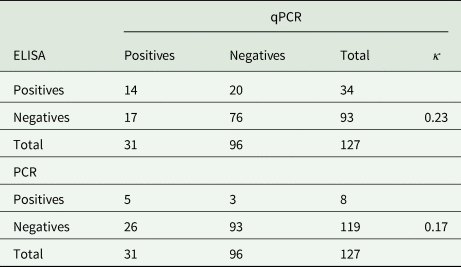
Of the 127 samples analysed by qPCR, 31 (24.4%) were positive for Leishmania spp. The agreement indexes between qPCR and ELISA rK39 and the conventional PCR are presented in Table 1. Comparing ELISA with qPCR, we obtained a κ index of 0.23, showing reasonable agreement between the tests. However, comparing PCR with qPCR, we had a κ index of 0.17, which shows low agreement.
Results of the analysis of κ agreement between ELISA and qPCR and conventional PCR and qPCR for the diagnosis of asymptomatic visceral leishmaniasis

ELISA, enzyme-linked immunosorbent assay; qPCR, quantitative polymerase chain reaction; PCR, polymerase chain reaction.
Confirmation of L. infantum infection by direct sequencing and cross-reactivity exclusion
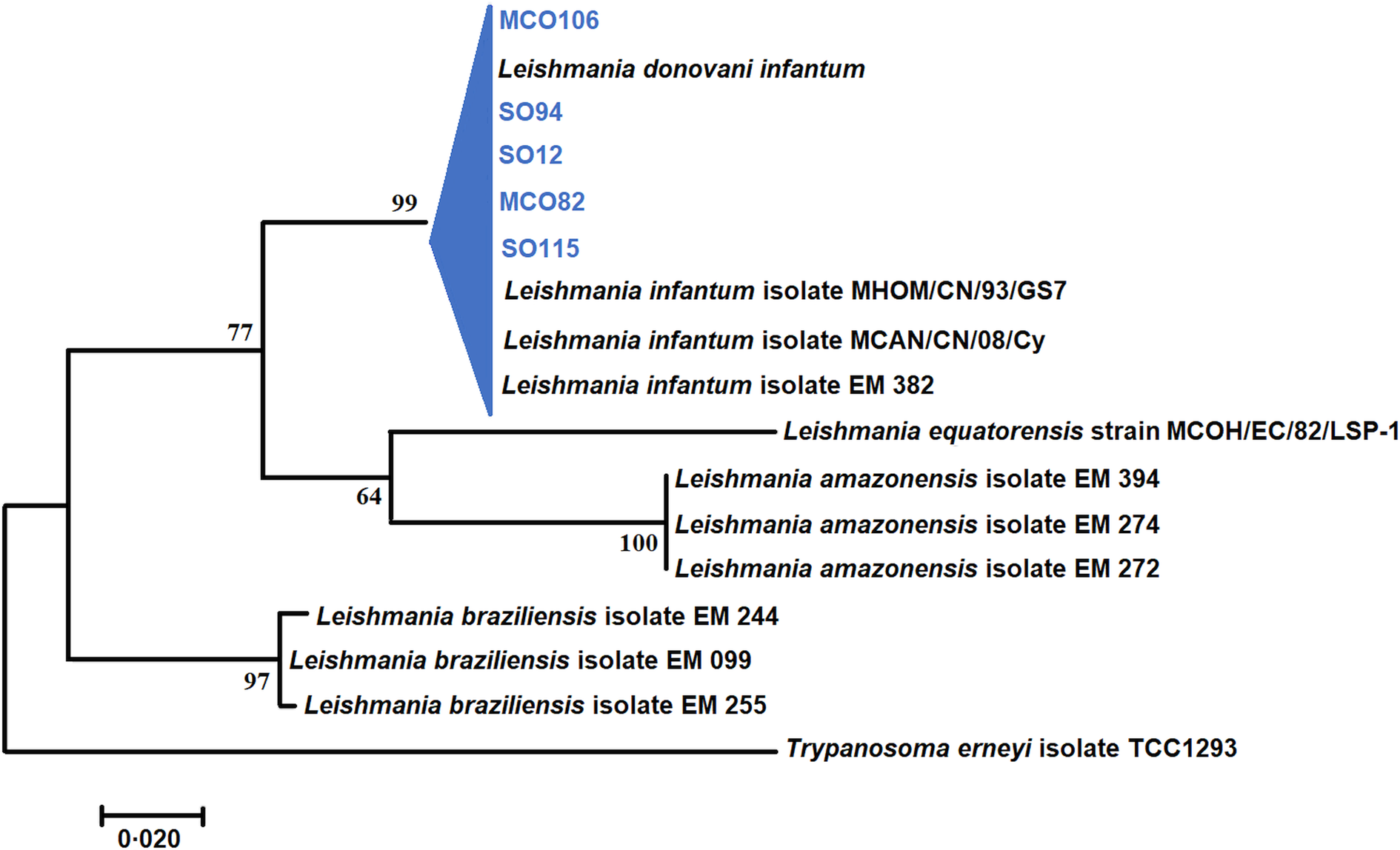
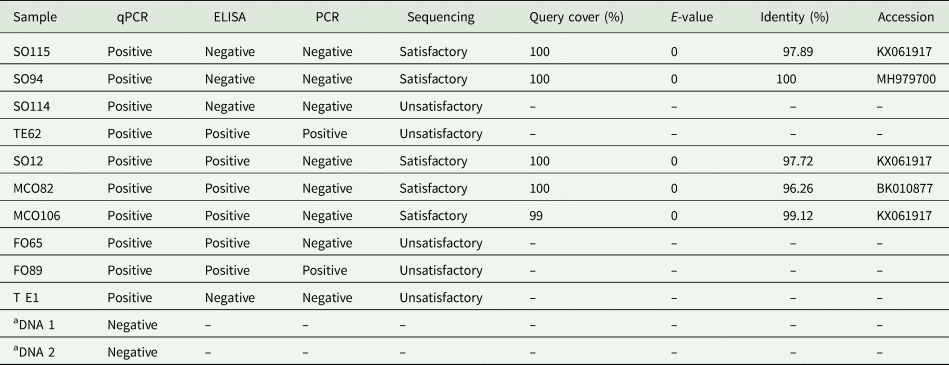
Gene sequencing to identify L. infantum was then carried out in 10 samples positive by qPCR: four from Sobral, two from Fortaleza, two from Teresina and two from Montes Claros. Of these, five samples (three from Sobral and two from Montes Clear) showed positive and satisfactory results with coverage of 95–100%, enabling the identification of L. infantum (Table 2). These samples were grouped with reference samples of L. infantum by the maximum likelihood of the phylogenetic tree constructed based on the sequences of the CytB gene (Fig. 1). Additionally, two DNA samples from T. cruzi were tested and inserted in the qPCR to detect possible cross-reactivity. The results demonstrated the non-amplification of these samples with the primers used (Table 2).
Molecular phylogenetic analysis by the maximum-likelihood (ML) method of partial CytB sequence. Taxons were grouped by the percentage generated by the bootstrap. The analysis involved 17 nucleotide sequences. Codon positions included were 1st + 2nd + 3rd + non-coding. All positions containing gaps and missing data were eliminated. There were a total of 617 positions in the final dataset.

Comparative results between the techniques used in the 10 samples sequenced to identify infection by Leishmania infantum

ELISA, enzyme-linked immunosorbent assay; qPCR, quantitative polymerase chain reaction; PCR, polymerase chain reaction.
a DNA samples from T. cruzi were inserted in the qPCR to detect possible cross-reactivity.
Discussion
The severity of VL and the possible risk of transfusion transmission by contaminated blood components justify the search and implementation of measures to ensure the security of recipients. However, the laboratory diagnosis of asymptomatic patients remains challenging, highlighting the need for a solution and evaluation of the different tools available (Pereira et al., Reference Pereira, Rocha-Silva, Graciele-Melo, Lafuente, Magalhães and Caligiorne2014).
To find a test that could better identify these individuals, as there is still no universally accepted gold standard for such cases (Alvar et al., Reference Alvar, Alves, Bucheton, Burrows, Büscher, Carrillo, Felger, Hübner, Moreno, Pinazo, Ribeiro, Sosa-Estani, Specht, Tarral, Wourgaft and Bilbe2020), our research group chose the available modern molecular biology techniques as tools. The molecular method of qPCR was selected because it has displayed better sensitivity and specificity than serological tests and other techniques (Reithinger and Dujardin, Reference Reithinger and Dujardin2007; Ruiter et al., Reference Ruiter, Veer, Leeflang, Deborggraeve, Lucas and Adams2014; Sudarshan et al., Reference Sudarshan, Singh, Singh, Chourasia, Singh, Wilson, Chakravarty and Sundar2014). This has been demonstrated in a wide variety of peripheral blood samples in clinical and subclinical forms (Galluzzi et al., Reference Galluzzi, Ceccarelli, Diotallevi, Menotta and Magnani2018), including the identification of asymptomatic infections (Sudarshan and Sundar, Reference Sudarshan and Sundar2014; Kaushal et al., Reference Kaushal, Bhattacharya, Verma and Salotra2017). As for the selected system in our study, although the literature has considered TaqMan™ to have high specificity, we opted for SYBR Green, a relatively more economical and frequently used system, as it is accessible and viable for use in the public health field (Pereira et al., Reference Pereira, Rocha-Silva, Graciele-Melo, Lafuente, Magalhães and Caligiorne2014).
The presence of diseases, caused by other etiologic agents with a clinical picture similar to leishmaniasis, is common in Brazil's endemic areas for VL (Reithinger and Dujardin, Reference Reithinger and Dujardin2007). Considering this, for this work, we chose a set of primers specific to conserved sequences from minicircles of kinetoplastid DNA present in Leishmania spp. (Nicolas et al., Reference Nicolas, Prina, Lang and Milon2012).
In the present study, the positivity for the genus Leishmania spp. by qPCR was 24.4%. When we compared the positive samples of ELISA rK39 and conventional PCR from the previous study (Ferreira-Silva et al., Reference Ferreira-Silva, Teixeira, Tibúrcio, Pereira, Santana, Afonso, Alves, Feitosa, Urias, Santos, Carvalho and Moraes-Souza2018) to the positive samples by qPCR, we observed that the positivity relation found in the current study was low, and the concordance between ELISA rK39 and qPCR was only reasonable. Similar to our findings, a study that compared the serology and qPCR of asymptomatic infection by L. donovani, the aetiological agent of VL in the Old World, reported low agreement between the molecular and serological tests used (Sudarshan et al., 2014). Pessoa-E-Silva et al. (Reference Pessoa-E-Silva, Vaitkevicius-Antão, Andrade, Silva, Oliveira, Trajano-Silva, Nakasone and Paiva-Cavalcanti2019) also found discordant results when comparing serology, qPCR and parasitological examination and observed low agreement between the tests in a group of asymptomatic individuals. Poor correlation between different techniques used in the diagnosis of asymptomatic L. infantum infection can occur because of multiple factors, ranging from the ability of each test to detect a different stage of infection (Silva et al., Reference Silva, Romero, Nogueira Nascentes, Costa, Rodrigues and Prata2011; Pessoa-E-Silva et al., Reference Pessoa-E-Silva, Vaitkevicius-Antão, Andrade, Silva, Oliveira, Trajano-Silva, Nakasone and Paiva-Cavalcanti2019) to a consequence of the variable presence of antibodies or parasites in the analysed samples and cross-reactivity, which can lead to false results (Rodríguez-Cortés et al., Reference Rodríguez-Cortés, Ojeda, López-Fuertes, Timón, Altet, Solano-Gallego, Sánchez-Robert, Francino and Alberola2007; Romero et al., Reference Romero, Silva, Silva-Vergara, Rodrigues, Costa, Guimarães, Alecrim, Moraes-Souza and Prata2009).
Even if the qPCR with the SYBR Green system is considered promising for the diagnosis of asymptomatic infection by L. infantum, no approach can, at the moment, be regarded as a gold standard (Kaushal et al., Reference Kaushal, Bhattacharya, Verma and Salotra2017; Varani et al., Reference Varani, Ortalli, Attard, Vanino, Gaibani, Vocale, Rossini, Cagarelli, Pierros, Billi, Mastroianni, Di, Cesare, Codeluppi, Franceschini, Melchiondas, Gramiccias, Scalone, Gentilomi and Landin2017; Galluzzi et al., Reference Galluzzi, Ceccarelli, Diotallevi, Menotta and Magnani2018). The ‘best approach’ depends on factors such as assay design, the selected target region, origin of the clinical sample, cycle temperature and the DNA extraction method (Gomes et al., Reference Gomes, Cesetti, Paula, Vernal, Gupta, Sampaio and Roselino2007; Medeiros et al., Reference Medeiros, Gomes, Oliveira, Souza, Mourão, Cota, Marques, Carneiro and Rabello2017).
Some genetic targets, such as 18S (18S-rRNA), gp63 and CytB, can be used for taxonomic identification of Leishmania parasites (Uliana et al., Reference Uliana, Affonso, Camargo and Floeter-Winter1991; Mauricio et al., Reference Mauricio, Gaunt, Stothard and Miles2001; Luyo-Acero et al., Reference Luyo-Acero, Uezato, Oshiro, Takei, Karika, Katakura, Gomez-Landires, Hashiguchi and Nokaka2009). The clinical-epidemiological importance of the identification of Leishmania species has encouraged the development and improvement of new molecular tools with greater accuracy, such as sequencing. We sequenced the CytB gene to confirm the presence of the parasite, and our results showed the presence of the L. infantum DNA in 50% of the analysed samples. Phylogenetic analysis of CytB gene sequencing provides high specificity in the classification of Leishmania species (Foulet et al., Reference Foulet, Botterel, Buffet, Morizot, Rivollet, Deniau, Pratlong, Costa and Bretagne2007; Ramírez et al., Reference Ramírez, Hernández, Léon, Ayala, Flórez and González2016; Gómez-Hérnárdez et al., Reference Gómez-Hernárdez, Bento, Rezende-Oliveira, Nascentes, Barbosa, Batista, Tiburcio, Pedrosa, Lages-Silva, Ramirez and Ramirez2017) and allows the separation of human pathogenic from non-pathogenic species (Asato et al., Reference Asato, Oshiro, Myint, Yamamoto, Kato, Marco, Mimori, Gomez, Hashiguchi and Uezato2009).
This two-stage strategy (qPCR and sequencing) could not be justified in other scenarios in which the species is almost always the same and where other diagnostic tools can be equally efficient (Foulet et al., Reference Foulet, Botterel, Buffet, Morizot, Rivollet, Deniau, Pratlong, Costa and Bretagne2007). Our study used qPCR and sequencing to identify and confirm the presence of L. infantum, given the high prevalence of other forms of leishmaniasis present in Brazil. In the diagnosis of asymptomatic infection by L. infantum, qPCR proved to be a suitable method in the present study, mostly as we observed that positive samples (confirmed by gene sequencing) were negative by ELISA rK39 and conventional PCR. However, we face some limitations when working with sequencing. The sequencing technique is a method of sensitive molecular biology, in which a conventional PCR must be performed before performing the sequencing. The main limitation involved is its detection capacity. Low parasitic loads may not be identified by the conventional method, and for this reason, sequencing did not identify positives. Thus, it is necessary to run a qPCR before sorting samples.
The present study is the first to detect the presence of L. infantum by qPCR followed by DNA sequencing in blood donors from endemic areas of Brazil. The results reinforce the need to expand the discussion on the actual risks of its transfusion transmission and to introduce relevant control measures.
The molecular method used in this study allowed us to identify the presence of L. infantum DNA in blood donors from endemic regions for VL in Brazil. Our findings showed that qPCR is a better tool for the identification of asymptomatic infection by L. infantum than ELISA and conventional PCR.
Acknowledgements
We would like to thank the employees of the UFTM Immunology Laboratory and the Minas Gerais State Research Support Foundation for their contributions to our research.
Financial support
We are grateful to the National Sanitary Surveillance Agency and National Technological Development for their financial support. We are grateful for the support given to scholarship holders by the Coordination for the Improvement of Higher Education Personnel.
Conflict of interest
None.
Ethical standards
All the participants signed a consent form to participate in the study. This study was approved by the Human Research Ethics Committee of the Federal University of Triângulo Mineiro and Hemominas Foundation (Protocol 2104 and 332, respectively.)