Experimental
The present study was aimed at to screen the barnyard millet germplasm against grain smut (Ustilago panici-frumentacei Brefeld) disease for the identification of resistant material. Two ear heads each of 257 barnyard millet accessions collected from different eco-geographical backgrounds and diverse agronomical types were inoculated with the grain smut spores using go-go technique (Joshi et al., Reference Joshi, Singh and Srivastva1988) at Vivekananda Parvatiya Krishi Anusandhan Sansthan experimental farm (1250 masl), Hawalbagh, Almora, during rainy season 2003. The harvested grains of each accession were grown during 2005 in an augmented block design with two checks (VL Madira 29 and VL Madira 172) using recommended agronomical practices.
At grain-filling stage, per cent grain smut incidence was calculated by counting the number of infected ear heads among the total population. On the basis of per cent grain smut incidence, accessions were characterized as immune (0%), highly resistant (0.1–5%), resistant (5–10%), moderately resistant (10–25%), susceptible (25–50%) and highly susceptible (>50%). Observations on plant height, peduncle length, internode length, inflorescence length, number of racemes, raceme length, 50% flowering, straw weight, grain yield and 1000 seeds weight were recorded on ten plants using IPGRI descriptors (1983) and averaged.
These 257 accessions were grouped into seven origin groups viz., advance breeding lines, Bihar, ICRISAT, Karnataka, unknown (origin not known), Uttar Pradesh and Uttarakhand. Range, mean and standard deviation (SD) of grain smut incidence and correlation coefficient between traits and grain smut incidence were calculated for each origin group as well as for the whole collection. The susceptible and resistant accessions were identified for each group.
Discussion
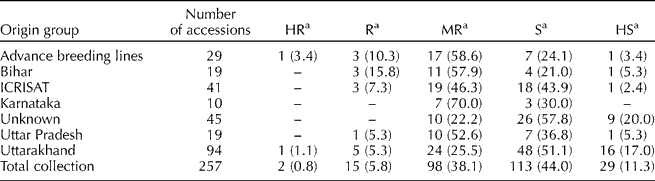
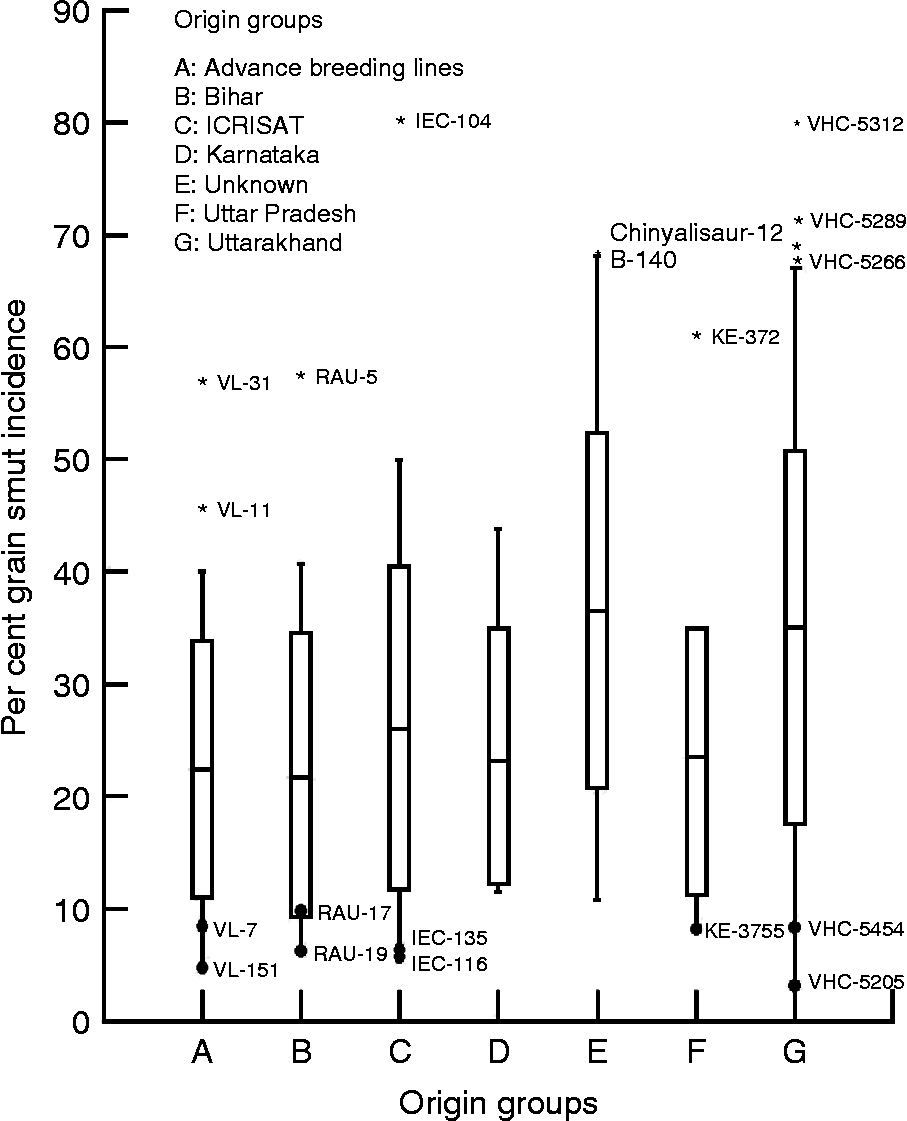
A wide range of reaction to grain smut, from highly resistant to highly susceptible, was observed among the studied accessions (Table 1), but none of the accessions was found immune. Nagaraja and Mantur (Reference Nagaraja and Mantur2008) also reported that none of the tested barnyard millet accessions was immune to grain smut in Karnataka. However, Anonymous (2001) reported that accessions PRB 9402 and PRB 9602 were completely immune to grain smut at Almora. Bandyopadhyay (Reference Bandyopadhyay1999) considered these accessions as Echinochloa cruss-galli. De Wet et al. (Reference De Wet, Rao, Mangesha and Brink1983) reported that Echinochloa frumentacea and E. cruss-galli are not crossable. This indicated that it will be difficult for plant breeders to evolve barnyard millet genotypes completely immune against grain smut. Snijders (Reference Snijders1990) proved the possibility of accumulation of resistance genes to head blight in winter wheat, when the complete resistance was not available. Significant enhancement of resistance levels has been achieved in barnyard millet through hybridization and selection, as the majority of accessions in advance breeding line group were resistant to moderately resistant to grain smut. Thus, resistance level in barnyard millet can be enhanced by adopting proper breeding strategies and selection for resistance in segregating generations. The variation in grain smut incidence in different barnyard millet of origin groups is depicted through box plots in Fig. 1. Bihar and Karnataka groups recorded lower mean values for grain smut incidence. These collections are genetically different from those of the Uttarakhand collection, and hence can be utilized in the hybridization programme for further enhancing the resistance level and grain yield.
Distribution of barnyard millet accessions based on their reaction to grain smut in different origin groups as well as in across the whole collection

Value in parenthesis indicates percentage of accessions.
a HR, highly resistant; R, resistant; MR, moderately resistant; S, susceptible; HS, highly susceptible.
Variation in grain smut incidence in barnyard millet accessions of different origin groups (Box represents the mean ± 1 SD, with error bar of 1 SD beyond the box, extreme values with more than 2 SDs from the mean or highly susceptible accessions; Highly resistant or resistant accessions).

Significant positive correlations between grain smut and days to flowering, and grain smut and grain yield were observed for ICRISAT and Karnataka groups, respectively. These correlations do not appear to be strong enough to prevent effective selection to combine disease resistance and agronomic performance. To achieve improved resistance, in combination with high yield, selection should be carried out for both the characters simultaneously. Significant negative correlations were observed between grain smut incidence and peduncle length for Karnataka and Uttar Pradesh groups. Skovmand et al. (Reference Skovmand, Wilcoxson and Heiner1977) also reported that peduncle characters are related with non-specific resistance to stem rust in wheat.
Variation in grain smut incidence among barnyard millet germplasm accessions suggests that there is a variability in the reaction to grain smut that can be manipulated by the breeder. The susceptibility of grain smut was found loosely associated with grain yield and yield contributing characters, but the associations observed were not strong enough to pose a serious obstacle to breeding to combine resistance to grain smut with high yield.
Acknowledgements
The authors thank Dr C. Tom Hash, ICRISAT and one anonymous reviewer for critically examining and improving the manuscript.