

9.1 Introduction
Today’s global governance system is characterized by institutional complexity, bottom-up and top-down elements, and a multiplicity of actors and levels. Public administrations are generally seen as an important element of this global governance architecture (Bauer, Knill, and Eckhard Reference Bauer, Knill, Eckhard, Bauer, Knill and Eckhard2017). Kingsbury and Stewart (Reference Kingsbury, Stewart and Papanikolaou2005: 17) even argue that “much of global governance can be understood and analyzed as administrative action: rule making, administrative adjudication between competing interests, and other forms of regulatory and administrative decisions and management.” Coining the term “global administrative law,” they and others call “for the recognition of a global administrative space in which international and transnational administrative bodies interact in complex ways” (Wessel and Wouters Reference Wessel and Wouters2007: 281) and in which states are no longer the single determinant but rather one among many.
The concept of a global administrative space relates to the institutional structure that underlies processes of global policymaking, namely the emergence of administrative structures beyond the territory of the nation-state (Kingsbury and Stewart Reference Kingsbury, Stewart and Papanikolaou2005). However, we still lack knowledge about the embeddedness, role, and position of environmental bureaucracies in their respective networks and how they interact with other types of actors. Only recently have scholars begun to study the interaction between state and nonstate actors and environmental bureaucracies within the architectures of global environment governance (see, e.g., Saerbeck et al. Reference Saerbeck, Well, Jörgens, Goritz and Kolleck2020; Wit et al. Reference Wit, Ostovar, Bauer, Jinnah, Biermann and Kim2020). Applying the notion of an administrative space to the global environmental governance regime promises to be a fruitful endeavor as it is believed that not just the state signatories of a convention contribute to processes of environmental multilateral decision-making. Rather, it is assumed that environmental bureaucracies and state and nonstate actors have formed complex networks, thereby strengthening the bond between once disconnected entities. As such, it is argued that, similar to the European administrative space, one needs “to stop thinking in terms of hierarchical layers of competence separated by the subsidiarity principle and start thinking, instead, of a networking arrangement, with all levels of governance shaping, proposing, implementing and monitoring policy together” (Prodi 2000 in Martens Reference Martens and Egeberg2006: 126).
This contribution seeks to deepen our understanding of the global environmental governance regime, and in particular the role of environmental bureaucracies within it. We argue that state and nonstate actors as well as environmental bureaucracies operating on various levels interact with one another within the global environmental governance regime. Furthermore, we argue that international public administrations play a central role not only in the global environmental governance regime but also in the global environmental administrative space. Building on an original dataset of issue-specific cooperation and information flows among organizations active in the global climate and the biodiversity regimes, we test our arguments by studying whether environmental bureaucracies, state organizations, and nonstate organizations interact horizontally and vertically with one another.
We assess our argument by means of social network analysis. This allows us to detect the diverse interactions that environmental bureaucracies cultivate with one another as well as with state and nonstate actors. Based on an original data set derived from a large-N survey among organizations in two fields of global environmental governance, our social network analysis maps networks of policy-specific communication and cooperation among diverse actor groups. This approach enables us to assess the position, the embeddedness, and the potential role of specific actors within these networks. Moreover, we can draw conclusions about the relationships between various actor types within the same negotiations.
Our study speaks to the literature on global environmental governance architectures (Aldy and Stavins Reference Aldy and Stavins2007; Biermann et al. Reference Biermann, Pattberg, van Asselt and Zelli2009; Keohane and Victor Reference Keohane and Victor2011). The literature on the global climate governance regime has focused mainly on the interaction between negotiation parties and nonparty actors (see, e.g., Nasiritousi and Linnér Reference Nasiritousi and Linnér2016; Nasiritousi, Hjerpe, and Buhr Reference Nasiritousi, Hjerpe and Buhr2014, Reference Nasiritousi, Hjerpe and Linnér2016; Tallberg et al. Reference Tallberg, Sommerer, Squatrito and Jonsson2013), thereby somewhat neglecting the link between administrations and state and nonstate actors (for a recent exception see Biermann and Kim Reference Biermann and Kim2020). Our approach focuses on the bureaucratic side of these governance arrangements and how they interact with others, a focus that we consider to be of great importance. For example, scholars of international public administration study their agency and influential role in multilateral negotiations by inquiring whether, how, and to which degree they exert influence on international policymaking (see, e.g., Bauer Reference Bauer2006, Reference Bauer, Biermann and Siebenhüner2009; Bauer, Andresen, and Biermann Reference Bauer, Andresen, Biermann, Biermann and Pattberg2012; Bauer and Ege Reference Bauer, Ege, Bauer, Knill and Eckhard2017; Busch Reference Busch, Biermann and Siebenhüner2009; Eckhard and Ege Reference Eckhard and Ege2016; Jinnah Reference Jinnah2011, Reference Jinnah2014; Johnson Reference Johnson2016; Saerbeck et al. Reference Saerbeck, Well, Jörgens, Goritz and Kolleck2020; Tallberg et al. Reference Tallberg, Sommerer, Squatrito and Jonsson2013; Well et al. Reference Well, Saerbeck, Jörgens and Kolleck2020). These scholars find that international bureaucracies partially act beyond the mandate state actors grant them, trying to mobilize support to advance their own proposals and to build momentum for multilateral agreements (Abbott and Snidal Reference Abbott and Snidal2010; Jörgens et al. Reference Jörgens, Kolleck, Saerbeck, Well, Bauer, Knill and Eckhard2017; Saerbeck et al. Reference Saerbeck, Well, Jörgens, Goritz and Kolleck2020). They can be powerful actors that wield (independent) influence in global policymaking by controlling information and the ability to transform this information into knowledge – that is, to structure perceptions (Barnett and Finnemore Reference Barnett and Finnemore2004). International bureaucracies exert influence, inter alia, through the use of their central position in actor networks, their privileged access to information, their professional authority, and technical expertise (Bauer and Ege Reference Bauer and Ege2016; Jinnah Reference Jinnah2014; Jörgens et al. Reference Jörgens, Kolleck, Saerbeck, Well, Bauer, Knill and Eckhard2017; Widerberg and van Laerhoven Reference Widerberg and van Laerhoven2014).
The next section reviews concepts of inter- and transnational administrative spaces to study the phenomenon of administrative structures and state- and nonstate actors’ networks. This allows us to formulate first expectations about the characteristics of a potentially emerging global environmental administrative space. The following section builds on an original dataset derived from a large-N survey among organizations operating in the fields of global climate and biodiversity governance to empirically map networks of policy-specific communication and cooperation. This allows us to assess the global environmental governance structure as well as the position that administrative organizations occupy within this regime. We discuss our findings in the conclusion, in which we also outline avenues for future research.
9.2 Concepts of International and Transnational Administrative Spaces
The international and transnational administrative spaces are relatively new concepts in the public administration and international relations literature. They were systematically dealt with for the first time in the context of European integration research. In the following, we first look at the characteristics of the so-called European administrative space before we review the concepts of global or transnational administrative structures that are not bound to the polity of the European Union.
The European and Global Administrative Spaces
The European administrative space is a nonhierarchical order of closely intertwined operational and decision-making levels combined with a major structural variability. A first wave of research on the European administrative space focused mainly on the convergence of (national) administrative systems “on a common European model” (Olsen Reference Olsen2003: 506), in which a “public administration operates and is managed on the basis of European principles, rules and regulations uniformly enforced in the relevant territory” (Olsen Reference Olsen2003: 508). Closely related to more general notions of European integration or Europeanization of national political systems, the Europeanization of national public administrations was seen as “a new pattern of European integration that complements regulatory integration” (Trondal and Peters Reference Trondal, Peters, Bauer and Trondal2015: 79). The emergence of a European administrative space was thought to be a cross-national convergence of national administrations.
Arguing that the convergence of national administrative systems was at best inconsistent and incomplete (Knill Reference Knill2001; Olsen Reference Olsen2003), a second wave of research focused on the multilevel character of European public administration. Departing from a predominant focus on the substantial attributes of administrative organizations – such as size and expertise of staff, financial resources, or formal mandates and competencies – to including relational attributes of public administrations led to a reconceptualization of the European administrative space as network-based rather than state-centric. From this perspective, a European administrative space emerges through the intensification of relationships between (integrated) administrative units at different levels of government, that is, a vertical pooling of administrative resources from different levels of government within particular policy domains or issue areas (Benz Reference Benz, Bauer and Trondal2015; Hofmann Reference Hofmann2008). The European administrative space is seen as “a space in which European, national and sub-national administrations and interested parties act together in agenda setting, rule-making and implementation” (Hofmann Reference Hofmann2008: 670). According to Heidbreder (Reference Heidbreder2011: 710), it is best understood “in procedural terms as a network marked by ‘functional unity’, ‘organizational separation’ and ‘procedural co-operation.’”
Overall, the prevailing notion of a European administrative space can be described as “a common European administrative infrastructure for the joint formulation and execution of public policy” (Trondal and Peters Reference Trondal, Peters, Bauer and Trondal2015: 79) with established links to relevant nonstate actors within a given issue area or policy domain. Its main features are (i) an interest of public administrations at different levels of government as political actors, (ii) a focus on their relationships and interactions with other bureaucracies as well as with other (non)state actors, and (iii) a governance perspective that is interested in processes of formulating and implementing political programs within the European multilevel polity. Research in this tradition is rooted simultaneously in the subdisciplines of public administration, public policy, European studies, and international relations.
Trondal and Peters (Reference Trondal and Peters2013, Reference Trondal, Peters, Bauer and Trondal2015) moreover identify three analytical dimensions that characterize the European administrative space – institutional independence, integration, and co-optation. The first dimension, institutional independence, “involves the institutionalization of some level of independent administrative capacity” at the international level, which the authors characterize as “relatively permanent and separate institutions that are able to act relatively independently from [national] governments” (Trondal and Peters Reference Trondal, Peters, Bauer and Trondal2015: 80). The second dimension, integration, “entails … the inter-institutional integration of administrative structures” at the global level. Finally, the third dimension, co-optation, means that “there is a mutual process of integration” of domestic agencies, regional administrative structures such as the institutions of the European Union, international bureaucracies, and nongovernmental organizations (NGOs) at all levels of government that are involved in the exercise of administrative tasks (Trondal and Peters Reference Trondal, Peters, Bauer and Trondal2015: 80).
In contrast to the concept of European administrative spaces, the term “global administrative space” is not frequently used in the fields of public administration, international relations and international law. It figures most prominently in the work of Kingsbury, Krisch, and Stewart (Reference Kingsbury, Krisch and Stewart2005: 25), who see the recognition of a distinct global administrative space as a way to overcome “the classical dichotomy between an administrative space in national polities on the one hand and inter-state coordination in global governance on the other.” They relate the concept of the global administrative space to the emergence of administrative structures beyond the nation-state. Kingsbury and Stewart (Reference Kingsbury, Stewart and Papanikolaou2008: 3–4) characterize this space as being “populated by several distinct types of regulatory administrative institutions and various types of entities that are the subject of regulation, including not only states but firms, NGOs and individuals.”Footnote 1 While their notion of a global administrative space shows a considerable degree of overlap with that of transnational governmental networks, it differs from the latter in that it defines the global administrative space in functional rather than formal terms. In their understanding, the global administrative space is restricted not to formal bureaucratic organizations (or their individual members) but to those organizations (and their individual members) that actually perform administrative functions at all levels of government.Footnote 2
Transgovernmental Networks and Multilevel Governance
A number of approaches describe and analyze the emergence of administrative structures beyond the European Union. A very early field of study was what Nye and Keohane (Reference Nye and Keohane1971b: 331) termed “transnational relations.” Transnational relations are defined as “contacts, coalitions, and interactions across state boundaries that are not controlled by the central foreign policy organs of governments.” While not specifically focusing on the interaction of administrative actors at different levels of government, Nye and Keohane explicitly acknowledge that public administrations at the (sub)national level may act in partial autonomy from their own governments when interacting with state or nonstate actors in other countries or at the international level. They observe that “subunits of governments may … have distinct foreign policies which are not all filtered through the top leadership and which do not fit into a unitary actor model” (Nye and Keohane Reference Nye and Keohane1971a: 731). At the same time, international secretariats may seek transgovernmental actors “as potential allies” (Nye and Keohane Reference Nye and Keohane1971a: 748) and can be expected “to form explicit or implicit coalitions with sub-units of governments as well as with nongovernmental organizations having similar interests” (Keohane and Nye Reference Keohane and Nye1974: 52).
In a state-of-the-art review on transnational relations, Nölke (Reference Nölke, Keman and Woldendorp2016) characterized transnational politics as a space in which a wide range of organizations, including businesses, NGOs, research institutes, national ministries, agencies, subnational governments, and international public administrations, interact and form transnational policy networks. Slaughter (Reference Slaughter2004) argues that transnational networks of government officials have substituted traditional diplomacy in many policy areas. Building on Keohane and Nye (Reference Keohane and Nye1974) and Slaughter (Reference Slaughter2004), Hale and Held (Reference Hale and Held2011: 16) define transgovernmental networks as more or less formalized fora that “bring ‘domestic’ government officials together with their peers around specific issues, often regulatory in nature.”
Multilevel governance approaches moreover cover linkages between the public and private sector more generally and between state and supranational authority specifically. They describe the complex distribution and linkages as well as the blurred boundaries of competencies and responsibilities between state and nonstate activities at different levels: “Multi-Level Governance posits that decision-making authority is not monopolized by the governments of the member states but is diffused to different levels of decision-making, the sub-national, national and supranational levels” (Marks Reference Marks, Cafruny and Rosenthal1993: 392). The multilevel governance approach “focuses on the change in form of the exercise of political power and the new forms of cooperation and coordination that transcend ‘hierarchy’ (in the sense of central control) and ‘market’ (in the sense of spontaneous, unplanned self-organization)” (Huster Reference Huster2008: 56). Whereas multilevel refers to the growing independence of the system from governments, the term “Governance” is a reference to the growing interdependence of state and nonstate actors (Bache and Flinders Reference Bache and Flinders2004: 2–3). Various forms of governance at different levels of decision-making are connected to form an overall composition of “Governance by, with, and without Government” (Zürn Reference Zürn1998: 166–167).
9.3 A Global Environmental Administrative Space?
Transnational relations as well as multilevel governance approaches direct the scholarly focus to the linkages between the public and private sphere on the international level. They conceptualize international governance processes as a space in which state and nonstate actors form complex policy networks. Studies of global climate governance echo this notion and describe the global environmental governance structure as highly dynamic relationships within and between different levels of governance and government (Biermann et al. Reference Biermann, Pattberg, van Asselt and Zelli2009; Saerbeck et al. Reference Saerbeck, Well, Jörgens, Goritz and Kolleck2020). For example, the climate regime that is based on the United Nations Framework Convention on Climate Change’s (UNFCCC) Paris Agreement has been described as a “hybrid system that combines bottom-up with top-down elements” (Falkner Reference Falkner2016: 21), which emphasizes the role and importance of issue-specific initiatives carried out by a diverse set of actors (Fuhr and Hickmann Reference Fuhr and Hickmann2016; Jänicke and Quitzow Reference Jänicke and Quitzow2017; Pattberg and Stripple Reference Pattberg and Stripple2008).Footnote 3 European/global administrative space approaches suggest that the existence of network-based administrative structures lies beyond the nation-state. They point to the multilevel character of public administrations.
Our argument is that a global environmental administrative space is currently emerging within the global environmental governance regime through the intensification of relationships between (integrated) administrative units at different levels of government. We also believe that environmental bureaucracies have formed bonds not only with one another but also with state and nonstate actors operating at different levels in the global environmental regime. Studies on international public administrations focus on interorganizational cooperation and issue-specific information flows (see, e.g., Bauer, Knill, and Eckhard Reference Bauer, Knill, Eckhard, Bauer, Knill and Eckhard2017; Saerbeck et al. Reference Saerbeck, Well, Jörgens, Goritz and Kolleck2020). Well et al. (Reference Well, Saerbeck, Jörgens and Kolleck2020), moreover, showed that expertise and information are more important tools for international public administrations than rules and formal powers. While the formal mandates and legal competencies of international public administrations are rather limited when compared to national bureaucracies, their strategic use of expertise, ideas, and procedural knowledge combined with their mostly central position in issue-specific information flows forms the basis of their impact on global policy outputs (Busch and Liese Reference Busch, Liese, Bauer, Knill and Eckhard2017). International public administrations actively shape their organizational environment by setting up and forming structures of multilevel administration and by creating informal alliances with nonstate actors at all levels of government. International bureaucracies then typically occupy a central position in “their” domain-specific organizational environment, especially within domain-specific information flows (Benz, Corcaci, and Doser Reference Benz, Corcaci, Doser, Bauer, Knill and Eckhard2017; Jörgens et al. Reference Jörgens, Kolleck, Saerbeck, Well, Bauer, Knill and Eckhard2017; Saerbeck et al. Reference Saerbeck, Well, Jörgens, Goritz and Kolleck2020; see also Chapter 4). As such, we expect international public administrations to be prominent actors within the global environmental administrative space as well as the global environmental governance regime.
H1: A global administrative space has emerged within the global environmental governance regime, in which environmental bureaucracies of all levels interact with each another.
H2: The global environmental administrative space comprises networks between environmental bureaucracies and state and nonstate actors.
H3: International public administrations play a prominent role in the global environmental administrative space.
9.4 Mapping the Global Environmental Administrative Space
In his article on the development of a European administrative space, Olsen (Reference Olsen2003: 506) asks, “How can we recognize an EAS [European administrative space] if one has emerged?” The same question applies to this chapter: How can we define, operationalize, and measure a potential global environmental administrative space? In this section, we will propose social network analysis as a method to respond to this challenge.
We believe that a global environmental administrative space can be best observed through a systematic empirical analysis of policy-related information flows and cooperation between different kinds of actors that are directly or indirectly involved in global environmental governance. Social network analysis focuses on social relations between actors and the resulting network structures, instead of actors’ individual attributes (Jörgens, Kolleck, and Saerbeck Reference Jörgens, Kolleck and Saerbeck2016). It allows us to map the issue-specific network of organizations operating within a given policy domain to identify relationships and types of interactions among them and, as such, to study the interaction patterns of state and nonstate actors as well as environmental bureaucracies.
Our analysis is based on data that we collected via a large-N online questionnaire between September 2015 and March 2016. In this questionnaire we approached a wide variety of state and nonstate actors operating at different levels in the global climate and biodiversity regimes.Footnote 4 We received 471 (sometimes partial) responses for the UNFCCC and 561 for the Convention on Biological Diversity (CBD). The questionnaire included two questions on the relationships between actors. The first question asked about cooperation among different actors (“Which organizations did you cooperate closely with regarding topics discussed under the UNFCCC/CBD during the last 12 months?”) and the second about information provision (“Which organizations did you receive trustworthy information from during the last 12 months?”).Footnote 5 Since both questions provide information on relationships relevant to the emergence of a global environmental governance regime and a global environmental administrative space, we combined the answers. This gives us an idea of whether interaction takes place among environmental bureaucracies themselves or between environmental bureaucracies and state and nonstate actors across different environmental issue areas (climate and biodiversity).
To measure the embeddedness of individual organizations in the combined network, we calculate different measures of centrality. The higher an organization’s centrality value, the higher its embeddedness in the global environmental governance regime and its global environmental administrative space (see, e.g., Hanneman and Riddle Reference Hanneman, Riddle, Scott and Carrington2011). First, degree centrality measures how many relationships an actor has within a given network. In our case, the degree centrality measures how often an actor is named as a source of policy-relevant information or a cooperation partner and how often an actor is the one who named others. It is a measure for reputation and general visibility in a network. Second, eigenvector centrality indicates the prominence of an actor in a network by measuring whether it is linked to other important actors. An actor’s eigenvector centrality is high only if the contacts also have a high eigenvector centrality. Such an actor may have only a few, but very important, relations. Finally, betweenness centrality measures how often an actor is positioned on the closest path between any other two actors within the network. In an information exchange network, for example, a high betweenness centrality enables an actor to alter the information that is being exchanged between different actors.
The next sections describe the global policy network that evolved around the UNFCCC and the CBD. The edges represent either instances of interorganizational cooperation or instances of communication where one organization receives trustworthy information related to the UNFCCC or the CBD from another organization. We distinguish between six actor groups (governments, international organizations [IOs], NGOs, research institutes, private businesses including banks, and others), which enables us to learn more about the relative centrality of different types of organizations. In the first step, we provide network graphs and tables with centrality values for the top thirty organizations to develop an initial understanding of the global environmental governance regime complex. Next, we draw our attention to the embeddedness of environmental bureaucracies as well as their interactions with state and nonstate actors within that regime to determine the characteristics of the global environmental administrative space.Footnote 6
The Global Environmental Governance Regime
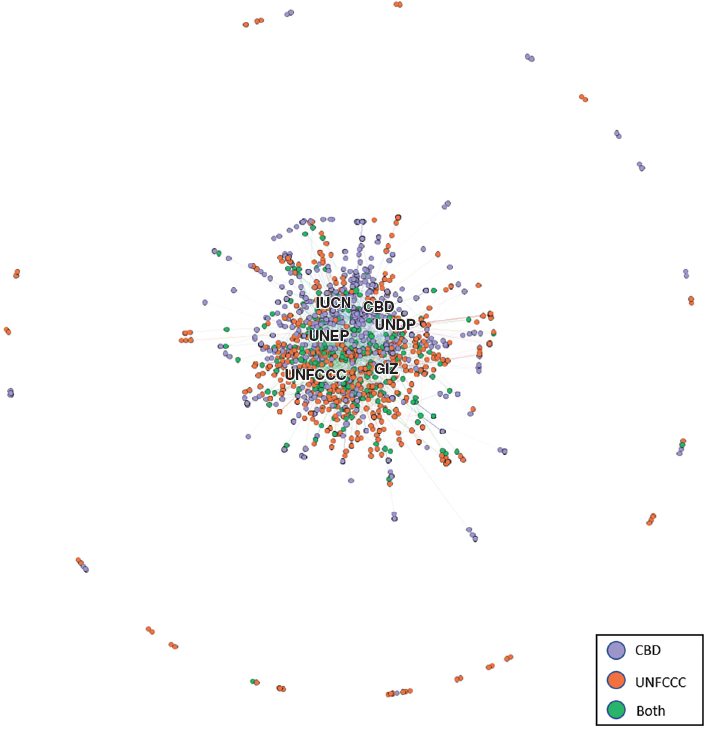
This section visualizes the current global environmental governance regime to gain a better understanding of the interaction taking place between state and nonstate actors and environmental bureaucracies. Figures 9.1 and 9.2 visualize the combined UNFCCC and CBD network. While the colors of the nodes in Figure 9.1 represent actor groups, the colors in Figure 9.2 indicate which of the two UN conventions an organization can be primarily attributed to. Table 9.1 lists the thirty organizations with the highest centrality values in the combined network.
The combined CBD and UNFCCC network by actor groups (node size refers to degree centrality, and node color refers to actor group)

The combined CBD and UNFCCC network by UN conventions (node size refers to degree centrality, and node color refers to convention)

| Degree centrality | Betweenness centrality | Eigenvector centrality | ||||||||||
|---|---|---|---|---|---|---|---|---|---|---|---|---|
| Organization | Type | Value | Con. | Organization | Type | Value | Con. | Organization | Type | Value | ||
| 1 | UNEP | IO | 133 | Both | CBD | IO | 281,093 | CBD | UNDP | IO | 1 | cbd |
| 2 | UNDP | IO | 132 | CBD | UNEP | IO | 240,335 | Both | CBD | IO | 0.96 | cbd |
| 3 | CBD | IO | 119 | CBD | UNDP | IO | 232,583 | CBD | UNEP | IO | 0.93 | both |
| 4 | IUCN | IO | 106 | CBD | UNFCCC | IO | 191,920 | Both | UNFCCC | IO | 0.85 | both |
| 5 | GIZ, Germany | Gov. | 102 | CBD | IUCN | IO | 173,717 | CBD | IUCN | IO | 0.82 | cbd |
| 6 | UNFCCC | IO | 95 | Both | GIZ, Germany | Gov. | 159,406 | CBD | GIZ | Gov. | 0.81 | cbd |
| 7 | WWF | NGO | 88 | Both | WWF | NGO | 123,716 | Both | WWF | NGO | 0.71 | both |
| 8 | MoEFCC, India | Gov. | 69 | Both | MoEFCC, India | Gov. | 109,146 | Both | CGIAR | Res. | 0.51 | cbd |
| 9 | CGIAR | Res. | 61 | CBD | CGIAR | Res. | 84,386 | CBD | FAO | IO | 0.51 | both |
| 10 | FAO | IO | 51 | Both | FAO | IO | 68,475 | Both | BMUB | Gov. | 0.42 | both |
| 11 | EU Commission | IO | 45 | Both | CAN | NGO | 56,380 | UNFCCC | MoEFCC, India | Gov. | 0.40 | both |
| 12 | BMUB, Germany | Gov. | 40 | Both | BMUB, Germany | Gov. | 48,863 | Both | WRI | Res. | 0.40 | both |
| 13 | CI | NGO | 37 | Both | UNESCO | IO | 48,334 | Both | EU | IO | 0.37 | both |
| 14 | CAN | NGO | 36 | UNFCCC | EU Commission | IO | 47,703 | Both | EU Commission | IO | 0.36 | both |
| 15 | GEF | IO | 35 | Both | CI | NGO | 43,787 | Both | World Bank | IO | 0.35 | both |
| 16 | IPCC | IO | 34 | Both | SPREP | IO | 37,538 | Both | MoE, Peru | Gov. | 0.35 | both |
| 17 | WRI | Res. | 34 | Both | IPCC | IO | 34,461 | Both | Go4BioDiv | NGO | 0.34 | cbd |
| 18 | EU Council | IO | 33 | CBD | DoECC, Canada | Gov. | 33,127 | Both | CI | NGO | 0.32 | both |
| 19 | EU | IO | 33 | Both | EU Council | IO | 31,376 | CBD | CAN | NGO | 0.31 | unfccc |
| 20 | DETEC, Switzerland | Gov. | 32 | Both | BirdLife | NGO | 30,137 | CBD | MoNRE, Thailand | Gov. | 0.31 | both |
| 21 | World Bank | IO | 31 | Both | DETEC, Switzerland | Gov. | 30,101 | Both | ICIMOD | IO | 0.29 | both |
| 22 | CIFOR | Res. | 31 | Both | DEA | Gov. | 29,285 | Both | IPCC | IO | 0.29 | both |
| 23 | BirdLife | NGO | 29 | CBD | WRI | Res. | 29,278 | Both | OECD | IO | 0.29 | cbd |
| 24 | MoE, Peru | Gov. | 28 | CBD | MoE, Peru | Gov. | 29,129 | Both | MoEW, Bolivia | Gov. | 0.28 | both |
| 25 | Go4BioDiv | NGO | 28 | Both | World Bank | IO | 29,111 | Both | MINAE, Costa Rica | Gov. | 0.28 | both |
| 26 | MoE, Japan | Gov. | 26 | Both | DOEE, Australia | Gov. | 28,780 | Both | IETA | Bus. | 0.27 | unfccc |
| 27 | OECD | IO | 26 | CBD | BNHS | NGO | 28,757 | CBD | EIB | IO | 0.27 | both |
| 28 | SPREP | IO | 24 | Both | Go4BioDiv | NGO | 28,734 | CBD | GHMC, India | Gov. | 0.27 | both |
| 29 | ICIMOD | IO | 24 | Both | CIFOR | Res. | 26,300 | Both | GEF | IO | 0.26 | both |
| 30 | BNHS | NGO | 23 | CBD | MoEW, Bolivia | Gov. | 26,156 | Both | ASEAN | IO | 0.25 | both |
Figure 9.1 shows the current global environmental governance regime. From a structural perspective, it is particularly interesting that the network consists of one main component of connected actors, while only a few actors are not involved in any sort of interaction with this component. Despite tendencies for polycentricism (Jordan et al. Reference Jordan, Huitema, van Asselt and Forster2018), there are core actors to the global environmental governance regime that are closely connected. No systematic structures of group formations in relation to actor type can be observed, indicating that all actor types engage in interactions with other types of stakeholders. When looking at the position of specific actors (see Table 9.1), we see that IOs are at the core of the current global environmental governance system. Interestingly, these are not only the United Nations Environment Programme (UNEP) and the United Nations Development Programme (UNDP), two IOs that play leadership roles in environmental and development policy, but also the two convention secretariats.
Figure 9.2 and Table 9.1 suggest that an institutional structure has evolved that is present in different issue-specific networks of global environmental governance. This structure comprises international (e.g., UNEP, UNDP, European Commission, the Food and Agriculture Organization [FAO]), governmental (different national environmental ministries and agencies), nongovernmental (e.g., WWF, CAN) and research organizations (e.g., WRI, CGIAR). Some organizations, such as the IUCN and the IPCC, are themselves compound organizations with traits of an IO and NGO (IUCN) or a research organization (IPCC), respectively.Footnote 7 However, the results suggest that the global environmental governance regime is mostly dominated by IOs, NGOs, and governmental actors, while only a few research organizations and businesses can be found among the most central actors.
The results suggest an embeddedness of environmental bureaucracies within the global environmental governance structure. The high centrality scores of international public administrations (according to all three centrality measures presented in Table 9.1) indicate that they occupy a central position in their respective treaty networks. Figure 9.2 and the betweenness centrality scores in Table 9.1 also show that in particular the CBD Secretariat occupies a very central position in the combined network that could be an indicator of a bridge function between the climate (orange) and the biodiversity (blue) regime.
A Global Environmental Administrative Space
To answer the question whether a global administrative space has emerged within the global environmental governance regime, in which environmental bureaucracies of all levels interact with one another as well as with state and nonstate actors, we focus on their interactions. At first, we look at the interactions of environmental bureaucracies with one another. For this purpose, we reduce the network to interactions of government actors and IOs. We assume that the answers given by our survey respondents that named IOs and government actors mostly refer to the administrative parts of these organizations.Footnote 8
The colors of the nodes indicate the convention the administrative actors can be attributed to. The structure of the graph in Figure 9.3 suggests that the environmental bureaucracies not only engage in cooperation and exchange of information within the scope of their respective convention but they also interact with public administrations from other environmental issue areas. Again, this applies particularly to the two convention secretariats. Table 9.2 lists the thirty environmental bureaucracies with the highest centrality values. Although no local actors can be found among the thirty most central actors, the presence of bureaucracies that belong to both IOs and national agencies and ministries indicates that vertical interaction patterns emerge in addition to the horizontal interactions observed from the network graph. These results serve as a first indicator for the integration of administrative structures and thus the existence of a global environmental administrative space.
Network of environmental bureaucracies (node size refers to degree centrality, and node color refers to convention)

| Degree centrality | Betweenness centrality | Eigenvector centrality | ||||||||||
|---|---|---|---|---|---|---|---|---|---|---|---|---|
| Organization | Type | Value | Con. | Organization | Type | Value | Con. | Organization | Type | Value | Con. | |
| 1 | UNDP | IO | 91 | CBD | UNEP | IO | 55,906 | Both | UNDP | IO | 1 | cbd |
| 2 | UNEP | IO | 83 | Both | UNDP | IO | 55,311 | CBD | UNEP | IO | 0.93 | both |
| 3 | GIZ, Germany | Gov. | 60 | CBD | CBD | IO | 46,844 | CBD | CBD | IO | 0.80 | cbd |
| 4 | CBD | IO | 56 | CBD | GIZ, Germany | Gov. | 32,210 | CBD | GIZ, Germany | Gov. | 0.69 | cbd |
| 5 | IUCN | IO | 52 | CBD | IUCN | IO | 26,669 | CBD | UNFCCC | IO | 0.67 | both |
| 6 | UNFCCC | IO | 43 | Both | UNFCCC | IO | 25,268 | Both | IUCN | IO | 0.67 | cbd |
| 7 | FAO | IO | 35 | Both | FAO | IO | 21,647 | Both | FAO | IO | 0.53 | both |
| 8 | EU Council | IO | 32 | CBD | EU Council | IO | 16,468 | CBD | EU Commission | IO | 0.38 | both |
| 9 | EU Commission | IO | 28 | Both | DoECC, Canada | Gov. | 13,851 | Both | EU | IO | 0.38 | both |
| 10 | EU | IO | 25 | Both | SPREP | IO | 13,224 | Both | BMUB, Germany | Gov. | 0.34 | both |
| 11 | MoEFCC, India | Gov. | 25 | Both | MoEFCC, India | Gov. | 12,428 | Both | OECD | IO | 0.32 | cbd |
| 12 | DETEC, Switzerland | Gov. | 25 | Both | EU Commission | IO | 11,672 | Both | MoNRE, Thailand | Gov. | 0.32 | both |
| 13 | GEF | IO | 20 | Both | UNESCO | IO | 10,932 | Both | MoE, Peru | Gov. | 0.32 | both |
| 14 | DoECC, Canada | Gov. | 20 | Both | DETEC, Switzerland | Gov. | 8,390 | Both | MoEW, Bolivia | Gov. | 0.31 | both |
| 15 | ICIMOD | IO | 20 | Both | EU | IO | 7,658 | Both | EIB | IO | 0.30 | both |
| 16 | SPREP | IO | 20 | Both | MoEE, Sweden | Gov. | 7,636 | Both | World Bank | IO | 0.28 | both |
| 17 | BMUB, Germany | Gov. | 19 | Both | BMUB | Gov. | 7,525 | Both | ICIMOD | IO | 0.28 | both |
| 18 | World Bank | IO | 19 | Both | MoNRE, Malaysia | Gov. | 7,372 | Both | NAMA Facility | IO | 0.28 | unfccc |
| 19 | OECD | IO | 18 | CBD | ICIMOD | IO | 7,212 | Both | IPCC | IO | 0.28 | both |
| 20 | MoEW, Bolivia | Gov. | 16 | Both | World Bank | IO | 7,210 | Both | NEAA, Netherlands | Gov. | 0.27 | both |
| 21 | MoE, Sweden | Gov. | 16 | Both | BMLFUW, Austria | Gov. | 6,084 | Both | MINAE, Costa Rica | Gov. | 0.27 | both |
| 22 | UNESCO | IO | 16 | Both | SEMARNAT, Mexico | Gov. | 6,001 | Both | MoE, Moldova | Gov. | 0.27 | both |
| 23 | MoNRE, Malaysia | Gov. | 15 | Both | COMIFAC | IO | 5,196 | Both | DENR, Philippines | Gov. | 0.25 | both |
| 24 | IPCC | IO | 15 | Both | MoCE, Norway | Gov. | 5,068 | Both | SEMARNAT, Mexico | Gov. | 0.25 | both |
| 25 | COMIFAC | IO | 14 | Both | NEPA, Afghanistan | Gov. | 4,900 | UNFCCC | ASEAN | IO | 0.24 | both |
| 26 | BMLFUW, Austria | Gov. | 14 | Both | GWP | IO | 4,850 | UNFCCC | DETEC, Switzerland | Gov. | 0.24 | both |
| 27 | SEMARNAT, Mexico | Gov. | 14 | Both | OECD | IO | 4,692 | CBD | GEF | IO | 0.24 | both |
| 28 | MoC, Norway | Gov. | 14 | Both | South Africa | Gov. | 4,690 | Both | UNESCO | IO | 0.24 | both |
| 29 | South Africa | Gov. | 14 | Both | MoEW, Bolivia | Gov. | 4,522 | Both | BMLFUW, Austria | Gov. | 0.23 | both |
| 30 | NAMA Facility | IO | 14 | UNFCCC | DEA, South Africa | Gov. | 4,451 | Both | MoCE, Norway | Gov. | 0.23 | both |
To further investigate the existence of a global environmental administrative space, we study the interactions between environmental bureaucracies and state and nonstate actors and the position of international public administration within this network. Figures 9.4 and 9.5 visualize the information exchange and cooperation of environmental bureaucracies with state and nonstate actors. In contrast to the network presented in Figures 9.1 and 9.2, we created this network by using only relations that involved administrative actors, either as the source or the target of interaction; hence, these figures can be interpreted as egocentric networks of the administrative actors involved. In this way, we can analyze co-optation, the mutual process of integration of domestic administrations, regional administrative institutions such as the European Union, international bureaucracies, and nongovernmental organizations at different levels of government (Trondal and Peters Reference Trondal, Peters, Bauer and Trondal2015: 80). Again, the colors of the nodes in Figure 9.4 represent actor groups and the colors in Figure 9.5 indicate to which of the two UN conventions an actor belongs to. We then calculated the centrality measures for the actors involved in this network in order to identify particularly central actors. Table 9.3 lists the thirty organizations with the highest centrality values in the global environmental administrative space.
Network of environmental bureaucracies and their relations with state and nonstate actors by actor group (node size refers to degree centrality, and node color refers to actor group)

Network of environmental bureaucracies and their relations with state and nonstate actors by UN convention (node size refers to degree centrality, and node color refers to convention)

| Degree centrality | Betweenness centrality | Eigenvector centrality | ||||||||||
|---|---|---|---|---|---|---|---|---|---|---|---|---|
| Organization | Type | Value | Con. | Organization | Type | Value | Con. | Organization | Type | Value | Con. | |
| 1 | UNEP | IO | 133 | Both | CBD | IO | 200,585 | CBD | UNDP | IO | 1 | cbd |
| 2 | UNDP | IO | 132 | CBD | UNEP | IO | 188,596 | Both | UNEP | IO | 0.95 | both |
| 3 | CBD | IO | 119 | CBD | UNDP | IO | 172,434 | CBD | CBD | IO | 0.95 | cbd |
| 4 | IUCN | IO | 106 | CBD | UNFCCC | IO | 125,348 | Both | UNFCCC | IO | 0.82 | both |
| 5 | GIZ, Germany | Gov. | 102 | CBD | IUCN | IO | 121,972 | CBD | IUCN | IO | 0.80 | cbd |
| 6 | UNFCCC | IO | 95 | Both | GIZ, Germany | Gov. | 116,954 | CBD | GIZ, Germany | Gov. | 0.80 | cbd |
| 7 | MoEFCC, India | Gov. | 69 | Both | MoEFCC, India | Gov. | 69,369 | Both | FAO | IO | 0.50 | both |
| 8 | FAO | IO | 51 | Both | FAO | IO | 53,776 | Both | WWF | NGO | 0.49 | both |
| 9 | WWF | NGO | 48 | Both | WWF | NGO | 42,061 | Both | CGIAR | Res. | 0.41 | cbd |
| 10 | EU Commission | IO | 45 | Both | UNESCO | IO | 39,124 | Both | BMUB, Germany | Gov. | 0.41 | both |
| 11 | BMUB, Germany | Gov. | 40 | Both | EU Commission | IO | 37,960 | Both | MoEFCC, India | Gov. | 0.37 | both |
| 12 | CGIAR | Res. | 37 | CBD | CGIAR | Res. | 37,930 | CBD | EU Commission | IO | 0.37 | both |
| 13 | GEF | IO | 35 | Both | BMUB, Germany | Gov. | 35,163 | Both | EU | IO | 0.35 | both |
| 14 | IPCC | IO | 34 | Both | SPREP | IO | 30,195 | Both | World Bank | IO | 0.34 | both |
| 15 | EU | IO | 33 | Both | DoECC, Canada | Gov. | 28,902 | Both | MoE, Peru | Gov. | 0.34 | both |
| 16 | EU Council | IO | 33 | CBD | CI | NGO | 28,200 | Both | MoNRE, Thailand | Gov. | 0.31 | both |
| 17 | DETEC, Switzerland | Gov. | 32 | Both | EU Council | IO | 25,723 | CBD | CI | NGO | 0.30 | both |
| 18 | World Bank | IO | 31 | Both | DETEC, Switzerland | Gov. | 25,516 | Both | OECD | IO | 0.29 | cbd |
| 19 | CI | NGO | 29 | Both | World Bank | IO | 24,458 | Both | ICIMOD | IO | 0.29 | both |
| 20 | MoE, Peru | Gov. | 28 | Both | IPCC | IO | 24,411 | Both | IPCC | IO | 0.29 | both |
| 21 | MoE, Japan | Gov. | 26 | Both | DOEE, Australia | Gov. | 24,346 | Both | MoEW, Bolivia | Gov. | 0.28 | both |
| 22 | OECD | IO | 26 | CBD | MoEW, Bolivia | Gov. | 21,004 | Both | Go4BioDiv | NGO | 0.28 | cbd |
| 23 | ICIMOD | IO | 24 | Both | MoE, Peru | Gov. | 20,880 | Both | MINAE, Costa Rica | Gov. | 0.27 | both |
| 24 | SPREP | IO | 24 | Both | DEA, South Africa | Gov. | 20,473 | Both | EIB | IO | 0.27 | both |
| 25 | UNESCO | IO | 22 | Both | EU | IO | 19,480 | Both | IETA | Bus. | 0.27 | unfccc |
| 26 | SEMARNAT, Mexico | Gov. | 22 | Both | MoNRE, Malaysia | Gov. | 19,367 | Both | GEF | IO | 0.26 | both |
| 27 | UBA, Germany | Gov. | 21 | UNFCCC | Climate Analytics | Res. | 18,998 | UNFCCC | GHMC, India | Gov. | 0.25 | both |
| 28 | IEA | IO | 21 | UNFCCC | ICIMOD | IO | 17,496 | Both | UNESCO | IO | 0.24 | both |
| 29 | IOC | IO | 21 | Both | GEF | IO | 17,391 | Both | NEAA, Netherlands | Gov. | 0.24 | both |
| 30 | MoEW, Bolivia | Gov. | 21 | Both | MoE, Brazil | Gov. | 17,298 | Both | WRI | Res. | 0.24 | both |
Figure 9.4 shows that the global administrative space comprises IOs, governmental administrations, NGOs, research organizations, and businesses. As could be seen already in the overall network, the administrations associated with IOs are mainly positioned in the center of the graph, while other stakeholders are evenly distributed. At the same time, the structure indicates that the global environmental administrative space comprises various state and nonstate actors that engage in cooperation and exchange of information with environmental bureaucracies. Similar to the previous findings, Table 9.3 shows that the actors with the highest centrality values belong to IOs, while research organizations and businesses are underrepresented. The high number of governmental actors among the most central actors again indicates that interactions emerge not only between various actors but also between different levels of governance.
9.5 Conclusions
This chapter studied the characteristics of the global administrative space and the embeddedness of environmental bureaucracies within that space. We applied concepts of inter- and transnational relations (e.g., transgovernmental networks, multilevel governance approaches, and the European/global administrative space) and used social network analysis. The latter allowed us to describe the current global environmental governance regime and to systematically examine the environmental bureaucrat’s relations. Building on an original dataset on issue-specific cooperation and information flows among organizations active in the global climate and the biodiversity regimes, we find that environmental bureaucracies interact with one another as well as with state and nonstate actors within the global environmental governance regime. They have succeeded in forming complex networks of relations stretching from the local and national to the international level, constituting an emerging global environmental administrative space.
We moreover discover that environmental bureaucracies, mostly international public administrations, occupy central positions within the global environmental governance regime, even bridging the two environmental treaty conventions under study. Their high centrality scores indicate that they are engaged in cooperation and information exchange with organizations that are more strongly involved in the negotiation and implementation of the other convention, thereby attempting to connect broader policy discourses with specific negotiation items. This may be a sign of (formal or informal) autonomy that they have acquired vis-à-vis state actors. It would be worthwhile to take into account the challenges that may arise in principal–agent relations,Footnote 9 as our results highlight the importance of a research agenda that focuses on potential autonomy of environmental bureaucracies as well as their functionality, structure, and legitimacy. International public administrations might aim to gain autonomy from their principals and seek influence in environmental policy processes, for example, by defining and framing problems, exchanging information about best practices, and proposing solutions that are potentially affecting the decision-makers at different levels of government.
The high number of governmental actors furthermore indicates that interactions emerge not only between various actors but also beyond different levels of governance. A multiplicity of sometimes overlapping environmental institutions have been detected, including numerous environmental treaty bodies such as the climate and biodiversity secretariats as well as various IOs that formally belong to other policy domains but whose tasks are in part immediately relevant for global environmental issues. These organizations include, among others, the World Bank and the FAO. Finally, we find that some organizations, such as the IUCN and the IPCC, are themselves compound organizations with traits of an IO, performing administrative tasks, and an NGO (IUCN) or a research organization (IPCC), respectively. These findings direct the attention to the administrative tasks that are being performed by diverse state and nonstate actors at different levels in a given policy domain. Taking our results as a starting point, future research could investigate whether these interactions also lead to processes of integration among administrative actors across different levels of government and to the co-optation of nongovernmental or semigovernmental actors within a common global environmental administrative structure. Kingsbury, Krisch, and Stewart (Reference Kingsbury, Krisch and Stewart2005: 22–23), for example, argue that at the international level private organizations, which they refer to as “hybrid intergovernmental-private administration,” fulfill functions similar to those of public administrations at the national level and propose to study such bodies “as part of global administration.” Further studies need to analyze the integration among administrative actors across different levels of government and of co-optation of nongovernmental or semigovernmental actors within a common global environmental administrative structure.



 Open access