Introduction
The gastrointestinal tract of mammals hosts a diverse community of bacteria, viruses, fungi, and other microorganisms known as the microbiota, which plays a crucial role in maintaining the host’s health and regulating the immune system (Ost and Round, Reference Ost and Round2018; Sender et al., Reference Sender, Fuchs and Milo2016). Host–microbiome dynamics can be symbiotic, where organisms engage in normal metabolic and immune interactions, or dysbiosic, when these interactions are significantly disrupted, often due to stress or infection (Apprill, Reference Apprill2017). The community of microorganisms residing in the intestine play an essential role in various physiological processes, including nutrient absorption and processing, lipid metabolism, immune system regulation, and influence on the development of various diseases (Bai et al., Reference Bai, Zhang, Lin, Lin, Yang and Li2021). Additionally, it plays a crucial role in maintaining overall health and well-being, helping to prevent infections and contributing to the organism’s homeostatic balance (Abdelrhman et al., Reference Abdelrhman, Ciofini, Bacci, Mancusi, Mengoni and Ugolini2020; Marón et al., Reference Marón, Kohl, Chirife, Di Martino, Fons, Navarro, Beingesser, McAloose, Uzal, Dearing, Rowntree and Uhart2019; Wan et al., Reference Wan, McLaughlin, Zheng, Hao, Fan, Tian and Wang2018). The microbiota’s ability to prevent opportunistic infections and respond to natural disturbances makes it a valuable indicator of ecosystem health, with disruptions potentially affecting the health of aquatic vertebrates (Abdelrhman et al., Reference Abdelrhman, Ciofini, Bacci, Mancusi, Mengoni and Ugolini2020; Sehnal et al., Reference Sehnal, Brammer-Robbins, Wormington, Blaha, Bisesi, Larkin, Martyniuk, Simonin and Adamovsky2021; Sender et al., Reference Sender, Fuchs and Milo2016). Links between microbiome community composition and factors such as animal health and diet have been established (Apprill, Reference Apprill2017; Nelson et al., Reference Nelson, Rogers, Carlini and Brown2013). Diet is the primary regulator of gut microbiota, however, environmental factors such as temperature, salinity, and geographical location also significantly influence its diversity and composition (Sehnal et al., Reference Sehnal, Brammer-Robbins, Wormington, Blaha, Bisesi, Larkin, Martyniuk, Simonin and Adamovsky2021; Sepulveda and Moeller, Reference Sepulveda and Moeller2020). Likewise, host-specific characteristics such as gut morphology, the social environment, and phylogenetic relationships play a role in shaping the structure of gut microbiota (Abdelrhman et al., Reference Abdelrhman, Ciofini, Bacci, Mancusi, Mengoni and Ugolini2020; Ley et al., Reference Ley, Hamady, Lozupone, Turnbaugh, Ramey, Bircher, Schlegel, Tucker, Schrenzel, Knight and Gordon2008; Nishida and Ochman, Reference Nishida and Ochman2018). In this sense, it has been observed that temperature can influence the composition of the microbiota. This variable also tends to correlate with other environmental factors, such as food availability, which also affects microbial composition due to diet, which could be attributed to, body size, and/or population size (Banks et al., Reference Banks, Cary and Hogg2014; Sehnal et al., Reference Sehnal, Brammer-Robbins, Wormington, Blaha, Bisesi, Larkin, Martyniuk, Simonin and Adamovsky2021). The study of the structure of the intestinal microbiota of mammals is essential for understanding the health status of both individual organisms and their populations (Abdelrhman et al., Reference Abdelrhman, Ciofini, Bacci, Mancusi, Mengoni and Ugolini2020; Bai et al., Reference Bai, Zhang, Lin, Lin, Yang and Li2021). These elements range from the provision of nutrients and energy sources to immune mechanisms that may either promote or inhibit the presence of different microbial groups based on their sensitivities and functions (Kuziel and Rakoff-Nahoum, Reference Kuziel and Rakoff-Nahoum2022). Lastly, evidence suggests coevolution between microbiomes and their hosts. It has been proposed for the vertical transmission of gut microbiota, its adaptability, and heritability (Sehnal et al., Reference Sehnal, Brammer-Robbins, Wormington, Blaha, Bisesi, Larkin, Martyniuk, Simonin and Adamovsky2021). However, despite their importance, little is known regarding marine mammal species (Bai et al., Reference Bai, Zhang, Lin, Lin, Yang and Li2021; Bik et al., Reference Bik, Costello, Switzer, Callahan, Holmes, Wells, Carlin, Jensen, Venn-Watson and Relman2016), maybe because they are elusive, protected, migratory, or too large to capture, making it difficult to obtain samples (Medeiros et al., Reference Medeiros, Giongo, Valdez, Blaese De Amorin, Tavares, d’Azevedo, Franco, Frazzon and Frazzon2016).
Marine mammals are considered significant indicators of ocean health due to their longevity, mobility, and different trophic habits, making it crucial to monitor their health status (Bossart, Reference Bossart2011; Fossi et al., Reference Fossi, Baini and Simmonds2020; Reddy et al., Reference Reddy, Dierauf, Gulland, Dierauf and Gulland2001). Due to their global distribution, many marine mammal species are exposed to various threats. For example, Pinnipeds are frequently exposed to many environmental microorganisms from seawater and terrestrial habitats, where dense colonies and social stress influence their composition (Grosser et al., Reference Grosser, Sauer, Paijmans, Caspers, Forcada, Wolf and Hoffman2019). Also, wastewater runoff and behaviour affect Pinniped microbiome diversity (Sehnal et al., Reference Sehnal, Brammer-Robbins, Wormington, Blaha, Bisesi, Larkin, Martyniuk, Simonin and Adamovsky2021). Currently, 124 distinct species (3 possibly extinct) of cetaceans and pinnipeds are recorded worldwide (Marine Mammal Science, 2024). Despite their fundamental role in the environment, the diversity, composition, and the factors influencing intestinal microbiota in pinnipeds and cetaceans have been poorly studied. This may be due to their migratory and elusive habits, the difficulty of sampling these individuals, or the challenge of accessing their habitats. For this reason, the microbiota is characterized not only through tissue samples from deceased animals but also from the feces of live animals (Bai et al., Reference Bai, Zhang, Lin, Lin, Yang and Li2021; Bik et al., Reference Bik, Costello, Switzer, Callahan, Holmes, Wells, Carlin, Jensen, Venn-Watson and Relman2016; Medeiros et al., Reference Medeiros, Giongo, Valdez, Blaese De Amorin, Tavares, d’Azevedo, Franco, Frazzon and Frazzon2016). Regarding the difficulty in sampling marine mammals, prior consideration of sample collection and preservation is key to ensuring high-quality studies (Van Cise et al., Reference Van Cise, Switzer, Apprill, Champagne, Chittaro, Dudek, Gavery, Hancock‐Hanser, Harmon and Jaffe2024).
In less-studied fields, bibliometric analysis tools can play a crucial role in consolidating and unifying the available information, assessing research trends and identifying knowledge gaps. (Broadus, Reference Broadus1987; Van Nunen et al., Reference Van Nunen, Li, Reniers and Ponnet2018; Wang et al., Reference Wang, Pan, Ke, Wang and Wei2014). This scientific approach provides a comprehensive broad view, helping to understand the current state of the art in research, focus areas, and determine where further investigation is needed.
There are bibliometric analyses of various marine mammal-related topics (Kulkarni and Edwards, Reference Kulkarni and Edwards2022; Palacios et al., Reference Palacios, Martins and Olavarría2011; Szteren et al., Reference Szteren and Lercari2022) and the number of bibliometric studies on microbial communities in humans and animals has grown exponentially in recent years (Colombino et al., Reference Colombino, Prieto-Botella and Capucchio2021; Huang et al., Reference Huang, Liu, Ma, Li, Mo and Liu2022; Xiaofei et al., Reference Xiaofei, Zhou and Pan2024). Nevertheless, the number of articles specifically focused on the study of the microbiome in the digestive tracts of pinnipeds and cetaceans is limited (Apprill, Reference Apprill2017; Nelson et al., Reference Nelson, Rogers, Carlini and Brown2013, Reference Nelson, Apprill, Mann, Rogers and Brown2015). Such a compilation would be valuable for establishing the current state of research in this area, identifying species of global interest, highlighting key authors, and detecting information gaps that could guide and strengthen future research efforts. However, research publications on pinnipeds and cetaceans tend to emphasize species of least concern, thereby overlooking those that are threatened or critically endangered (Jarić et al., Reference Jarić, Knežević-Jarić and Gessner2015). Furthermore, they identified discrepancies in scientific attention among different cetacean and pinniped groups, largely due to varying degrees of access to these animals, with the Monodontidae family receiving notably more focus. Addressing these imbalances through a comprehensive examination of articles would not only shed light on poorly studied species but also help prioritize future research initiatives aimed at conservation and effective management.
Therefore, given the importance of publishing research on the health of these sentinel species for monitoring the ocean and the significant rise of studies on microbial structures in different organisms in recent years, this article aims to analyse publications on microbiota in the digestive tract of pinnipeds and cetaceans. The analysis will evaluate bibliometric variables such as the number of publications, co-authorship between countries, and other bibliometric relevant data. Additionally, this study delved into each of the published articles on the subject to identify the objectives and specific objectives, the methods, the most studied marine mammal species, the study country or region, the sample(s) origin, and the most common bacterial phyla found and the reported pathogens.
Methods
Selection of articles
For this analysis, we used the Scopus database (https://www.scopus.com/home.uri), one of the most comprehensive and recognized databases worldwide for searching and retrieving academic and scientific literature. In addition to being one of the most renowned platforms for bibliographic searches, access to this database is subsidized by the state in Uruguay, which facilitated this study.
Considering the objective of this work, the following search was conducted with keywords in Scopus general database:
(TITLE-ABS-KEY (microbiota) OR TITLE-ABS-KEY (“gut bacteria”) OR TITLE-ABS-KEY (“rna 16s”) AND TITLE-ABS-KEY (“marine mammal”) OR TITLE-ABS-KEY (dolphin) OR TITLE-ABS-KEY (whale) OR TITLE-ABS-KEY (pinniped) OR TITLE-ABS-KEY (cetacean) OR TITLE-ABS-KEY (mysticeti) OR TITLE-ABS-KEY (odontoceti) OR TITLE-ABS-KEY (“sea lion”) OR TITLE-ABS-KEY (“fur seal”) OR TITLE-ABS-KEY (seal) OR TITLE-ABS-KEY (walrus)OR TITLE-ABS-KEY (otariidae) OR TITLE-ABS-KEY (phocidae) OR TITLE-ABS-KEY (odobenidae))
Once the database yielded the articles matching these keywords in the title, abstract, or keywords, a thorough one-by-one review was conducted to eliminate articles not related to digestive microbiota. Only studies focusing on any part of the digestive system were selected, including different sampling methods and sections of the gastrointestinal tract (oral swabs, samples of digestive tissues, anal swabs, and fecal samples from live animals). No article was excluded due to the approach or methodology used. Articles from the first year of publication on the topic up to December 2023 were considered.
Bibliometric indices and measurements
Regarding bibliometric indices and measurements, this study described the total number of articles found in the Scopus database, the total number of authors (including co-authors), the number of articles per author, the number of articles per country of authors, the number of articles per year, as well as combinations between these different measurements. Additionally, the countries with the highest number of publications and citations, and the average number of citations per year were determined. To identify the most relevant topics in the studies, the keyword selection provided by Scopus was used, and co-occurrence networks of these keywords were created. Similarly, collaborations between countries were analysed to evaluate cooperation and links when publishing articles.
Data obtained from Scopus was analysed using the bibliometrix package in R (Aria and Cuccurullo, Reference Aria and Cuccurullo2017). Its web interface biblioshiny was used to analyse metrics related to the number of publications by authors, by country (all authors affiliation), number of citations, among others. Networks of keyword co-occurrence and co-authorship between countries, among other parameters, were obtained using the software VOSviewer (Van Eck and Waltman, Reference Van Eck and Waltman2010).
In depth analysis
In addition to bibliometric data, each article was reviewed in depth to gather other general information, i.e., identification of the main objective (which were classified in four categories: microbial characterization, bacterial isolation, comparisons and other topics), and objectives subcategories, the origin of the samples: intestinal (any intestinal tissue), faeces (faecal samples), rectal swabs, combined (combination of two or more types of samples), other (buccal swab, stomach samples, fluids), and N/A (data analysis, or review). In addition, we identified the marine mammals status according if were sampled wild, in captivity, or found stranded, if they included both wild and captive animals or N/A (data analysis or review), the sample size: number of analysed individuals, faecal samples collected, or N/A (data analysis, reviews or information not provided), and the region and/or country where the study was developed. We also determined the four most abundant phyla (when identified), and the pathogens reported in each study. Finally, we reviewed the different methodologies and approaches undertaken in each publication.
Results
After eliminating no target articles and reviewing each article retrieved from the Scopus search, a total of 83 articles spanning from 1994 to 2023 were selected. These articles focused on studies of the microbiome within the digestive tract of pinnipeds and cetaceans worldwide. The publications included 43 different sources, with 94% of them being scientific articles (Table 1).
Summary of documents on gut microbiota in marine mammals in the Scopus database

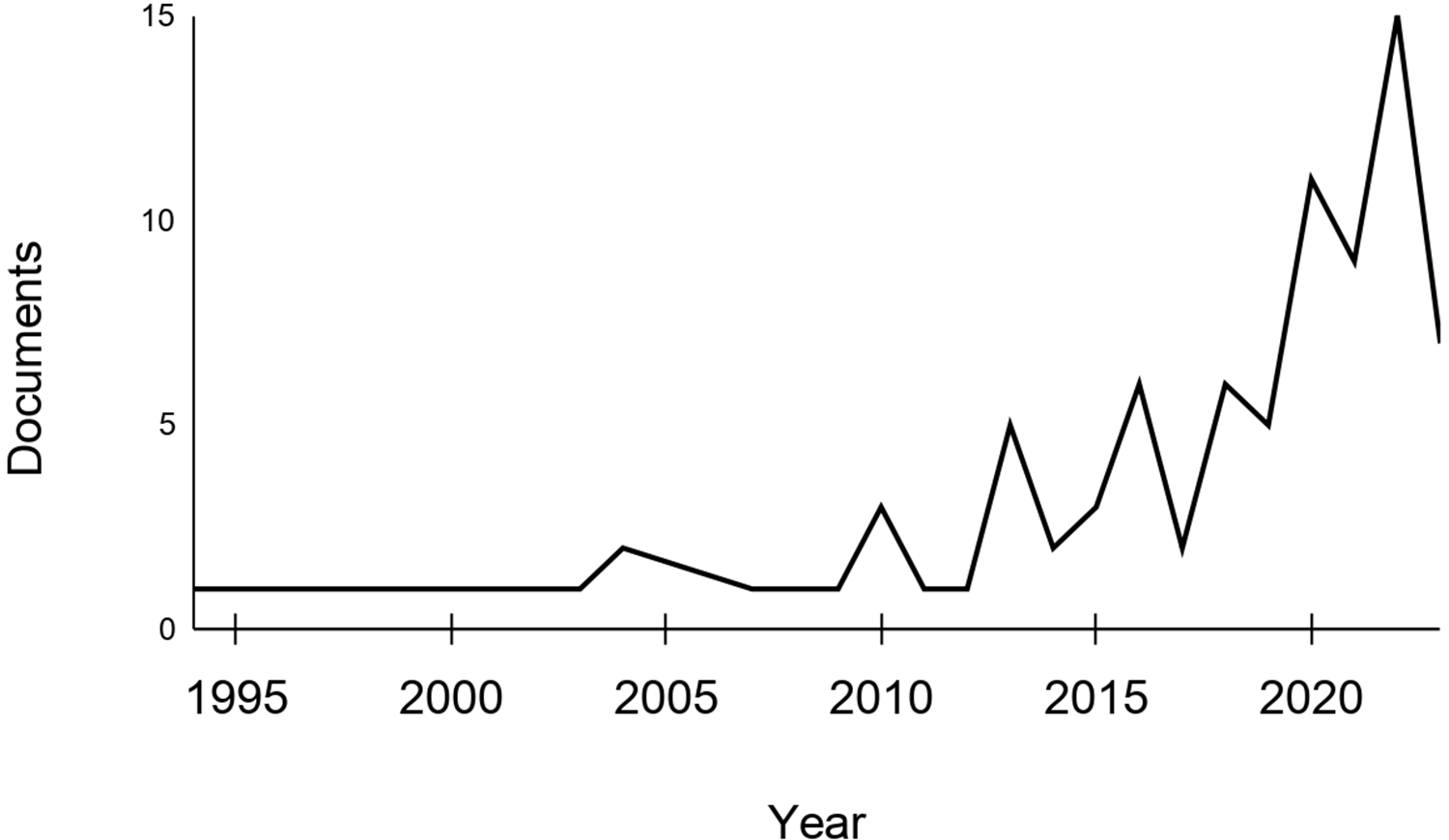
The USA emerged as a leader in this research area, contributing with 18 articles (21.7%), followed by China with 14 articles (10.8%). Other European and Asian countries (Germany, United Kingdom, Japan, Italy, and Norway) contributed fewer than 10 articles each. Among the top 10, Brazil and Mexico were the only Latin American countries with three documents each. The annual publication trend showed a 6.94% increase from 1994 to 2023, indicating a growing interest in this research area. Notably, 2022 had the highest number of publications, with 22 documents, followed by 2020 with 11 articles, and 2021 with 9 articles, illustrating a peak period of scholarly activity (Figure 1). However, in 2023, the number of publications declined, with only seven documents published on this subject.
Annual global publications on the digestive tract microbiota of pinnipeds and cetaceans in the Scopus database.

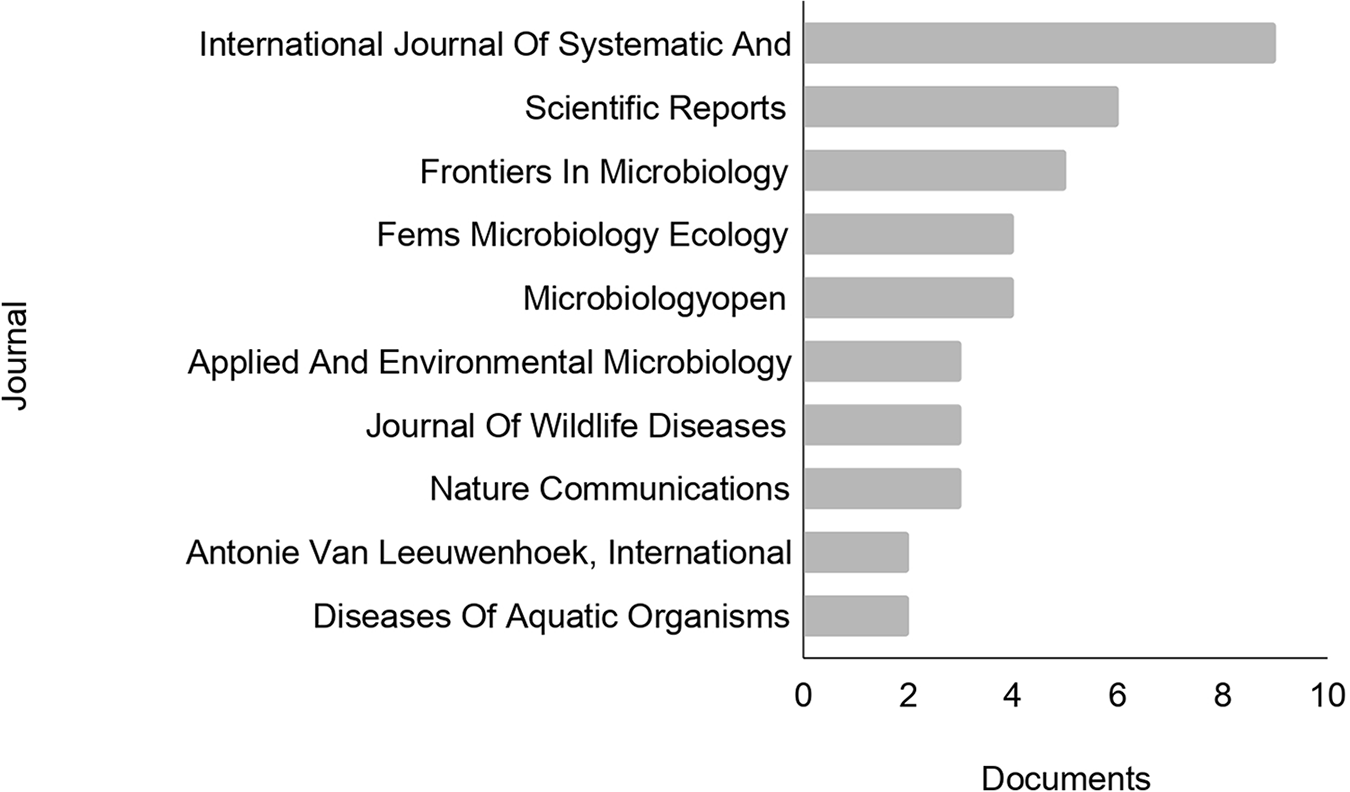
Regarding the sources of publications, the International Journal of Systematic and Evolutionary Microbiology leads the number of publications on the topic with nine documents, followed by Scientific Reports with six documents. The remaining top 10 sources included between 2 and 5 publications related to the topic in pinnipeds and cetaceans (Figure 2). The majority are not primarily focused on marine mammals or aquatic ecosystems alone, but rather publish research based on microbiological or disease studies in various animal groups.
Top 10 most relevant sources where the study documents on gut microbiota in marine mammals were published.

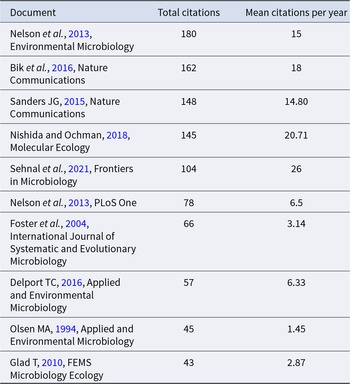
The bibliometric measures related to citations, the top 10 most cited articles from our study are shown in Table 2. These were published between 1994 and 2021, with the article ‘Diet and phylogeny shape the gut microbiota of Antarctic seals: A comparison of wild and captive animals’ by (Nelson et al. Reference Nelson, Rogers, Carlini and Brown2013), being the most cited with 180 citations. Furthermore, the annual average number of citations was maximum in the article entitled ‘Rates of gut microbiome divergence in mammals’ by Nishida, A.H. & Ochman, H. which achieved a rate of 20.41 citations per year (Table 2).
Top 10 most cited documents on digestive microbiota of pinnipeds and cetaceans, total citations, and citations per year

The co-authorship network between countries differentiated six distinct groups: the USA and China, which published the highest number of documents on the topic and shared some co-authorships; Norway and Italy linked to the USA; Argentina and Australia; a group composed by Spain, Portugal, and Puerto Rico linked to the previous group and to Germany. Another group included the Czech Republic, Austria, and Germany also linked to the USA; and finally, a group formed by the United Kingdom and Chile (Figure 3).
Co-authorship network between countries in documents on gut microbiota in marine mammals published in Scopus.

Concerning the analysis of the different objectives of the articles, they were classified into four main groups: characterization, characterization and comparison, bacterial isolation, and others. Within these main categories, specific subcategories related to the particular objectives of the documents were identified (Figure 4). For the characterization and comparison category, 37 articles were recorded. Among them, a large proportion (10 articles) conducted a taxonomic characterization and compared different species, while others included comparisons across various environments (8 articles), age classes (7 articles), between intestinal regions (5 articles), organs (4 articles), between wild and captive animals (3 articles), among others. In the characterization category, 13 out of 17 articles performed taxonomic characterizations of microbial structures, three articles also detected pathogens, and one analysed the phylogenetic composition. Regarding bacterial isolation (17 articles), the majority of the publications focused on isolating specific bacterial strains (12 articles). Finally, in the ‘Others’ category (12 articles), there was a diversity of unique specific objectives, with the search for a specific bacteria being the only objective repeated in two articles within this category (Figure 4, Supplementary Table S1)
Scope of the 83 studies classified in 4 categories and specific subcategories. Font size variation reflects the frequency of each subcategory in the publications.

These diverse topics are reflected in the keyword co-occurrence network through terms such as ‘bacterium isolate’, ‘gut microbiota’, and ‘gastrointestinal tract’ (Figure 5). The co-occurrence network was formed by 89 keywords with a minimum of 5 occurrences each. Among all, the keyword with the highest occurrence was ‘animal’ followed by ‘16S RNA’. Four clearly defined groups were evident, and one group comprised words associated with taxonomic groups and a cetacean species (Tursiops truncatus). Another cluster is more related to pinnipeds and topics associated with the 16S rRNA gene, DNA sequences, bacterial isolation, phenotypes, and other molecular terms. The third cluster is associated with bacteria of the gut microbiome, integrating different bacterial phyla and terms related to the biodiversity of this structure, with ‘microbiota’ and ‘bacteria’ being central terms (Figure 5).
Co-occurrence keyword network on gut microbiota publications obtained in the scopus search with its clusters differentiated by colour.

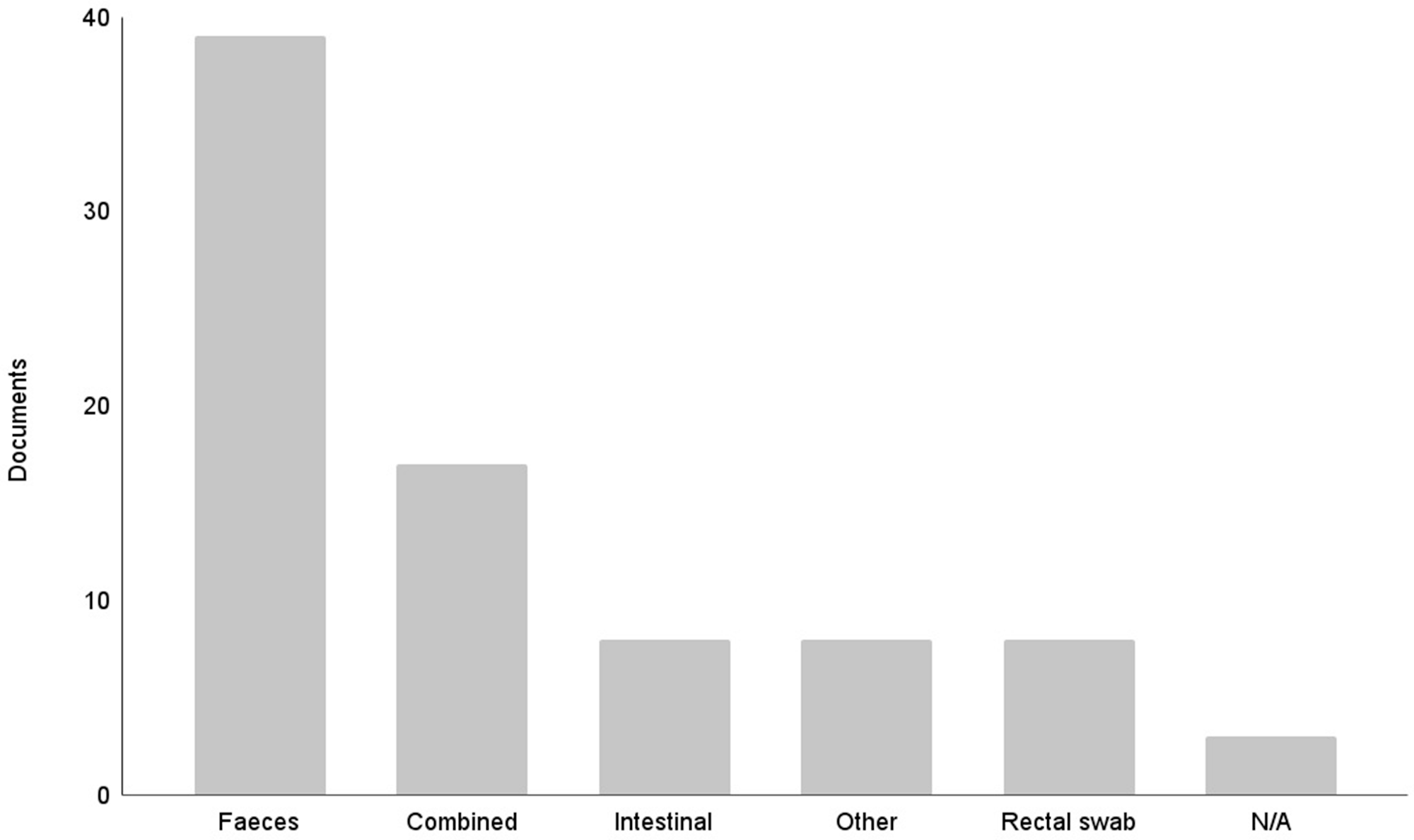
The in-depth analysis of the 83 articles revealed that the most studied species were Phoca vitulina (19 articles), and Tursiops truncatus (13 articles) among a total of 48 species. Many of these articles also included other species, mainly Pinnipeds (20 species). Specifically, Zalophus californianus, Leptonychotes weddellii, Mirounga leonina, and Neophoca cinerea were each studied in four documents (Figure 6), while other species were present in three or fewer articles. Additionally, 3 out of the 83 documents did not mention the species studied; they were simply characterized as dolphins, seals, or marine mammals in general, without identification. The detailed analysis of each publication also allowed to determine the study area (i.e., country, or region where the marine mammals were analysed). The majority of the studies were conducted in the United States (15 articles) and China (14 articles). Australia gathered 7 articles, the Antarctic 6, Mexico and Japan (4 articles each), while Europe was represented by Germany (6 articles), Portugal and Italy (3 articles each), among other countries, South America mainly by Brazil and Chile (3 articles each) (Figure 7 and Supplementary Table S1). Regarding the origin of the samples used to analyse microbiota in the selected documents, a vast majority utilized faecal samples (n = 39), combined studies (17 articles), intestinal samples (8 articles), rectal swabs (8 articles), others (8 articles) and N/A (3 articles) (Figure 8 and Supplementary Table S1). The majority of the studies analysed the microbial structure in wild animals (n = 36, 43.4%), 18 documents (21.7%) used captive marine mammals, 16 (19.3%) dead stranded animals, 9 compared wild and captive animals (10.8%), while 4 (4.8%) were data analysis or reviews. Concerning sample sizes, studies ranged from analyzing gut microbiota of 1 individual marine mammal to 549. However, more than half of the studies (54%) analysed less than 20 animals (in 10 studies only one), and sample numbers higher than 100 corresponded to faecal samples or combined faecal with another sample origin (Supplementary Table S1).
Species studied in the different articles about gut microbiota. Species studied in less than three documents were grouped under the category ‘other species’.

Countries or regions where the studies were conducted in the analysed documents. The circle size is proportional to the number of documents, ranging from 1 to 15.

Origin of the samples used to sample marine mammals microbial characterization in the articles selected in this study.

Studies on gut microbiota in marine mammals have followed various approaches and methodological strategies depending on their specific objectives. One widely used approach is the taxonomic characterization of microbial communities through high-throughput sequencing of 16S rRNA gene regions, allowing for the identification of microbiome diversity and composition of the individual or species. The most commonly used regions for these analyses in marine mammals, are the V3–V4 regions (e.g., Bai et al., Reference Bai, Zhang, Lin, Lin, Yang and Li2021; Indrawati et al., Reference Indrawati, Safika, Ningrum, Aulia, Maheshwari and Andriyono2023; Wan et al., Reference Wan, Li, Ao, McLaughlin, Fan, Wang and Zheng2023). However, other authors have used other regions such as V2, V5, V6, V7, V8, and V9 (e.g. Cicala et al., Reference Cicala, Ramírez-Delgado, Gómez-Reyes, Martínez-Porchas, Rojas-Vargas, Pardo-López and Licea-Navarro2022; Ramirez-Delgado et al., Reference Ramirez-Delgado, Cicala, Gonzalez-Sanchez, Avalos-Tellez, Solana-Arellano and Licea-Navarro2022). Other studies have focused on the isolation of specific bacteria or group of bacteria, combining biochemical and phylogenetic analyses for their identification and functional characterization (e.g., Hoyles et al., Reference Hoyles, Pascual, Falsen, Foster, Grainger and Collins2001; Foster et al., Reference Foster, Holmes, Steigerwalt, Lawson, Thorne, Byrer, Ross, Xerry, Thompson and Collins2004; González et al., Reference González, Villanueva, Latif and Fernández2009). Additionally, some studies have employed advanced techniques such as cryo-electron transmission microscopy and tomography, along with micromanipulation and genomic DNA sequencing, to examine microbial structures in detail (e.g., Dudek et al., Reference Dudek, Galaz-Montoya, Shi, Mayer, Danita, Celis, Viehboeck, Wu, Behr, Bulgheresi, Huang, Chiu and Relman2023).
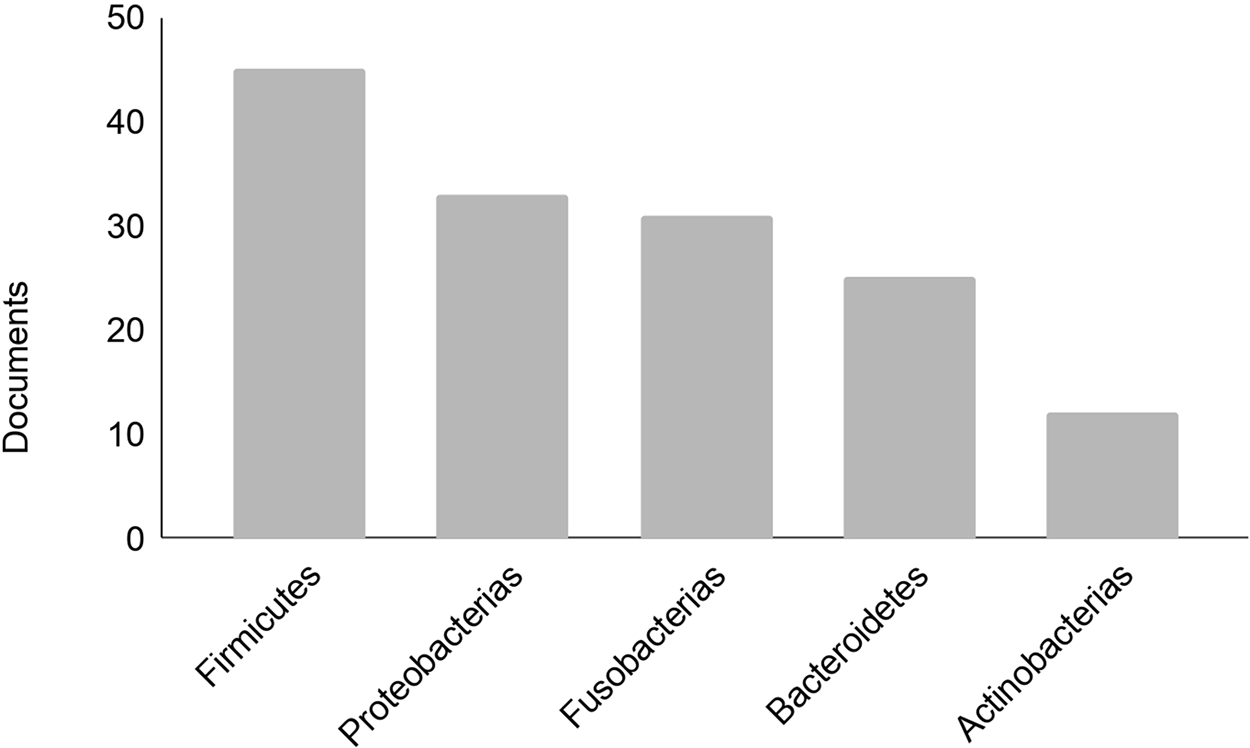
The five main phyla found in the microbial structures of pinnipeds and cetaceans were Firmicutes, Proteobacterias, Fusobacterias, Bacteroidetes, and Actinobacterias, the first two being the most abundant, with more than 30 publications (Figure 9, Supplementary Table S1). Similarly, approximately 30 articles mentioned pathogen bacteria, where the genera Campylobacter, Shewanella, Edwardsiella, and Escherichia/Shigella were the most mentioned.
The five most abundant phyla found in the selected articles about gut microbiota in pinnipeds and cetaceans.

Discussion
Bibliometric measures
The analysis of 83 articles retrieved from Scopus database, reveals a growing body of research on the digestive microbiota of pinnipeds and cetaceans, spanning from 1994 to 2023. This highlights the increasing interest and progress in studying microbiota of the digestive tracts of pinnipeds and cetaceans, as reflected by an annual growth rate of 6.9%, underscoring the expanding attention to this research area.
This analysis showed an increase in the number of publications related to intestinal microbiota in cetaceans and pinnipeds over the past decade. A similar trend was observed in studies linking intestinal microbiota with various diseases in humans (Xiuqing et al., Reference Xiuqing, Hu, Deng, Tan, Qiu, Zhang, Ni, Lu, Wang, Li, Chen, Huang, Xiao, Shang and Wen2021; Zyoud et al., Reference Zyoud, Shakhshir, Abushanab, Al-Jabi, Koni, Shahwan, Jairoun and Abu Taha2022) coinciding with publications on marine mammals in South America (Szteren and Lercari, Reference Szteren and Lercari2022), fisheries (Aksnes and Browman, Reference Aksnes and Browman2016), and general ocean science publications trends (IOC-UNESCO (Intergovernmental Oceanographic Commission, United Nations Educational, Scientific and Cultural Organization), 2020; Moya-Anegón and Herrero-Solana, Reference Moya-Anegón and Herrero-Solana1999; Pan et al., Reference Pan, Kaski and Fortunato2012)
Studies concerning all topics related to microbiota peaked during 2020–2022, suggesting an progress in this field, potentially driven by advancements in sequencing technologies and an enhanced awareness of microbiome research. These approaches are evolving rapidly, driven by advances in biomedical research and growing interest in marine animals and environmental changes. Key developments in the field include innovations in computational and metagenomic tools, advanced microscopy techniques, and experimental studies in advanced facilities (Apprill, Reference Apprill2017). However, the number of publications decreased from a peak of 22 in 2022 to 7 in 2023. This decrease contrasts markedly with the previous upward trend, which may be due to two possible and non-excluding causes: Maybe publications from 2023 were not yet available in Scopus in March 2024, when this analysis was carried out, or a simple variability in the number of publications. We rule out any shift in research focus that might have influenced the number of studies conducted and published, as this is a novel and rapidly increasing field of study with many areas yet to be explored. However, the overall trend over the years reflects a sustained and growing interest in marine mammal microbiome, providing valuable insights that contribute to marine biology, ecology, and conservation. Continuous monitoring of editorial trends would be essential to understanding these dynamics.
Comparing the authors’ countries with the countries where the studies were conducted, we found a notable similarity: the top four countries, USA, China, Germany, and Australia, were the same in both cases. However, the authors’ affiliations spanned 32 countries, including Austria, Puerto Rico, Czech Republic, among others, while the studies were conducted in 22 countries or regions. This discrepancy may be due to research in Antarctica being carried out by scientists from several countries, as well as international collaborations among research groups from different nations.
The dominance of the USA and China and the representation of all the continents in publishing on this topic highlight the global nature of this research. However, the low representation of African and Central American authors is remarkable. Furthermore, a comparison of the number of scientific publications on marine mammals among South American countries concluded that it was directly related to the countries budgets allocated to research and development and their GDP (Szteren and Lercari, Reference Szteren and Lercari2022). Notably, both the USA and China have the highest GDP globally (World Bank, 2024)). The dominance of these countries in this area of research is consistent with their substantial investments in scientific research and infrastructure (Moya-Anegón and Herrero-Solana, Reference Moya-Anegón and Herrero-Solana1999; Pan et al., Reference Pan, Kaski and Fortunato2012). The presence of Brazil and Mexico among the top contributors from Latin America, although having fewer publications, indicates emerging research efforts in this region. Furthermore, they are also countries with high GDP (World Bank, 2024). International collaboration plays a significant role in advancing this field. Collaborative networks, such as those between the USA and China, and among European countries, enhance the diversity and depth of research through sharing resources, expertise, and data.
The most influential works in the field with a high number of total and annual citation rates, highlight key insights or methodological improvements in understanding gut microbiota of marine mammals, that have propelled further research.
Research focus and methodologies
The diverse range of study topics, from microbial characterization in single species to comparative studies and bacterial isolations, reflects the complexity and depth of research in this area and reveals key trends in microbial research. Among these categories, the characterization and comparison was the largest (37 articles), revealing a focus on understanding microbial diversity across different contexts. Notably, interspecies comparisons accounted for the largest proportion within this group, indicating the significance of phylogenetic assessments in microbial ecology. Comparisons of microbial communities across various environments and age classes suggest the interest in understanding how external and host-related factors shape microbial diversity, and comparisons across intestinal regions, organs, and between wild and captive animals highlight the potential influence of environmental and physiological factors. Secondly, the characterization category (18 articles) further reinforces the importance of taxonomic assessments and the detection of pathogens indicates the practical relevance of microbial characterization for disease monitoring and epidemiology. In this context, the identification of key phyla and pathogenic genera provides valuable insights into the microbial diversity and potential health implications for these species. Firmicutes, Proteobacteria, Bacterioidetes, and Fusobacteria were the most abundant phyla, consistent with findings in other mammalian microbiome studies (Cicala et al., Reference Cicala, Ramírez-Delgado, Gómez-Reyes, Martínez-Porchas, Rojas-Vargas, Pardo-López and Licea-Navarro2022; Nelson et al., Reference Nelson, Rogers, Carlini and Brown2013, Reference Nelson, Apprill, Mann, Rogers and Brown2015; Olmstead et al., Reference Olmstead, Mathieson, McLellan, Pabst, Keenan, Goldstein and Erwin2023; Pacheco-Sandoval et al., Reference Pacheco-Sandoval, Lago-Lestón, Abadía-Cardoso, Solana-Arellano and Schramm2022; Wan et al., Reference Wan, Li, Ao, McLaughlin, Fan, Wang and Zheng2023), and indicating their crucial role in marine mammals intestinal ecosystems. A comparison between 151 mammals reported a significantly greater average relative abundance of the phylum Fusobacteria in marine carnivore species in comparison with terrestrial mammals (Nelson et al., Reference Nelson, Rogers, Carlini and Brown2013). The presence of pathogens such as Campylobacter, Shewanella, and Escherichia/Shigella in approximately 30 articles, highlights the importance of studying the microbial composition, not only to characterize it but also to evaluate the main agents affecting the health of marine mammals. This suggests an avenue for future research focused on understanding the health implications of these bacteria in marine mammals. The analysis of phylogenetic composition demonstrates a niche interest in evolutionary microbial dynamics. Third, the bacterial isolation category (17 articles), reflects a continued interest in identifying novel bacteria, exploring their functional roles, and harnessing their biotechnological or therapeutic potential. Isolating bacterial strains remains a crucial step in elucidating microbial physiology and interactions, which is fundamental for both applied and basic research. Finally, the ‘Others’ category (11 articles) encompasses a diversity of topics, suggesting that there are also unique, specialized investigations addressing particular microbial phenomena. This highlights the evolving and interdisciplinary nature of microbial studies, which increasingly integrate novel methodologies and address emerging questions in microbial ecology and host–microbe interactions.
In addition, the variation in sample sizes and origins further illustrates the multifaceted approach to understanding marine mammal microbiota. Studies conducted on faeces and intestinal samples dominated compared to studies on other tissues or gastric fluids. On the other hand, analyses of the intestine in marine mammals are still scarce, maybe due to the difficulty in obtaining samples because of the ecology and habits of many species (Bai et al., Reference Bai, Zhang, Lin, Lin, Yang and Li2021; Bik et al., Reference Bik, Costello, Switzer, Callahan, Holmes, Wells, Carlin, Jensen, Venn-Watson and Relman2016; Medeiros et al., Reference Medeiros, Giongo, Valdez, Blaese De Amorin, Tavares, d’Azevedo, Franco, Frazzon and Frazzon2016; Sehnal et al., Reference Sehnal, Brammer-Robbins, Wormington, Blaha, Bisesi, Larkin, Martyniuk, Simonin and Adamovsky2021). Sampling wild live animals poses a challenge due to the logistics of capturing, sedation and restraint of an adequate sample number of animals (Nelson et al., Reference Nelson, Apprill, Mann, Rogers and Brown2015), specially for oceanic species. In this sense, faecal samples and sampling of stranded or captive animals are the most frequent methods. Higher sample numbers were usually associated to faecal samples or stranding events. Faecal samples are widely used due to their non-invasive and easily accessible nature, particularly in both captive and wild conditions. The predominance of faecal samples as the primary source for microbiota analysis is consistent with common practices in microbiome research, emphasizing the practical considerations in sample collection (Medeiros et al., Reference Medeiros, Giongo, Valdez, Blaese De Amorin, Tavares, d’Azevedo, Franco, Frazzon and Frazzon2016). Intestinal samples provide critical insights into the gut microbiota suggesting a need for more integrative approaches that combine various sample types to achieve a more comprehensive understanding of the microbiome (Medeiros et al., Reference Medeiros, Giongo, Valdez, Blaese De Amorin, Tavares, d’Azevedo, Franco, Frazzon and Frazzon2016; Marón et al., Reference Marón, Kohl, Chirife, Di Martino, Fons, Navarro, Beingesser, McAloose, Uzal, Dearing, Rowntree and Uhart2019; Tian et al., Reference Tian, Du, Lu, Han, Wang, Li and Guan2020).
The wide range of species studied, although in few documents, demostrates the diversity within marine mammal research interests and highlights the importance of broadening the scope to less-studied species to gain a comprehensive understanding of marine mammal microbiomes. The majority of the studies were conducted on Pinnipeds (ca 57%), probably because it is easier to collect samples, especially faeces, which was the most common source analysed. The greater focus on Phoca vitulina and Tursiops truncatus aligns with their status as common and well-studied marine mammals. This could be attributed to the wide distribution of both species: P. vitulina can be found in the Atlantic and Pacific Oceans of the northern hemisphere (Burns, Reference Burns, Perrin William, Bernd and Thewissen2009), while T. truncatus are distributed in nearly all template and warm waters of the world (Leatherwood and Reeves, Reference Leatherwood and Reeves1990), this implies that their distribution includes many countries. The bottlenose dolphin is one of the most extensively studied species in microbiota research and has increasingly been used as a model species for publications addressing other topics (Jarić et al., Reference Jarić, Knežević-Jarić and Gessner2015). Additionally, these species are readily available for sampling due to their frequent presence in captivity. Their coastal habitats further facilitate sample collection in the wild.
The absence of some widely studied species such as Callorhinus ursinus, Pontoporia blainvillei, Orcinus orca, or other Phocoenids, as well as studies from some geographic regions, reflect that there are still important gaps in gut microbiome research. For example, no study was conducted in Africa or Central America, only one in Oceania and few (n = 4) in Asian and South American countries. Future research should aim to expand the range of species studied, enhance methodological approaches to sample collection and analysis, and foster international collaborations to address gaps in knowledge. Additionally, we identified a recent trend in the objectives of the documents in our study, observing that the most recent studies focus on characterizing and taxonomically comparing microbial structures. This contrasts with early publications, where the main objective was to isolate and identify individual bacteria. Probably, advances in metagenomic tools, especially massive sequencing, which enable the characterization of entire microbial structures, are filling various knowledge gaps related to marine mammals microbioma. Concerning the methodological approaches used for the study of marine mammal gut microbiota, high-throughput sequencing of 16S rRNA gene regions, particularly V3–V4, is the most common for taxonomic characterization, though alternative regions are also used. Bacterial isolation studies combine biochemical and phylogenetic analyses to identify and characterize specific strains, while advanced techniques like cryo-electron microscopy and genomic sequencing provide deeper structural and functional insights. The integration of these methods highlights the need for a multifaceted approach to better understand microbial diversity and host–microbe interactions in marine mammals. In this sense, implementing existing standardized protocols for sample collection, handling, and preservation can increase the scientific value of biological samples, enhance their quality, facilitate collaboration across institutions and comparisons (Van Cise et al., Reference Van Cise, Switzer, Apprill, Champagne, Chittaro, Dudek, Gavery, Hancock‐Hanser, Harmon and Jaffe2024). Sequencing methodologies and sampling techniques should be standardized to minimize variability in microbiome research (Sehnal et al., Reference Sehnal, Brammer-Robbins, Wormington, Blaha, Bisesi, Larkin, Martyniuk, Simonin and Adamovsky2021). Increasing the number of replicates would be essential to achieve more robust conclusions at the population or species level.
Finally, exploring the functional roles of identified microbiota and their interactions with host physiology, health, and environmental factors remains a critical area of interest (Marchesi et al., Reference Marchesi, Adams, Fava, Hermes, Hirschfield, Hold, Quraishi, Kinross, Smidt, Tuohy, Thomas, Zoetendal and Hart2016). Integrative studies combining genomics, proteomics, and metabolomics can provide deeper insights into the functional implications of gut microbiota in marine mammals. For example, Miller et al. (Reference Miller, Holm, Horstmann, George, Fredricks, Van Mooy and Apprill2020) integrate lipidomics and microbiota analysis, combining multiple disciplines, such as marine ecology, microbiology, and biogeochemistry, to reveal the crucial role of gut microbes in bowhead whale digestion and their impact on marine nutrient cycles. The findings emphasize the importance of an interdisciplinary approach to understanding gut microbiota in marine mammals. Describing the microbiome remains challenging due to sequencing limitations, incomplete taxonomic databases, and difficulties in identifying unknown genes. Despite these obstacles, continued investment in this research area is essential for advancing our knowledge and informing conservation and management strategies for marine mammals. Our results demonstrate that the study of gut microbiota in marine mammals is a dynamic and expanding field that continues to evolve, offering significant insights into marine mammal microbiomes and enhancing our understanding of these complex systems.
Supplementary material
The supplementary material for this article can be found at https://doi.org/10.1017/S0025315425100258.
Data availability
The authors confirm that the data supporting the findings of this study are available within the article and in the supplementary material.
Author contribution
D.B.S.: data curation, data analysis, investigation, writing and editing; D.S.: conceptualization, supervision, writing and editing.
Funding
D.B.S. acknowledges PEDECIBA Biología postgraduate program and the Agencia Nacional de Investigación e Innovación (ANII) for the postgraduate scholarship (173681). We are grateful to Universidad de la República (Uruguay), which provides researchers free access to the SCOPUS database and to Dr Diego Lercari for his help in data analysis.
Competing interest
The authors declare no conlicts of interest.
Ethical standards
This article did not require any research permit.