1. Introduction
Environmentalist and sound artist David Dunn suggests that ‘we require new modes of experience that can help recover those aspects of human integrity that are rooted in a fundamental sense of connectedness with the non-human world’, and that this demand ‘not only requires a heightened awareness of the role of art and the artist but of the very metaphors we use to organize reality’ (Dunn Reference Dunn1997: 4, my italics). I concur, but would go further, in my belief that through considering those very metaphors as a means of engagement – with the listener, in the case of sound-based work – artists might invigorate that sense of connectedness that Dunn finds fundamental to new modes of experience.
Some of these metaphors are what I would like to pursue here, with especial regard to ‘place’, and with reference to some sound-based works. In this particular investigation I am focusing neither on listening metaphors per se, nor on theories of listening in relation to works of art that use recognisable environmental sound. Listening theories and metaphors of this kind are of course highly significant in engaging with work about, and made from, environmental sound, and such theories remain an important part of my own (and many others’) previous research (Norman Reference Norman1996; Norman Reference Norman2004). But, here, I want to draw on an interdisciplinary thread – between sound-based music and ways of thinking, outside music, about place and perception. I am interested in how such compositions might, somehow, call on those place-making metaphors we collectively understand to the extent that we exploit them unthinkingly in our routine engagement with the environment. My only points of disagreement with Dunn are, firstly, that the required ‘modes of experience’ that these metaphors (such as those to do with place) might invigorate are probably not ‘new’ at all: they are so familiar as to be invisible in our everyday encounters with the environment. And secondly, for me, that environment includes – and must include – consideration of both human and non-human sonic activity, as already inseparably fused and interconnected. It is, I feel too easy to take the intellectually utopian route, assuming that (a) the possibility of separating human and non-human ‘worlds’ is either physically or philosophically achievable and (b) this is the preferable state for resuming a ‘connectedness’ with ‘the environment’ (expressed as somehow out there, rather than here with, and within, us). This premise – to separate non-human from human as some kind of idealistic preservation of the former – is unrealistic even to those who propound it: it takes a romantic rather than a practical stance. And transferred to the acoustic environment it proselytises for a ‘desirable’ human listening experience being one that engages with a sonic world untroubled – untainted – by the more challenging sonic (and social) complexities of human presence, in particular the presence of industrial, mechanical or otherwise ‘unnatural’ (that is, fabricated through human endeavour) sound. Given that life is never ‘all or nothing’ and that heightened awareness is ill served by eradication, this can become an unhelpful form of censure. Besides, many of the sounds that disrupt, change or otherwise enliven the sonic environment are the result of human connectedness – people being in place together. An environment denuded of the sonic artefacts of social discourse is just as disquieting to contemplate as one where a natural environment is removed through insensitive actions and uncontrolled human activity. Perhaps learning to interconnect in a responsive ‘self-educating’ manner requires human presence to take the stage.
The three works I've chosen to explore in the course of this writing are Steven Feld's Rainforest Soundwalks (2001), David Monacchi's Integrated Ecosystem (Reference Monacchi2009) and Francisco López's La Selva (Reference López1998a). In each, the lived body is present, in differing ways: physically through performance (Monacchi) or implicitly, through the ways the sound environments are shaped (Feld), or through occasional vestigial sounds of human presence, and a focus on human perception (López). Each work is made from rainforest recordings – recorded by the artists, each in a different part of the world. The dense sound environments are compelling to anyone interested in the aural, and are for many listeners extraordinary to the point of ‘exoticism’, and widely appreciated as from a ‘fragile’ environment, both culturally and physically under threat from human activity – deforestation and insensitive farming, for instance. These aspects, I think, actually place a barrier between the listener and the environment that the composer wants to convey as a ‘place’, because installing a sustained sense of knowing a place in your listener requires his or her commitment to a, somehow, familiar environment. It is easier to elicit this commitment when art is embedded and physically encountered in the places that we feel we already ‘know’, and yet the rainforest is for most of us a long, long way away.
1.1. Make yourself at home: putting ‘place’ in place
Although if asked we might provide a rudimentary definition of place as relating to a known locale or region, we do also commonly understand the additional, perhaps fundamental, definition of place as – to adopt philosopher Edward Casey's term – a ‘gathering’ (Casey Reference Casey1996: 38) of feeling, memories and habitual actions: we usher friends into our house, urging them to make themselves ‘at home’, with the implication that they should feel free to behave as they would in a place in which feelings of safety, relaxation and pleasant memories are gathered, for them – where they, habitually, simply ‘live’. Whether we truly expect (or want) our party guests to loosen their trousers, pick their noses and turn the TV to the sports channel is less important than the fact that this little snippet of linguistic social coding acknowledges ‘place’ as not inherent to the external environment, but to what we make of it.
Whereas space is delineated by extent (even if infinite), a place begins and ends with a relationship between the perceiver and the perceived. So, I measure whether there is sufficient space for my new piano against the sitting room wall, but the place where I bought it is defined by lived experience, an experience that in addition to the parsing of sensory data includes entering the showroom, talking to the owner, trying out the instruments, and writing a cheque for a terrifyingly large amount. Emotions are meshed with sensory perception, creating a place to which I can return in memory – re-inscribing the place in mind from time to time. The question is, can sound-based music and art elicit the same kinds of investment through, somehow, encouraging place-making metaphors?
1.2. Some metaphors of place and place making
Here I would like to pull just a few conceptual threads from Casey's comprehensive examination of place, situated within the phenomenological tradition, in preparation for considering sound-based music and art in relation to place and – perhaps more importantly – place making. These specific ideas each relate to the perceiving body within, with and as part of place.
-
1. Place – how we sense and make it – is a process. We move, and in moving create place; ‘places not only are, they happen’ (Casey Reference Casey1996: 27). The amassing of knowledge that forms a sense of ‘place’ requires our lived experience, and so requires a bodily presence ‘being’ in’ an environment (even if in metaphorical terms).
-
2. That articulated human body that is both emplaced and ‘making place’ through its movement in an environment, is itself in movement – ‘even if stationary the articulate body (fingers, thumbs etc) is moving’, and so the body is ‘basic to place and part of place’ (both Casey Reference Casey1996: 24).
-
3. And through this dynamic relationship, Casey asserts, bodies and places ‘interanimate each other’ (Casey Reference Casey1996: 24). Casey is here positioning the body – living, moving and constantly experiencing – as vital to the existence and continuation of place, and places in turn as vital to the existence and continuation of lived experience.
-
4. If perception is essential to an understanding of ‘place’ then perception must have an ‘ingredient’ that conveys place – Casey teases apart the notion that ‘emplaced’ perception must contain a kind of place-making quality from the start, so ‘we are surrounded by depths and horizons of perceptional experience, rather than in a confusing kaleidoscope of free-floating sensory data’ (Casey Reference Casey1996: 17). Casey's perusal of the role of perceptual horizons in place-making activity (which I discuss further, in relation to the works under consideration, in section 5) rests on a view that perception is never without both cultural and social components, embedded in the lived body that does the perceiving.
-
5. We are both ‘with’ and ‘in’ place. While places are something that we form through perceptual experience, and in which we move, they are not external to us: they enter and form us through our being in the environment. Casey also regards our sense of ‘withness’ (citing A.N. Whitehead) as ‘critical’ to our experience – ‘responsible for the body's unique contribution to our experience of the world in general and of place in particular’ (Casey Reference Casey1997: 214). Whitehead's evocative, perhaps intuitively comprehensible, concept of ‘withness’ concerns the awareness by the perceiving body of both its experientially infused perceiving activity and its position in the landscape of perceived objects. (It is somehow difficult to describe this without veering unhelpfully into Cartesian mind–body dualities.) As Whitehead has it, in this reflexive relationship ‘we see the contemporary chair, but we see it with our eyes; and we touch the contemporary chair, but we touch it with our hands. Thus, colours objectify the chair in one way, and objectify eyes in another way, as elements in the experience of the subject’ (Whitehead Reference Whitehead1978: 62–3).Footnote 1
2. Mapping place: places not only are, they happen
In claiming place making as part of perception, by a body that is emplaced by its perceptual activity and its physical movement (discernible physical movement or its analogs in the human body's construction, and also imaginative and emotive movement), Casey clearly aligns place making with our ‘mapping’ of the environment – how we make sense of the world. And since our mappings of place often, quite literally, come from our movement within the environment it is already hard to avoid hearing a variety of ecological messages resonating from these images of place and place making, viewed through a phenomenological lens.
Social anthropologist Tim Ingold also posits ‘the world of our experience’ as ‘a world suspended in movement, that is continually coming into being as we – through our own movement – contribute to its formation’ (Ingold Reference Ingold2000: 242).Footnote 2 And the difficulty for the artist wanting to explore metaphors of the ‘world of experience’ from which we make place is that, in real life, our ‘immersion’ in a place often comes from an accretion of apparently trivial experiential knowledge, gained unthinkingly. I do not decide to ‘make’ places when I relocate to a new town but gradually, through quotidian, knowledge-gathering movements, begin to map them, through my connection to them: the dog-walking fields; the market with the excellent bread stall; the road with the terrible potholes. While I think it is no accident that ‘soundscape compositions’ seeking immersive listening experiences frequently use surround-sound or eight-channel presentation to encompass the ‘static’ listener, my feeling is that there is equal value in finding ways to encourage listeners to participate in ‘making place’, so that they might feel that place is ‘happening’ to them, and because of them, through their movement in the world.
Steven Feld's Rainforest Soundwalks are carefully crafted from his recordings of the rainforest environment in the foothills of Mount Bosavi, Papua New Guinea. The four tracks are each around 15–16 minutes in duration, all but one named for a time of day – morning, afternoon, night (Feld Reference Feld2001).Footnote 3 While called ‘soundwalks’ they are not intended to represent a physical walk, and nor is there an aural human presence. Instead, Feld addresses the experiential ‘movement’ in mapping place metaphorically, saying ‘I call these tracks soundwalks because they focus on the organic experience of sound in motion through space and over time. As you listen, imagine a brief walk along a small stretch of rainforest trail. Listen to the way the sound moves around with you … You'll feel the heights and depths of the forest above and to the sides, as the figure and ground shifts … the acoustic density that Bosavi people so poetically call the “lift-up-over sounding” of the rainforest’ (Feld Reference Feld2001, CD liner notes).
‘Lift-up-over sounding’ (dulugu ganalan), the Bosavi term Feld cites regularly in his writing on how the indigenous people perceive their sound environment, has both spatial and temporal indications that Feld defines as relating to ‘the way all sounds necessarily co-exist in fields of prior and contiguous sound’ (Feld Reference Feld2005: 187). Feld sets out to create – ‘partially achieve’, as he puts it – this sensation in the Soundwalks ‘by mixing two to four pairs of stereo tracks, each originally recorded from slightly different forest heights and depths. The effect is to create something that is both acoustically transparent and hyperreal, a cross between soundscape documentary and electroacoustic composition’ (Feld Reference Feld2001: CD liner notes).
Can this bring us, listening, nearer to the place he knows, with a new ‘connectedness’ to this environment? As an anthropologist, linguist and musician, Feld's work arises from long familiarity with the Bosavi region – both its natural environment and its people, whose music he has collected separately. He is making work about a place he knows extremely well, and his desire is to convey his sense of that place to others, sharing his listening through sound. He knows well that the success of this exercise has less to do with the sounds themselves than with his experience – ‘my history of listening … over 25 years … a sonic way of knowing place, a way of attending to hearing, a way of absorbing’ (Palombini Reference Palombini2001).
Feld's invitation to hear and create ‘place’ through his listening ears, and his means of trying to move us nearer, recognises how metaphors of reality can furnish a compositional intent. Nevertheless, 25 years is a long while to have been listening and, moreover, any mapping of place continues in both individual memory and that tacit knowledge ‘remembered’ through generations of the indigenous community. Listeners have only 60 minutes of sound on CD, and given all the time in the world could never quite know the place Feld knows, just as Feld will never quite know the place the Bosavi people know – and he is the first to acknowledge that we, listening, will experience just ‘a touch of what I've encountered and tried to absorb’. Yet Feld accelerates the process of place making through his manipulation and representation of the environment, using metaphors realised in sound to bring the listener just that bit closer towards inhabiting his experience of place.
David Monacchi's work is characterised by several distinctive approaches, and is driven by ecological concerns. As in Feld's Rainforest Soundwalks, Monacchi's Integrated Ecosystem (one output from his much larger composition-research project, Fragments of Extinction) displays a consciousness of time – and time, of course, inflects one's sense of place. Whereas Feld is more concerned with conveying a particular ‘time of day’ (different in each walk) in a general sense, Monacchi scales the temporal rhythms of a single night – recorded over a continuous nine-hour period in the African primary rainforest – to the durational norms of a concert hall attention span, so making the nightly patterns of sonic activity apparent, and performable, to an audience.Footnote 4
Leaving aside the allure of the pristine, spatialised sound recording, and a sound environment that is itself enchanting through its novelty and variety (and leaving these aside only in order to attend to some other things), I think there are some interesting aspects to the way Monacchi both presents and performs the work, as well as in its – ostensibly quite straightforward – construction. I think that these aspects tend towards involving a listener in recognising ‘place-making’ metaphors. I think this tendency in turn draws listeners towards contributing ‘place-making’ activity – perceptually and emotionally – as part of their experience of the work and that this ultimately, perhaps, contributes to a heightened awareness of ‘place’ in relation to the sounds themselves. And from that comes an awareness of having a sustained connectedness to the ‘place’ the sound environment represents.
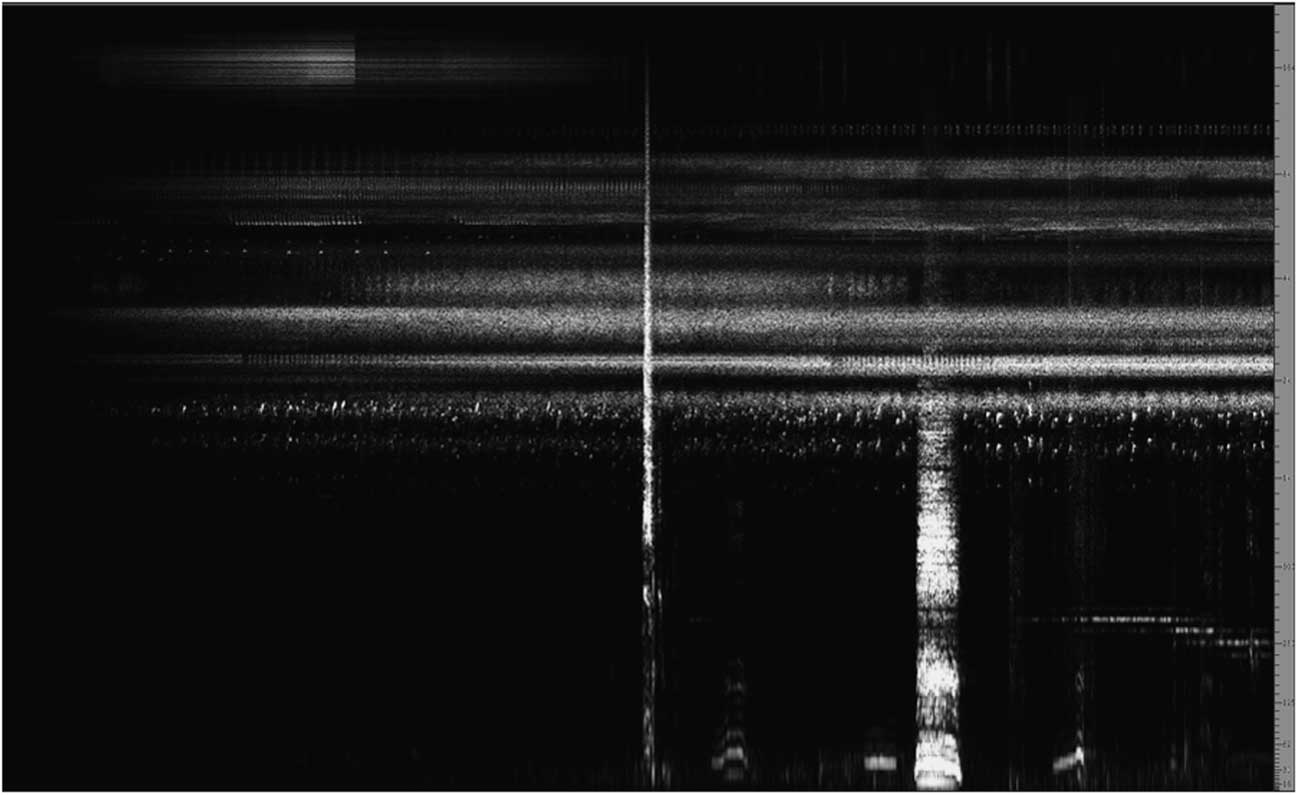
Monacchi forms two large sections from his material, the first a more documentary ‘time-lapse’ presentation of the entire nocturnal sequence, constructed from a simple cross-faded sequence of one-minute extracts taken from every 40 minutes of the original nine hours; the second a transformation of the recorded sound environment through live manipulation and additional live synthesis by Monacchi, working movement-triggered sensors with his hands – visibly, but without any particular flamboyance. Throughout the whole performance, a live spectrogram of the sonic environment is displayed to the audience, forming a kind of ‘living score’ (Movie example 1, and see Monacchi Reference Monacchi2011: 244–8 for a detailed description). Here I will make reference to a performance by Monacchi that I attended at the World Forum for Acoustic Ecology annual conference, October 2011. At this performance the visual display took up the entire back wall of a conventional ‘proscenium arch’ theatre's large stage, and Monacchi was seated visibly to the right of the stage, between audience and screen and in relative darkness.
The first of the two main sections of Integrated Ecosystem is ostensibly the ‘simplest’ for a listener to understand. The carefully selected sounds that make up a compressed chronology of one night's duration are presented as a continuous sequence. As the sounds issue from speakers, the spectrogram scrolls slowly, the display moving from right to left (Figure 1). The arrangement is synchronised so that each visual moment first comes into view at the point at which the moment in time it represents is heard, and this moment of time remains visible – moving on – as successive moments occur. So there is always a visual reminder of the sonic ‘continuity’ – and listening continuity – in keeping with the dense, continuous nature of the sound environment.
Spectrogram output from Integrated Ecosystem by David Monacchi

I think this live spectrogram, which is very much part of the performance, is actually quite a bit more than the ‘visual aid’ to our auditory focus that Monacchi feels it to be (Monacchi Reference Monacchi2011: 243). The presence of a carefully synchronised, moving image encourages a sense of ‘emplacement’ in, and from, the listener – by which I mean emplacement in the live ‘creation’ of the work, rather than the ‘place’ of the rainforest per se. Firstly we, listening, are simultaneously reading the score (even for an untutored listener, the spectrogram is straightforward enough to comprehend in conjunction with the sounds heard) and an environment replete with useful and relevant information is travelling towards us. Secondly, there is a silent ‘visual reverberation’ as recently heard sounds – along with our memories of very recent listening – progress across the visual and temporal field, eventually departing off screen, stage left; departing away from the performer, who is seated stage right. There is a clear relationship between the body in place – the performer (Monacchi himself at the performance I attended) – serving for all of us, and the movement of sounds in time.
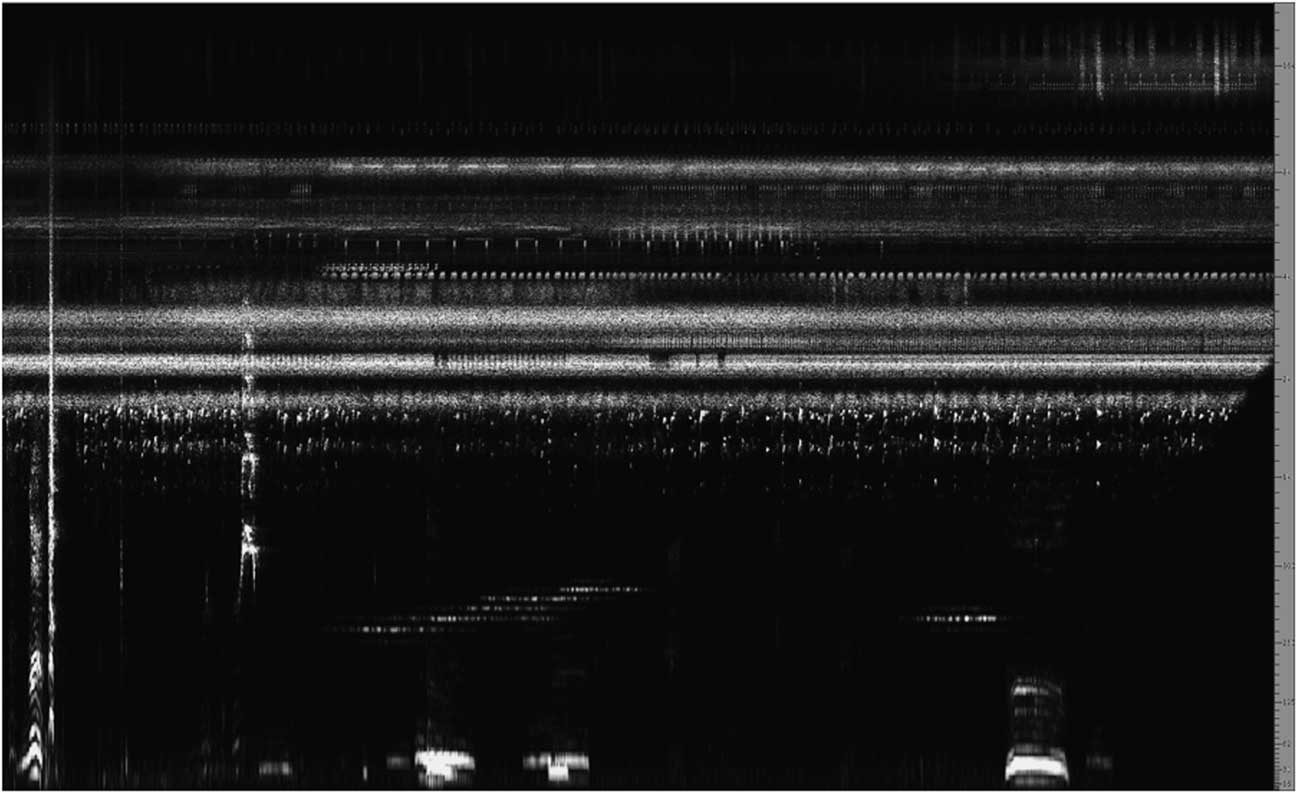
I will return later to considering aspects of ‘embodiment’ inherent to this performance. But first, let me share my experience of a performance of Cage's Water Music, as a telling contrast to Monacchi's arrangement. The score was similarly displayed to the audience (as stipulated by Cage), also via a scrolling image – this time projected above the performer (beyond her sight), who had her own copy on the piano. The timing was such that the appearance of events on the visual display preceded the performer's realisation by a few seconds. So the audience, having seen the display a little ahead of time, was in a constant state of anticipation – and of evaluation. In this sense at least, the performance left little to chance; the audience, quite literally, ‘knew the score’. Effectively, audience and the performer occupied slightly different, unsynchronised, places – an experience that I found alienating rather than involving. I offer this anecdote to illustrate just why I think Monacchi's visual projection of a ‘score’ that is constantly ‘coming into being’ simultaneously with sound is a powerful metaphor. The presentation means we are not so much following a score, as moving our perception in tandem with the frontier of the visual–aural events, together – and with the performer. The listener/viewer's attention is being ‘directed’ by this ongoing movement – the coming into being of listener attention coinciding with the visual–aural metaphor of ‘becoming’ within the work. Yet there is also room for a bit of visual–aural back and forth from each individual, able to move between listening and looking, and between now and then – both visually and in the listener/viewer's recent memory (Figure 2).
Spectrogram output from Integrated Ecosystem by David Monacchi
And we, listening and viewing, are performing all this together: in the darkened concert hall each of us encounters this frontier of ‘new’ experience simultaneously, and knows this to be so – a collective act. Both collectively and individually, we ‘move’ in a landscape that unfolds as it meets our perception; we are ‘engaging’ with the environment of the work (that is, with its performance ecology rather than the environmental sounds per se) in a manner that, metaphorically, is not dissimilar from mapping place. For, as Ingold would have it, in the ‘real world’ of mapping a physical landscape through habitually traversing the land ‘we know as we go, not before we go’, and do so via a process that ‘consists in the engagement of the mobile actor-perceiver with his or her environment’ (Ingold Reference Ingold2000: 230).
3. The body in place – ‘basic to place and part of place’
Returning to Casey's summary of the moving body as both basic and part of how we create place, how can the ‘lived experience’ of the listening body, moving, contribute to place-making activity when seated, apparently motionless – in the concert hall for Monacchi's Integrated Ecosystem, or in a comfortable chair with cat on lap, listening to Feld's Rainforest Soundwalks? But, then again, even at rest we move – our articulated fingers thrumming, our cells humming with activity, our neurons pinging signals from place to place. We are a veritable hive of activity.
Monacchi's Integrated Ecosystem has an apparent edge when it comes to the body in place, given that it incorporates the presence of a live performer. Indeed Monacchi regards the actions of the performing body, in this work, as a metaphor of the engagement of a species with an environment (Monacchi Reference Monacchi2011: 247). But here I would like to focus specifically on the body as both ‘basic to’ and ‘part of’ place in his performance, and on our listening participation in ‘place making’.
The second section of Integrated Ecosystem commences at a stage where the listener has already come to understand, and participate, in a species of meta-‘place making’ – moving through the visual–aural performance environment, mapping that experience, becoming somehow ‘emplaced’ in the performance. But there is something more, I think: the place-making sensibility engaged in relation to the unfolding performance also, I believe, heightens a listener's connectedness to the sonic environment (the environment through which the listener ‘moves’, and which the listener ‘meets’ at each moment of unfolding time): the recognisable vocalisations of animal communication, a density indicating a certain kind of physical habitat, and a ‘time-lapsed’ sense of a night passing. What could have been simply a documentary recording of a distant environment is brought into a performance context that has become a meaningful place for the listener, who is moving ‘within’ this place, rather than listening ‘to’ the rainforest environment. The listener already feels ‘emplaced’ bodily in the work, and the actions of the performer that now commence further solidify this attachment. This, I think, allows for a more radical transformation of the sound materials without losing – and in fact potentially increasing – the listener's connectedness to them.
The sound environment in this new section is ‘hyper-real’, as with Feld's spatially mixed Soundwalks, but here partly from being recorded at a sampling rate (192kHz) that captured animal communications inaudible to human ears, now shifted to within human audibility (Monacchi Reference Monacchi2011: 247). In addition, sounds are ‘tuned’ to a harmonic series that filters the animal calls at various pitches as Monacchi processes the sounds through sensors. Monacchi's gestures are relatively small movements – physically and in terms of sonic processing – that highlight rather than obliterate the essential qualities of the sounds, and form a layer of interaction that is ‘part’ of the, by now familiar, place. I suspect that if Monacchi had gone straight into this section without the preceding sequence of relative ‘realism’ the effect would remain powerful, but would be far less involving for listeners in terms of their ‘connectedness’ to sounds, and the ability to accommodate and appreciate these subtle changes of perspective (and I'll return to this shortly in relation to horizons and depth).
Monacchi's Integrated Ecosystem in some respects deals with ‘the body’ in a direct – if not simple – manner. The performer moves, visibly and aurally, through sound. But the body, and its contributing movement in making place, is no less significant to Feld, who in both his Rainforest Soundwalks and his writing about them, recognises the body as inherent to listening experience (hardly unsurprising, given his anthropological focus). On the face of it, the Rainforest Soundwalks seem devoid of bodily presence. Despite the fact that Feld's recordings were made at the edge of a village, he has edited out any signs of either his presence or that of others. But rather than negating the moving body as essential to place making, Feld's excision of audible bodily movement has the effect of making room for the listener's movement in the sounds, inviting the listener to experience ‘a sonic suggestion of what it might be like to live in a different auditory body and another sound world’ (Feld Reference Feld2001: CD liner notes), and unequivocally defining the auditory body as both basic and part of the place he has come to know – a mapping activity – through listening. As an anthropologist collecting, experiencing and theorising about human experience in the environment, Feld is acutely conscious of the role of the body in motion, and of the interplay of sensory perception, in forming place – what he calls the ‘intertwined nature of sensual bodily presence and perceptual engagement’ (Feld Reference Feld2005: 181).
Monacchi ‘places’ the body through a performer's presence, and Feld invites the listener to take on his listening body; Francisco López takes a somewhat opposite approach in La Selva, named eponymously for a region of Costa Rican rainforest, recorded in the rainy season (Sound example 1). La Selva, as López takes pains to point out, is constructed from a composed montage of recordings that have neither been edited to remove ‘extraneous’ non-biotic sounds nor enhanced to bring the sounds of particular creatures or events into clearer aural ‘focus’ (as in Feld's intentionally hyper-real sound environment). López presents the composition as representing a ‘single day’ between one night and the next. Once again there is a concern with time as a ‘frame’ – often so pertinent to both the creation and our memories of place.
For López, the desired state of listening is a ‘blind’ one, a state he describes as ideal and ‘pure’. This is not to say he requires the edited materials themselves to be pure in the sense of retaining only ‘non-human’ animal sounds. For López, the whole sound environment is of equal importance, and ‘the sound-producing animal species appear together with other accompanying biotic and non-biotic components of the sound environment that happened to be there’ (this and ensuing quotations, López: 1998) – though the recordings are edited to exclude his presence.
While much of López's oeuvre is made from documentary, environmental recording, La Selva remains unusual in being of an overtly recognisable environment, though it is hardly documentary, and López makes clear that it was his ‘apprehension of sound matter itself’ that dictated his compositional choices, rather than any ‘intention of documenting the place’. La Selva, then, appears unconcerned with conveying either his ‘personal’ listening experience of place or any ecologically motivated – or even musically motivated – diegesis. Indeed López goes further, professing himself unconcerned with the living ‘sounding bodies’ that create the sounds, since, in his view, ‘as soon as the call is in the air, it doesn't belong to the frog that produced it’ (López Reference López1998b). For López, it appears, sound is simply ‘up for grabs’ and he seeks what he calls a ‘transcendent’ listening experience, untroubled by any connectedness to the source of the sonic environment. In the context of more traditional thinking about composition and ‘acoustic ecology’ this might be seen as a controversial stance, even perhaps – to some hardliners – morally reprehensible. But I'm not so sure I feel that way. It might be, whether consciously or inadvertently, that in this particular work López offers a particularly ‘honest’ way of eliciting place-making activity in his listeners. After all, all we are given is sound – from which we have to form our own conclusions of what place this is, or might be.Footnote 5
Because of course we cannot ‘be there’ in the rainforest, really. We cannot feel the humidity that affects both the microphones of the visiting composer and the visiting composer himself; neither can we share the environment's influence on the lives, languages, culture and very psyche of the indigenous inhabitants. We cannot, listening, become ‘acclimatised’ to the feel of tree bark, the insects brushing our face, the touch of leaves against our arm as we move, the smell of the soil. Yes, we can imagine it all, and even enter it in mind, for a while. But ours is a temporary experience of a ‘framed’ environment – like walking into the heated palm-house of a municipal park. Soon we are back in our normal place – out in the gardens, turning up a collar against the cold. But in both presenting non-animal sounds and refusing to cast a spotlight on particular animal sounds, López in a sense also refuses to stress the fragile ‘separateness’ of the rainforest environment: rather than set it apart, he connects if firmly to the wider world – one of human experience and responsibility.
In a manner of speaking, López does ‘disembody’ place: he doesn't provide a ‘route’, through performance or spatialisation, that assists us towards feeling we're ‘there’, in person, moving through the sounds. And yet, of all three works, I think La Selva perhaps does most to involve – force – us into active ‘place making’. (This appears to defeat the composer's stated intent, but you should never rely on a composer's words entirely, in my experience.) Why should place making be easy, after all? The active, mapping of the environment that we perform in day-to-day perception is certainly not without effort – and it is precisely through this effort (whether physical – tramping across fields – or mental – processing perceptual activity) that we make sense – sight, sound, smell – of our surroundings and form a sense of place. It might be that in refusing to assist, with ‘beautified’ recordings or carefully placed sound objects, that López is encouraging us to put in some work – to move ourselves. And movement requires a body, in place. And as we move, we do some work – recognising, or attempting to recognise, the provenance of the sounds.
This is not a ‘transcendent’ listening experience because we cannot get away from our ‘desire’ to know – which is, to my mind, a propensity that brings some optimism to Dunn's call for greater ‘connectedness’. We want to understand our environment through our experience, and we do not relinquish our desire to do so readily – it's in our interests to keep plodding on, one corporeal foot after the other. Contrast López's call for a ‘blind’ listening to abstract sounds with Feld's desire to draw us in to his own listening – and in some sense to his bodily experience. It is not that López denies human presence; indeed, he acknowledges that ‘the very temporality of our presence in a place is a form of mediation’ (López Reference López1998b). But López's desire for a ‘perceptional shifting from recognition and differentiation of sound sources to the appreciation of the resulting sound matter’ (López Reference López1998b) is asking a great deal, in the context of recognisable sounds – our bodily experience is always with us and, walking around in sound, we are always going to take the shortest listening route – and especially so when it rains. There is a point in La Selva when the sound of torrential rain claims the entire canvas for several minutes. There is surely no possibility of ‘blinding’ one's recognition of hearing – and envisioning – the heavy raindrops falling and collecting on leaves, drenching the ground beneath. Rain is for many of us a familiar ‘place’; through bodily, real world experience we know how rain reveals space, indicates the absorptive acoustic properties of materials, provides depth and dimension – and all through sound. Unless it is transformed to the extent that it is no longer the sound of rain, we can never ‘transcend’ the referential meaning of the sound. When rain falls, it is hard – listening – not to feel that you are there, outside, getting soaked.
4. Making place: bodies and places ‘interanimate each other’
Consider for a moment the combination of place and body as a commutative relationship: each belonging to the other, each animated by the other, and the combination of both, proceeding from either, furnishing a meaningful connectedness with ‘the world of our experience’. That is, if we ‘belong’ to place in some sense, places also ‘belong’ to us: they are not only external to us, created through our perceptual motion in the world of experience, but also infiltrate and ‘move’ through our being. Monacchi, Feld and even – perhaps especially – López, in differing ways each echo Casey's assertion of this ‘interanimation’ of bodies and place (Casey Reference Casey1996: 24). Casey takes his cue from Merleau-Ponty (‘the body is our general medium for having a world’ [Merleau-Ponty Reference Merleau-Ponty1962: 146]) and speaks of bodies and places as ‘connatural terms’, belonging to one another.
Monacchi also recognises the ‘interanimation’ of body and place, seeing the live performer's actions in Integrated Ecosystem as ‘building a powerful metaphor as of one species that performs within a composite ecosystem while trying to find a balanced, harmonic relationship to it’ (Monacchi Reference Monacchi2011: 247–8). Going a little further, I suggest that the moving performer, whose observable actions change and inflect the visual–aural environment, becomes in Monacchi's work a bodily metaphor for the embodied interanimation in which the audience has already become engaged. The performing body moves within the performance environment but is also being ‘moved’ by the place it encounters, through interacting with the ‘connatural’ movement of sounds that, symbolically, travel ‘towards’ the viewer/listener – including the performer – both on screen and across the auditorium. In creating and reinforcing this metaphor of ‘interanimation’ as essential to making, and experiencing, a place, Monacchi also – metaphorically – attends to the particular presence of the human in the acoustic environment. In positioning the body as engaged with, and seeking knowledge and understanding of, this sonic ecosystem, Monacchi's work strives for coexistence rather than eradication of human intervention – integration. In this rarefied performance context, the ‘intervention’ is the performer's sonic manipulation of the environmental sounds, themselves already composed.
Outside the concert hall, the chatter, rumble and clatter of human activity – and its sounds – is similarly part of an acoustic environment that we might tend, engage with and explore as we, ‘intervening’, perform our daily social ablutions within in it and as an integrated part of it. We will strive to comprehend sounds in terms of what they are ‘about’ and our relationship to them – a productive tension on which López's desire for listening ‘transcendence’ in fact depends. Rain will be rain, and it will take a long time (or extremes of transformation) to stop it being rain to listening ears; cicadas will be cicadas or, if cicadas are unknown, a ‘sound like a high-pitched sewing machine’, ‘something hissing in chorus’ – or any other familiar place that comes to mind. Rather than bemoan this tendency to grab at a familiar, if incongruent, thread, it is a listening practice that interanimates our relationship to the environment and indicates the importance of ‘connectedness’. Place moves towards us, and into us, and from us – and we want it to.
5. Horizons: perception must have an ‘ingredient’ that conveys place
Nearing the end of this consideration of place and place making in relation to music and sound-based art, I would like to gaze briefly at the distant horizon, or rather at a multitude of perceptual horizons, near and far. Casey speaks of perception as synesthetic at the primary level, in that to perceive is to involve the whole body ‘moving and sensing’. Proceeding from Merleau-Ponty and Husserl, he summarises our ‘position’ in place as being ‘continually … in the midst of perceptual horizons, both the “internal” horizons of particular things (i.e., their immediate circumambience) and the “external” horizons that encompass a given scene as a whole’. He describes this combination of perceptual depth and horizon as providing a coherence of perception that we can trust with ‘animal faith’ (citing Santayana Reference Santayana1955), precisely because it is ‘supplied by the depth and horizons of the very place we occupy as sentient subjects’ (Casey Reference Casey1996: 18–19). Importantly, Casey attends to the presence of both cultural and societal factors that ‘pervade every level of perception’ (Casey Reference Casey1996: 19). Perception does not precede the complex of cultural and social processes that the ‘lived body’ – moving and emplacing – contains, and ‘the primacy of perception does not entail the priority of perception to the givens of culture of society’ (Casey Reference Casey1996: 19). We do not, and cannot, perceive in a ‘vanilla’ way, untouched by the patina of our prior experience. This might appear tautologous in some respects – since we are perhaps prone to think of perception as somehow ‘preceding’ and creating cultural and social ‘knowledge’. Casey's exposition, however, clarifies a distinction – perhaps rectifying a tendency to misalign ‘primacy’ and ‘precedence’. Perception, having primacy, does not necessarily precede the social or cultural. As Casey puts it, ‘social and cultural structures … sediment themselves into the deepest level of perception’ (Casey Reference Casey1996: 18).
Despite the visual metaphors, or perhaps because they allow a separation that provides some distance, I find Casey's a most helpful analysis of perception in relation to listening and sound (and would urge readers to seek out the passage in full – the paper is available on Casey's web page at the time of writing). Immersion in amassed and shifting perceptual horizons, themselves embedded and contributory to the larger view, is a relevant metaphor for the aural perception of environments that are continuous, and continually coming into ‘being’ – places that move towards our listening ears. With Casey's metaphor in mind, let me suggest that, rather than think of sound ‘objects’ placed in space, think instead of a continuous environment from which things emerge and recede, but do not detach, each ‘internal’ perceptual horizon’ giving sounds a ‘nebula’ of placed-ness – and each within that place encompassed by a larger horizon. And once again, considering Casey's insistence on the social and cultural as integral to perception, it becomes invalid to consider the absence of human intervention in a sonic environment as some kind of moral imperative.
It is notable that all three composers – Feld, Monacchi and López – are attentive to perspective in a ‘practical’ manner when making their work, recognising both ‘depth’ and ‘horizon’ as essential to a perception of place. Feld is highly sensitive to depth and perspective, in both his recording and mixing of the sounds in Rainforest Soundwalks (as already discussed) and his assessment of the close relationship – connectedness – between the environment of the Bosavi and the music of the local inhabitants. He speaks of environment and music in the same breath, hearing one as the ‘intertwined’ result of the other, with for instance the dense polyphony of the indigenous music echoing, or modelling, the dense aural environment of the rainforest where ‘there are no single discrete sounds to be heard … One hears no unison in nature’ (Feld Reference Feld2005: 187). Monacchi, writing about Integrated Ecosystem, describes the ‘horizon harmonics’ he creates to ‘enhance the perception of the soundscapes’. Tuning his aural canvas to an harmonic series, sometimes aligned to recognisable pitches in the original recording, enables the listener, Monacchi feels, to ‘focus on the foreground of the natural sound environments’ (Monacchi Reference Monacchi2011: 243).
López, too, is conscious of perceptual horizons – and of how they can be manipulated compositionally. He positions his approach as oppositional to what he regards as the ‘reductive’ stance of (the kind of) nature recording where the sonic communications of individual creatures are isolated from their aural background, for purposes of listening identification and appreciation. López not only retains sounds that happened to be present at the time of recording but also states that ‘in this sense, there is no purposeful a priori distinction of foreground/background, but only their unavoidable arisal due to the location of the microphones, as … happens with our ears’ (López Reference López1998b). But this is not, quite, how it ‘happens with our ears’ because we bring intelligence and judgement to listening, and we cannot listen to the sonic environment – or a recording, or composition made from it – from one, undifferentiated ‘direction’, any more than we can look at the visual environment – or a photograph, or painting – without moving our eyes from one place to another, constantly engaging with our subjective vision in order to ‘make sense’. We move – or else we cease to perceive. Indeed, it appears López is implicitly aware that listening is by nature in flux, saying that he is ‘not claiming objectivism but rather that the “focus” of my attention was the sound environment as a whole’; as we transition from one perceptual horizon to another we are forming a larger picture of the ‘whole’ environment that surrounds us – which is not ‘undifferentiated’, but is ‘connected’ through our place-making activity.
6. Listening together: BOTH ‘WITH’ and ‘in’ places
So, finally, we come together in an environment that has become a larger place. Perhaps I am reading too much into Ingold's words on ‘the world of our experience’ in suggesting that, when he speaks of ‘our’ experience of place and that ‘we’ contribute to its formation, he trusts (linguistically at least) that this coming together of experiential knowledge is both a personal and community endeavour. And yet, even if this was not on his mind, the collective ‘we’ that any writer – and this writer, now – employs as part of conventional discourse has the intention of drawing the imagined community of readers, collectively, into the place of his or her ideas. My point is that in metaphorical no less than in concrete terms – and whether reading a text, walking a path, or listening to a rainforest composition – place making is a collective act. Even though we might be reading, walking or listening at different times, and even if our individual perceptual mileage may differ, we are travelling along well-worn paths that map a place, and we are neither alone nor the first to walk them. And we know this. We have come to some consensus as to the most useful path to follow. In doing so we – reading, walking or listening – form an asynchronous community that sustains a place, through inscribing the paths that connect and define it, over time.
Consensus cannot itself be preordained but is rather a movement created through, and as a function of, human effort, knowledge and desire – three activities that, as I hope I have illustrated, are closely aligned to making place. How then might listening draw us together in a collective ‘connectedness’ to that larger environment and horizon that, as inhabitants of the world, we share?
Monacchi concludes his essay on his eco-acoustic approach with some philosophical questions, asking whether it is ‘possible to bridge such intricate, stable and fragile soundscapes with electroacoustic composition/performance? Does it make sense to interact with an eco-acoustic system that has created its own rules throughout a slow evolutionary process – the interchange between acoustic function and survival of each species?’ His response to this self-interrogation is cautious, admitting only that ‘bringing the sound of these biomes into concert halls, and perhaps revealing and interacting with their hidden aesthetic, helps to create an ecological awareness for repositioning our species within nature’ (Monacchi Reference Monacchi2011: 248). But I think Monacchi's qualified self-assessment underestimates the ways in which his performance, perhaps intuitively, models the ways we come to ‘know’ and form place. Monacchi does indeed succeed in ‘repositioning’ his listeners collectively – embodied and emplaced by performance. When, as in the performance I saw, both the spectrogram and sound are removed without warning near the end, replaced by silent footage of logging activity, an environment that had become known as ‘a place’ to listeners was summarily snatched away. Audience members, myself included, flinched in dismay – and that comes from more than having been immersed in sound, it comes from having come to feel ‘at home’.
Environmental art is effective, and affective, if it changes our relationship to the world and makes us more aware of our ‘connectedness’ to that world – and its places – in a sustained and fundamental sense. Not every listener will turn to sonic ‘activism’ or eco-composition but those who do (like Monacchi, in particular) are vital in their role of heightening our connectedness to place, and our understanding of art as something that, to return to Dunn, heightens ‘the very metaphors we use to organise reality’ – a place that we thought we knew. We are all in this together.