Research has consistently found an association between maternal depression and increased risk for psychopathology among children of depressed mothers (Downey & Coyne, Reference Downey and Coyne1990; Goodman & Gotlib, Reference Goodman and Gotlib1999). Compared to children of nondepressed mothers, children of depressed mothers are six times more likely to suffer from depression (Downey & Coyne, Reference Downey and Coyne1990). The risk, however, is not limited to depression or other mood disorders. Children of depressed mothers are also more likely to suffer from other types of psychopathology, including attention-deficit/hyperactivity disorder (ADHD; Orvaschel, Walsh-Allis, & Ye, Reference Orvaschel, Walsh-Allis and Ye1988), conduct disorder (Hammen, Burge, Burney, & Adrian, Reference Hammen, Burge, Burney and Adrian1990), anxiety disorders (Fendrich, Warner, & Weissman, Reference Fendrich, Warner and Weissman1990; Weissman, Warner, Wickramaratne, Moreau, & Olfson, Reference Weissman, Warner, Wickramaratne, Moreau and Olfson1997), and substance abuse (Weissman et al., Reference Weissman, Warner, Wickramaratne, Moreau and Olfson1997). Although a large body of research documents the association between presence of maternal depression and child psychopathology, relatively less research has examined how the course, timing, and severity of the mother's depression are related to outcomes for children of depressed mothers. Furthermore, limited research has examined the possible mechanisms that might account for the negative outcomes observed in children of depressed mothers.
Maternal depression is also associated with alterations in children's psychophysiological systems associated with emotion regulation and expression. Alterations have been found in level of cortical activation, as assessed by EEG, autonomic nervous system activity, and stress hormone levels. Specifically, researchers have found that infants of depressed mothers exhibit reduced left frontal electrical brain activation in a variety of conditions (Dawson, Frey, Panagiotides, Osterling, & Hessl, Reference Dawson, Frey, Panagiotides, Osterling and Hessl1997; Dawson, Frey, Panagiotides, et al., Reference Dawson, Frey, Panagiotides, Yamada, Hessl and Osterling1999; Dawson, Grofer Klinger, Panagiotides, Hill, & Spieker, Reference Dawson, Grofer Klinger, Panagiotides, Hill and Spieker1992; Field, Fox, Pickens, & Nawrocki, Reference Field, Fox, Pickens and Nawrocki1995; Jones, Field, Fox, Lundy, & Davalos, Reference Jones, Field, Fox, Lundy and Davalos1997). Studies of preschool children have also found atypical frontal brain activation in children of depressed mothers (Jones, Field, & Davalos, Reference Jones, Field and Davalos2000; Dawson et al., Reference Dawson, Ashman, Panagiotides, Hessl, Self and Yamada2003). With respect to autonomic nervous system activity, researchers have found that infants of depressed mothers have higher heart rate and lower vagal tone than infants of nondepressed mothers (Dawson et al., Reference Dawson, Ashman, Hessl, Spieker, Frey and Panagiotides2001; Field et al., Reference Field, Healy, Goldstein, Perry, Bendell and Schanberg1988; Field, Pickens, Fox, Nawrocki, & Gonzalez, Reference Field, Pickens, Fox, Nawrocki and Gonzalez1995; Jones et al., Reference Jones, Field, Fox, Davalos, Lundy and Hart1998).
Alterations in child psychophysiology may index a psychobiological vulnerability that increases a child's risk for developing emotional and behavior problems. Relative right frontal brain activation has been found to be associated with negative emotions in infants (Davidson & Fox, Reference Davidson and Fox1982; Fox, Reference Fox1991). Dawson Frey, Self, et al. (Reference Dawson, Frey, Self, Panagiotides, Hessl and Yamada1999) hypothesized that the atypical brain activity observed in infants of depressed mothers reflects both a tendency to experience more frequent and possibly more intense negative affect, as well as a lack of adequate self-regulatory strategies that might be used to modulate negative emotions. In an earlier time point in the longitudinal investigation described in the present paper, Dawson and colleagues (2003) found that frontal brain activation mediated the relation between maternal depression and child behavior problems, suggesting a possible role for frontal brain activation in understanding the relation between maternal depression and child emotional and behavior problems.
Although genetic and biological vulnerability as well as prenatal environmental influences may play a role in the relations between maternal depression and child psychopathology and child psychophysiology, maternal depression also exerts a potent environmental influence on family life. The depressed mother may be insensitive or withdrawn, and may be unable to interact optimally with her children or use effective parenting approaches. This phenomenon has been described extensively in the literature (for a review, see Lovejoy, Graczyk, O'Hare, & Neuman, Reference Lovejoy, Graczyk, O'Hare and Neuman2000). Maternal depression may also impact family life by introducing an interpersonal stressor and/or reducing the availability of social support to help a child cope with other stressful life events (Hammen, Burge, & Adrian, Reference Hammen, Burge and Adrian1991). Thus, child adjustment may reflect not only the mother's depression, but also reduced ability to cope with other life stressors.
Children of depressed mothers also frequently live in a context characterized by high family stress, marital conflict, lack of social support, and/or financial stress, such as low socioeconomic status (SES) or unemployment (Adrian & Hammen, Reference Adrian and Hammen1993; Cicchetti, Rogosch, & Toth, Reference Cicchetti, Rogosch and Toth1998; Hammen, Reference Hammen, Goodman and Gotlib2002). These contextual factors may contribute directly or indirectly to the development of child behavior problems (Adrian & Hammen, Reference Adrian and Hammen1993; Cicchetti et al., Reference Cicchetti, Rogosch and Toth1998; Emery, Weintraub, & Neale, Reference Emery, Weintraub and Neale1982). Some evidence suggests contextual factors predict child outcome above and beyond the direct effects of maternal depression (Duggal, Carlson, Sroufe, & Egeland, Reference Duggal, Carlson, Sroufe and Egeland2001; Seifer et al., Reference Seifer, Sameroff, Dickstein, Keitner, Miller and Rasmussen1996). Other studies suggest contextual risks partially account for the relation between maternal depression and child outcomes (Cicchetti et al., Reference Cicchetti, Rogosch and Toth1998; Dawson et al., Reference Dawson, Ashman, Panagiotides, Hessl, Self and Yamada2003).
In early studies of maternal depression, factors such as timing and chronicity of the mother's depression were frequently ignored or inadequately assessed. The course, timing, and severity of the mother's depression may impact children's emotional and behavioral adjustment as women whose depression is in remission may interact more normally with their children. Furthermore, the occurrence of maternal depressive symptoms may have a differential impact on a child's ability to cope with life stress depending on the developmental stage of the child when the maternal depression occurs. For example, maternal depression early in the child's development may interfere with development of a secure attachment or important self-regulatory skills. Several studies have found enduring effects of earlier maternal depression that improves or remits (Alpern & Lyons-Ruth, Reference Alpern and Lyons-Ruth1993; Fergusson & Lynskey, Reference Fergusson and Lynskey1993; Hay et al., Reference Hay, Pawlby, Sharp, Asten, Mills and Kumar2001). It is unclear, however, whether these continued decrements in child functioning are because of maternal depression per se or to the persistent effects of other adversity associated with maternal depression (e.g., family conflict). Furthermore, in some cases, concurrent or recent maternal depression appears to predict more negative child outcomes than depression that occurs earlier in the child's life (Luoma et al., Reference Luoma, Tamminen, Kaukonen, Laippala, Puura and Salmelin2001; Sinclair & Murray, Reference Sinclair and Murray1998).
Several recent studies have suggested adverse child outcomes are related to the severity or chronicity (or recurrence) of maternal depression as opposed to the absence or presence of a diagnosis (Brennan et al., Reference Brennan, Hammen, Andersen, Bor, Najman and Williams2000; Campbell, Cohn, & Meyers, Reference Campbell, Cohn and Meyers1995; Luoma et al., Reference Luoma, Tamminen, Kaukonen, Laippala, Puura and Salmelin2001; NICHD Early Child Care Research Network, 1999). For example, Brennan and colleagues (2000) assessed maternal depressive symptoms at four time points and child outcomes at age 5 years in a large, community sample. Mothers with more chronic and severe depression had children with more severe behavior problems, especially when the chronicity and severity occurred in combination. Although this study represents an advance in the assessment of maternal depression over time, it is still limited by the sole use of self-report measures and the failure to examine the interval between assessments.
The present study had three main goals. The first goal was to identify longitudinal patterns of maternal depression over the child's first 7 years of life. Although many studies have examined the relation between maternal depression and child adjustment problems, this study advanced the existing literature because it used a month-by-month assessment of the mother's depression to chronicle retrospectively the intervals between assessments. It was anticipated that there would be substantial variability in course of depressive symptoms over time, and it was hypothesized that different patterns of longitudinal course of maternal depression would predict different child outcomes. Given the episodic nature of depressive disorders (Judd, Reference Judd1997) as well as examination of data from previous time points in this longitudinal investigation, it was predicted that at least three different trajectories of maternal depression would be observed: mothers with a relatively high and stable level of chronic depression, mothers whose depression remitted early in the child's life, and mothers who experienced relatively infrequent, minor depression throughout the study period.
The second goal of this study was to examine the predictive relationship between variations in mother's longitudinal course of depression and child outcome measures of emotional and behavior problems, electrical brain activity, and autonomic nervous system activity in 6.5-year-old children. Based on previous research, it was hypothesized that 6-year-old children whose mothers had experienced more chronic and severe depression would exhibit elevated levels of emotional and behavior problems, decreased social competence, atypical autonomic nervous system activity, and atypical brain activity from regions related to emotion regulation. A secondary hypothesis was that there would be some enduring effects of early maternal depression that remitted earlier in the child's life, suggesting a possible sensitive period in the development of emotion regulation and the biological systems underlying emotion regulatory behaviors. No further predictions were made regarding the specific behavioral outcomes associated with specific courses of maternal depression because the literature is inconsistent in this regard.
The final goal of this study was to examine the possible mechanisms of transmission of maternal psychopathology from mother to child. Although a number of potential mechanisms exist, including genetic vulnerability, prenatal alterations in the intrauterine environment, disrupted mother–child interactions, and contextual risk factors, this study examined contextual factors and child frontal brain activation, which was hypothesized to index emotional and behavioral self-regulation. Child emotional and behavior outcomes were modeled as a joint function of maternal depression, contextual risk factors, and child psychophysiology at age 6.5 years. Based on previous research (Cicchetti et al., Reference Cicchetti, Rogosch and Toth1998; Fergusson, Horwood, & Lynskey, Reference Fergusson, Horwood and Lynskey1995), including an analysis of the same sample when the children were 3.5 years old (Dawson et al., Reference Dawson, Ashman, Panagiotides, Hessl, Self and Yamada2003), it was expected that contextual risk factors and child frontal brain activity would partially mediate the association between maternal depression and child emotional and behavior outcomes.
Methods
Participants
Participants were part of a sample of 159 mother–child dyads participating in a longitudinal study of the effects of maternal depression on children's psychobiological and emotional development. Mothers were initially recruited when the children were 14 months old from a variety of sources, including the Psychology Department infant subject pool, newspaper advertisements, community hospitals, and clinics. Prior to entry in the study, mothers and children were carefully screened for medical and psychiatric problems as well as prenatal and birth complications or exposures that might impact child outcomes (see Dawson et al., Reference Dawson, Frey, Panagiotides, Osterling and Hessl1997, for a complete description of recruitment and exclusion criteria). Participants were followed longitudinally over the next 5 years, during which there were four additional points of contact: ages 24 months (N = 133), 3.5 years (N = 130), 4.5 years (N = 141), and 6.5 years (N = 138).
Of the 159 mother–child dyads originally recruited into the study, 138 (86.8%) participated at the 6.5-year contact. Of the 21 mother–child dyads who did not participate at the 6.5 year contact, 10 could not be located for contact, 9 refused to participate, and 2 could not schedule the interview before the end of data collection. Compared to mothers who participated at the 6.5-year contact, nonparticipating mothers were more likely to have been depressed, 85.7 versus 52.2% of participating mothers; χ2 (1) = 8.35, p = .004, and less likely to have been married, 52.4 versus 93.5% of participating mothers; χ2 (1) = 29.26, p < .001, at initial contact. Nonparticipating mothers were also younger at initial contact, with nonparticipating mothers having a mean age of 27.0 years (SD = 5.44) and participating mothers having a mean age of 31.1 years, SD = 4.54; t (157) = −3.79, p < .001, and of a lower SES as measured by the Hollingshead (Reference Hollingshead1975) at initial contact, with nonparticipating mothers having a mean SES of 36.8 (SD = 16.56) and participating mothers having a mean SES of 45.4, SD = 11.07; t (157) = −3.11, p = .002.
Diagnosis of depression and depression groupings
Mothers were interviewed about their depressive symptoms using the Structured Clinical Interview for DSM-III-R (SCID; Spitzer, Williams, Gibbon, & First, Reference Spitzer, Williams, Gibbon and First1989), the Center for Epidemiological Studies Depression Questionnaire (CES-D; Radloff, Reference Radloff1977), and a modified interview version of the Longitudinal Interval Follow-up Evaluation (LIFE; Keller et al., Reference Keller, Lavori, Freidman, Niesen, Endicott and McDonald-Scott1987; Keller, Shapiro, Lavori, & Wolfe, Reference Keller, Shapiro, Lavori and Wolfe1982), a month-by-month assessment of the mother's depression (nondepressed, subthreshold depression, or major depression). Using these measures, mothers were interviewed about their symptoms of depression on five separate occasions, when their children were 14 months, 24 months, 3.5 years, 4.5 years, and 6.5 years of age. At each contact point, mothers were interviewed retrospectively about the time period between the current and most recent contacts (see Dawson et al., Reference Dawson, Ashman, Panagiotides, Hessl, Self and Yamada2003, for a detailed description of these measures).
Procedures and measures at age 6.5 years
At the 6.5-year assessment, mothers and children participated in three laboratory visits: (a) a diagnostic and neuropsychological assessment during which mother and child were interviewed separately by trained graduate student research assistants, (b) an assessment of child psychophysiology during which the child watched several emotion-eliciting video clips while his/her brain activity and heart rate were monitored, and (c) a videotaped mother–child interaction session. Families were not always able to complete all three visits because of scheduling difficulties. One hundred eight mother–child dyads completed all three laboratory sessions. Six families completed only the first visit. Two families completed Visits 1 and 2, six families completed only Visits 1 and 3, and one family completed only Visit 1. In addition, to minimize attrition, mothers who had moved out of the area were contacted for long-distance telephone interviews. Sixteen mothers who no longer lived within commuting distance of the university were interviewed by telephone and completed questionnaires through the mail.
Assessment of child psychophysiology
Psychophysiological testing took place in Dawson's Developmental Psychophysiology Laboratory at the Center on Human Development and Disability (CHDD) at the University of Washington. To make the room more attractive to 6.5-year-old children, lab assistants decorated the room to resemble a space capsule. During the EEG/electrocardiograph (ECG) session, children sat in a chair across from a black curtain behind which there was a video camera for recording child affect and behavior. A television monitor was located in front of the black curtain. Children's EEG and ECG were recorded during six conditions. In the first condition (Baseline 1), children watched while soap bubbles cascaded over the curtain for 90 s. This baseline condition was followed by the presentation of four brief film clips designed to elicit specific emotions (happy, sad, neutral, and anxious/scared). The clips included segments from the movies, “Andre” (happy), “Where the Red Fern Grows” (sad), “Fantasia” (neutral), and “Jurassic Park” (anxious/scared). All segments were accompanied by music, but spoken language was absent or minimal. Children were asked not to talk while watching the videos. The order of presentation of the video clips was counterbalanced among the children. Following the presentation of all four video clips, the children viewed another 90 s of cascading bubbles (Baseline 2). During the entire session, the mother was seated behind her child during the EEG recording and asked to remain quiet and maintain a neutral expression if her child looked toward her.
EEG recording methods
The experimenter used Omni-prep as an abrading compound prior to attaching individual silver and silver chloride electrodes to the scalp with Grass EEG cream. The EEG was recorded from six scalp locations: left and right frontal, parietal, and temporal (F3, F4, P3, P4, T3, T4; International 10–20 system). Active EEG leads were referenced to linked right and left mastoid electrodes for which identical impedances were obtained by matching the lower impedance to the higher one using a potentiometer. A forehead electrode served as ground. Eye movements were recorded for offline removal of ocular artifact via electrodes placed on the external canthus and supraorbit positions. All impedances were under 5 kΩ, measured before and after testing. The EEG was recorded on a Grass Neurodata Acquisition System (Model 12). The high-pass active filter was set at 1 Hz and the low-pass filter at 30 Hz. Analog to digital conversion was based on a 512 points/s sampling rate. Digitized data were stored continuously on an IBM PC-AT.
EEG editing and analysis
James Long Co. (Caroga Lake, NY) EEGEDIT software was used to visually edit EEG for motor artifacts, including EOG. Analyses required a minimum of 15 s of artifact-free EEG. Discrete Fourier analyses were performed on all artifact-free EEG data using custom-made software developed by James Long Co. Analyses were based on 1-s epochs and used a Hanning window of 1 s, with 0.5-s overlapping windows. The Fourier analyses yielded EEG spectral power in the 7–13 Hz band. Analyses focused on the alpha band, 7–13 Hz range, a measure of brain activation or arousal (Steriade, Reference Steriade1981), with lower EEG alpha power indicating higher levels of brain activation or arousal. The distribution of EEG spectral power was normalized using natural log transformations. Asymmetry scores (ln right EEG power minus ln left EEG power) were derived to reflect relative activation of homologous right and left hemisphere regions. Because reduced EEG alpha power indicates increased brain activation (Steriade, Reference Steriade1981), positive asymmetry scores indicate relative higher levels of left frontal activation and negative asymmetry scores indicate relative lower levels of left frontal activation.
Heart rate recording and analysis
Heart-rate data were obtained by placing two electrodes on the children, one on the sternum and a second one on the lower left costal region. The ECG signal was then amplified and filtered through a high pass filter set at 0.1 Hz. The signal was then digitized through an analog to digital converter at 512 samples/s. The digitized data were stored on a hard disk for offline processing. The timing of the R-waves was extracted using a program designed by James Long, Inc. The output of the R-wave detection was edited and corrected by visual inspection. The corrected records were, in turn, segmented by experimental condition and R-to-R wave intervals were entered into an analysis program designed by Steve Porges that computed heart rate.
Heart-rate variability was computed from the ECG record. Interbeat intervals (IBI) between R-waves were algorithmically extracted. The records were then visually inspected and corrected for errors. IBI values were then entered into Mxedit for further visual inspection and heart rate variability computation. Mxedit uses the Porges–Bohrer algorithm for bandpass filtering of IBI data that is based on a moving polynomial to remove nonstationarities. Filtering values for children between 0.24 and 1.04 with a polynomial order of 3 and a coefficient number of 21 were used in each condition analysis. The Porges–Bohrer moving polynomial algorithm estimates respiratory sinus arrhythmia (RSA), which is a measure of vagus nerve activity or vagal tone.
Assessment of child emotional and behavior problems
Child emotional and behavior problems were assessed using multiple methods and multiple informants. Mothers were interviewed using the Diagnostic Interview Schedule for Children IV—Parent Version (DISC-P; Shaffer et al., Reference Shaffer, Schwab-Stone, Fisher, Davies, Piacantini and Gioia1991). This computer-assisted structured interview assesses child behavior problems using DSM-IV criteria. The DISC-P has been shown to have good validity and reliability (Shaffer, Fisher, Lucas, Dulcan, & Schwab Stone, Reference Shaffer, Fisher, Lucas, Dulcan and Schwab Stone2000). Between visits, mothers and 104 fathers completed the Child Behavior Checklist (CBCL; Achenbach, Reference Achenbach1979) and the Child Adaptive Behavior Inventory (CABI; Cowan, Cowan, Schulz, & Heming, Reference Cowan, Cowan, Schulz, Heming, Parke and Kellam1994). Teachers (N = 127) also completed a variety of questionnaires designed to assess child behavior problems and school adjustment. These included the Achenbach Teacher Report Form, CABI, ADHD Rating Scale, and the Child Behavior Scale peer subscales (see descriptions below).
CBCL
The Achenbach CBCL (Achenbach, Reference Achenbach1979) is a 113-item questionnaire on which parents can report about their child's behavior problems, including both internalizing and externalizing behavior problems. On each item, parents answer on a 3-point scale about whether the item is not true, somewhat true, or very true for their child. The CBCL is standardized and has adequate validity and reliability (Sattler, Reference Sattler1990). Mothers and fathers completed the CBCL and teachers were asked to complete the Teacher Report Form, a teacher version of the CBCL.
CABI
The CABI (Cowan et al., Reference Cowan, Cowan, Schulz, Heming, Parke and Kellam1994) is a 106-item questionnaire on which parents and teachers respond to items about a child's behaviors and social and academic competence. The questionnaire yields 22 scale scores, which measure a variety of child attributes, such as intelligence, creativity, task orientation, hyperactivity, introversion, extroversion, and social skills. These scale scores are combined into six factor scores: academic competence, social competence, externalizing–aggressive, externalizing–hyperactive, internalizing–social isolated, and internalizing–anxious, and depressed.
ADHD Rating Scale
The ADHD Rating Scale (DuPaul, Reference DuPaul1991) is a 14-item questionnaire based on DSM-III-R criteria for ADHD. The ADHD Rating Scale yields three scores: a total score, an inattention/restlessness score, and an impulsivity/hyperactivity score. For teacher ratings, alpha reliabilities of these scales ranged from .95 to .96 (DuPaul, Reference DuPaul1991). The scale also demonstrated adequate criterion-related validity.
Child Behavior Scale (CBS)
The CBS (Ladd & Profilet, Reference Ladd and Profilet1996) is a 59-item teacher-report scale used to measure young children's behaviors with peers at school. The scale produces six subscales: aggressive with peers, prosocial with peers, asocial with peers, excluded by peers, anxious–fearful, and hyperactive–distractible. Only the peer subscales were used in this study. Alpha values for the peer subscales ranged from .54 to .72 (Ladd & Profilet, Reference Ladd and Profilet1996). The CBS also demonstrated adequate validity, correlating in the expected direction with other measures of child behavior with peers (Ladd & Profilet, Reference Ladd and Profilet1996).
Assessment of family contextual risk factors
Mothers completed a variety of questionnaire measures designed to assess other risk factors in the social environment that might relate to maternal depression and child outcome, including measures of stressful life events, social support, parenting stress, and marital satisfaction. These measures included the Life Experiences Survey (LES; Sarason, Johnson, & Siegel, Reference Sarason, Johnson and Siegel1978), the Dyadic Adjustment Scale (DAS; Spanier, Reference Spanier1976), the Parenting Stress Index (PSI; Abidin, Reference Abidin1990), the Family Environment Scale (FES; Moos, Reference Moos1974), and the Social Support Questionnaire (SSQ; Sarason, Levine, Basham, & Sarason, Reference Sarason, Levine, Basham and Sarason1983). All measures were also administered at earlier time points in the study and have been described in detail elsewhere (Dawson et al., Reference Dawson, Ashman, Panagiotides, Hessl, Self and Yamada2003). To take advantage of this longitudinal assessment of the social context, correlations across time points were assessed. Because all measure demonstrated moderate stability over time (mean r range = .43–.75), averages were computed across time points to create a composite measure.
Contextual risk composite score
Data from the five contextual risk measures were combined to create a composite measure of contextual risk based on a model presented in Cicchetti et al. (Reference Cicchetti, Rogosch and Toth1998). A similar composite was also used at an earlier time point in this study (Dawson et al., Reference Dawson, Ashman, Panagiotides, Hessl, Self and Yamada2003). For each measure, a total scale score or representative subscale score was selected as a global indicator of the particular domain being measured. The following scale scores were selected as indicators of each domain: LES total negative events scale for stressful life events, DAS total dyadic adjustment scale for marital satisfaction, PSI total stress score for parenting stress, FES family conflict subscale for family conflict, and SSQ total social support score for social support. For each variable a score of 1 SD above or below the mean was established as a criterion for high risk, and variables were transformed into dichotomous indicators of risk. For variables for which higher scores reflected more adverse circumstances (stressful life events, parenting stress, and family conflict), 1 SD above the mean was established as the criterion for high risk. For variables for which lower scores reflected more adverse circumstances (marital satisfaction and social support), 1 SD below the mean was established as the criterion for high risk. If the high-risk criterion was met for a particular variable, a score of 1 was assigned. The risk scores (0 or 1) were then summed across the five domains to compute an overall contextual risk composite score, which ranged from 0 to 5.
Results
Identifying classes of mothers based on course of depression
The first goal of the current study was to identify classes of depressed mothers based on variations in initial levels and rates of change in depressive symptoms over time. As we were interested in modeling course of depression, nondepressed mothers (i.e., mothers who were nondepressed on all measures of depression throughout the study period; N = 26) were not included in this analysis. The remaining 133 mothers were included in the analysis. Latent growth mixture modeling was used to identify homogenous groups of depressed mothers based on specified growth parameters, including each mother's initial level and rate of change in depressive symptoms.
Latent growth mixture models
The dependent variable used in the growth mixture models was maternal depressive symptoms as assessed by the LIFE. Using the LIFE data, variables were created based on the sum of the number of months of maternal depression experienced during each year of the child's life. Each month was weighted for severity (0 = no depression, 1 = subthreshold depression, 2 = major depression) before being summed, with months of major depression receiving greater weighting than months of subthreshold depression. The result of this process was variables (range = 0–24) representing the average level of maternal depression across each year. Seven variables were created representing frequency and severity of depression during each year from the child's birth through age 7 years.
A visual examination of the LIFE data indicated there might be a significant nonlinear growth pattern to the data, suggesting that fitting a quadratic growth model to the data might be warranted. Therefore, as a preliminary step, two growth curve models were estimated with change in depression over time specified as a function of linear and quadratic growth parameters. Initial status when the child was 1 year old was selected as the intercept because of interest in modeling how maternal depression changed from study entry. The likelihood ratio test was conducted to compare the fit of the linear versus the quadratic model. The model including a quadratic growth parameter was found to be significantly different from the linear model, χ2 diff (4) = 37.89, p < .01. Furthermore, the quadratic mean and variance were significant, suggesting that a quadratic model was appropriate for the data. Given these findings, a quadratic growth model was used for the subsequent analyses.
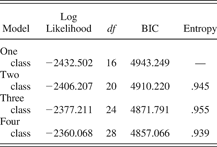
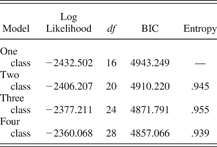
The next set of analyses investigated the existence of two or more subgroups of depressed mothers with varying patterns of initial level and growth trajectory in depression. To determine the optimal number of latent growth classes, three growth mixture models were estimated and compared using Bayesian information criterion (BIC) values, which should be minimized in the most appropriate model (Muthen et al., Reference Muthen, Hendricks Brown, Masyn, Jo, Khoo and Yang2002). These models were two-class, three-class, and four-class models. Table 1 presents the results of these analyses. The likelihood statistics and BIC values indicated that the three- and four-class models fit better than the two-class model, and that the four-class model fit slightly better than the three-class model. Inspection of the growth parameters, however, indicated the three-class model yielded the most interpretable trajectories with reasonable class sizes. In addition, the entropy value decreased slightly from the three to the four-class model, suggesting little was gained from the addition of a fourth class.
Fit statistics for two-, three-, and four-class growth mixture models
Note: BIC, Bayesian information criteria.
Individuals are assigned to the class for which they have the highest probability of membership. Probability estimates range from 0 to 1.0 with a probability of 1.0 reflecting perfect classification. Ideally, the probability of membership in one class will approach 1.0 and other probabilities will be very small, indicating relatively unambiguous classification. This was true for the predicted probabilities for class membership for the three-class solution. Average predicted probabilities for class membership for the three classes ranged from .97 to 1.0.
Final latent growth mixture model
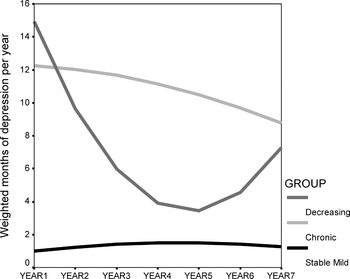
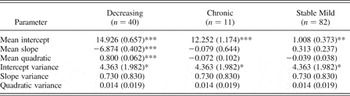
Table 2 presents the growth parameters and variances for each class in the final three-class growth mixture model. For ease of interpretation, descriptive labels have been added to the classes. Mothers with “decreasing depression” (N = 40, 30%) started out with a high frequency and severity of depression during their child's first year of life and decreased to a moderate level during their child's preschool years before beginning to increase again in their child's school years. Mothers with “chronic depression” (N = 11, 8%) had high frequency and severity of depression throughout the study period. Finally, mothers with stable mild depression (N = 82, 62%) had infrequent and mild depression throughout the study period, averaging about 1 month of subthreshold depressive symptoms per year. Significant variance in the intercept parameters suggests that, within groups of depressed mothers, there is significant variation in the average level of depression. Figure 1 presents the average predicted trajectories for each class of depressed mothers.
The average predicted trajectories for latent classes of depressed mothers.

Mean parameter estimates (standard errors) for final three-class growth mixture model

* p < .05.
** p < .01.
*** p < .001.
Validation of maternal depression groups
To explore the validity of the empirically identified maternal depression groups, groups were compared on other measures of depression (CES-D and SCID) used in the study. Valid trajectories should correspond to patterns of change in other variables. These analyses provided support for the depression groups. As expected, mothers with chronic depression had average CES-D scores in the clinical range at all major time points, whereas nondepressed mothers and mothers with stable mild depression had average CES-D scores below the clinical range at all major time points. Mothers with decreasing depression reported a decrease in depressive symptom severity from a high to a moderate level over the course of the study period.
SCID data also appeared to corroborate the findings from the growth mixture models. Nondepressed mothers had no SCID diagnosis, whereas chronically depressed mothers consistently had the highest frequency of major depression diagnoses throughout the study period. Mothers with decreasing depression had a high frequency of major and subthreshold depression diagnoses at study entry, and their diagnoses decreased in frequency over time. Mothers with stable mild depression had a consistently low level of depression diagnoses throughout the study.
Demographics of maternal depression groups
At the age 6.5 contact, one demographic variable, child's age, differed by maternal depression group, F (3, 134) = 4.36, p = .006. Children of mothers with decreasing depression were slightly but significantly younger than children of mothers with stable mild depression (mean age = 82.0 vs. 83.9 months, respectively). Other demographic variables did not differ by maternal depression group, including mother's ethnicity, partner status, education or occupation level, or number of hours spent working outside the home. Children of depressed and nondepressed mothers did not differ in terms of gender, number of hours spent in daycare, or number of hours spent in the care of someone other than their mothers. Families did not differ significantly in terms of SES as measured by the Hollingshead (Reference Hollingshead1975) or number of children in the family. Father's ethnicity, education, and occupation level also did not differ significantly by maternal diagnostic group.
Child behavior outcome
Creation of child behavior composite constructs
To reduce the number of child behavior outcome variables analyzed, theoretically driven child behavior constructs were created using the mother, father, and teacher questionnaire data. Four constructs were created: child internalizing behavior problems, child externalizing–aggressive behavior problems, child externalizing–ADHD behavior problems, and child social competence. To prevent loss of data for single-mother families, a mean of mother and father report was taken to create a parent scale. Items were standardized before taking their mean to form the parent scales. In families where the mother was the only available reporter, the parent scale included only her report. Mother and father report were significantly correlated for all scales used to create constructs (mean r = .39, range = .20–.56).
The internalizing construct included the CABI internalizing–anxious factor score, the CABI internalizing–isolated factor score, the CBCL Withdrawn Scale score, and the CBCL Anxious/Depressed Scale score. The externalizing–aggressive construct consisted of the CABI externalizing–aggressive factor score, the CBCL aggressive behavior scale score, and the CBCL delinquent behavior scale score. The externalizing–ADHD construct consisted of the CABI externalizing–hyperactive factor score and the CBCL attention problems scale score. The teacher report composite also included teacher report on the ADHD Rating Scale. The social competence construct included the CABI social competence factor score and, for the teacher report composite, teacher report on the CBS prosocial with peers subscale. If the distributions of variables were highly skewed, variables were log transformed to meet the assumptions of the statistical analyses.
Internal consistency (Cronbach alpha) of the items within the parent and teacher internalizing behavior problems constructs was .84 and .87, respectively. There was a significant correlation between parent and teacher reports of child internalizing problems (r = .39, p < .001). Internal consistency (Cronbach alpha) of the items within the externalizing–aggressive constructs was .88 for parent report and .83 for teacher report. Internal consistency of the items within the externalizing–ADHD constructs was .86 for parent report and .92 for teacher report. There were also significant correlations between parent and teacher reports of child externalizing–aggressive (r = .34, p < .001) and externalizing–ADHD (r = .38, p < .001) behaviors problems. Internal consistency (Cronbach alpha) of the items within the teacher-reported social competence construct was .87. There was a significant correlation between parent and teacher reports of child social competence (r = .38, p < .001).
Effect of maternal depression group
A two-way multivariate analysis of variance (MANOVA) was conducted to determine whether child behavior differs by maternal depression group or child gender. Separate MANOVAs were conducted for parent and teacher reports. Results revealed significant differences among maternal depression groups on the dependent variables for both parent report, Wilks λ = .84, F (12, 315) = 1.76, p = .05, ηp2 = .06, and teacher report, Wilks λ = .79, F (12, 260) = 2.00, p = .02, ηp2 = .08, and significant differences between boys and girls on the dependent variables for both parent report, Wilks λ = .89, F (4, 119) = 3.70, p = .007, ηp2 = .11, and teacher report, Wilks λ = .82, F (4, 98) = 5.54, p < .001, ηp2 = .18.
Follow-up univariate analyses of variance (ANOVAs) on each of the child behavior constructs revealed significant differences among maternal depression groups on parent report of externalizing–aggressive behaviors, F (3, 124) = 4.41, p = .006, ηp2 = .10, parent report of externalizing–ADHD behaviors, F (3, 125) = 5.63, p = .001, ηp2 = .12, parent report of social competence, F (3, 125) = 4.04, p = .009, ηp2 = .09, teacher report of externalizing–aggressive behaviors, F (3, 116) = 3.29, p = .02, ηp2 = .08, and teacher report of externalizing–ADHD behaviors, F (3, 118) = 3.47, p = .02, ηp2 = .08. Significant differences between boys and girls were found for parent report of externalizing–aggressive behaviors, F (1, 124) = 6.12, p = .01, ηp2 = .05, teacher report of internalizing behaviors, F (1, 112) = 4.51, p = .04, ηp2 = .04, and teacher report of externalizing–aggressive behaviors, F (1, 116) = 7.12, p = .008, ηp2 = .06. Boys had higher parent and teacher-reported externalizing–aggressive behaviors and girls had higher teacher-reported internalizing behavior problems.
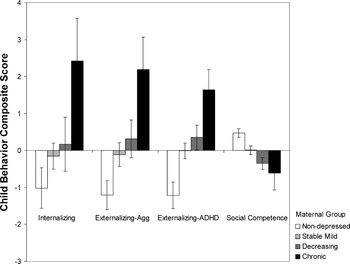
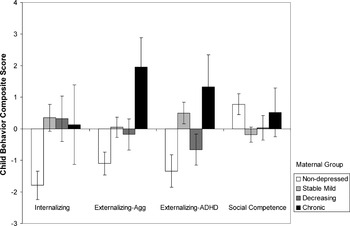
Post hoc Tukey tests revealed that children of chronically depressed mothers had significantly higher levels of parent-reported externalizing–aggressive and externalizing–ADHD behavior problems compared to children of nondepressed mothers and mothers with stable mild depression. Children of mothers with decreasing and stable mild depression also had significantly higher levels of parent-reported externalizing–ADHD behavior problems compared to children of nondepressed mothers. Children of nondepressed mothers had significantly higher parent-reported social competence than children of mothers with decreasing and chronic depression. Compared to children of nondepressed mothers, children of chronically depressed mothers also had significantly higher levels of teacher-reported externalizing–aggressive behavior problems. Figures 2 and 3 display parent and teacher-reported child behavior construct composite scores by maternal depression group.
Mean parent-reported child behavior composite scores (and standard errors) by maternal depression group.

Mean teacher-reported child behavior composite scores (and standard errors) by maternal depression group.

Diagnostic Interview Schedule for Children (DISC)
Of the 138 children who participated at the 6.5-year contact, 137 had completed DISC data. In all, 57 children (41.6% of sample) met criteria for one or more psychiatric diagnoses as measured by mother report on the DISC. Thirty-seven children (27.0%) met criteria for one DISC diagnosis. Fourteen children (10.2%) met criteria for two DISC diagnoses. Five children (3.6%) met criteria for three DISC diagnoses, and one child (0.7%) met criteria for four DISC diagnoses. Thirty-six children (26.3% of sample) met criteria for at least one anxiety disorder (separation anxiety disorder, social phobia, specific phobia, agoraphobia, posttraumatic stress disorder), and 36 children (26.3% of sample) met criteria for one or more behavior disorders (oppositional defiant disorder, ADHD, conduct disorder). No children met criteria for any of the following diagnoses, which were also assessed: generalized anxiety disorder, obsessive compulsive disorder, panic disorder, selective mutism, major depression, mania/hypomania, or dysthymia.
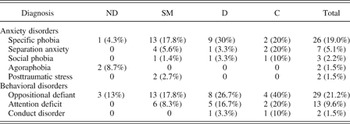
Table 3 presents the frequency of diagnosis by maternal depression group. There was no relation between maternal depression group and frequency of diagnosis with an anxiety disorder. There was a significant association between maternal depression group and diagnosis of a behavior disorder, χ2 (3, N = 136) = 10.98, p = .01. Follow-up 2 × 2 chi-square tests indicated that children of chronically depressed mothers were significantly more likely to be diagnosed with a behavior disorder compared to children of nondepressed mothers, χ2 (1, N = 33) = 7.75, p = .005, and mothers with stable mild depression, χ2 (1, N = 83) = 7.24, p = .007.
Frequency of Diagnostic Interview Schedule for Children diagnosis by maternal depression group

Note: ND, nondepressed; SM, stable mild; D, decreasing; C, chronic.
Child psychophysiology
Brain activity
EEG data from the five main conditions (baseline, neutral film, happy film, sad film, and fear film) were analyzed. Of the children who completed the psychophysiology visit, 97 had complete EEG data in all five conditions, including 16 children of nondepressed mothers, 51 children of mothers with stable mild depression, 22 children of mothers with decreasing depression, and 8 children of mothers with chronic depression. The remaining children were missing data from one or more leads in one or more conditions because of motor artifact or technical problems. Loss of EEG data because of motor artifact is very common in this difficult to test age range. Children from different maternal depression groups did not differ in terms of their familiarity with the various film clips.
A 5 (Condition) × 2 (Region) × 2 (Hemisphere) × 4 (Maternal Depression Group) × 2 (Child Gender) repeated-measures ANOVA with EEG alpha power as the dependent variable was conducted. Mauchly's Test of Sphericity was significant indicating heterogeneity of covariance; therefore, the Greenhouse–Geisser correction was used to correct for potentially inflated p values. Degrees of freedom and p values reported are Greenhouse–Geisser corrected where appropriate. The analysis revealed significant main effects of condition, F (3, 268) = 16.79, p < .001, ηp2 = .16, hemisphere, F (1, 89) = 11.87, p = .001, ηp2 = .12, and maternal depression group, F (3, 89) = 3.11, p = .03, ηp2 = .09, a significant Condition × Maternal Depression Group interaction, F (9, 268) = 1.96, p = .04, ηp2 = .06, a significant Condition × Region interaction, F (2, 207) = 21.42, p < .001, ηp2 = .19, a significant Condition × Hemisphere interaction, F (3, 308) = 9.75, p < .001, ηp2 = .10, and a significant Region × Hemisphere interaction, F (1, 89) = 6.46, p = .01, ηp2 = .07. Post hoc Tukey tests revealed that children of mothers with chronic depression, on average, had lower brain activation (greater EEG alpha power) than children of mothers in the nondepressed group, across all brain regions assessed. To understand the significant Condition × Maternal Group interaction effect, individual 2 (Region) × 2 (Hemisphere) × 4 (Maternal Depression Group) repeated-measures ANOVAs were conducted for each condition separately. Results revealed significant main effects of maternal depression group for the baseline, F (3, 102) = 4.87, p = .003, ηp2 = .13, happy film, F (3, 100) = 2.71, p = .049, ηp2 = .08, sad film, F (3, 101) = 2.70, p = .05, ηp2 = .07, and fear film, F (3, 96) = 2.87, p = .04, ηp2 = .08, conditions. The effect of maternal group was not significant for the neutral film condition, F (3, 102) = 1.87, p = ns, ηp2 = .05.
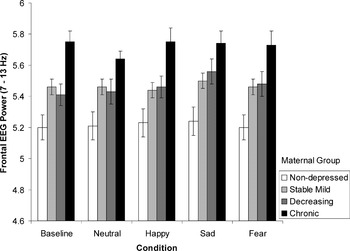
Because previous research has found the association between maternal depression and child brain activity to be specific to the frontal region, separate analyses were conducted by region. Results revealed that, when frontal and parietal regions were analyzed separately, there was a main effect of maternal depression group for the frontal region, F (3, 89) = 4.57, p = .005, ηp2 = .13, but not the parietal region, F (3, 89) = 1.74, p = ns, ηp2 = .06. Post hoc Tukey tests revealed that children of mothers with chronic depression, on average, had lower frontal brain activation (greater frontal EEG alpha power) than children of nondepressed mothers, across all conditions. Figure 4 displays frontal EEG alpha power scores by maternal depression group.
Mean frontal EEG power (and standard errors) by maternal depression group.

Because previous research has found EEG laterality differences in infants and young children of depressed versus nondepressed mothers, EEG data were further analyzed using asymmetry scores as the dependent variable. A 5 (Condition) × 2 (Region) × 4 (Maternal Depression Group) × 2 (Child Gender) repeated-measures ANOVA with EEG asymmetry scores as the dependent variable revealed significant main effects of condition, F (3, 308) = 9.65, p < .001, ηp2 = .10, and region, F (1, 89) = 6.34, p = .01, ηp2 = .07. Maternal depression was not significantly associated with EEG laterality in this study. Degrees of freedom and p values reported are Greenhouse–Geisser corrected where appropriate.
RSA
A 5 (Condition) × 4 (Maternal Depression Group) × 2 (Child Gender) repeated-measures ANOVA with child RSA as the dependent variable was conducted. Mauchly's Test of Sphericity was significant indicating heterogeneity of covariance; therefore, the Greenhouse–Geisser correction was used to correct for potentially inflated p values. Degrees of freedom and p values reported are Greenhouse–Geisser corrected where appropriate. This analysis revealed significant main effects of condition, F (3, 269) = 9.17, p < .001, ηp2 = .10, and child gender, F (1, 87) = 4.60, p = .04, ηp2 = .05. On average, RSA was lowest in the neutral and sad film conditions and highest in the baseline and happy film conditions. Within-subjects contrasts with baseline RSA as the reference category revealed significant decreases from baseline RSA in the neutral film, F (1, 87) = 17.72, p < .001, ηp2 = .17, sad film, F (1, 87) = 17.91, p < .001, ηp2 = .17, and fear film, F (1, 87) = 7.37, p = .008, ηp2 = .08, conditions. There was no significant difference between baseline RSA and RSA during the happy film, F (1, 87) = .421, p = ns. These findings corroborate other research studies that have found decreases in RSA when emotion is manipulated toward the negative (for a review, see Beauchaine, Reference Beauchaine2001). On average, girls had significantly lower RSA than boys.
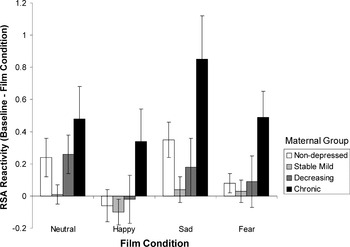
Although children of depressed and nondepressed mothers did not differ in terms of average RSA, there was a possibility they might differ in terms of RSA reactivity, change in RSA from baseline. Although tonic differences in vagal tone may reflect differences in temperament or emotionality, differences in vagal reactivity may indicate differences in attention, emotional regulation, or mood (Beauchaine, Reference Beauchaine2001). RSA reactivity scores were calculated by subtracting RSA during each of the emotion-eliciting film conditions from baseline RSA, yielding scores that indicated the extent of increase or decrease in RSA from baseline. Higher RSA reactivity scores indicated increased parasympathetic withdrawal during the film conditions. A 4 (Condition) × 4 (Maternal Depression Group) × 2 (Child Gender) repeated-measures ANOVA with child RSA reactivity as the dependent variable revealed significant main effects of condition, F (2, 221) = 7.82, p < .001, ηp2 = .08, and maternal depression group, F (3, 87) = 3.04, p = .03, ηp2 = .09. The Greenhouse–Geisser correction was used for this analysis. Post hoc Tukey tests revealed that children of chronically depressed mothers had higher RSA reactivity than children of mothers with stable mild depression. Across conditions, children of chronically depressed mothers demonstrated more parasympathetic withdrawal in reaction to the emotion-eliciting film conditions than children of mothers with stable mild depression (see Figure 5).
Mean RSA reactivity (and standard errors) by maternal depression group.

Child frontal brain activity and contextual risk factors as mediators of the relation between maternal depression and child behavior
The final goal of the study was to explore the possible mechanisms of transmission of maternal psychopathology from mother to child by analyzing the combined influence of maternal depression, child psychophysiology (as an index of psychobiological vulnerability), and contextual risk factors on child behavior at age 6.5 years. Of the psychophysiological measures used in this study, only child frontal brain activity was selected as a potential mediator of the relation between maternal depression and child behavior for several reasons. First, of the psychophysiological measures assessed in this study, only child frontal brain activity and RSA reactivity demonstrated a significant association with maternal depression thereby meeting a critical condition for testing mediation (Baron & Kenny, Reference Baron and Kenny1986). Second, child frontal brain activity was found to partially mediate the relation between maternal depression and child behavior problems at an earlier time point in this study (Dawson et al., Reference Dawson, Ashman, Panagiotides, Hessl, Self and Yamada2003). Third, previous research suggests patterns of frontal brain activity may index individual differences in emotion and behavior regulation (Dawson, Panagiotides, Grofer Klinger, & Hill, Reference Dawson, Panagiotides, Grofer Klinger and Hill1992).
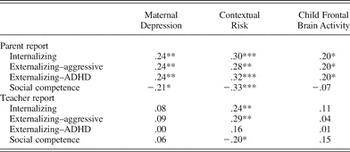
Zero-order correlations among the independent and dependent variables were examined. Because path analysis assumes a continuous variable, the weighted sum of months of depression that was initially used to derive the depression groupings was used as the maternal depression variable in the path analysis. An aggregate measure of child frontal brain activity was created by averaging left and right frontal brain activity across conditions. Maternal depression was moderately correlated with both child frontal brain activity (r = .30, p = .003) and contextual risk factors (r = .46, p < .001). Frontal brain activity and contextual risk were also moderately correlated (r = .29, p = .004). Zero-order correlations between independent variables and child behavior outcomes are presented in Table 4. Only parent-reported child behavior outcomes met preliminary conditions for mediation, including correlations with both maternal depression and at least one potential mediator.
Zero-order correlations between predictor variables and child behavior outcomes

Note: ADHD, attention-deficit/hyperactivity disorder.
* p < .05.
** p < .01.
*** p < .001.
Path analysis was used to investigate whether contextual risk factors and/or child frontal brain activity mediated the relation between maternal depression and parent-reported child behavior outcomes. It was expected that there would be a significant reduction in the direct relation between maternal depression and child outcome when the mediators were included in the model. A separate path analysis was tested for each child outcome. Analyses were conducted using the covariance matrix and maximum likelihood estimation with robust standard errors. As only 97 children had complete EEG data, this analysis was based on 97 cases.
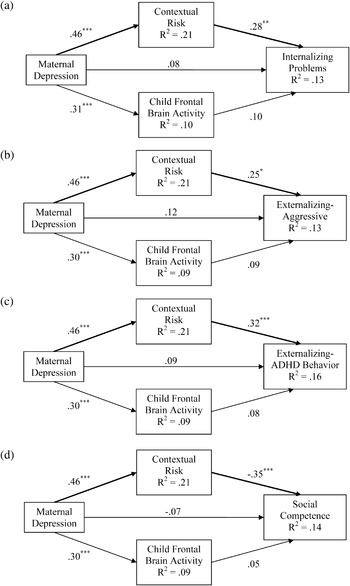
Figure 6a–d presents the standardized path estimates and R 2 values for the models predicting parent-reported internalizing, externalizing–aggressive, externalizing–ADHD, and social competence, respectively. As shown in Figure 6, for all four of the child behavior outcome variables, the direct relation between maternal depression and child behavior outcome was reduced to nonsignificant when the mediating paths were added. As expected, contextual risk factors were found to mediate the relation between maternal depression and child behavior outcomes. Maternal depression was associated with higher levels of contextual risk, which was in turn, associated with increased child behavior problems and decreased social competence. Child frontal brain activity was not found to be a significant mediator; the paths between child frontal brain activity and child behavior were not significant.
Path models examining children's frontal brain activity and contextual risk factors as mediators of the relation between maternal depression and parent-reported child behavior outcomes. Standardized path coefficients are presented. Bold lines indicate significant mediation effects. Models for (a) internalizing behavior (comparative fit index [CFI] = 0.96), (b) externalizing–aggressive behavior (CFI = 0.94), (c) externalizing ADHD behavior (CFI = 0.97), and (d) social competence (CFI = .95). *p < .05. **p < .01. ***p < .001.

Based on a formula derived by Sobel (Reference Sobel and Leinhardt1982), tests for mediation were computed to determine whether contextual risk factors significantly mediated the relation between maternal depression and child outcomes. Results indicated that contextual risk factors significantly mediated the relations between maternal depression and child internalizing behaviors (z = 2.53, p < .05), externalizing–aggressive behaviors (z = 2.14, p < .05), externalizing–ADHD behaviors (z = 2.92, p < .05), and social competence (z = −2.83, p < .05).
Discussion
This study investigated the associations among the longitudinal course of maternal depression, co-occurring risk factors in the family environment, and school age children's psychophysiology and behavior. Using a sample of mostly middle class mothers and their children, this study examined data that chronicled the mother's depression over 7 years, from the child's birth through age 6.5 years, and examined whether variation in the longitudinal course of maternal depression was related to differences in child psychophysiology and behavior at age 6.5 years. Latent growth mixture models identified three classes of depressed mothers based on information about the mother's depression from her child's birth through age 7 years. Three courses of maternal depression were identified: a chronic, severe course, a course characterized by decreasing depressive symptoms over time, and a stable course characterized by mild depression. The percentage of mothers with chronic depression (8%) in this sample is similar to the prevalence rates observed in epidemiological studies (Keller et al., Reference Keller, Lavori, Mueller, Endicott, Coryell and Hirschfeld1992). Notably, patients in the Keller study did not meet full criteria for major depression during the entire follow-up period, which is similar to the mothers with chronic depression in this sample who, although chronically symptomatic, also experienced periods of subthreshold depression. Mothers with decreasing depression did not completely recover during the study period. These mothers continued to experience less frequent, low to moderate levels of depression. This finding is not surprising given the recurrent nature of depressive disorders (Judd, Reference Judd1997) and the tendency of subthreshold episodes to precede or follow episodes of major depression (Angst & Merikangas, Reference Angst and Merikangas1997). The identification of these different courses of maternal depression highlights the importance of assessing depression during the interval between assessments and assessing for subthreshold depression.
Consistent with previous studies of the chronicity and severity of maternal depression (Alpern & Lyons-Ruth, Reference Alpern and Lyons-Ruth1993; Brennan et al., Reference Brennan, Hammen, Andersen, Bor, Najman and Williams2000; Campbell et al., Reference Campbell, Cohn and Meyers1995; NICHD Early Child Care Research Network, 1999), child behavioral outcomes varied as a function of the longitudinal course of maternal depression. Children of chronically depressed mothers were reported to have the highest levels of externalizing behavior problems and behavior disorder diagnoses, and the lowest social competence. Notably, this finding held for both parent and teacher-reported externalizing behavior problems. Many previous studies have relied exclusively on mother reports of child behavior problems (Brennan et al., Reference Brennan, Hammen, Andersen, Bor, Najman and Williams2000; Munson, McMahon, & Spieker, Reference Munson, McMahon and Spieker2001). Although the majority of significant findings in this study were based on parent (combined mother and father) report and concerns about reporter bias cannot be eliminated, the addition of father and teacher reports in this study reduces concerns about potential reporter bias and increases the validity of the results.
In contrast to some previous studies, group comparisons did not reveal differences in child internalizing behavior outcomes based on maternal depression course. In the path analyses, which examined combined influences of maternal depression and other factors, number of months of maternal depression was significantly, but only modestly, correlated with parent-reported internalizing problems. The inconsistency of this finding suggests a weaker association between maternal depression and school age children's internalizing behaviors, which may not have been detectable in the group analysis because of the small sample size in the chronic depression group. Previous studies that have examined internalizing problems in children of depressed mothers have had inconsistent results. Some have found associations between maternal depression and child internalizing symptoms (Alpern & Lyons-Ruth, Reference Alpern and Lyons-Ruth1993; Essex, Klein, Miech, & Smider, Reference Essex, Klein, Miech and Smider2001; Zahn Waxler, Iannotti, Cummings, & Denham, Reference Zahn-Waxler, Iannotti, Cummings and Denham1990), although others have not (Cicchetti et al., Reference Cicchetti, Rogosch and Toth1998; Luoma et al., Reference Luoma, Tamminen, Kaukonen, Laippala, Puura and Salmelin2001). This inconsistency may reflect developmental differences in the expression of behavior problems. Clinical levels of depressive symptoms are rare in young children. Associations between maternal depression and child internalizing symptoms are more consistently found for older children and adolescents (Anderson & Hammen, Reference Anderson and Hammen1993; Hammen et al., Reference Hammen, Burge and Adrian1991; Lee & Gotlib, Reference Lee and Gotlib1991). Furthermore, parents and teachers may be less aware of young children's internalizing symptoms. Some research has shown parents report fewer internalizing symptoms in their children compared to the children themselves.
Children of mothers with decreasing depression were reported by parents to have higher levels of externalizing–ADHD behaviors and lower social competence compared to children of nondepressed mothers. Children of mothers with stable mild depression also were reported to have higher levels of externalizing–ADHD behaviors compared to children of nondepressed mothers. Other studies have also found associations between nonchronic maternal depression and adverse child outcomes. Alpern and Lyons-Ruth (Reference Alpern and Lyons-Ruth1993) found that depressive symptoms when children were 18 months old predicted children's anxious and withdrawn behavior at age 5 years. In the same study, concurrent, but nonchronic maternal depression was associated with mother and teacher reports of attention problems and hyperactive behaviors. Essex and colleagues (2001) found that maternal depression during infancy was associated with increased child internalizing problems during kindergarten, whereas maternal depression during the toddler/preschool period only was associated with increased externalizing behavior problems for girls. Taken together, these findings suggest there might be enduring effects of nonchronic exposure to maternal depression. The nature of these effects, however, remains unclear. As in the Alpern and Lyons-Ruth (Reference Alpern and Lyons-Ruth1993) study, in this sample, nonchronic maternal depression was associated with increased externalizing behaviors (e.g., hyperactivity and attention problems) that did not reach more serious, deviant levels characterized by aggressive behaviors. This study, however, failed to find an association between earlier, nonchronic maternal depression and child internalizing problems. This difference in findings may reflect the nature of the samples studied. The Alpern and Lyons-Ruth (Reference Alpern and Lyons-Ruth1993) study was based on a sample of low-income families, whereas this sample included mostly middle-class mothers. Although the Essex et al. (Reference Essex, Klein, Miech and Smider2001) study included higher income families, their sample was much larger (421 children) and more variable in terms of family socioeconomic status. Family income has been found to predict children's depressive symptoms above and beyond the effects of maternal depressive symptoms (Graham & Easterbrooks, Reference Graham and Easterbrooks2000).
The effects sizes for the relations between maternal depression and child behavior were small to medium in magnitude. This may reflect the fact that this study was based on a relatively homogenous, middle-class sample of depressed and nondepressed mothers. In addition, increased attrition of lower income, unmarried, depressed mothers in this sample may have led to a more conservative estimate of the association between maternal depression and child behavior outcomes. Small effect sizes may also have made some associations, such as the relation between maternal depression and child internalizing symptoms, difficult to detect with the small sample in the study, particularly the small sample in the chronic group. Future research will need to replicate these findings with a larger sample.
Extending earlier research on infants and preschool children of depressed mothers, this study found an association between maternal depression and school age children's brain activity. Consistent with findings in this same sample at the preschool age (Dawson et al., Reference Dawson, Ashman, Panagiotides, Hessl, Self and Yamada2003), school-age children of mothers with chronic depression were found to have decreased generalized brain activation (higher EEG alpha power). Reduced generalized brain activation (higher EEG alpha power) may reflect reduced attentiveness or engagement with the external environment. When frontal and parietal regions were analyzed separately, however, the finding held for the frontal, but not the parietal region. The specificity of this finding to the frontal region corroborates previous research that has found associations between maternal depression and child frontal brain activity (Dawson et al., Reference Dawson, Frey, Panagiotides, Osterling and Hessl1997; Dawson, Frey, Panagiotides, et al., Reference Dawson, Frey, Panagiotides, Yamada, Hessl and Osterling1999; Field, Fox, et al., 1995; Jones et al., Reference Jones, Field and Davalos2000) and may reflect the well-established role of the prefrontal cortex in emotion regulation and expression (Davidson, Reference Davidson2000; Marshall & Fox, Reference Marshall, Fox, Johnson and Hayes2000). Maternal depression likely affects children's patterns of brain activity through a combination of genetic and prenatal and postnatal environmental factors.
Whereas during infancy and in one prior study of preschool children children of depressed mothers were found to have relative right frontal EEG asymmetry compared to children of nondepressed mothers (Dawson et al., Reference Dawson, Frey, Panagiotides, Osterling and Hessl1997; Jones et al., Reference Jones, Field and Davalos2000; Jones, Field, Fox, Davalos, & Gomez, Reference Jones, Field, Fox, Davalos and Gomez2001; Jones et al., Reference Jones, Field, Fox, Lundy and Davalos1997, Reference Jones, Field, Fox, Davalos, Lundy and Hart1998), in this study, school-age children of depressed mothers were found to have reduced generalized frontal brain activation. Because so few studies have examined frontal brain activity in children of depressed mothers beyond infancy, the implications of this finding remain unclear. Additional research is necessary to replicate and explain this finding. In particular, research on the psychophysiology of children of depressed mothers that uses a more economically and ethnically diverse sample could examine the potential moderating influences of SES and ethnicity. Research that directly examines the possible moderating role of mother–child interactions would also help elucidate the circumstances under which children of depressed mothers are most likely to develop atypical psychophysiology.
With respect to autonomic activity, children of chronically depressed mothers were found to have higher RSA reactivity compared to children of mothers with stable mild depression. Previous studies of infants and preschool children have also found associations between maternal depression and measures of parasympathetic activity (Field et al., Reference Field, Lang, Martinez, Yando, Pickens and Bendell1996; Field, Pickens, et al., 1995; Jones et al., Reference Jones, Field, Fox, Davalos, Lundy and Hart1998). These studies found that maternal depression is related to lower vagal tone in infants and preschool children. Although this study did not find differences in baseline vagal tone, children of chronically depressed mothers were found to have greater parasympathetic withdrawal in response to the emotion-eliciting film clips. Tonic differences in vagal tone observed during infancy and preschool may indicate differences in temperament or emotionality, whereas differences in vagal reactivity may reflect differences in attention, emotional regulation, or mood (Beauchaine, Reference Beauchaine2001). For all children, RSA reductions and heart rate acceleration were observed during the neutral and negative emotion-eliciting film conditions, suggesting vagal withdrawal. Children of mothers with chronic depression, however, exhibited a more pronounced reduction in RSA across all conditions, including the happy film condition when increases in RSA would be expected. Although RSA suppression in response to challenge has been found to relate to lower rates of behavior problems and more adaptive emotion regulation in preschool children, and sustained attention in school-age children (Calkins & Fox, Reference Calkins and Fox2002), too much suppression may mark a propensity toward fight or flight responding, and has been associated with anxiety disorders and impulsive aggression (Beauchaine, Reference Beauchaine2001). Both anxiety disorders and aggressive behaviors have been observed in children of chronically depressed mothers. Thus, high RSA reactivity in children of the most chronically and severely depressed mothers may indicate general dysregulation and a vulnerability to psychopathology.
Consistent with previous research, contextual risk factors, such as low marital satisfaction and high family conflict, were found to mediate the relation between maternal depression and child behavior outcomes (Cicchetti et al., Reference Cicchetti, Rogosch and Toth1998; Dawson et al., Reference Dawson, Ashman, Panagiotides, Hessl, Self and Yamada2003; Fergusson et al., Reference Fergusson, Horwood and Lynskey1995; Hammen, Reference Hammen, Goodman and Gotlib2002). Higher levels of maternal depression were associated with increased contextual risks, which were, in turn, associated with more negative child behavioral outcomes. These results suggest maternal depression may influence child behavior through its association with a more stressful social context. The contextual risks assessed in this study may have been particularly potent because of their stability over time, suggesting repeated or chronic exposure to stressful life circumstances. This finding should be interpreted with caution, however, as both child behavior problems and contextual risk factors were based on parent (primarily mother) report. In addition, although this analysis implies a directional effect, it is important to note the correlational nature of the data cannot detect causality. As implied in this analysis and as Hammen and colleagues have suggested (Hammen, Reference Hammen, Goodman and Gotlib2002), depressed mothers may generate interpersonal difficulties and stressful life events because they have impaired coping and interpersonal problem-solving skills. There is some evidence that depression contributes to the occurrence of stressful life events (Hammen, Reference Hammen, Mundt and Goldstein1996). Alternatively, maternal depression may result from a more stressful environment or the two risk factors co-occur. More research examining the temporal association between stressful life events and episodes of maternal depression is needed to investigate the mechanism through which contextual risk factors affect the relation between maternal depression and child behavioral outcomes.
In contrast to findings at an earlier time point in this study (Dawson et al., Reference Dawson, Ashman, Panagiotides, Hessl, Self and Yamada2003), child frontal brain activity was not found to partially mediate the relation between maternal depression and child adjustment. Rather, once contextual risk is taken into account, the association between frontal brain activity and adjustment is reduced to nonsignificant. This suggests that the association between frontal brain activity and adjustment may be because of their shared variance with contextual risk. It is possible that a less supportive and stressful environment influences children's patterns of brain activation as well as their behavioral outcomes.
Conclusion
In summary, this study provides evidence that maternal depression, especially chronic and severe maternal depression, is associated with less optimal behavior and psychophysiology in school-age children. Children of chronically depressed mothers had higher levels of parent- and teacher-reported externalizing problems, reduced generalized frontal brain activation, and higher RSA reactivity to emotion-eliciting conditions. Contextual risk factors, such as family conflict and life stress, were found to partially account for the relation between maternal depression and child behavior. The results of this study contribute to our understanding of the mechanisms by which maternal depression places children at risk for emotional and behavioral difficulties. Early identification of children at risk may inform early intervention and prevention research and intervention programs.