Armed actors of different types shape the situation during and after armed conflict in manifold ways. On the one hand, they are often perceived as responsible for violence against unarmed civilians in breach of international humanitarian law, as well as for the establishment of criminal and informal economies. On the other hand, they are often the expression of social problems because they see themselves as representatives of distinct interests and may build on broad support within communities. Non-state armed actors, such as rebel groups, militias, organizations led by warlords, and criminal networks, often bear the potential to disturb, undermine, or completely truncate processes of peace- and state-building, leading violence to flare up again. Additionally, international actors, such as humanitarian aid workers, representatives of governments, and peacekeepers, are often affected by this violence in their work.
Considering the degree of dispersion of non-state armed actors, their potential influence and their effects on international politics, and learning about the possibilities and chances of success of strategies and concepts regarding an interaction with them, appears crucial. This article aims to provide a general framework about possible strategies for actors in international politics to deal with armed actors. It offers first assessments of the prerequisites of specific strategies, as well as of the suitability and applicability of strategies for particular actors. It does so by reviewing existing strategies for countering and otherwise engaging non-state armed actors (realist, institutionalist, and constructivist) and introducing options for ‘spoiler management’ with reference to specific types of armed actor. From this framework, the article draws conclusions about which international actors (states, international organizations, and non-governmental organizations (NGOs)) are most likely to apply which option with regard to non-state armed actors. The article closes with an assessment of the problems and difficulties that arise from the plurality of approaches and options.
Non-state armed actors in peace-building and state-building processes
A definition of non-state armed actors has proven difficult owing to their many types and characteristics. Generally speaking, non-state armed groups are defined as distinctive organizations that are (i) willing and capable to use violence for pursuing their objectives and (ii) not integrated into formalized state institutions such as regular armies, presidential guards, police, or special forces. They, therefore, (iii) possess a certain degree of autonomy with regard to politics, military operations, resources, and infrastructure. They may, however, be supported or instrumentalized by state actors either secretly or openly, as happens often with militias, paramilitaries, mercenaries, or private military companies. Moreover, there may also be state officials or state agencies directly or indirectly involved in the activities of non-state armed actors – sometimes for ideological reasons (e.g. secret support for rebels), sometimes because of personal interests (such as political career, corruption, family or clan ties, clientelism, and profit). Nevertheless, despite close relationships with state actors, these groups can still be seen as non-state actors since they are not under full state control. On the contrary, they may be attractive for some government agencies precisely because of their non-state character.
International efforts in peace-building and state-building challenge the position of most of these non-state armed actors in the conflict by aiming at strengthening or reconstructing state structures and institutions. While peace-building works towards the resolution of violent conflict and the establishment of a sustainable peace in general, state-building specifically focuses on the construction of a functioning state. Accordingly, peace-building is often followed by state-building efforts in a process of intervention by external actors. In each of these processes, non-state armed actors usually become a factor that needs to be addressed to succeed. However, the aim to construct capable state structures would, on the whole, limit non-state armed actors’ room for manoeuvre and opportunities to pursue their political and/or economic agendas.Footnote 1 Some groups would face disarmament and, eventually, disbandment. Others would probably be forced to transform themselves and become political forces or integrate into official state structures, while criminals, mercenaries, or marauders would simply risk economic profits and face measures under law enforcement. International peace-building and state-building efforts therefore pose a danger to these actors, who in consequence are more likely to challenge than to support any steps that would strengthen or re-establish the state's monopoly on the use of force. Such behaviour can be observed in almost every international intervention, ranging widely from Bosnia and Kosovo to Somalia, Haiti, Afghanistan, and the Democratic Republic of the Congo.
Accordingly, engaging non-state armed actors has posed a distinct challenge to international peace-building and state-building efforts. On the one hand, peace-building and state-building activities have to be implemented against the vested interests of armed actors in order to achieve positive results in the long run. On the other hand, progress regarding a secure environment is often only possible if at least the most powerful of the non-state armed actors involved can be included in a political process that grants them some kind of political influence (for example, posts in an interim government) and/or economic and financial privileges, which may in turn undermine the whole process of state-building.
In other words, non-state armed actors are part of the problem in today's conflicts as much as they must sometimes be part of the solution.Footnote 2 The international community, however, faces several problems in the attempt to engage and involve non-state armed actors. Particularly with regard to already established para-state structures by warlords, rebels, big men, or militias, it has been questioned whether it is possible to use these structures as temporary solutions and building blocks for reconstructing statehood, or whether this would simply increase the risk of strengthening and legitimizing armed actors so that the establishment of the state's monopoly on the use of force becomes even less likely. In other words, those actors who, in theory, have the greatest potential for state-building and security governance are also the ones who can mobilize the greatest spoiling power. Additionally, such a course of action runs the risk of sending the wrong message (‘violence pays’) by devoting too much attention or by granting privileges to non-state armed actors who have already benefited from war and shadow economies. This may not only trigger increasing demands by such actors but also seriously harm the credibility and legitimacy of external actors vis-à-vis the general public (‘moral hazard’ problem).Footnote 3 Finally, the task of external peace-building and state-building becomes even more difficult if an actor has been or is involved in gross human rights violations, if an actor becomes transnationalized and can exploit opportunities across borders, or if an actor is characterized by a loose network structure where central decision-making can no longer be assured. All these factors may make deals by international mediators or facilitators with these actors difficult.
Options for dealing with non-state armed actors
Clearly, there are no satisfying solutions to these issues. In the light of past experience, context-specific, flexible arrangements in dealing with non-state armed actors will always be necessary. However, more broadly speaking, the international community in principle has a number of options at its disposal. One prominent attempt to systematize strategies for dealing with non-state armed actors is Stedman's contribution, which distinguished three so-called spoiler management strategies: positive propositions or inducements to counter demands made by non-state armed actors; socialization in order to bring about situational or even normative changes of behaviour; and arbitrary measures to weaken armed actors or force them to accept certain terms.Footnote 4 A study conducted by the German Development Institute (Deutsches Institut für Entwicklungspolitik, DIE) identified avoidance of engagement, disregard/observation/involuntary engagement, apolitical action or equidistance, exclusion, and co-operation as possible courses of action for development agencies specifically when dealing with non-state armed actors.Footnote 5 Under closer scrutiny, however, these approaches lack theoretical substantiation and do not cover the complete range of options available.
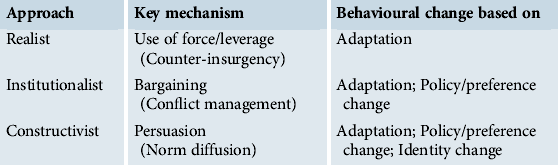
The benefit of using international relations theory in this context is that different camps and strategic orientations in dealing with armed actors can be better structured and understood.Footnote 6 Each of these approaches is linked to particular paradigms and worldviews, which explicitly or implicitly carry with them assumptions about the character of the underlying conflict, as well as about the nature and the typical behaviour of armed actors when they are confronted with particular situations, means, and actions. Realist approaches ultimately focus on elimination of, suppression of, and control over non-state armed actors in order to force them to adapt to a new situation; institutionalist approaches aim at changes of interests and policies of these actors; constructivist approaches concentrate on a change in norms (such as non-violence) and in the self-conception (identity) of the respective actor. Thus, the approaches not only differ regarding strategies and instruments but also show different underlying assumptions with respect to learning processes of armed actors, ranging from pure adaptation to changes of preferences to changes of identity.
Approaches for dealing with non-state armed actors.
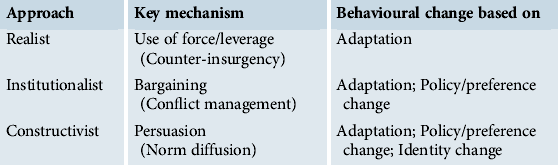
Accordingly, the approaches base themselves on different mechanisms and result in different degrees of behavioural change, which are summarized in Table 1. The realist approach mainly rests on the application of force and the use of leverage, which may precipitate a behavioural change only as long as force is applied. Under continuous pressure from the outside, non-state armed actors may change their policies but usually inherent preferences will remain unchanged and their positions may even become hardened. The institutional approach focuses on bargaining as its key mechanism, which may achieve a sustainable result but relies heavily on the respective actor to remain a part of the bargaining system. Only the incessant application of an institutional setting offers enough incentives and guidance to change first policies and later possibly preferences. Constructivists rest their efforts on persuasion, which may not easily lead to results but if a behavioural change occurs it will – in theory – be sustainable, as the motivation to maintain conform behaviour may over time be internalized by the actor. The literature accounts for an array of approaches that may roughly be assigned to these different tendencies.Footnote 7
Realist approaches: the use of force and leverage
The realist perspective emphasizes the role of ‘power’ and ‘countervailing power’, and focuses on repressive means in order to put pressure on armed groups. The overall objective is to combat, to eliminate, to deter, to contain, and to marginalize armed actors.
1. Coercion
International actors may use coercive measures, including the use of force and coercive diplomacy.Footnote 8 Typical instruments are military or police operations aimed at fighting or arresting members of armed actors, the deployment of international troops in order to stabilize a post-war situation, and the implementation of international sanctions (such as arms embargoes, no-fly zones, economic sanctions, freezing of foreign assets, travel sanctions, or war criminal tribunals), which could harm the interests of at least some non-state armed actors, in particular paramilitaries, rebel leaders, warlords, and clan chiefs. This approach is often accompanied by law enforcement measures at national and/or international level. Examples of the latter are the activities of the International Criminal Court and other international criminal tribunals.Footnote 9
2. Control and containment
This strategy aims at systematically controlling and containing the activities of non-state armed actors, thereby reducing their freedom to manoeuvre and communicate. The object is to maintain a certain status quo and to put these actors under strict surveillance (by using police and intelligence measures). This is particularly effective with actors who are concentrated in a certain territory that can be cut off (for example, through the use of fences and checkpoints) from the rest of the country.
3. Marginalization and isolation
This approach is concerned with reducing the political and ideological influence of armed actors. The idea is to marginalize their worldviews and demands in public discourse and to isolate them – politically as well as physically – from actual or potential followers and their constituencies. For this scenario, a broad consensus is needed among political elites and societal groups not to deal with these actors and not to react to their violent provocations, but to continue an agreed political process. This approach works particularly well for weak or already weakened actors such as smaller rebel groups, terrorists, or marauders.
4. Enforcing splits and internal rivalry
Another option aims to fragment and divide armed actors between more moderate forces and hardliners. This can be achieved by different means, be it the threat of using force indiscriminately, by offering secret deals to some key figures, or by inviting factions in a political process that would encourage them to leave their group or to transform it into a political movement. Such a strategy can, however, result in the establishment of radical fringe and splinter groups, which may be even more extreme than the former unified group. These fragmentation processes can often be observed with rebel or terrorist groups, for example when the Kato group split from the Moro Islamic Liberation Front (MILF) in the Philippines, or when the Islamic Courts Union (ICU) in Somalia splintered into numerous factions after 2006, one of which being the militant Al-Shabaab.
5. Bribery and blackmail
Members of armed actors may be corrupted in certain ways: they may be forced or induced to co-operate or silenced through the offering of material incentives, such as economic resources or well-paid posts. In some cases, this may also involve attempts to blackmail or to intimidate leaders (for instance through threatening family members) in order to make them more likely to accept money or other offers. This strategy is politically and normatively questionable; however, in some cases it is indispensable for getting a peace process started in the first place. In particular, profit-driven actors, such as warlords and criminals, have often been receptive to such a strategy. A recent example of this strategy in practice is the December 2001 Bonn Agreement for Afghanistan, where a regime change was agreed upon in exchange for handing over considerable power to factional leaders who were perceived to be on the ‘right side’ of the war on terror.Footnote 10
Most of these approaches involve a mixture of sticks and carrots, occasionally including deals with the actor, with the leadership, or with some key members in order to alter their behaviour to conform, at least in the short term. Therefore, in most instances, these strategies are not used exclusively but in combination. For example, the concept of counter-insurgency combines some of these approaches in order not only to fight against rebels or other actors but also to cut off the links between an armed actor and its (potential) constituency or supporters among the population.Footnote 11 Yet the focus remains mainly on coercive measures backed by (material) incentives, which reflect the underlying premises that most leaders of armed actors– despite their political rhetoric – are not driven by ideals but by narrowly defined, selfish interests. For realists, the bottom line reads as follows: if one is able to put enough pressure on them and/or offer them some profits, these people will ultimately comply.
Institutionalist approaches: the power of bargaining
At the heart of institutionalist approaches are processes of bargaining aimed at the establishment of procedures, rules, and institutional settings that acknowledge the preferences and interests of all conflict parties and allow for some kind of peaceful co-existence (conflict management). Examples are ceasefires, confidence-building measures, and peace agreements, as well as mechanisms for conflict settlement and arbitration. In general, these arrangements need to be implemented, guaranteed, and controlled internationally. Two different approaches – which do not exclude each other – aim to achieve such arrangements.
1. Mediation and negotiation
Using this approach, external actors primarily work to foster a negotiation process among different parties, including non-state armed actors, in order to find a political settlement.Footnote 12 As facilitators or mediators, they will try to urge armed actors to refrain from the use of force and to abandon maximalist political demands. For that purpose, informal contacts, multi-track diplomacy and extensive pre-negotiations are often necessary, in particular when direct contact between the conflicting parties (for example a local government and a rebel group) is unlikely. In such a process, pros and cons of possible solutions usually have to be weighed, incentives and disincentives (such as possible sanctions) have to be taken into account, and a compromise acceptable to all sides has to be found. Arguing and bargaining methods (including cost-benefit analysis) often need to be combined in order to achieve such an outcome. These approaches imply a long-term engagement, since mediation may still be necessary during the implementation of agreements. This scenario applies mainly to actors with a political agenda who are strongly tied to a defined constituency such as tribes, clans, ethnic groups, and political parties.
2. Co-optation and integration
Here the basic idea is that non-state armed actors, and in particular their respective leaderships, can be co-opted and slowly integrated into a political setting, for example by distributing resources and sharing political responsibility. This approach therefore implies a certain degree of informal or formal power-sharing, be it at national or local level, which would involve leaders of armed groups in day-to-day politics.Footnote 13 In other words, the attempt would be to give them a role to play, which might then change their attitudes and preferences. This strategy is sometimes based on a formal agreement, brokered by outsiders, but it is often pursued by efforts of building alliances and coalitions among different local groups. A good illustration is the attempt to gradually integrate Afghan warlords into the newly established political system, not least by offering them positions such as governors or ministers, but also by granting them a certain political status quo. Similar processes can be observed in various African societies with regard to clan chiefs, big men, or certain militia groups.
In contrast to the realist version, the starting point here is that many non-state armed actors are indeed driven by certain grievances and political demands, which can be addressed through negotiations and/or other means. Even if the leadership is corrupt and greedy, in many instances they must show some kind of political programme or agenda in order to find followers and supporters in local communities. In other words, even the most selfish leaders are under pressure to deliver – and therefore may be receptive to incentives and guarantees, assured by institutional arrangements.
Constructivist approaches: the power of persuasion
In general, constructivist approaches emphasize the central role of arguing and persuasion, as well as processes of norm diffusion. Their ultimate aim is to persuade armed actors to accept, respect, and eventually internalize norms, thereby fostering long-term transformation processes that involve not only conformity of behaviour for tactical reasons but also a genuine and sustainable change of the actors’ policies and self-conception (identity change).
1. Processes of socialization
By involving non-state armed actors in processes and institutions, this approach claims that, over time, chances will increase that (potential) spoilers will be successively socialized into accepting certain norms and rules of the game.Footnote 14 Armed actors will undergo processes of collective learning, which will alter strategies and, eventually, their self-conception. This medium- to long-term strategy may work best for those armed actors with clear political ambitions who have to address long-term expectations of their constituencies and develop an interest in improving their local as well as international image.
2. Naming and shaming
The attempt here is to organize social pressure and to campaign publicly, at the national and the international level, against certain practices of non-state armed actors in order to harm their legitimacy within and outside their (actual or potential) constituencies. The aim is usually to persuade them to accept and respect certain agreements and norms, in particular norms of humanitarian international law, and to foster them by refraining from certain violent methods (such as terrorist acts) and from using particular means (for example landmines or child soldiers). Such campaigns are often conducted by international NGOs. Again, this approach may be useful in cases involving actors who need moral and material support from abroad.
3. Reconciliation and transitional justice
These processes are more institutionalized, and often preceded by an agreement between conflict parties that lays down the provisions and details of a process in which a recent, violent past will be addressed, including the handling of war crimes and war criminals.Footnote 15 They present a framework for armed actors to accept basic norms and critically reflect their self-image and their actions. Reconciliation processes encompass, inter alia, empathy for victims, the confession of guilt, and public remorse. Common tools for reconciliation processes and transitional justice are truth and reconciliation commissions and criminal tribunals, which may be linked with amnesty provisions for leaders and members of armed groups if they participate in the investigation of war crimes and human rights violations, regret their past actions believably, and want to change their behaviour. On the one hand, such amnesty provisions are normatively highly contested because they may contradict the demands for justice by the victims and thus endanger the reconciliation process. On the other hand, as part of an agreement, they may serve as an incentive to end violence and to refrain from using violence in the future.
The underlying assumption of constructivist approaches is that non-state armed actors can be affected by norms and arguments because many of them are concerned with their public image, their moral authority (vis-à-vis their enemies), and their sources of legitimacy. Indeed, a number of leaders refer in their public statements to general norms and thereby also try to argue their case from a normative perspective. So, as constructivists would ask, why not take them seriously and engage them in debates about norms and standards?
The politics of external actors: who is doing what?
The above-mentioned approaches offer different methods for dealing with armed actors based on different assumptions, mechanisms, and instruments. Generally, the realist approach mainly addresses the costs of an engagement with armed actors, focusing on how to diminish their influence and spoiling potential quickly and effectively. Arguably, the other two approaches – institutionalism and constructivism – are more occupied with a longer-term perspective that incorporates armed actors into the existing international system, hoping that they can, over time, be co-opted and socialized into conformity. While, in their own logic, each approach attempts to increase the cost of deviant behaviour as well as the benefits of behavioural change for armed actors, they employ very different means and methods based on different actor capacities and capabilities to achieve this aim. For instance, state actors will be more likely to be able to use coercive measures or bribery and blackmail when attempting to influence the behaviour of armed actors, international organizations will be able to use their political leverage, and NGOs will focus on mechanisms that do not require massive resources and political authority. NGOs may, however, be able to pursue a longer-term approach of socialization, while international organizations and state actors often have to present ‘results’ much faster, in order to respond to political pressure. As a result, it is more likely and more obvious for external actors engaging in local conflicts to prefer one approach over another, depending on their objectives, resources, and capacities. Overall, international organizations appear to have the instruments of all three approaches at their disposal (benefiting from their independent status as well as from the capacities of states as their primary members), whereas states generally appear to focus on realist and institutionalist approaches. The capacities of NGOs appear to be the most restricted in this context, making use of constructivist approaches alone, owing to the nature of their organization and status.
International organizations and multilateral fora
International organizations such as the United Nations (UN), including its special agencies, and regional organizations such as the European Union (EU) and the African Union (AU), as well as multilateral fora (for instance the G8 or G20), make use – at least in theory – of the most comprehensive range of options to handle (potential) spoilers in international politics. More precisely, with regard to realist approaches, international organizations have the capability to build alliances and coalitions among their member states that allows them, in many cases, to take direct action and physically intervene in a conflict.Footnote 16 For example, they may do so by invoking resolutions that allow for the use of force by member states to achieve a certain aim (coercion). The most recent instance for such action was the UN's authorization of its member states to ‘take all necessary measures … to protect civilians and civilian populated areas under threat of attack in the Libyan Arab Jamahiriya’ and the approval of a no-fly zone over Libya,Footnote 17 prompting military engagement by NATO countries against Muammar al-Gaddafi's forces and facilities. The same resolution also calls for the enforcement of an arms embargo, a ban on flights, and an assets freeze.
In the same way, international organizations may also play a crucial role in preparing, drafting, and implementing multilateral strategies vis-à-vis non-state armed actors in zones of conflict, particularly with regard to the use of sanctions, peacekeeping, and peace enforcement operations. A case in point is the imposition of travel bans and assets freezes by the UN on several high-ranking members of a number of non-state armed groups in the Democratic Republic of the Congo.Footnote 18 These restrictive and coercive measures are designed to preserve peace and strengthen international security, if there is a threat to the peace, a breach of the peace, or an act of aggression.
The institutionalist approach relies heavily on the standing that international organizations hold in international politics. The organizations often assume the role of negotiator or mediator in a multi-level environment, for example through UN and EU Special Representatives, Special Envoys, or other specific arbitration mechanisms. In this role, they may call on all parties involved in a conflict or crisis – state actors as well as non-state armed actors – to commit to and enforce a peace process or a political settlement, as well as to monitor such settlements. The purposeful distribution of incentives and disincentives also allows international organizations to apply some leverage in negotiations with non-state armed actors, either by punishing them (for example, through economic sanctions or naming and shaming) or by rewarding them for conforming behaviour and engagement in a peace process (for example, by supporting an actor transformation through development aid, capacity-building programmes, disarmament, demobilization and reintegration (DDR) programmes, security sector reform, and so on). International organizations may also decide to offer a share of the political responsibility for certain issues, going as far as integrating armed actors into post-conflict governance, for example through power-sharing agreements such as the ones designed for Sudan (2005),Footnote 19 Zimbabwe (2008),Footnote 20 and Kenya (2008).Footnote 21 International institutions are thus particularly useful in offering a platform for rapprochement between governments and armed opposition.
With regard to constructivist methods, international organizations have the capacity to influence international politics through the establishment of procedures, rules, and institutional settings that serve two particular purposes: they promote new international norms among members, and they aim to guide their behaviour. One example of this approach is the 1997 Convention on the Prohibition of the Use, Stockpiling, Production and Transfer of Anti-Personnel Mines and on their Destruction (also Anti-Personnel Mine Ban Convention or Ottawa Treaty) that bans the use of anti-personnel landmines by states – establishing an internationally recognized norm against the use of specific types of landmine – and promotes this ban through specific measures, such as assistance for mine clearance and destruction, and review conferences in 2004 and 2009.Footnote 22 Another example is the 1979 Convention on the Elimination of all Forms of Discrimination against Women, supported by the UN Security Council Resolutions 1820 (2008) and 1888 (2009).Footnote 23 Such rules and regulations target the actors’ behaviour on the basis of incentives and rewards, and hope to alter their self-conception and identity to sustain peaceful means in the long run. Through this capacity, international organizations effectively possess the capability to act as international norm entrepreneurs, promoting certain normative choices while discouraging and potentially sanctioning others. When addressing non-state armed actors, constructivist methods make an effort to regulate their behaviour in the same manner by setting guidelines and frameworks for appropriate behaviour. The most recent examples address the situations in Côte d'Ivoire, Western Sahara, and Sudan.Footnote 24 Exemplarily, under threat of targeted measures, these UN resolutions call for adherence to the rough diamonds embargo, to the ceasefire, and to human rights (particularly with regard to sexual exploitation and abuse); they call for the holding of parliamentary elections, implementation of the peace process, and the holding of substantial negotiations; and they urge non-state armed actors to end violence and lay down their arms immediately.
Governments and state actors
State actors seem to be most likely to employ realist and institutionalist approaches when dealing with non-state armed actors in international politics. The availability of the necessary resources to states makes these approaches an obvious option. States often possess the required authority and resources (material as well as human) to be able to conduct operations relying on force or the credible threat of force against armed actors, being able either to disrupt the actions of non-state armed actors or to defeat them altogether. For this purpose, governments have not only some form of military and enforcement units at their disposal but also usually multiple intelligence services, which open up an array of possible measures against non-state armed actors. Intervening governments may obtain important information that can be used as leverage against non-state armed actors. Non-compliance may lead to the enforcement of targeted sanctions through states, as seen in Darfur, Sudan (2006) and many other states, as well as to targeted attacks on non-state actors, as seen in Sierra Leone (particularly between 1999 and 2002). In extreme cases, intervening governments may decide to employ full military means, ranging from the enforcement of no-fly zones – see, for example, in northern Iraq between 1991 and 1998 – to a comprehensive military strike – as employed in Kosovo (1999), Afghanistan (2001), and Iraq (2003). The danger that arises from relying on a realist approach is that non-state armed actors may be pushed further into spoiling and violent behaviour because they face an enemy that already uses force against them. This may coerce non-state armed actors into defending themselves and retaliating (see, for instance, Hezbollah on multiple occasions).Footnote 25 The lack of constructive communication between the two parties may reinforce a circle of violence and lead to more extremism.
For this reason, state actors may also use their institutional status and the institutional channels at their disposal to create public discourse and to put pressure on other stakeholders involved. These channels may comprise multilateral international organizations such as the UN, the EU, and the AU, economic forums, or ad hoc alliances. Co-operation with other states and organizations opens up a whole range of possible courses of action, such as negotiations, mediations, and facilitations by ‘honest brokers’. A coalition of states may act as a ‘group of friends’ or ‘contact group’, engaging in conflict management and conflict mediation in specific cases. States with a strategic interest in a particular conflict may take the lead in arguing and bargaining processes, as for example the US, the EU, the UN, and Russia (the ‘Quartet’) in the Middle East peace process, which may then result in some form of co-operative agreement, such as the Road Map for Peace of 2003.Footnote 26 Or they may choose to apply more coercive measures such as favouring one party over another and thus increasing pressure on the other party (see, for instance, the US support of Fatah over Hamas in the Middle East). Donor conferences, as employed in Kosovo and Afghanistan, may set additional incentives for conflict actors to change their behaviour and comply with international demands. However, institutional channels may also be used to strengthen a military engagement: if negotiations fail, intervening governments may resort to force either though multilateral co-operation (for example, through the UN and the EU – as done in the peacekeeping missions in the Democratic Republic of the Congo (MONUSCO), Haiti (MINUSTAH), East-Timor (UNMIT), Kosovo (UNMIK), Lebanon (UNIFIL), and others) or through ad hoc military coalitions, such as the US-led coalitions in Afghanistan and Iraq.
Non-governmental organizations (NGOs)
International NGOs’ approaches towards non-state armed actors in intra-state conflicts mainly rest on constructivist approaches because NGOs usually lack the capacities to employ serious leverage and effective bargaining attempts. Their goals for an engagement of armed actors may also differ distinctly from those of states. NGOs tend to focus primarily on the humanitarian objective of decreasing violence. However, international NGOs are able to support mediation and negotiation processes with non-state armed actors at high and medium levels – for example, through the facilitation of talks, informal pre-negotiations, and the preparation of non-papers – and in some cases even conduct mediations themselves. In these instances, they largely rely on argument and persuasion in order to bring the parties to conflict to the table and, eventually, to an agreement (see, for example, the Carter Center or the Centre for Humanitarian Dialogue).Footnote 27
Generally, NGOs have a strong capacity to influence public opinion (often with the use of the media), to educate and raise awareness about certain issues, to lobby political decision-makers, and to engage with diplomatically unacknowledged actors, such as non-state armed actors, without implying a political shift in their favour. What is more, NGOs’ long-term engagement in relevant fields often grants them a certain amount of trust even from non-state armed actors. They benefit from their reputation as neutral and independent actors even if this perception is not necessarily shared by all. This puts them into a position to act as a facilitator for specific issues. For example, the International Committee of the Red Cross (ICRC) engages non-state armed actors in the application of international humanitarian law;Footnote 28 the Cluster Munitions Coalition (CMC) was a key actor in the preparation of the Dublin Conference on Cluster Munitions in May 2008; and the Centre for Humanitarian Dialogue regularly supports global intra-state mediation efforts by providing thematic and technical assistance. NGOs are in the fairly unique position of being able to communicate with non-state armed actors independently of political circumstances, focusing on specific issues rather than on entire peace processes, and trying to persuade them of the utility of specific international norms and rules (such as international humanitarian law), as well as of the lack of utility of violence and particular means of war to achieve their aims. For instance, NGOs such as Geneva Call and the Coalition to Stop the Use of Child Soldiers approach non-state armed actors purposefully in order to provide a platform for armed actors to adhere to international norms, in this case the bans on landmines and child soldiers. The arguments that NGOs employ strategically in order to persuade armed actors focus on the benefits of adherence to specific norms and the costs of violations. They comprise, inter alia, the improvement of their reputation, the better treatment of prisoners on the principle of reciprocity, the preservation of resources and military interests (for example, through discipline and a functioning command structure), and the danger of prosecution (for example, through criminal tribunals or the International Criminal Court).
In their interaction with armed actors, international NGOs focus heavily on the transmission of information and knowledge, including technical knowledge, and aim to persuade armed actors with arguments that speak to their particular position in conflict (the empathic approach). In other words, they explain to armed actors what they are supposed to do (and why) and, furthermore, lay out concrete methods for the implementation of the norms in question. This flexible but principle-oriented approach is one of the strengths of NGOs because it can be adjusted to the situation of the individual non-state armed actor. The decision on whether and which norms are adopted by armed actors is not a precondition for further dialogue but the result of a long-term process.Footnote 29
The only leverage that these NGOs are perceived to have in their interaction with armed actors is their influence on public opinion, locally as well as internationally. They can create public pressure on non-compliant actors by employing naming and shaming techniques, which may, however, also have repercussions on the relationship between the NGO and the armed actor, which is why these techniques are seldom used. To offer incentives and disincentives to armed actors, NGOs by and large remain dependent on other actors, such as international organizations and states, to provide the required resources and political pressure. Moreover, the engagement of NGOs in political issues may also result in a worsening of the relationship between non-state armed actors and the international community.
Conclusion
Engagement with non-state armed actors is dependent on various factors. To begin with, these groups differ widely in kind, displaying different forms of appearance, aims, and underlying motivations. They may seek to change the existing status quo or be a distant agency of the ruling party; they may seek territorial dominance or simply any dominance; they may use physical and psychological violence for different reasons; and they may be predominantly ideology-oriented or profit-driven – or a combination thereof. Concurrently, external actors, depending on their character and abilities, display different means when engaging non-state armed actors. While states largely rely on realist and institutionalist approaches (with force, leverage, and bargaining as the main mechanisms), international organizations may revert to realist, institutionalist, and/or constructivist approaches, using the institutional framework for medium- and long-term strategies and falling back on their member states to carry out realist approaches. In contrast, international NGOs are capable of applying constructivist approaches, building on their civil base and also benefiting from an elaborate institutional network.
The resulting web of variables that describe an engagement with non-state armed actors suggests the following key problems:
– Internal armed conflicts or non-state conflicts usually involve more than one non-state armed actor. Multiple actors often exist in parallel to each other and are often treated differently by their local government – some are being utilized, some are supported, some are even deliberately set up by governments (see militias), while others, such as rebels or warlords, are combated. This results in distinctly different forms of non-state armed actors.
– At the same time, in many conflicts we also deal with a plurality of external actors, who apply, whether intentionally or unintentionally, different approaches. In theory, these approaches may complement each other. In practice, however, they exist in parallel, pursuing different goals, prioritizing different means, and competing against each other. The problem is also complicated by the fact that external actors do not exchange information about their own strategies vis-à-vis armed actors, which in the field may lead to a number of unintended effects.
– Owing to this situation, non-state armed actors are often in a position to play actors off against each other and use their different strategies and lack of communication with each other to the advantage of the non-state actors. Moreover, local actors are aware that time is usually is on their side, since external actors will not stay forever but need to leave the country because of limited resources and pressure from the public at home. Against this background, non-state armed actors may misuse offers by international organizations or NGOs to avoid or deal with external pressure or external coercion. For example, they may accept participation in a peace process led by an international organization to bypass legal prosecution or economic or military sanctions. In this way, different strategies may neutralize each other – the pressure built up through realist approaches may be annulled by insincere commitments by the non-state armed actor. For example, such criticism has been voiced recently regarding the Afghanistan Peace and Reintegration Program (APRP), which works towards winning over loyalties of Taliban fighters to the government. Many observers fear that much of the money invested in ex-combatants simply disappears back into the Taliban machinery.Footnote 30
– In general, external actors often lack knowledge about the non-state armed actors with whom they are dealing and about the range of options that they may have at their disposal in that particular case. In particular, governments are often unwilling or unable to reflect all possible strategies. Instead, they tend to choose an approach that they may have most experience with, are most familiar with, or are most capable of applying, but they are not flexible enough to adapt their position to, for example, a transformation of the non-state armed actor during the conflict. This has often resulted in the expansion of counter-insurgency efforts beyond their original goals, owing to a previous failure to reach the set goals (the ‘mission creep’ problem, demonstrated in Afghanistan and Iraq). At the same time, abandoning the mission in favour of official peace negotiations is often seen as giving in and awarding the use of violence by non-state actors. Here, international organizations or NGOs need to come in. However, they frequently lack the political backing of the international community (despite resolutions at the UN) and are not able to grant required security measures or deliver the necessary resources.
To sum up, external actors dealing with non-state armed actors need to be aware of the existing range of approaches, used by the different actors, as well as of their pros and cons. In a particular case, they need to know who can do what and when, in order to develop a joint effort vis-à-vis armed actors. Some governments and international peace operations have already attempted to incorporate international NGOs into their engagement strategies (particularly counter-insurgency strategies), recognizing the contribution that NGOs can make, based on their unique skills. However, as a general rule, NGOs are uncomfortable with participating in these types of operations. Some even refuse to communicate with the military for fear of losing their comparative advantages, in particular their creditability vis-à-vis the local population. Much of the resulting debate on this issue in both camps has focused on whether NGOs should or should not co-operate with military counter-insurgents and peace operations. For a more productive approach, however, scholars and practitioners should focus on finding middle ground that would allow realist, institutionalist, and constructivist approaches to work independently of each other but with a fundamental understanding about each other's methods. At the same time, actors need to reflect on the changing nature of these armed actors during and in the aftermath of a conflict to apply the appropriate mix of strategies. This, however, requires a much more nuanced understanding of the characteristics, dynamics, and opportunity structures under which those different armed actors act.