Introduction
Sodium channel blocker insecticides (SCBIs) have been used in insect resistance management (IRM) programmes due to their unique mode of action. These compounds target voltage-gated sodium channels (Carnevale and Klein, Reference Carnevale and Klein2017), binding to their inactivated state and preventing sodium influx, which results in paralysis and death of the insect (Silver et al., Reference Silver, Song, Nomura, Salgado and Dong2010). SCBIs include two commercially registered insecticides: indoxacarb and metaflumizone. Indoxacarb, an oxadiazine, is a pro-insecticide bioactivated by amidases or esterases into the active metabolite DCJW (Wing et al., Reference Wing, Sacher, Kagaya, Tsurubuchi, Mulderig, Connair and Schnee2000). In contrast, metaflumizone is a semicarbazone that does not require metabolic activation. Despite these differences, both induce identical neurotoxic symptoms in insects (Salgado and Hayashi, Reference Salgado and Hayashi2007).
SCBIs are used worldwide and resistance cases have already been reported in many insect pests (Scott, Reference Scott2019), e.g Helicoverpa armigera in Australia and China (Bird et al., Reference Bird, Drynan and Walker2017, Reference Bird, Walker and Drynan2023; Cui et al., Reference Cui, Wang, Qi, Wang, Yuan and Rui2018; Wang et al., Reference Wang, Rui, Wang, Nahiyoon, Huang, Zhu, Ji, Yang, Yuan and Cui2021b), Spodoptera litura in Pakistan and China (Ahmad et al., Reference Ahmad, Sayyed, Saleem and Ahmad2008; Hou et al., Reference Hou, Staehelin, Elzaki, Hafeez, Luo and Wang2021; Sayyed et al., Reference Sayyed, Ahmad and Saleem2008), S. exigua in China and Pakistan (Ahmad et al., Reference Ahmad, Farid and Saeed2018; Su and Sun, Reference Su and Sun2014), S. frugiperda in China (Guo et al., Reference Guo, Guo, Gao, Huang, Wan, He, Xie, Li and Ma2022; Hafeez et al., Reference Hafeez, Li, Ullah, Zhang, Zhang, Huang, Chen, Siddiqui, Ren, Zhou, Imran, Assiri, Zalucki, Lou and Lu2022), S. littoralis in Egypt (Mokbel et al., Reference Mokbel, Moustafa, Alfuhaid and Fouad2024), Plutella xylostella in China and Brazil (Khakame et al., Reference Khakame, Wang and Wu2013; Pudasaini et al., Reference Pudasaini, Chou, Wu and Dai2022; Santos et al., Reference Santos, Siqueira, Silva and Farias2011; Shen et al., Reference Shen, Li, Zhang, Zhu, Wan and Li2017; Wang et al., Reference Wang, Zheng, Yuan, Wang, Xu, Wang, Zhang and Wu2021a; Zhang et al., Reference Zhang, Zhang, Shen, Li, Wan, You and Li2017), and Tuta absoluta in Greece, Brazil, and Iran (Aboutalebian-Soureshjani et al., Reference Aboutalebian-Soureshjani, Rafiee-Dastjerdi, Naseri, Hassanpour and Khajehali2023; Roditakis et al., Reference Roditakis, Mavridis, Riga, Vasakis, Morou, Rison and Vontas2017; Silva et al., Reference Silva, Assis, Ribeiro and Siqueira2016, Reference Silva, Picanço, Bacci, Crespo, Rosado and Guedes2011).
Resistance to SCBIs is mainly associated with two point mutations, F1845Y and V1848I, in the sixth transmembrane segment of domain IV of the voltage-gated sodium channel gene. These mutations were first identified in P. xylostella (Wang et al., Reference Wang, Su, Zhang, Yang, Dong and Wu2016) and later the combination of both or only the V1848I mutation was found in resistant populations of T. absoluta and Liriomyza trifolii, respectively (Li et al., Reference Li, Gong, Yuan, Pan, Jin, Lu and Wu2022; Roditakis et al., Reference Roditakis, Mavridis, Riga, Vasakis, Morou, Rison and Vontas2017). A gene-editing study in Drosophila melanogaster confirmed differences in the functional contribution of each mutation to SCBIs resistance, supporting the need for further investigation of their roles in other pests (Samantsidis et al., Reference Samantsidis, O’Reilly, Douris and Vontas2019). Most recently, the V1848I mutation was associated with indoxacarb resistance in S. exigua field populations (Zhang et al., Reference Zhang, Zhang, Yu, Liu, Liu, Teng, Pei, Hu and Zuo2024). However, the molecular basis of SCBIs resistance in other species within this important genus remains unclear.
Spodoptera frugiperda is a highly polyphagous pest with a broad host range (Montezano et al., Reference Montezano, Sosa-Gómez, Specht, Roque-Specht, Sousa-Silva, Paula-Moraes, Peterson and Hunt2018), causing significant crop losses across the Americas (Overton et al., Reference Overton, Maino, Day, Umina, Bett, Carnovale, Ekesi, Meagher and Reynolds2021). It has recently spread to Africa, Asia, and Oceania, becoming a globally significant agricultural threat (Baloch et al., Reference Baloch, Fan, Haseeb and Zhang2020; CABI, 2024; Goergen et al., Reference Goergen, Kumar, Sankung, Togola and Tamò2016; Jeger et al., Reference Jeger, Bragard, Caffier, Candresse, Chatzivassiliou, Dehnen‐Schmutz, Gilioli, Gregoire, Jaques Miret, Navarro, Niere, Parnell, Potting, Rafoss, Rossi, Urek, van Bruggen, van der Werf, West, Winter, Gardi, Aukhojee and MacLeod2017). Current management strategies rely heavily on transgenic Bt crops and insecticides, although resistance to both has been widely reported (Bolzan et al., Reference Bolzan, Padovez, Nascimento, Kaiser, Lira, Amaral, Kanno, Malaquias and Omoto2019; Carvalho et al., Reference Carvalho, Omoto, Field, Williamson and Bass2013; Diez-Rodríguez and Omoto, Reference Diez-Rodríguez and Omoto2001; Garlet et al., Reference Garlet, Gubiani, Palharini, Moreira, Godoy, Farias and Bernardi2021; Lira et al., Reference Lira, Bolzan, Nascimento, Amaral, Kanno, Kaiser and Omoto2020; Muraro et al., Reference Muraro, Oliveira Abbade Neto, Kanno, Kaiser, Bernardi and Omoto2021; Nascimento et al., Reference Nascimento, Fresia, Cônsoli and Omoto2015, Reference Nascimento, Pavinato, Rodrigues, Silva-Brandão, Consoli, Michel and Omoto2022, Reference Nascimento, Rodrigues, Kanno, Amaral, Malaquias, Silva-Brandão, Consoli and Omoto2023; Okuma et al., Reference Okuma, Bernardi, Horikoshi, Bernardi, Silva and Omoto2018). Since discovering insecticides with novel modes of action is difficult and costly, preserving the efficacy of existing products is critical (Sparks et al., Reference Sparks, Crossthwaite, Nauen, Banba, Cordova, Earley, Ebbinghaus-Kintscher, Fujioka, Hirao, Karmon, Kennedy, Nakao, Popham, Salgado, Watson, Wedel and Wessels2020; Sparks and Lorsbach, Reference Sparks and Lorsbach2017).
Recent studies have shown that S. frugiperda populations in Brazil remain highly susceptible to indoxacarb and metaflumizone, with no cross-resistance to other insecticides or Bt proteins (Kaiser et al., Reference Kaiser, Kanno, Bolzan, Amaral, Lira, Guidolin and Omoto2021). These findings suggest that SCBIs are still effective tools for managing this pest, reinforcing the importance of delaying resistance development. To assess this risk, we selected resistant strains of S. frugiperda to indoxacarb and metaflumizone and evaluated the inheritance pattern of resistance and cross-resistance to other voltage-gated sodium channel-targeting insecticides. Additionally, we screened for the presence of the two previously reported sodium channel mutations to investigate their potential role in SCBIs resistance. This information will contribute to proactive resistance management strategies for S. frugiperda.
Materials and methods
Strains of Spodoptera frugiperda
The susceptible strain (SUS) was obtained from a laboratory colony at Embrapa Milho e Sorgo, Sete Lagoas, Minas Gerais State, Brazil, and has been maintained in the laboratory without selection pressure from insecticides or Bt proteins since 1996. The resistant strain to indoxacarb (Indoxacarb-R) was selected in previous work using the F2 screen method (Andow and Alstad, Reference Andow and Alstad1998) with a diagnostic concentration of 100 µg of indoxacarb mL−1 from a population collected in a non-Bt maize crop at Roda Velha (population identified as BA 48), Bahia State, Brazil, during the 2017/2018 crop season (Kaiser et al., Reference Kaiser, Kanno, Bolzan, Amaral, Lira, Guidolin and Omoto2021). The same field-collected population was used in this work to select the resistant strain to metaflumizone (Metaflumizone-R) using mass selection from 500 field-collected larvae with diagnostic concentration bioassays of 100 µg of metaflumizone mL−1, as previously defined (Kaiser et al., Reference Kaiser, Kanno, Bolzan, Amaral, Lira, Guidolin and Omoto2021). The survival rate of the field-collected population at the diagnostic concentration was 8.1% for indoxacarb and 12.7% for metaflumizone (Kaiser et al., Reference Kaiser, Kanno, Bolzan, Amaral, Lira, Guidolin and Omoto2021). The Indoxacarb-R and Metaflumizone-R strains were maintained under selection pressure with increasing concentrations varying from 100 up to 180 µg mL−1 for indoxacarb and from 100 up to 320 µg mL−1 for metaflumizone. After 15 generations (G15) of selection, we performed the characterisation of inheritance of resistance. For each strain, nearly 2,000 larvae were screened per generation and the survival rate at G15 was approximately 65% for the Indoxacarb-R strain and 85% for the Metaflumizone-R strain at the diagnostic concentration of each insecticide. The individuals used for mutation screening were collected after G15 and kept at−80 °C until DNA extraction.
Larvae of all three strains were reared on an artificial diet based on dry beans and wheat germ (Kasten et al., Reference Kasten, Precetti and Parra1978). Adults were fed a 10% honey solution and maintained in polyvinyl chloride cages (10 cm diameter × 20 cm height) covered internally with paper as an oviposition substrate. Strains were maintained under controlled conditions (25 ± 1°C, 70 ± 10% relative humidity, and a 14:10 h light/dark photoperiod) during all phases of development.
Characterisation of Spodoptera frugiperda resistance to indoxacarb and metaflumizone
To characterise the inheritance pattern of resistance, pupae from the Indoxacarb-R, Metaflumizone-R, and SUS strains were sexed and individualised in plastic cups (50 mL) placed on moistened filter paper to maintain humidity. After the emergence of adults, reciprocal crosses were carried out between the Indoxacarb-R strain and the SUS strain to establish Hi1 (♀ Indoxacarb-R × ♂ SUS) and Hi2 (♀ SUS × ♂ Indoxacarb-R) strains. The same procedure was done with the Metaflumizone-R strain and the SUS strain to establish Hm1 (♀ Metaflumizone-R × ♂ SUS) and Hm2 (♀ SUS × ♂ Metaflumizone-R) strains. All strains were subjected to concentration–response curves using the diet overlay bioassay method.
Bioassays were conducted in 24-well plates (Costar®, Corning Inc., Corning, NY, USA), each containing 1.25 mL of artificial diet per well (1.9 cm2 area). Each S. frugiperda strain was exposed to nine concentrations of insecticides, spaced on a logarithmic scale. The concentration range varied depending on the strain used. Larvae of the SUS strain were exposed to concentrations ranging from 1 to 100 µg mL−1, for both indoxacarb and metaflumizone insecticides. Insecticide concentrations for the Indoxacarb-R strain ranged from 10 to 1,000 µg mL−1 of indoxacarb, whereas for the Metaflumizone-R strain, concentrations ranged from 32 to 56,000 µg mL−1 of metaflumizone. For heterozygous Hi1 and Hi2, indoxacarb concentrations ranged from 1.8 to 180 µg mL−1 and for the heterozygous Hm1 and Hm2, metaflumizone concentrations ranged from 3.2 to 1,800 µg mL−1. The insecticide solution was diluted in distilled water and a surfactant (Triton® X-100, Labsynth, Diadema, SP, Brazil) was added at a concentration of 0.1%. A 30 µL volume of the solution was added to each well and allowed to dry. For each concentration, 72 third-instar larvae were tested. Mortality was assessed after 48 h and larvae showing no coordinated movements when touched with a brush were considered dead.
Mortality data were submitted to Probit analysis using Polo-Plus software (Robertson et al., Reference Robertson, Preisler and Russell2007a, Reference Robertson, Savin and Preisler2007b) to estimate lethal concentrations expected to kill 50% of the individuals (LC50), respective confidence intervals (95% CI), and slope values for all concentration–response curves. The resistance ratio was estimated by dividing the LC50 of the resistant strains or reciprocal crosses by the LC50 of the SUS strain. In addition, tests of parallelism and equality (P < 0.05) were performed to compare the slope and linear coefficients obtained for the regression lines established for each strain (Robertson et al., Reference Robertson, Savin and Preisler2007b).
Inheritance pattern of Spodoptera frugiperda resistance to indoxacarb and metaflumizone
The dominance of resistance used the mortality data and LC50s obtained in the characterisation of resistance described above. The dominance level for each concentration tested was calculated using the method described by Bourguet et al. (Reference Bourguet, Genissel and Raymond2000). Data were also analysed using Stone’s method (Stone, Reference Stone1968), where D values close to −1 represent completely recessive inheritance and values close to 1 represent completely dominant resistance.
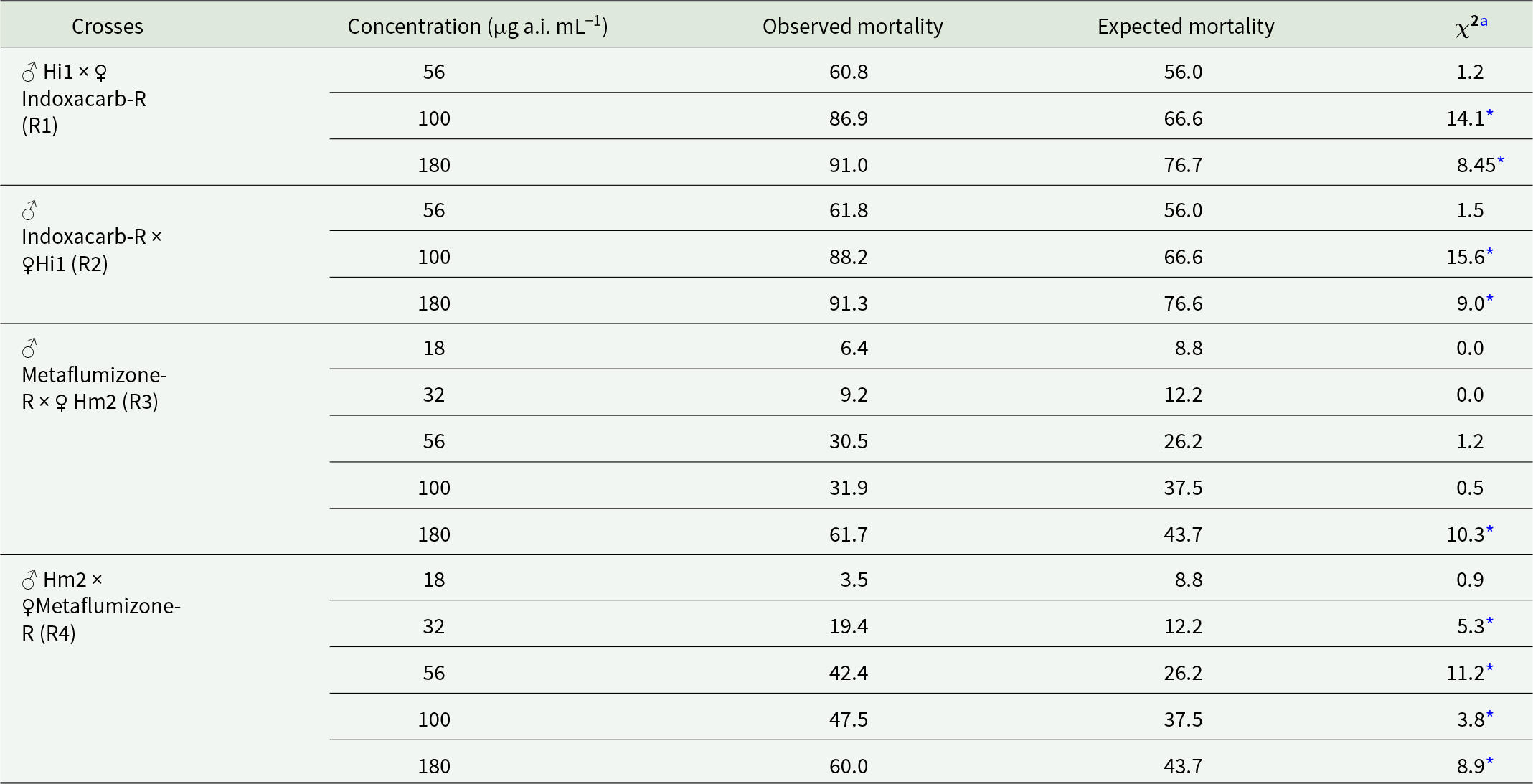
The possible number of genes related to resistance was inferred according to the methodologies proposed by Tsukamoto (Reference Tsukamoto, Georghiou and Saito1983) and Roush and Daly (Reference Roush, Daly, Roush and Tabashnik1990). Initially, heterozygous strains and the resistant strains were backcrossed to result in R1 (♂ Hi1 × ♀ Indoxacarb-R), R2 (♂ Indoxacarb-R × ♀ Hi1), R3 (♂ Metaflumizone-R × ♀ Hm2), and R4 (♂ Hm2× ♀ Metaflumizone-R). When the progeny of these backcrosses reached the third instar, larvae were exposed to concentration–response curves using the same diet overlay bioassay. Insecticide concentrations ranged from 1.8 to 180 µg mL−1 for indoxacarb and 3.2 to 1800 µg mL−1 for metaflumizone. The possibility of monogenic inheritance was evaluated using the chi-square test. The hypothesis of monogenic inheritance was rejected when the calculated chi-square was greater than or equal to the tabulated chi-square, with one degree of freedom (Sokal and Rohlf, Reference Sokal and Rohlf1995).
Cross-resistance of Spodoptera frugiperda to voltage-gated sodium channel insecticides
Concentration–response curves using diet overlay bioassay were done to estimate the cross-resistance between Indoxacarb-R, Metaflumizone-R, and SUS strains and the voltage-gated sodium channel insecticides indoxacarb, metaflumizone, and lambda-cyhalothrin. Thus, Indoxacarb-R and SUS strains were used to estimate the cross-resistance to the insecticides metaflumizone (Verismo®, 240 g of a.i. L−1, BASF S.A., Brazil) and lambda-cyhalothrin (Karate Zeon 250 CS®, 250 g of a.i. L−1, Syngenta Proteção de Cultivos Ltda., Brazil), while Metaflumizone-R and SUS strains were used to estimate the cross-resistance to the insecticides indoxacarb (Avatar® 150, 150 g of a.i. L−1, FMC Química do Brasil Ltda., Brazil) and lambda-cyhalothrin.
Larvae of each strain were exposed to six to nine concentrations of insecticides, spaced on a logarithmic scale. For each concentration, 72 third-instar larvae were tested. The concentration range varied depending on the strain and the insecticide used. Concentration–response curves with the SUS strain utilized insecticide concentrations ranging from 0.32 to 18 µg lambda-cyhalothrin mL−1, 1 to 56 µg metaflumizone mL−1, and 1 to 56 µg indoxacarb mL−1. Concentration–response curves with the Indoxacarb-R strain utilized insecticide concentrations ranging from 1.8 to 100 µg lambda-cyhalothrin mL−1 and 5.6 to 180 µg metaflumizone mL−1. Concentration–response curves with the Metaflumizone-R strain utilized insecticide concentrations ranging from 1.8 to 100 µg lambda-cyhalothrin mL−1 and 18 to 560 µg indoxacarb mL−1.
Mortality was assessed after 48 h and larvae showing no coordinated movements when touched with a brush were considered dead. Mortality data were submitted to Probit analysis using Polo-Plus software (Robertson et al., Reference Robertson, Savin and Preisler2007b) to estimate lethal concentrations expected to kill 50% of the individuals (LC50), respective confidence intervals (95% CI), and slope values for all concentration–response curves. The resistance ratio was estimated by dividing the LC50 of the resistant strains or reciprocal crosses by the LC50 of the SUS strain.
Association of F1845Y and V1848I mutations with Spodoptera frugiperda resistance to indoxacarb and metaflumizone
All strains used in this study were submitted to DNA extraction and Sanger sequencing methods in order to examine the association of F1845Y and V1848I mutations. Third-instar larvae from Indoxacarb-R and Metaflumizone-R strains were exposed separately to diet overlay bioassay conducted in 24-well plates (Costar®, Corning Inc., Corning, NY, USA) with a 100 μg mL−1 discriminating concentration of indoxacarb and metaflumizone. The evaluation of the bioassays was performed after 48 h of infestation to phenotypically identify surviving individuals. Larvae that did not show coordinated movement when touched with a pencil were considered dead. Moths selected from the bioassays were stored at −80ºC prior to DNA extraction.
DNA was extracted from individual moths of the SUS, Indoxacarb-R, and Metaflumizone-R strains using a modified CTAB protocol (Marín et al., Reference Marín, Castillo, López-Lavalle, Chalarca and Pérez2021) and its quality was verified on a 1.5% agarose gel. Custom primers were designed based on the S. frugiperda sodium channel gene to amplify a 645 bp target region: forward (5′-GGCCCTGTTCAACATCTGTC-3′) and reverse (5′-GAATGTACTGCGTGCCATCC-3′). PCR conditions were optimised from standard protocols, with a final volume of 25 µl containing: 2.5 µl of 10X PCR buffer (Mg2+ free), 1.75 µl of 25 mM MgCl₂, 0.5 µl of 10 mM dNTPs, 0.8 µl each of 10 µM primers, 0.3 µl of Taq DNA polymerase (5 U/µl), and 2 µg of DNA. Thermocycling conditions were: 94°C for 2 min; 35 cycles of 94°C for 1 min, 55°C for 45 s, and 72°C for 2 min; with a final extension at 72°C for 10 min.
The amplified PCR fragments were submitted to purification using the ExoSAP-IT™ PCR Product Cleanup Reagent (Thermo Fisher Scientific) and quantified by a 1.5% agarose gel electrophoresis reaction. Purified PCR fragments were sequenced using the forward primer. Sequencing was performed i nthe Applied Biosystems 3500 Genetic Analyser equipment at the Plant Breeding Laboratory – CENA/USP. The alignment of sequences was done against the reference sequence of the S. frugiperda sodium channel gene available at NCBI (BioProject: PRJNA809428).
Results
Characterisation of Spodoptera frugiperda resistance to indoxacarb and metaflumizone
Concentration–response curves using indoxacarb estimated an LC50 (95% CI) of 114.43 (92.45–142.32) µg indoxacarb mL−1 for the Indoxacarb-R strain and 3.72 (3.31–4.14) µg indoxacarb mL−1 for the SUS strain. The resistance ratio for the Indoxacarb-R strain was more than 30-fold (table 1). There was no difference in the response of heterozygous strains Hi1 and Hi2 because of the overlapping LC50 confidence intervals for the heterozygous strains (table 1). The hypotheses of equality (χ2 = 0.17, df = 2, P = 0.917) and parallelism (χ2 = 0.05, df = 1, P = 0.823) were not rejected. These results indicated that the resistance of S. frugiperda to indoxacarb is autosomal.
Concentration–response of Spodoptera frugiperda strains to indoxacarb and metaflumizone

a Number of larvae tested.
b Lethal concentration (μg mL−1) of the applied insecticide solution that kills 50% of the individuals.
c Degrees of freedom.
d Resistance ratio: LC50 of the tested strain/LC50 of the susceptible reference strain.
Concentration–response curves using metaflumizone estimated an LC50 (95% CI) of 3141.96 (1638.32–6345.66) µg metaflumizone mL−1 for the Metaflumizone-R strain and 4.57 (3.69–5.62) µg metaflumizone mL−1 for the SUS strain. Thus, the resistance ratio for Metaflumizone-R was > 680-fold (table 1). The heterozygous strains, Hm1 and Hm2, showed overlapping confidence intervals, with LC50 values of 61.78 (49.97–76.47) µg metaflumizone mL−1 and 78.99 (62.54–98.59) µg metaflumizone mL−1 for Hm1 and Hm2, respectively (table 1). However, the heterozygous strains did not differ from each other based on the equality test (χ2 = 2.56, df = 2, P = 0.278) and the parallelism test (χ2 = 0.08, df = 1, P = 0.773). Therefore, the resistance of S. frugiperda to metaflumizone was also characterised as autosomal.
Inheritance pattern of Spodoptera frugiperda resistance to indoxacarb and metaflumizone
The dominance of the resistance was dependent on the concentration tested. At lower concentrations, below 56 µg indoxacarb mL−1 for the Indoxacarb-R strain and 1,000 µg metaflumizone mL−1 for the Metaflumizone-R strain, the inheritance pattern was codominant. However, at higher concentrations, above 100 µg indoxacarb mL−1 for the Indoxacarb-R strain and 1,800 µg metaflumizone mL−1 for the Metaflumizone-R strain, the inheritance pattern was considered functionally recessive (Fig. 1). Using the method of Stone (Reference Stone1968), D was estimated as −0.076 for Hi1, −0.097 for Hi2, − 0.203 for Hm1, and − 0.066 for Hm2. Therefore, the inheritance pattern was considered incompletely recessive.
Dominance of resistance to indoxacarb (A) and metaflumizone (B) in Spodoptera frugiperda depending on insecticide concentration.

The observed and expected mortality values analysed by the chi-square test were significantly different at the two highest concentrations; thus, the hypothesis of monogenic inheritance was rejected. These results allowed us to infer that the survival of S. frugiperda at high concentrations of indoxacarb or metaflumizone might be associated with a polygenic effect (table 2).
Chi-square analysis of the mortality data of Spodoptera frugiperda to infer monogenic inheritance of resistance to indoxacarb and metaflumizone

* Significant difference (P < 0.05, df = 1) between observed and expected mortalities.
a Chi-square analysis.
Cross-resistance of Spodoptera frugiperda to voltage-gated sodium channel insecticides
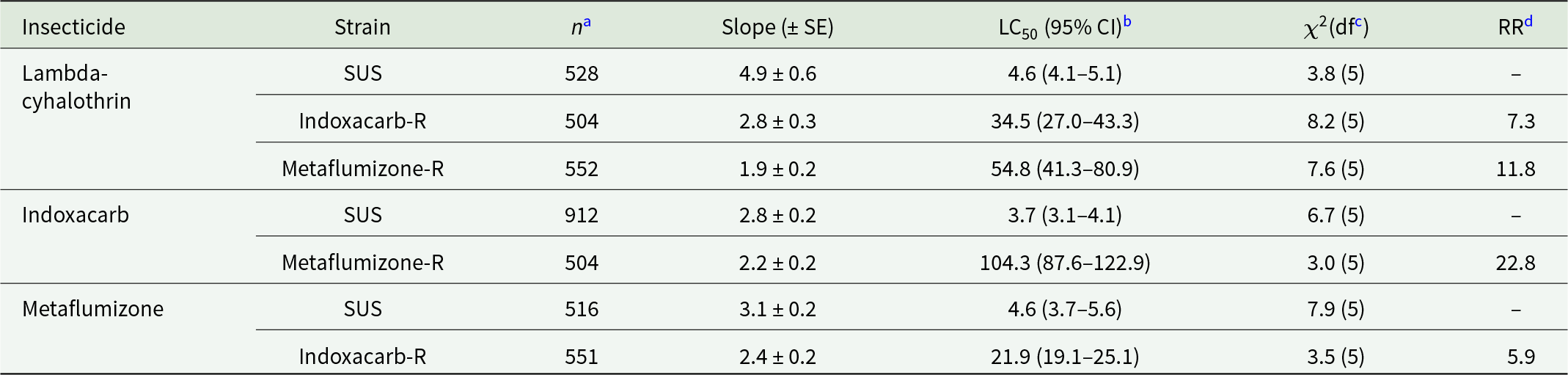
The Indoxacarb-R strain showed a resistance ratio of 5.9-fold to metaflumizone and 7.3-fold to lambda-cyhalothrin. The Metaflumizone-R strain exhibited higher resistance ratio values compared with the Indoxacarb-R strain. Metaflumizone-R demonstrated a resistance ratio of 22.8-fold to indoxacarb and 11.8-fold to lambda-cyhalothrin (table 3).
Susceptibility of Spodoptera frugiperda SUS, indoxacarb-R, and metaflumizone-R strains to voltage-gated sodium channels insecticides

a Number of larvae tested.
b Lethal concentration (μg mL−1) of the applied insecticide solution that kills 50% of the individuals.
c Degrees of freedom.
d Resistance ratio: LC50 of the tested strain/LC50 of the susceptible reference strain.
Association of F1845Y and V1848I mutations with Spodoptera frugiperda resistance to indoxacarb and metaflumizone
The sequences presented high percentages of alignment similarity in relation to the reference sequence of the S. frugiperda sodium channel gene (∼88.7%). The partial sequencing of S. frugiperda sodium channel gene did not confirm the association of F1845Y and V1848I mutations with S. frugiperda resistance to indoxacarb and metaflumizone. The results revealed a complete absence of both mutations in the nucleotide sequences of SUS, Indoxacarb-R, and Metaflumizone-R strains (Fig. 2). There were also no differences between the nucleotide sequences from susceptible and resistant strains to indoxacarb and metaflumizone when compared to the reference sequence (Fig. 3).
Positions of sodium channel mutations associated with SCBIs resistance and S. frugiperda strain sequence alignment obtained from the partial sequencing of the sodium channel. (A) The sodium channel consists of four main domains (I–IV) and six (1–6) transmembrane segments in each main domain. The F1845Y and V1848I mutations, described in the literature as being related to SCBIs resistance, are marked with solid stars. (B) Sequence alignment of the S. frugiperda sodium channel partial sequencing against the reference sequence. The red boxes indicate where both mutations would need to be found to be associated with S. frugiperda resistance to SCBIs.

Alignment of the triple codons corresponding to the F1845Y and V1848I mutations obtained from the S. frugiperda strains sodium channel partial sequencing. The percentage represents the similarity from the susceptible and resistant strains to indoxacarb and metaflumizone between the reference sequence. The red boxes indicate where the alternative allele would need to be found to be associated with S. frugiperda resistance to SCBIs. N represents the number of sequenced individuals for each strain.

Discussion
This study characterised the resistance inheritance pattern of S. frugiperda to indoxacarb and metaflumizone insecticides as autosomal, incompletely recessive at a concentration close to the field-recommended rate, polygenic, and not associated with F1845Y and V1848I mutations. Cross-resistance between indoxacarb and metaflumizone was also observed.
Spodoptera frugiperda resistance to SCBIs was characterised as autosomal, which means that both females and males carry the genetic factors associated with resistance, allowing for a faster evolution of resistance. Such a trait is common in lepidopteran pests, as few insect pests have resistance to insecticides linked to maternal effects or sex chromosomes (Cao and Han, Reference Cao and Han2015; Kanga et al., Reference Kanga, Pree, Plapp and van Lier2001). In diploid species, resistance linked to autosomal chromosomes provides a faster evolution of resistance compared to sex-linked chromosomes (Carrière, Reference Carrière2003).
The resistance ratio of S. frugiperda was nearly 30-fold for indoxacarb and 600-fold for metaflumizone. These values can be considered low for indoxacarb and moderate for metaflumizone, as the range of resistance ratios observed for other Lepidopteran pests varies from 15-fold in S. litura to 1043.9-fold in P. xylostella for indoxacarb (Sayyed et al., Reference Sayyed, Ahmad and Saleem2008; Zhang et al., Reference Zhang, Zhang, Shen, Li, Wan, You and Li2017) and from 1-fold in P. xylostella to 942-fold in S. exigua for metaflumizone (Khakame et al., Reference Khakame, Wang and Wu2013; Su and Sun, Reference Su and Sun2014). The wide range of resistance ratios has been associated with the presence of two point mutations (F1845Y and V1848I) in the sixth transmembrane segment of domain IV of the sodium channel gene (P. xylostella numbering) (Wang et al., Reference Wang, Su, Zhang, Yang, Dong and Wu2016). However, these mutations were not observed in the resistant strains selected and characterised in this study.
The inheritance pattern also varies depending on the pest species, selection pressure, and resistance mechanism (Bourguet et al., Reference Bourguet, Prout and Raymond1996). Here, we demonstrated that the inheritance pattern of S. frugiperda resistance to indoxacarb and metaflumizone was incompletely recessive at a concentration close to the field rate recommended for managing S. frugiperda in maize crops. Most cases of resistance to SCBIs have also concluded that resistance was incompletely recessive, such as in P. xylostella, S. frugiperda, and S. littoralis resistance to indoxacarb (Hafeez et al., Reference Hafeez, Li, Ullah, Zhang, Zhang, Huang, Chen, Siddiqui, Ren, Zhou, Imran, Assiri, Zalucki, Lou and Lu2022; Jun et al., Reference Jun, Dongyang, Shuzhen, Xun, Hu and Jianhong2017; Mokbel et al., Reference Mokbel, Moustafa, Alfuhaid and Fouad2024; Nehare et al., Reference Nehare, Ghodki, Lande, Pawade and Thakare2010) and metaflumizone (Shen et al., Reference Shen, Li, Zhang, Zhu, Wan and Li2017). However, in H. armigera (Bird et al., Reference Bird, Drynan and Walker2017), S. litura (Sayyed and Wright, Reference Sayyed and Wright2006), another population of P. xylostella (Marak et al., Reference Marak, Firake, Sontakke and Behere2017) and S. exigua (Zhang et al., Reference Zhang, Zhang, Yu, Liu, Liu, Teng, Pei, Hu and Zuo2024), indoxacarb resistance was incompletely dominant.
The dominance of resistance has a significant impact on the speed of resistance evolution, especially at the beginning, when the frequency of resistant alleles is low and heterozygous individuals are the most common carriers of the resistant alleles (Roush and Daly, Reference Roush, Daly, Roush and Tabashnik1990). An incompletely recessive inheritance indicates that heterozygous individuals tend to be phenotypically susceptible. On the other hand, in the incompletely dominant inheritance model, heterozygous individuals tend to behave as resistant. In terms of the evolution of resistance, incompletely recessive inheritance provides a slower evolution of resistance, as the frequency of resistant alleles will initially increase based only on a few homozygous resistant individuals (Roush and McKenzie, Reference Roush and McKenzie1987).
The dominance of resistance is also a dose-dependent characteristic (Bourguet et al., Reference Bourguet, Genissel and Raymond2000) and S. frugiperda resistant to SCBIs showed a codominant inheritance pattern at lower concentrations. Insecticide concentrations lower than recommended can occur due to a drop in the biological activity of the insecticides sprayed in the field or technical errors during spraying. If so, a higher number of heterozygous strains may survive, accelerating the evolution of resistance.
The indoxacarb-resistant strain showed a cross-resistance of nearly 6-fold to metaflumizone, but the metaflumizone-resistant strain showed more than 10-fold cross-resistance to indoxacarb. The presence or lack of cross-resistance between the two SCBIs has been reported (Cui et al., Reference Cui, Wang, Qi, Wang, Yuan and Rui2018; Khakame et al., Reference Khakame, Wang and Wu2013; Nehare et al., Reference Nehare, Ghodki, Lande, Pawade and Thakare2010; Roditakis et al., Reference Roditakis, Mavridis, Riga, Vasakis, Morou, Rison and Vontas2017; Shen et al., Reference Shen, Li, Li, Wang, Zhang, You and Li2020; Wang et al., Reference Wang, Su, Zhang, Yang, Dong and Wu2016). A high level of cross-resistance between indoxacarb-resistant strains and other insecticides, such as fipronil, spinosad, and emamectin benzoate, has also been reported. These studies indicate that resistance is associated with multiple genetic factors, suggesting a metabolic resistance mechanism (Shono et al., Reference Shono, Zhang and Scott2004; Sayyed and Wright, Reference Sayyed and Wright2006; Nehare et al., Reference Nehare, Ghodki, Lande, Pawade and Thakare2010; Pang et al., Reference Pang, You, Duan, Song, Li and Wang2012; Zhang et al., Reference Zhang, Zhang, Shen, Li, Wan, You and Li2017; Shi et al., Reference Shi, Li, Zhou, Liao and Shi2022). However, our data cannot debate further insight into this hypothesis because we did not perform any experiments with synergists.
The cross-resistance to lambda-cyhalothrin is interesting. The absence of cross-resistance between SBCIs (indoxacarb and metaflumizone) and pyrethroids has been reported in T. absoluta, H. armigera, and P. xylostella (Bird et al., Reference Bird, Drynan and Walker2017; Shen et al., Reference Shen, Li, Li, Wang, Zhang, You and Li2017, Reference Shen, Li, Zhang, Zhu, Wan and Li2020; Silva et al., Reference Silva, Assis, Ribeiro and Siqueira2016). On the other hand, there are reports of moderate cross-resistance in populations of P. xylostella resistance to indoxacarb and pyrethroid insecticides (cypermethrin and beta-cypermethrin) (Nehare et al., Reference Nehare, Ghodki, Lande, Pawade and Thakare2010; Zhang et al., Reference Zhang, Zhang, Shen, Li, Wan, You and Li2017). In all these studies, the authors could not infer if the results were due to multiple resistance. Here, Indoxacarb-R and Metaflumizone-R strains of S. frugiperda showed resistance ratios to the lambda-cyhalothrin insecticide of 7.3- and 11.8-fold, respectively. However, a previous study from our group showed that a lambda-cyhalothrin-resistant strain of S. frugiperda did not show cross-resistance to indoxacarb and metaflumizone (Kaiser et al., Reference Kaiser, Kanno, Bolzan, Amaral, Lira, Guidolin and Omoto2021). This suggests a multiple resistance and not a cross-resistance between SBCIs and lambda-cyhalothrin. This hypothesis is supported by the history of resistance evolution of S. frugiperda to lambda-cyhalothrin in Brazil (Diez-Rodríguez and Omoto, Reference Diez-Rodríguez and Omoto2001) and the mechanisms of resistance due to both target-site mutation and metabolic mechanisms (Carvalho et al., Reference Carvalho, Omoto, Field, Williamson and Bass2013). Recently, a study showed a high survival rate of field-collected populations of S. frugiperda in Brazil to lambda-cyhalothrin (Nascimento et al., Reference Nascimento, Rodrigues, Kanno, Amaral, Malaquias, Silva-Brandão, Cônsoli and Omoto2021), which indicates a high frequency of resistance alleles. Thus, the Indoxacarb-R and Metaflumizone-R strains were selected simultaneously with the alleles that confer resistance to lambda-cyhalothrin.
The molecular mechanism of SCBIs resistance was characterised by the presence of F1845Y and V1848I mutations in many species of insect pests, including P. xylostella, T. absoluta, L. trifolii, and S. exigua (Wang et al., Reference Wang, Su, Zhang, Yang, Dong and Wu2016; Roditakis et al., Reference Roditakis, Mavridis, Riga, Vasakis, Morou, Rison and Vontas2017; Li et al., Reference Li, Gong, Yuan, Pan, Jin, Lu and Wu2022; Zhang et al., Reference Zhang, Zhang, Yu, Liu, Liu, Teng, Pei, Hu and Zuo2024). However, in this study, both mutations were not confirmed to be associated with SCBIs resistance in S. frugiperda Indoxacarb-R and Metaflumizone-R strains. This is consistent with the results from the cross-resistance and dominance experiments, which suggest that the strains studied in this work exhibit polygenic and metabolism-based resistance to SCBIs. Previous studies have already demonstrated complex gene expression profiles associated with SCBIs resistance, gene from flavin-dependent monooxygenases (FMOs), P450 monooxygenases (P450s), and UDP-glucuronosyltransferases contributed to S. exigua resistance to metaflumizone and indoxacarb, respectively (Hu et al., Reference Hu, Zhang, Ren, Tian, Wei, Mburu and Su2017; Tian et al., Reference Tian, Sun and Su2014); glutathione S-transferase and P450 were the main resistance mechanisms of P. xylostella to indoxacarb (Zhang et al., Reference Zhang, Zhang, Shen, Li, Wan, You and Li2017); overexpression of carboxylesterase (CarE) genes was associated with S. litura resistance to indoxacarb (Shi et al., Reference Shi, Li, Zhou, Liao and Shi2022); and elevated activity levels of CarEs and P450s were observed in T. absoluta resistance to indoxacarb (Aboutalebian-Soureshjani et al., Reference Aboutalebian-Soureshjani, Rafiee-Dastjerdi, Naseri, Hassanpour and Khajehali2023).
Further, methodologies grounded on a transcriptomic approach followed by co-expression network analysis must be implemented in future studies to verify the possible association of detoxification genes or other multigenic systems with S. frugiperda resistance to SCBIs. This approach will allow assessment of whether there are coordinated expression patterns between detoxification enzymes and other genes possibly involved in multigenic resistance mechanisms, providing a more comprehensive and integrated view of the underlying molecular processes.
We highlight that inferring the molecular mechanisms associated with the resistance of S. frugiperda to SCBIs, through identifying mutations or performing functional genomics, is only possible after the selection of resistant strains and proper characterisation of those strains. Here, we provide the resistant strains that can be used in future studies and define the main characteristics of their inheritance pattern of resistance. Our results provide useful information to implement proactive IRM strategies to preserve SCBIs as a viable option for the control of S. frugiperda in Brazil and advances in the general comprehension of the basis of SCBIs resistance.
Acknowledgements
This research was conducted in partial fulfillment by the senior author for the Doctoral Degree in Entomology at the University of São Paulo and was financed in part by the Coordination for the Improvement of Higher Education Personnel (CAPES) – Finance Code 001. We also thank the Brazilian National Council for Scientific and Technological Development (CNPq) for granting a research fellowship to C.O. (Process #314160/2020-5), the Coordination for the Improvement of Higher Education Personnel (CAPES) for the scholarship to A.S.G. (Grant #88882.317558/2019-01), the Brazilian National Council for Scientific and Technological Development (CNPq) for the scholarship to F.S.A.A. (Grant #141089/2018-0), the São Paulo Research Foundation (FAPESP) for the scholarship to R.H.K. (Grant #2019/06217-8), and the Brazilian Insecticide Resistance Action Committee (IRAC-BR) for providing partial financial support for this study.
Competing interests
The authors declare that they have no known competing financial interests or personal relationships that could have appeared to influence the work reported in this paper.