CHDs are the most common type of birth defects, affecting approximately 0.4–1% of children born alive.Reference Botto, Correa and Erickson1, Reference Marelli, Mackie, Ionescu-Ittu, Rahme and Pilote2 Among a wide range of aetiologically heterogeneous conditions, conotruncal heart defects are caused by abnormal development of the cardiac outflow tract during embryogenesis and account for 25–33% of all patients with non-syndromic CHDs.Reference Johnson3, Reference Debrus, Berger and de Meeus4 As a subgroup of CHD, examples of conotruncal heart defects include tetralogy of Fallot, pulmonary atresia with ventricular septal defect, double-outlet right ventricle, transposition of the great arteries, persistent truncus arteriosus, and interrupted aortic arch.Reference Anaclerio, Di Ciommo and Michielon5 It has been suggested that the risk of conotruncal heart defect in general could be reduced by periconceptional folic acid consumption.Reference Shaw, O’Malley, Wasserman, Tolarova and Lammer6 Although the protective mechanism of folic acid during cardiac morphogenesis is unclear, many studies have demonstrated that genetic variations which alter the activity of key enzymes in the folate pathway are associated with the risk of such heart defects.Reference Goldmuntz, Woyciechowski, Renstrom, Lupo and Mitchell7, Reference Wang, Liu and Yan8
The human Thymidylate synthase gene locus is at chromosome 18p11.32. It encodes an enzyme that catalyses the intracellular conversion of deoxyuridylate to thymidylate, which is essential for DNA replication and repair.Reference Kim, Ozawa and Saito9 This enzyme competes with 5,10-methylenetetrahydrofolate reductase for the availability of 5,10-methylenetetrahydrofolate, which is a central metabolite in folate metabolism.Reference Selhub10 Several studies have demonstrated that the genetic variants within the Thymidylate synthase gene that influence the activity of the enzyme may affect plasma homocysteine levels,Reference Volcik, Shaw, Zhu, Lammer, Laurent and Finnell11, Reference Trinh, Ong, Coetzee, Yu and Laird12 which is a known risk factor for neural tube defects and pregnancy complications.Reference Ueland, Refsum, Beresford and Vollset13 At present, genetic studies on Thymidylate synthase are mainly focussed on the polymorphisms located within the untranslated regions. There are two common Thymidylate synthase polymorphisms that have been most extensively investigated in the association with the risk of heart defects:Reference Wang, Liu and Yan8, Reference Lupo, Mitchell and Goldmuntz14–Reference Zhu, Yang and Shaw17 one is a 28 bp tandem repeat in the promoter enhancer region of the 5′-untranslated region; the other is a 6 bp deletion in the 3′-untranslated region. It was reported that the two-repeat allele of the 28 bp tandem repeat exhibited lower expression relative to the three-repeat allele,Reference Ulrich, Bigler, Bostick, Fosdick and Potter18 and the 6 bp deletion polymorphism was associated with decreased messenger RNA stability in vitro and lower intratumoral Thymidylate synthase expression in vivo.Reference Mandola, Stoehlmacher and Zhang19 Thus, these two Thymidylate synthase variants are supposed to affect the enzyme’s activity and plasma folate and homocysteine levels, which are correlated with the risk of CHDs.Reference Verkleij-Hagoort, Bliek, Sayed-Tabatabaei, Ursem, Steegers and Steegers-Theunissen20 However, studies conducted to evaluate the association between the risk of heart defects and the polymorphisms of Thymidylate synthase have yielded conflicting results for different diseases in different populations.Reference Wang, Liu and Yan8, Reference Volcik, Shaw, Zhu, Lammer, Laurent and Finnell11, Reference Lupo, Mitchell and Goldmuntz14–Reference Zhu, Yang and Shaw17 In addition, most studies are focussed on fetal polymorphism, except for one study by Philip J. Lupo et al, which reported that the maternal genotype for Thymidylate synthase 6 bp deletion is associated with the risk of conotruncal and related defects in their offspring.Reference Lupo, Mitchell and Goldmuntz14
In the present study, we aimed to investigate whether the two maternal Thymidylate synthase functional variants, the 28 bp tandem repeat and the 6 bp deletion, are associated with the risk of a conotruncal heart defect, including various subgroups of conotruncal heart defect, in the Chinese population. In addition, the relationship between homocysteine levels of the patients with regards to the two Thymidylate synthase polymorphisms was also determined.
Materials and methods
Patients and controls
A total of 193 mothers of echocardiographically proven conotruncal heart defect-affected children in the conotruncal heart defect group with mean age 29.4 ± 5.1 and 234 mothers of healthy children in the control group with mean age 29.1 ± 5.1 who visited Guizhou Provincial People’s Hospital between January 2017 and January 2018 were recruited for the study. The present study was approved by the Ethics Committee of Guizhou Provincial People’s Hospital. All participants provided written informed consent form to approve the use of their blood samples for research purposes. All participants were genetically unrelated ethnic Han Chinese. Each of the 193 mothers in the conotruncal heart defect group had only one child with a conotruncal heart defect: tetralogy of Fallot (90 cases), pulmonary atresia with ventricular septal defect (31 cases), double-outlet right ventricle (35 cases), transposition of the great arteries (10 cases), persistent truncus arteriosus (14 cases), and interrupted aortic arch (13 cases). Each mother in the control group had single child who was totally healthy. Individuals who had infants without a classic conotruncal heart defect but other types of birth defects were excluded from the current study. From each mother, 5 ml of peripheral blood was collected in ethylenediaminetetraacetic acid tubes, and within 5 hours, genomic DNA was isolated from whole blood using the QIAamp DNA Blood Mini Kit (QIAGEN, Germany) according to the manufacturer’s protocol. Then, the genomic DNA was either stored at −80°C or polymorphism detection was conducted immediately. In addition, plasma homocysteine levels were measured in the perinatal period using high-performance liquid chromatography for 140 mothers in the conotruncal heart defect group and 161 mothers in the control group.
Polymorphism detection
The 28 bp tandem repeat polymorphism and 6 bp deletion polymorphism were analysed using the polymerase chain reaction method and a restriction fragment length polymorphism method, respectively. Briefly, as described by Sirachainan et al,Reference Sirachainan, Wongruangsri and Kajanachumpol21 for the 28 bp tandem repeat polymorphism (rs34743033), a fragment containing the repeats was amplified by polymerase chain reaction using following primers: Forward primer: 5′-GTGGCTCCTGCGTTTCCCCC-3′; Reverse primer: 5′-GGCTCCGAGCCGGCCACAGGCATGGCGCGG-3′. The amplified fragments were then separated on a 3% NuSieve agarose gel (Lonza, Switzerland). The detected fragment sizes were 271, 243, and 215 bp for the four, three, and two repeats, respectively. As described by Fujishima et al,Reference Fujishima, Inui and Hashimoto22 for the 6 bp deletion polymorphism (rs34489327), a fragment containing the 6 bp insertion or deletion was amplified by polymerase chain reaction using following primers: Forward primer: 5′-CAAATCTGAGGGAGCTGAGT-3′; Reverse primer: 5′-CAGATAAGTGGCAGTACAGA-3′. The amplified fragments were then digested with DraI (Fermentas, Lithuania) and the products were separated on a 3% NuSieve agarose gel (Lonza, Switzerland). The detected fragment sizes were 70 and 88 bp for the wild-type (+) allele and 152 bp for the variant (−) allele.
Statistical analyses
The statistical analyses were performed using the Statistical Package for the Social Sciences (SPSS) version 19.0 software. The differences in the maternal characteristics, and the allele frequencies between cases and controls were evaluated using χ2-test. The associations between genotypes and the risk of conotruncal heart defect were estimated by calculating the odds ratios and their 95% confidence intervals from logistic regression analyses. The Mann–Whitney U-test was used to determine the differences in homocysteine level of the various genotypes and groups.
Results
Association of Thymidylate synthase 28 bp tandem repeat and 6 bp deletion polymorphisms with risk for conotruncal heart defects
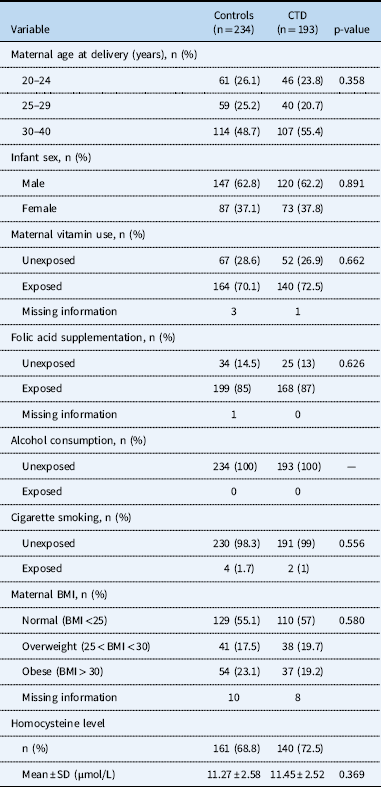
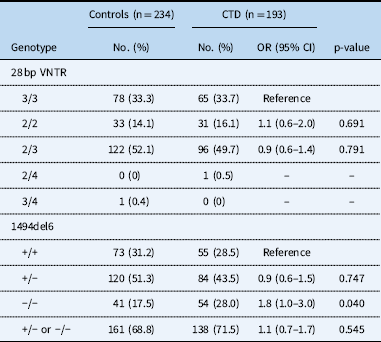
The clinical information for the mothers in the two groups is summarised in Table 1. No statistical differences were found in maternal age at delivery, infant sex, vitamin use, folic acid supplementation, alcohol consumption, cigarette smoking, body mass index, and homocysteine level between the two groups. The association between risk for conotruncal heart defects and maternal genotypes for the Thymidylate synthase 28 bp tandem repeat and 6 bp deletion was evaluated (Table 2). In single-locus analyses, the genotype frequencies of Thymidylate synthase 28 bp tandem repeat showed that 33.7% were homozygous for the three 28 bp tandem repeats (genotype 3/3), 49.7% were heterozygotes with two and three repeats (genotype 2/3); 16.1% were homozygous for the two 28 bp tandem repeats (genotype 2/2) in the conotruncal heart defect group, and 33.3% (3/3), 52.1% (2/3); and 14.1% (2/2) in the control group. Additional 2/4 and 3/4 variants were only found in two individuals. No statistical differences were found in the genotype distributions between the two groups, when using the genotype 3/3 as referent. Moreover, the genotype frequencies of Thymidylate synthase 6 bp deletion showed that 31.2% were homozygotes with no deletion (genotype +/+), 51.3% were heterozygotes with deletion (genotype +/−), 17.5% were homozygotes with deletion (genotype −/−) in the control group, and 28.5% (+/+), 43.5% (+/−), and 28% (−/−) in the conotruncal heart defect group. Logistic regression analyses revealed that patients carrying the genotype −/− had a 1.8-fold (odds ratio: 1.8; 95% confidence interval: 1.0–3.0) increased risk for conotruncal heart defects, compared with the patients carrying the genotype +/+.
Maternal characteristics for controls and conotruncal heart defect cases.

BMI=body mass index; CTD=conotruncal heart defect
*means p-value<0.05
Genotype frequencies of TYMS 28 bp VNTR and 1494del6 among controls and CTD cases.

CI = confidence interval; CTD = conotruncal heart defect; OR = odds ratio; TYMS = thymidylate synthase; 28 bp VNTR = 28 bp tandem repeat in the promoter enhancer region of the 5′-UTR; 1494del6 = 6 bp deletion in the 3′-UTR
Association of Thymidylate synthase 28 bp tandem repeat and 6 bp deletion polymorphisms with risk for tetralogy of Fallot, pulmonary atresia with ventricular septal defect, double-outlet right ventricle, transposition of the great arteries, persistent truncus arteriosus, and interrupted aortic arch
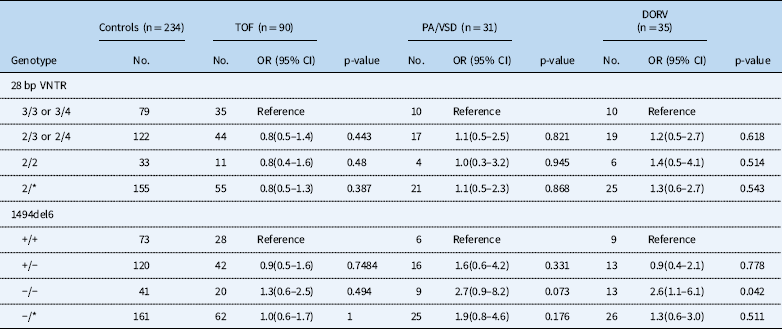
On the basis of genotyping results for Thymidylate synthase 28 bp tandem repeat, the patients carrying the 3/3 and 3/4 variants were considered as referent, and patients carrying the 2/3 and 2/4 variants were also considered as one group. Since the number of cases for transposition of the great arteries (n = 10), persistent truncus arteriosus (n = 14), and interrupted aortic arch (n = 13) were too small to be analysed, we only made stratification analyses to evaluate the effects of Thymidylate synthase 28 bp tandem repeat and 6 bp deletion polymorphisms on other types of conotruncal heart defect (Table 3). Our results suggest that none of the variants were found to be associated with risk for tetralogy of Fallot, pulmonary atresia with ventricular septal defector double-outlet right ventricle.
Genotype frequencies of thymidylate synthase 28 bp VNTR and 1494del6 among controls, TOF, PA/VSD, and DORV cases.

CI = confidence interval; CTD = conotruncal heart defect; DORV = double-outlet right ventricle; OR = odds ratio; PA/VSD = pulmonary atresia with ventricular septal defect; TOF = tetralogy of Fallot; TYMS = thymidylate synthase; VNTR = variable number of tandem repeats; 1494del6 = 6 bp deletion in the TYMS 3′-untranslated region; 2/*: 2/2 or 2/3 or 2/4; −/*: +/− or −/−
Thymidylate synthase 28 bp tandem repeat, 6 bp deletion genotype, and homocysteine level
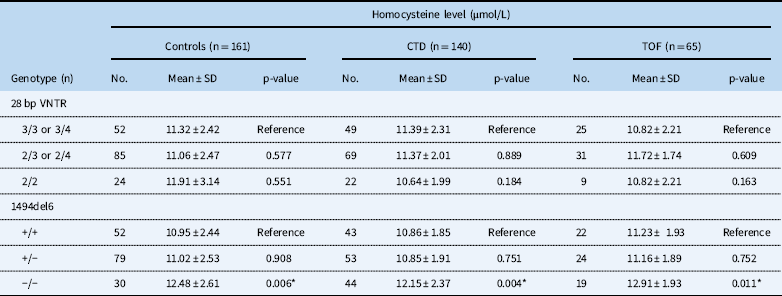
The plasma homocysteine level was only measured for 72.5% of mothers in the conotruncal heart defect group and 68.8% of mothers in the control group. By using Mann–Whitney U-test, we made analyses to evaluate the association between the two Thymidylate synthase variants and homocysteine level in each group, including the tetralogy of Fallot subtype of conotruncal heart defect (Table 4), as the sample sizes of the other subtypes such as pulmonary atresia with ventricular septal defect, double-outlet right ventricle, transposition of the great arteries, persistent truncus arteriosus, and interrupted aortic arch, were individually too small (n <30). Our results suggest that patients carrying the genotype −/− of Thymidylate synthase 6 bp deletion had a significantly higher homocysteine level in the control, conotruncal heart defect, and tetralogy of Fallot groups (12.48 ± 2.61 versus 10.95 ± 2.44 μmol/L, p = 0.006, 12.15 ± 2.37 versus 10.86 ± 1.85 μmol/L, p = 0.004, and 12.91 ± 1.93 versus 11.23 ± 1.93 μmol/L, p = 0.011 respectively), when compared with the patients carrying the genotype +/+. In addition, no associations were found between the Thymidylate synthase 28 bp tandem repeat polymorphism and homocysteine level in each group.
Thymidylate synthase genotype and homocysteine level.

CTD = conotruncal heart defect; TOF = tetralogy of Fallot; TYMS = thymidylate synthase; VNTR = variable number of tandem repeats; 1494del6 = 6 bp deletion in the TYMS 3′-untranslated region
* means statistical significance
Discussion
Epidemiological studies have demonstrated that a high level of homocysteine could increase the risk of fetal CHD. Folate is known to play a crucial role in preventing CHD,Reference Bailey and Berry23 by decreasing the homocysteine level in serum through regulation of the folate metabolic pathway, in which there are many crucial enzymes, including Thymidylate synthase. Up to now, Thymidylate synthase 28 bp tandem repeat and 6 bp deletion polymorphisms have been most extensively investigated, because they are both located in regulatory regions of the gene and could affect gene expression, enzyme levels, and homocysteine levels.Reference Trinh, Ong, Coetzee, Yu and Laird12, Reference Ulrich, Bigler, Bostick, Fosdick and Potter18 There are five studies that have been done on the association of these two Thymidylate synthase variants with heart defects;Reference Wang, Liu and Yan8, Reference Lupo, Mitchell and Goldmuntz14–Reference Zhu, Yang and Shaw17 the results are inconclusive and contradictory. We provided reliable evidence that the Thymidylate synthase variants may be only associated with specific subtypes of CHD, which may have led to the conflicting results. The present study is the first to provide reliable evidence about the association of the Thymidylate synthase 28 bp tandem repeat and 6 bp deletion polymorphisms with homocysteine level and risk for conotruncal heart defects, specifically including various subtypes of conotruncal heart defect in the Chinese population. Particularly, this study was focussed on maternal genotype. As it was hypothesised that maternal genetic effects behave as environmental risk factors for offspring,Reference Doolin, Barbaux, McDonnell, Hoess, Whitehead and Mitchell24 and it was easier to identify maternal genotype than fetal genotype during pregnancy, thus it would be more convenient for clinical translation. For women carrying high-risk genotypes, clinicians could suggest targeted risk reduction strategies such as increasing folic acid supplementation.
For Thymidylate synthase 28 bp tandem repeat polymorphism, although two-repeat allele of the 28 bp tandem repeat exhibited lower expression than the three-repeat allele,Reference Ulrich, Bigler, Bostick, Fosdick and Potter18 it was reported by Trinh et al that the 3/3 genotype was associated with elevated plasma homocysteine levels among individuals with low dietary folate intake, a recognised metabolic risk factor for cardiovascular disease.Reference Trinh, Ong, Coetzee, Yu and Laird12 However, in the current study, we did not observe any association of Thymidylate synthase 28 bp tandem repeat polymorphism with homocysteine level in the control and conotruncal heart defect groups, including subtypes of conotruncal heart defect. These results were consistent with the study by Wilding et al,Reference Wilding, Relton and Sutton15 which also reported that Thymidylate synthase was not a determinant of homocysteine levels in a population from the Northern United Kingdom. Moreover, Vijaya Lakshmi et al reported that the 2/2 genotype appeared to be beneficial for coronary artery disease,Reference Vijaya Lakshmi, Naushad, Rupasree, Seshagiri Rao and Kutala25 whereas Volcik et al found that the 2/2 genotype was associated with an increased risk for spina bifida.Reference Volcik, Shaw, Zhu, Lammer, Laurent and Finnell11 However, these findings were not replicated for conotruncal heart defects and neural tube defects in the United States of America or European population,Reference Wilding, Relton and Sutton15, Reference Zhu, Yang and Shaw17 wherein the Thymidylate synthase 28 bp tandem repeat polymorphism appeared to be not universally associated with risk for these diseases. In a Han Chinese population, polymorphisms in the non-coding region of Thymidylate synthase including 28 bp tandem repeat were also found to be related to the risk for congenital cardiac septal defects.Reference Zhao, Sun and Gu16 Our results, as well as those of previous studies, indicate that the maternal genotype of Thymidylate synthase 28 bp tandem repeat is not strongly related to the risk in offspring for conotruncal heart defects, including tetralogy of Fallot, pulmonary atresia with ventricular septal defect, double-outlet right ventricle, transposition of the great arteries, persistent truncus arteriosus, and interrupted aortic arch.
As the 6 bp deletion allele of Thymidylate synthase is thought to decrease messenger RNA stability and gene expression,Reference Mandola, Stoehlmacher and Zhang19 the maternal genotype for this variant is supposed to be associated with risk for conotruncal heart defects. Previous studies by Zhao et alReference Zhao, Sun and Gu16 and Wang et alReference Wang, Liu and Yan8 demonstrated that there was no association between the fetal genotype of Thymidylate synthase 6 bp deletion and risk for congenital cardiac septal defects and CHDs in the Chinese population. However, in the United States of America population, Zhu et al showed a 3.6-fold increased conotruncal heart defect risk among infants who were homozygotes for the Thymidylate synthase 6 bp deletion variant (−/−) compared to infants with the genotype +/+.Reference Zhu, Yang and Shaw17 Lupo et al reported that the maternal Thymidylate synthase 6 bp deletion variant was also associated with an increased risk for classic conotruncal defects.Reference Lupo, Mitchell and Goldmuntz14 In the present study, our results demonstrated that mothers carrying the genotype −/− of the Thymidylate synthase 6 bp deletion had an increased risk for conotruncal heart defects in offspring, but this was not statistically significant. These results are consistent with studies about fetal genetic effects in the Chinese population. In addition, individuals carrying the genotype −/− of the Thymidylate synthase 6 bp deletion had higher plasma homocysteine levels compared with the mothers carrying the genotype +/+ in the control, conotruncal heart defect and tetralogy of Fallot groups, which appears to be consistent with the relationship between genotype and risk for conotruncal heart defects, although the sample size is too small to draw any concrete conclusions as yet. We suggest that Thymidylate synthase 6 bp deletion could influence the activity of enzyme which may affect plasma homocysteine levels; however, further studies are required.
The present study has several limitations. First, it was a hospital-based case–control study, thus the recruited patients may not be representative of the general population. Second, the sample size was moderate in this study, and the subgroup analyses including pulmonary atresia with ventricular septal defect, double-outlet right ventricle, transposition of the great arteries, persistent truncus arteriosus, and interrupted aortic arch had relatively small numbers of cases. Therefore, further studies with larger sample sizes are required to confirm the present findings. Furthermore, as all individuals were recruited from Guiyang city, we assumed that they had similar dietary habits. However, we only collected one test result from over 80% of the pregnant women in whom we measured plasma homocysteine levels, and we are unable to say whether their homocysteine levels may have changed over time.
In conclusion, our results demonstrated that maternal genotypes for the Thymidylate synthase 6 bp deletion may be associated with plasma homocysteine levels and risk for conotruncal heart defects in offspring, including certain subtypes of conotruncal heart defect.
Acknowledgements
The authors thank the patients and their parents who participated in this study.
Financial Support
This work was supported by Science and Technology Project of Guizhou Province in China (no. [2016]7141 and [2017]1106), Science and Technology Innovation Talent Team Project of Guizhou Province (no. [2015]4019) and high-level innovative talents training project of Guizhou Province (no. GZSYQCC[2016]004).
Conflicts of Interest
The authors have no conflict of interest to declare.
Ethical Standards
All procedures performed in studies involving human participants were in accordance with the ethical standards of the Guizhou Provincial People’s Hospital and with the 1964 Helsinki Declaration and its later amendments or comparable ethical standards.