Introduction
Tobacco smoking is a leading cause of preventable deaths, killing an estimated five million people worldwide every year and is therefore seen as a global health concern (World Health Organisation 2009). The last few decades have seen a greater understanding of what impact persistent tobacco smoking has upon the brain and its associated cognitive function. Smoking-related memory decline has been linked with increases in accelerated cerebral degeneration and brain atrophy, including evidence of structural deficits of several cortical and subcortical regions known to mediate a range of memory processes including working memory and attention (Gallinat et al. Reference Gallinat, Meisenzahl, Jacobsen, Kalus, Bierbrauer, Kienast and Staedtgen2006; Nooyens et al. Reference Nooyens, van Gelder and Verschuren2008; Durazzo et al. Reference Durazzo, Insel and Weiner2012). Recent evidence from animal studies has highlighted links between exposure to dangerous carcinogens in tobacco smoke and neuronal damage in the mammalian brain (Ghosh et al. Reference Ghosh, Mishra, Das, Kaushil and Basu2009). In terms of the cognitive consequences, persistent tobacco smoking has been linked to a range of memory deficits, including impaired working memory function (Ernst et al. Reference Ernst, Heishman, Spurgeon and London2001; Fried et al. Reference Fried, Watkinson and Gray2006; Jacobson et al. Reference Jacobson, Mencl, Constable, Westerveld and Pugh2007; Greenstein & Kassel Reference Greenstein and Kassel2009), deficits in executive function (EF) (Hill et al. Reference Hill, Nilsson, Nyberg and Backman2003; Glass et al. Reference Glass, Buu, Adams, Nigg, Puttler and Jester2009; Tait & Siru Reference Tait and Siru2009) and more recently in prospective memory (PM) (Heffernan et al. Reference Heffernan, Clark, Bartholomew, Ling and Stephens2010; Heffernan & O’Neill Reference Heffernan and O’Neill2011; Heffernan et al. Reference Heffernan, O’Neill and Moss2012).
Executive function is an umbrella term used to describe a set of processes within cognition that includes planning, attention, initiating appropriate actions and inhibiting inappropriate stimuli, as well as the manipulation of information within working memory (Baddeley Reference Baddeley2012). PM involves remembering to execute a particular behaviour at some point of time in future, be that over a short or a long period, for example remembering to lock one’s door after leaving the house or remembering to take an important medication at a predetermined time (Brandimonte et al. Reference Brandimonte, Einstein and McDaniel1996). It is worthy to note that PM functions may be defined as either event-based (where PM is triggered by some predetermined event) or time-based (where the PM task occurs over a period of time). There is good evidence that performance on PM tasks relies on prefrontal systems in the brain and on the integrity of related EF (Burgess et al. Reference Burgess, Quayle and Frith2001: Simons et al. Reference Simons, Scholvinck, Gilbert, Frith and Burgess2006). Frontally mediated EF is believed to play key roles in a range of processes, including planning a task, monitoring one’s environment, the inhibition of extraneous responses and cognitive flexibility, all of which will have an impact upon successful PM functioning (Martin et al. Reference Martin, Kliegel and McDaniel2003; Kliegel et al. Reference Kliegel, Jager, Altgassen and Shum2008). Previous research have measured smoking-related deficits in these functions, however these functions have only been tested in separate studies (using different cohorts to test EF and PM separately), with no research to date demonstrating that both sets of functions are detrimentally affected in the same cohort of active smokers. Given that EF and PM are interrelated it is predicted that both EF and PM deficits should be evident in the same cohort of current smokers (CS) when compared with a never-smoked (NS) group.
Current study
The current study sought to test this hypothesis that deficits in both sets of memory processes would be evident in the CS group when compared with the NS control group, by studying both EF and PM processes within the same cohort of CS and comparing these with a NS control group. The Reverse Digit Span Task (RDST) was used here as a measure of EF, since the task requires the retrieval and complex manipulation of information in verbal working memory (Towse & Houston-Price Reference Towse and Houston-Price2001), thus making it an excellent task to measure executive functioning within memory. The Cambridge Prospective Memory Test (CAMPROMPT) (Wilson et al. Reference Wilson, Emslie, Foley, Shiel, Watson, Hawkins, Groot and Evans2005) is a standardised measure of both time and event-based PM and was used here to measure PM. Other recreational drug use and mood were also measured and compared between the groups, since these variables are known to affect EF and PM performance independent of smoking (Kliegel et al. Reference Kliegel, Jäger, Phillips, Federspiel, Imfeld, Keller and Zimprich2005; Mitchell & Phillips Reference Mitchell and Phillips2007; Bartholomew et al. Reference Bartholomew, Holroyd and Heffernan2010; Heffernan et al. Reference Heffernan, Clark, Bartholomew, Ling and Stephens2010; Rodgers et al. Reference Rodgers, Buchanan, Scholey, Heffernan, Ling and Parrott2011). Finally, it would clearly be prudent to control for variations in IQ, since this can impact upon memory tasks that involve manipulation and storage in memory (Friedman et al. Reference Friedman, Miyake, Corley, Young, DeFries and Hewitt2006). Based on the premise that both EF and PM share similar resources it was hypothesised that deficits in both sets of memory processes would be evident in the CS group when compared with the NS control group. In addition, the inter-relationship between EF and PM will also be explored.
Methods
Sample
An opportunity sample of 80 participants aged between 18 and 25 years were recruited from populations of undergraduate university students in the North of England. None of the participants were paid or given any inducement for their participation, it was purely voluntary. Thirty-two of these were subsequently omitted from the study on the basis that they had reported using one or more of a range of illegal substances (including ecstasy or cannabis) alongside smoking, were very heavy drinkers, or had used alcohol within the past 48 hours or had reported suffering from a psychiatric condition such as substance dependence, clinical depression or amnesia. Of the remaining 48 participants, 24 were CS (the CS group: six females) who were smoking on average 37.1 cigarettes/week and had been smoking for an average of 5.50 years. The remaining 24 participants reported that they had NS any tobacco product (the NS group: 10 females). χ 2 analysis revealed no significant difference in the number of males and females between the CS and NS groups (χ 2=1.50, d.f.=1, p=0.22).
Smoking and other substance use
Smoking and other substance use were assessed by a modified version of the University East London ‘Recreational Drug Use Questionnaire’ (RDUQ), which has been used in previous research (Heffernan et al. Reference Heffernan, Clark, Bartholomew, Ling and Stephens2010; Heffernan et al. Reference Heffernan, O’Neill and Moss2012). This measured smoking status and history, their intake of alcohol in terms of the total number of units per week consumed, (they were given the following UK guidelines: 1 unit of alcohol equates to  ${\scale60%{\vskip-7pt1}{\hskip-3pt\vskip-5.6pt\rot160/}{\scale60%{\hskip-4pt\vskip0pt2}$
pint of normal strength beer, a standard 125 ml glass of wine or 1×25 ml measure of spirit; with each unit being equal to approximately 8 g or 10 ml of pure alcohol) last alcohol use in hours and how many years they had been drinking. Similar details were also collected regarding other drug use (e.g. cannabis and ecstasy). The participants were also asked to list any psychiatric condition that they had/were suffering from (such as a substance dependence disorder, clinical depression or amnesia).
Mood: anxiety and depression
The Hospital Anxiety and Depression Scale (HADS) (Zigmond & Snaith Reference Zigmond and Snaith1983) was used to measure anxiety and depression states. This 14-item self-report standardised questionnaire was developed to identify cases of anxiety and depression in non-psychiatric samples (Crawford et al. Reference Crawford, Henry, Crombie and Taylor2001). Seven items relate to generalised anxiety symptoms and seven to the loss of interest and diminished-pleasure aspects of depression, with a focus on the last few days. Sample items include ‘I feel tense or “wound up” (anxiety)’ and ‘I feel as if I am slowed down’ (depression). Each response was scored on a four-point rating scale from 0 (which indicated little or no symptom) to 4 (which indicated that the person exhibited a great deal of that particular symptom). Separate scores were calculated for anxiety and depression, with each score ranging from between 0 and 21, with the higher score indicating more severe symptomatology.
EF
EF was measured using the RDST since the task requires the retrieval and complex manipulation of information in verbal working memory (Towse & Houston-Price Reference Towse and Houston-Price2001) thus making it an excellent task to measure executive functioning across working memory. During this task the participant was presented aurally with a set of digits and immediately after presentation he/she was required to recall this sequence, but in backwards order. The testing began with three trials of two-digit lists and if the participant successfully recalled the majority of trials at this level, then the digit span size was increased to three digits/set; again if the participant successfully recalled the majority of trials at this level then the digit span size was increased to four digits/set; and so on. When the participant failed at the majority of trials within a given digit span size then their RDST score was the digit span below this threshold. The higher the score on the RDST the more proficient their EF was deemed to be.
PM
PM was measured using the CAMPROMPT, which is a standardised measure of time-based and event-based PM (Wilson et al. Reference Wilson, Emslie, Foley, Shiel, Watson, Hawkins, Groot and Evans2005). In this procedure, each participant is tested individually for about 20–25 minutes, during which he/she was asked to remember to carry out three time-based tasks and three event-based tasks during the procedure, while performing filler activities (such as word-finder puzzles or a general knowledge quiz), using both verbal and written instructions. The time-based tasks required the participant to remember to complete each task at appropriate times during testing (e.g. when 7 minutes had elapsed after the start of the procedure, he/she had to remember to stop whichever task they were engaged in and change to another activity). The event-based tasks required the participant to remember to complete a task when an appropriate cue was given (e.g. they were told before the task that they had to remember to return a book to the researcher when the cue word ‘EastEnders’ appeared as part of a set of quiz questions). Six points were awarded for each of the six subtasks that the participant successfully completed, unaided. If the task was completed after a single general prompt from the experimenter, then only 4 points were awarded. If the task was completed after a second prompt then 2 points were awarded, with no points being awarded if no response was made after repeated prompting. Thus, the score for the set of time-based tasks ranged from 0 to 18 points and the same applied to the set of event-based tasks, with the higher the score on the sub-scales and on the total score on the CAMPROMPT tasks, the better one’s PM is concluded to be.
IQ
The National Adult Reading Test (NART) is a standardised test (Nelson & Willison Reference Nelson and Willison1991) which is widely used in research and clinical practice as an estimate of pre-morbid IQ or prior ability and was therefore used here to assess general intellectual function. Each participant was required to read 50 words aloud and their pronunciation of each word was checked by the researcher for accuracy. For example, the words ‘Chord’, ‘Equivocal’, ‘Naïve’, ‘Gaoled’, ‘Zealot’, ‘Quadruped’ and ‘Puerperal’ were used. For each word incorrectly pronounced an error score of 1 point was scored and the total number of errors was then converted on the WAIS full scale verbal and performance IQ table to provide a predicted full-scale IQ score for each participant.
Procedure
The study was approved by the Psychology Ethics Committee at Northumbria University. Participation was voluntary and each participant was told that the study would explore the relationship between smoking and everyday remembering. They were informed that they would be asked to complete two self-reports; one on substance use (the RDUQ) and a second on general mood (the HADS); as well as three objective measures; one which measured EF (the RDST), a second of which measured PM (the CAMPROMPT) and a third which measured general IQ (the NART). The demographic details were taken first regarding gender and age. The RDUQ was administered second, followed by the HADS, RDST, CAMPROMPT and finally the NART. The procedure took ~45 minutes to complete. Each participant was tested individually in a quiet and undisturbed laboratory setting. The order of presentation was held constant across each participant. After taking part in the study, each participant was fully debriefed and provided with details on how they could withdraw their data if they so wished (none of whom opted to do so) and how they could access the overall findings from the study.
Results
Descriptive analysis and covariates
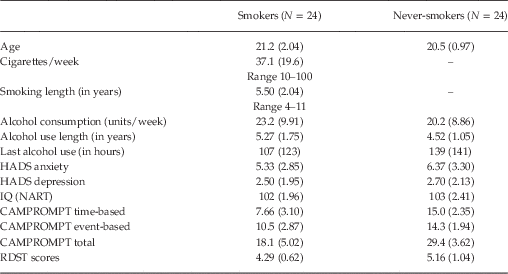
Table 1 contains the estimated marginal means and standard errors (in brackets) comparing the CS and NS groups on age, weekly alcohol use, years spent drinking, last alcohol use in hours, HADS anxiety and depression scores, IQ, as well as scores on the CAMPROMPT time-based, event-based, total PM scores and on the RDST. A series of Pearson Product Moment correlations revealed significant positive correlations between scores on the RDST and the CAMPROMPT time-based task scores [r (48)=0.50, p<0.001], the RDST scores and CAMPROMPT event-based task scores [r (48)=0.40, p<0.005], and between RDST scores and CAMPROMPT total scores [r (48)=0.49, p<0.001] – indicating good convergent validity between the RDST and CAMPROMPT constructs. χ 2 analysis revealed no significant difference in the number of males and females between the CS and NS groups [χ 2(1)=1.50, p=0.22]. Seven univariate analysis of variance revealed no significant differences between the two groups on age [F (1, 46)=2.08, p=0.15], weekly alcohol use (in units) [F (1, 46)=1.25, p=0.26], years spent drinking [F (1, 46)=3.22, p=0.07], last drink in hours [F (1, 46)=0.71, p=0.40], HADS anxiety [F (1, 46)=1.36, p=0.24], HADS depression [F (1, 46)=0.12, p=0.70], nor on IQ [F (1, 46)=3.37, p=0.07]. Since years spent drinking and IQ were approaching significance, only these two covariates were included in the main between-groups analyses on EF and PM.
Estimated marginal means and standard errors (in brackets) comparing smokers with never-smokers on age, cigarettes smoked per week, length of smoking in years, the number of units of alcohol consumed per week, years of alcohol use, last alcohol use in hours, scores on the HADS Anxiety and Depression sub-scales, scores on NART, scores from CAMPROMPT time-based, event-based and total PM scores; as well as RDST performance

HADS, hospital anxiety and depression scale; NART, national adult reading test; CAMPROMPT, cambridge prospective memory test; PM, prospective memory; RDST, reserve digit span task.
Analysis of co-variance (ANCOVA)
Four univariate ANCOVAs were applied to the RDST data and CAMPROMPT data (controlling for variations in years spent drinking and IQ). These revealed that the NS group performed significantly better than the CS group on the RDST task [F (1, 44)=9.40, p<0.01; η 2=0.17; see Table 1 for means]. It also revealed that the NS group recalled significantly more time-based items [F (1, 44)=77.0, p <0.001; η 2=0.63], event-based items [F (1, 44)=21.2, p<0.001; η 2=0.32] and total items [F (1, 44)=66.0, p<0.001; η 2=0.60] on CAMPROMPT than CS group (see Table 1 for means). Finally, a series of univariate ANCOVAs applied to the CAMPROMPT data (while controlling for the RDST scores) revealed that the smoking-related deficits on CAMPROMPT remained significant for time-based items [F (1, 45)=58.7, p<0.001; η 2=0.56], event-based items [F (1, 45)=18.4, p<0.001; η 2=0.29] and for total PM scores [F (1, 45)=59.9, p<0.001; η 2=0.54]. However, a series of univariate ANCOVAs applied to the RDST data (while controlling for the CAMPROMPT scores) revealed that the smoking-related deficit in EF was reduced to non-significance when CAMPROMPT time-based scores were controlled for [F (1, 45)=0.52, p=0.47; η 2=0.06] and when total PM scores were controlled [F (1, 45)=0.65, p=0.42; η 2=0.01], but remained significant when event-based PM scores were controlled for [F (1, 45)=4.20, p<0.05; η 2=0.08]. This pattern of results suggests although EF was compromised in the smokers, this particular executive impairment did not significantly contribute to either the time-based or the event-based PM deficits observed in the group of smokers in this study. Interestingly, when the measures of PM were employed as covariates in the ANCOVA of group and RDST performance, the analyses indicated that the executive impairment in smokers could be fully accounted for by impairment in the time-based PM measure.
Discussion
The aim of the study was to observe whether both EF and PM deficits were evident in same cohort of CS when compared with the NS control group. After observing no significant difference between the CS and NS groups on age, gender, alcohol use, anxiety scores, depression scores and IQ, the main findings from the study revealed that the NS group performed significantly better on the RSDT and recalled significantly more time-based, event-based and total items on CAMPROMPT and when compared with the CS group. These findings were also observed after omitting anyone who reported using an illegal substance, anyone who drank heavily or had used alcohol within the last 48 hours, or reported suffering from a psychiatric condition – which means that the effects found here cannot be attributable to these extraneous factors.
These findings provide support for previous independent evidence of deficits in EF (Hill et al. Reference Hill, Nilsson, Nyberg and Backman2003; Glass et al. Reference Glass, Buu, Adams, Nigg, Puttler and Jester2009; Tait & Siru Reference Tait and Siru2009) and more recently deficits in PM associated with persistent smoking (Heffernan et al. Reference Heffernan, Clark, Bartholomew, Ling and Stephens2010; Heffernan & O’Neill Reference Heffernan and O’Neill2011; Heffernan et al. Reference Heffernan, O’Neill and Moss2012), but this analysis is the first to observe both EF and PM deficits in the same group of active smokers. Furthermore, these results indicate a degree of complexity in the relationship between EF impairment (as measured by the RDST) and impairments in PM (as measured by CAMPROMPT). The findings suggest that, despite the smoking-related impairment in the RDST EF task performance, this executive impairment could not significantly account for the smoking-related impairments observed in the CAMPROMPT time-based or event-based PM tasks. Thus, the observed deficits in PM performance can be attributed to compromised cognitive processes beyond those involved in the organisation and manipulation of verbal and non-verbal information within working memory (i.e. in EF). However, the analyses also indicated a common source of impairment between PM and executive processes; more specifically, impairment in the time-based PM measure fully accounted for the impairment in the RDST performance; this was not the case when controlling for the event-based score. Given that time-based PM relies on self-initiated reactivation of an intention when no external cues are available (unlike event-based PM where prominent cues appear within the task) it would be expected that time-based PM would draw more heavily upon executive resources. A possible explanation for this finding therefore might be as follows; the RDST requires co-ordinating information within both verbal and non-verbal working memory in order to achieve the correct output, whereas the time-based PM tasks on CAMPROMPT requires co-ordination of information in verbal and non-verbal working memory, also time monitoring, as well as engaging in an on-going filler (distractor) task; therefore requiring greater executive demands (and resources) than the RDST. Future work may wish to include a more complex working memory/executive task (one which places greater demands on executive resources) than the one employed in the current study, perhaps employing a dual-task working memory task.
There are a number of mechanisms that have been proposed, which could offer explanations as to why chronic tobacco smoking might compromise both EF and PM. Previous literature suggests that prolonged tobacco smoking may damage the brain at a global level in terms of cerebral atrophy or reductions in volume (Gallinat et al. Reference Gallinat, Meisenzahl, Jacobsen, Kalus, Bierbrauer, Kienast and Staedtgen2006; Nooyens et al. Reference Nooyens, van Gelder and Verschuren2008; Durazzo et al. Reference Durazzo, Insel and Weiner2012), or may lead to impairments at a local level in terms of specific mechanisms being damaged (Ghosh et al. Reference Ghosh, Mishra, Das, Kaushil and Basu2009). Since both EF and PM have been shown to share prefrontal and frontal resources in the brain (Burgess et al. Reference Burgess, Quayle and Frith2001; Martin et al. Reference Martin, Kliegel and McDaniel2003; Simons et al. Reference Simons, Scholvinck, Gilbert, Frith and Burgess2006; Kliegel et al. Reference Kliegel, Jager, Altgassen and Shum2008) the current findings suggests persistent smoking may lead to some reduced function in these regions of the brain. However, given that other brain regions may be involved in PM, such as the medial temporal lobes (Okuda et al. Reference Okuda, Fujii, Ohtake, Tsukiura, Tanji, Suzuki, Kawashima, Fukuda, Itoh and Yamadori2003) and the possible involvement in the hippocampal region (McDaniel & Einstein Reference McDaniel and Einstein2011). Since controlling for EF scores in the current PM data did not significantly contribute to either the time-based or the event-based PM deficits observed in smokers, supports the notion that the PM deficits observed here may reside in the medial temporal lobe region or specifically within the hippocampal region.
A number of methodological issues should be considered when interpreting these results. Although the RDST and CAMPROMPT are standardised measures of EF and PM, recent literature has emphasised the need to utilise more ecologically valid tasks to measure memory (McDaniel & Einstein Reference McDaniel and Einstein2007), those that might best reflect the everyday difficulties experienced by smokers. Future work could therefore utilise a more ecologically valid memory paradigm that embeds both EF and PM tasks within the same task, for example, a virtual reality task that incorporates both of these components within the same ‘virtual office’ environment (Jansaari et al. Reference Jansaari, Froggatt, Edginton and Dawkins2012). Since smoking as a habit can begin as early as 9 years of age (Ringlever et al. 2012), future research might wish to examine what impact persistent smoking has upon young childrens’ neurocognitive development, given that recent evidence has suggested that the brain is still developing across this critical period (Spear Reference Spear2013). Any injurious impact upon this development could interfere with everyday memory (of which PM and EF play critical roles).
To conclude, the current findings demonstrate smoking-related deficits in both EF and PM functions within the same cohort of active smokers. The precise underlying mechanism by which this occurs in smokers is unclear. The findings from the current study could be used in anti-smoking campaigns in order to highlight the everyday cognitive consequences of persistent smoking in addition to the wealth of knowledge on health deficits, given that both EF and PM are critical to independent living. Understanding more about the everyday cognitive consequences of persistent smoking could also be used to better inform medical staff and clinicians who work with problem smokers, a move welcomed by practitioners worldwide (Richmond et al. Reference Richmond, Zwar, Taylor, Hunnisett and Hyslop2012).
Acknowledgement
Heffernan, Carling and O’Neill designed the study and wrote the protocol. Carling collected the data for the study. Heffernan, Carling, O’Neill and Hamilton wrote the draft of the manuscript.
Financial Support
No funding was received in support of this study.
Conflicts of Interests
The authors have no financial interests, relationships or affiliations relevant to this manuscript, thus there are no conflicts of interests.