INTRODUCTION
Despite the notable medical advances made in recent years to significantly decrease mortality, hematological malignancies are associated with fear and uncertainty. These malignancies comprise 8.1% of total cancers (nonmelanoma skin cancers excluded) in Latin America. In Brazil, the crude cumulative incidence rates for non-Hodgkin's lymphomas, Hodgkin's lymphoma, multiple myeloma, and leukemia for both males and females is 12 and 8.7 per 100,000 inhabitants, respectively (Fife & Fausel, Reference Fife, Fausel and Holland2010; WHO, 2008).
Hematological malignancies can be divided into aggressive or high-grade neoplasm (including acute leukemia, Hodgkin's lymphomas, and aggressive non-Hodgkin's lymphomas) and indolent or low-grade neoplasm (including indolent non-Hodgkin's lymphomas, multiple myeloma, chronic lymphocytic leukemia, and chronic myeloproliferative disorders) (Swerdlow et al., Reference Swerdlow, Campo and Harris2008).
Aggressive neoplasms have high proliferation rates, whereas indolent malignancies grow slowly. This difference in growth rates has several practical implications. High-grade tumors, if not cured, can typically kill the patient in a matter of weeks to months. In contrast, low-grade tumors may have a waxing and waning behavior and not even require immediate therapy. While high-grade tumors can be cured, low-grade tumors can only be controlled for a period of time, before relapsing and demanding subsequent therapy (Swerdlow et al., Reference Swerdlow, Campo and Harris2008; Armitage & Weisenburger, Reference Armitage and Weisenburger1998).
The difference between high-grade and low-grade neoplasm can affect the way patients cope with diagnosis and treatment and determine emotional burdens, such as level of distress, anxiety, and depression (Lesko, Reference Lesko and Holland1998). Distress is defined as “a multi-determined unpleasant emotional experience of a psychological (cognitive, behavioral, emotional), social and/or spiritual nature that may interfere with the ability to cope effectively with cancer, and its physical symptoms and treatment. Distress extends along a continuum, ranging from common normal feelings of vulnerability, sadness, and fears to problems that can become disabling, such as depression, anxiety, and existential and spiritual crisis” (National Comprehensive Cancer Network, 2012).
Many studies have been done to better understand the psychosocial factors associated with hematological cancer and treatment experiences. Most of them have assessed the psychological effects of bone marrow transplantation and the remission phase (Allart et al., Reference Allart, Soubeyran and Cousson-Gélie2013); however, only a few of them have examined the longitudinal prevalence of problem-related distress, especially during the period of chemotherapy (McDowell et al., Reference McDowell, Occhipinti and Fersguson2010; Giese-Davis et al., Reference Giese-Davis, Waller and Carlson2012). It is important to note that patients with hematologic malignancies often require urgent, aggressive, and lengthy chemotherapy, sometimes involving hospitalization (Albrecht & Rosenzweig, Reference Albrecht and Rosenzweig2012). Consequently, patients with hematological malignancies may experience distress, leading to the importance of early recognition and management of problem-related distress (Albrecht & Rosenzweig, Reference Albrecht and Rosenzweig2012). The assessment routine could be an instrument to improve the supportive care that physicians provide, helping them to understand how patients are experiencing the disease, who needs urgent help, who needs psychosocial intervention, and who lacks sufficient motivation for adequate active treatment (Allart et al., Reference Allart, Soubeyran and Cousson-Gélie2013; Lamers et al., Reference Lamers, Hartmann and Goldschmidt2013). Moreover, treatment and intervention of a patient with hematological malignancies could be based on psychosocial evaluation (Allart et al., Reference Allart, Soubeyran and Cousson-Gélie2013). Winzer et al. (Reference Winzer, Hoppe and Altenhoff2009) observed that patients accept more when psychosocial services are offered than when they only have to answer a single question about their need for help. All these topics have not been studied previously in hematological cancer patients, considering the treatment period.
A few studies have addressed the issue of psychological adaptation to hematological malignancies in general. Zabora et al. (Reference Zabora, Brintzenhofe-Szoc and Curbow2001), for example, studied the prevalence of distress in 14 different cancer diagnoses, 3 of which were hematological malignancies. Hodgkin's was found to be the third most distressful diagnosis (37.8% of patients with distress, 55% with anxiety, and 52.8% with depression), lymphoma the fifth (36% of patients with distress, 55.3% with anxiety, and 53.4% with depression), and leukemia the tenth (32.7% of patients with distress, 54.5% with anxiety, and 54.1% with depression).
With a slight minor degree of prevalence, a study involving Brazilian patients found that 20.5% of patients experienced anxiety and 16.8% experienced depression (Santos et al., Reference Santos, Kozasa and Chauffaille2006). Wittmann et al. (Reference Wittmann, Vollmer and Schweiger2006) found a similar result: 22% of patients reported anxiety and 18% depression. In a prospective study, Prieto et al. (Reference Prieto, Blanch and Atala2002) found that 14.1% of patients met the DSM-IV criteria for mood disorder and 8.2% for anxiety disorder. Moreover, Cole et al. (Reference Cole, Haugen and Mathiason2011) observed that 34% of patients rated distress levels ≥4, and 31% had positive HADS results. No significant differences were found between hematological malignancy cohorts; however, the percentage of subjects with a positive HADS result was higher in Hodgkin's lymphoma patients (52%).
Considering the differences between oncologic and hematological cancers, the literature pointed out that there is no difference in distress prevalence based on cancer setting and suggested that the effect of cancer stage might have been overstated by other studies. Moreover, several large-scale symptom studies have shown either no difference or only modest differences in prevalence of depression or distress according to disease stage (Mitchell et al., Reference Mitchell, Chan and Bhatti2011). Loscalzo (Reference Loscalzo2008) observed that, controlling for gender, stage 4 patients reported significantly higher problem-related distress levels than stages 1, 2, and 3 patients (p < 0.01); however, no significant differences were found in number of problems with high distress levels.
Gender is another important factor affecting patients' adaptation to cancer diagnosis and treatment (Pal & Hurria, Reference Pal and Hurria2010). Gender differences have often been shown to explain differences in health. For example, women are more likely than men to engage in illness-related behaviors, such as reporting and monitoring symptoms, utilizing both informal and formal healthcare services, and adopting the sick role more easily (Keller & Henrich, Reference Keller and Henrich1999; Schmetzer & Florcken, Reference Schmetzer, Florcken, Oertelt-Prigione and Regitz-Zagrosek1998). Other studies have found that women usually share their emotional concerns to reduce their immediate sense of threat and are more likely to ask for social support. On the other hand, since men can experience a sense of diminished self-esteem by sharing their vulnerabilities, they minimize sharing their sufferings with others (Loscalzo et al., Reference Loscalzo, Kim, Clark and Holland2010). Keller and Henrich (Reference Keller and Henrich1999) emphasize that distress might be overestimated in women and underestimated in men.
Considering gender differences between oncohematological patients, Khan et al. (Reference Khan, Irfan and Shamsi2007), found no evidence of significant gender differences in psychiatric diagnostic. On the other hand, Keller and Henrich (Reference Keller and Henrich1999) found that the prevalence of overall illness-related distress is greater in women (54%) than in men (28%). Moreover, Cole et al. (Reference Cole, Haugen and Mathiason2011) observed that women were more likely to have a history of depression than men, and Pandey et al. (Reference Pandey, Sarita and Devi2006) noted that female patients report more symptoms and higher overall distress due to illness compared with male patients.
The aim of this study was twofold: (1) to describe the course of distress, anxiety, and depression as well as problem-related distress in hematological cancer patients throughout their chemotherapy, and (2) to examine the association of gender and grade of hematological cancer with distress, anxiety, depression, and problem-related distress frequencies and levels.
METHOD
A prospective study was done in 104 hematological cancer patients, 17.3% of whom were diagnosed with leukemia, 77.9% with lymphoma, and 4.8% with multiple myeloma. About 52.9% of the patients were female. They were recruited at Centro de Câncer de Brasília (CETTRO), located in Brazil's Federal District. This is a private multidisciplinary cancer center, where the majority of patients have private health insurance.
Procedures
All patients who began chemotherapy treatment between March 2009 and August 2012 were seen by a psychologist (first author) through a clinical counseling program and were invited to participate in the study's assessments before starting chemotherapy. Patients not interested in participating in the study still received the same counseling through the clinical program. The counseling program fostered discussing the results for patients obtained on instruments with the physician, in order to establish the best treatment and interventions for patients with high distress, anxiety, or depression symptoms. Patients with mild distress were followed up in order to monitor possible changes. Adjuvant treatments included psychoeducation, changes in medication dosage (toxicity), treatment for side effects, and referrals.
Patients with an interest in participating signed an informed consent, and participants completed demographic and clinical data forms. Other assessments included the Distress Thermometer (DT) and Problem List (PL), and the Hospital Anxiety and Depression Scale (HADS); participants were asked to complete the DT, PL, and HADS at three timepoints: T1 (before commencing chemotherapy), T2 (middle of treatment protocol as defined by a physician: about 2.5 months after starting chemotherapy), and T3 (last day of chemotherapy as defined by a physician: about 5 months after commencing treatment).
In our cohort, there were 26 patients who did not complete the study, 13 (12.5%) due to discontinuation of assessments, 12 (11.5%) due to death, and 1 (1%) due to discontinued treatment. Of those 13 patients, 7 (6.7%) left the study before the second assessment and 5 (4.8%) before the third assessment.
The eligibility criteria included: (1) diagnosis of hematological malignancies, (2) having chemotherapy for the first time, (3) a minimum age of 18, (4) the ability to provide verbal/written informed consent, and (5) an adequate level of functioning. All 104 patients consented to participate in the study and met the above criteria. An informed consent was received from all participants, and the study protocol was reviewed and approved by the ethics committee of the Health Sciences Faculty at Brasilia University.
Measures
Demographic data were obtained through a questionnaire designed specifically for this study. The variables assessed were age, gender, marital status, education. Type of hematological malignancy and disease stage were obtained from patients' files, and the phases of assessment were defined by patients' physicians.
We employed a version of DT plus PL developed by the National Comprehensive Cancer Network (NCCN) (2012) and translated into Portuguese and validated (Decat et al., Reference Decat, Laros and Araujo2009). This comprises a self-report screening measure for distress and is composed of two parts. In the first part (DT), patients were asked to circle the number that best represents their level of distress during the past week on an 11-point visual analogue scale, with scores ranging from 0 (no distress) to 10 (extreme distress). In the second part (PL), patients were given a list and asked to check all the problems that they have experienced during the past week. A total of 35 problems are distributed in five categories (Practical Problems, Family Problems, Emotional Problems, Spiritual Problems, and Physical Problems); the PL lists problems that might contribute to distress in cancer patients (NCCN, 2012; Decat et al., Reference Decat, Laros and Araujo2009; American Psychosocial Oncology, 2006). A cutoff score of 4 (sensitivity 0.82 and specificity 0.98) was used to indicate clinically significant distress (Decat et al., Reference Decat, Laros and Araujo2009).
A Portuguese version of the HADS was employed (Botega et al., Reference Botega, Bio and Zomignani1995). This is a 14-item self-report questionnaire in which patients rate how they felt during the previous week on a 4-point Likert scale. The questionnaire includes depression and anxiety subscales (seven items for each). Total scores range from 0 to 42 for all 14 items, and each subscale is scored from 0 to 21. Subscale scores of 9–21 indicate greater depression and 8–21 greater anxiety (Botega et al., Reference Botega, Bio and Zomignani1995).
Data Analysis
For all analyses we utilized the Statistical Package of Social Sciences (SPSS) (version 17.0 for Mac). Descriptive statistics were used to characterize participants by demographic and clinical characteristics; by incidence of distress (DT ≥ 4), anxiety (HADS-A ≥ 8), and depression (HADS-D ≥ 9); and frequencies of problems with distress as rated on the PL. For the problem summary scores, frequencies of problems were determined for all patients who reported one or more for each problem area (Practical, Family, Emotion, Spiritual and Physical). Repeated Measures Analysis of Variance (RM-ANOVA) was utilized over the three timepoints of evaluation for the PL: distress, anxiety, and depression levels by gender and grade of hematological cancer (low and high).
RESULTS
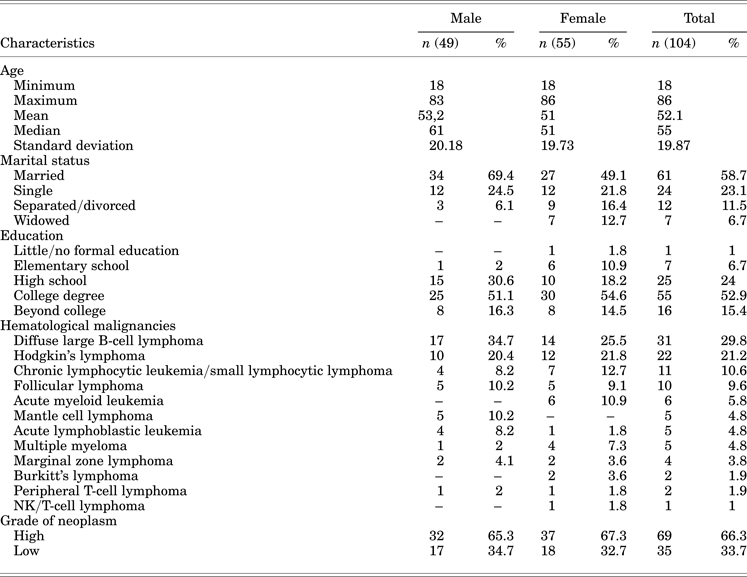
Table 1 presents the demographic information for the patient sample (N = 104). The average age of patients was 52.1 years (SD 19.8; range 18–86 years), 52.9% were female, 58.7% were married, and 68.3% had at least a college degree. The main diagnoses were diffuse large B-cell lymphoma (29.8%), Hodgkin's lymphoma (21.2%), and chronic lymphocytic leukemia/small lymphocytic lymphoma (10.6%). Most patients (66.3%) were diagnosed with high-grade hematological disease.
Demographic and clinical characteristics of patients by gender (N = 104)

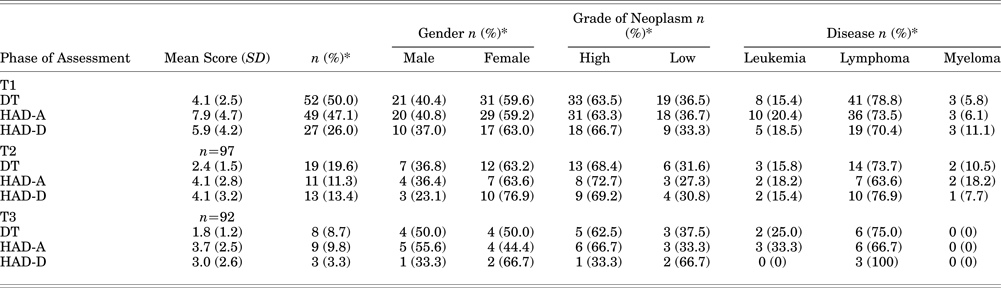
Regarding distress, anxiety, and depression incidence at T1, (1) 50% of participants reported significant distress levels (DT ≥ 4), of whom 59.6% were female; 63.5% were diagnosed with high-grade disease; and 15.4% had leukemia, 78.8% lymphoma, and 5.8% myeloma. (2) About 47.1% of participants reported significant anxiety; 59.2% were female, 63.3% had high-grade disease, and 73.5% had lymphoma. (3) Of the 26% of participants who reported depression, 63% were female, 66.7% had high-grade disease, and 70.4% had lymphoma.
Similar results were found at T2, in which most participants with significant anxiety, depression, and distress were women, had high-grade neoplasm, or had lymphoma, as illustrated in Table 2. However, the incidence of these conditions reduced to 19.6% for distress, to 11.3% for anxiety, and to 13.4% for depression. At T3, incidence was further reduced for distress (8.7%), anxiety (9.8%), and depression (3.3%). Of those with significant distress levels, 50.0% were male, 62.5% had high-grade neoplasm, and 75.0% had lymphoma; of those with significant anxiety, 55.6% were male, 57.1% had high-grade neoplasm, and 66.7% had lymphoma; of those with significant depression, 66.7% were female, 66.7% had low-grade neoplasm, and 100% had lymphoma.
Mean levels of distress, anxiety, and depression scores by gender, grade of neoplasm, and type of cancer (N = 104)
* DT ≥ 4; HAD-A ≥ 8; HAD-D ≥ 9
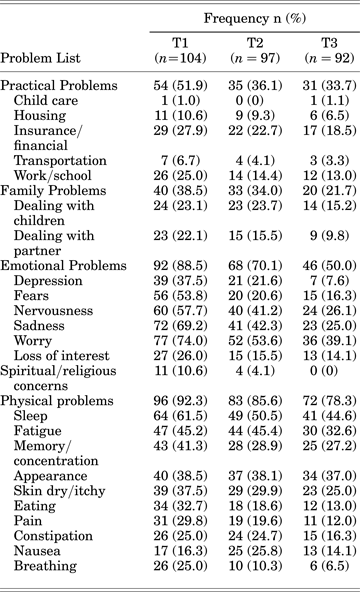
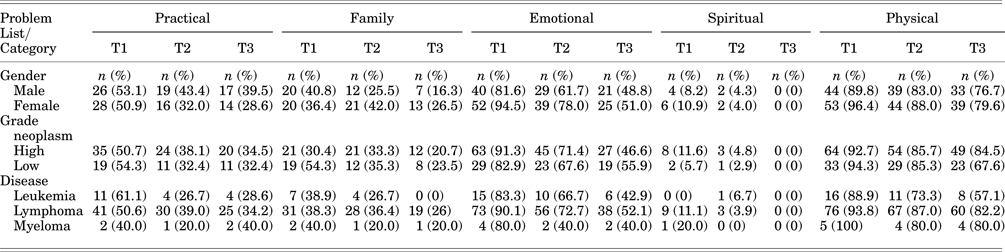
Table 3 shows the list of problems reported by all participants during the three phases of evaluation. At T1, about 51.9% of the patient sample reported distress due to Practical Problems. About 38.5% reported distress from Family Problems, 88.5% from Emotional Problems, 10.6% from Spiritual Problems, and 92.3% from Physical Problems. At the second assessment (T2), the prevalence of problem-related distress in the patient sample decreased: about 36.1% reported distress from Practical Problems, 34.0% reported Family Problems, 70.1% Emotional Problems, and 85.6% Physical Problems. A reduction in the prevalence of problem-related distress was also found at final evaluation (T3), with 33.7% reporting distress from Practical Problems, 21.7% Family Problems, 50.0% Emotional Problems, 0% Spiritual Problems, and 78.3% Physical Problems. Table 4 presents the differences between problem-related distress based on gender, grade of hematological cancer, and type of hematological cancer. The percentage of participants who reported one or more problem as distressful was determined for each problem category. In terms of gender, more men reported distress due to Practical Problems than women for all assessments. For the other problem categories, more women reported problem-related distress than men for all assessments. As for grade of hematological cancer, more participants with low-grade disease reported distress due to Practical Problems at T1 than participants with high-grade disease; however, more patients with high-grade disease reported distress from Practical Problems at T2 and T3. In terms of Family Problems, more low-grade participants reported problem-related distress at T1, T2, and T3; Emotional and Spiritual Problems were reported as distressful more often by participants with high-grade disease at T1 and T2, and more often by participants with low-grade disease at T3. For Physical Problems, we observed that participants with low-grade disease reported problem-related distress more frequently at T1 and less frequently at T2 and T3. As for hematological cancer diagnosis, Practical Problems were reported as distressful most commonly by leukemia patients at T1 and by lymphoma patients at T2 and T3. Family and Spiritual Problem–related distress was most common for myeloma patients at T1 and for lymphoma patients at T2 and T3. Emotional and Physical Problems were reported as distressful most commonly by participants with lymphoma during all phases of evaluations.
Frequency of problem-related distress reported by patient sample
Frequencies of problem-related distress over three assessments by gender, grade neoplasm, and cancer diagnosis
The RM-ANOVA was conducted for distress level by gender and grade (high or low) of hematological cancer in order to check the variance/covariance matrix of the observed data and to determine if there was a statistically significant effect of time on mean distress levels. Mauchly's assumption of sphericity was not met, and the Greenhouse–Geisser significance test was statistically significant. Therefore, we found a main effect of distress (DT) decreasing significantly over time: T1 (mean = 4.13), T2 (mean = 2.4), and T3 (mean = 1.88), p < 0.001. However, there were no significant joint effects with gender or grade of hematological cancer over the three assessments.
Another RM-ANOVA test was conducted over the three assessments for the PL by gender and grade of hematological cancer. Mauchly's assumption of sphericity was met for Practical Problems, and the sphericity-assumed RM-ANOVA test showed a statistically significant effect of time; therefore, the prevalence of distress due to Practical Problems decreased significantly over time: T1 (51.9%), T2 (36.1%), and T3 (33.7%), p = 0.029. In terms of Family Problems, the Mauchly's assumption sphericity was met, and the sphericity-assumed RM-ANOVA showed a statistically significant main effect of time on prevalence of distress from Family Problems: T1 (38.5%), T2 (34.0%), and T3 (21.7%), p = 0.003. In addition, the sphericity-assumed RM-ANOVA test showed a significant joint effect (p = 0.048) of gender on prevalence of distress due to Family Problems (male: T1 = 40.8%, T2 = 25.5%, and T3 = 16.3%; female: T1 = 36.4%, T2 = 42.0%, and T3 = 26.5%). For Emotional Problems, Mauchly's assumption of sphericity was met, and there was a significant main effect over time for prevalence of distress from Emotional Problems: T1 (88.5%), T2 (70.1%), and T3 (50.0%), p < 0.001. With regard to Physical Problems, Mauchly's assumption of sphericity was not met; the Greenhouse–Geisser RM-ANOVA test indicated a main effect of time (T1 = 92.3%, T2 = 85.6%, and T3 = 78.3%; p < 0.001), showing that fewer patients reported Physical Problems as distressful over time. There was also a significant joint effect of gender on prevalence of distress from Physical Problems over time (male: T1 = 89.8%, T2 = 83.0%, and T3 = 76.7%; female: T1 = 94.5%, T2 = 88.0%, and T3 = 79.6%; p = 0.046). In brief, no significant joint effect was found for grade of hematological cancer on distress from Practical, Family, Emotional, and Physical Problems over time. Moreover, there were no significant interactions with gender on distress due to Practical and Emotional Problems over time.
DISCUSSION
The proportion of participants experiencing distress decreased over the three assessments, and this reduction over time was found to be statistically significant. We observed that the incidences of distress, anxiety, and depression at T1 were higher than those shown in other studies and smaller at T2 (Santos et al., Reference Santos, Kozasa and Chauffaille2006; Wittmann et al., Reference Wittmann, Vollmer and Schweiger2006; Prieto et al., Reference Prieto, Blanch and Atala2002). The results found at T1 could be related to cultural differences or to the quality of information that patients received; the lower incidence of problem-related distress at T2 and T3 may possibly serve as an indicator of the quality of cancer care and psychosocial counseling provided at the institution. Distress assessments provide healthcare professionals with information about how patients are coping with diagnosis and treatment, allowing treatment or prevention of problems causing distress. The second and third evaluations allow an opportunity to closely follow patients, offering a personalized approach.
Lymphoma patients reported greater distress than leukemia and myeloma patients, as also shown by Zabora et al. (Reference Zabora, Brintzenhofe-Szoc and Curbow2001); however, these results should be interpreted with caution because of the unequal sample sizes for each disease. Study participants with significant levels of distress, anxiety, and depression at T1 and T2 were mostly women, were diagnosed with lymphoma, and had high-grade hematological cancer; similar results were found by Pandey et al. (Reference Pandey, Sarita and Devi2006) and Keller and Henrich (Reference Keller and Henrich1999). The difference in the incidence of distress, anxiety, and depression by gender was not as pronounced as in the above studies at T1, but similar results were found in T2. No statistically significant effect of gender or neoplasm grade was found on distress levels over time. However, this lack of interaction may be due to the small subgroup sample sizes. The finding that more women report distress could characterize the ease with which women express and communicate their emotions.
On the PL, there was a statistically significant decrease in the frequencies of problem-related distress over time. These data emphasize the importance of a reassessment routine, providing more indications about how patients cope with longitudinal cancer care. The problem categories most commonly reported as distressful over the three assessments were Physical and Emotional Problems. More male participants reported Practical Problems as distressful at all timepoints, Family Problems at T1, and Spiritual Problems at T2; more women participants reported problem-related distress in the other categories and assessments. These findings could be explained by the role differences between genders; for example, more men reported distress due to Practical issues than women, who asked for more help and support and were more likely to share their emotions (Keller & Henrich, Reference Keller and Henrich1999; Schmetzer & Florcken, Reference Schmetzer, Florcken, Oertelt-Prigione and Regitz-Zagrosek1998). In general, more women reported symptoms than men, mainly for Emotional and Physical Problems, which was also shown by Keller and Henrich (Reference Keller and Henrich1999), Schmetzer and Florcken (1998), and Pandey et al. (Reference Pandey, Sarita and Devi2006). This finding could highlight the male preference to minimize suffering and cope emotionally alone, highlighting the challenge of finding strategies that assist men in expressing their feelings. As Keller and Henrich (Reference Keller and Henrich1999) reported, these symptoms were probably underestimated in men and overestimated in women. An unexpected finding in our study was that more men than women reported distress due to Family Problems in T1.
With regard to hematological cancer grade, more patients with low-grade disease reported distress due to Practical Problems at T1, Family Problems at all three assessments, Emotional Problems at T3, and Physical Problems at T1. These findings may characterize the impact of disease on distress and behavior; while patients with low-grade disease might live with the notion that they have a chronic disease, patients with high-grade cancers live with the fear of whether or not they will survive. Future exploratory studies, in which prognosis data are obtained, could be done to determine if patients with high-grade disease who receive a good prognosis or outcome (at diagnosis, middle, and end of treatment) report less overall distress and problem-related distress than patients with a bad prognosis. RM-ANOVA tests showed significant joint effects of gender on distress due to Family and Physical Problems over time, thereby indicating that gender does play a role in how problem-related distress manifests over time.
There are a number of limitations to this study. The small sample sizes at each assessment and the lack of homogeneity between cancer diagnoses subgroups limited our analysis. Participants were not controlled for treatment-related variables such as chemotherapy regimen, and those factors most likely would influence the level of distress and types of problems reported as distressing. The fact that this study recruited patients only from only one cancer center may have reduced the study's generalizability to other settings and patients. Future studies should be conducted to replicate and extend the current findings to verify and further understand the effects of gender and grade of hematological cancer on distress, anxiety, and depression.
CONCLUSION
Our findings demonstrate the importance and complexities of examining gender and disease variables that influence the incidence of distress and also encourage the use of distress assessments as a part of routine clinical care. We observed a statistically significant decrease in distress (DT) prevalence over time, which could be an indicator of the quality of service and counseling offered to patients; the study assessments demonstrate not only how the patients cope with cancer diagnosis and treatment but also evaluated if an improvement occurred since the last evaluation, allowing healthcare professionals to choose the best interventions to care for patients. These results indicate the importance of assessment and management of distress being a part of the cancer care routine. The statistical analysis showed some significant differences in problem-related distress between gender; differences were also found based on grade of hematological cancer, but they were not found to be statistically significant. These findings emphasize the importance of continuing investigation of the effects of gender and disease characteristics on distress.