


Introduction
Around one in six people aged 16 years and over in England meets criteria for a common mental health disorder such as depression or anxiety (McManus et al., Reference McManus, Bebbington, Jenkins and Brugha2016). Of these, half have symptoms severe enough to warrant active intervention. The Improving Access to Psychological Therapies (IAPT) initiative aimed to increase access to evidence-based psychological treatments for common mental health problems in line with National Institute for Health and Care Excellence (NICE) guidelines (Department of Health, 2008).
The second phase of the IAPT programme included plans to extend access to psychological therapies for common mental health problems to children and young people (CYP-IAPT) (Department of Health, 2011). In the east of England, CYP-IAPT principles (Kingsbury et al., Reference Kingsbury, Rayment, Fleming, Thompson and York2015) were integrated into the development of an innovative youth mental health service model for 14- to 25-year-olds (Wilson et al., Reference Wilson, Clarke, Lower, Ugochukwu, Maxwell, Hodgekins and Fowler2017). Norfolk Youth IAPT was a joint venture between the Norfolk Youth Service and the local IAPT service, which aimed to provide young people aged 16–25 years with access to evidence-based stepped care interventions within a developmentally appropriate framework.
Norfolk Youth IAPT aimed to incorporate a developmental framework to support adolescents and young adults towards a successful adulthood. Efforts were made to offer interventions in appropriate venues, offer drop-in clinics to aid swift face-to-face contact, and to tailor interventions to adolescents and young adults (Collins et al., Reference Collins, Notley, Clarke, Wilson and Fowler2017).
Details of Psychology of Emotions workshops
The diagnostic model of mental illness is the dominant framework used by professionals, researchers, the media, and increasingly the general public. However, there are significant issues with the model, particularly for adolescents and young adults. Firstly, there are issues with its reliability, validity and utility, which have led leading proponents of youth mental health to conclude that the diagnostic model ‘struggles to fulfil its key purposes of guiding treatment selection and predicting outcome’ and that ‘understanding of this is crucial in youth mental health’ (McGorry et al., Reference McGorry, Purcell, Hickie, Yung, Pantelis and Jackson2007). The diagnostic model also emphasizes the individual over their environmental context: a psychiatric diagnosis is defined as a mental disorder ‘that occurs within the individual’ (American Psychiatric Association, 2013), which is particularly problematic for young people where context is an important part of development. The association of stigma with diagnosis is also recognized internationally as a significant problem for youth mental health (e.g. Patel et al., Reference Patel, Flisher, Hetrick and McGorry2007). Given the link between stigma and self-stigma, the provision of a diagnostic label at a crucial point in the development of identity is particularly problematic (Howells, Reference Howells2018). Perhaps the most significant issue with the diagnostic model, from the point of view of youth mental health, is its focus: the diagnostic model is a model of illness; it does not provide a framework within which young people can orient themselves towards living healthy, happy and fulfilled lives.
Cognitive behavioural therapy (CBT) has a strong base of evidence for mild to moderate mental health difficulties in children, adolescents (e.g. Crowe and McKay, Reference Crowe and McKay2017) and adults across disorders (e.g. Hofmann et al., Reference Hofmann, Asnaani, Vonk, Sawyer and Fang2012). There is also evidence for the effectiveness of trans-diagnostic interventions for mixed anxiety groups in adults (e.g. Norton, Reference Norton and Barrera2012) and anxiety and depression in children (Bilek and Ehrenreich-May, Reference Bilek and Ehrenreich-May2012). ‘Psychology of Emotions’ workshops took this one step further and were designed to offer the benefits of cognitive behavioural intervention without using a diagnostic framework at all, instead grounding the interventions in emotion science and emotional understanding. Adolescents and young adults learnt not about disorders and symptoms, but about emotions, emotional ‘traps’ (CBT maintenance formulations) and how they could use CBT to bring about change. The educational basis of the workshops was emphasized and participants were informed that they did not have to share personal information or talk in the workshop. However, efforts were made to encourage participation in the content without significant self-disclosure, for example by moving around the room in answer to questions, using images and videos, and sharing goals in between sessions.
The workshops consisted of six separate sessions. Session 1 was an introductory session in which emotions, their function, regulation, and a model of the brain were outlined. The remaining sessions focused in detail on a specific emotion and each session built upon the previous ones. The emotions were, in order: fear, sadness, anger, emotional instability, and happiness. Each session outlined what the emotion was, what it was for, and outlined a ‘trap’, a cognitive behavioural formulation illustrating common difficulties with that emotion, along with associated interventions to get out of the trap. Participants were provided with a workbook containing the information of the session as well as space to write homework tasks that encouraged them to use the content to make changes in their lives.
Whilst each session had a distinct focus, the six sessions were designed to fit together as a coherent whole and the language and concepts used were consistent throughout. Participants were invited to attend all sessions rather than to pick and choose. The workshops were delivered by Psychological Wellbeing Practitioners who received at least a week’s training in the intervention and ongoing contact and supervision from the clinical psychologists who developed the intervention. The intervention is described as non-diagnostic as it goes a step further than transdiagnostic interventions (e.g. Harvey et al., Reference Harvey, Watkins and Mansell2004), which retain reference to models of disorder or illness. A detailed treatment manual is available in CBT for Adolescents and Young Adults: An Emotion Regulation Approach (Howells, Reference Howells2018).
Provision of group interventions is attractive to providers of IAPT services operating in a climate of limited resources and high demand (Whitfield, Reference Whitfield2010). Although the research in support of group interventions is less extensive than for individual treatments, available evidence suggests that group interventions are more effective than usual care alone, and are comparably effective to individual treatment (Huntley et al., Reference Huntley, Araya and Salisbury2012; Newby et al., Reference Newby, McKinnon, Kuyken, Gilbody and Dalgleish2015). Group interventions delivered within adult IAPT services have been found to be experienced by service-users as normalizing mental health difficulties, increasing social support, and promoting hope through observing the progress of others (Newbold et al., Reference Newbold, Hardy and Byng2013). However, there is little evidence to support group interventions delivered specifically within adolescent and young adult services, and little evidence relating to non-diagnostic group-based interventions in clinical populations.
This study aimed to evaluate the effectiveness of the non-diagnostic Psychology of Emotions workshops for young people in a youth IAPT service. The main data source was the IAPT minimum dataset (Department of Health, 2011), which includes self-report measures of depression and anxiety collected at each clinical contact, as well as demographic characteristics and information on referrals and attendance. Qualitative data were also available from feedback forms provided in the final session of the workshops.
Method
Design
The study involved retrospective analysis of routinely collected quantitative and qualitative data. Data, including demographic characteristics and scores on standardized measures of depression and anxiety, were extracted from the service’s electronic patient management system by a member of the clinical team. All data were anonymized in preparation for analysis by the research team. In line with IAPT sessional outcome monitoring procedures, participants were asked to complete outcome measures prior to, or at each session they attended, allowing comparison of scores pre-and post-intervention. Qualitative data were collected at the end of each session through anonymized feedback forms offered to participants. These forms included two questions about participants’ views of the intervention, covering what they liked about the intervention and what they thought could be improved.
Participants
Norfolk Youth IAPT offered a variety of interventions to young people aged 16–25 years experiencing mild to moderate mental health problems (defined as clusters 1–4 on the mental health clustering tool; Department of Health, 2010). Psychology of Emotions workshops were available to all young people open to Norfolk Youth IAPT irrespective of diagnosis or presenting difficulty. Upon presentation to the service, young people were offered a brief assessment of their needs, either by telephone or face-to-face. In this assessment, young people were given choices about possible interventions that would be suitable to meet these needs. Psychology of Emotions workshops were one of a variety of potential options, and one of few workshops tailored to young people.
There were no specific inclusion or exclusion criteria for the workshops, but they tended to be recommended where a single focus of intervention (e.g. behavioural activation) was unlikely to be sufficient, or where young people spoke of not understanding emotions or having difficulty with a variety of emotions. Young people could only engage in one intervention at a time, so those attending Psychology of Emotions workshops would not be concurrently receiving other interventions. However, they may have had other interventions prior to the workshops or have gone on to have further intervention afterwards. All service-users invited to attend the Psychology of Emotions workshops between 1 January 2016 and 30 September 2016 were included in this evaluation.
Measures
Measures were completed by each participant in each session of the workshops. Facilitators handed out paper questionnaires at the beginning and ensured they were all collected in by the end.
The Patient Health Questionnaire (PHQ-9; Kroenke et al., Reference Kroenke, Spitzer and Williams2001) is a 9-item self-report measure of depression severity based on the DSM-IV criteria for major depression. It has sound psychometric properties in participants aged 13 and over (Allgaier et al., Reference Allgaier, Pietsch, Frühe, Sigl-Glöckner and Schulte-Körne2012; Kroenke et al., Reference Kroenke, Spitzer and Williams2001; Kroenke et al., Reference Kroenke, Spitzer, Williams and Löwe2010; Richardson et al., Reference Richardson, McCauley, Grossman, McCarty, Richards, Russo and Katon2010) and has been validated in a UK population (Gilbody et al., Reference Gilbody, Richards, Brealey and Hewitt2007). Scores range from 0 to 29, and scores of 10 or above are considered indicative of clinical ‘caseness’ within an IAPT context. Young people were asked to approach a member of staff should they feel unsafe or at risk of harming themselves, and staff also approached young people who scored highly on question 9 of the PHQ-9. In each case, an appropriate safety plan was put in place.
The Generalized Anxiety Disorder Scale (GAD-7; Spitzer et al., Reference Spitzer, Kroenke, Williams and Löwe2006) is a 7-item self-report measure used within IAPT services as a generic measure of anxiety severity (Clark et al., Reference Clark, Layard, Smithies, Richards, Suckling and Wright2009). It has good internal consistency and convergent validity with other anxiety scales (Kroenke et al., Reference Kroenke, Spitzer, Williams and Löwe2010) and has acceptable psychometric properties in both clinical samples of adolescents (Mossman et al., Reference Mossman, Luft, Schroeder, Varney, Fleck, Barzman and Strawn2017) and individuals aged 14 and over from the general population (Löwe et al., Reference Löwe, Decker, Müller, Brähler, Schellberg, Herzog and Herzberg2008). The measure has a range of 0–21 with scores of 8 and above considered indicative of clinical ‘caseness’ within an IAPT context.
Analysis plan
Quantitative data
Analyses were carried out using SPSS for Windows, version 23 (IBM, 2013). Descriptive statistics for the number of sessions attended and the demographic characteristics of those who did and did not attend were calculated. Tests of the significance of between-group differences in the gender, age and initial severity of depression and anxiety symptoms were conducted. Prior to testing, data were examined to assess whether they met the assumptions for parametric analysis, and non-parametric tests were used where the assumptions of their parametric equivalents were not met.
Outcomes of the workshops were investigated by using paired-samples t-tests to examine within-group differences in PHQ-9 and GAD-7 scores before and after participating in the Psychology of Emotions workshops. Effect sizes (Cohen’s d for paired samples) were calculated for all differences found to be statistically significant. The primary outcome analysis focused on the depression and anxiety scores of those participants who attended all six sessions, as these participants received the full intervention and the time delay between the pre- and post-measurements was consistent for all participants, limiting sources of confounding. As a secondary analysis, we also examined the depression and anxiety scores at the first and last session attended of all participants who attended at least two sessions.
In line with IAPT criteria (Clark et al., Reference Clark, Layard, Smithies, Richards, Suckling and Wright2009), young people were classified in a binary fashion as either recovered if they had moved from above to below the clinical thresholds for the PHQ-9 (score of 9 or lower) and GAD-7 (score of 7 or lower) at their final session, and not recovered if they were above either of these thresholds. We calculated the percentage of those who attended all six sessions, and of those who attended at least two sessions, who met these criteria for recovery at the final session they attended.
Qualitative data
Feedback received was collated and analysed using the Framework Method (Gale et al., Reference Gale, Heath, Cameron, Rashid and Redwood2013). The Framework Method is a systematic and flexible approach to analysing qualitative data that falls in the family of analytic methods termed ‘qualitative content analysis’. The approach involves charting data using a framework matrix consisting of rows (representing cases) and columns (representing codes). Having summarized the data in this way, the dataset as a whole can be interpreted and themes identified. This approach to analysis was chosen as it allows for the identification of descriptive themes, is appropriate for relatively large datasets, and provides step-by-step guidelines to ensure transparency and rigour (Gale et al., Reference Gale, Heath, Cameron, Rashid and Redwood2013).
Results
Workshop attendance
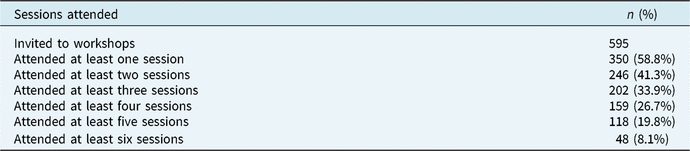
During the study period, 595 service-users were invited to attend a Psychology of Emotions workshop, 415 (69.7%) of whom were female. The mean age of invitees was 19.8 years (SD = 2.76). Of the 448 young people invited whose ethnicity was recorded, 415 (92.6%) described themselves as White British. Data came from 23 different workshops hosted across seven locations in the region served by Norfolk Youth IAPT. Table 1 shows the attendance by number of sessions; the mean number of sessions attended was 1.89 (SD = 2.13).
Number of sessions attended

There was no significant difference between the percentage of male and female invitees who attended at least one session: 59.5% (n = 247) of females compared with 57.2% (n = 103) of males (χ2 = .27, d.f. = 1, p = .601). In addition, no statistically significant association was found between gender and the total number sessions attended (χ2 = 7.57, d.f. = 6, p = .272). The mean age of those who did not attend any sessions was 19.7 years (SD = 2.72) and the mean age of those who attended at least one session was 19.9 years (SD = 2.79, range = 16–25). The age of participants who did not attend the workshops did not differ significantly from the age of those who attended at least one session (U = 41205, z = –.81, p = .42). There was also no significant difference in the ages of those attending all six sessions compared with those who attend one to five sessions and those who did not attend any sessions (H (2) = 2.65, p = .27). On average, 26 people attended each session of the workshops (range 8–45).
The mean PHQ-9 score at the initial session was 14.66 (SD = 5.92) and the mean GAD-7 score was 12.43 (SD = 4.77). An independent samples t-test showed that there was no significant difference in initial PHQ-9 (t (348) = .538, p = .591) or GAD-7 scores (t (348) = .665, p = .507) of young people who attended all six sessions and those who attended fewer than six sessions.
Workshop outcomes
Depression
Paired-samples t-tests were conducted to explore if there was a significant difference in participants’ PHQ-9 scores before and after taking part in the Psychology of Emotions workshops. For the 48 participants who attended all six sessions of the workshops, there was a statistically significant decrease in PHQ-9 score after attending the workshops (t (47) = 4.00, p < .001). Mean PHQ-9 score decreased from 14.23 (SD = 5.60) before participating in the workshops to 11.44 (SD = 7.06) after the final session, indicating a medium effect size (d = .58). Across all participants who attended at least two workshop sessions (n = 246), there was a statistically significant difference in PHQ-9 score at the first and last session attended (t (245) = 6.98, p < .001). Mean PHQ-9 score decreased from 14.56 (SD = 5.96) to 12.51 (SD = 6.74) at the final session attended, indicating a small to medium effect size (d = .45).
Anxiety
A paired-samples t-test showed that there was a statistically significant decrease in GAD-7 scores for the 48 young people those who attended all six sessions (t (47) = 4.97, p < .001). Mean GAD-7 score decreased from 12.00 (SD = 4.58) before participating in the workshops to 8.98 (SD = 5.64) after the final session, indicating a large effect size (d = .72). For the 246 participants who attended at least two sessions, a paired t-test demonstrated a statistically significant difference between GAD-7 scores at the first and last session attended (t (245) = 6.47, p < .001). The mean GAD-7 score at the initial session was 12.30 (SD = 4.67) and at the final session attended 10.55 (SD = 4.67), indicating a small to medium effect size (d = .42).
Recovery
As detailed above, young people were classified as recovered if they moved from above to below the clinical thresholds for both the PHQ-9 (score of 9 or lower) and GAD-7 (score of 7 or lower) at their final session. Of those who attended all six sessions (n = 48), 45 were classified as in caseness (above clinical cut-off on both GAD-7 and PHQ-9) at the beginning of the intervention and of these, 16 (35.5%) could be classified as recovered by the end of the workshops. Of those who attended at least two sessions (n = 256), 223 were classified as in caseness at the beginning of the intervention and of these, 49 (22.0%) were classified as recovered at the last session attended.
Qualitative findings
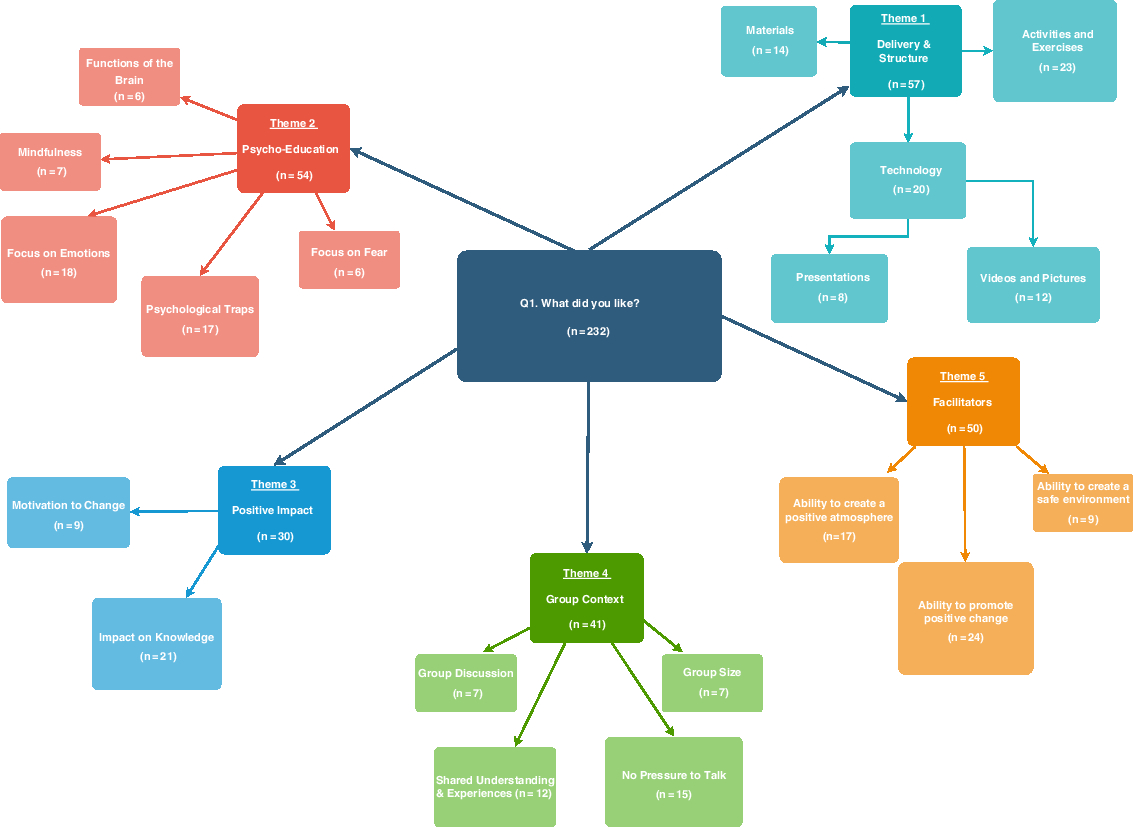
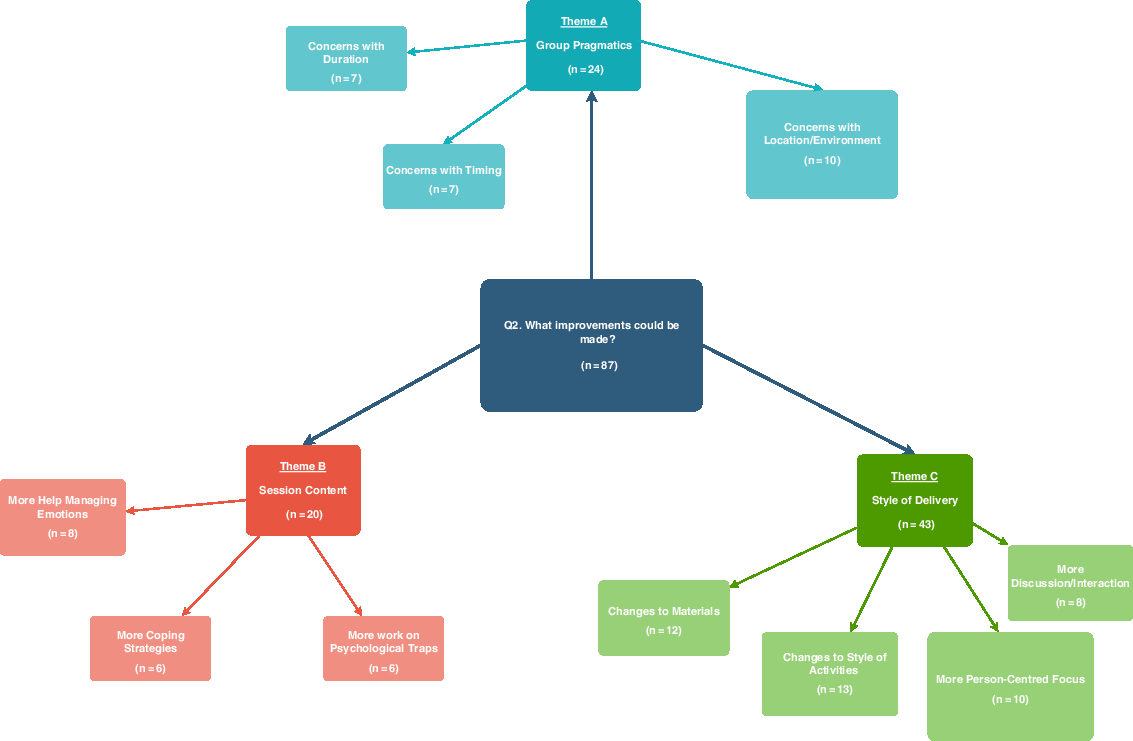
In total, 212 feedback forms were completed by participants. Five themes were identified related to aspects of the intervention that participants liked (Fig. 1), and three themes regarding improvements that participants felt could be made to the workshops (Fig. 2). Each theme was further divided into a number of codes, with the frequency of codes for each theme and sub-theme represented in parentheses (see Figs 1 and 2). The themes and codes related to each of the two questions asked are outlined in more detail below. Overall, participants who provided feedback were positive about the workshops. The aspects of the workshops they reported liking were largely consistent. Suggestions for improvement were more idiosyncratic, often focusing on participants’ specific needs and circumstances.
Themes identified in framework analysis for Question 1: ‘What did you like?’. Numbers in parentheses denote the number of codes relating to each theme or sub-theme.

Themes identified in framework analysis for Question 2: ‘What improvements could be made?’. Numbers in parentheses denote the number of codes relating to each theme or sub-theme.

What did you like about the workshops?
Theme 1. Delivery and structure
Participants reported appreciating various aspects of the way in which the workshops were delivered. The aspects of delivery and structure they liked divided into three codes: ‘Materials’, ‘Activities and exercises’ and ‘Technology’. The ‘Technology’ subtheme was further divided into ‘Presentations’ and ‘Videos and Pictures’. The activities and exercises included in the intervention were the aspect of intervention delivery most frequently commented upon positively by participants, with several stating that they enjoyed that most of the activities were interactive and required them to move around, which kept participants’ attention and enabled them to engage with one another.
Theme 2. Psycho-education
Participants reported liking various aspects of the psycho-education content of the workshops linked to five codes: ‘Focus on emotions’, ‘Psychological traps’, ‘Mindfulness’, ‘Functions of the brain’and ‘Focus on fear’. Work on emotions and feelings, and discussion of ‘Psychological traps’ (diagrammatic cognitive behavioural formulations illustrating problems with different emotions), were the aspects of session content that were most frequently commented upon positively. Several participants spoke of how working on their emotions was the one thing they wanted to focus on, and that they enjoyed how the workshops helped them understand their emotions, before looking at ways they can better manage them. Participants also wrote that discussion of traps was something they enjoyed, had not come across before, and found useful.
Theme 3. Positive impact
Several participants reported that the one thing they liked most about the workshops was the impact or change they had caused. Two codes were identified: ‘Impact on knowledge’ and ‘Impact on motivation to change’. Many participants reported that the workshops had improved their knowledge in some way, including increasing self-understanding, learning new ways to cope and having a greater understanding of psychology in general.
Theme 4. Workshop context
Several participants mentioned positives related to the intervention being delivered in the context of a group. The codes identified were: ‘Group discussion’, ‘Shared understanding and experiences’, ‘No pressure to talk’ and ‘Group size’. A number of participants wrote about liking that the workshop setting allowed them to be open about their experience, without feeling pressured to talk or engage if they did not want to.
Theme 5. Facilitators
Several participants commented on the ability of the facilitators to create a supportive environment. Codes included: ‘Ability to create a positive atmosphere’, ‘Ability to promote positive change’ and ‘Ability to create a safe environment’. Participants commented on various positive qualities of the facilitators that contributed to creating this positive atmosphere, including that they were friendly, encouraging and supportive.
What improvements could be made?
Theme A. Practicalities
Several participants commented with suggestions for improvements to session structure and setting. Codes included: ‘Concerns with duration’, ‘Concerns with timing’ and ‘Concerns with location or environment’. With regard to duration, there were an equal number of comments suggesting that sessions should be longer as comments suggesting they should be shorter. Feedback regarding problems with the location or environment mostly related to chair layout or the room being too warm.
Theme B. Session content
Participants gave a number of suggestions for improvements to session content. Codes included: ‘More help managing emotions’, ‘More coping strategies’ and ‘More work on psychological traps’. Although these codes were evident, there was a large amount of variation in what people suggested for improvements to the workshops. A large majority of responses appeared to be in reference to aspects of the workshops that they found beneficial (such as traps), but wanted more time spent on this, or more information or management techniques moving forward. There were also several participants who suggested improvements specifically related to certain populations. For example, ‘more focus on teenagers/young people’ or ‘some could benefit from autism-related sessions’.
Theme C. Style of delivery
Several participants commented with suggestions for improving how the workshops were delivered. Codes included: ‘Changes to materials’, ‘Changes to style of activities’, ‘More person-centred focus’ and ‘More discussion/interaction’. Most of the suggestions related to participants wanting increased focus on their own personal difficulties and the opportunity to have one-to-one discussions or to seek support for personal goals.
Discussion
The aim of this study was to evaluate the Psychology of Emotions workshops. The workshops were based on evidence-based cognitive behavioural principles, but delivered within a framework of understanding emotion and emotion regulation rather than a framework of diagnosis and illness. Further information about the approach is available in the associated treatment manual (Howells, Reference Howells2018). There were no exclusion criteria, resulting in a diverse sample of young people aged between 16 and 25 years experiencing mild to moderate mental health problems. The study examined rates of attendance, the characteristics of those who were referred and attended, and whether there were changes in self-reported depression and anxiety pre- and post-intervention. Additionally, qualitative feedback provided by those who attended the workshops was reviewed to explore participant views of the intervention. The study has particular strengths in terms of the size and diversity of the sample and the mixed-methods approach.
The primary analysis of clinical outcome found that the subgroup of young people who attended all six sessions experienced a significant decrease in self-reported depression and anxiety over the course of the intervention. The size of the effect was medium for depression and large for anxiety. Of this subgroup, 35.5% were classified as recovered (scored below clinical thresholds for both anxiety and depression) by the end of the intervention. There was also a statistically significant small to medium decrease in both the depression and anxiety scores of those young people who attended at least two sessions. This suggests that the intervention has the potential to be of benefit even for those young people who do not attend all sessions. However, the percentage of young people who attended at least two workshop sessions who were classified as recovered at their last session was smaller (22.0%), highlighting the importance of finding ways to keep young people engaged in order to gain maximum benefit. Qualitative feedback received suggested that many of those who attended felt they had made meaningful gains as a result of attending the workshops.
Clinical implications
These findings are of significant clinical importance. Firstly, they demonstrate that workshops based on cognitive behavioural principles can be delivered effectively to young people without reference to the diagnostic framework; the interventions remain effective within an alternative framework of understanding emotions and emotion regulation. This is important given the problems of the diagnostic model in the context of young people, including problems of reliability, validity and utility (McGorry et al., Reference McGorry, Purcell, Hickie, Yung, Pantelis and Jackson2007), decontextualization (Howells, Reference Howells2018), stigma and self-stigma in the context of developing identity (Patel et al., Reference Patel, Flisher, Hetrick and McGorry2007; Howells, Reference Howells2018), and a focus on illness rather than health. This is the first study that demonstrates initial effectiveness for a completely non-diagnostic form of CBT in such a large and diverse clinical sample. Qualitative feedback also highlighted that young people particularly liked the framework of emotional traps (Howells, Reference Howells2018).
Secondly, the findings also demonstrate that it is possible, within this alternative framework, to deliver a broad intervention, to a sample with a variety of different presentations and demonstrate initial effectiveness of intervention for those that attend. The effect sizes found in this study, with no exclusion criteria, are similar to those in studies of trans-diagnostic interventions (Bilek and Ehrenreich-May, Reference Bilek and Ehrenreich-May2012; Norton, Reference Norton and Barrera2012). This study demonstrates initial effectiveness in a group that may include individuals with difficulties with fear, sadness, anger, and broader emotion regulation.
Limitations
Significant limitations of this study include the high rate of non-attendance and the low rate of completion. Forty-one per cent of the young people invited did not attend any of the sessions, and only 8.1% attended all six sessions. Although this rate of non-attendance is not unusually high [across IAPT services in 2016, 58.9% of referrals did not result in any treatment (NHS Digital, 2017)], it nonetheless raises questions about reasons for non-attendance. Whilst group interventions have been found to be experienced as beneficial by attendees, some people express apprehension at the prospect of group-based treatment (Newbold et al., Reference Newbold, Hardy and Byng2013). Reluctance to engage in group interventions has been attributed to the perceived social stigma attached to mental health problems, and stigma has been identified as one of the main barriers to young people accessing mental health services (Plaistow et al., Reference Plaistow, Masson, Koch, Wilson, Stark, Jones and Lennox2013). Therefore, it is possible that group interventions might have low acceptability for some young people. The qualitative feedback received corroborates this explanation as, while many participants were positive about the group setting and the opportunities this afforded, some also commented that they would have liked more personalized, one-to-one support. The low number of young people attending all six sessions might also be partly accounted for by some young people choosing to attend only those sessions focusing on aspects of emotion they felt were relevant to their specific difficulties. However, very few participants who left qualitative feedback reported that they had chosen not to attend certain workshops because they felt they were not relevant. It is worth remembering that high rates of drop-out from services are also not unusual for young people; one study found that 69% of young people were classified as drop-outs from individual therapy (Baruch et al., Reference Baruch, Vrouva and Fearon2009).
The high rate of non-attendance and low completion rate raises questions about whether there might be differences between those who attend and complete the intervention compared with those who do not. There were no significant differences in gender or age between those who did not attend the workshops and those who attended at least one session. PHQ-9 and GAD-7 scores for participants who did not attend any sessions were not available as measures were collected at the sessions. Therefore, it was not possible to investigate whether there were differences in the initial scores of those who did not attend the workshops compared with those who did attend. However, there was no significant difference in the initial PHQ-9 and GAD-7 scores of the young people who completed all six sessions and those who did not, suggesting that completion of the intervention was not influenced by initial symptom severity.
Unfortunately, it was not possible to determine whether there were any differences between non-attendees, attendees and completers in terms of their presenting difficulties. The population invited to attend the workshops was diverse and heterogeneous, but it is possible that those with particular difficulties might have found the content more helpful than others. This is a particularly important limitation in light of the assertion that the intervention might be helpful for a diverse population and deserves further investigation in future studies.
Another significant limitation concerns the restriction of data collection to routinely collected data within the workshops. This means that data (both quantitative and qualitative) are unavailable for those who did not attend the workshops, are only partially available for those who did not complete, and are completely unavailable for longer-term follow-up. As a result, it is not possible to exclude the possibility that the change in anxiety and depression scores observed was caused by factors other than participation in the Psychology of Emotions workshops. It is also not possible to determine the impact of the intervention on longer-term functioning. The qualitative data collected were also limited as not all those who attended a workshop session provided feedback, and the data collection method used did not facilitate rich understanding of participant experiences. Finally, the quantitative measures used are diagnostic in nature, which is potentially problematic for evaluating the impact of a non-diagnostic intervention. Although it does ensure consistency with other studies and IAPT services nationally (NHS Digital, 2017), research with a more robust design and additional measures would be needed in order to isolate the effect of the Psychology of Emotions workshops and more fully understand how they are experienced by young people.
In summary, the current study suggests that the Psychology of Emotions intervention is an effective treatment option for young people with mild to moderate mental health difficulties seen within IAPT services. On average, young people who complete the intervention experience large reductions in self-reported anxiety and moderate reductions in depression. Those young people who attend at least two sessions also experience significant improvements in both anxiety and depression scores. This supports the provision of this intervention within IAPT services for young people. This is particularly important given the non-diagnostic position taken in the workshops, and demonstrates initial effectiveness for an approach based on understanding emotions rather than illness. Given high rates of non-attendance, further investigation is needed to understand the factors that determine whether or not a young person attends sessions and the individual benefits gained. This would allow the intervention to be more effectively targeted at those most likely to benefit, with the potential to increase the cost-effectiveness of intervention delivery. Better understanding reasons for non-attendance might also allow modifications to be made to make the Psychology of Emotions intervention appealing and accessible to more young people, thereby potentially improving outcomes.
Acknowledgements
The authors would like to thank Dr Nicola Martin, Glyn Bannon-Ryder and Dr Peter Cairns for their work developing the workshops. They are also grateful to staff of the Norfolk Youth Wellbeing Team for their role in organizing and running the workshops, in particular to Linda Simpson.
Conflicts of interest
Authors A.R., B.G., T.C., B.C., S.H., C.O. and J.W. have no conflicts of interest with respect to this publication. L.H. was involved in developing the Psychology of Emotions intervention and associated treatment manual (Howells, Reference Howells2018) but has no other interests with the potential to bias the research.
Financial support
This research received no specific grant from any funding agency, commercial or not-for-profit sectors.
Ethical approval
Ethical approval for the study was granted by the Faculty of Medicine and Health Sciences Research Ethics Committee at the University of East Anglia (reference no. 20161741). Authorization to conduct the study as a service evaluation was granted by the host NHS Trust following internal review. The research abided by the Ethical Principles of Psychologists and Code of Conduct as set out by the APA.



Comments
No Comments have been published for this article.