INTRODUCTION
Ancient trash has always been an essential resource for archaeologists. It is indicative of the kinds of practices that took place in the past, and its context helps us better understand the function of specific spaces. Although refuse is often used as a lens for better understanding everyday lives and mundane practices of people from the past, it is now widely acknowledged that trash, dirt, and other “matter out of place” can take on symbolic forms (Douglas Reference Douglas1966). Trash is increasingly recovered from sacred contexts in Mesoamerica, sometimes in ways that indicate that it was not merely a byproduct of ritual practices but a central component of them (Brown Reference Brown2000; Clayton et al. Reference Clayton, Driver and Kosakowsky2005; Navarro-Farr Reference Navarro-Farr2009, Reference Navarro-Farr, Iannone, Houk and Schwake2016; Walker Reference Walker and Boteler-Mock1998).
Using the central Mexican site of Xaltocan as a case study, this paper explores how Xaltocan's Middle Postclassic (a.d. 1240–1350) leaders defined and outlined sacred spaces. Specifically, archaeological excavations have revealed that during this period of political florescence ceramic fragments were sometimes used to mark or outline elite ritual spaces. This might indicate that Xaltocan's leaders believed that ceramic fragments—a variety of objects typically characterized as trash—could be transformed into something sacred. This practice might be related to the Nahua concept of tlazolli, which is used to define physical refuse as well as a wide variety of moral transgressions. Despite its negative connotations, tlazolli was not inherently corrupted and when properly harnessed it might have been useful for energizing sacred spaces (cf. Burkhart Reference Burkhart1989:97; Hamann Reference Hamann2008:807). While ethnohistorical (Alva Ixtlilxochitl Reference Alva Ixtlilxochitl and O'Gorman1975–1977) and archaeological data (Brumfiel et al. Reference Brumfiel, Salcedo, Schafer, Hodge and Smith1994) indicate that during the Middle Postclassic period Xaltocan was ruled by people that were ethnically Otomi—not Nahua—the concept of tlazolli, or something like it, might have been widely shared across the region. If the Postclassic leaders of Xaltocan had some concept of tlazolli, then perhaps by reordering ceramic fragments and arranging them in and around their ritual spaces they were imbuing them with special power and marking them as sacred.
TRASH AND SACRED CONTEXTS IN MESOAMERICA
Trash might be defined as an object or set of objects that are divorced from their original form, used up, or worn out. Common examples of trash recovered in Mesoamerica include ceramic fragments, animal bones, botanical remains, crafting debitage, charcoal, and ash from household hearths, as well as other damaged or broken objects. Trash is commonly recovered in domestic middens or swept along the edges of buildings and settlements. While trash is often discarded in ways that clearly mark it as unwanted refuse, it is also sometimes recovered from sacred contexts. These contexts are extremely variable and reflect a great deal about the role trash might have played in creating and delineating sacred spaces in Mesoamerica.
For example, broken objects that might ordinarily qualify as trash are commonly recovered from ritual deposits in Mesoamerica. Such deposits, sometimes referred to as “problematical deposits” (Iglesias Ponce de León Reference Iglesias Ponce de León1988), are composed of an array of artifacts indicative of refuse (such as those objects listed above) as well as those suggestive of ritual behavior (Newman Reference Newman2015:117). Such deposits include those associated with termination rituals, which were intended to kill animate objects and architecture to make way for something new (Mock Reference Mock1998; Stuart Reference Stuart and Houston1998). Termination deposits are typically composed of broken vessels and other fragmented materials that might correspond to burning or destructive events (Stanton et al. Reference Stanton, Brown and Pagliaro2008:228, 242). While the individual objects contained within termination deposits were not necessarily sacred unto themselves, collectively, and in the context of the ritual, they were made so.
Other examples of ritual deposits include those associated with the New Fire Ceremony. New Fire deposits have been recovered across Mesoamerica but are most commonly associated with the Postclassic Highlands of Mesoamerica. Like termination deposits, they are composed of broken vessels and other common variants of household refuse and are indicative of sacred rites. It was believed that the disposal of old and used up things was necessary to successfully end the previous 52-year calendrical cycle and start the new. Thus, New Fire deposits typically contain an array of household items and are similar to trash deposits in terms of their contents. Unlike trash middens, however, the contents of New Fire deposits can often be reconstructed and appear to have been dumped all at once (De Lucia Reference De Lucia2014:389; Elson and Smith Reference Elson and Smith2001:159). These deposits are full of objects perceived as “used up” and therefore not suitable to carry over into the new calendar cycle. The objects incorporated into New Fire deposits, like those in termination deposits, are made sacred through ritual practice.
In the cases outlined above, trash was made sacred by the context in which it was created or used. In other instances, however, trash appears to have had specific meaning or history that rendered it symbolically significant unto itself (Overholtzer Reference Overholtzer2015:95). This was probably the case with trash that was intentionally incorporated into socially meaningful places such as building walls. In coastal Oaxaca, Joyce et al. (Reference Joyce, Bustamante and Levine2001) recovered fragments of Classic-period carved stone monuments that were incorporated into Early Postclassic building walls (see also Joyce and King Reference Joyce and King2001; Urcid and Joyce Reference Urcid and Joyce2001:202, 204, 212). Joyce and colleagues argue that placing the fragments of once-powerful monuments into their house walls was an act of “denigration of sacred objects, symbols, spaces and buildings by commoners” (Joyce et al. Reference Joyce, Bustamante and Levine2001:361). I would argue that this could also reflect an attempt to harness the sacred energy bound up in ancient monuments and to transform it into something newly meaningful.
A similar example of the incorporation of trash into socially significant spaces comes from Xaltocan, where a single carved stone block with plaster and a large metate fragment were incorporated into an Early Postclassic commoner house wall made of adobe (De Lucia Reference De Lucia2011:135). Both objects might be interpreted as trash given their fragmentary nature. The stone block with plaster likely came from an elite context, whereas the origin of the metate fragment is unknown and may or may not have elite origins. The incorporation of these objects might reflect an attempt by the house's residents to infuse some of the meaning bound up in these objects into the structure of their house. In particular, incorporating the faced stone with plaster into an adobe wall might have been intended to tie the house's residents to local political elites.
The above examples demonstrate that in Mesoamerica objects that might typically qualify as trash—particularly fragmentary objects—could be socially meaningful or even sacred. Archaeologically identifying sacred trash, as distinct from mundane trash, however, is relational and dependent on the context in which it is found and how it was deposited. While the methods of trash deposition are diverse, I propose two main processes by which trash ends up in scared contexts: incidental processes and deliberate processes. Incidental processes of deposition include instances in which trash is simply left behind or disposed of in or near its place of use after sacred rites take place. Such categories of deposition might include primary and de facto refuse (Schiffer Reference Schiffer1976). In these instances, trash is indicative of sacred or ritual activities, but the way it is deposited does not indicate that the trash held special significance outside of the context of the ritual or that the processes of its deposition were part of the ritual. Examples of incidental deposition might include ash piles scattered on top of or near spaces where burning rites took place (Elson and Smith Reference Elson and Smith2001:161) or ceramic fragments and animal bones disposed of in middens adjacent to spaces where ritual feasts were held (Brumfiel et al. Reference Brumfiel2006; LeCount Reference LeCount2001; Smith et al. Reference Smith, Wharton, Olson and Bray2003). In both instances trash might be reasonably categorized as sacred, or at least ritually significant, because it was made for and by ritual practices. In these instances, however, trash might be better understood as a byproduct of ritual rather than a central component of it.
On the other hand, deliberate processes of deposition are those in which objects contained within sacred spaces, including trash, were intentionally placed there, presumably because they held special significance or because they provide evidence for practices that were central to the sacredness of the place or the associated ritual. Deliberate processes of deposition indicate that trash was intentionally incorporated into the ritual and that the trash, or the processes of making and placing the trash, were integral to the ritual—not merely byproducts of it. This process was certainly the case with trash that was deliberately incorporated into building walls at Xaltocan. This may also have been the case with the termination deposits and New Fire deposits. In both instances, the production and deposition of trash is a central component of the ritual. The ceramic fragments and other broken objects contained within these deposits were key implements, without which the ritual might not have been successful.
The processes by which trash was incorporated into sacred spaces reflect how it was made meaningful by ancient peoples. In particular, deliberate processes of deposition reveal that in certain circumstances trash was imbued with sacred energy. Although trash deposition was socially meaningful for peoples across Mesoamerica (Hutson and Stanton Reference Hutson and Stanton2007), the Nahua concept of tlazolli is a particularly useful concept for exploring this phenomenon in greater depth.
TLAZOLLI
Tlazolli is a Nahua concept that literally translates to “old or worn out thing.” Molina (Reference Molina1571:118v) described it as the rubbish that Nahuas threw on a dung heap, while Burkhart (Reference Burkhart1989:88) defined it as “little bits and pieces of things, which might once have belonged somewhere but…have become formless and unconnected.” It was anything useless, used up, or otherwise divorced from its original structure. Objects that might be categorized as tlazolli included “rags, potsherds, cobwebs, dust, mud, straw or grass, charcoal, disheveled hair, excrement, urine, vomit, nasal mucus, sweat, pus, coagulated semen, niter or salt-peter, the dregs of pulque—anything of unpleasant odor, of rotten or formless composition” (Burkhart Reference Burkhart1989:88).
Although tlazolli is generally equated to trash or filth, it might be better understood as a force or essence imbued in objects that have been separated from their original structure or condition—objects that were broken, swept away, or disposed of. As a force, tlazolli was both dangerous and powerful (Klein Reference Klein1993:20) because impurities had the potential to contaminate the world and inflict both physical and spiritual harm. Fear of tlazolli is reflected in the Nahua emphasis on cleanliness and order. In pre-Hispanic central Mexico, women were responsible for maintaining an unpolluted home, and frequently swept in and around their houses to remove tlazolli and to ensure the health of their families. Folio 60r of the Codex Mendoza (Berdan and Anawalt Reference Berdan and Anawalt1992:161) contains the image of a 12-year-old girl who is overseen by her mother as she sweeps. Duran (Reference Duran1971:134) also commented on indigenous women rising at dawn to sweep in and around their homes, and Sahagún (Reference Sahagún and Sullivan1997:bk. 1, p. 75) listed sweeping among the most significant tasks of central Mexican women.
Frequent sweeping in and around the house kept living spaces more sanitary and likely prevented the spread of illness, but cleanliness was also important for maintaining spiritual order. Thus, ritual spaces were also swept, and according to Burkhart (Reference Burkhart, Schroeder, Wood and Haskett1997:32) “just as the housewife had to be constantly vigilant to maintain cleanliness and order, so did the priests in their temples.” Folio 62r of the Codex Mendoza (Berdan and Anawalt Reference Berdan and Anawalt1992:173) contains the images of a series of priests, one of whom is depicted with a broom in hand. The accompanying text states that the priest “has the duty of sweeping” (Berdan Reference Berdan and Anawalt1992:172). In Primeros memoriales, Sahagún (Reference Sahagún and Sullivan1997:bk. 1, pp. 88, 126, bk. 3, p. 201) also writes at length about the frequency of ritual sweeping, which often required priests to wake before dawn.
The practice of sweeping was so sacred that even gods were depicted doing it. According to legend, the goddess Coatlicue was sweeping the temple at the top of Coatepec (Snake Hill) when a floating ball of feathers—an entity that might be categorized as tlazolli—impregnated her (Carrasco Reference Carrasco1999:74–75). The child she later bore, Huitzilopochtli, went on to be one of the most revered gods in the Aztec pantheon and the patron deity of the capital city of Tenochtitlan. Thus, the act of sweeping—clearing spaces of tlazolli—was so central to Nahua society that it was an integral practice of commoner women, priests, and goddesses. The significance of sweeping and cleaning speaks to the deep fear that central Mexicans had for tlazolli and its potential physical and spiritual impacts.
Despite the dangers associated with it, tlazolli was not inherently bad. As a potent spiritual force, tlazolli could also be manipulated by central Mexicans to create or outline desired ritual states (Burkhart Reference Burkhart1989:97). Tlazolli was a frequent product of certain kinds of rituals, particularly the well-known New Fire Ceremony that occurred every 52 years in correspondence with the duration of the combined 365-day and 260-day calendars. The New Fire Ceremony was a reenactment of the mythical event that resulted in the creation of the current age—the Fifth Sun. According to Nahua myth, after previous ages had ended apocalyptically, the gods gathered with the intention to start the world anew. They drilled a new fire in a sacred hearth and offered sacrifices to the flames, resulting in the rising of the new sun (Carrasco Reference Carrasco1999; Elson and Smith Reference Elson and Smith2001; Hamann Reference Hamann2002, Reference Hamann2008; Taube Reference Taube, Carrasco, Jones and Sessions2000). To reenact this myth, central Mexicans extinguished fires across the land to mimic the predawn darkness. It was not appropriate for objects belonging to a previous age to be carried forward into the next one. As vestiges of the old world they would be anachronistic or “matter out of time” (Hamann Reference Hamann2008:806). Thus, in preparing for the ceremony, people disposed of household goods, swept away flecks of soot and dirt, and disposed of trash and debris not intended to be carried forward into the new age. Sahagún (Reference Sahagún, Anderson and Dibble1950–1982 [1547–1579]:bk. 7, ch. 12) depicts an indigenous man discarding a variety of goods including ceramic jars and bowls, a god image, hearthstones, and a woven box in preparation for the ceremony. Through the proscriptive disposal of household objects, the New Fire Ceremony resulted in the creation of tlazolli. Although the New Fire Ceremony is perhaps the best known, it is far from the only central Mexican ritual that involved tlazolli.
In some instances, ritual spaces were marked using tlazolli. Monaghan (Reference Monaghan2000:33–36) has noted that bits of trash, ranging from crushed insects to ash to the various bodily fluids and debris left behind after sacrifices, made the walls of temples sacred. The construction of Mesoamerican temples also incorporated tlazolli by capping old structures and previous construction rubble with new layers. The Aztec Templo Mayor, for example, was constructed and then reconstructed six times in its less than 200-year life span. Using this building method, “a new shell of stone would contain (and harness) the dangerous, used-up power of its predecessors” (Hamann Reference Hamann2008:807). The practice of incorporating tlazolli into sacred spaces persisted well into the colonial period with numerous sixteenth-century churches containing fragments of pre-Hispanic pottery and stone idols (Reyes-Valerio Reference Reyes-Valerio1978). The deliberate incorporation of tlazolli into ritual contexts indicates that it was a powerful and sacred substance.
Tlazolli was not only a force attributed to inanimate objects, it was also manifested through acts of moral impurity or sin. While analogizing tlazolli and sin has been criticized as a European reading of a Mesoamerican concept, both López Austin (Reference López Austin, Ortiz de Montellano and Ortiz de Montellano1993:66) and Carrasco (Reference Carrasco1999:18) have argued that the broad definition of sin is not unique to Christianity and aligns well with the Mesoamerican concept of wrongdoing. Moral transgressions were not taken lightly among the Nahuas, as they were viewed as potentially damaging to society (Klein Reference Klein1993:24). In fact, social status and especially poverty, illness, and powerlessness were often attributed to immoral actions.
Although tlazolli might be used to describe a wide range of moral wrongdoings, it seems to be particularly tied to sexual transgressions, especially adultery or breaking vows of abstinence. These crimes were serious, and among Aztec nobility they were punishable by death (Klein Reference Klein1993:21). One of the most evocative Aztecs myths, that of the departure (or expulsion) of Topiltzin Quetzalcoatl from Tollan, involves such a transgression. According to legend, the god Tezcatlipoca tricked Topiltzin Quetzalcoatl into getting drunk and losing his judgement. As a result of his drunkenness, Topiltzin Quetzalcoatl neglects his ritual duties and has sex with his older sister. Upon waking and learning of his transgressions, Topiltzin Quetzalcoatl leaves the Tollan in shame, ultimately resulting in the city's downfall (Carrasco Reference Carrasco1999:16–18). As penance and for the good of his people, Topiltzin Quetzalcoatl sacrifices himself. This legend served as a moral guide for nobles and rulers to avoid the activities—particularly excessive drinking—that might lead to poor judgement, neglect of ritual obligations, and sexual offenses.
Acts of moral wrongdoing and sexual transgressions were linked to a collective of female moon deities (Klein Reference Klein1993:21). Principal among these deities was the powerful Tlazolteotl, known as the goddess of filth (literally, “divine filth”). Tlazolteotl was known as the patroness and protector of adulterers but also the consumer of carnal sins (Carrasco Reference Carrasco1999:20; Quiñones Keber Reference Quiñones Keber1995:179–181). Although Tlazolteotl was linked to the physical impurities and moral transgressions of the world, she was also responsible for the processes that transformed them into something good (Klein Reference Klein1993:22). These processes might have included decomposition, which transformed garbage and excrement into humus (tlazollalli) and revitalized the earth (Sullivan Reference Sullivan, Boone and Benson1982:15). They also included spiritual transformation or atonement, which neutralized the negative consequences brought on by moral failings (Carrasco Reference Carrasco1999:15).
Given her curative or corrective powers, Tlazolteotl was the goddess called upon in rituals of ablution or atonement. According to Sahagún (Reference Sahagún, Anderson and Dibble1950–82 [1547–1579]:bk. 1, pp. 23–24), “she heard all confessions, [and] she removed corruption.” Atoning for moral transgressions was one of the only means for staving off the natural and supernatural threats brought on by licentious behavior. Left unaddressed, moral transgressions could cause physical harm or death to the wrongdoer, but also to those connected to him or her. By confessing one's transgressions and performing penance, the moral transgressions of an individual could be transformed or converted, thereby restoring equilibrium. Thus, like tlazolli, which was shunned yet sacred, Tlazolteotl was the patroness of wrongdoers and yet the key to neutralizing their transgressions. Together, these concepts highlight a fundamental principle of the Mesoamerican worldview—elements that have the power to disrupt health and harmony also have the power to restore them (Klein Reference Klein1993:25).
Thus far, tlazolli has been explored as a broad Nahua concept, belonging to the people that inhabited much of the Basin of Mexico during the Late Postclassic. Nahuatl speakers included the Mexicas who ruled over the massive Aztec empire at the time of the Spanish conquest. Evidence for whether some concept of tlazolli was shared by non-Nahuatl speaking groups, especially in the centuries prior to the founding of the Aztec empire, is still poorly understood. The recent discovery of Middle Postclassic (a.d. 1240–1350) ritual remains at the site of Xaltocan in the northern Basin of Mexico, however, provide evidence for the use of ceramic fragments, or tapalhcatl, to outline sacred spaces. This could indicate that other central Mexican peoples, including the Otomi leaders of Xaltocan, may have also believed that trash could be imbued with sacred energy.
ARCHAEOLOGY AND HISTORY OF XALTOCAN
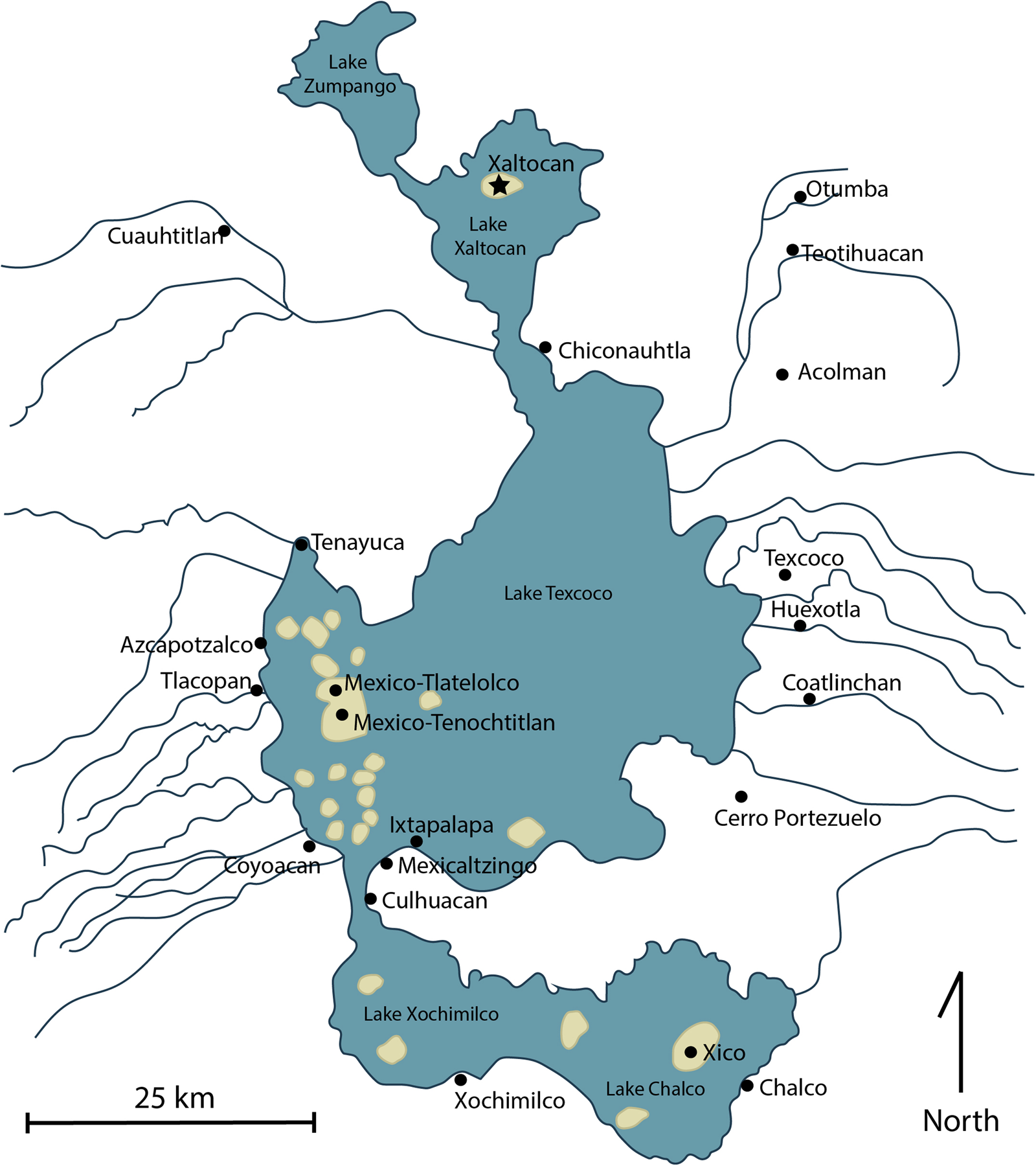
Built atop an anthropogenic island in the brackish Lake Xaltocan, the Postclassic town of Xaltocan is located in the northern Basin of Mexico (Figure 1). Ethnohistorical sources suggest that Xaltocan was founded by the tenth century (Alva Ixtlilxochitl Reference Alva Ixtlilxochitl and O'Gorman1975–1977:vol. I, pp. 293, 423, vol. II, p. 299; Barlow Reference Barlow1949) but archaeological data have indicated that people were living on the island at least a century earlier (Brumfiel Reference Brumfiel and Brumfiel2005a:Table 2.1). Xaltocan rose to power as the capital of the Otomi city-state between the eleventh and twelfth centuries (Alva Ixtlilxochitl Reference Alva Ixtlilxochitl and O'Gorman1975–1977:vol. I, pp. 293, 423, vol. II, p. 299; Barlow Reference Barlow1949; Bierhorst Reference Bierhorst1992; Hicks Reference Hicks, Marcus and Zeitlan1994) and reached its political peak between roughly a.d. 1200 and 1350 (Bierhorst Reference Bierhorst1992; Nazareo de Xaltocan Reference Nazareo de Xaltocan and Troncoso1940).
Map of the Postclassic Basin of Mexico.

By the second half of the fourteenth century, after centuries of autonomy and relative political prominence, Xaltocan was in decline. Persistent conflict with neighboring polities resulted in the erosion of its once-expansive domain and in a.d. 1395, neighboring polity Cuauhtitlan, allied with the powerful Tepanecs of Azcapotzalco, conquered Xaltocan. Ethnohistorical accounts suggest that after the conquest, Xaltocan's residents were forced to flee, leaving the island largely abandoned. Archaeological research, however, has demonstrated that at least some of Xaltocan's commoner residents stayed behind (Overholtzer Reference Overholtzer2012, Reference Overholtzer2013). In a.d. 1427, Xaltocan was incorporated into the newly formed Aztec Triple Alliance, and in a.d. 1435 Acolman, Colhua, Tenochca, and Otomi tribute payers were sent by the Aztec state to resettle the island (Bierhorst Reference Bierhorst1992:104; Hicks Reference Hicks, Marcus and Zeitlan1994). While the ethnohistorical record conveys a neat, if overly simplistic, narrative of Xaltocan's pre-Hispanic history, archaeological research has provided a more detailed understanding of the lives and practices of Xaltocan's Postclassic inhabitants.
Based on archaeological research initiated in the late 1980s, Brumfiel (Reference Brumfiel and Brumfiel2005b) proposed an initial ceramic chronology which has been modified over the last three decades. The most recent chronology (created by Overholtzer [Reference Overholtzer2012] and verified by Morehart and Frederick [Reference Morehart and Frederick2014]), divides the Postclassic into three phases: Early Postclassic (a.d. 920–1240), Middle Postclassic (a.d. 1240–1350), and Late Postclassic (a.d. 1350–1521) (Table 1). The Early and Middle Postclassic periods correspond to Xaltocan's political autonomy as the capital of the Otomi city-state, while the Late Postclassic period corresponds to when Xaltocan was under the control of the Aztec empire.
Xaltocan ceramic chronology. Adapted from Overholtzer (Reference Overholtzer2012:Table 4.4).

This refined ceramic chronology, combined with extensive archaeological data, has allowed archaeologists to understand a great deal about how the lives and practices of the people that lived at Postclassic Xaltocan changed over time. Until recently, however, this research has focused primarily on the everyday productive activities of Xaltocan's commoners (Brumfiel Reference Brumfiel and Brumfiel2005c; De Lucia Reference De Lucia2011; Morehart Reference Morehart2010; Overholtzer Reference Overholtzer2012; see also Rodríguez-Alegría [Reference Rodríguez-Alegría2010] for Colonial period). The nature of rulership and the relationship that Xaltocan's leaders had with their local subordinates are still poorly understood. This considerable imbalance of archaeological knowledge is attributable to the fact that Xaltocan has been continuously occupied since the Postclassic and many of the site's earliest remains—especially the remains of buildings and spaces inhabited by Xaltocan's elites—are buried beneath modern structures.
Although archaeological and ethnohistorical evidence indicates that Xaltocan's pre-Hispanic leaders likely resided near the modern-day plaza (Brumfiel Reference Brumfiel and Brumfiel2005a; Rodríguez-Alegría Reference Rodríguez-Alegría2010:56–57), many archaeological investigations have focused on spaces located near the site's periphery where modern Xaltocan still remains largely undeveloped (Morehart Reference Morehart2010; Overholtzer Reference Overholtzer2012). One notable exception is a house that has been dated to the Early and Middle Postclassic and was located east of Xaltocan's modern plaza. Excavations of the house recovered the remains of high-quality adobe walls and stucco floors (De Lucia Reference De Lucia2011), and artifacts that were of marginally higher quality than those recovered from commoner contexts elsewhere at Xaltocan. These findings indicate that the house's residents may have been wealthier or of higher status than the average Xaltocan resident and support the hypothesis that wealthier members of the community lived close to the center of town. It also appears these wealthy or high-status individuals used high-quality architecture to differentiate themselves from other residents (Farah Reference Farah2017:126; Rodríguez-Alegría Reference Rodríguez-Alegría2010:56– 57).
Although previous archaeological research has provided an abundance of new and insightful information about the everyday practices of Xaltocan's Postclassic inhabitants, it has not facilitated a thorough understanding of the nature of political leadership at the site. Only recently were archaeological excavations undertaken at an elite context at Xaltocan with the intent of better understanding the everyday practices of its Postclassic leaders.
EXCAVATIONS AT CERRITO CENTRAL
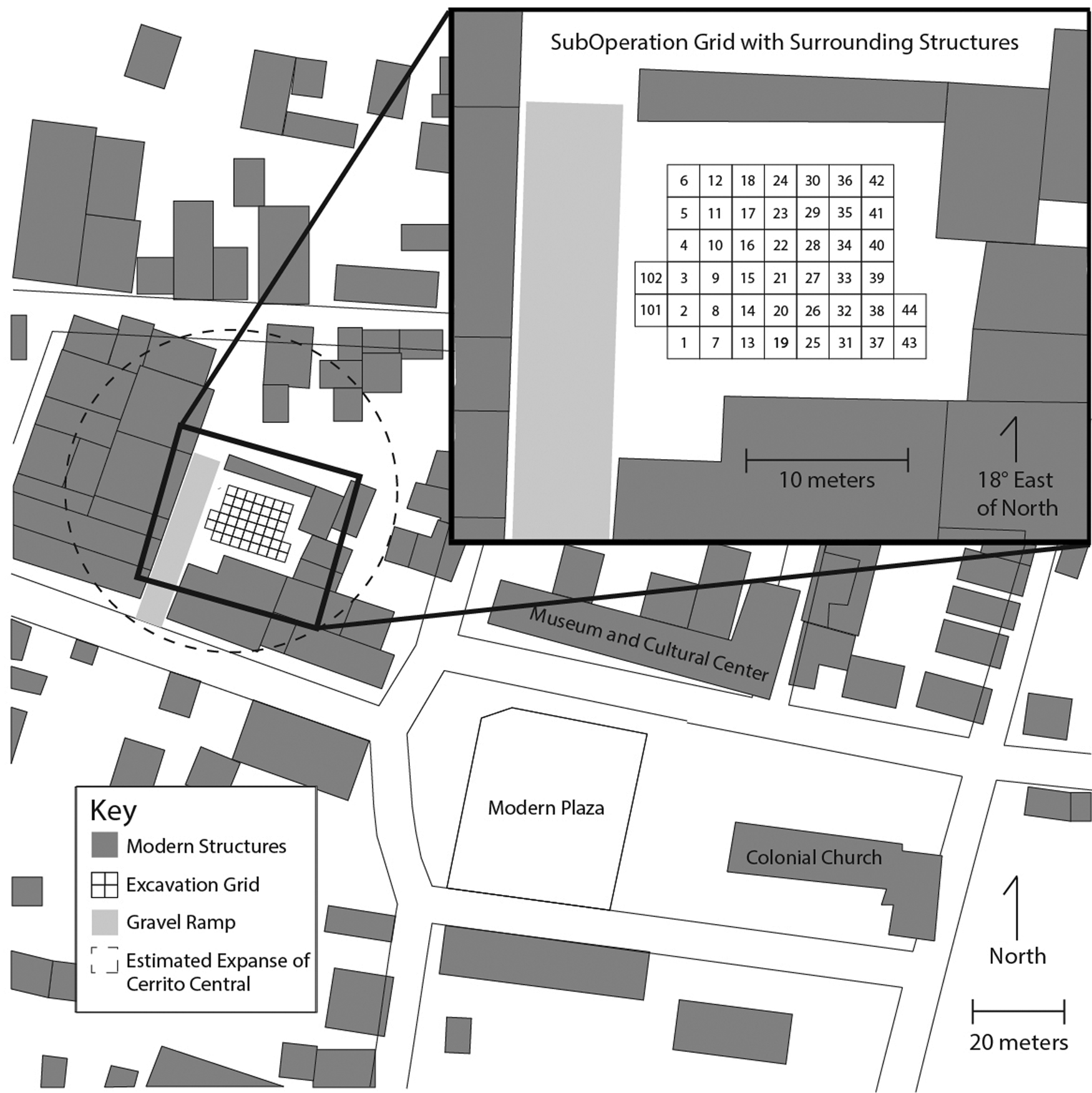
Between July 2014 and December 2015, I directed excavations at a mound located west of the current town square of Xaltocan (Figure 2). This mound, Cerrito Central, was targeted for excavation because of its conspicuous location, in especially close proximity to Xaltocan's seventeenth-century church, and for its relative size and elevation. These factors have long led archaeologists to suspect that Cerrito Central might have been the location of Xaltocan's Postclassic palace. Despite a lengthy history of archaeological research at Xaltocan, Cerrito Central had not yet been excavated because the mound is largely covered by modern structures leaving only a limited area exposed.
Map of Cerrito Central and excavation grid.

Confronted with the same obstacles as previous researchers, the horizontal scope of the excavations at Cerrito Central were limited to only a small area (approximately 200 m2). A pedestrian survey revealed that Cerrito Central might have been as large as 70 m across (an area of approximately 3,800 m2). Thus, the excavation area represents about only five percent of the total area of the mound. Units, measuring 2 × 2 m, were excavated horizontally in 10-cm increments. This controlled excavation process resulted in the recovery of three successive civic and residential structures dating to the Postclassic period.
Early Postclassic Construction Phase
The earliest construction phase recovered through excavations has been dated to the Early Postclassic (a.d. 900–1240), and was probably constructed sometime in the late eleventh century a.d. Although this construction phase dates to early in Xaltocan's history, it may not represent the earliest construction at Cerrito Central. A series of limitations, including safety concerns, made it impossible to excavate deeper than 3.5 m on the mound. It is possible that there was earlier construction at Cerrito Central, perhaps dating to as early as the site's initial occupation in the ninth century a.d.
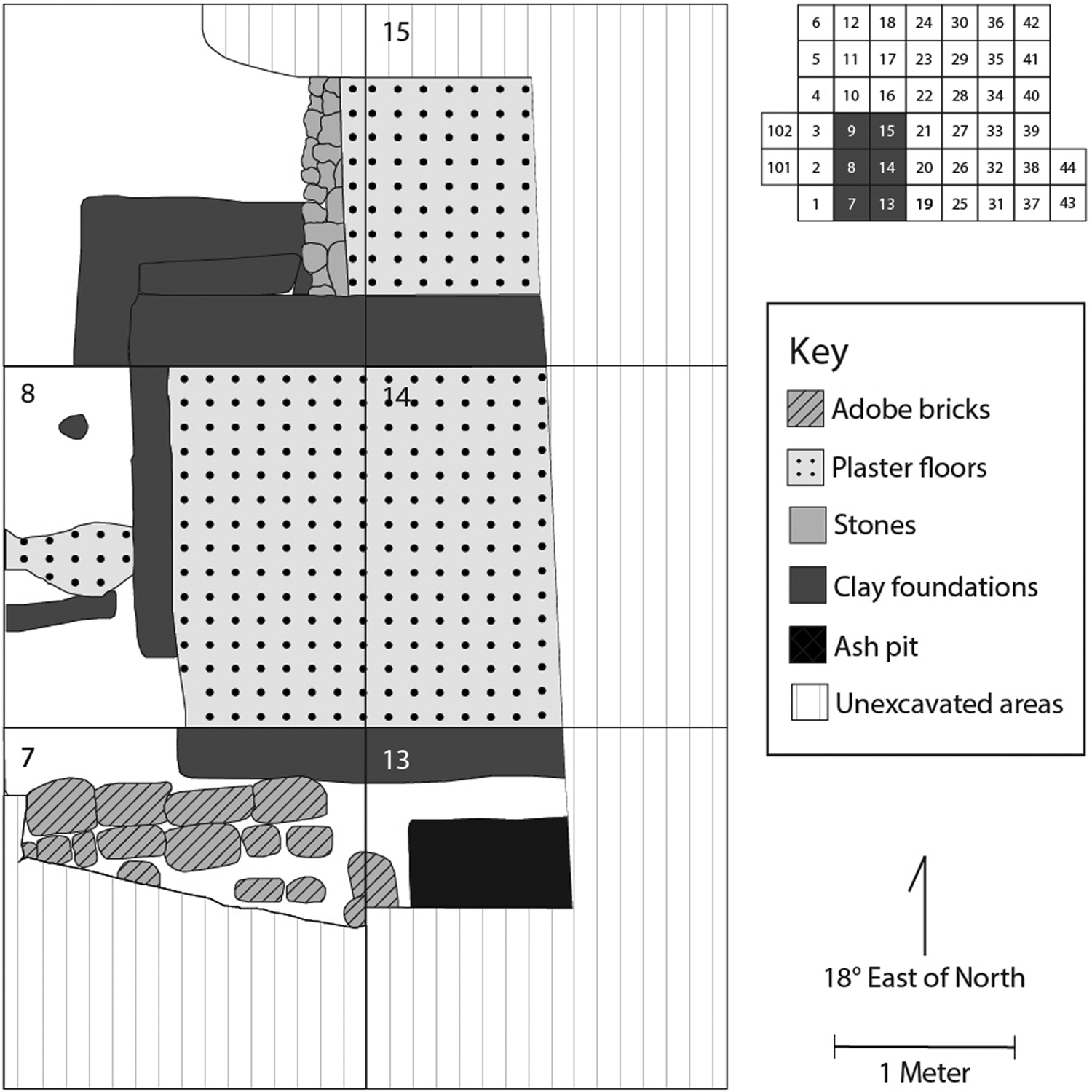
The portions of Early Postclassic architecture that were recovered include a small room, measuring approximately 2 × 2 m in area (Figure 3). The room walls were constructed with uniform adobe bricks placed atop clay foundations—a common architectural convention at this time. The floor was made of plaster laid atop a thin layer of tezontle (porous volcanic stone) gravel. Remnants of other rooms with plaster floors were also recovered. The presence of plaster floors indicates that the people living at Cerrito Central during the Early Postclassic probably occupied a higher socioeconomic status than the majority of Xaltocan's inhabitants. Although there is some evidence for the use of plaster floors elsewhere at Xaltocan during the Early Postclassic (De Lucia Reference De Lucia2010, Reference De Lucia2014), compacted dirt floors are far more common during this time period (Espejel Reference Espejel and Brumfiel2005).
Plan map of Early Postclassic architecture at Cerrito Central.

The Middle Postclassic Construction Phase
The second construction phase at Cerrito Central was initiated at the end of the Early Postclassic (ca. a.d. 1200) and continued to be used and renovated throughout the Middle Postclassic (a.d. 1240–1350). This building episode corresponds to Xaltocan's political apogee as the autonomous capital of the Otomi city-state. As part of the construction project, all earlier architecture at Cerrito Central was dismantled and buried under a thick layer of materially rich fill, which consisted of large quantities of various artifacts and contained particularly high quantities of both plain and red-painted stucco. These stucco fragments may have come from walls and floors that were destroyed during the construction process. Stucco fragments have not been recovered in this density elsewhere at Xaltocan and is a clear indicator of the relative quality of architecture at Cerrito Central compared to other buildings in the community.
The process of demolishing earlier architecture and filling the space it left behind elevated Cerrito Central by nearly one meter. Then, as part of the same construction program, the fill was capped with an expansive adobe platform. The adobe platform likely served multiple purposes including raising and leveling the surface of the mound as well as creating an elevated base for subsequent structures. It is possible that the adobe platform was covered in a stucco façade. Over 1,300 stucco fragments were recovered from the fill surrounding the platform, about 150 of which contained red paint. Unfortunately, none of these fragments were found directly adhered to the surface of the platform (in situ), so this hypothesis is difficult to confirm.
A structure was built atop the adobe platform, but unfortunately the architecture was badly damaged in many areas due to intrusive pits and subsequent construction projects. Nevertheless, a small room and a patio space—both of which appear to have been used primarily for ritual purposes—were recovered mostly intact. These spaces contained a variety of ritual features and implements, including altars, a hearth, and a ritual deposit.
Sometime during the late fourteenth century a.d., Cerrito Central appears to have been briefly vacated. This abandonment may correspond to the reported conquest of the island that occurred at the hands of Cuauhtitlan in a.d. 1395. After being unoccupied for a period of perhaps 40 years (based on ethnohistorical accounts), people returned to Cerrito Central. They razed the Middle Postclassic architecture and constructed new and dramatically different buildings.
Late Postclassic Construction Phase
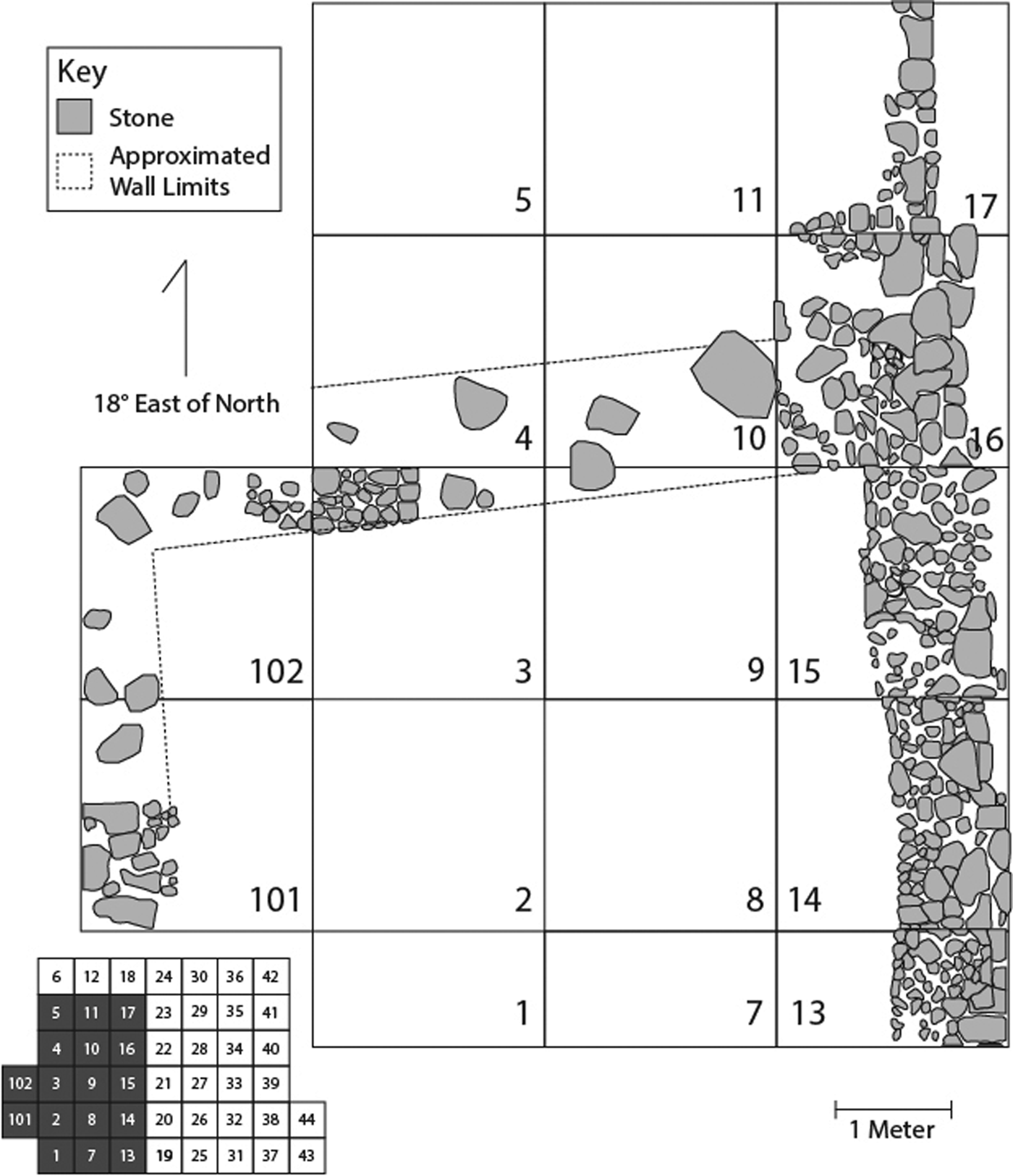
The final Postclassic construction event at Cerrito Central was initiated during the Late Postclassic (a.d. 1350–1521), likely sometime in the early decades of the fifteenth century a.d. after Xaltocan was incorporated into the Aztec empire. Unfortunately, this Late Postclassic architecture was also badly damaged by modern processes, especially construction of modern buildings. Despite the damage, what remains represents a significant divergence from earlier architectural conventions. Wall foundations recovered from this period were roughly three times larger than those recovered from earlier phases (Figure 4). They were about one meter wide and were constructed from large stones (many of which measured over 30 centimeters in diameter). Room sizes were also much larger than previous structures, measuring as much as eight meters across in certain areas. Although the function of the Late Postclassic structure is unclear, the dramatic shifts in architectural style suggest the presence of new leadership and may also reflect better access to stone which was a relatively scarce building material in previous construction phases.
Plan map of Late Postclassic architecture at Cerrito Central.

Generally speaking, the architecture recovered at Cerrito Central is distinctive from architecture recovered elsewhere at Xaltocan, and observations of the changes over time support the hypothesis that it was a place of great political importance for the majority of the Postclassic. While many of the architectural features described above warrant a more intensive study, the focus of the current paper is the ritual features and implements constructed and utilized during the Middle Postclassic period.
MIDDLE POSTCLASSIC RITUAL FEATURES AND IMPLEMENTS AT CERRITO CENTRAL
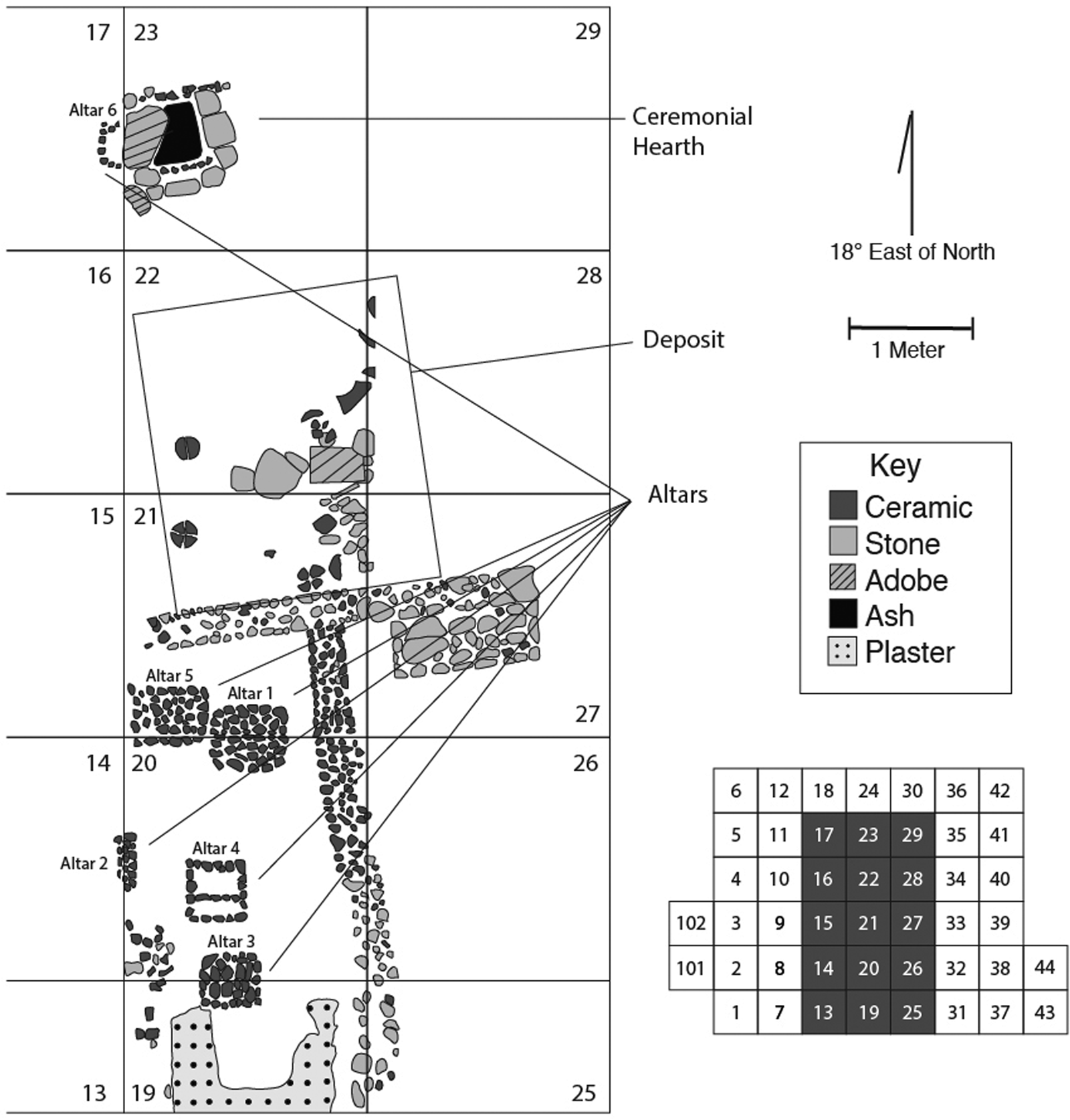
The Middle Postclassic ritual features and implements recovered at Cerrito Central reflect a range of practices that occurred over an approximately 100-year period. Two primary ritual spaces were recovered (Figure 5), the first of which contains the earliest evidence for ritual practice; a small room 3 × 4 m in area. This room was defined by a series of low-lying wall foundations that were approximately 30 centimeters wide and composed of several courses of small (approximately 15 centimeters in diameter) stone cobbles. These wall foundations were lined along the top with deliberately placed ceramic fragments (Figure 5), a construction technique that has not been observed elsewhere in the Basin of Mexico. The ceramic fragments used to line the wall foundations came from a variety of vessels including ollas (jars), comales (flat cooking griddles), plates, and bowls. Most of the sherds came from utilitarian cooking and serving ware, with only a handful from decorated vessels (Table 2). The diversity of the ceramic fragments, which could not be reconstructed, indicates that they may have been randomly scooped out of a trash midden, perhaps chosen based on their size or shape—most fragments are flat and smooth. It does not appear that the original purpose of the sherds, nor their cohesiveness as objects of common origin, played any role in their selection. Nevertheless, the deliberateness with which they were placed along the tops of the wall foundations in one, single layer suggests that their role was either functional or symbolic, perhaps both.
Plan map of Middle Postclassic ritual spaces at Cerrito Central.

Ceramic fragments recovered from the surface of Middle Postclassic wall foundations.

a Includes two plates, one molcajete (grinding bowl), and one unknown form (possibly a serving dish).
b Plate fragment.
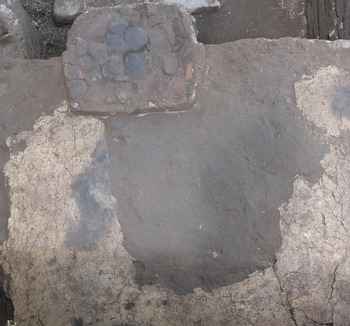
Ceramic fragments were also used as construction media on the interior of the room where a series of five altars were recovered. These altars, defined as such because of their apparent function as ritual surfaces, were constructed by pressing sherds into the surfaces of packed earth and stucco floors (Figure 6). Altars were approximately 50 × 50 centimeters and were roughly square-shaped, raised merely a few centimeters off the floor. Like the lining of the wall foundations, the altars were constructed using a wide array of sherds that appear to come from mostly utilitarian vessels (Table 3). The altars were successive (never contemporaneous) but do not directly overlap each other. It appears that as floors were resurfaced, altars were buried along with the floors they sat atop. When the new floor was built, a new altar was constructed atop it, but was deliberately moved to not overlap with the previous altar.
Altar 3 built into plaster floor.

Ceramic fragments recovered from Middle Postclassic altars.

a Only some fragments (approximately 20 percent) were excavated because the remainder of the feature was under the Late Postclassic wall, which was left intact.
b Two rim fragments of the same Black-and-White-on-Red bowl.
c One fragment was from Aztec II Black-on-Orange plate and one fragment was a Black-and-White-on-Red bowl rim.
d Only some fragments were excavated because the remainder of the feature was under the ceremonial hearth, which was left intact.
The altars were probably used for rituals that involved the burning of incense in portable containers. Sherds from ceramic braziers and censers were recovered from the fill surrounding the altars. In some instances, these fragments could be reconstructed, suggesting that burning vessels might have been destroyed and left in situ after use. Many of the altars contained thin layers of ash along their surfaces, which might have been dumped out of burning vessels at the end of rituals. There is no evidence that fires were lit directly atop the altars.
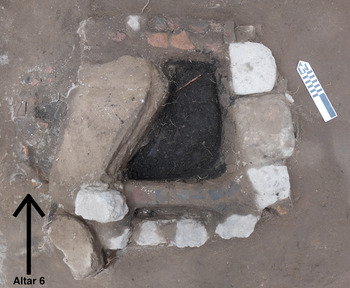
The second ritual space was located about two meters north of the room in what appears to be an outdoor patio space (Figure 5). Ritual remains recovered from the patio included a sixth altar, which was constructed in the same manner as the previous five—with ceramic sherds pressed into a compacted dirt floor (Figure 7). Stratigraphy indicates that the patio altar was constructed after the final altar in the room to the south, suggesting that ritual practices may have been intentionally moved out of the room and into the nearby patio space.
Altar 6 and ceremonial hearth.
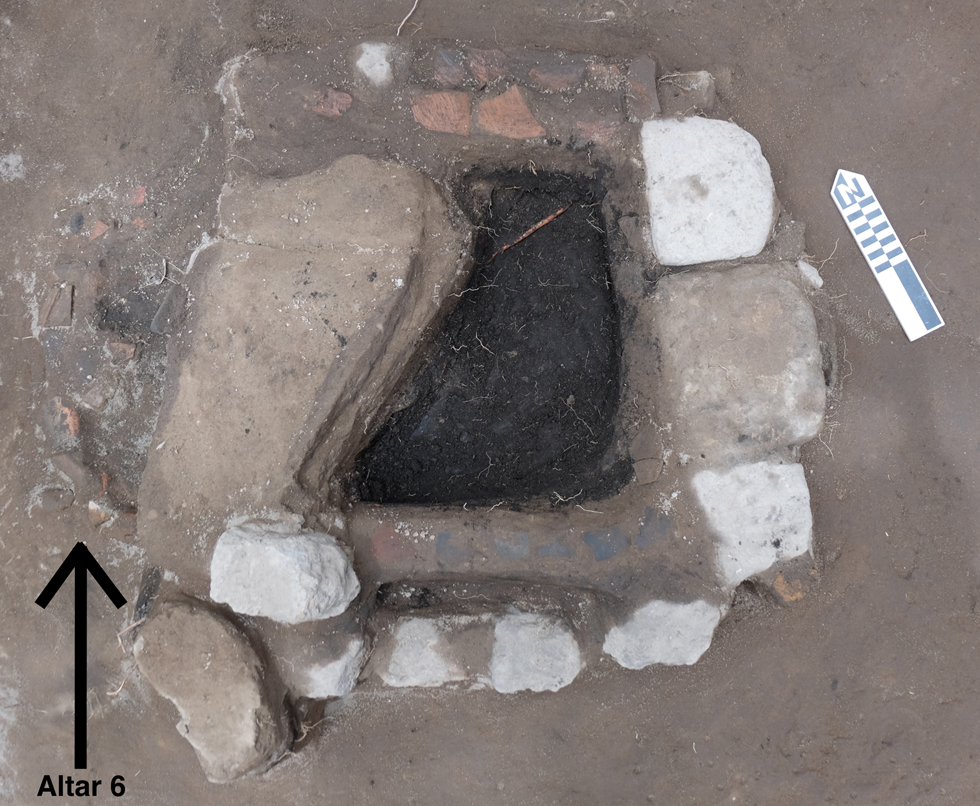
Built atop the altar, and overlapping it slightly, was a large hearth (Figure 7) constructed of a combination of adobe bricks and stone. Sherds lined the hearth across its northern and southern edges. Like the ceramic fragments used to construct the altars and to line the wall foundations, the pieces on the hearth came from a variety of utilitarian vessels. Also like the altars, the ceremonial hearth might have been used for burning rituals or perhaps a single burning event. A black soil matrix peppered with hundreds of small charcoal pieces lined the interior of the hearth. This composition indicates that unlike the altars, the hearth probably housed an open fired. The hearth has been deemed ceremonial in nature because of its high-quality construction, relatively large size (approximately 70 × 70 cm), and its association with a large ritual deposit.
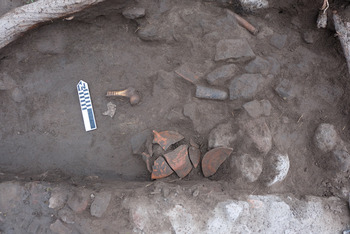
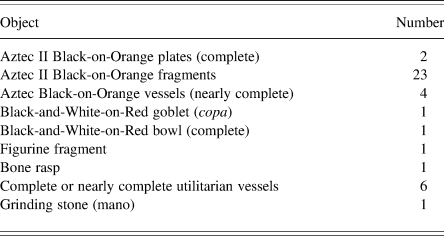
The deposit, which is stratigraphically associated with the hearth, was located north of altar room (Figure 8) and just south of the hearth. The deposit contained the remains of numerous ceramic vessels, including decorated Aztec II Black-on-Orange plates, ollas and molcajetes (grinding bowls). All these vessels were broken, though many could be fully reconstructed, suggesting that they were deposited whole. The deposit also included a broken bone rasp, a mano (grinding stone), and a figurine fragment (Table 4). Large stones were intermixed with the deposit and may have been used to mark it. The hearth and ritual deposit were among the last significant features recovered from the Middle Postclassic occupation.
Ritual deposit.

Objects recovered from Middle Postclassic ritual deposit.

The Middle Postclassic ritual features at Cerrito Central were split between two contexts. Five of the altars were recovered from the interior of a small room that was presumably private. Given the size of the room (approximately 3 × 4 meters), it is unlikely that more than 10 people could have comfortably fit inside it at the same time. This size indicates that the rituals performed inside the room were attended by only a select group of people who were perhaps high-ranking political and religious leaders in the community. The private nature of this ritual space might also indicate that the performances contained within the room were not geared toward the public.
The sixth altar, the ceremonial hearth, and the ritual deposit were all recovered from a patio space that was more public than the room. While it is unclear how many people might have been able to access the patio space, it is possible that it would have been visible across much of the town given its relative elevation. It is difficult to determine whether walls or other features might have obstructed its visibility. All these ritual features, beginning with the sixth altar and ending with the ceremonial hearth and deposit, were created after the final fifth altar was constructed in the private room. The chronology of these two spaces and their proximity might indicate that practices were intentionally moved from the room to this new, more public space.
Although the ritual features recovered in the altar room and patio differed in terms of time of use, accessibility, and associated paraphernalia, a common thread across ritual features was that they all contained ceramic fragments. Ceramic fragments were used to construct all six altars, were placed along the northern and southern edges of the ceremonial hearth and were found along the surfaces of the wall foundations of the altar room. Large quantities of ceramic fragments were also recovered in the ritual deposit—though these fragments were likely created when the objects were dumped. The presence of ceramic fragments in all these ritual contexts suggests that Xaltocan's leaders used them to outline or energize ritual space. While it is unclear why sherds were used for this purpose, it is possible that Xaltocan's leaders recognized ceramic fragments as potentially powerful or sacred, and perhaps even conceived of them as tlazolli.
DISCUSSION
Given the significance of tlazolli in Nahua ideology, it is possible that Otomis living in Xaltocan between approximately a.d. 1200 to 1400 had a similar reverence for refuse. While linguistically and ethnically distinct, the Otomi residents of Xaltocan lived and worked in close proximity to Nahuas. Although Xaltocan is affiliated with the Otomis, the island residents were probably ethnically diverse and likely included Nahuas. Furthermore, people living in Xaltocan during the Middle Postclassic participated in the same trade networks as their Basin of Mexico peers, and Xaltocan's leaders formed marriage alliances with the rulers of Nahua polities (Nazareo de Xaltocan Reference Nazareo de Xaltocan and Troncoso1940). This willingness to interact and even merge families across ethnic lines for the purposes of economic and political gain indicates that ethnic affiliation did not create significant barriers between Postclassic central Mexican groups. In fact, given the multiethnic nature of the Basin of Mexico during the Postclassic, it is completely possible that there were many Nahuas living in Xaltocan during the Middle Postclassic as there were Otomis.
Thus far, archaeological research has been unsuccessful in procuring substantial material evidence supporting major cultural differences between the Nahua groups living in Postclassic central Mexico and the Otomis of Xaltocan. The most intensive research on the topic focused on the use of lip plugs at Xaltocan, which according to ethnohistorical documents were affiliated with Otomi ethnic identity (Berdan Reference Berdan, Berdan, Chance, Sandstrom, Stark, Taggart and Umberger2008:118; Berdan and Anawalt Reference Berdan and Anawalt1992:64r; Boone and Nuttall Reference Boone and Nuttall1983:vol. I, p. 38; Codex Borbonicus Reference Borbonicus1974:28). Brumfiel and colleagues (Reference Brumfiel, Salcedo, Schafer, Hodge and Smith1994) found that there were higher frequencies of rod-shaped lip plugs recovered at Xaltocan during the Early and Middle Postclassic periods than during the Late Postclassic period. This drop off in the frequency of lip plugs might be linked to a decrease in the Otomi population at Xaltocan that presumably occurred between the Middle and Late Postclassic when Cuauhtitlan conquered Xaltocan, causing many of its original inhabitants to flee. Beyond this study, most archaeological research has indicated that people living at Xaltocan participated in many of the same productive and ritual practices as their Nahua counterparts.
Participation in Nahua practices and adherence to certain Nahua beliefs might have been as much a result of constant interaction and intermarriage as it was a strategic choice on the part of Xaltocan's rulers. Similar strategic choices were employed by the nearby Tlaxcallans as they resisted Aztec rule in the late centuries of the Postclassic. While Tlaxcallan was a Nahua state, their system of political organization was much different than that of their Aztec counterparts as they opted for a more egalitarian or collective system of rulership. To ideologically support their preferred method of collective leadership, Tlaxcallans selected aspects of Nahua myth and history that supported their political choices and rejected those that conflicted (Fargher et al. Reference Fargher, Blanton and Espinoza2010). Thus, selective adoption and rejection of cultural beliefs and practices based on what best served local agendas is a possible explanation for the adoption of the Nahua concept of tlazolli by the thirteenth-century rulers at Xaltocan.
If the residents of Middle Postclassic Xaltocan did have some concept like tlazolli, then the presence of ceramic fragments in ritual contexts might reflect an attempt to energize ritual space. This argument does hinge on the idea that the ceramic fragments recovered from these contexts could be considered tlazolli. Ceramic fragments, while certainly divorced from their original structure were probably not inherently trash, especially given the frequency with which they were reused for a variety of purposes (Deal Reference Deal1985; Hayden and Cannon Reference Hayden and Cannon1983; Sullivan Reference Sullivan1989). These particular ceramic fragments, however, could neither be refitted nor appear to have been reshaped or reused prior to being placed in their ritual context. Outside of their ritual context, these ceramic fragments are indistinguishable from those that might have been recovered from any ordinary trash pit at Xaltocan. Thus, characterizing these fragments as trash or possibly tlazolli seems a fair assessment.
Tlazolli was a powerful substance and harnessing its power may have imbued the spaces it was used to define with that power. Perhaps by reordering the ceramic fragments to outline ritual spaces, they were transformed into something differently powerful. The idea that through human actions ceramic fragments could be transformed from something negative (trash) to positive (sacred energy) is consistent with Nahua beliefs regarding the transformative nature of tlazolli. Indeed, this seems to be what happened at Cerrito Central.
The variety of ritual contexts in which ceramic fragments were utilized at Cerrito Central provides ample evidence for their ideological significance. Perhaps the most straightforward evidence for ceramic fragments marking ritual space comes from the ceramic altars. These altars were distinctive from altars found elsewhere at Xaltocan, which were typically made of either square-cut stones (De Lucia Reference De Lucia2011, Reference De Lucia2014) or elevated, clay surfaces covered in plaster (Brumfiel Reference Brumfiel2010). Despite the structural differences, given the ash and burning implements associated with the altars, there is little doubt as to their function as ritual surfaces.
Further, and perhaps more compelling, evidence for the use of ceramic fragments to outline ritual space comes from the wall foundations that surrounded the room with the altars. Unlike the altars, the sherds used to line the wall foundations would not have been visible. They would have been hidden beneath the adobe walls that were presumably constructed atop them. As energized objects however, their visibility was not necessary for them to imbue spaces with power. As previously noted, it was common for Mesoamericans to incorporate vestiges of the past, including a variety of objects that might have qualified as tlazolli, into their religious and domestic structures (Overholtzer Reference Overholtzer2015). The ceramic fragments embedded in the wall foundations may reflect similar intentions.
During the second half of the thirteenth century, and for reasons that remain unclear, the altar room appears to have fallen into disuse and ritual practices that once took place in the room were moved to a more public patio space to the north. Both stratigraphic and radiocarbon data support this chronology. The last altar constructed inside the altar room was buried under a compacted dirt floor that appears to continue outside the room into the northern patio, underlying later ritual features. Although these two floors (inside the altar room and outside on the northern patio) are not contiguous, they may have been constructed at the same time and with the same materials. Furthermore, a radiocarbon sample recovered from the last altar constructed inside the altar room was dated to cal a.d. 1154–1269 (692 ± 31; AA106194; wood charcoal; δ13C = −24.2). A sample taken from the hearth in the exterior patio dated to cal a.d. 1264–1312 (833 ± 35; AA106198; wood charcoal; δ13C = −9.9). These date ranges support the proposed chronology of the ritual spaces.
Like the wall foundations and altars recovered from inside the room, the more recent patio space contained ritual features composed of or decorated with ceramic fragments, apparently marking them as ritually significant. In particular, the hearth provides compelling evidence for the symbolic weight of ceramic fragments. Unlike the altars, the ceramic fragments laid along the northern and southern edges of the hearth were not integral to the structure of the hearth. They do however connect the hearth materially and symbolically to the altars, including the sixth altar, which it directly overlies (Figure 7).
Together with the ritual deposit, the ceremonial hearth may have been constructed for a New Fire Ceremony—a ceremony that frequently resulted in the creation of tlazolli. It is interesting that if the ceremonial hearth and ritual deposit were created as part of a New Fire Ceremony, they were also the final ritual features recovered at Cerrito Central. While it is tempting to speculate about the various reasons this practice may have been abandoned, without a more expansive investigation of Cerrito Central it is difficult to remark with any confidence that the practice ended altogether. It is also plausible that ritual practices simply moved once again to a new space.
The combined evidence for ceramic fragments used in ritual contexts at Cerrito Central supports the argument that they were used to delineate ritual spaces. Furthermore, given the apparent similarities in lived experience and ideology of the peoples living across the Basin of Mexico, there is a possibility that Otomi leaders at Middle Postclassic Xaltocan had some concept similar to the Nahua concept of tlazolli. Ceramic fragments (tapalhcatl), which were among the most common form of refuse at Xaltocan, would have certainly fallen under this category if it indeed existed.
The significance of tlazolli as a physical and moral substance had broad implications. It was an inherently powerful substance, but it was also linked to the powerful goddess of filth and atonement, Tlazolteotl. The Aztecs would give confession to Tlazolteotl as she was responsible for absolving them of the guilt of their sins. These ritual confessions were conducted in private spaces, often in the home, and only involved the sinner and the priest (Carrasco Reference Carrasco1999:23, 27). It is possible that if the ceramic fragments used to define ritual spaces at Cerrito Central were conceptualized as tlazolli then they were also associated with the goddess Tlazolteotl (or perhaps a similar goddess). If this was the case, then the ritual spaces recovered at Cerrito Central might have been associated with rituals of atonement and renewal.
Five of the six recovered altars were found in a private room that might have been an ideal setting for ritual confessions. According to Carrasco (Reference Carrasco1999:27), before a new ritual confession was conducted, the space was thoroughly cleaned, and new ritual implements were used—presumably so that the new space would be pure. This practice could account for the multiple floor resurfacing events, which also resulted in the construction of new altars. Futhermore, confession rituals were often associated with the burning of incense—albeit a common ritual practice—and there is ample evidence that similar burning activities occurred atop the altars.
As rituals that initially took place inside the altar room were moved to a more public patio space, rituals may have become less about personal atonement and more about communal ablution and renewal (Carrasco Reference Carrasco1999:27). If this was the case, then it is not surprising that sherds were also used to mark the ceremonial hearth. Although technically different, rituals of confession and atonement overlapped ideologically with the New Fire Ceremony in terms of overall objective. Both rituals were aimed at transformation and renewal. Their purpose was to destroy the negative or tainted objects and actions of the past to make way for a new and purer state of being.
On a final note, it is worth mentioning that, excepting ritual deposits, there is no evidence for the use of ceramic fragments in ritual contexts elsewhere at Xaltocan. Evidence for such practices have thus far been recovered only at Cerrito Central, and may therefore represent an exclusively elite practice. Certainly, ceramic fragments were a widely accessible medium at Xaltocan and could be found in any trash pit. Thus, commoners could have easily incorporated ceramic fragments into their ritual spaces, unless the practice was prohibited or unknown. It is possible that the practice was associated with knowledge or beliefs that were possessed only by Xaltocan's leaders or that ritual significance of ceramic fragments did not apply to Xaltocan's commoners. It is also possible that commoners may have chosen not to reuse fragments in this way. Whatever the reason for this disparity in the use of ceramic fragments in ritual contexts at Xaltocan, it speaks to the ways in which the goals, experiences, and worldviews of Postclassic leaders may have differed from their constituents and vice-versa.
Further, while there is certainly evidence for the use of multiple forms of tlazolli in ritual contexts across the Basin of Mexico at this time, the specific way in which ceramic fragments were incorporated into ritual contexts at Cerrito Central has not been observed elsewhere in the Basin of Mexico. This includes the deliberate and careful placement of ceramic fragments along wall foundations and the construction of altar surfaces using only ceramic fragments pressed into floors. Thus, while it remains plausible that Xaltocan's leaders may have incorporated ceramic fragments into ritual contexts in order to energize them with the power of tlazolli, the exact way in which they did so was distinctive. Perhaps, this was an invention of Xaltocan's leaders that did not spread.
CONCLUSIONS
The ritual features and implements recovered at Middle Postclassic Cerrito Central indicate that Xaltocan's leaders used ceramic fragments to mark or outline a variety of ritual spaces. Although it remains unclear why ceramic fragments were used in these contexts, it is certainly possible, given the sacred nature of the spaces in which they were used, that they were also conceived of as sacred elements. In fact, they may have been conceived of as tlazolli, or divine filth, and as such were considered energetically charged. If this was the case, then the reordering of the sherds in an orderly manner might be tied to the notion of duality inherent in the concept of tlazolli. In its natural form, tlazolli was inherently chaotic, disorganized, or out of place, but by reordering it Xaltocan's leaders may have also been harnessing the negative energy of tlazolli and transforming it to something equally powerful, but positive.
Among the Aztecs, tlazolli and the goddess Tlazolteotl were associated with moral transgressions but also with confession and atonement. If Xaltocan's leaders were in fact incorporating tlazolli into their ritual spaces, then perhaps the associated rites were concerned with confession, purification, and renewal. The nature of the ritual practices is difficult to decipher from material remains given that many of the features are associated with burning rituals, which were fairly common in central Mexico at the time. The ceremonial hearth, however, which is also associated with a ritual deposit, could have been used for a New Fire Ceremony. Although the New Fire Ceremony is not explicitly tied to confession or atonement for personal sins, it is associated with notions of renewal and involved the destruction of old and worn out vestiges of the past.
Although material evidence for tlazolli has been found in ritual contexts throughout Mesoamerica, the deliberate and orderly integration of ceramic fragments has not yet been observed elsewhere. Even at Cerrito Central, there is evidence that the practice endured for only a little over a century, and it does not appear to have spread throughout the community. Perhaps the practice was unique to Xaltocan's leaders and prohibited or not known or accepted by the wider community. It may have also been tied to the unique Otomi or even Xaltocameca identity of Xaltocan's leaders—explaining why it is not observed elsewhere in the Basin of Mexico. Whatever the reason, the practice of neatly realigning ceramic fragments to outline ritual spaces at Cerrito Central represents an esoteric but deliberate and socially meaningful action.
RESUMEN
Este papel examina el uso de fragmentos cerámicos para marcar espacios de rituales en el posclásico sitio de Xaltocan en México central. Excavaciones recientes han recuperados una serie de artefactos y rasgos arqueológicos—incluyendo una serie de altares, un fogón ritual, y un depósito—de un contexto élite que fecha al periodo posclásico medio de Xaltocan. Todos de estos rasgos arqueológicos incorporaran fragmentos cerámicos en su forma y su diseño, sugestionado que cerámica fragmentada podría haber ser usado para delinear espacios rituales. Yo comento que el significo es relacionado al concepto de tlazolli. Aunque tlazolli es generalmente definido como basura o roñía, también ha sido asociado malas acciones morales, especialmente transgresiones sexuales. A pesar de sus connotaciones negativas, tlazolli era una fuerza poderosa que los mexicanos, potencialmente, podían manipular para dar energía a espacios rituales. Yo comento que los lideres posclásico de Xaltocan usaban fragmentos cerámicos, tal vez conceptualizado como tlazolli, para delinear espacios rituales y marcarlos como lugares sagrados. La incorporación de fragmentos cerámicos en contextos rituales (con la excepción de depósitos en común) no han observado en otra parte en Xaltocan, y tal vez representa una práctica exclusivamente elite en este sitio.