Introduction
Chronic rhinosinusitis is characterised by persistent inflammation of nasal cavity and sinus membranes, with a duration of more than 12 weeks. Chronic rhinosinusitis has become a common health problem, with significant morbidity, which affects the general health of affected individuals and increases medical costs.Reference Bachert, Zhang, van Zele and Gevaert 1 Chronic rhinosinusitis is divided into two subtypes: chronic rhinosinusitis with nasal polyps and chronic rhinosinusitis without nasal polyps. Chronic rhinosinusitis without nasal polyps usually manifests as fibrous and type 1 T helper cell biased inflammation,Reference Akdis, Bachert, Cingi, Dykewicz, Hellings and Naclerio 2 whereas chronic rhinosinusitis with nasal polyps has a more complex pathogenesis. Although the exact origin of chronic rhinosinusitis with nasal polyps remains unclear, aetiological factors including allergy, infection, inflammation, anatomical abnormality, genetic nature, bacterial superantigens and biofilm are involved.Reference Muñoz-Del-Castillo, Jurado-Ramos, Soler, Fernández-Conde, Barasona and Cantillo 3
Systemic allergy has been considered an important cause of chronic rhinosinusitis with nasal polyps. Currently, it is considered one of several aetiological factors, especially in Caucasians.Reference Kennedy and Borish 4 Several studies have found that 63–66.3 per cent of chronic rhinosinusitis with nasal polyps patients test positive in skin prick tests assessing reactions to airborne allergens,Reference Asero and Bottazzi 5 , Reference Erbek, Erbek, Topal and Cakmak 6 but this association remains controversial.Reference Collins, Loughran, Davidson and Wilson 7 Recently, the presence of local allergy in the nasal cavity was found in a number of patients diagnosed previously with non-allergic rhinitis.Reference Rondón, Romero, López, Antúnez, Martín-Casañez and Torres 8 , Reference Wierzbicki, Majmundar, Schull and Khan 9 This new form of rhinitis with ‘entopy’ or local allergic rhinitis manifests as elevated allergen-specific immunoglobulin E (IgE) to local allergens in the nasal membrane, and shows positivity in nasal allergen provocation testing without evidence of systemic allergy.Reference Rondón, Canto and Blanca 10 In a previous study, we demonstrated the existence of local allergic rhinitis in Chinese patients with non-allergic rhinitis.Reference Cheng, Xu, Liu and Wang 11 However, few studies have described local allergy in chronic rhinosinusitis with nasal polyps patients. Therefore, this study investigated the pathogenic role of local allergy in Chinese chronic rhinosinusitis with nasal polyps patients.
Staphylococcus aureus, a common organism in the nasal cavity, is closely associated with acute sinusitis. S aureus enterotoxins are considered superantigens that modify airway inflammation, and are known aetiological factors in chronic rhinosinusitis with nasal polyps patients.Reference el-Fiky, Khamis, Mostafa Bel and Adly 12 The S aureus enterotoxins can activate a large number of T and B cells, and trigger an eosinophilic inflammatory reaction and local polyclonal IgE formation. These IgEs are specific to many airborne allergens. S aureus enterotoxins can increase local IgE levels and be an aetiological factor of chronic rhinosinusitis with nasal polyps, similar to local allergy. In this study, we describe the role of S aureus enterotoxins in Chinese patients with chronic rhinosinusitis with nasal polyps.
Chronic rhinosinusitis with nasal polyps can be divided into two subgroups: eosinophilic and non-eosinophilic, according to the inflammatory cell infiltration.Reference Ikeda, Shiozawa, Ono, Kusunoki, Hirotsu and Homma 13 The subgroups have different clinical features, therapeutic strategies and prognoses. Therefore, subgroup designation is important for the correct diagnosis and treatment of chronic rhinosinusitis with nasal polyps patients. Hence, this aspect was investigated in the current study. We proposed that local allergy might be one pathogenesis of chronic rhinosinusitis with nasal polyps, and have no association with S aureus enterotoxins.
Materials and methods
Subjects
This study included a total of 36 chronic rhinosinusitis with nasal polyps patients (22 males and 14 females; mean age, 43.9 years), who underwent endoscopic sinus surgery in our hospital from May to June 2013. The diagnosis of chronic rhinosinusitis with nasal polyps in each patient met the guidelines from the European position paper on rhinosinusitis,Reference Fokkens, Lund, Mullol, Bachert, Alobid and Baroody 14 and was confirmed by post-operative pathological results. Patients who had used nasal or oral corticosteroids, or decongestants and antihistamines, within the previous four weeks, were excluded from this study. The duration of chronic rhinosinusitis with nasal polyps in patients ranged from 6 months to 40 years. Computed tomography (CT) scans were scored according to the Lund–MacKay criteria.Reference Lund and Kennedy 15
The control group consisted of turbinate tissues obtained during septoplasty or sinus cystectomy from 18 control subjects with no history of allergic disease.
This study was approved by the local ethics committee. Each patient provided written informed consent before participating.
Supernatant of nasal tissue homogenate
All nasal tissues (polyps and turbinates) were collected at the time of surgery and stored immediately in liquid nitrogen. Specimens were processed as previously described.Reference Zhang, Van Zele, Perez-Novo, Van Bruaene, Holtappels and DeRuyck 16 First, specimens were thawed in saline (0.1 g in 1 ml) and processed in a tissue homogeniser. Then, the suspensions were centrifuged for 5 minutes at 3000 revolutions per minute. The supernatants were collected and stored on ice prior to analysis.
Phadiatop test, total immunoglobulin E and eosinophil cationic protein levels
Allergen-specific IgE levels were measured in vitro using the Phadiatop™ test, which included most common aeroallergens. The total IgE and eosinophil cationic protein levels were determined using the UniCAP100 automated allergy testing system (Pharmacia Diagnostics, Uppsala, Sweden), according to the manufacturer's instructions.Reference Cheng, Xu, Liu and Wang 11 The cut-off value of the allergen-specific IgE assay was set at 0.35 KU/l, the normal range of total IgE in the serum was 0–100 KU/l and the normal range of serum eosinophil cationic protein was 4–20 µg/l.
Staphylococcal enterotoxin A and B specific immunoglobulin E, staphylococcal enterotoxin A and B, and myeloperoxidase levels
Staphylococcal enterotoxin types A and B specific IgE levels in the supernatant were measured using the UniCAP100 automated system. The cut-off value was set at 0.35 KU/l. Staphylococcal enterotoxin types A and B levels were measured using an enzyme-linked immunosorbent assay (R&D Systems, Minneapolis, Minnesota, USA). Myeloperoxidase levels were detected by enzyme-linked immunosorbent assay (eBioscience, Vienna, Austria).
First, samples were diluted (1:50) with sample diluent according to the following dilution scheme: 10 µl sample + 490 µl sample diluent. We determined the number of microwell strips required to test the desired number of samples, plus microwell strips for blanks and standards (coloured). The samples, standards and blanks were assayed in duplicate. The extra microwell strips were removed from the holder and stored in a tightly sealed foil bag with desiccant at −20 °C.
Distilled water (100 µl) was added to all standard and blank wells as indicated on the label of the standard strips. Pre-diluted samples (50 µl at 1:50 dilution) were added in duplicate to the designated wells, and the contents were mixed. The wells were covered with an adhesive film and incubated at room temperature (18–25 °C) for 3 hours on a microplate shaker at 400 revolutions per minute. After removing the adhesive film, the microwell strips were washed four times with approximately 400 µl wash buffer per well with thorough aspiration of microwell content between washes. The wash buffer remained in the wells for approximately 10–15 seconds before aspiration. After the last wash, excess wash buffer was removed by tapping the microwell strips on an absorbent pad. After washing, the microwell strips were placed upside down on a wet absorbent paper for no longer than 15 minutes.
3,3′,5,5′-Tetramethylbenzidine (TMB) substrate solution (100 µl) was added to all wells, and the microwell strips were incubated at room temperature (18–25 °C) for about 10 minutes, avoiding direct exposure to intense light. The enzyme reaction was stopped by quickly adding 100 µl stop solution into each well. The absorbance in each microwell was read on a spectrophotometer using 450 nm as the primary wavelength.
Statistical analysis
All statistical analyses were performed using SPSS™ for Windows software, version 20.0. Given the non-normal distributions of parameters, we reported the results as medians (25–75 percentiles). Differences in these parameters between each group were also compared using the Mann–Whitney U test. Correlations between the indicators and CT scores were calculated using the Kendall rank co-efficient test. P-values of less than 0.05 were considered to indicate statistical significance.
Results
Serum indicators
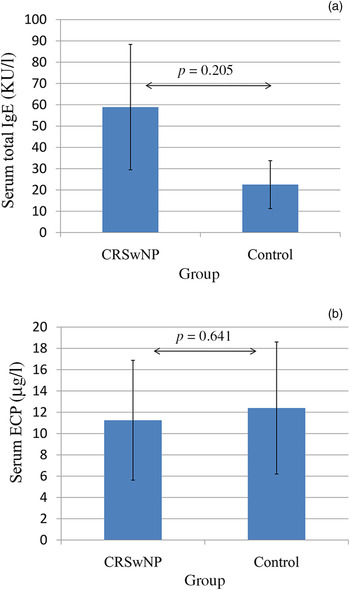
According to the serum Phadiatop test results, six chronic rhinosinusitis with nasal polyps patients showed systemic allergies, and none of the controls had positive results. Compared to the control group, the chronic rhinosinusitis with nasal polyps group showed no significant elevation in total IgE or eosinophil cationic protein levels in serum (Figure 1 and Table I). However, the total levels of IgE and eosinophil cationic protein were increased in the patients with systemic allergy, which may have resulted from systemic allergy and eosinophilic inflammation.
Compared to the control group, the chronic rhinosinusitis with nasal polyps (CRSwNP) group showed no significant elevation in total immunoglobulin E (IgE) and eosinophil cationic protein (ECP) levels in serum.

Total immunoglobulin E and eosinophil cationic protein levels

Data represent median values (and ranges) in the serum, unless indicated otherwise. CRSwNP = chronic rhinosinusitis with nasal polyps; IgE = immunoglobulin E; ECP = eosinophil cationic protein
Local allergy and S aureus enterotoxins
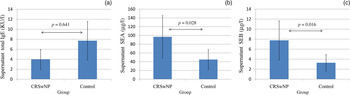
The control subjects had negative results in the Phadiatop test, and in staphylococcal enterotoxin A specific IgE and staphylococcal enterotoxin B specific IgE in the supernatant. Aside from the six patients with systemic allergy, four patients with chronic rhinosinusitis with nasal polyps showed local allergy according to the Phadiatop test results in the supernatant. All chronic rhinosinusitis with nasal polyps patients tested negative for staphylococcal enterotoxin types A and B specific IgE. However, the chronic rhinosinusitis with nasal polyps group showed significantly elevated staphylococcal enterotoxin types A and B levels in the supernatant. No significant difference was detected in the total IgE level in the supernatant between the chronic rhinosinusitis with nasal polyps group and the control group (Figure 2). Table II shows the total IgE, staphylococcal enterotoxin A and staphylococcal enterotoxin B levels in the supernatant.
(a) No significant difference was detected in the total immunoglobulin E (IgE) level in supernatant between the chronic rhinosinusitis with nasal polyps (CRSwNP) group and control group. (b&c) The chronic rhinosinusitis with nasal polyps group showed significantly elevated staphylococcal enterotoxin A (SEA) (b) and staphylococcal enterotoxin B (SEB) (c) levels in supernatant.

Total immunoglobulin E, and staphylococcal enterotoxin A and B levels

Data represent median values (and ranges) in the supernatant, unless indicated otherwise. CRSwNP = chronic rhinosinusitis with nasal polyps; IgE = immunoglobulin E; SEA = staphylococcal enterotoxin A; SEB = staphylococcal enterotoxin B
Eosinophilic or neutrophilic chronic rhinosinusitis with nasal polyps
As has been described previously, eosinophilic chronic rhinosinusitis with nasal polyps is characterised by an eosinophil ratio of more than 10 per cent in a high power field.Reference Asero and Bottazzi 5 According to this criterion, 14 patients belonged to the eosinophilic chronic rhinosinusitis with nasal polyps group and the others were characterised as having non-eosinophilic chronic rhinosinusitis with nasal polyps. The total eosinophil cationic protein/myeloperoxidase ratio was 0.345, with a notable bias toward neutrophilic inflammation.
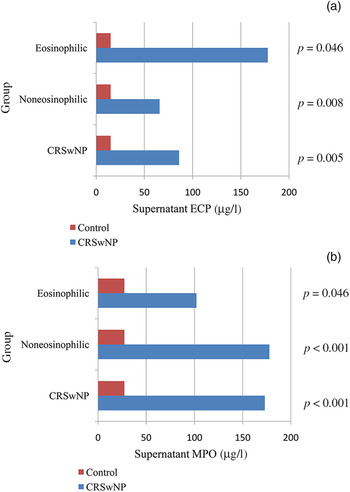
Table III shows the eosinophil cationic protein and myeloperoxidase levels in the supernatants. The eosinophil cationic protein levels were significantly increased in the eosinophilic and non-eosinophilic chronic rhinosinusitis with nasal polyps groups compared to the controls. The myeloperoxidase levels in the supernatant were significantly elevated in the non-eosinophilic and eosinophilic chronic rhinosinusitis with nasal polyps groups compared to the control group (Figure 3). Interestingly, the eosinophilic group showed an elevated myeloperoxidase level, and the non-eosinophilic group showed an increased eosinophil cationic protein level.
Eosinophil cationic protein (ECP) and myeloperoxidase (MPO) levels in supernatant were significantly increased in the eosinophilic and non-eosinophilic chronic rhinosinusitis with nasal polyps (CRSwNP) groups compared to the control group.

Eosinophil cationic protein and myeloperoxidase levels

Data represent median values (and ranges) in the supernatant, unless indicated otherwise. p1 value: chronic rhinosinusitis with nasal polyps group versus control group. p2 value: eosinophilic group versus control group. p3 value: non-eosinophilic group versus control group. CRSwNP = chronic rhinosinusitis with nasal polyps; ECP = eosinophil cationic protein; MPO = myeloperoxidase
Relationship between indicators and computed tomography scores
The eosinophil cationic protein level was significantly correlated between the serum and supernatant (r = 0.482, p = 0.006), and the total IgE level in serum was correlated with that in the supernatant (r = 0.516, p = 0.003). No parameters in the chronic rhinosinusitis with nasal polyps group, including serum eosinophil cationic protein, total IgE, supernatant eosinophil cationic protein and myeloperoxidase, were associated with the CT scores.
Discussion
Chronic rhinosinusitis with nasal polyps is a multifactorial disease resulting from the inflammation of the nasal cavity and paranasal sinuses. There are many forms of chronic rhinosinusitis with nasal polyps, each with its own cause and requiring individual treatment. However, the pathogenesis and subtypes of chronic rhinosinusitis with nasal polyps remain unclear.
Superantigens are a type of antigen that can bind to the lateral aspect of the major histocompatibility complex class II molecule and upregulate as much as 30 per cent of the body's lymphocytes, whereas conventional antigens regulate approximately 10–100 million lymphocytes.Reference Bernstein and Kansal 17 Superantigens are thought to be the product of viruses or bacteria, and are associated with diseases including toxic shock syndrome, Kawasaki disease, rheumatoid arthritis, atopic dermatitis, and chronic rhinosinusitis with nasal polyps.
S aureus enterotoxins are a type of superantigen considered to have a close relationship with chronic rhinosinusitis with nasal polyps and asthma.Reference Tomassen, Jarvis, Newson, Van Ree, Forsberg and Howarth 18 S aureus enterotoxins comprise staphylococcal enterotoxin types A, B, C and D, and toxic shock syndrome toxin 1. Staphylococcal enterotoxin types A and B play an important role in airway disease.Reference Pezato, Świerczyńska-Krępa, Niżankowska-Mogilnicka, Derycke, Bachert and Pérez-Novo 19 In Caucasian patients with chronic rhinosinusitis with nasal polyps, many studies have shown the existence of S aureus enterotoxins that act as superantigens in the course of the disease. Roughly 37–50 per cent of patients with chronic rhinosinusitis with nasal polyps are S aureus enterotoxin specific IgE positive, and show polyclonal IgE elevation and eosinophilic inflammation.Reference Pérez-Novo, Claeys, Van Zele, Holtapples, Van Cauwenberge and Bachert 20 , Reference Bachert, Zhang, Holtappels, De Lobel, van Cauwenberge and Liu 21 S aureus enterotoxin superantigens are also found in Chinese subjects with chronic rhinosinusitis with nasal polyps, but at a lower incidence.Reference Zhang, Holtappels, Claeys, Huang, van Cauwenberge and Bachert 22 In contrast, some studies have found no correlation between S aureus enterotoxins and the presence of chronic rhinosinusitis with nasal polyps.Reference Heymans, Fischer, Stow, Girard, Vourexakis and Des Courtis 23 , Reference Chakhtoura, Hadi, Rameh, Nassar and Abdelnoor 24
In the present study, no patients with chronic rhinosinusitis with nasal polyps tested positive for staphylococcal enterotoxin types A or B specific IgE, similar to the controls. In the chronic rhinosinusitis with nasal polyps group, no increase in total IgE was detected in the serum or supernatant. However, both the staphylococcal enterotoxin types A and B levels in the supernatant were significantly elevated. These results suggest that S aureus enterotoxins might play a role in the course of chronic rhinosinusitis with nasal polyps, but not as a superantigen. Our results are in conflict with those of previous studies, and this discrepancy might be because of the following reasons. First, the prevalence of S aureus enterotoxin superantigens in Chinese patients with chronic rhinosinusitis with nasal polyps is lower than that in Caucasians. Second, we detected staphylococcal enterotoxin types A and B levels, which might not represent all S aureus enterotoxins. According to our results, antibiotic treatment for S aureus may be suggested in the patients with S aureus enterotoxins elevation.
Although systemic allergy is a known aetiological factor for chronic rhinosinusitis with nasal polyps, the prevalence is still uncertain. In this study, we found that 6 out of 36 (16.7 per cent) of chronic rhinosinusitis with nasal polyps patients had systemic allergy (compared to 0 out of 18 in controls), which was lower than that reported in previous studies.Reference Asero and Bottazzi 5 , Reference Erbek, Erbek, Topal and Cakmak 6 We inferred that systemic allergy might play a role in causing chronic rhinosinusitis with nasal polyps in Chinese subjects.
Local allergy has been demonstrated in non-allergic rhinitis using nasal allergen provocation testing or local allergen specific IgE detection.Reference Rondón, Romero, López, Antúnez, Martín-Casañez and Torres 8 , Reference Rondón, Canto and Blanca 25 It is uncertain whether local allergy plays a role in chronic rhinosinusitis with nasal polyps. Some authors have reported elevation of local allergen specific IgE in chronic rhinosinusitis with nasal polyps patients;Reference Wise, Ahn and Schlosser 26 , Reference Sheahan, Ahn, Harvey, Wise, Mulligan and Lathers 27 however, most reports have suggested that this phenomenon is caused by S aureus enterotoxin superantigens.Reference Van Zele, Gevaert, Holtappels, van Cauwenberge and Bachert 28 – Reference Zhang, Holtappels, Gevaert, Patou, Dhaliwal and Gould 30 In the present study, we demonstrated the existence of local allergen specific IgE, independent of S aureus enterotoxin superantigens. This result confirmed those of several previous studies.Reference Cao, Zhang, Liao, Ma, Wang and Wang 31 , Reference Bernstein, Allen, Rich, Dryja, Bina and Reiser 32 We inferred that local allergy might play a role in causing chronic rhinosinusitis with nasal polyps in Chinese patients, without the influence of superantigens. Instead, it may be caused by the local activation of mast cells. According to our results, local allergy examinations should be performed in the patients with chronic rhinosinusitis with nasal polyps who had negative results for systemic allergy. If the results for local allergy tests are positive, anti-allergic treatments should be applied.
Chronic rhinosinusitis with nasal polyps can be divided into eosinophilic and non-eosinophilic subgroups according to the tissue eosinophil count. Most Chinese patients belong to the non-eosinophilic subgroup and have neutrophilic inflammation.Reference Hu, Cao, Liang, Cui and Liu 33 , Reference Kim, Park, Rhee, Chung and Kim 34 In the present study, 22 of 36 patients (61.1 per cent) belonged to the non-eosinophilic subgroup, which showed good agreement with previous studies. In this subgroup, the eosinophil cationic protein level was increased, suggesting that eosinophils also play a role in non-eosinophilic chronic rhinosinusitis with nasal polyps.
No parameter was associated with the CT scores. Until now, no objective indicator has been effective for describing the severity of chronic rhinosinusitis with nasal polyps. We found statistical correlations between the eosinophil cationic protein and total IgE levels in serum and supernatant. These results imply that systemic reactions might be associated with local inflammation.
-
• Chronic rhinosinusitis with nasal polyps is a multifactorial disease; the pathogenesis remains unclear
-
• In Chinese patients, chronic rhinosinusitis with nasal polyps usually manifests as a neutrophilic inflammation
-
• Regarding pathogenesis, Staphylococcus aureus enterotoxins may play roles other than acting as superantigens
-
• Local allergy may elevate local immunoglobulin E and play a role in Chinese patients, independent of S aureus enterotoxin superantigens
Our study has several limitations. First, the number of patients was limited. Second, other S aureus enterotoxins including staphylococcal enterotoxin types C and D, and toxic shock syndrome toxin 1 were not detected. These issues should be examined in future studies.
In conclusion, systemic allergy and local allergy may play roles in causing chronic rhinosinusitis with nasal polyps. Local allergy may play a role in Chinese patients with chronic rhinosinusitis with nasal polyps, independent of S aureus enterotoxin superantigens. Allergic reaction usually manifests as an eosinophilic inflammation. S aureus enterotoxins may play a role in the pathogenesis of chronic rhinosinusitis with nasal polyps; however, their roles as superantigens were not confirmed in this study. In Chinese subjects, chronic rhinosinusitis with nasal polyps usually manifests as a neutrophilic inflammation. However, eosinophils also had a role in this subtype. We inferred that the infection of S aureus might play an important role in the non-eosinophilic subgroup of chronic rhinosinusitis with nasal polyps, especially in the Chinese. In contrast, S aureus enterotoxins might act as superantigens in the eosinophilic subgroup of chronic rhinosinusitis with nasal polyps, especially in Caucasians.
Acknowledgements
We thank Wei Wu for the enzyme-linked immunosorbent assay examination. The study was supported by the Zhejiang Province Health Department of Scientific Research Funds (grant number 2013KYB112).