Introduction
The United States’ incarceration rate of its national population is the highest in the world.Reference Walmsley 1 The percentage of incarcerated individuals with a mental illness is substantial, with 10% to 15% of inmates suffering from a serious mental illness.Reference Hoge, Buchanan, Kovasznay and Roskes 2 Two-thirds of sentenced jail inmates met criteria for drug dependence or abuse.Reference Bronson and Stroop 3 Many inmates experience both mental illness and a substance use disorder as co-occurring conditions.
Multiple reasons account for the rise in the number of individuals with mental illness entering the criminal justice system. First, in the 1960s, a movement began to deinstitutionalize individuals with mental illness and discharge them from psychiatric hospitals to the least restrictive environment. As a result, large numbers of individuals previously treated in an inpatient setting were released into the community with a resulting decrease in inpatient psychiatric hospital beds. Second, during the 1970s, the United States increasingly turned to punishment of individuals with a drug offense rather than treatment. As a result, drug-related offenses increased with a subsequent rise in arrests and incarcerations. Third, during this same relative time-period, judges were given less discretion in imposing sentence lengths as legislatures increasingly mandated determinate and fixed sentencing to demonstrate a “get tough on crime approach.” Fourth, during the 1960s and mid-1970s, civil commitment laws were substantially reformed, making involuntary commitment of individuals with mental illness more difficult.Reference Pinals 4 As a result of these, and other factors, a ballooning number of people with mental illness are finding their way into a jail or prison, rather than a hospital setting.
Criminalization of mental illness refers to the inappropriate diversion of those with mental problems to the criminal justice system rather than to treatment.Reference Dewa, Loong, Grujillo and Bonato 5 To help address this mismatch of people and resources, public policy is shifting to finds ways to divert these individuals away from potentially long and costly incarcerations and into appropriate and effective treatment. An increasing use of the principle known as “therapeutic jurisprudence” is being utilized as an alternative approach to the mass incarceration of individuals with mental illness. Core concepts of therapeutic jurisprudence include the application of law in the most appropriate way to benefit all individuals, increasing therapeutic aspects of legal interventions while decreasing antitherapeutic aspects, and protecting the due process rights of both offenders and victims.Reference Winick and Wexler 6
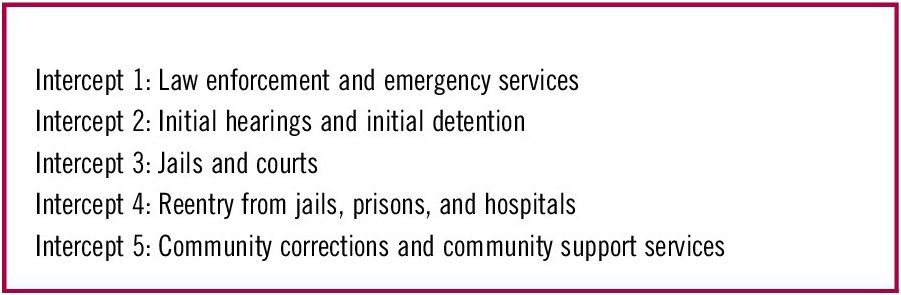
In general, individuals eligible for diversion from the criminal justice system are those with a treatable mental and/or substance use disorder that can be safely maintained in the community. Munetz and GriffinReference Munetz and Griffin 7 proposed the Sequential Intercept Model (SIM) as a useful framework to conceptualize a series of “points of interception” where individuals with a mental illness may be prevented from entering or progressing further into the criminal justice system. These authors acknowledge that individuals with mental illness who demonstrate criminal behavior unrelated to their mental illness should be held accountable for their behavior; however, people with mental illness should not be arrested or detained longer than others only because of their mental illness.Reference Munetz and Griffin 7 The five intercept points proposed by the SIM are summarized in Table 1.
Sequential Intercept Model Interception Points

This article focuses primarily on the first three SIM intercept points as related to jail diversion and reviews types of diversion programs, research outcomes for diversion programs, and important components that contribute to successful diversion.
Prebooking Diversion Programs
The first intercept point involves the role of police in managing individuals in psychiatric crises who come to their attention with resolution of difficulties on site without further intervention. Persons with mental health (MH) problems may be referred to the police through concerns by family members, friends, or colleagues or through potentially law violating behaviors when police are called to the scene. Some research indicates that individuals with mental illness have more police contacts during their life than those without mental illness.
In his systematic review of nearly 330 000 cases involving police contacts, Livingston found that approximately 25% of people with mental disorders had a history of police arrest, nearly 10% had police involved in their pathway to MH care, and 1% of all police dispatches and encounters involved people with mental disorders.Reference Livingston 8 Fisher et al.Reference Fisher, Roy-Bujnowski, Grudzinskas, Clayfield, Banks and Wolff 9 compared the arrest rates for eight offense categories of nearly 11 000 individuals with severe and persistent mental illness to 3.3 million persons in the same age group (aged 18-54). These researchers found that individuals with mental illness had a significantly higher odds of having at least one arrest across all charge categories. Except for charges of assault and battery against a police officer, the largest odds ratio for those with mental illness was for misdemeanor crimes.Reference Fisher, Roy-Bujnowski, Grudzinskas, Clayfield, Banks and Wolff 9 Increased police contacts are not the only risk for individuals with a serious mental illness. Research also indicates that nearly 25% of individuals fatally shot by the police are persons with a serious mental illness.Reference Fuller, Kamb, Biasotti and Snook 10
The police often serve as a gatekeeper in deciding whether or not an individual with MH problems enters the MH system, is taken to jail, or remains in their community without further intervention. In many situations, the person with a MH problem may be well known to the police through numerous contacts over time.Reference Reuland, Schwarzfeld and Draper 11 Moreover, police may serve as a peacekeeper or a provisional solution that helps reduce the likelihood of future interactions with the police.Reference Wood and Watson 12
Numerous approaches to assist in the interactions between the police and individuals with MH problems and potentially divert these persons have been proposed and are summarized below.
Police-based specialized police response
As described above, police are often the first responders to situations involving individuals suffering from psychiatric symptoms. A major revamping of how police interact with individuals with mental illness stems from a fatal shooting by police in Memphis, TN. On September 24, 1987, Memphis police officers were called to the LeMoyne Gardens public housing project by a mother concerned about the mental state of her African-American 27-year-old son Joseph DeWayne Robinson. Mr. Robinson was reportedly diagnosed with schizophrenia and intoxicated on cocaine. By the time the police arrived, Mr. Robinson was holding an 8-in. butcher knife to his throat and threatening suicide. He had inflicted nearly 120 wounds over his body. When the police ordered him to put down his knife, he refused and allegedly lunged at the police. The surrounding four officers, all white, fired approximately 8 to 10 times and Mr. Robinson died of multiple gunshot wounds. As a result of this tragedy, the Memphis Mayor sought help from advocates from the National Alliance on Mental Illness and enlisted police, community MH professionals, hospital administrators, and church officials to develop a more effective way for the police to intervene with persons in the midst of a psychiatric crisis. Ultimately, Dr. Randolph Dupont and Major Sam Cochran developed a program known as “Crisis Intervention Training” (CIT) for front-line officers who volunteer for the training. The goal of CIT is to enhance police’s ability to better respond to individuals with mental illness and to find appropriate opportunities to connect the individual with treatment services rather than the criminal justice system. The CIT training developed has become known as the “Memphis Model.”Reference Dupont, Cochran and Pillsbury 13
The CIT Center at the University of Memphis has developed a national curriculum offered for selected officers within a police department who volunteer for the training. The 40-hour training involves six core areas as part of the curriculum delivered over a 1-week period. The core areas include the following: MH didactics; community support and resources; de-escalation training; site visits of settings providing MH treatment; law enforcement issues related to police procedures and law enforcement liability; and research and systems with an emphasis on diversion strategies. 14 Subsequent research has demonstrated that delivering the training in segments over time produces similar results regarding officers’ knowledge of mental illness and attitudes toward individuals with MH problems.Reference Cuddeback, Kurtz, Wilson, VanDeinse and Burgin 15 This segmented approach may provide an alternative approach to delivering CIT training thereby potentially increasing the availability of this training.
Over 3000 programs in the United States have implemented CIT and approximately 20% of patrol officers in those programs receive the CIT training.Reference Watson, Ottati, Morabito, Draine, Kerr and Angel 16 Those officers who volunteer for CIT training have better outcomes with regard to key attitudes toward individuals with mental illness have better outcome with regard to key attitudes, skills, and behaviors.Reference Compton, Bahor, Watson and Oliva 17 , Reference Compton, Bakeman, Broussard, D’Orio and Watson 18 In his study of 46 police officers from 7 rural departments and 13 suburban departments, StrassleReference Strassle 19 also noted that officers who underwent CIT training had reductions in stigmatic attitudes toward individuals with mental illness.
Research that CIT decreases the arrest rate of persons with mental illness is mixed. Watson et al.Reference Watson, Ottati, Morabito, Draine, Kerr and Angel 16 provided three possible reasons to explain why research on CIT programs outside of Memphis has not shown a decrease in arrest rates. (1) Other programs do not adhere to the Memphis CIT program and therefore successful decrease in arrest rates cannot be duplicated; (2) Officers without CIT training are arresting more people with mental illness but are not aware they are mentally ill thereby negating decrease arrest rate results from CIT trained officers; and (3) Both non-CIT and CIT trained officers are decreasing their arrest of those with mental illness resulting in no appreciable difference in arrest rates between trained vs nontrained officers.Reference Watson, Ottati, Morabito, Draine, Kerr and Angel 20 If a reduction in arrests of individuals with mental illness results from decreased arrests by both non-CIT and CIT trained officers, then this reduction nevertheless represents an overall success in preventing unnecessary arrests of individuals with serious mental illnesses (SMI).
Despite mixed evidence on CIT decreasing arrest rates, multiple studies have demonstrated that CIT programs increase the transport of individuals with mental illness to emergency treatment facilities and improve linkages to MH programs.Reference Watson, Ottati, Morabito, Draine, Kerr and Angel 16 Steadman and Morrissette recommend a reframing of the CIT approach that focuses not only on what the police should do when they interact with a person in emotional distress but also on how police can be engaged as partners with community MH providers responsible for designing crisis treatment and interventions along the continuum.Reference Steadman and Morrissette 21
Police-Based Specialized MH Response Approach
Prearrest diversion can also be accomplished through a model where police and a MH professional work together to respond to a MH crisis. This model has been referred to as a “police-based specialized mental health response” or “police mental health street triage.” This approach typically involves an on-site assessment by the police followed by a MH evaluation by a clinician who evaluates the level and nature of psychiatric distress. In some co-responder models, the MH professional assists remotely from a control room where they may have access to patient records and can help guide the officer on site. Compton et al.Reference Compton, Halpern and Broussard 22 describe a police-MH linkage system that illustrates one variation as to how remote assistance may help a police officer called to the scene. In this model, individuals with a serious mental illness who receive community MH treatment and have a prior criminal history agree to be included in a database that can provide information in the event of future police encounters. If an officer has contact with a person enrolled in this system and runs a background check, the officer receives a text message that this person may be involved in the MH linkage system project. At this point, the officer can call a social worker employed at the community MH agency who can provide background information for the officer and assist him or her with how to manage certain behaviors and potential dispositions.Reference Compton, Halpern and Broussard 22
Research indicates that this approach has achieved some success even though significant limitations on the quality of the research likely limit conclusive findings. In their review of the literature examining the effectiveness of co-response models, Puntis et al.Reference Puntis, Perfect and Kirubarajan 23 found that this co-responder approach was associated with decreased use of involuntary psychiatric referrals and detentions in police custody. Their review also notes that service users found this approach less distressing than a standard police response with quicker access to MH treatment during the crisis.Reference Puntis, Perfect and Kirubarajan 23
Meehan et al.Reference Meehan, Brack, Mansfield and Stedman 24 followed 122 Australian individuals who had direct contact with the police-MH co-responder for 2 weeks to monitor subsequent emergency department presentations and inpatient admissions. Their research indicated that following the direct contact with the co-responder team, 67% of these individuals remained at their residence, 29% were transported to the emergency department, and only 4% were taken into custody by the police. These authors concluded that co-responded interventions helped resolve the immediate crisis for most of the contacts and likely diverted many away from the emergency room and inpatient treatment.Reference Meehan, Brack, Mansfield and Stedman 24
MH-Based Specialized MH Response Programs
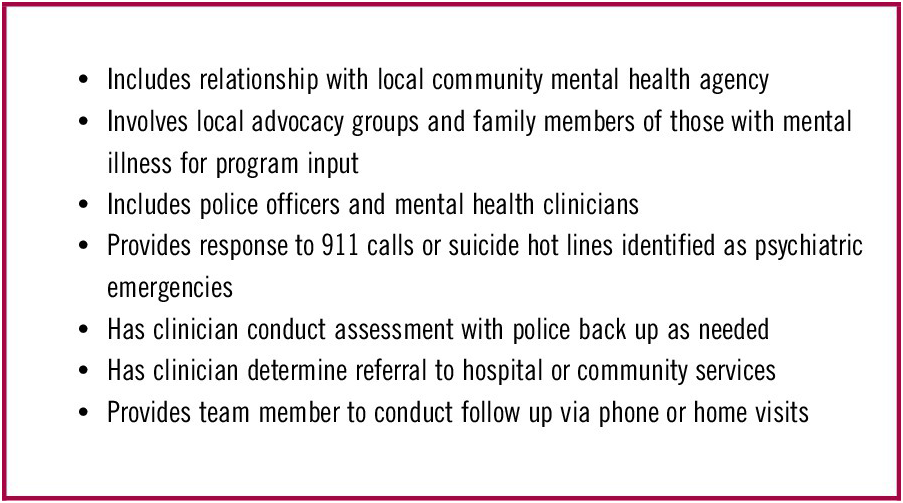
Like police-based specialized MH response programs described, above, MH-based specialized MH response programs typically involve coordination between law enforcement and MH providers. However, in these programs, the MH clinician does the initial triage assessment with police back up as needed. These programs are often referred to as mobile crisis programs. The mobile crisis program of DeKalb County, Georgia illustrates several components of this approach summarized in Table 2.Reference Scott 25
Common Components of Mobile Crisis Programs

In a retrospective review of Dekalb County’s mobile crisis program, ScottReference Scott 25 examined the effectiveness and efficiency of this program in addressing 911 psychiatric emergency calls. In cases involving regular police intervention, 28% of the cases were managed without psychiatric hospitalization. In contrast, 55% of emergencies referred to the mobile crisis team avoided psychiatric hospitalization. Although this finding did not reach statistical significance, the average cost per case was 23% less for persons evaluated by the mobile crisis team. In addition, both consumers and police officers viewed the mobile crisis program positively.Reference Scott 25
Specialized Crises Response Sites
Emergency rooms are unlikely settings to adequate address the needs of all individuals with mental illness who are detained by the police in lieu of jail. Challenges with emergency rooms serving the sole or primary avenue to address psychiatric crises include long periods of wait times for police in the emergency room setting, refusal of psychiatric admission due to the individual not meeting involuntary commitment criteria, and diversion of individuals who need MH assistance but do not represent a psychiatric emergency.Reference Steadman, Stainbrook, Griffin, Draine, Dupont and Horey 26 In addition, using the emergency room department to board psychiatric patients after medical clearance increases emergency room costs, diverts care from other psychiatric and medical emergencies, and creates an often loud and chaotic setting not equipped to appropriately manage psychiatric patients.
Specialized crisis response sites can serve an important role in prebooking pretrial diversion programs. Steadman et al.Reference Steadman, Stainbrook, Griffin, Draine, Dupont and Horey 26 outline basic principles have been described as important to the role of these sites in assisting with the success of pretrial diversion programs. First, the centralized site should be available 24 hours a day so that police can take a person in MH crises to this location whenever needed. The MH and substance use services should be co-located at the site to minimize the responsibility of officers in determining the primary etiology of the person’s acute symptoms and where the person should be taken. Second, the drop off site should have “police friendly” procedures with a no-refusal policy for law enforcement referrals. The site should strive for a streamlined intake to expedite the officer’s transport and transition of the individual so that they can quickly return to their work promoting public safety. Third, the site should have an established legal foundation to accept and hold persons who may also be facing a criminal charge. Fourth, training should be provided to both law enforcement and MH providers to address roles and responsibilities as well as any biases of either group. Finally, these specialized crisis sites should establish strong linkages to community services, including facilitating connections with both MH and substance abuse services. A responsible individual, referred to as a “boundary spanner,” plays a crucial role in overcoming various institutional barriers to ease access to care. In their review of different prebooking diversion models, these researchers found that having a psychiatric triage or drop-off center was a key factor in the success of prebooking diversion, regardless of the diversion model.Reference Steadman, Stainbrook, Griffin, Draine, Dupont and Horey 26
Postbooking Diversion
Postbooking diversion involves a process where inmates with a mental illness who have been arrested and booked are identified and subsequently diverted to a treatment program outside of the jail setting. Three models of postbooking diversion described are pretrial jail diversion programs, deferred prosecution programs (prearraignment or postarraignment), and specialty courts. Each of these models is summarized below.
Jail-based post booking diversion
In jail-based post booking diversion programs, pretrial service personnel or specialized jail personnel identify those jail inmates appropriate for community treatment with the agreement of the judge, prosecutor, and defense attorney. Proposed benefits of jail diversion include improvement of MH symptoms, reduction in overcrowded jails with insufficient resources to treat this population, fewer future contacts with police, and decreased criminal recidivism.Reference Sirotich 27
In one of the few studies examining the outcomes specific to jail-based post booking, Shafer et al.Reference Shafer, Arthur and Franczak 28 followed 248 individuals with co-occurring disorders of serious mental illness and substance use disorders who had been arrested and booked on misdemeanor charges. Numerous outcomes of individuals assigned to diversion or nondiversion were evaluated 12 months after their index offense. The authors found that diverted clients were significantly more likely to utilize emergency rooms for MH or substance use treatment and reported fewer symptoms of depression and anxiety than their nondiverted counterparts. However, they did not show any significant difference in their rearrest rate compared to nondiverted individuals, although they did have significantly lower rearrest for lower level misdemeanor crimes.Reference Shafer, Arthur and Franczak 28
Gill and MurphyReference Gill and Murphy 29 examined the outcomes of a unique jail-based diversion program coordinated by the county prosecutor’s office. These researchers followed outcomes of 125 individuals diverted toward MH services over a 5-year period. In contrast to earlier research, individuals who completed the program were a lower risk of being arrested and had fewer arrests. Although those who did not complete the diversion program also benefited in these same areas, their response was not as strong as diversion completers. Individuals who had a longer period of participation in active treatment demonstrated better outcomes, indicating that a lengthier period of follow up care may be needed to sustain initial gains.Reference Gill and Murphy 29
Deferred Prosecution Programs
In deferred prosecution programs, the court refers a defendant charged with a crime to a community treatment program in lieu of prosecution. If the person successfully completes the proposed treatment, then the original charge may be dismissed and the arrest no longer appears on the defendant’s record. Deferred prosecution has been a diversion tool for decades for individuals charge with driving while intoxicated (DWI). In a 1983 study of offenders charged with DWI in Washington State, DWI offenders who received deferred prosecution and concomitant alcoholism treatment had significantly more postdeferral alcohol-related traffic violations than did a control group of DWI offenders who received normal judicial sanctions. The authors suggested two possible reasons why those diverted to a treatment program had higher alcohol related violations compared to those who were not referred. First, the deferred prosecution group may have accepted the treatment to avoid legal sanctions rather than to genuinely address their alcohol problem. Second, the alcoholism treatment offered to this group may not have been effective.Reference Salzberg and Klingberg 30 What constituted “alcoholism treatment” was not defined in this study making it difficult to know if the lack of benefit was due to a poor treatment, lack of motivation by those referred, or some other factor.
In 2007, the University of Washington State Institute for Public Policy studied the impact of deferred prosecution of driving under the influence (DUI) cases on recidivism. Recidivism was defined as filing of a subsequent DUI, criminal traffic, or alcohol-related case within 3 years of the original DUI filing. Under this Washington State statute, deferred prosecutions have strict requirements In particular, the defendant must admit they have an alcohol, drug, or mental disorder that will likely result in re-offense without treatment, must attend a 2 year substance abuse or MH treatment program, must attend two self-help meetings (eg, alcoholic anonymous) every week for at least 2 years, must pay for treatment, and must continue under court monitoring for at least 3 additional years with no use of alcohol or nonprescribed drugs. Failure to meet any of these conditions results in prosecution of the DUI. Under these strict guidelines, individuals with a DUI deferred prosecution had lower adjusted recidivism rates than defendants with similar characteristics who pled guilty or were convicted of a DUI. 31 The results of this study suggest that rigid ongoing monitoring in deferred prosecution of cases involving substance use may be an essential component of success as defined by decrease recidivism of alcohol or drug-related charges.
Problem Solving Courts
As with other forms of diversion, problem solving courts work to connect individuals with a mental illness who may be better served through community treatment as opposed to incarceration. A wide range of problem solving courts has developed and examples of such courts are listed in Table 3.
Problem Solving Court Examples

Miami Dade drug treatment court (DTC) has often been cited as the first example of a problem solving court. This court was established in 1989 by Judge Herbert Klein. An important goal of this court was to address the escalating violence associated with cocaine trafficking in the Miami, FL area and failure of the criminal justice system and the “War on Drugs” to decrease drug use and arrests. Drug courts represent an example of therapeutic jurisprudence and restorative justice through utilization of treatment for the offender, intense supervision, regular court appearances, and the chance to make amends to victims and the community by becoming more productive citizens free from addiction. There are two general formats of drug courts. In a preadjudication drug court, the individual does not plead guilty but does waive his or her right to a jury trial, a speedy trial, and a right to confront witnesses. If the person successfully completes the program, charges are dismissed. In contrast, individuals who enter a drug court through a postadjudication format plead guilty and are referred to drug court as a condition of probation. If the person does not complete the program, then probation can be revoked with sentencing and potential incarceration following.Reference Fulkerson, Keena and O’Brien 32 Sanctions are an important component associated with decreased drug use and recidivism of drug court participants.Reference Harrell and Roman 33 Sanctions can be wide ranging and include jail incarceration, increased treatment, performing community service, increased court appearances, verbal reprimands, increased court appearances, and program termination.Reference Lindquist, Krebs and Lattimore 34
Research has demonstrated that individuals who complete the treatment program prescribed by the drug court have decreased recidivism. In his study of 381 subjects referred to a DTC, FulkersonReference Fulkerson 35 noted that subjects in the DTC group had a significantly lower recidivism rate over a 4-year period when compared to a traditional probation group. Successful completion of the program was a key factor, as those who withdrew or failed the DTC program experienced the same frequency of future arrests as those never referred to the DTC program.Reference Fulkerson 35
The goal of a mental health court (MHC), like other forms of jail diversion, is to decrease criminal recidivism while improving the MH of participants.Reference Goldkamp and Irons-Guynn 36 Although MHCs across the United States vary in how participants are selected and the length of time from identification to MHC referral, they generally have the following common characteristics: voluntary participation; separate docket for defendants with mental disorders; judicial oversight of treatment plans; regular appearance by the participant in court before the judge; nonadversarial team approach with both criminal justice and MH professionals involved in the decision making, and defined conditions for successful completion.Reference McNeil and Binder 37 , Reference Lowder, Rade and Desmarais 38
Redlich et al.Reference Redlich, Steadman, Monahan, Petrila and Griffin 39 noted that MH courts have evolved since their first inception and describes differences between “first generation” MH courts and “second generation” MHCs. In their review, these authors note that most “first generation” courts accepted only individuals with a mental illness facing misdemeanor charges and all used sanctions when difficulties arose with compliance. Supervision models included primary responsibility resting with community providers, court staff or probation officers, or joint supervision by both MH staff and probation.Reference Yuan and Capriotti 39
Although second generation MH courts also utilize a therapeutic jurisprudence model for inmates with mental illness, four dimensions have evolved when compared to first generation MHCs. These dimensions involve an increased acceptance of defendants facing felony charges, increased use of postplea adjudication models, increased use of jail as a sanction, and increased use of criminal justice supervision as compared to supervision by community providers.Reference Redlich, Steadman, Monahan, Petrila and Griffin 39
Do MHCs work in their stated goals to decrease recidivism and improve quality of life for participants? Several studies have attempted to answer this question with some mixed results. In their study of a San Francisco MHC, McNeil and BinderReference McNeil and Binder 37 compared 170 people who entered a MHC after arrest with adults with mental disorders who were booked into the county jail but not referred to the MHC. These authors concluded that participation in the MHC program had the following positive outcomes: longer time without any new criminal charges; longer time without new charges for violent crime; and decreased recidivism and violence even after graduates were no longer under the MHC supervision.Reference McNeil and Binder 37
In their meta-analytic investigation of studies examining recidivism rate for MHC participants, Lowder et al.Reference Lowder, Rade and Desmarais 38 noted that participation in MHC had a small effect on recidivism compared with traditional criminal processing but appeared to be most effective at decreasing time spent in jail after exiting from MHC. These authors encouraged further research examining strategies that may improve outcomes and decrease recidivism such as more frequent status hearings and increased attention to addressing criminogenic risks and needs.Reference Lowder, Rade and Desmarais 38
Yuan and CapriottiReference Yuan and Capriotti 40 reviewed existing research in this area and concluded that the literature suggests that those who participate in MHC do have lower recidivism rates when compared with those who do not. Furthermore, individuals with mental illness who participated in MHCs demonstrated fewer postcourt arrests, longer average time to arrest, and decreased offense severity when they did reoffend. In their review of the Sacramento County MHC, these same authors also found MHC graduates had fewer psychiatric hospitalizations than those who did not graduate from the MHC program.Reference Yuan and Capriotti 40
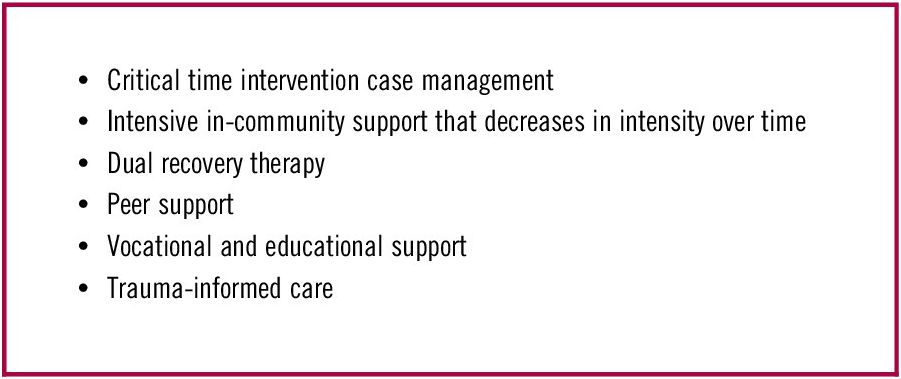
An important aspect of enhancing positive outcomes for participants in MHC treatment programs, is the provision of care that matches the needs of the referrals. Pinals et al.Reference Pinals, Gaba, Clary, Barber, Reiss and Smelson 41 examined an approach for treating individuals with co-occurring disorders known as Maintaining Independence and Sobriety through Systems Integration, Outreach, and Networking-Criminal Justice (MISSION-CJ). MISSION-CJ utilizes six integrated evidence-based components outlined in Table 4.
MISSION-CJ Evidence-Based Components.

In their review of 97 MHC participants followed up at 6 months, those MHC participants who received MISSION-CJ demonstrated a decrease in behavioral health symptoms, illegal drug use, trauma symptoms, and time incarcerated. This study reflects the relevance of addressing specific needs of referred individuals at a level of intensity sufficient to meet those needs.Reference Yuan and Capriotti 40
Summary
The success of jail-based diversion, whatever diversion model is used, depends in large part on the availability and quality of the community MH treatment provided.Reference Shafer, Arthur and Franczak 28 In addition to matching treatment to the person’s specific risks and needs, the success of the program depends on the selection of appropriate candidates for the specific diversion program, a trusted collaboration between MH community services, law enforcement, and the court, and the careful monitoring of program compliance with both rewards and sanctions used where appropriate. As individuals with SMI do not only commit crimes because of their mental illness, treatment programs should also attend to criminogenic factors unrelated to mental illness to maximize reductions in recidivism.
The need for continued research is substantial. Although many prior studies have attempted to examine the impact of diversion on decreasing recidivism in those with SMI, there are also numerous limitations when examining the literature at large. Challenges when drawing general conclusions from the research include varying definitions of SMI, different criteria qualifying an individual for diversion, a lack of uniformity in how risk assessments are conducted (if at all), the lack of a matched control population not diverted, the failure of some programs to address co-occurring substance use disorders, the failure of some programs to address criminogenic needs, the use of evidence-based treatment programs, and varying lengths of time to measure recidivism. Future research will be improved by addressing these limitations as well as evaluating how motivation vs coercion impacts outcome and the likely need for continued and ongoing long-term management.
In his forward in the book titled “Insanity Inside Out, Judge Bazelon addresses an individual’s right to MH treatment. His poetic words of yesterday apply to the challenges we face today as a society striving to provide better care for those with mental illness who may be best served by diverting away from the criminal justice system. When discussing the need for the judicial and MH systems to work together toward this goal, he eloquently acknowledges, “These are large demands, but the problems cannot be met with less.”Reference Bazelon 42
Disclosure
The author has nothing to disclose.