Introduction
Most flowering plants require pollination services for reproduction (Ollerton et al. Reference Ollerton, Winfree and Tarrant2011) and pollinators need resources such as nectar and pollen (Westrich Reference Westrich1996). These requirements are reflected in ubiquitous mutualisms between plants and pollinators (Engel and Irwin Reference Engel and Irwin2003; Sahli and Conner Reference Sahli and Conner2007). With increasing concern over pollinator declines, recent studies have investigated linkages between plants and pollinators to assess community resilience in the face of anthropogenic change (King et al. Reference King, Ballantyne and Willmer2013; Ballantyne et al. Reference Ballantyne, Baldock and Willmer2015). However, there is some concern that studies based on visit records may not reflect the effectiveness of pollination events, since factors such as visitor behaviour and the amount and type of pollen on their bodies may influence conspecific pollen deposition to floral stigmas (Alarcón Reference Alarcón2010; King et al. Reference King, Ballantyne and Willmer2013).
Behaviour of floral visitors can affect pollen transfer dynamics (Herrera Reference Herrera1987; Fishbein and Venable Reference Fishbein and Venable1996; Ne’eman et al. Reference Ne’eman, Jürgens, Newstrom-Lloyd, Potts and Dafni2010). For example, visitors collecting pollen may be more likely to deposit conspecific pollen when compared to those collecting nectar (Javorek et al. Reference Javorek, Mackenzie and Vander-Kloet2002). Foraging habits such as floral fidelity, or short-term specialisation on a particular plant species, may also facilitate conspecific pollen transfer (Waser Reference Waser1986; Chittka et al. Reference Chittka, Thomson and Waser1999; Brosi and Briggs, Reference Brosi and Briggs2013). Since behaviour can influence visitor ability to transfer pollen to floral stigmas (Chagnon et al. Reference Chagnon, Gingras and DeOliveira1993), pollination effectiveness may be studied by categorising insects with similar characteristics into functional groups (Fenster et al. Reference Fenster, Armbruster, Wilson, Dudash and Thomson2004; Hoehn et al. Reference Hoehn, Tscharntke, Tylianakis and Steffan-Dewenter2008). Functional groups with different foraging habits may vary significantly in quantity as well as quality (e.g., conspecific versus heterospecific) of pollen deposited (Ballantyne et al. Reference Ballantyne, Baldock and Willmer2015), making behavioural observations useful for evaluating relative effectiveness (Chagnon et al. Reference Chagnon, Gingras and DeOliveira1993).
Since plant stigmas must receive conspecific pollen for fertilisation to occur (Alarcón Reference Alarcón2010), the composition of visitor body pollen has important implications for plant reproduction (Sahli and Conner Reference Sahli and Conner2007; Castro et al. Reference Castro, Loureiro, Ferrero, Silveira and Navarro2013). Many studies depend on visit records of insects contacting flowers, but these interactions may only partially predict pollen transport patterns (Popic et al. Reference Popic, Wardle and Davila2013). Pollination may only occur in a fraction of floral visits, sometimes making visit frequency a poor proxy for pollination (Castro et al. Reference Castro, Loureiro, Ferrero, Silveira and Navarro2013; King et al. Reference King, Ballantyne and Willmer2013; Ballantyne et al. Reference Ballantyne, Baldock and Willmer2015). For example, differences in visitor ability to transfer conspecific pollen can make some frequent visitors unlikely pollinators, while less frequent visitors can be more likely to affect fertilisation (Schemske and Horvitz Reference Schemske and Horvitz1984; Mayfield et al. Reference Mayfield, Waser and Price2001; Javorek et al. Reference Javorek, Mackenzie and Vander-Kloet2002; Sakamoto et al. Reference Sakamoto, Morinaga, Ito and Kawakubo2012; Ballantyne et al. Reference Ballantyne, Baldock and Willmer2015). Analysis of pollen from the bodies of floral visitors can provide a useful measure of visitor ability to transfer conspecific pollen to floral stigmas (Alarcón Reference Alarcón2010; Ballantyne et al. Reference Ballantyne, Baldock and Willmer2015).
To investigate this, we studied visitor behaviour and pollen transport for a focal wildflower, Camassia quamash (Pursh) Greene (Asparagaceae). This species is a native perennial herb in the endangered oak-savannah ecosystem of southwestern British Columbia, Canada (Fuchs Reference Fuchs2001). Camassia quamash has a generalist pollination syndrome, with five or more large (3.5 cm diameter), accessible flowers on each inflorescence (Pojar and Mackinnon Reference Pojar and Mackinnon1994; Gillespie et al. Reference Gillespie, Bayley and Elle2017). Although self-compatible, our previous research demonstrated that insect visitation is required for seed production (Gielens et al. Reference Gielens, Gillespie, Neame and Elle2014). Camassia quamash is visited by a diversity of insects and is likely of high ecological importance in these communities (Parachnowitsch and Elle Reference Parachnowitsch and Elle2005). Through analysis of C. quamash visitor behaviour, body pollen, and ambient C. quamash stigma pollen, we examined how functional visitor groups differed in factors that may affect conspecific pollen transfer and how these plant-insect interactions may be linked to pollen delivery. We asked (1) How does behaviour vary by functional visitor group; (2) how does body pollen composition vary by functional visitor group; and (3) how do C. quamash visitors affect pollen deposition on C. quamash stigmas?
Methods
Study system
Field work was conducted at two sites approximately 45 km apart, both within oak-savannah on southeastern Vancouver Island. Knockan Hill Park (48.463277°N, 123.418135°W), Victoria, British Columbia, Canada, is located in a residential neighbourhood within a suburban matrix while Cowichan Garry Oak Preserve (48.808459°N, 123.623513°W), Duncan, British Columbia, is surrounded partially by suburban development and partially by coniferous forest. We designed our sampling of the plant-pollinator community to capture all interactions, but studied pollen delivery for a single focal species, C. quamash. This species blooms mid-spring, so field sampling took place in May 2017. Within each site, we delineated a 1 ha area in which to sample, a scale within foraging ranges of most pollinators (Greenleaf et al. Reference Greenleaf, Williams, Winfree and Kremen2007). We conducted two sampling episodes at each site (Knockan Hill Park 1: May 4–5; Knockan Hill Park 2: May 9–10; Garry Oak Preserve 1: May 18–20; Garry Oak Preserve 2: May 22–23). Data collected from Garry Oak Preserve 2 were later discarded as the peak bloom of C. quamash had unexpectedly passed due to a shift in the weather, and C. quamash abundance was too low to examine pollen deposition on floral stigmas.
Functional visitor groups
We categorised common C. quamash visitors into five functional visitor groups based on body size and natural history, groups that could additionally be distinguished on the wing. These functional groups included Andrena Fabricius (Hymenoptera: Andrenidae)/Halictidae (Hymenoptera) (small to mid-sized solitary mining and sweat bees; substantially smaller species of Halictus Latreille and Lasioglossum (Dialictus) Robertson not included), Apis mellifera Linnaeus (mid-sized, introduced, managed honeybee), Bombus Latreille (Hymenoptera: Apidae) (large-bodied social bumblebees), Osmia Panzer (Hymenoptera: Megachilidae) (mid-sized solitary mason bees), and Syrphidae (Diptera) (including only large hoverflies such as Eristalis Latreille and Volucella Geoffroy). We expected larger-bodied functional groups (e.g., Bombus) to be more likely to contact both anthers and stigma when foraging. We expected foraging behaviour of bees to differ from that of flies because flies do not actively collect pollen to provision nests, potentially leading to less contact with anthers. We additionally expected eusocial bees (A. mellifera and Bombus) to have individual workers that might specialise on either nectar or pollen foraging, leading to variation in visit behaviour within the functional groups. Data from other functional groups defined at the start of research (small hoverflies, small bees like Lasioglossum (Dialictus) and Ceratina Latreille) were discarded due to insufficient sample sizes.
Plant community
We surveyed the flowering plant community at each sample episode to determine the density of C. quamash for use in analysis, and to determine the plants available to foraging insects. Because pollen of C. quamash was indistinguishable from pollen of Camassia leichtlinii (Baker) Watson (see Methods: Camassia quamash visitor body pollen section), we additionally were interested in determining the density of this congener. Each site survey included four parallel transects, approximately 25 m in length and 25 m apart. We laid a 0.5 m2 quadrat (0.25 m × 2 m) 10 times along the length of each transect, at random intervals of 1–4 m, randomly placed to either the left or right side of the transect for a total surveyed area of 20 m2 per sampling episode. We identified all forbs (Pojar and MacKinnon Reference Pojar and Mackinnon1994) with open flowers within the quadrat and counted all inflorescences (sometimes individual flowers) by species. We additionally estimated the abundance for all species in bloom at the site on a log scale, as the patchy distribution of most plant species in this ecosystem can lead to incomplete species lists, and we needed a complete list to ensure representation of candidate species in our pollen reference collection. To control for differences in C. quamash density across sampling dates in our analysis, we calculated mean density (number of inflorescence/m2) for each site and date. We also calculated an additive measure of C. quamash/C. leichtlinii density (hereafter Camassia density) used when analysing pollen delivery, because the pollen of these congeners is indistinguishable.
Insects
Floral visitors
Insect sampling took place under warm (temperature ≥13°C), sunny (full sun to partly cloudy) conditions with low wind. We collected insect floral visitors observed contacting sex organs of open flowers from all plant species in bloom. Two collectors used hand nets to capture all visitors observed for 20 minutes both in the morning (10:00–12:00) and afternoon (14:00–16:00) for a total of 80 minutes per sampling episode. We paused timers when processing insects and distributed observation time among all plant species in bloom to minimise overrepresentation of conspicuous species. Specimens were kept separate by plant species visited, euthanised, pinned, and identified. Identification to genus was the focus of this study and was completed using Stephen et al. (Reference Stephen, Bohart and Torchio1969), Vockeroth and Thompson (Reference Vockeroth and Thompson1987), and Michener et al. (Reference Michener, McGinley and Danforth1994). Voucher specimens have been retained in the Simon Fraser University Pollination Ecology Laboratory (Burnaby, British Columbia, Canada).
Camassia quamash visitor behaviour
We recorded the behaviour of individual C. quamash visitors from functional visitor groups during each sampling episode. We observed insects for 10 consecutive visits to C. quamash flowers, until they visited a different plant species, or until the observer lost track of the insect. We classified plant–visitor interactions as legitimate (visitor contacted stigma and anthers), anthers (visitor contacted anthers only), or neither (visitor contacted neither anther nor stigma).
Legitimate visitor groups
We calculated the mean proportion of legitimate visits made by each functional visitor group during our behavioural sampling for each sampling episode (the observed range was 0.5–1.0, see Results). Functional visitor groups with a mean proportion of legitimate visits ≥0.75 (midpoint of our observed range) were defined as “legitimate visitor groups.” We then calculated the proportion of C. quamash visitors in our net-collected insect data that were “legitimate” for each sampling episode.
Camassia quamash visitor body pollen
When possible, we collected five additional C. quamash visitors from each functional visitor group using hand nets each sampling episode. Insects were individually transferred to clean 25 mL vials and frozen for later analysis. We removed pollen from insect bodies through repeated blotting with a 2 mm cube of fuchsin jelly (Kearns and Inouye Reference Kearns and Inouye1993), avoiding scopal pollen as it is unlikely to be available for pollination (Alarcón Reference Alarcón2010; Popic et al. Reference Popic, Wardle and Davila2013). Each fuchsin jelly cube was melted on a microscope slide and covered with a microscope coverslip. For each slide, we counted 100 pollen grains along a transect, identifying pollen to the lowest taxonomic level possible at 400 times magnification using a reference collection of pollen from oak-savanna wildflowers developed by the Pollination Ecology Laboratory for this purpose. If fewer than 20 pollen grains were present the sample was discarded, both because low numbers of pollen grains could have been due to contamination and because such low numbers would result in anomalous proportions for analysis. We identified pollen to genus whenever possible, as this is normally the best resolution for pollen identification, but sometimes could only resolve identification to family. As noted earlier, pollen from the two species in genus Camassia Lindley (C. quamash, C. leichtlinii) could not be distinguished. We calculated the proportion of C. quamash+C. leichtlinii pollen (hereafter Camassia pollen) on all slides with pollen.
Conspecific visitor groups
We calculated the mean proportion of Camassia body pollen for each functional visitor group for each sampling episode (the observed range was 0.2–0.8, see Results). Functional visitor groups with mean proportions of Camassia body pollen ≥0.5 (midpoint of our observed range) were defined as “conspecific visitor groups.” We then calculated the proportion of C. quamash visitors from our netting data that were “conspecific” for each sampling episode.
Camassia quamash stigma pollen
Four linear transects were marked throughout each site, with transect length varying from 2.5 m to 20 m depending on C. quamash density. We randomly selected 25 flowers from different C. quamash plants along the length of each transect (total of 100 flowers per sampling episode), with flower inclusion conditional on appearing freshly opened and with no apparent pollen on the stigmatic surface. Petioles of selected flowers were marked with BIC (Clichy, France) Wite-Out correction fluid between 9:00 and 10:00. We collected stigmas from marked flowers with forceps between 16:00 and 17:00 the same day, placed them immediately onto microscope slides with premelted fuchsin jelly, and covered them with coverslips.
Within three hours of stigma collection, we heated and pressed stigmas on slides to preserve them for later pollen counting in the laboratory. We counted and identified all pollen grains close to the stigma surface (within a distance equal to the width of the squashed stigma). Slides with fewer than 20 pollen grains present were once again discarded; the range in pollen grains counted on stigmas was 20–628. We calculated the proportion of Camassia pollen for each slide.
Statistical analysis
We constructed linear mixed-effects models using the lme4 package in R (R Development Core Team 2009). We tested for functional visitor group effects while controlling for differences in Camassia density, which was included as a random effect in all models. For all models, we ran the Anova function in the car package in R to extract Type III P-values using Wald chi-square tests and verified residuals for normality, independence, and homogeneity of variance.
Behaviour and body pollen of Camassia quamash visitors
We tested for a functional visitor group effect on the proportion of legitimate visits made by C. quamash visitors, with C. quamash density included as a random effect. Separately, we tested for a functional visitor group effect on the proportion of Camassia body pollen of C. quamash visitors, with total Camassia density (of both C. quamash and C. leichtlinii) included as a random effect. We use density of both Camassia species combined as the random effect for measures of pollen as we cannot distinguish between C. quamash and C. leichtlinii pollen. To test for pairwise differences, we used residuals extracted between the proportions of Camassia body pollen and Camassia density and ran Tukey’s honest significant difference tests to examine functional visitor group-by-group differences.
Camassia quamash stigma pollen
The calculated proportions of Camassia pollen on C. quamash stigmas were transformed using the arcsine transformation, since errors from original data were not normally distributed. Using the calculated proportion of “legitimate visitor groups” and “conspecific visitor groups” for each sampling episode (see Methods: Insects), we tested whether these variables affected the proportion of Camassia pollen deposited on C. quamash stigmas. We examined “legitimate” visitor groups and “conspecific” visitor groups separately, as these variables were highly correlated.
Results
Plant community
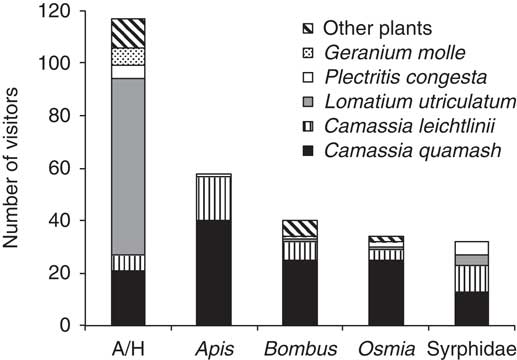
Our surveys identified over 35 species in flower during our sample episodes; abundant species included C. quamash, Geranium molle Linnaeus (Geraniaceae), Lomatium utriculatum (Nuttall ex Torrey and Gray) Coulter and Rose (Apiaceae), Plectritis congesta (Lindley) Candolle (Caprifoliaceae), and Ranunculus occidentalis Nuttall (Ranunculaceae). Only 14 of the species in flower were visited during our surveys (Fig. 1, and next section). Mean C. quamash density (number of inflorescence/m2) decreased across sampling episodes (Knockan Hill Park 1: 13.83; Knockan Hill Park 2: 1.68; Garry Oak Preserve 1: 0.88) and C. leichtlinii density was low across sampling episodes (Knockan Hill Park 1: 0.25; Knockan Hill Park 2: 0.55; Garry Oak Preserve 1: 0.03).
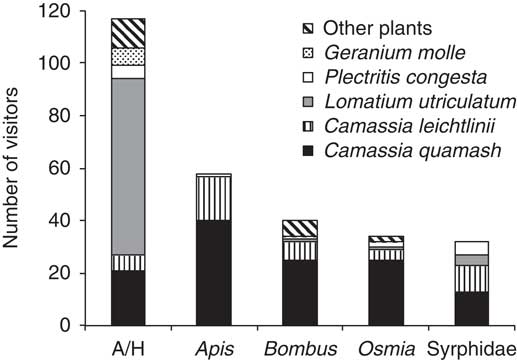
Visit patterns at our field sites as described by the number of floral visitors net-collected from 14 plant species over four hours of sampling from two sites and three dates. Only our five functional groups are shown, which comprise 281 of 320 insects collected. A/H is Andrena/Halictidae; Syrphidae includes only large-bodied species of Volucella, Eristalis, and Scaeva Fabricius. Flower species with less than five insects collected were combined into “Other plants” (Capsella bursa-pastoris (Linnaeus) Medikus (Brassicaceae), Cerastium arvense Linnaeus (Caryophyllaceae), Collinsia parviflora Lindley (Plantaginaceae), Delphinium menziesii Candolle (Ranunculaceae), Plectritis macrocera Torrey and Gray (Caprifoliaceae), Ranunculus occidentalis Nuttall (Ranunculaceae), Sanicula crassicaulis Poeppig ex Candolle (Apiaceae), Trifolium willdenowii Sprengel (Fabaceae), Vicia sativa Linnaeus (Fabaceae)).
Insects
Floral visitors
We collected a total of 320 insects comprising 44 species from 14 plant species (Knockan Hill Park 1: 140; Knockan Hill Park 2: 89; Garry Oak Preserve 1: 91; Fig. 1). Of these, 281 were in our five functional groups: Andrena/Halictidae (n = 117), A. mellifera (n = 58), Bombus (n = 40), Osmia (n = 34), and Syrphidae (n = 32). The remainder included other flies (Diptera) (n = 30), other bees (Hymenoptera) (n = 7), and butterflies (Lepidoptera) (n = 2). Of the insects in our functional groups, all but Andrena/Halictidae primarily visited the two species of Camassia (Fig. 1)
Camassia quamash visitor behaviour
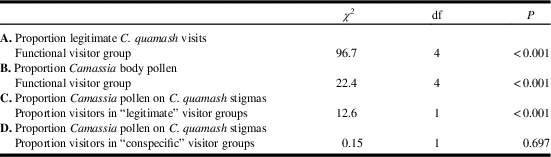
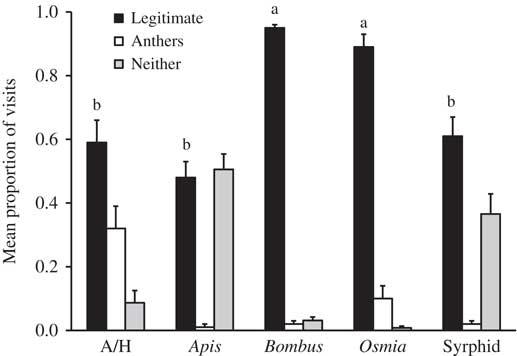
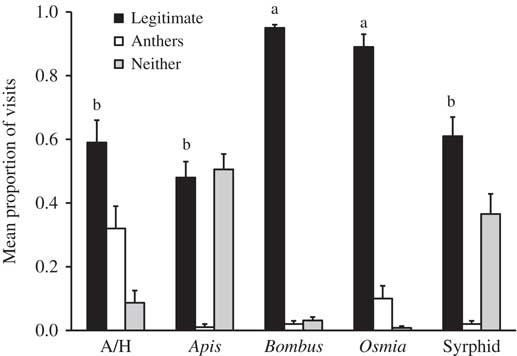
We recorded the behaviour of C. quamash visitors from each functional visitor group (Andrena/Halictidae: n = 36; A. mellifera: n = 37; Bombus: n = 70; Osmia: n = 43; Syrphidae: n = 31), and behaviour differed significantly among them (Table 1A). Tukey’s honest significant difference tests illustrated that of the ≤10 consecutive visits to C. quamash observed, the proportion of legitimate visits (contacting both anthers and stigma) made by Bombus and Osmia were significantly higher than for other groups but not significantly different from one another (Fig. 2). In addition, Andrena/Halictidae individuals were most likely to forage for pollen from C. quamash anthers without contacting stigmas, while anther visits were relatively uncommon for all other functional visitor groups (Fig. 2). Overall, A. mellifera were least likely to visit legitimately and were often observed “nectar robbing,” probing for nectar from basal gaps in the corolla without contacting reproductive structures.
Linear mixed-model statistics for explanatory variables tested for models (A) through (D).

Notes: All variables reported were included as fixed effects, and we report the Wald chi-square (χ2), degrees of freedom (df), and Type III P-values (P). Camassia quamash density was included as a random effect in (A) while combined Camassia density was included as a random effect in (B). Proportion of Camassia pollen on C. quamash stigmas arcsine transformed in models (C) and (D).
Mean proportion of “Legitimate” visits (visitor contacted anthers and stigma), “Anther” visits (visitor contacted anthers only), and “Neither” visits (visitor contacted neither anthers nor stigma) made by functional visitor groups on C. quamash flowers. A/H is Andrena/Halictidae. Letters indicate significance (P <0.05) from Tukey’s honest significant difference tests for differences among groups in “legitimate” visits after accounting for differences in Camassia density; because the three visit categories within functional visitor groups are proportions and not independent, we did not test for differences in the other two visit types (“anther” and “neither”).
Legitimate visitor groups
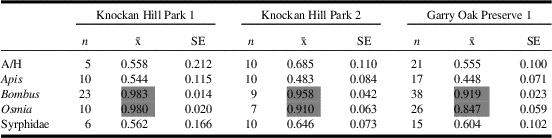
For all sampling episodes, only Bombus species and Osmia species functional visitor groups were classified as “legitimate” visitor groups using our criteria (Table 2).
Mean proportion of legitimate Camassia quamash visits made by functional visitor groups during our observations of insect behaviour. Number observed per group, site, and sampling episode indicated.
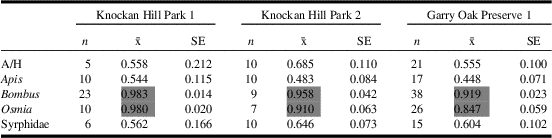
Notes: A/H is Andrena/Halictidae. Functional visitor groups for which the mean proportion of legitimate visit behaviour was ≥0.75 (midpoint of observed range of 0.5–1.0) were classified as “legitimate visitor groups.” For all sampling episodes, Bombus and Osmia classified as “legitimate” visitor groups, as indicated with grey cells.
Camassia quamash visitor body pollen
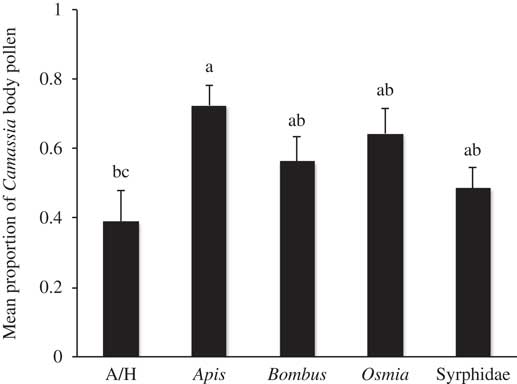
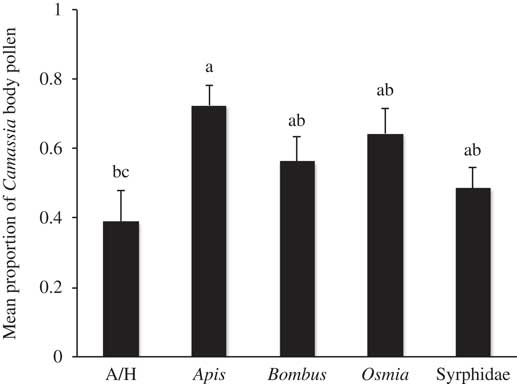
Individuals with pollen on their bodies were collected from all functional visitor groups (Andrena/Halictidae: n = 19, two excluded as <20 grains present; A. mellifera: n = 15; Bombus: n = 27; Osmia: n = 15; Syrphidae; n = 14), and the proportion of Camassia body pollen varied significantly among groups (Table 1B). To interpret functional visitor group differences we performed Tukey’s honest significant difference tests, which illustrated that the proportion of Camassia body pollen on A. mellifera was significantly higher than on Andrena/Halictidae, but did not differ from the other functional groups (Fig. 3). Andrena/Halictidae mostly visited L. utriculatum (Fig. 1) and often had less than 100 total pollen grains on their bodies; of 20 collected, one had no pollen, two had less than 20 pollen grains and were excluded, and three more had more than 20 but less than 100. In contrast all individuals of other functional visitor groups had greater than 100 pollen grains.
Mean proportion of Camassia pollen on the bodies of C. quamash visitors from functional visitor groups. A/H is Andrena/Halictidae. Letters indicate significance (P <0.05) from Tukey’s honest significant difference tests for differences among groups after accounting for differences in Camassia density.
Conspecific visitor groups
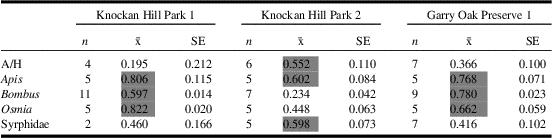
For Knockan Hill Park 1 and Garry Oak Preserve 1, A. mellifera, Bombus, and Osmia classified as “conspecific” visitor groups using our criteria. For Knockan Hill Park 2, Andrena/Halictidae, Apis mellifera, and Syrphidae classified as “conspecific” visitor groups (Table 3).
Mean proportion of Camassia body pollen on functional visitor groups, with sample size for each group, site, and sample date indicated.

Notes: A/H is Andrena/Halictidae. Functional visitor groups for which the mean proportion of Camassia body pollen was ≥0.50 were classified as “conspecific visitor groups” (midpoint of observed range of 0.2–0.8). The identities of “conspecific visitor groups” varied across sampling episodes, as indicated with grey cells, but always included A. mellifera.
Camassia quamash stigmatic pollen
Of the 100 C. quamash flowers marked for each sample episode, most stigmas had more than 20 pollen grains present (Knockan Hill Park 1: n = 71; Knockan Hill Park 1: n = 75; Garry Oak Preserve 1: n = 84). Pollen on C. quamash stigmas consisted of high proportions of Camassia pollen in all sampling episodes (Knockan Hill Park 1: x̄ = 0.91 ± 0.01; Knockan Hill Park 2: x̄ = 0.88 ± 0.02; Garry Oak Preserve 1: x̄ = 0.84 ± 0.02). The proportion of Camassia pollen on C. quamash stigmas increased (P <0.001) as the proportion of “legitimate” visitors increased (Table 1C) and did not change (P = 0.65) with the proportion of “conspecific” visitors (Table 1D).
Discussion
Our functional visitor groups differed in behaviour at flowers and in the proportion of conspecific pollen on their bodies, providing additional support for using a functional group approach (as in Ballantyne et al. Reference Ballantyne, Baldock and Willmer2015). Bombus and Osmia showed “legitimate” visit behaviour, with bees consistently contacting both anthers and stigmas of C. quamash flowers while actively foraging for nectar and pollen. Andrena/Halictidae were less likely to visit legitimately and were observed foraging almost exclusively for pollen from C. quamash anthers, often without contacting stigmas. While other studies have found Halictidae to be effective pollinators (e.g., Rader et al. Reference Rader, Howlett, Cunningham, Westcott, Newstrom-Lloyd, Walker and Edwards2009), the fact that this group foraged largely for pollen (and not nectar) in our study affected the way they visited C. quamash flowers. In addition, the relatively smaller body sizes of some of these bees (e.g., Lasioglossum (Lasioglossum) Curtis compared to Bombus species and Osmia lignaria in our data) may have reduced their potential to contact both anthers and stigmas of C. quamash.
Two other functional groups had high proportions of visits where neither anthers nor stigma were contacted, but for different reasons. Syrphid flies often landed on the petals without contacting the sex organs. Syrphidae do not actively collect pollen to provision nests as bees do which can affect their behaviour on flowers and reduce their pollination effectiveness (Ballantyne et al. Reference Ballantyne, Baldock and Willmer2015). Apis mellifera were also foraging for nectar, not pollen, but were frequently positioned behind the corolla, accessing nectar from between the backs of the petals without approaching anthers or stigma. Apis mellifera are commonly reported to be nectar robbers, a behaviour that may be used to increase foraging efficiency (Free Reference Free1968; Carbonari et al. Reference Carbonari, Polatto and Alves2009; Irwin et al. Reference Irwin, Bronstein, Manson and Richardson2010) but can reduce their contribution to pollination.
Despite this nectar robbing behaviour, A. mellifera had a high proportion of Camassia pollen on their bodies. This could be because they groom body pollen less often than some other visitors, or it could be because our net-collection data indicate they almost exclusively visited the two Camassia species during our sample dates (Fig. 1), and it is likely that at least some of those visits resulted in contact with anthers. High-floral fidelity, or selective foraging on the same floral species, is thought to contribute to high levels of conspecific pollen on the bodies of visitors (Waser Reference Waser1986; Chittka et al. Reference Chittka, Thomson and Waser1999; Brosi and Briggs Reference Brosi and Briggs2013). Although A. mellifera had the highest levels of Camassia pollen on their bodies of our functional groups, and was always classified as a “conspecific” functional group, Bombus and Osmia also had high amounts, not significantly different from that of A. mellifera. In the case of these functional groups, high body pollen may be related to their tendency to visit flowers legitimately. In contrast, Andrena/Halictidae visitors had a low proportion of Camassia body pollen, significantly lower than A. mellifera, even though they had high contact with pollen while foraging directly from anthers. They also tended to have less pollen available on their bodies for study, perhaps due to more frequent grooming behaviour. Evaluating grooming behaviour away from flowers would be interesting. Also relevant is that Andrena/Halictidae mostly visited L. utriculatum while all other functional groups preferred C. quamash (Fig. 1). Some of the species in this functional group have exhibited pollen specialist behaviour in our region (Wray and Elle Reference Wray and Elle2016).
The proportion of Camassia body pollen on syrphid flies was lower than A. mellifera, Bombus, or Osmia, but not significantly so, suggesting these flies may also play a role in conspecific pollen delivery. Indeed, furry Diptera such as Volucella are considered important pollinators for some native plants (Kearns and Inouye Reference Kearns and Inouye1994; Larsson Reference Larsson2005). In our study, all but one of the syrphid flies collected from C. quamash for pollen analysis were Volucella bombylans (Linnaeus), a species whose larvae scavenge the nests of bumblebees (Goulson Reference Goulson2003). While bees are known to transport large quantities of pollen, the role of syrphids in pollen delivery is much less understood (Goulson and Wright Reference Goulson and Wright1998; Rader et al. Reference Rader, Edwards, Westcott, Cunningham and Howlett2011; Neame et al. Reference Neame, Griswold and Elle2013).
As expected, pollen on C. quamash stigmas was primarily comprised of Camassia species (>80%), but varied with the composition of visitor assemblages on our three sample dates. Stigmatic Camassia pollen increased with the proportion of “legitimate” C. quamash visitors, but was not affected by the proportion of “conspecific” C. quamash visitors. Our finding that legitimate visit behaviour is important for pollen transfer dynamics is similar to that of other researchers (e.g., Herrera Reference Herrera1987; Fishbein and Venable Reference Fishbein and Venable1996; Ballantyne et al. Reference Ballantyne, Baldock and Willmer2015), but our finding that pollen composition (“conspecific” visitors) is unimportant is in contrast to others. Conspecific pollen receipt by flower stigmas often reflects the conspecific pollen composition on visitor bodies (Larsson Reference Larsson2005; Larson et al. Reference Larson, Royer and Royer2006; Brosi and Briggs Reference Brosi and Briggs2013). The lack of this finding in our data may be because we did not consider the possibility of mechanical isolation due to morphological differences among flower species, a hypothesis with considerable evidence in other systems (Armbruster et al. Reference Armbruster, Edwards and Debevec1994; Caruso Reference Caruso2000; Yang et al. Reference Yang, Gituru and Guo2007). For example, reproductive organs of different flower species can differentially contact ventral versus dorsal surfaces of visitor bodies (Snow and Roubik Reference Snow and Roubik1987; Caruso Reference Caruso2000). Pollen deposited on difficult-to-groom areas is likely to then be deposited on conspecific stigmas (Koch et al. Reference Koch, Lunau and Wester2017). This mechanism may contribute to high levels of Camassia pollen on C. quamash stigmas, despite a generalist pollination syndrome and a diversity of visitors.
Our results suggest that stigmatic pollen receipt in a generalist wildflower was best described by visitor behaviour, but there are limitations to our study. Our limited site/date sample size means we cannot rule out that the composition or placement of pollen on visitor bodies matters more than we were able to show, contributing (along with visitor behaviour) to pollen transfer dynamics. In addition, the bloom period of C. quamash was very short in the year of our study, preventing us from getting multiple replicates at both sites. We included two sites because we anticipated that the co-flowering community would be an important driver of patterns of pollen deposition, but were unable to test this with our limited site/date samples. The importance of variation in the co-flowering community for visitor behaviour and pollen transfer would be an interesting question for follow-up studies. In addition, in order to get a large sample size for stigmatic pollen we had to forego bagging inflorescences to ensure “virgin” stigmas for logistical reasons. This means some of the pollen on stigmas may not have been deposited on the day of our intensive characterisation of the visitor and co-flowering communities, although we made an effort to only include flowers with no pollen visible on stigmas. Despite these limitations, our approach provided insight into pollen transfer dynamics, and we encourage others to consider including the combination of behavioural observations and characterisation of pollen composition on in future studies aimed at understanding how visit patterns translate to pollination.
Conclusions
Overall, our results demonstrate that both behaviour and body pollen composition varied by functional visitor group. Bombus and Osmia behaved as “legitimate” C. quamash visitors, while other functional groups did not; the frequency of these visitors was the most important determinant of conspecific pollen receipt by C. quamash. This finding suggests that evaluating the combination of visit frequency and visit behaviour may be sufficient to determine pollination effectiveness. The proportion of Camassia body pollen varied among our functional groups, with different groups classified as “conspecific” visitors for different sampling episodes, and no detectable impact on C. quamash pollen receipt. These findings highlight the use of evaluating behaviour in combination with measuring pollen composition on both floral visitors and plant stigmas for the understanding of pollen transfer dynamics.
Acknowledgements
David Green and the Simon Fraser University Pollination Ecology Laboratory provided comments on the project and on earlier versions of this manuscript. Geneviève Reynolds assisted with field sampling. Site access was granted by The Nature Conservancy Canada and the District of Saanich. Funding was provided by the Natural Sciences and Engineering Research Council (NSERC) of Canada through a Discovery Grant to E.E.