National guidelines specify that prophylactic antibiotics be administered within 1 to 2 hours of skin incision for many, but not all, surgical procedures. Reference Ban, Minei and Laronga1–Reference Berríos-Torres, Umscheid and Bratzler3 Postoperative antibiotic prophylaxis following incision closure is discouraged and should not exceed 24 hours. Reference Ban, Minei and Laronga1–Reference Branch-Elliman, O’Brien, Strymish, Itani, Wyatt and Gupta4 Real-world surgical practices do not always adhere to these guidelines and have varied widely in national assessments. Reference Bratzler5 Assessments of neurosurgical practices have previously noted substantial discordance with World Health Organization (WHO) guidelines. Reference Matsuda, Ikawa and Ohba6 We sought to conduct a survey of surgical antibiotic prophylaxis for neurosurgical procedures.
Methods
This project received exemption from approval by our institutional review board. A survey was distributed to all Society for Healthcare Epidemiology of America Research Network (SRN) participants from November 2020 to June 2021. The SRN identification numbers were solicited to prevent duplicate responses. Survey responses were primarily categorical.
Results
Overall, 23 surveys were completed from 84 recipients for a response rate of 27%. Among 23 respondents, 4 (17%) reported they did not conduct pediatric neurosurgery; 2 (9%) of 23 reported they did not care for spine trauma patients.
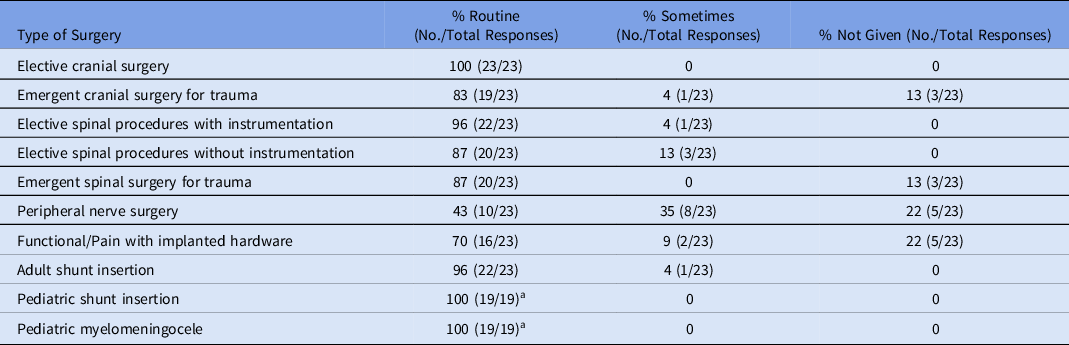
All respondents routinely administered prophylactic antibiotics for elective cranial surgery, pediatric shunt insertion, and pediatric myelomeningocele repair. Practices varied in other surgical categories (Table 1).
Use of Antibiotic Before Various Neurosurgical Procedures

a 4 respondents indicated that they did not perform these procedures.
In this study, 91% of respondents reported that they routinely administer antibiotics after incision closure in at least 1 neurosurgical procedure (Supplementary Table 1 online); 24% of respondents continued antibiotics for >24 hours postoperatively. Furthermore, 43% of respondents routinely screened patients for methicillin-resistant Staphylococcus aureus (MRSA) and methicillin-sensitive S. aureus (MSSA), and 26% routinely performed decolonization. Vancomycin powder was used routinely at 13% of centers and in a procedure-dependent manner at 30% of centers.
Across all categories, cefazolin was the most used antibiotic in each procedure, followed by vancomycin (Supplementary Table 2 online).
Discussion
Antibiotic prophylaxis is an essential component of any multifaceted approach to SSI prevention. Although multiple national and international guidelines govern perioperative decision making, real-world practice varies substantially among surgeons, institutions, and specialties. Reducing SSI risk is certainly a surgical imperative. Antibiotic stewardship is necessary to minimize antibiotic-related adverse events, such as Clostridium difficile infection, acute kidney injury, and the development of antibiotic resistance. Given this potential variability, this study was conducted to assess the current practice of antibiotic prophylaxis in neurosurgery, a field that spans a large variety of surgical procedures. Taken together, our results suggest that antibiotic prophylaxis is close to universal among neurosurgical procedures except in peripheral nerve and emergent surgery. Postoperative prophylaxis, including after closure of the incision and even more than 24 hours after surgery, is commonplace and not in compliance with clinical practice guidelines. Only a minority of surveyed centers routinely screen for MRSA/MSSA. A small number of respondents use vancomycin powder during wound closure.
The aggregate incidence of SSI, including superficial infection, deep infection, and meningitis, after craniotomy with appropriate antibiotic prophylaxis is ∼5%. Reference Korinek, Golmard and Elcheick7 Given uniform trends in both prospective and retrospective assessments of prophylaxis in cranial neurosurgery, a single dose of preoperative prophylaxis has been recommended. Reference Bratzler, Dellinger and Olsen2 Guideline recommendations for both adult and pediatric shunt procedures are similar. Postoperative prophylaxis, either up to or beyond 24 hours after closure of the incision, was used by 65% of respondents’ institutions. A similar rate of 63% was recently reported in a Japanese survey of neurosurgical practice; even among patients who received postoperative antibiotics, a plurality (40%) actually received these antibiotics for 3 days after surgery. Reference Matsuda, Ikawa and Ohba6
National guidelines also recommend antibiotic prophylaxis for both instrumented and noninstrumented spinal procedures, though it is relatively well known that noninstrumented procedures carry a lower risk of SSI Reference Bratzler, Dellinger and Olsen2 . In our survey, preoperative prophylaxis was commonly used for both subtypes of spine surgery; however, rates of postoperative antibiotic administration differed between instrumented (78%) and noninstrumented (48%) procedures. This difference may reflect continuing systemic antibiotics the entire duration of time for which surgical drains are in place postoperatively. Reference Lewis, Lin, James, Hill, Sen and Pacione8
The greatest variation in our survey was in peripheral nerve surgery. In these procedures, many of which are also performed by orthopedic or plastic surgeons in both inpatient and outpatient settings, the role of antibiotic prophylaxis is unclear due to the low incidence of SSI. Reference Bratzler, Dellinger and Olsen2 Pre- and perioperative antibiotic prophylaxis for peripheral nerve surgeries may be used more commonly by neurosurgeons who may be more inclined to do these procedures in an outpatient setting. However, we did not survey other surgical specialties to confirm this hypothesis.
Overall, ∼15%–20% of patients undergoing emergent neurosurgical procedures did not receive antibiotic prophylaxis. Although patients undergoing emergent procedures are likely at increased risk of SSI, they are also at high risk for receiving nonstandardized perioperative prophylaxis due to the fragmented and unpredictable nature of their care. Nevertheless, adherence to guidelines, even under these circumstances, has been associated with decreased risk of SSI. Reference Smith, Fox and Fakhro9
Finally, MRSA and MSSA screening and/or decolonization and vancomycin powder use during wound closure are emerging practices that have not yet been included in formal national guidelines despite evidence in favor of both practices. The results of our survey suggest that these practices are not widespread.
This study has limitations. It was a survey of SRN members, and practices from nonmember institutions were not included. The overall response rate was relatively low. Nevertheless, we believe that the results of this survey point to some areas of concern and reflect the gaps between guidelines and clinical practice in this, and likely other, surgical subspecialties.
In conclusion, antibacterial prophylaxis for neurosurgical procedures varies widely, as does MRSA and MSSA screening/decolonization and vancomycin powder use during wound closure.
Supplementary material
For supplementary material accompanying this paper visit https://doi.org/10.1017/ice.2021.488
Acknowledgments
The authors thank Valerie Deloney for her assistance with dissemination of the survey and the SRN participant institutions for taking part in the survey.
Financial support
No financial support was received for this work.
Conflicts of interest
All authors report no conflicts of interest relevant to this article.