Presidents’ ability to govern depends on their public standing. Seminal work on the United States is unequivocal on this point and identifies a consistent cycle of honeymoon, decay and rebound punctuated by elections (Mueller Reference Mueller1970; Mueller Reference Mueller1973; Neustadt Reference Neustadt1960; Stimson Reference Stimson1976). Comparative research corroborates both conclusions. In Latin America, for example, popularity exhibits similar dynamics (Carlin et al. Reference Stensöta and Wängnerudforthcoming), helps presidents finish their terms (Pérez-Liñán Reference Pérez-Liñán2007), enact their agendas (Calvo Reference Calvo2007), prevail in inter-branch bargaining (Martínez-Gallardo Reference Martínez-Gallardo2012), govern by decree (Shair-Rosenfield, Stoyan, and Sagarzazu Reference Shair-Rosenfield, Stoyan and Sagarzazun.d.) and change re-election rules (Corrales Reference Corrales2016). Popularity, in short, is power.
Mounting research, however, suggests female presidents wield that power differently than their male counterparts. Not only are they more likely to mobilize their core constituents on the basis of gender identity and network with elite feminists (Reyes-Housholder Reference Reyes-Housholderforthcoming), to advance pro-women policies and gender equality (Waylen Reference Waylen2016), and to nominate more women to cabinet posts (Reyes-Housholder Reference Reyes-Housholder2016), they are also less likely to govern by executive decree – especially when they are highly popular (Shair-Rosenfield and Stoyan Reference Shair-Rosenfield and Stoyanforthcoming). The centrality of public approval to presidential politics, coupled with distinct governing styles of male and female presidents, make the following question a research imperative: does the sex of the president influence public evaluations of him or her?
This study addresses this question first by analyzing whether female and male presidents are, on average, equally popular and whether their popularity follows similar dynamics. If not, it could suggest they face distinct opportunities to shape political outcomes. Secondly, this study tests whether the public punishes female and male presidents differently for policy failures across the domains of security, corruption and the economy. If so, the executive’s sex would become crucial to theories of mass politics, political accountability and presidentialism – a discussion to which we later return. In short, answering these questions can identify potential power discrepancies between male and female presidents and assess whether executive sex hinders the attribution of responsibility mechanisms that undergird policy accountability.
To guide our analysis, we develop a theoretical framework built on insights about gender stereotypes from the literatures on gender and politics and social, organizational and political psychology. Traditionally the executive is considered the most masculine branch of government (Duerst-Lahti Reference Duerst-Lahti1997). Gender and politics research underscores how gender stereotypes fuel the perception that female political leaders lack the stereotypical masculine attributes (such as toughness, decisiveness) associated with leadership (Alexander and Andersen Reference Alexander and Andersen1993; Huddy and Terkildsen Reference Huddy and Terkildsen1993; Lawless Reference Lawless2004; Leeper Reference Leeper1991; Schneider and Bos Reference Schneider and Bos2014). Despite an explosion of research on female presidents (Martin and Borrelli Reference Martin and Borrelli2016; Murray Reference Murray2010; Reyes-Housholder Reference Reyes-Housholder2016; forthcoming; Schwindt-Bayer Reference Schwindt-Bayer2018; Schwindt-Bayer and Reyes-Housholder Reference Schwindt-Bayer and Reyes-Housholder2017; Shair-Rosenfield and Stoyan Reference Shair-Rosenfield and Stoyanforthcoming), how gender stereotypes influence their public standing remains unclear. Hence our study makes important theoretical and empirical contributions.
Compared to their male counterparts, we expect gender stereotypes to dilute female presidents’ honeymoon support levels, make them less popular on average and raise the price they pay for policy failures. We test these expectations using quarterly measures of public approval of presidents in twenty democracies in Latin America and East Asia over the past thirty-five years from the Executive Approval Project (Carlin et al. Reference Carlin2016), economic indicators from World Bank, corruption perceptions from Varieties of Democracy (Coppedge et al. Reference Coppedge2016) and security data from United Nations and the Global Terrorism Database (2017). Corroborating expectations, results suggest female presidents enjoy less initial approval, experience exaggerated approval dynamics and their approval is more responsive to security and corruption (though not economic) outcomes. Hence mass publics endow female presidents with less power to shape policy throughout their administrations and hold them to higher standards in key policy areas than male presidents.
The rest of this study proceeds as follows. First, we theorize how gender stereotypes influence public evaluations of the president and identify some observable expectations. Next we describe the data and methods used to test our expectations. After reporting and discussing our results, our conclusion explores their broader implications.
Gender Stereotypes and Presidential Approval
Our theory assumes gender stereotypes lead the public to apply stricter, and even double, standards to female presidents. As a result, they should tend to begin their terms with lower levels of approval than men, govern with less approval than men and sink to lower levels over the course of their terms than men. Additionally, poor performance on valence issues should, on average, be more damaging to female presidents than male presidents. Let us consider each of these propositions in turn.
Psychic handicaps: exceptions, tokens, double standards and double binds
The notion that female presidents are less popular than male presidents might seem counter-intuitive. If one typically breaks the ‘highest glass ceiling’ by besting at least one male candidate, then the negative gender stereotypes that might otherwise undermine a woman’s successful bid for the presidency are unlikely dominant in society. By this logic, women might be expected to enjoy higher levels of presidential approval than men. But female presidents’ pathways to power and the contexts surrounding their elections often augur against it, spurring powerful counter-narratives that sap their public legitimacy.
Critics can, for example, overshadow the significance and novelty of electing a country’s first woman president by crediting her triumph to exceptional circumstances that create space for outsiders (Jalalzai Reference Jalalzai2013; Jalalzai Reference Jalalzai2016; Skard Reference Skard2015; Schwindt-Bayer Reference Schwindt-Bayer2010) – such as a democratic transition, a post-conflict situation, severe political mistrust. Other counter-narratives link women’s rise to power to privileged connections with a male political leader, that is, wives/widows, daughters and protégées (see Hinojosa Reference Hinojosa2012, chapter 7). Although many male presidents have benefitted from similar circumstances (Carreras Reference Carreras2012) and connections (Reyes-Housholder and Thomas Reference Reyes-Housholder and Thomas2018), these counter-narratives can nevertheless undercut public support for female executives, as we explain below.
Such counter-narratives are sustained by well-known psychological foundations. Our workhorse is the Lack of Fit Model, which presupposes that expectations about a person’s success at a particular task affect evaluation processes (Heilman Reference Heilman2001, 660; see also Heilman Reference Heilman1995). Through this lens, gender stereotypes ought to influence presidential approval because effective political leadership requires actors to display agentic traits – such as aggressiveness, ambition, forcefulness, self-sufficiency, self-confidence – generally associated with men (Alexander and Andersen Reference Alexander and Andersen1993; Bakan Reference Bakan1966; Eagly Reference Eagly1987; Huddy and Terkildsen Reference Huddy and Terkildsen1993). However, most people associate women with the oppositeFootnote 1 – communal traits – such as affection, compassion, kindness, helpfulness and gentleness. These widespread (cf. Hartmann Reference Hartmann2006; Williams and Best Reference Williams and Best1990) and remarkably durable (Deaux and Kite Reference Deaux and Kite1993, 114) gender stereotypes create incongruity between the essential qualities of leadership and expectations for female leaders (Eagly and Karau Reference Eagly and Karau2002; Fulton Reference Fulton2014). In turn, this ‘lack of fit’ leads the public to evaluate female presidents more harshly than male presidents.
Additionally, gender stereotypes feed skepticism towards female executives. Scholars cite a double standard whereby women political executives are subjected to closer scrutiny and stricter demands than their male colleagues (Skard Reference Skard2015, 78). This argument parallels organizational psychology research highlighting a double standard in evaluations of the job performance of female and male leaders or managers (Berger et al. Reference Berger1986). Experimental research consistently shows that when female and male subjects achieve equal levels of performance, women are held to stricter competence standards (Foschi Reference Foschi1996; Foschi Reference Foschi2000; Heilman Reference Heilman2001). In other words, female leaders must outperform men to be considered equally competent. After interviewing fifteen women presidents and prime ministers from around the world, Liswood (Reference Liswood1995, 68) reaches the same conclusion: ‘on no question posed to women at the top was there more uniformity than on this one: Are women leaders scrutinized differently than male leaders? From all quarters came a resounding Yes.’ Female executives felt they had to work harder than men because the public, the press and other politicians doubted their capacities.
What fosters this double standard? The main mechanism at work is asymmetric performance attribution. Women’s success in managerial roles is more often attributed to luck or effort than to ability. Yet their failures tend to be ascribed to lack of ability. For men, the logic is reversed. When men succeed, it is attributed to their ability, but when they fail it is chalked up to bad luck or lack of effort (Deaux and Emswiller Reference Deaux and Emswiller1974; Nieva and Gutek Reference Nieva and Gutek1980; Swim and Sanna Reference Swim and Sanna1996).
Hypothetically, female political leaders could dodge such bias by adopting a posture that clearly contradicts these stereotypes, by acting tough and leading assertively. Practically, this is futile for two main reasons. First, sociologists find that in male-dominated arenas, such as politics, women are usually seen as ‘tokens’ of their groups (Kanter Reference Kanter1977). Sapiro (Reference Sapiro1981, 711) notes that, even when they do not claim to represent women, ‘female candidates and officeholders are forced into a “woman’s role,” or at least they are forced to be defined as “woman” candidates or politicians rather than simply as candidates or politicians’. Gender stereotypes are also hard to shake because they are not only descriptive but prescriptive (Burgess and Borgida Reference Burgess and Borgida1999). Prescriptive norms require women leaders to be nurturing and to seek compromises, not assertive or aggressive. Since behaving ‘agentically’ violates these prescriptive norms for women (Heilman Reference Heilman2001; Rudman and Glick Reference Rudman and Glick2001), this strategy could backfire, fueling public disapproval of female presidents. Indeed female executives are often derided as authoritarian or too aggressive.Footnote 2 Traits considered normal or fitting in a male president are disparaged in female presidents, thus depressing their public standing (Goodyear-Grant Reference Goodyear-Grant2013). Female presidents thus face a femininity/competence ‘double bind’ (Jamieson Reference Jamieson1995): if they are caring and kind, their political ability is questioned, but if they display assertiveness and competitiveness, they are criticized for lacking femininity (Carroll Reference Carroll2009). Therefore, we expect gender stereotypes to condition public evaluations of female presidents.
The gendered toll of policy failures on presidential approval
Building on this theoretical scaffolding, we expect gender stereotypes to translate into gendered differentials in punishment for policy failures in a range of domains. While presidents can, generally, expect rising corruption, economic downturns and escalating insecurity to damage their public standing, we expect the damage will be worse for female presidents than for their male counterparts. We see these claims as a series of auxiliary hypotheses to our original expectation that gender stereotypes undermine the popularity of female presidents. As such, to the extent these expectations are consistent with empirical reality, they should bolster our stereotyped-based theoretical framework.
How gender stereotypes lead to differential public scorn for men and women leaders is, perhaps, clearest in the case of corruption. Women are generally believed to be morally superior to men and, hence, less politically corruptible (Barnes and Beaulieu Reference Barnes and Beaulieu2014; Barnes and Beaulieu n.d.; Goetz Reference Goetz2007). Traits such as ‘honesty’, ‘trustworthiness’ and ‘integrity’ are more consistently associated with female politicians (Alexander and Andersen Reference Alexander and Andersen1993; Huddy and Capelos Reference Huddy and Capelos2002; Huddy and Terkildsen Reference Huddy and Terkildsen1993; Kahn Reference Kahn1996). These stereotypical traits of female politicians are particularly salient in the electoral arena. While corrupt bureaucratic institutions tend to constrain the behavior of women, female executive candidates have more leeway to develop their own agenda and embrace an anti-corruption message consonant with their value preferences. Women tend to emphasize their integrity for strategic reasons also, to stand out and attract votes (Stensöta and Wängnerud Reference Stensöta and Wängnerud2018; Stensöta, Wängnerud, and Svensson Reference Stensöta, Wängnerud and Svensson2015). While women’s perceived edge over men on these traits is an asset for female presidential candidates during campaigns, especially where corruption is rife, once in office these traits exaggerate expectations of probity for women. Since corrupt behavior is profoundly counter-stereotypical and violates prescriptive gender norms of purity, honesty and morality, a female president implicated in corruption could lead to exaggerated punishment in the court of public opinion (Eggers, Vivyan, and Wagner Reference Eggers, Vivyan and Wagner2018).
Work on scandals demonstrates how severely the public castigates women politicians for transgressing these stereotypical norms (Barnes, Beaulieu, and Saxton Reference Barnes, Beaulieu and Saxtonforthcoming; Barnes, Beaulieu, and Saxton Reference Barnes, Beaulieu and Saxton2018). More generally, Skard (Reference Skard2015, 192) notes ‘corrupt practices continued [under female presidents in the Philippines and Indonesia], and the women presidents were hit all the hardest by allegations of corruption and nepotism because they had promised principled governance’. Dramatic events elsewhere echo this point. Revelations of massive corruption schemes begun under their male predecessors led to the impeachment of Dilma Rousseff and calls for Michelle Bachelet to step down in Brazil and Chile, respectively. Argentina’s former president, Cristina Fernández de Kirchner, has been indicted on multiple fraud and corruption charges and public opinion is overwhelmingly against her. But when the Panama Papers linked incumbent, Mauricio Macri, to illegal offshore tax havens, his approval ratings did not sustain any lasting damage. While male South Korean presidents have not been immune to accusations of corruption and cronyism, evidence implicating female president, Park Geun-hye, in abuses of power led to the country’s first impeachment in 2017. In a similar vein, Joyce Banda (first female president of Malawi) received a higher electoral sanction for her implication in a corruption scandal (Cashgate) than male incumbents facing similar corruption allegations in previous elections. While corrupt male incumbents tend to easily win reelection in Malawi, Banda was defeated and only received 20 per cent of the votes in the 2014 presidential elections (Dulani et al. Reference Dulaniforthcoming; Lora-Kayambazinthu and Kalilombe Shame Reference Lora-Kayambazinthu and Kalilombe Shame2016). In short, since corruption runs counter to women’s perceived rectitude, we expect women presidents to pay more dearly for it.
Beyond corruption, crisis contexts can activate stereotypes and increase their influence on mass opinion in other policy domains. The psychological processes whereby citizens tend to attribute stereotypical leadership qualities to politicians based on their sex result in the stereotypical attribution of issue skills. Hence men are perceived to perform better on ‘masculine’ issues (defense, security, foreign affairs), which require tough, rational, emotionally stable and decisive leaders; that is, the stereotypical characteristics of male political leaders (O’Brien and Barnes Reference O’Brien and Barnes2018). Indeed, Tickner’s seminal work argues that gender-based leadership stereotypes ‘reinforce the belief, widely held [. . .] by both men and women, that military and foreign policy-making are arenas of policy-making least appropriate for women’ (1992, 3). On the contrary, women are perceived as more qualified to deal with ‘feminine’ issues (health care, education and the environment), policy domains more closely associated with stereotypical female characteristics (Alexander and Andersen Reference Alexander and Andersen1993; Huddy and Terkildsen Reference Huddy and Terkildsen1993; Sjoberg Reference Sjoberg2014). We argue that the policy failures of female presidents in ‘masculine’ policy areas activate gender stereotypes, and result in steeper declines in public approval.
In particular, publics often hold negative stereotypes regarding women’s ability to deal with issues of physical security, including foreign and domestic terrorism (Holman, Merolla, and Zechmeister Reference Holman, Merolla and Zechmeister2011; Holman, Merolla, and Zechmeister Reference Holman, Merolla and Zechmeister2016), defense (O’Brien and Barnes Reference O’Brien and Barnes2018) and crime (Dolan and Lynch Reference Dolan and Lynch2016; Sanbonmatsu and Dolan Reference Sanbonmatsu and Dolan2009). Political opponents and the media may implicitly reinforce these stereotypes by questioning female presidents’ competence on security. Therefore, when faced with significant security challenges (crime, terrorism) female leaders should enjoy limited, if any, rally-round-the-flag effects. And since, as mentioned above, women’s failure in ‘masculine’ tasks tends to be attributed to intrinsic inability, whereas men’s failure in those same tasks tends to be attributed to external factors (such as bad luck) (Swim and Sanna Reference Swim and Sanna1996), the president’s sex could be expected to affect how the public attributes responsibility for security crises. Female presidents might be perceived as directly responsible because stereotypes suggest they are incompetent in this area, whereas male presidents’ failures may be deflected from incompetence onto external factors. By this rationale, female presidents should be expected to suffer greater declines in approval than male leaders when foreign or domestic terrorist attacks occur or crime spikes.
Finally, policy failure in the economic realm could lead to divergence in public approval for female and male presidents. Though the gender and politics literature often considers economics and finance as male domains, the empirical record, and thus our expectations, are decidedly mixed. Research on women’s political representation in Latin America demonstrates that women are less likely to be appointed to economic committees in the legislature (Schwindt-Bayer Reference Schwindt-Bayer2010) and economic portfolios in the cabinet (Escobar-Lemmon and Taylor-Robinson Reference Escobar-Lemmon and Taylor-Robinson2016). The implication is that women are discriminated against and not considered good economic managers. This may well be the case for Latin American party leaders, but it is not necessarily indicative of gender stereotypes in the economic domain among the public at large. Indeed, Funk Hinojosa, and Piscopo (Reference Funk, Hinojosa and Piscopo2017) find that while the public’s economic perceptions are positively related to the likelihood of women being nominated as legislative candidates in Latin America, they do not systematically influence women’s electoral success in the region. Hence the clear bias against female politicians in the economic domain among party gatekeepers is inconsistent with evidence of such bias in the electorate. In other words, the elite-level dynamics that lead to the underrepresentation of women in top economic posts cannot clearly be attributed to widespread gender stereotypes in the economic domain.
Similarly, political psychologists find no systematic link between stereotypical traits attributed to female and male politicians and perceptions of economic expertise and effective economic management. According to Huddy and Terkildsen (Reference Huddy and Terkildsen1993, 122), ‘personality traits that might improve a candidate’s standing on economic matters are simply not thought of as exclusively male or female characteristics […]. On the basis of trait stereotypes, we would not necessarily expect voters to rate male or female politicians as better able to handle economic issues’. Several studies corroborate this conclusion (Alexander and Andersen Reference Alexander and Andersen1993; Leeper Reference Leeper1991; Sapiro Reference Sapiro1983; Williams and Best Reference Williams and Best1990).
Clearly, the literature contains competing arguments that augur against a simple theoretical expectation. If the scholarly ambiguity is replicated among the public, then female presidents may not be more harshly punished than their male counterparts for economic downturns. Such a null finding in this domain could be interpreted as evidence of the power of gender stereotypes in the domains of corruption and security and their relative weakness in the economic domain. Evidence consistent with gender bias among the public in the economic domain, however, could allow our results to weigh in on this unresolved matter. We present two-tailed hypothesis tests to address both possibilities.
Data and Methods
To test our expectations we employ data from third-wave democracies with presidential systems, that is, with (a) a single popularly elected head of state and government, not accountable to the legislature or (b) a popularly elected head of state and a separate head of government, with the latter not accountable to the legislature (Siaroff Reference Siaroff2003). Beyond this institutional commonality, cases in our sample share liberalizing development arcs and democratization processes marked by relatively high degrees of Western linkage and leverage (Levitsky and Way Reference Levitsky and Way2005) – characteristics not shared by established Western presidential democracies, such asthe United States – which could affect presidential approval dynamics and accountability.
Sample
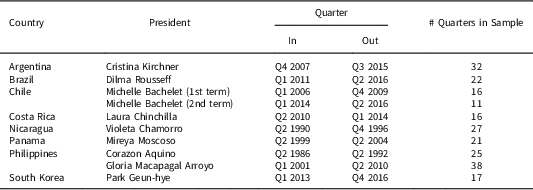
Our sample is comprised of the most recent post-transitional periods in Argentina, Bolivia, Brazil, Chile, Costa Rica, Colombia, Dominican Republic, Ecuador, El Salvador, Guatemala, Honduras, Mexico, Nicaragua, Panama, Paraguay, Peru, the Philippines, South Korea, Uruguay, and Venezuela. These twenty cases account for two-thirds of the universe of presidential systems per Siaroff (Reference Siaroff2003); data limitations preclude the other ten.Footnote 3 Our sample also includes ten female presidents or two-thirds of the universe (see Table 1).Footnote 4 Given the relatively few cases of female presidents to date, we opted for including in our sample all female presidents for which we have data (six from Latin America and three from East Asia); but since gender stereotypes are prevalent cross-nationally in different cultural contexts (Fiske Reference Fiske2017; Hartmann Reference Hartmann2006; Williams and Best Reference Williams and Best1990) we fully expect our results would hold if data were available for other cases in Asia and Africa.
Observations of Female Leaders in Our Sample

Restricting our sample to either Latin America or East Asia would reduce not only external validity, but statistical power and our estimates’ reliability as well. Indeed, the Philippines and South Korea make up 33.33 per cent of the female presidents in our sample.Footnote 5 Moreover, variation on our key explanatory variables is more pronounced within these regions than across them. For example, South Korea rates between Costa Rica and Argentina on V-Dem’s corruption scale; the Philippines is on par with Mexico. With regards to security, the Philippines’ homicide rate is nearly identical to Peru’s with South Korea and Chile having similarly low levels of crime and political violence. As for economic growth, the Philippines is no outlier, with similar rates of growth (and contraction) as many Latin American cases. South Korea’s economy has generally fared better than the Latin American cases, but like many of them, such as Argentina and Chile, it too has seen periods of significant contractions along with periods of booming growth.
The extensive overall variation Latin America boasts on these dimensions is, nevertheless, attenuated under female presidents. For example, according to Transparency International, corruption tends to be lower in Latin American countries with female leaders than in the Philippines (only Nicaragua rates worse) but higher than in South Korea (only Chile and Costa Rica rate better). And although some Latin American female leaders have presided over discrete incidents of terrorism, the regional hotbeds (Colombia, Peru, El Salvador) lack female presidents. Conversely, in the Philippines terrorist attacks have been relatively high under both male and female presidents (see Figure 1).
Terrorist incidents in the Philippines (1986–2016). Source: Global Terrorism Database.

One potential drawback of our broad sample is that cultural norms and the nature of gender stereotypes may exhibit national and regional idiosyncrasies (see Murray Reference Murray2010). To the extent that this is true, finding support for our hypotheses should be harder. In all, sampling across regions helps maximize variation on our main explanatory variables – president sex conditioning honeymoons and performance in the economic, corruption and security domains – which facilitates our hypothesis test and bolsters generalizability.
Measuring presidential approval
The Executive Approval Project (Carlin et al. Reference Carlin2016) collects multiple aggregate survey data series from public and private polling firms for each country in our sample. In their natural forms, these data series present two key challenges for creating comparable and reliable time-serial measures of presidential approval. First, question wordings and response options differ from firm to firm and even from survey to survey within the same firm. Second, the periodicity at which firms run surveys can vary from weekly to biennially. Looking across countries, rarely are the same questions polled regularly in more than a handful of countries. Not surprisingly, much of the previous work on comparative executive approval is limited to data sources from single firms that have maintained the same question wording and sample structure over a number of years (Campello and Zucco Jr. Reference Campello and Zucco2016; Cuzán and Bundrick Reference Cuzán and Bundrick1997; Fernández-Vázquez Reference Fernández-Vázquez2007; Johnson and Schwindt-Bayer Reference Johnson and Schwindt-Bayer2009; Pérez-Liñán Reference Pérez-Liñán2007).
To overcome these challenges we turn to an approach first developed for analyzing presidential popularity and macro public opinion in the United States. Stimson’s (Reference Stimson1991) dyads-ratio algorithm combines all available approval series from multiple polling firms into country-specific measurement models to generate quarterly time series of presidential approval that are valid and comparable across presidents, countries and time. More technically, Stimson’s approach converts each individual time series of presidential approval in a given country into temporal dyadic ratios. Using forwards and backwards recursion, the algorithm computes communalities between the various data sources and time points. From these communalities the algorithm creates a time-continuous measure of approval. Thus, this recursive algorithm allows for numerous disparate public opinion sources to be reliably and consistently combined into a single unidimensional series capturing the public’s view of the executive (see Stimson Reference Stimson2018 for a detailed explanation). Through it, we have generated quarterly measures of presidential approval Footnote 6 for over 150 presidential administrations from eighteen Latin American countries, South Korea and the Philippines from the 1970s to 2017. This is our dependent variable.
A key proposition of this article is that female presidents are, on average, less popular than male presidents. While this hypothesis can and will be tested with a dummy variable indicating the sex of the president, the dynamics of presidential approval offer additional points of comparison. Specifically, do female and male presidents have similar honeymoons, decays in support and end-of-term campaign effects? Our analysis does not force honeymoons to be of a specific duration based on previous work. Rather, we derive it empirically using a set of dummies indicating quarters elapsed since the election and another set for the two quarters remaining until the next presidential election.
Explanatory variables
Beyond how approval differs across the sex of presidents, we are also interested in how the public views female and male presidents when faced with differing governance challenges. As outlined above, we analyze gender differentials in aggregate approval across three issue areas: corruption, security and macro-economy.
We gauge corruption with the index of political corruption that Varieties of Democracy (V-Dem) calculates from country expert surveys of corruption perceptions in various aspects of the government (executive, legislature, judiciary and public sector) (Coppedge et al. Reference Coppedge2016). While V-Dem includes a specific measure for executive corruption, often presidents (including women) are judged not only on their perceived ability to control corruption in the presidential palace but across the public sector as well (Pérez-Liñán Reference Pérez-Liñán2007; Reyes-Housholder Reference Reyes-Housholder2018). We also select the V-Dem scale over other public corruption measures for a key reason: it has greater temporal coverage than any other measure for our sample. However, our results are unchanged if we substitute Transparency International’s Corruption Perceptions Index for the V-Dem measure (see Table A5 in the online appendix).
Physical security is operationalized with two indicators. The first is crime. Measuring crime rates is complicated within countries and becomes dramatically more so across countries. Underreporting by ineffective police can make a country seem safer than it is. Scholars commonly overcome this challenge by focusing on a particularly serious crime that is least likely to go unreported – homicide. In many Latin American countries and in the Philippines violent crime has remained a salient public issue for decades.Footnote 7 Since 2004, Latin Americans surveyed in the AmericasBarometer consistently rank crime (along with the economy) among the top two most important problems (one in three respondents say it is the most important issue). We approximate crime with United Nations’ annual homicide rate data. Since they are not reported annually for every country we fill in missing years using linear interpolation. Our second indicator is terrorism. Here we use the number of terrorist attacks per quarter from the Global Terrorism Dataset (2017). Because we have no a priori expectation regarding domestic versus internationally derived terrorist attacks on presidential approval, and completely international attacks are rare in our sample, we include all attacks recorded in the GTD. However, if we exclude those with an international component (ideological, logistical, etc.) the results are unchanged.Footnote 8
For the economy, we use the World Bank’s World Development Indicators data to measure GDP per capita growth (growth) and natural log of inflation. Since these variables are measured on a monthly basis for most of the period covered, they are aggregated into quarterly averages for our analyses. All other contextual variables are measured annually. To match them to our quarterly approval series, we follow Carlin, Love, and Martinez-Gallardo (Reference Carlin, Love and Martínez-Gallardo2015a) and Carlin, Love, and Martinez-Gallardo (2015b) and linearly convert these annual data series into quarterly data series.Footnote 9
Our empirical tests of the relationship between sex and presidential approval employ both semi-parametric and parametric approaches. First, we use smoothed kernel-weighted local-regression to see if female and male presidents have, on average, different patterns of popularity. While this approach gives us a flexible and general view of gender differences in presidential approval it cannot tell us whether the public responds differently to adversity regarding corruption, security and the economy depending on the sex of the president.Footnote 10 To test these arguments we turn to a parametric approach – panel regression with panel-specific AR(1) corrections (for serial correlation) and country fixed-effects (for panel heteroskedatiscity). The inclusion of a regional control variable for the East Asian cases is consistently insignificant (see Table A8 in the appendix). Lags of independent variables are included where model fit indicates their appropriateness. The results reported are generated from an OLS model but are identical to those produced from a panel GLS model. Below we include additional details on modeling choices.
Results
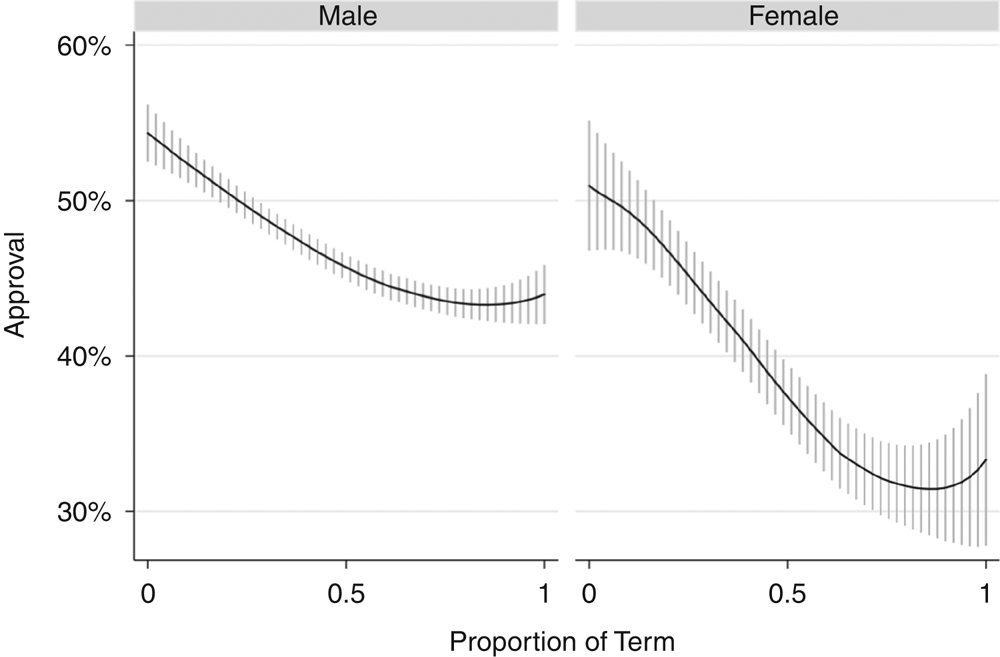
Starting with the semi-parametric approach, Figure 2 graphs presidential approval (y-axis) over the proportion of the term (x-axis) for male (left panel) and female presidents (right panel). It shows how strikingly different the overall patterns of approval are depending on the sex of the president. Male presidents, on average, enter office with higher approval levels than female leaders; they also enjoy longer honeymoons. Female presidents tend to begin their terms 5.75 percentage points lower than men according to a t-test (p=0.03) based on the first tenth of their tenure. Additionally, they suffer steeper declines over the course of their terms and reach a significantly lower floor than male presidents (30.5 per cent versus 43.9 per cent, p=0.000). Overall, the results displayed in Figure 2 strongly support our theoretical expectation that female presidents are, generally, viewed with a more critical eye than male leaders and their popular support suffers in turn. Though female presidents appear to have a more pronounced end-of-term campaign bump, neither this bump nor the observed bump for male presidents – let alone the difference between them – is significant.
Smoothed public approval of male and female presidents. (w/95% c.i.)

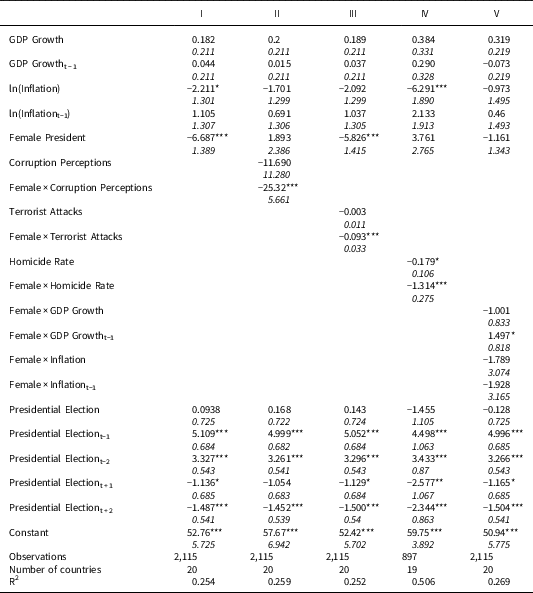
While the semi-parametric approach has the distinct advantage of allowing the data to speak more independently from modeling decisions it also is somewhat limited in its ability to provide direct tests of how and when the public evaluates female presidents differently than male presidents. Thus, Table 2 displays the results from time-series cross-sectional models. Model I is the baseline test of whether or not, on average, the public rates female leaders less favorably than male leaders, controlling for economic conditions and honeymoon effects (the election lags and leads). The results replicate those of the semi-parametric model in Figure 2: female presidents, on average, are significantly less popular than male presidents. Specifically, they are 15 per cent less popular (roughly 7.2 percentage points).
Sex and Executive Approval in Twenty Presidential Democracies

Country Fixed-Effect regression with panel-specific AR1 corrections. Standard errors in italics.
*** p<0.01, ** p<0.05, * p<0.1.
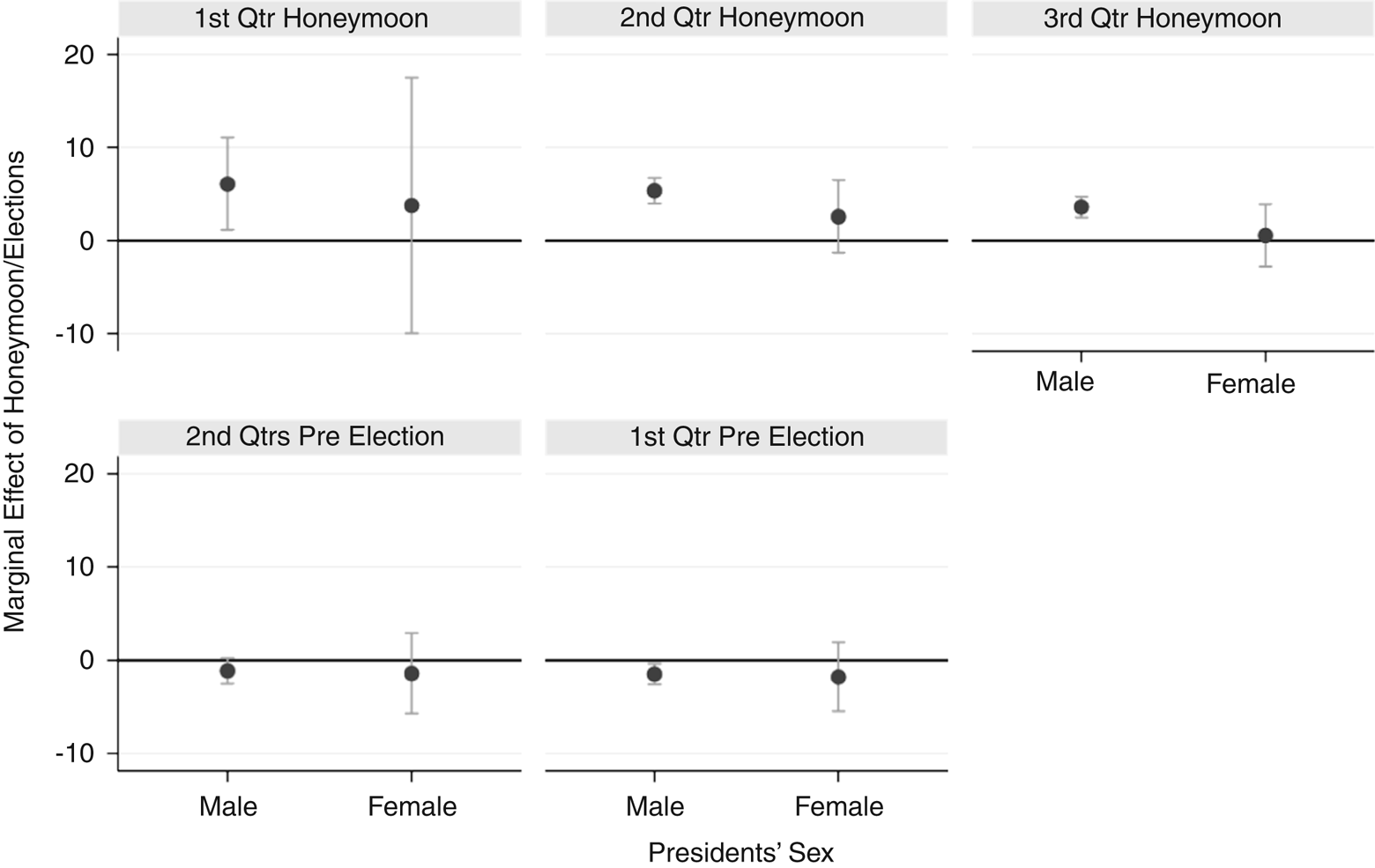
Turning to sex differentials vis-à-vis election effects, we produce the marginal effects for three quarters following an election to capture the honeymoon period and for two quarters preceding an election for male and female presidentsFootnote 11 (additional quarters are not significant in either case). Figure 3 clearly illustrates that while male presidents enjoy significantly greater approval during the first three months of their presidencies in comparison to the rest of their tenure, female leaders have, at best, a very limited and short-lived honeymoon. While the differences in honeymoon effect for each individual quarter between male and female presidents are insignificant,Footnote 12 the cumulative impact of negligible honeymoon effects for female presidents means that the total honeymoon effect between male and female leaders is substantial (7.2 percentage point gap) and significant (p=0.001). The figure also shows that female presidents revert to the sample mean at the end of the term while male leaders remain about 1 percentage point below it. This fits Figure 2 – female leaders’ approval falls faster and into a much greater trough than male leaders but with the possibility of an end of term bounce that male leaders do not experience (however, the bounce only brings female leaders to parity with male leaders).
Honeymoon/election effects by sex (95% c.i.).

The related set of expectations regarding public evaluations of female and male leaders in the areas of corruption, physical security and economic performance are tested in models II–V of Table 2. Model II tests our theory that perceived public corruption damages female leaders’ public standing more than their male counterparts. Results are consistent with this expectation. The sharp sex-based effect is highlighted in the top graph of Figure 4, which plots the predicted approval levels for male and female presidents across the range of observed public corruption ratings for female leaders. Mounting corruption perceptions have essentially no effect on male presidents’ approval ratings but significantly, and substantially, damage public support for female presidents.
Conditional presidential approval, by sex (w/95% c.i.).

The last two elected presidents in Brazil effectively illustrate the general pattern shown in Figure 4. Both Luiz Inácio ‘Lula’ da Silva (a male) and Dilma Rousseff (a female) presided over major corruption scandals, but the consequences were much direr for Rousseff than for Lula. During Lula’s first term, the ruling party (Partido dos Trabalhadores or PT) was accused of making large monthly payments to a number of deputies in exchange for votes supporting the agenda of the PT (Pereira, Power, and Raile Reference Pereira, Power and Raile2008). Lula was never charged for this highly publicized scandal – known as the ‘mensalaõ’ – but many of his key advisers were sentenced and several others were forced to resign. Most crucially for our purposes, Lula’s approval rate was largely unaffected and he easily won reelection in 2006. Moreover, his approval ratings during his second term defied the common pattern of cyclical approval, increasing steadily over time (Santos Mundim Reference Santos Mundimn.d.).
In stark contrast, Rousseff’s popularity nosedived as a result of corruption allegations. Despite being widely perceived as ‘one of the few politicians in Brazil not to accept bribes’ (Watts Reference Watts2016), Rousseff faced accusations of manipulating the federal budget to conceal economic problems and improve fiscal outcomes ahead of the 2014 elections. Window-dressing government accounts is arguably a much less serious offense than bribing opposition deputies. Nevertheless Rousseff suffered a steep decline in her popularity. By late 2015, her approval rate had sunk from the 40s at the time of her reelection to just 8 per cent. Massive street demonstrations and widespread public support for her impeachment (Romero Reference Romero2016) eventually ended in Rousseff’s impeachment and removal from office in 2016. In sum, if we compare recent male and female Brazilian presidents from the same political party, the male survived a major corruption scandal almost unscathed and remains in the hunt for a second reelection while a comparatively less serious corruption allegation unseated the female.
Physical security is another performance area we expect to generate sex-based divergence in leader evaluations. Models III and IV suggest the popularity of female leaders is, indeed, more sensitive than that of male leaders to terrorist attacks and homicide rates. The middle graph in Figure 4 illustrates that an upturn in terrorist attacks neither boosts nor tanks male leaders’ approval, possibly due to countervailing effects of ‘rally-round-the-flag’ and security failures (Carlin, Love, and Martínez-Gallardo Reference Carlin, Love and Martínez-Gallardo2015b; Romero, Magaloni, and Díaz-Cayeros Reference Romero, Magaloni and Díaz-Cayeros2016).Footnote 13 But an escalation in terror attacks erodes female leaders’ public standing. As for the homicide rate, increases hurt both male and female leaders. However, as the bottom graph of Figure 4 displays, the negative slope for male leaders is nowhere near as steep as that of female leaders. We also note that the top and bottom graphs in Figure 4 suggest the public generally supports male and female presidents equally well when times are good – when corruption is low or homicides are rare. It is only when conditions deteriorate that public evaluations of female and male leaders diverge.
The Philippines is a good case to compare the effects of physical security outcomes on the popularity of female and male presidents. Terrorism has been a major policy problem in the Philippines since the early 1970s (Banlaoi Reference Banlaoi2007; Ferrer Reference Ferrer2007). A leftist insurgency (the New People’s Army) and Islamic militant groups (Moro Islamic Liberation Front and Abu Sayyaf Group) have committed thousands of terrorist attacks. However, as can be observed in Figure 1, the number of terrorist attacks varies over the Philippines’ democratic period from lows near zero in some quarters to more than 200 in others.
Compare the administrations of female president, Gloria Macapagal Arroyo (2001–10), and her male successor, Benigno Aquino III (2010–16). As Figure 1 illustrates, under Gloria Macapagal Arroyo terrorist incidents were far fewer (27 per quarter on average) than under Benigno Aquino III (118 attacks per quarter on average). In spite of governing during a period of significantly lower terrorist activity in the country, the average approval of Gloria Macapagal Arroyo was much lower (23 per cent) than that of Benigno Aquino III (55 per cent).
It is also informative to contrast how spikes in terrorist attacks affected these presidents’ popularity. A massive rise in terrorist incidents in 2008 (275, up from 65), nearly cut Gloria Macapagal Arroyo’s approval ratings in half (from 22.5 per cent to 12 per cent). By contrast, when terrorist attacks nearly doubled in the first quarter of 2013 (from 64 to 104) Benigno Aquino III’s popularity did not fall – in fact, it rose slightly (60 to 64 per cent) in the next quarter. Only after several years of more than 100 attacks per quarter did his approval rate start dropping, and then only marginally, staying well above 40 per cent.
In sum, contemporary evidence from the Philippines elucidates the differential punishment the public metes out for security failures depending on the sex of the president. In line with our theoretical intuitions, the female president (Gloria Macapagal Arroyo) suffered a greater decline in approval than her male successor (Benigno Aquino III) when terrorist attacks spiked. Moreover, she had a much lower average approval rate despite governing during a period with much fewer terrorist incidents.
Model V reveals no substantial evidence that the public judges female and male presidents differently when it comes to economic conditions (Growth or Inflation). Neither female nor male leaders are consistently rewarded for economic growthFootnote 14 yet both are punished for high levels of inflation. These results resonate with political psychology research implying trait stereotypes about economic acumen are not gendered. As such, they bolster our theory, which hinges on clear stereotypes. Our results also underscore the potentially novel conclusion that the gender bias that reduces women’s appointments to top economic posts in legislatures (Schwindt-Bayer Reference Schwindt-Bayer2010) and cabinets (Escobar-Lemmon and Taylor-Robinson Reference Escobar-Lemmon and Taylor-Robinson2016) and nominations as legislative candidates (Funk, Hinojosa, and Piscopo Reference Funk, Hinojosa and Piscopo2017) is not replicated among the mass public. Therefore, women’s lack of advancement to positions of economic power may owe more to supply-side, elite bottlenecks than demand-side, voter stereotypes. Such a conclusion is consistent with public opinion’s comparatively more central role in determining who runs and wins the presidency and party elites’ more determinative role in legislative and cabinet nominations. We stress the tentative nature of this conclusion and call for more research on gender stereotypes vis-à-vis presidents’ economic management.
Overall, these analyses reveal contrasting patterns of public job approval across male and female presidents that are consistent with our stereotypes-based theory. On average, female leaders come into office with less support than male leaders and their support erodes more quickly. Furthermore, the public strongly withdraws support from female leaders in the wake of policy failures in physical security and public corruption. The one area in which the public appears to evaluate male and female presidents similarly is the economy. The analyses therefore provide macro-opinion evidence consistent with scores of micro-level studies on gender stereotypes in political, cognitive, social and organizational psychology. Moreover, the analyses complement a growing corpus of gender and politics research identifying the particular challenges female leaders face.
Conclusion
The consensus view from decades of research in the United States is that popularity is a form of political capital that presidents can harness to help advance their agendas, improve the governing party’s electoral prospects, and ensure reelection. Since no woman has yet been elected President of the United States, this case can tell us little about how gender stereotypes affect mass support for the president. The rise of women as political executives worldwide and what drives this trend are well documented (see reviews in Htun and Piscopo Reference Htun and Piscopo2014; Jalalzai Reference Jalalzai2013; Jalalzai and Krook Reference Jalalzai and Krook2010). In turn, this has prompted much comparative research into women’s representation, the individual-level predictors of support for women leaders, and whether women and men display different patterns of political behavior under women leaders (Carreras Reference Carreras2017; Desposato and Norrander Reference Desposato and Norrander2009; Escobar-Lemmon and Taylor-Robinson Reference Escobar-Lemmon and Taylor-Robinson2014; Inglehart and Norris Reference Inglehart and Norris2003; Morgan Reference Morgan2015; Morgan and Buice Reference Morgan and Buice2013). It is not an exaggeration to say that our knowledge of women in politics has grown exponentially over the last three decades. Nevertheless, we still lack a basic comparison of macro-approval – a potent source of leverage for all presidents – when women and men are at the helm. As such, we have serious lacunae in our understandings of the role of the executive’s sex in mass politics, political accountability and presidentialism.
The rise of female political leaders to top executive positions clearly signals that the political arena is no longer an exclusively male domain. Indeed, the notion of shattering of the ‘highest glass ceiling’ (Fitzpatrick Reference Fitzpatrick2016; Murray Reference Murray2010; Reynolds Reference Reynolds1999) suggests that barriers are no longer absolute, and that women can now aspire to occupy high-profile executive positions. While gender stereotypes may not universally hurt female candidates (Murray Reference Murray2010), this study’s arguments and findings imply that stereotypes impose important obstacles for women in executive office. Eagly and Carli (Reference Eagly and Carli2007, 64) argue the ‘glass ceiling’ metaphor is obsolete and inaccurate because ‘by depicting a single, unvarying obstacle, the glass ceiling fails to incorporate the complexity and variety of challenges that women can face in their leadership journeys’. The present study echoes that argument and shows that, even when they reach top positions in the executive, female political leaders still encounter hurdles in mass opinion that male politicians do not. In particular, our results demonstrate that female presidents are held to higher standards and punished more severely for policy failures than their male counterparts. Therefore, when assessing the political advancement of women, we should consider not only the formal positions they occupy, but also the unique challenges they face when they reach those positions.
The foregoing analysis also suggests that the political advancement of women is not irreversible. If female presidents are evaluated more harshly and govern with lower public support on average, their rise to power might paradoxically create additional hurdles for female politicians. A case in point is Brazil. After the country’s first female president, Dilma Rousseff, was impeached in 2016 in the midst of a corruption scandal, her male successor, Michel Temer, completely excluded women from his first twenty-two-person cabinet, signaling an immediate backlash against female involvement in the executive (Sims Reference Sims2016).
Regarding mass politics, our findings that the sex of the president is a reliable determinant of macro-approval should give scholars pause. If, indeed, women enjoy lower levels of presidential approval and tend to suffer greater punishment in the public eye for failures on major valence issues, how many other dimensions of macro-opinion behave differently with women at the helm? Might policy mood (cf. Erikson, MacKuen, and Stimson Reference Erikson, MacKuen and Stimson2002) have distinct dynamics or skew more rapidly leftwards? Does the thermostatic model of public opinion (Wlezien Reference Wlezien1995), whereby the public adjusts its spending preferences in various policy domains downward (upward) when outlays increase (decrease), operate differently depending on whether the policy domains in question (mis)match the president’s gender stereotypes? And to what extent might female leaders influence trends in macro-partisanship (MacKuen, Erikson, and Stimson Reference MacKuen, Erikson and Stimson1989)? In short, the results presented here point to numerous questions that have clear theoretical, normative and practical implications.
Our conclusion that female leaders have the deck stacked against them when it comes to mass support does not fit neatly into extant theories of representation and accountability. Reams of studies on economic voting, and burgeoning literatures on corruption and crime voting, analyze how a wide range of contextual and individual factors influence the likelihood of sanctioning the executive for poor performance on these key valence issues (see Anderson Reference Anderson2007; Duch Reference Duch2007; Stegmaier and Lewis-Beck Reference Stegmaier and Lewis-Beck2013 for reviews) or selecting good leaders based on their competence (Alesina and Rosenthal Reference Alesina and Rosenthal1995; Duch and Stevenson Reference Duch and Stevenson2008; Fearon Reference Fearon1999). Such work spans from developed to developing contexts (Campello and Zucco Jr. 2016; Gélineau and Singer Reference Gélineau and Singer2015; Lewis-Beck and Stegmaier Reference Lewis-Beck and Stegmaier2008; Manzetti and Rosas Reference Manzetti and Rosas2015; Pérez Reference Pérez2015). Core questions are whether citizens consider performance with respect to society as a whole (sociotropic) or just themselves (egotropic) and whether they judge based on the past (retrospective) or expectations (prospective). Few, if any, works in this area take seriously the impact of the sex of executive leaders. Our work provides a partial corrective in this regard but its theoretical ripple effects could be considerable.
For example, our findings challenge the sophisticated, but logical, sanction and selection models undergirding much of this research paradigm. If men are only systematically sanctioned for the economy, but not security or corruption, and women are sanctioned for all three, then gender stereotypes appear to disrupt individuals’ ability to correctly attribute responsibility for outcomes in particular policy arenas. Existing models do not account for the role of gender stereotypes in responsibility attribution at all, let alone across policy domains. Hence our study introduces a major wrinkle in sanctioning models of accountability. When it comes to selection models our findings imply that the leaders’ sex enters into voters’ evaluation of whether candidates are, ‘“good types” who are principled, competent, and share the electorate’s ends, independent of reelection incentives’ (Fearon Reference Fearon1999, 82). Theorists who employ the selection model of rational retrospective voting (Alesina and Rosenthal Reference Alesina and Rosenthal1995; Duch and Stevenson Reference Duch and Stevenson2008) may, thus, seek to incorporate gender into the ‘competency signal’ on which it hinges. In sum, if gender informs voters’ responsibility attributions and the policy maker competency signals they extract, it alters the form and predictions of canonical models of accountability which serve as pillars of democratic theory.
Finally, as scholars weigh the pros and cons of presidential, parliamentary and dual-executive models of democracy, they would do well to take our findings seriously. If female presidents are punished more roundly for policy failures than male presidents, and women are increasingly reaching the executive, then, ceteris paribus, we might expect female leaders to get impeached and/or removed at higher rates than males. If so, it could exacerbate the phenomenon of ‘interrupted presidencies’ (Valenzuela Reference Valenzuela2004; see also Hochstetler and Samuels Reference Hochstetler and Samuels2011; Pérez-Liñán Reference Pérez-Liñán2007). More broadly, presidentialism – with its fixed terms and national executive mandates – may inject more gender bias into public support for the executive than parliamentarism – wherein executive survival depends on an ongoing cultivation of confidence and support. As primus inter pares, women prime ministers may be able to diffuse gender’s effects through the parliament and cabinet more easily than a president with her own national mandate.
While the questions outlined in this final section are well beyond the scope of this study, they are suggestive of the wider set of puzzles our results place on the table. As women increasingly serve as political executives, questions surrounding the justice and fairness of public opinion vis-à-vis female executive leaders will occupy a more central role in debates over democratic quality and democratic representation. If this is the case, it could trigger creative public policies and institutional reforms that seek to mitigate the effects of sex-based stereotypes on governance. Without speculating further, let it suffice to say that our study holds theoretical and practical implications that warrant attention from students of democracy.
Supplementary material
Data replication sets can be found in Harvard Dataverse at: https://doi.org/10.7910/DVN/QCGKV5 and online appendices at: https://doi.org/10.1017/S0007123418000364