Surgical treatment of tetralogy of Fallot has led to a growing number of adolescents and adults with cardiac defects. In the long term, these patients may demonstrate progressive pulmonary regurgitation with right ventricular dilation and dysfunction, which are known to be important determinants of their late outcome.Reference Redington 1 – Reference Therrien, Marx and Gatzoulis 4 Impaired exercise tolerance, ventricular arrhythmia, and sudden death have all been reported as secondary complications of pulmonary regurgitation.Reference Wessel, Cunningham and Paul 5 – Reference Gatzoulis, Balaji and Webber 7 Left ventricular dysfunction has been reported to be present as a late sequel in 20% of tetralogy of Fallot patients.Reference Broberg, Aboulhosn and Mongeon 8 On the other hand, patients with normal right ventricular ejection fraction were more likely to have normal left ventricular function.Reference Broberg, Aboulhosn and Mongeon 8
This concomitant dysfunction of the left heart appears to increase heart failure and mortality in these patients.Reference Geva, Sandweiss and Gauvreau 3 , Reference Broberg, Aboulhosn and Mongeon 8 – Reference Knauth, Gauvreau and Powell 10 The reasons for left ventricular dysfunction in patients with tetralogy of Fallot have been under active examination. In one study, left ventricular dysfunction was shown to be affected by preoperative hypoxaemia.Reference Hausdorf, Hinrichs and Nienaber 11 Other possible causes are electromechanical asynchrony, shared septal myocardial fibres, the effect of ventricular septal defect, and adverse impact of the septal shift.Reference Helbing, Roest and Niezen 12 – Reference Weyman, Wann and Feigenbaum 14 Our hypothesis was that, in postoperative patients of tetralogy of Fallot, severe chronic pulmonary regurgitation impedes the transpulmonary flow, which, by disturbing the preloading of the left ventricle, may be an additional factor affecting left ventricular performance.
Methods
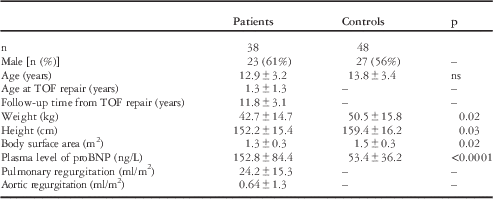
The study group comprised 38 patients who had undergone surgical repair of tetralogy of Fallot between 1990 and 2003. The patients were referred for cardiac magnetic resonance by a paediatric cardiologist because their echocardiographic findings suggested significant pulmonary regurgitation and increased right ventricular size. The patients had undergone surgical correction for tetralogy of Fallot at the age of 1.3 years (with a range from 0.2 to 4.6). The postoperative follow-up period was 11.6±2.9 years (with a range from 7.2 to 18.4 years). A transannular patch was used in 24 (53%) patients. In 17 patients, pulmonary valve annulus could be preserved at the primary repair. All corrective operations were performed on cardiopulmonary bypass with an aortic cross-clamp. The myocardium was protected with cold-blood cardioplegia. Table 1 summarises the baseline characteristics of patients with tetralogy of Fallot and those of healthy controls. There were no time-related trends in surgical techniques during the operative period from 1990 to 2003.
Characteristics of the study population.

proBNP=pro B-type natriuretic peptide; TOF=tetralogy of Fallot
Postoperatively, 11 of our patients with a transannular patch had severe (>30 ml/m2) pulmonary regurgitation (mean 30.8 ml/m2±10.2; range 16.7–59.4). Patients with preserved pulmonary valve annulus (15 patients) had mostly non-severe pulmonary regurgitation (mean 9.8 ml/m2±10.3; range 0–31.8) and only two patients had pulmonary regurgitation exceeding 30 ml/m2. In controls, pulmonary regurgitation was negligible.
For the control group, 48 healthy age- and gender-matched paediatric and adolescent volunteers were recruited. They were eligible for the study if they had no medical history of any cardiovascular disease and no other pre-existing condition that would affect the cardiovascular system. An electrocardiogram was recorded and a paediatric cardiologist performed a morphological ultrasound to exclude possible latent cardiac problems.
Cardiac magnetic resonance was performed for all patients and controls. Cardiac MRI were obtained with a 1.5 Tesla Philips Achieva imager (Philips Healthcare, Amsterdam, The Netherlands) using a 5-channel cardiac coil. For right ventricular volume analysis, transaxial and left ventricle short-axis balanced turbo-field echo breath-hold cine images were obtained for the whole heart. The slice thickness was 5–8 mm depending on the patient’s size, gap was 20%, and temporal resolution was 26–43 ms. For the ventricular volume measurements, both transaxial and left ventricular short-axis cine images were manually planimetered using the cardiac analysis tool of a Philips ViewForum workstation (Philips Healthcare, Amsterdam, The Netherlands). The pulmonary valve regurgitation fraction was calculated from volumetric measurements of both ventricles. The amount of tricuspid regurgitation was nonexistent or minimal in the controls, and it was minimal (n=4) or mild (n=40) within the patients.
For the atrial volume measurements, transaxial cine images were manually planimetered as described earlier.Reference Jarvinen, Kupari and Poutanen 15 , Reference Jarvinen, Kupari and Poutanen 16 Atrial volumetric measurements were used to calculate the cyclic volume change using the following formula: volume max−volume min. Conduit volume, which refers to diastolic blood flow to the chambers while the atrial pump remains passive, was assessed by subtracting cyclic volume change from the left ventricular stroke volume. The combined preload volumes from the atria for each ventricle were calculated by adding the cyclic volume change to conduit volume. Intraobserver variability was tested using the Bland–Altman method. The mean difference between two observations was −1.7 ml with a standard deviation of 3.1 ml in right atrium and −1.2±2.9 ml in left atrium.
Statistical analysis was performed using GraphPad Prism 5.0a (GraphPad Software, Inc., San Diego, California, United States of America). All results are reported as means and SD. Comparisons of continuous data between the groups were performed using an unpaired t-test. Correlations were calculated using linear regression. A two-tailed p-value of less than 0.05 was considered statistically significant.
The Ethics Committee of our hospital approved the study. Written informed consent was obtained from all participants and/or their parents.
Results
All patients in our study had pulmonary regurgitation. Pulmonary regurgitation was severe (>30 ml/m2) in 13 patients (34%), of whom 11 had a transannular patch. In order to study the impact of pulmonary regurgitation on left ventricular preloading, left ventricular systolic function, and right ventricular volume and function, we compared these 13 patients with patients having non-severe regurgitation (n=25) and with controls.
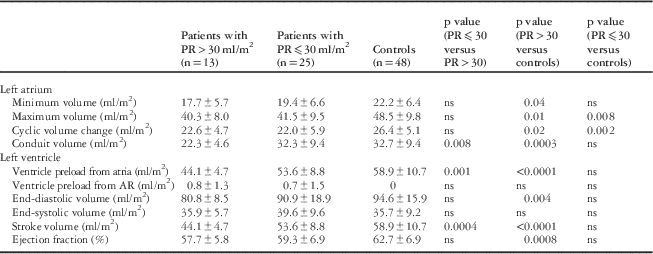
In tetralogy of Fallot patients, the maximum volume and cyclic volume change in the left atrium were significantly smaller than those in controls (Table 2). In addition, the conduit volumes were smaller in patients with severe pulmonary regurgitation, leading to diminished left ventricular preload volume. Consistently, these patients also had significantly smaller left ventricular end-diastolic volume, left ventricular stroke volume, and ejection fraction compared with controls. In comparison with controls, patients with non-severe regurgitation despite smaller left atrial cyclic volume change had similar conduit volumes and there was no significant difference in left ventricular preloading. Accordingly, the left ventricular end-diastolic volume, left ventricular stroke volume, and ejection fraction of these patients were similar to those of controls (Table 2).
The indexed volumes and function of left atrium and ventricle in patients and controls.

AR=aortic regurgitation; PR=pulmonary regurgitation
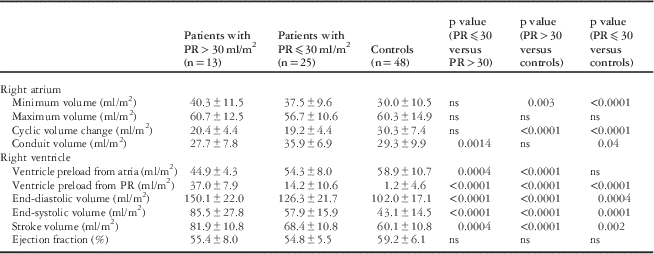
In all patients with tetralogy of Fallot, the maximum volumes of the right atria were comparable to those of controls; however, the right atrial minimum volumes were increased in patients with tetralogy of Fallot, resulting in a reduced cyclic volume change (Table 3). The indexed right ventricular end-diastolic and end-systolic volumes of tetralogy of Fallot patients were significantly larger than those of controls, and the largest volumes were encountered in patients with severe pulmonary regurgitation (150.1±22.0 ml/m2 and 85.5±27.8 ml/m2). The right ventricular atrial preload was decreased in patients with severe pulmonary regurgitation compared with that in patients with non-severe pulmonary regurgitation (Table 3).
The indexed volumes and function of right atrium and ventricle in patients and controls.

PR=pulmonary valve regurgitation
As the vast majority of patients with severe pulmonary regurgitation had undergone transannular patching, the patient material was divided according to the surgical method.
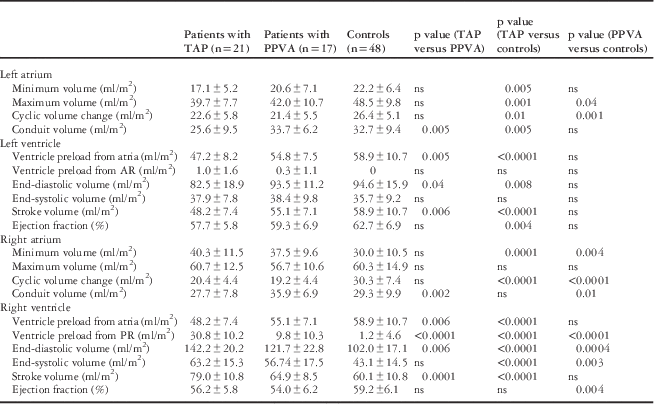
In comparison with controls, patients with a transannular patch had smaller left atrial maximum, cyclic, and conduit volumes, smaller left ventricular end-diastolic volume, smaller left ventricular stroke volume, and a smaller ejection fraction (Table 4). On the other hand, in patients with preserved pulmonary valve annulus, there was no difference in left ventricular preloading compared with that in controls. In patients with a transannular patch, the indexed right ventricular end-diastolic and end-systolic volumes (142.2±20.2 ml/m2 and 63.2±15.3 ml/m2, respectively) were significantly larger than those in controls. Consistently, in patients with a transannular patch, the right ventricular atrial preload was smaller than that in patients with a preserved pulmonary valve annulus. In fact, the right ventricular atrial preload of patients with preserved pulmonary valve annulus was similar to that of controls (Table 4).
The volume and function of left and right atria and ventricles of patients with transannular patch (TAP), patients with preserved pulmonary valve annulus (PPVA), and healthy controls.

AR=aortic regurgitation; PR=pulmonary regurgitation
Discussion
Our study shows that patients with tetralogy of Fallot and severe chronic pulmonary regurgitation have abnormal filling of the left ventricle resulting in smaller left ventricular end-diastolic and stroke volumes. The left atrial maximum volumes, cycling volume changes, and conduit volumes of our patients were smaller in comparison with those of controls. We propose that a significant pulmonary regurgitation among postoperative patients with tetralogy of Fallot results in reduced transpulmonary flow, affecting the left ventricular preloading, which may impede ventricular interaction and induce left ventricular dysfunction.
In the postoperative phase of repaired tetralogy of Fallot, chronic pulmonary regurgitation causes profuse diastolic filling of the right ventricle with dilation.Reference Friedberg, Fernandes and Roche 17 , Reference Tobler, Crean and Redington 18 In these patients, despite normal right ventricular and left ventricular ejection fractions measured with ultrasound, disturbed postoperative pathophysiology can be teased out by exercise to demonstrate the defective contractile reserve of the left ventricle.Reference Roche, Grosse-Wortmann and Friedberg 19 Marked pulmonary regurgitation and right ventricular dilation have recently been described to affect the left ventricle early-diastolic radial and circumferential strain rates,Reference Friedberg, Fernandes and Roche 17 and myocardial deformation imaging has demonstrated reduction in left ventricular systolic indices even in patients with preserved left ventricular ejection fraction.Reference Nakamura, Horigome and Seo 20 , Reference Kempny, Fernandez-Jimenez and Orwat 21 Accordingly, as many as 20% of late survivors of tetralogy of Fallot develop a concurrent left ventricular dysfunction, making it an important factor in the patient’s late outcome.Reference Broberg, Aboulhosn and Mongeon 8 An important finding of the present study is that, despite successful surgical repair carried out in our patients with tetralogy of Fallot, left atrial function was impaired. This was especially remarkable in patients with severe pulmonary regurgitation in whom florid regurgitation was associated with defective atrial filling and left ventricular diastolic function due to reduced transpulmonary flow. In other recent studies on patients with CHD, similar changes in left ventricular filling have been linked to chronic reduction in left ventricular diastolic performance despite corrective surgery, suggesting that prenatal and postnatal haemodynamic factors present before the surgery may affect the left atrial filling and the left ventricular preload.Reference Marcondes, Galati and Jones 22 We have demonstrated that left ventricular preload volume is defective in tetralogy of Fallot, which may be an important factor, in addition to the substantial pulmonary regurgitation, contributing to disturbed ventricular interaction and the consequent dysfunction and reduction in the reserves of the left ventricle.
Finally, it is noteworthy that severe pulmonary regurgitation, disturbed left atrial function, and filling of the left ventricle were encountered especially in patients with a transannular patch compared with patients with preserved pulmonary valve annulus and controls.Reference Frigiola, Bull and Coats 23 – Reference Ghez, Frigiola and Coats 27
To allow proper postoperative remodelling of the enlarged right ventricle, intervention to correct pulmonary regurgitation is considered appropriate when the right ventricle has dilated up to 150 ml/m2, even in patients without symptoms. Interestingly, despite gains in exercise tolerance and NYHA functional class after pulmonary valve replacement following repair of tetralogy of Fallot,Reference Frigiola, Bull and Coats 23 , Reference Discigil, Puga and Schaff 24 objective improvements in systolic and diastolic function of both ventricles have not been uniformly demonstrated.Reference Warner, O’Brien and Rhodes 25 – Reference Ghez, Frigiola and Coats 27 It would be important to find out whether pulmonary valve replacement in addition to correcting the preloading of the right ventricle has a beneficial effect on left ventricular preloading.
Conclusions
In patients with tetralogy of Fallot, transpulmonary flow is affected by an abundant pulmonary regurgitation, leading to volume impediment of the left atrial filling and defective left ventricular preload volume. Our observation may be an important additional mechanism contributing to disturbed ventricular interaction causing dysfunction and reducing the reserves of the left ventricle.
Acknowledgements
The authors acknowledge the work of research nurse Tiina Järvinen and the X-ray technicians Inka-Mari Granlund, Marika Myöhänen, and Nelli Varis.
Financial Support
This study was supported by the Finnish Governmental Subsidy for health Sciences, the Finnish Foundation for Cardiovascular Research, the Academy of Finland (O.M.P.-A.), Tor and Kirsti Johansson’s Foundation (O.M.P.-A., and the Foundation of Pediatric Research. The sponsors had no involvement in any of the following: study design, collection, analysis, or interpretation of data, writing of the report, or the decision to submit the paper for publication. The given grants were not numbered.
Conflicts of Interest
None.