Introduction: Argument and structure
This author's particular point of interest in pleeng luuk tung is the role that it has played in facilitating the rebirth or regeneration of Isan identity and culture. My overall research proposes that the significant involvement of Isan people within the luuk tung music industry has provided Isan people with an entry point into mainstream Thai society and culture, when most avenues were closed to them. Through luuk tung, Lao-IsanFootnote 1 culture has been able to influence Thai society to the point that Isan language and culture has become acceptable. However I aim to demonstrate that this heavy Isan involvement is one of the main reasons why luuk tung has historically been accorded low status.
Conversely, luuk tung's rise in status in Thailand since 1997 has prompted attempts to disguise the Isan involvement in luuk tung. The status of luuk tung is the subject of this article, with status being defined as the degree of prestige attached to an activity/person by society. I propose that from 1958 to approximately 1990, a number of social, political and academic movements combined to present a more negative image of luuk tung than was warranted and, as a result, the genre has been understudied. This article aims to address these issues by, first, identifying the forces that influenced the development of luuk tung's status in Thai society prior to 1997; second, comparing the portrayal of luuk tung in the three most recent and significant publications; and, third, by examining the career, songs, as well as songwriting and recording techniques of Sorapet Pinyoo, a well-known luuk tung artist.
As my research into the genre progresses, it is apparent that very little has been written about the art of luuk tung songwriting. In both the Thai and English literature, analysis of luuk tung lyrics as poetry is virtually non-existent. As a consequence, the limited English language literature is unable to give non-Thais a real understanding of what luuk tung is. It is hoped that an analysis of Sorapet's work will provide insight into the nature of the genre and allow readers to reassess some of the negative aspects of luuk tung's conventional image. This case study is also intended to complement the overall argument of my research — that luuk tung has provided Isan people with the means to revitalise the image of Isan culture within Thailand.
The development of luuk tung's conventional image
The low status of luuk tung in Thai society before 1997 has been referred to by many authors, such as Ubonrat Siriyuvasak,Footnote 2 Craig LockardFootnote 3 and Amporn Jirattikorn,Footnote 4 but there has yet to be a concerted attempt to identify the reasons behind it. The contention of this article is that a number of different social and political forces, movements or conditions combined to produce an overly negative image of luuk tung in Thai society and in academic writing before 1997.Footnote 5 The first such force is the dialectic between Thai classical music linked to the monarchy and popular song genres linked to Luang Phibunsongkraam. Luuk tung developed during the period of Phibunsongkraam's influence and the revision of his image after his overthrow in 1957 may have indirectly affected that of genres associated with him. The second force that contributed to the low status of luuk tung in the past was the high level of Isan involvement. Isan people have long been derided by central Thais and were regarded with suspicion during the years of the communist insurgency. Throughout the last 100 years, Thai rulers and governments have sought to build a cohesive nation-state and Isan culture has been both suppressed and appropriated in the service of nationhood. The third force to be discussed is the tendency for Thais to classify luuk tung as rural folk music. It was not until the late 1970s, with the influence of Marxist theory, that Thai historians became interested in writing about the culture of ordinary people. Even then, the stereotype of luuk tung as rustic and traditional was perpetuated by the majority of commentators. Fourth, in terms of external forces, western ethnomusicologists have generally preferred to study Thai traditional and classical music rather than popular genres. The fifth force is that the attention of western scholars influenced by the Birmingham School theory has been diminished by luuk tung's apparent lack of counter-hegemonic potential. Relevant to both of these forces is the information filter provided by the Thai language. Texts in Thai language focusing on high culture are more likely to be translated than those on low culture. Finally, the interest of foreign tourists in the exotic and oriental aspects of Thai culture has amplified the status of Thai classical music above more westernised and therefore more familiar genres.
Recent publications
On the other hand, the increase in status of luuk tung over the past decade has led to a reinvigorated discussion of the genre's history and renewed academic interest. The heightened sense of nationalism following the 1997 Asian Financial Crisis and the development of a tongtin (local) culture movement have resulted in attempts by both nationalists and ethnic minorities to lay claim to various cultural activities. Luuk tung has been a particular target for these claims because of its increased status. Thus, the second section of this article is a comparison of the most recently published texts on luuk tung: (1) Luuk tung Isan: Bpraawatsaat Isan dtamnaan pleeng luuk tung, an ethnocentric history written by a Lao-Isan author, Waeng Palangwan;Footnote 6 (2) Wiwatanagaan pleeng luuk tung nai sangkom Thai by Siripon Grorptong,Footnote 7 the most thoroughly researched and comprehensive history of luuk tung yet; and (3) ‘Lukthung: Authenticity and modernity in Thai country music’ by Jirattikorn,Footnote 8 which downplays Isan involvement in luuk tung.
A description of luuk tung
Luuk tung, literally ‘children of the field’ (as opposed to luuk grung, ‘children of the city’), is usually translated as Thai country music. Since the late 1960s, it has been the most popular form of music in Thailand, although this popularity has only recently extended to the middle and upper classes. The songs, which can be slow and sad or fast and fun, describe the impact of urban development on rural Thais and, although usually sung in Thai, many Isan words and phrases are used. Luuk tung is an example of fusion — blending western dance rhythms from the 1940s with (pseudo) traditional melodies and borrowing further musical influences as necessary for commercial reasons. Chord progressions are determined by the traditional pentatonic melodies which means that the stock I–IV–V of western pop music is seldom used. Minor progressions such as i–iv–v, i–iv–VII and i–VI–III are more common with sudden shifts to relative, tonic or dominant major chords. Vocal and instrumental melodies are highly ornamented; as in Thai classical singing, the vocals are nasalised and combined with techniques such as luk kor (heavy vibrato) and uean (melodic embellishment on a vocable or melisma). Western tuning is employed because the basic luuk tung band is drums, bass, organ and electric guitar but folk instruments such as kaen (Lao mouth organ), pin (Lao three-stringed guitar), klui (Thai flute) and bponglang (Isan wooden xylophone) are commonly added. Thai classical instruments are also sometimes added (with adjusted tuning) such as ranaat (Thai xylophone) or sor (Thai violin). The career practitioners of luuk tung are highly skilled artists who, similar to blues performers, write, perform and distribute their music for the duration of their lives.
Section 1: Forces contributing to the low status of luuk tung before 1997
The dialectic between Thai classical music and Thai popular music, Phibunsongkraam and the monarchy
One of the forces that may have influenced the status of luuk tung in different periods is its connection with Phibunsongkraam. The social engineering characteristic of Phibun's pre-World War II regime created the conditions that allowed luuk tung and other popular song genres to develop. According to official Thai historians, the first luuk tung song was written in 1938.Footnote 9Luuk tung really developed as a separate genre during the 1950s and 1960s but this earlier date is significant because it coincides with the first prime ministership of Phibun, who had an overall strategy to weaken the monarchy's hold on Thai society and attempted to do this through modernisation.Footnote 10Pleeng Thai saagon Footnote 11 had begun to develop as part of the motion picture industry, and the Fine Arts Department under Luang Wichit Wathakan used the new song style as a hegemonic tool.Footnote 12 Commenting on Phibun and Wichit's concerted efforts to impose a popular culture upon the masses, Pamela Moro observes that ‘the performing arts became a focal point in top-down efforts to create a modern, national Thai culture’.Footnote 13
It is therefore possible that pleeng Thai saagon and early luuk tung had higher status during the years of Phibun's influence because of government patronage and the corresponding neglect of Thai classical music. In an excellent summary of the development of Thai popular music, Siriyuvasak points out that, following the abolition of the absolute monarchy, Thai governments adopted western music as the basis for a new national popular music because it ‘broke with the classical court music of the ancien regime’.Footnote 14 Both Phibun and the architect of his cultural policy, Wichit, could see that a new society needed new performance stylesFootnote 15 and they seem to have grasped instinctively what popular music theorists only later realised, that popular music has greater potential for social and political influence than avant garde or art music because it can generate a mass audience.Footnote 16 The ‘preservation and classicisation’ (in other words, restriction and sidelining) of the Royal musical tradition gave pleeng Thai saagon the space in which to grow and develop eventually into luuk grung and luuk tung.Footnote 17 On the other hand, the overthrow of Phibun's government in 1957 may have resulted in a loss of status for the popular music genres associated with him. Despite the far-reaching effects of Phibun's time in office, he has completely fallen out of favour in Thailand today — the 50-year anniversary of the name change from Siam to Thailand was ignored because of its association with his first militaristic, fascist regime.Footnote 18 It is possible to suggest that Phibun's fall from grace, combined with the rehabilitation of the monarchy under Sarit's rule and a renewed interest in Thai classical music among the central Thai middle class,Footnote 19 may have contributed to the lower status of some popular music during the 1960s and 1970s. This does not mean that genres such as luuk tung and string became less popular but that they were regarded as having little cultural value.
Luuk tung perceived as ‘low’ culture because of the involvement of Isan people
A possible main reason why luuk tung had such low status in Thai society was its link with the Isan people and culture. Thais take great nationalistic pride in the idea that Thailand was never colonised by western nations, and yet Siam was its own colonial power in the nineteenth century, ‘drawing neighbouring peoples around its periphery into its sphere’.Footnote 20 In 1827, the destruction of Vientiane by Rama III was accompanied by the forced migration of the population, transferring ethnic Lao into areas they had not previously occupied, including the central Chao Phraya river basin area.Footnote 21 Over the past 100 years, there has been a systematic dismantling of ethnic Lao identity in Thailand, in the service of nation-building. Central Thai chauvinism towards Isan people extends back centuries, on the basis that Isan was never part of the original Sukhothai kingdom. This prejudice was exacerbated during the 1960s by the Thai government's characterisation of Isan as a hotbed of communist activity even though any such activity was caused by the neglect of successive Thai governments. Until the recent revival of interest in Isan culture, anything associated with Lao or Isan was disparaged by most central Thais. In an extensive explanation of how ‘Lao’ came to be a pejorative term in Thailand, Palangwan observes that ‘if Central Thai people wish to refer to products, animals or things in a derisory manner they will use the word Lao even if the item does not originate from the North East’.Footnote 22 The heavy Isan involvement in luuk tung during the 1960s and 1970s led to it being classified as music for ‘country bumpkins’.Footnote 23
Luuk tung perceived as ‘low’ culture through its designation as folk music
The designation of the genre as pleeng luuk tung (‘children of the field’) from 1964 has contributed to most Thais associating it with folk music and this association has been confirmed by the majority of Thai commentators. It was not until the late 1970s that Thai professional historians such as Chaatip Nartsupha and Nitti Iaosiiwong became interested in writing about ordinary people and their culture, using ‘Marxist socio-analysis as a lever to pry the chronicles and archives away from royalist and nationalist myth-making concerns.’Footnote 24 Several articles were published on luuk tung between 1978 and 1985, Anek Nawikmuun (1978),Footnote 25 Payong Mukda (1984),Footnote 26 Naowarat Pongpaibun (1984),Footnote 27 Sujit Wongtet (1984)Footnote 28 and Kobkul Putharaporn (1985),Footnote 29 all more or less classifying it as updated Thai folk music. Arguably the most well-known Thai historian, Iaosiiwong, responded to these articles in 1985, arguing that luuk tung was like many other forms of popular culture in that it borrowed from numerous sources, including western dance music, pleeng Thai saagon, Thai folk and classical music.Footnote 30 His main thesis was that luuk tung began in urban areas and had more urban influences than rural. Despite SiriyuvasakFootnote 31 agreeing with Iaosiiwong, the view of luuk tung as rural music has persisted in the popular media. In a society which, up until the 1997 Asian Financial Crisis, privileged the elite, the modern and the urban, luuk tung was accorded low status.
The designation of luuk tung as folk music can be observed in a variety of texts. In 1988 and 1991, a series of concerts and ceremonies was organised by the government to mark the 50-year anniversary of the birth of Thai country music. The wording of the official review of the concerts published in the Thai Cultural Newsletter is revealing:
Some Look Thung songs, in spite of their popularity amongst the local people, have considerable influence over them and their way of life. Some remain a source for sociological studies and a mine of local wisdom. Such a cultural heritage should be preserved.Footnote 32
Luuk tung is classified as local culture here, and only useful for sociological study — not as an art form. Clearly what is regarded as influential culture should not be popular and any quality of sophistication is not to be considered in relation to luuk tung. The distinction between high and low culture is clearly drawn in Wongtet's short story, ‘Second nature’:
(They) were dancing to the tempo of pigs or dogs scalded with boiling water. Alas and alack! … Two of the girls … danced together on the stage, complacently bumping and grinding their hips – oblivious to their fellow countrymen, oblivious to the Chronicles of Si Ayuttaya [the most famous Thai historical chronicle], oblivious to the inscription of the Kingdom of Sukhothai [a great early Thai kingdom] … oblivious of King Chulalongkorn [a great Thai king who reformed the nation].Footnote 33
Popular music here is marked by immorality and animalistic behaviour. High culture is defined as central Thai culture, implicitly denying high status to Isan (and other minorities).
The influence of western ethnomusicologists
Throughout most of the twentieth century, Thai society has been influenced by western assignations of value. This can be seen in the development of pleeng Thai saagon and string, in the adoption of western business dress and in the presentation of Thai culture to tourists. Thus it is unsurprising that Thai popular music genres were not studied by Thais until the late 1970s, since before 1970, ‘mass-mediated and popular culture … were all but ignored by (western) historians, area specialists and most social scientists’.Footnote 34 Western ethnomusicology may have contributed to a negative image of luuk tung by privileging high and folk culture over popular culture. Some ethnomusicologists have blamed ‘the siren songs of extensively promoted pop music’ for the loss of more authentic Thai folk and classical music genres.Footnote 35 Terry E. Miller was dismissive of luuk tung when he conducted the definitive English language study of mor lam Footnote 36 in the early 1970s:
The new genre, called pleng look toong (“children of the fields”), however, is marked by simple poetry, direct sentiment, and a general lack of sophistication. The subjects are the lives of ordinary people, especially villagers. For singing styles the composers, most of whom live in Bangkok, plunder any and all regional folk and art forms including mawlum glawn and mawlum moo.Footnote 37 … pleng look toong, the popular songs which plunder regional styles.Footnote 38
In contrast, he considered luuk grung as ‘sophisticated and highly westernised (and) the lyrics … relatively polished and subtle’.Footnote 39 Miller's portrayal of luuk tung songwriters as wealthy Bangkok Thais who plunder peasant culture is difficult to sustain when the history of luuk tung is examined. As demonstrated by PalangwanFootnote 40 and Grorptong,Footnote 41 most songwriters had rural origins (some were Mor Lam) but they migrated to Bangkok in order to make a living. Miller presents luuk tung more favourably, albeit briefly, in a recent articleFootnote 42 which suggests that the field of ethnomusicology has since become more accommodating of popular genres. However, his conclusion in The garland encyclopaedia of world music, that ‘Thailand's heart may beat to the sounds of rock and modernized regional music, but its soul rejoices in its classical tradition’,Footnote 43 does not allow for class and ethnic divisions in Thailand. Isan people, who comprise approximately one-third of the population, have very little interest in central Thai classical music — even gentrified and urbanised Isan are intensely proud of mor lam.
The influence of Birmingham School theory
The overt commercialism and (occasionally) nationalistic lyrics of luuk tung have possibly discouraged the attention of cultural studies. Michael Hayes identifies the reluctance of some western popular music writers to discuss music within its commercial context — ‘the avoidance of commercialism’ and a corresponding level of discomfort with music that does not call explicitly for revolution.Footnote 44 For the listeners of world music, this has translated into a general aversion to nearly all East and Southeast Asian popular music because it is openly commercial and not obviously rebellious. The influence of Birmingham School theory has encouraged scholars to analyse popular music genres in terms of counter-hegemony. Sometimes, as in Myers-Moro's examination of pleeng puea chiiwit,Footnote 45 the genre demands this kind of analysis, but with luuk tung, such analyses have not been so successful. Tony Mitchell criticises Lockard (Dance of life, 1998) for ‘trying to fit his subjects into outmoded western sociological paradigms of rock music as “a vehicle for social and political comment”’(1998: 268).Footnote 46
Actually, luuk tung has at times been explicitly counter-hegemonic. In addition to the examples quoted by LockardFootnote 47 from Siriyuvasak, Pasuk and Baker, Nawikmuun records that several songs were banned during the 1950s and 1960sFootnote 48 while Palangwan writes a whole chapter on the subgenre of ‘communist luuk tung’ from the 1970s.Footnote 49 The problem for non-Thai scholars has been the limited access to such information. As the Thai people saw that Thai classical music was valued by foreign ethnomusicologists, they were more likely to translate high, rather than low, culture texts. In addition, texts that supported the royalist nationalist history taught throughout the Thai education system were more likely to be translated than texts which questioned central Thai cultural and political hegemony. Consequently, foreign scholars have sometimes accepted the information they were given as the only discourse. In Thai popular musicology, as in historiography, the Thai and English literatures have tended to operate virtually as separate worlds — Lockard openly acknowledges that his work is a synthesis of the few secondary sources available at the time in English: Siriyuvasak (1990),Footnote 50 Marre and Charlton (1985)Footnote 51 and Putharapon (1985).Footnote 52 The exceptions such as Siriyuvasak (popular musicology) and Thongchai Winichukun (historiography) assume great importance because they permit the flow of information, ideas and criticism between the literatures.
The influence of foreign tourism
Another external force that has influenced the status of Thai classical music and popular genres is the expectation of foreign tourists regarding Thai culture. The importance of tourism to Thailand's economy has resulted in an emphasis on the exotic and oriental: ‘Classical music and dance are one of the messages foreigners want to hear about the Thai, and which the Thai are willing to tell.’Footnote 53 Clewley asserts that Thai popular music in general is largely ignored by tourists, who are far more likely to encounter ‘classical or court ensembles at restaurants or the National Theatre’.Footnote 54 Understandably Thais want to put their best foot forward and the influence of foreign ethnomusicologists and the dominance of central Thai culture have contributed to Thai classical music being viewed as the most appropriate representation of Thai culture. Luuk tung is certainly as representative of the cultural endeavours of Thai people as Thai classical music,Footnote 55 but when it comes to representing Thailand to tourists, luuk tung has been regarded as too westernised by foreigners and mai tansamai (‘old fashioned or rustic’) by Thais.
Section 2: The effect of luuk tung's present higher status on academic writing
Few texts of significance on luuk tung were published between 1990 and 1998 but the genre's rise in status after the 1997 Asian Financial Crisis has led to an increase in academic discussion of the genre among Thai authors. Luuk tung has become a valuable cultural commodity and is now considered more worthy of academic study.
Waeng Palangwan: An alternative ethnic discourse
Palangwan's Luuk tung Isan (2002) is significant because it is the first widely published text by an Isan author to question the royalist nationalist view of the history of Thai popular music. It is also significant in terms of length – over 600 pages, making it the longest book available on luuk tung – and because it contains a large amount of information not recorded elsewhere in published form. Waeng Palangwan is the pseudonym for an unidentified journalist and documentary maker born in Udon Thani. Luuk tung Isan can be seen as part of the tongtin (local) culture movement, inspired by the generation of professional historians from the 1970s and 1980s influenced by Marxist theory. The tongtin revival has been strongest in Isan with centres for Isan studies being established at the University of Mahasarakam and Loei Rajabat University. Palangwan's purpose is accurately described by Catherine Hesse-Swain's comment that ‘Lao-Isan scholars … grounded in the harsh realities of leftist repression during the 1970s, are openly writing about how to maintain Lao cultural integrity in the face of central Thai and western cultural domination.’Footnote 56Luuk tung is important to him but his primary concern is the cultural identity and heritage of Lao-Isan people.
Palangwan makes a case for recognition of the Lao-Isan involvement in luuk tung, arguing that the early participation of Lao-Isan people contributed significantly to the genre's development. His book was written during a period of increased status for luuk tung (1997–2001) and he wants Lao-Isan people to share in that higher status. Palangwan believes that the Isan involvement in luuk tung has been downplayed and underestimated by some historians and the Thai popular media. In the preface, Palangwan is explicit in his intention to expand the scope of Thai history: ‘I want to bring glory back to Isan people and take the opportunity to invite people who work in high positions to look at the lies of western culture.’Footnote 57 Many Thai commentators blamed the 1997 Asian Financial Crisis on western investors and the capitalist system,Footnote 58 and it was widely interpreted as a warning to return to traditional Thai values. Palangwan's purpose is made clear in the following statement:
People say that music is the international language but no one is interested in the music of Australian Aboriginals, or the music of Uganda, or the Naakaa tribe in Myanmar, or the music of the Djam tribe in Cambodia and Vietnam, or the songs of Pii Dtornglueang in the Northern province of Thailand. Why is this? Because these groups do not have any political power.Footnote 59
Palangwan equates the status of Isan people within Thailand with that of other oppressed and disenfranchised minorities elsewhere. He is an impassioned participant on an evangelical mission, who sets out to redress what he regards as past injustices by proposing an alternative history of Thai popular music, a history that allows Isan people to share in the increased status of luuk tung.
Palangwan's revision of the history of Surapon Sombatjaroen (1925–68) is a calculated attempt to transfer some of Surapon's high status back to Isan musicians. The centrepiece of Palangwan's argument is an explanation of the relationship between Surapon and two Isan contemporaries, Chaloemchai Siiruechaa and Benjamin. Hailing from Surapburi in central Thailand, Surapon dominates all discussion of luuk tung in Thailand, occupying a position similar to that of Elvis in rock music or Hank Williams in American country music. Chaloemchai, an established Isan ramwong Footnote 60 singer and songwriter originally from Roi Et, was one of Surapon's closest friends. Palangwan makes the convincing point that Surapon could not speak Isan and when he sang Isan words, they were often mispronounced. Some of the songs upon which he built his popularity, such as ‘Namdtaa Lao Wiang’ (‘Tears of a Lao girl’), ‘Korng bplorm’ (‘Fake things’) and ‘Snooker’, were most probably written or co-written by Chaloemchai, and even Surapon's habit of shaking the microphone stand was an imitation of Chaloemchai.Footnote 61 The hypothesis that Surapon would not have been able to write Isan songs, or songs using Isan elements without assistance is supported indirectly by Raadtrii Siiwilai's observation on why Isan people have influenced luuk tung so heavily. She told this author that Isan people were able to borrow from central Thailand because they could speak central Thai but the opposite was not true because most central Thais could not speak Isan.Footnote 62 Clewley confirms that Isan performers, ‘brought up bilingually’, can easily switch between luuk tung and mor lam but that central Thai artists must stick to luuk tung.Footnote 63
Dtamtorng Chookchana, born in Ubon Ratchatani and otherwise known as Benjamin (1921–94), was the most popular ramwong singer in Thailand until he enlisted in the Thai army in order to serve in Korea. During his absence, Surapon became the unrivalled superstar of luuk tung. Palangwan claims that competition with Benjamin was one of the main reasons why Surapon developed into such a fine artist. Palangwan refers to the song ‘Yaa tiang gan loei’ (‘Don't argue with each other’) in which Benjamin denounces Surapon for criticising Pongsii Woranut and for copying his singing style. He also says that all singers should only sing their own songs. In reply, Surapon wrote ‘Sip niu kor kamaa’ (‘Ten fingers asking for forgiveness’) in which he tells Benjamin not to interfere in the affairs of young people and denies that he has copied Benjamin's voice. He says that Benjamin should be proud that there is another voice like his!Footnote 64 Palangwan's point is that the contributions of Isan musicians to Surapon's development should be remembered.
Siripon Grorptong: The study of luuk tung taken seriously
The publishing of Grorptong's Wiwatanagaan pleeng luuk tung nai sangkom Thai (2004) represents a further stage of development in the status of luuk tung. Luuk tung is here presented as a subject for book-length academic study by a history graduate from Chulalongkorn University.Footnote 65 Grorptong's history is meticulously researched and carefully assembled from the many Thai journal, newspaper and magazine articles previously published on luuk tung. Interviews with key industry personalities provide fresh information, including an awareness of the participation of Isan people through the input of such artists as Sonchai Meekwichian and Yenjit Pontewii. Grorptong was only 31 at the time of publishing, and her book represents a towering achievement for a young, female Thai scholar because publishing has usually been reserved for old male professors. There is, however, no reference to the work of Siriyuvasak or Putharapon, demonstrating again the discrete natures of the Thai and English literatures. A further problem is that her account is overly dominated by discussion of Surapon Sombatjaroen and Pumpuang Duangjan — indeed, she stops at Pumpuang's death in 1992.
Grorptong follows Iaosiiwong in proposing that luuk tung was originally an urban art form that spread to rural areas via seasonal migration and mass media.Footnote 66 She also argues that the audiences for luuk tung and luuk grung were not divided significantly along rural/urban lines, as hasd been previously accepted. What makes her arguments so powerful is that she provides a wealth of information in the form of charts and tables. Her lists of luuk tung singers and songwriters are far more comprehensive than Nawikmuun's and can be used to support Iaosiiwong's thesis that luuk tung began in urban rather than rural areas, and Palangwan's argument for the early involvement of Isan people in the industry. In a list of 46 singers and songwriters from before 1957 (pleeng Thai saagon, ramwong and early luuk tung and luuk grung), 15 were born in Bangkok, while only six were born in Isan and seven in Supanburi.Footnote 67 In a list of luuk tung singers and songwriters from after 1957, only six were born in Bangkok, whereas 29 were born in Isan and nine in Supanburi.Footnote 68 Grorptong has investigated previously unresearched material, such as television and radio fan magazines and government statistical reports, in order to assemble tables of audience preferences from the 1960s and 1990s. These tables are divided into regions and rural/urban areas and show that in 1968, luuk tung was almost equally popular with rural and urban audiences (93 per cent to 90 per cent), whereas there was a marked difference with regard to pleeng Thai saagon (54 per cent to 89 per cent).Footnote 69 These results were repeated in 1993 although with less of a difference. Such information can be used to critique the classification of luuk tung as a rural art form.
Amporn Jirattikorn: Luuk tung as a central Thai art form
Jirattikorn's ‘Lukthung: Authenticity and modernity in Thai country music’ (2006), is an important addition to the small English language literature on luuk tung. The main thesis of her article is that the terms ‘authentic’ and ‘inauthentic’ are socially constructed, and various notions of authenticity (the perception of something as genuine) have been applied to luuk tung during the past 15 years. Jirattikorn details the change in status experienced by luuk tung after the 1997 Asian Financial Crisis, commenting that ‘contemporary lukthung has become so popular that pop stars, movie stars, and foreigners want to sing lukthung songs’.Footnote 70 Jirattikorn's article can be interpreted as a reaction to the tongtin culture movement represented in this article by Palangwan's Luuk tung Isan. She does not refer directly to the tongtin movement or Palangwan, but central Thai cultural hegemony is confirmed throughout her article. If the tongtin movement can be characterised as an attempt by ethnic minorities to claim a greater share of the cultural currency, then a reaction on behalf of central Thai cultural hegemony is to be expected. The interest of both movements in luuk tung stems from the genre's increase in status after 1997.
In her discussion of authenticity, Jirattikorn provides the example of a Thai commentator, Wanit Jarungkitanan, who believes that since 1997, recording companies have reshaped luuk tung to the point that it is no longer authentic.Footnote 71 Her implication is that Jarungkitanan is engaged with a non-issue because authenticity is always changing. This immediately brings her into conflict with the tongtin movement and Palangwan's belief that although Isan people are heavily responsible for luuk tung, they have been disinherited by central Thai cultural hegemony. Jarungkitanan is really protesting over the proliferation of luuk tung recordings by luuk krueng (half Thai, half western) actors and actresses at the expense of career luuk tung singers — the crowding out of Isan faces by central Thai. For writers such as Palangwan and Jarungkitanan, authenticity matters because it is a means of asserting and denying ownership. The refusal to judge authenticity in, or assign ownership to luuk tung can be perceived as the appropriation of Isan culture. In the words of Jacques Attali, the ‘appropriation and control (of music) is a reflection of power, that it is essentially political’.Footnote 72
Although not relevant to her main thesis, Jirattikorn denies the possibility of Isan involvement in the development of luuk tung and in doing so, makes uncharacteristic errors. Her choice of words is somewhat reminiscent of the ultra-nationalistic discourse of the Pan-Thai movementFootnote 73 of the 1930s and 1940s:
Western scholars studying Thai popular music often argue that lukthung comes from Isaan, or northeastern Thailand, which is linked to Lao ethnicity. Most Thais recognize, however, that lukthung developed out of central Thai folk traditions, and for the first two or three decades had little Isaan input. It was only with the later influx of Isaan people into the writing and production of lukthung that the music came to be associated by some with this region and its traditions. Anake (sic) (1978) lists the thirty most popular lukthung singers in the 1970s. All are from central Thailand … Clewley (2000) argues that many lukthung singers came from the central town of Suphanburi, and they added their own unique accent to the style, another fact well known to Thai fans of the music.Footnote 74
Western scholars have actually been no more likely to suggest that luuk tung comes from Isan than Thai scholars.Footnote 75 Jirattikorn appears to be attempting to restructure the debate as between all Thais on one side and farang – the wicked Other – on the other.Footnote 76 Nawikmuun's Pleeng nork satawat does indeed list 30 luuk tung singers from the 1960s and 1970s. Most are from central Thailand, but not all — the extremely popular Saksayaam Petchompuu and Sonchai Meekwichian were born in Isan, while Panom Noppon and Cholatii Tarntorng had Isan lineage.Footnote 77 Unlike what Jirattikorn suggests, Nawikmuun does not claim that his list is exhaustive or that it is a list of the most popular singers — in fact he states that he is establishing the rural origins of luuk tung versus the urban origins of luuk grung. Furthermore, the lists found in Grorptong confirm Palangwan's argument that Isan people were active in the luuk tung industry right from the beginning. Palangwan also notes that many people in Supanburi and Chonburi have Lao ancestry because of Rama III's conquest of Vientiane and forced repatriation of the Lao people.Footnote 78 Jirattikorn's assessment of mor lam Footnote 79 is equally revealing: ‘In the Thai perception, if lukthung is considered “low-class” music and somewhat associated with being a “country bumpkin” morlam is truly “bumpkin” music and definitely rustic.’Footnote 80
Apart from demonstrating the negative image luuk tung held in the past, this statement ignores the steady growth in popularity of mor lam over the last decade, to the extent where mor lam sing has become the coolest music for young Thais and even older styles, like lam glorn, have begun to make a comeback.Footnote 81 In a recent interview, Mor Lam Raadtrii Siiwilai stated that she has had an increase in requests for older styles, indicative of a groundswell of interest in Lao-Isan culture (and also the desire of house owners to discourage the drunken fighting that often breaks out at village mor lam song concerts).Footnote 82
The main focus of Jirattikorn's article is a discussion of Bird Thongchai'sFootnote 83 2002 luuk tung album Chut rap kaek,Footnote 84 which includes Isan vocals by mor lam singer Jindtaraa Puunlaap. The words of Joey Boy, the producer of Chut rap kaek, demonstrate the extent to which the status of luuk tung has changed, but also assert central Thai cultural hegemony over luuk tung:
We kissed America's ass for a long time. I think it's time to learn that we have so many valuable things in our language, our music. The beauty of Thai language as it is expressed in four different dialects is stressed here. I want to introduce Thai music to the world and hope to pave the way for the new generation to follow.Footnote 85
Here Joey Boy is protesting against the colonisation of Thai pop music by America but, at the same time, he is trumpeting the Thai government's policy of the central Thai language ruling over regional differences. That Isan is much closer to Lao than Thai is ignored and the ‘four dialects’ all became ‘Thai’. As in the study of TaiFootnote 86 peoples by some Thai scholars, an ‘h’ is conveniently inserted to spread Thai hegemony throughout Thailand and neighbouring countries.Footnote 87 In addition, Boy unrealistically claims that he wants to introduce Thai music to the world but the appeal of Chut rap kaek was always going to be strictly limited to Thailand and Laos. It is not unreasonable to suggest that Boy is more interested in reinforcing the status of central Thailand as the centre of the Tai cultural world rather than in promoting luuk tung to the rest of the world.
My purpose in discussing these three recent texts is to demonstrate how the rising status of luuk tung has influenced recent academic writing by Thai authors. Luuk tung has become cultural currency to be argued over and claimed. The Lao-Isan tongtin movement, represented by Palangwan, views luuk tung as part of Isan heritage whereas writers such as Jirattikorn wish to extend central Thai cultural hegemony over the whole of Thailand. Scholarly texts such as that written by Grorptong present the opportunity to measure the claims of each side through detailed research. The overall increase in debate is extremely welcome because of the past lack of interest in luuk tung. I will now move on to an area that has not really been addressed in detail in any text up to this point — the techniques of luuk tung songwriting.
Section 3: The practitioner's art: A case study of Sorapet Pinyoo
The third section of this article is a case study of the songwriting and recording techniques of Sorapet Pinyoo. My intention is to ground a survey of the voices that speak on luuk tung with an analysis of the lyrics and melodies of an experienced practitioner.
We must put a price to our work since the music companies make so much money out of it … Just to give an idea of the differences … The company made approximately 44 million bahts (about 1.1 milion pounds) from ‘Num Ma Kao, Sao Na Klua’ (sic) (‘Rice Field Lad, Salt Field Girl’) but the songwriter, Sorapet Pinyoo, received 8000 bahts initial payment plus another 2000 bahts (approximately 250 pounds in total). When the song became a hit, the company then paid him 50000 bahts more (approximately 1250 pounds). You see the gap?…Footnote 88
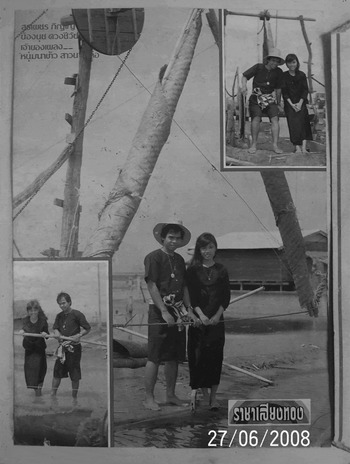
The above quote is the only mention of Sorapet in the English language literature. Indeed in Thailand, people recognise his biggest hit, ‘Num naa kaao, saao naa gluea’ (‘Rice farming boy, salt farming girl’), far more easily than his name (see Figure 1). My contact with Sorapet began in January 2007 and during our first interview, he expressed interest in recording a luuk tung album sung in English. After I agreed to translate, he wrote 10 new songs in four days. As I slowly translated the songs and attempted to match the English versions to the original melodies, I was surprised by the complexity and artistry of the rapidly composed lyrics because luuk tung lyrics are usually characterised as simplistic, clichéd and rustic.
An original promotional poster for Num naa kaao, saao naa gluea'

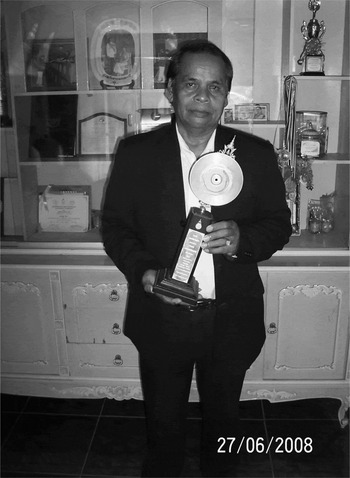
Sorapet Pinyoo is the stage name for Samoe Jandaa, born in 1950, in Bua Yai near Nakon Ratchasima in Isan. His story is typical of luuk tung singers in terms of humble rural beginnings, ambition and career development. He left school after finishing sixth class and started learning how to sing, because performing was a profession which does not require high educational qualifications. He went to watch all the travelling ramwong bands that came to his village and remembers that only he, out of his extended family of rice farmers, had a desire to be something different. All of his eight brothers and sisters are still rice farmers. When he was 15 years old, he entered a radio singing competition at Chaiyapum and won. The competition's MC asked him to record for him in Khon Kaen. He joined the army at 20 for two years but returned to singing and writing songs in Bangkok afterwards. In 1982, his duet with Nong Nut Duangchiiwan, ‘Num naa kaao’, was the top selling song for that year and started a fashion for duets (see Figure 2). As a result, he was awarded a paen siang tong kam,Footnote 89 a highly prized honour from the royal family. He had other hits during this period, including ‘Tui ort yaa kaa ort kaao’ (‘No grass for buffalo, no rice for me’). In 1989, ‘Num naa kaao’ was listed in the top 50 luuk tung songs of all time by the Office of National Culture.Footnote 90 For the past 20 years or so, Sorapet has lived in Khon Kaen, where he still makes a good living from writing songs.Footnote 91
Sorapet Pinyoo with his royal award for ‘Num naa kaao, saao naa gluea’

The yet-to-be-titled album consists of 10 songs, which is fairly standard for luuk tung projects. Four of the songs – ‘Kittueng kon koei rak’ (‘Missing you’), ‘Kit nak’ (‘Think hard’), ‘Muean kaao ror fon’ (‘Like rice waiting for rain’), and ‘Ork hak rak salaai’ (‘My broken heart’) – are from the point of view of an abandoned lover. There are two ‘sights of Thailand’ songs – ‘Mueang Thai naa tiao’ (‘Touring Thailand’) and ‘Yaak yuu tii Mueang Thai’ (‘I want to live in Thailand’) – although the latter is a ‘sights of Isan’ song from the point of view of a farang (caucasian) living in Isan. There are two other songs from the point of view of a farang — ‘Farang pop rak’ (‘Farang finds love’) and ‘Rak kam korp faa’ (‘Love beyond the sky’). ‘Toe tuun Mueang Thai’ (‘All hail Thailand’) is a patriotic song, while ‘Chaonaa naa dam’ (‘Farmer with a dark face’) is narrated from the point of view of an Isan farmer who feels unattractive.Footnote 92 The translation of each song keeps the rhyming pattern, number of syllables and as far as possible, the rhythm of the original. The original Thai words are included whenever the songs are quoted in this article. Please note that the English versions are not exact translations of the Thai.
All of the songs were newly composed for this album after our first meeting and what is truly astounding is that eight of the songs were written over a period of two days. This is only possible because of the skill accumulated over 40 years of writing and an intimate knowledge of the subject matter that luuk tung songs draw upon. Siriyuvasak asserts that ‘the uniqueness of the artist stems largely from his/her ability to innovate while not departing entirely from the current trend’,Footnote 93 although it is possible to go further and say that the artist relies on the similarity between songs for financial security. For most songwriters, the ability to produce songs according to demand is what ensures ongoing commercial success — not the ability to innovate. Sorapet said that if he did not write quickly, other songwriters would get the work. On the other hand, he also said that he was inspired by the story of my wife and I to write ‘Farang finds love’ and ‘Love beyond the sky’. He had not previously written songs about interracial relationships. A common criticism of luuk tung is that many of the songs sound the same — ‘one hundred songs in one tune’.Footnote 94 However, this could be equally applied to other genres such as blues. It is certainly true that some phrases of several of the faster songs are quite similar but as in blues, the basic melody is skilfully manipulated to fit the required syllables. Like other luuk tung songwriters, Sorapet has sometimes reused the melodies of old Thai doem and luuk tung songs. He borrowed the melody of ‘Kaek Mon Baangkunprom’Footnote 95 for one of his early hits ‘Sansanii nii cham’.Footnote 96
The songs follow the usual luuk tung themes, such as rural poverty juxtaposed with urban wealth and urban migration resulting in cultural and emotional dislocation (lost love). Typically, however, the themes are updated with contemporary concerns and references. These include the increasing presence of farang in Isan (‘I want to live in Thailand’), emigration of Isan women through overseas marriages (‘Farang finds love’ and ‘Love beyond the sky’) and the division of Isan society in terms of wealth and class (‘Farmer with a dark face’). In the latter song, the poor farmer resents teachers, rather than the usual rich politicians, reflecting the growth of an Isan middle class [although Sorapet did explain that kruu (‘teacher’) was easier to manipulate than damruat (‘policeman’) or sapaapuutaenrasadon (‘politician’)]:
Sorapet is clearly still in touch with the ongoing poverty of Isan people outside the cities. His imagery reflects the rural audience without becoming patronising or clichéd. In the following example, he extends the commonly used imagery of rice fields in drought:
Sorapet makes frequent use of this kind of metaphorical language. In ‘Love beyond the sky’, a cross-cultural marriage is portrayed as a union between ‘sticky rice and white bread’ (kaao niao gap kanom bang maa ruam bpen kaao dtang). In ‘My broken heart’, the impact of a relationship breakup is ‘like a punch, like a punch, thrown back, thrown back’ (muean doon chok muean doon chok ngaai pueng).
Humorous songs are expected in luuk tung albums and the humour is usually at the expense of outsiders, whether that be the rich city folk or foreigners. The gentle humour of ‘Farang finds love’ is self-referential, imagining the smell of bladaek (Isan fermented fish sauce) being released on a modern airplane:
Patriotic songs are also common in luuk tung albums. ‘Toet tuun Mueang Thai’ (‘All hail Thailand’) is a patriotic song in the tradition of Wichit's best known song, ‘Rak Mueang Thai’.Footnote 97 The continuing popularity of this kind of song both demonstrates and reinforces the presence of Pan-Thai thinking among Thai people. These nationalistic songs are popular to a certain extent but their presence in luuk tung albums is also expected by the Thai establishment. Lop Burirat, a well-known songwriter, points out that ‘the extras are imperative for our trade … it is a sort of statement of allegiance … it doesn't really bother me as long as we get to do what we want to’.Footnote 98 Keeping Sorapet's experience with Bangkok music companies in mind, it is difficult to believe that he is not being a little facetious with lines like: ‘For nowhere else has air so good, air filled with ozone/Morality lives in Thai people's pure hearts/We are not deceitful’ (Mai waa ja bpen puumiaagaat dem duai taat ozone/Mai waa ja bpen kunatam bprajam yuu nai jai kon/Mai mii wokwon sapsorn). As Siriyuvasak observes, the presence of this kind of song is a commercial requirement — part of the narrow path that luuk tung songwriters must negotiate to be successful.Footnote 99
The rhyme structures of Sorapet's lyrics illustrate one of the most interesting features of luuk tung. Thai school students learn to write highly complex forms of poetry in high school — klong, chan, gaap, raai and glorn. Traditional Thai poetry has tonal rules but also uses rhyme. Luuk tung songwriters have taken these forms and adapted them for use in songs. The traditional tone rules that poets follow are not used (perhaps because of the distraction of instrumental accompaniment) but there is a greater emphasis on rhyme. These structures require great skill and their use differentiates luuk tung from both ‘songs for life’ and Thai pop or string. Myers-Moro establishes that ‘songs for life’ use the internal rhymes of glorn but usually not the external,Footnote 100 whereas Thai pop is more likely to make sporadic use of external rhyme (following western pop music).
Sorapet's rhyme structures are far more complex than traditionally structured English poems. Furthermore, the rhymes are not in any way related to tones. In ‘Love beyond the sky’, each three-line stanza follows the same rhyme structure. Each line is two bars long and contains an inner rhyme with the third beat of the first bar rhyming with the first beat of the second bar. The dominant rhyme is the final syllable of lines one and two which also rhymes with the inner rhyme of the third line. The final syllable of the stanza becomes the dominant rhyme of the next stanza.
This rhyme structure is also used in ‘Touring Thailand’ and ‘Farmer with a dark face’. ‘Missing you’ is a typical glorn bpaet poem:
Each four-line stanza has eight syllables per line and a similarly complex rhyme structure. The final syllable of line one rhymes with the third syllable of the second line. The final syllable of line two rhymes with the final syllable of line three and the third syllable of line four. The final syllable of the stanza becomes the dominant rhyme for the next stanza.
Thai speech has a melodic (pitch and rhythm) contour of its own and the degree to which the speech melody and song melody match may be seen as a mark of authenticity by Thai listeners. Several authors have discussed the very high level of correspondence found in Thai classical music, notably Yoko Tanese-Ito (1988)Footnote 101 and most recently, Dusadee Swangviboonpong (2003)Footnote 102 and Vicki-Ann Ware (2006).Footnote 103 An older study by George List is pertinent to this article because it includes an example of pleeng Thai saagon, the forerunner of luuk tung. List found that, as the imitation of western styles spread throughout the culture, coordination of register tones (low, medium, high) with musical contours tended to diminish but that contour tones (rising, falling) strongly influenced the melodic line.Footnote 104 A more recent study by Saurman examines the correlation between linguistic tone and melodic settings in several central Thai musical genres, ranging from traditional and classical through to Thai pop songs and found that ‘the more the pitches move with the tones, the more clarity there is in understanding a new song's textual meaning’ (1996: 5).Footnote 105
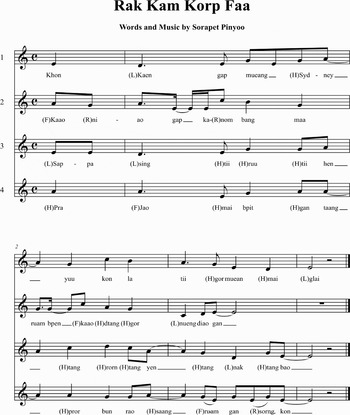
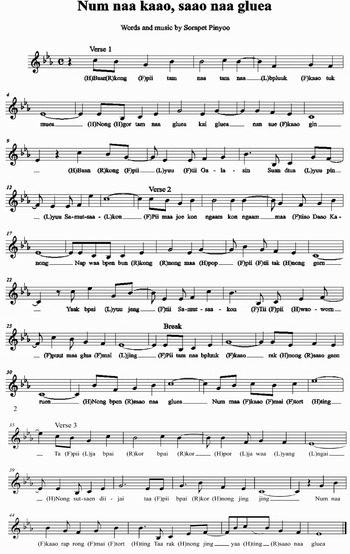
Sorapet composes melodies using only his voice which suggests the possibility of a high level of coordination. In ‘Love beyond the sky’, significant evidence of coordination can be seen for both sets of tones but, as a strophic song, there is a common melody which must be adapted to fit with the speech melody. Figure 3 compares the second line of all four verses and interestingly shows a high level of coordination in the second and third verses but not so much in the first and fourth. In the third verse, the phrase ‘(H)tang (H)rorn (H)tang yen (H)tang (L)nak (H)tang bao’ is perfectly coordinated. It is possible that, since I am transcribing from a guide vocal without much ornamentation, closer coordination with linguistic tones may be accomplished via embellishment during the recording process (see Figures 3 and 4). This is demonstrated in the transcription of the recording of ‘Num naa kaao’. The melody reflects speech tones in many places and ornamentation is used to increase the coordination, as with the falling and high tones in the second phrase of the third verse (‘num maa (F)kaao (F)mai (F)tort (H)ting’). Occasionally, words, such as saao in the last phrase ‘yaa (H)ting (R)saao naa gluea’ have to be ornamented to make them fit. The singer, Nong Nut, glides up on the note to make it seem like a rising tone even though the overall direction of the melody is downward.
Comparison of the second line from each verse of ‘Love beyond the sky’

Melody and lyrics of ‘Num naa kaao, saao naa gluea’

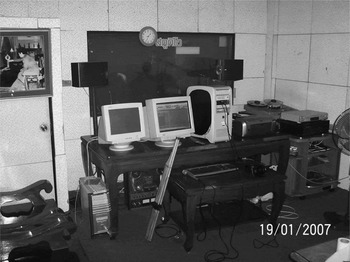
Sorapet's ongoing success is conditional upon his ability to record and distribute his songs (see Figure 5). Throughout his recording career, he has had to master new technology. He said that in the past he would raise a small amount of money to record a demo of songs. Then he would offer the songs to companies who would pay for better recordings to be made in Bangkok. The recording of each album would often be completed in one day. For the past 20 years, however, he has been able to record songs to album standard in his own studio (‘the best recording facilities in Khon Kaen’Footnote 106), which he runs as a company called SP Sound Limited. He has recently changed over to digital recording through a computer and recording can now take place over months when musicians are not available at the same time (see Figure 6). Much of his output is passed on to other artists through a network of friends and business acquaintances. He has written hit songs for Pimpaapon Siri (‘Namdtaa mia Saud’),Footnote 107 Jindtaraa Puunlaap (‘Waan puean kian jotmaai’)Footnote 108 and Somport Duangsompong, among others. This writer overheard a phone call in which Sorapet accepted a booking to have 10 of his songs recorded at Bua Yai. He later explained that the price he charged was 60,000 baht but that he gave 10,000 baht to his representative in Bua Yai. His representative said that was too much but Sorapet told him it was ‘okay’ because he had hundreds of songs ready to go. Sorapet made the decision early on in his career to not rely on the copyright system. In the past, he always sold his songs to companies for a set fee and capitalised on their popularity by touring. Despite missing out on millions of baht of royalties from a few extremely successful songs, he has been able to ensure a regular income by his creativity, technological skill and business sense.
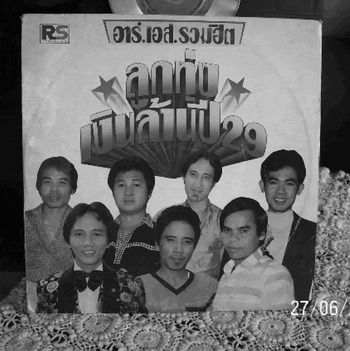
LP cover from 1986. Sorapet is at the bottom right

Sorapet's home studio in Khon Kaen. In the top left corner hangs a picture of him receiving his royal award from the Queen of Thailand

Sorapet is still making a good living from his art 25 years after reaching his peak of popularity. He is in no doubt as to the worth of his chosen field and is still looking to reach new audiences. Although he is not permitted to re-record his most famous song because a record company owns the copyright, he is constantly producing new songs. Selling each song for a set 5,000 baht (AUD 180) means that he must maintain creativity in order to support his family. Now 57 years old, he is attempting to qualify for the status of Silabin Haeng Chaat (‘artist of the nation’), a royal honour conferred on famous artists when they turn 60 years old. They receive a pension of 17,000 baht per month (about AUD 600), which would translate to financial security in a country without general pensions, and an associated increase in status. While Sorapet's financial future might have been assured already if the copyright system dealt fairly with songwriters, he has survived and prospered because of his skills in writing poetry and melodies that appeal to a luuk tung audience (see Figure 7).
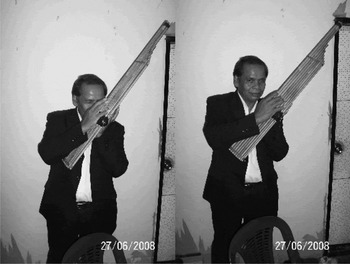
Sorapet is an accomplished kaen, guitar and piano accordion player

Conclusion
This case study of Sorapet Pinyoo is intended to assist in the contextualisation of the literature on luuk tung by demonstrating the variety of skills that a luuk tung songwriter needs in order to be successful. Speed of writing and the ability to adapt established forms to the current trends are vital. A strong command of central Thai is required to be able to manipulate complex poetic structures and knowledge of Isan is helpful in appealing to the majority audience. Sorapet shows considerable business acumen and is able to keep pace with music technology. Despite never attending high school, he is an accomplished artist.
There are many reasons why luuk tung has historically been accorded low status in Thai society. The transition from absolute monarchy to emergent democracy has resulted in the growth of a popular music industry, which eventually allowed many Isan people to escape the endemic poverty that oppressed their region. However after the 1957 coup, the revival in status of the Royal music may have contributed to an overall loss in status for popular song genres associated with Phibunsongkraam. The high level of Isan participation in luuk tung and the Isan audience's preference for luuk tung certainly resulted in the genre having a low status in wider Thai society. The rehabilitation of Thai classical music and the popular classification of luuk tung as folk music led to a heightened distinction between high and low culture. This distinction was exaggerated by western ethnomusicologists, who privileged art and (real) folk music over the popular. The preference of Birmingham School scholars to engage with less commercial and more rebellious genres also compounds the fact. The difficulty of translating the Thai and Isan languages has acted as an information filter, where texts supporting central Thai hegemony are more likely to be translated than those questioning the royalist nationalist history. Finally, foreign tourists have expected to see the exotic and oriental aspects of Thai culture and Thais have preferred to show the tourists something representing high culture. These forces are intertwined and their cumulative effect has been to accord luuk tung lower status in Thai society and in academic writing than was warranted by the genre's characteristics.
The desire to build a cohesive nation-state has assured the paramountcy of the royalist nationalist historiography, which has alternately overlooked or classified luuk tung as a central Thai art form. Under this kind of nationalist ideology, ethnicity markers are marginalised while ruling sensibilities and institutions are privileged. A genre of music wielding strong influence over the rural and urban underclass was dangerous and needed to either be crushed (censorship) or co-opted (appropriation). Both tactics have been employed to disguise the Isan involvement in luuk tung. The appropriation of Isan involvement in luuk tung, represented in this essay by Jirattikorn, may be explained in part as a reaction to a strengthening of ethnic identity by Lao-Isan Thais and the tongtin movement. The recent upsurge of interest in Isan culture may have encouraged some central Thai authors to define the historical and cultural borders around luuk tung more firmly than is warranted.
The good news is that Isan musicians like Sorapet Pinyoo are today being recognised for their part in the development and history of luuk tung. The increase in status of luuk tung over the past decade has not only benefited luuk tung performers but also prompted the publication of texts by authors with such varied perspectives as Palangwan, Grorptong and Jirattikorn. A recent visit to Mahasarakam in the heart of Isan revealed 10 copies of Palangwan's Luuk tung Isan in the university library. The revision of luuk tung's status has only just begun — it is to be hoped that the future will be filled with the sound of both Isan and Thai luuk tung songs.