Introduction
Oxygen is a medical resource critical to treatment of hypoxemia in all medical environments, including emergency departments, operating rooms, intensive care units (ICUs), and in the field with Emergency Medical Services (EMS). Oxygen is designated as an essential medicine by the World Health Organization (WHO; Geneva, Switzerland) and the average hospital consumes approximately 350,000L of oxygen per hospital bed annually. Reference Gómez-Chaparro, García-Sanz-Calcedo and Armenta Márquez1,2 In high-resource areas, hospitals and emergency medical agencies employ complex logistics networks and expensive equipment to meet this demand. Distribution and use of oxygen outside of hospitals are largely reliant upon oxygen gas cylinders. Oxygen cylinders contain highly compressed oxygen and can provide high minute flow of gas. However, they are heavy and contain a limited volume. The typical oxygen cylinder available in the prehospital setting is the M-15 tank, also known as the D-cylinder, which contains approximately 425L under 3,000psi of pressure. Reference Srivastava3 At a flow rate of 4L/minute, an M-15 tank provides gas for 106 minutes and at 15L/minute, only for 28 minutes. In high-resource settings, this rate of consumption is inconvenient but can be logistically maintained. Reference Costantino, Gravio and Tronci4 Trained personnel are able to refill oxygen cylinders from either a large and extremely heavy supply cylinder or some other refillable source of oxygen such as a large, insulated tank of liquified oxygen. Reference Srivastava3
Providing oxygen to low-resources environments, such as austere locations, military combat zones, rural EMS, and during disasters, becomes burdensome, expensive, or logistically intensive. Portable oxygen concentrator (POC) technology promises to transform the availability of supplemental oxygen in low-resource settings. Reference Dobson5 Unlike bulky liquid oxygen systems, chemical oxygen generators, or reliance upon a large network of oxygen cylinders, POCs can provide a nearly limitless supply of oxygen by concentrating oxygen from ambient air. Capable of delivering moderate flows of gas, POCs can bring supplemental oxygen to austere and isolated locations or where modern supply chains fall short. Furthermore, POCs provide unique advantages in some specific environments, such as military combat, where compressed oxygen poses an explosive risk if struck by high-speed projectiles. Reference Rybak, Huffman and Nahouraii6
Although oxygen concentrators have been in production since the 1980s, advances over the last two decades have miniaturized and ruggedized the technology. Due in part to improvements for the out-patient treatment of chronic obstructive pulmonary disease (COPD) in high-resource settings, concentrators are now lightweight, low-cost, and can provide flow rates up to 10L/minute. Reference Chatburn and Williams7,8 As is often the case with new technologies, however, POCs overcome important disadvantages while introducing new issues and caveats. In this systematic review, the pertinent literature regarding the use of POCs in low-resource settings will be analyzed and technical information relevant to the use of POCs in these clinical settings will be highlighted. Emphasis will be placed on the use of POCs in austere, military, veterinary, and EMS settings as there is a paucity of literature discussing the use of POCs in these settings.
Methods
Systematic review of the available literature was performed for reports, articles, and abstracts related to the use of POCs in low-resources conditions, such as military, EMS, or austere environments. The 2020 Preferred Reporting Items for Systematic Reviews and Meta-Analyses (PRISMA) guidelines were followed (checklist available as Supplementary Material; available online only). Reference Moher, Shamseer and Clarke9 All human and animal studies, case series, case reports, or reviews were considered for inclusion in this review. Data were abstracted systematically from a query of PubMed (National Center for Biotechnology Information, National Institutes of Health; Bethesda, Maryland USA); Google Scholar (Google Inc.; Mountain View, California USA); and Defense Technical Information Center (Fort Belvoir, Virginia USA) from inception to November 2021. A gray literature search was also performed using Google. Studies published in a language other than English without available translation or articles not specifically addressing the use of POCs in conditions outside high-resource settings, such as data evaluating domestic use of POCs for COPD, chemical oxygen generation systems, or non-portable oxygen generation systems, were excluded. If government reports and peer-reviewed manuscripts contained the same experimental data, the government report was excluded.
The final search strategy included free-text words (TW) and controlled vocabulary terms using medical subject headings (MeSH) for these topics, their synonyms, abbreviations, and alternate spellings. The final search string was: (“Portable Oxygen Concentrator” [TW]) AND (“austere” [TW] OR “emergency medical services” [MeSH] OR “resuscitation” [MeSH] OR “trauma” [TW] OR “military” [TW] OR “ventilator, mechanical” [MeSH]). References in each selected publication were also carefully screened for any additional reports having relevance. All references are cited in appropriate context. Three authors (CDN, MLD, and DJP) were independently involved in the search process and in the review of the identified articles. Data were collected from included articles by the same three authors and were inserted into a spreadsheet accessible to all authors (Google Inc.; Mountain View, California USA).
Due to limited available clinical data, no specific outcome measures were assessed. Articles with clinical data were subsequently graded using the 2011 Oxford Centre for Evidence-Based Medicine (OCEBM; University of Oxford; Oxford, England) levels of evidence by a single author (CDN). 10 These levels were defined as: Level I = properly powered and conducted randomized clinical trial, systematic review, or meta-analysis; Level II = well-designed controlled trial without randomization, prospective comparative cohort, outcomes research; Level III = case-control studies, retrospective cohort studies; Level IV = case series with or without intervention, cross-sectional studies; and Level V = opinion of authorities, case reports, non-clinical studies, veterinary and animal studies. Due to the low number of clinical data and large number of Level V reports, bias was not formally assessed.
Results
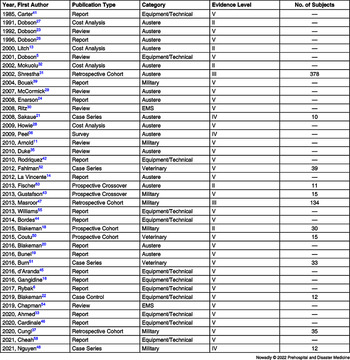
The initial search identified 349 articles. The references of all cited literature were reviewed during which an additional 18 articles were identified. These records were screened for eligibility after 19 duplicates were removed, and 283 were excluded from review of title and abstract contents. Of the remaining 66 publications, 26 addressed issues outside the scope of this systematic review. The remaining 40 articles were included in the review (Figure 1). Literature obtained included human and animal studies, case studies, technical reports, white papers, graduate thesis, and review articles. A total of 724 study subjects were associated with the included articles. There were no Level I systematic reviews or randomized controlled trials. The search identified three Level II studies involving cost analysis and two Level II studies involving 41 humans. Furthermore, there were two Level III studies and three Level IV studies. There were 30 Level V reports and pertinent articles. The included articles were further sub-divided into five categories based on their primary content: Austere, Military, EMS, Veterinary, or Equipment/Technical (Table 1). No evidence-based guidelines or protocols regarding the use of POCs were identified.
PRISMA Flow Diagram of Publications Reporting on Topics Specific to Use of POCs in Low-Resources Settings.
Abbreviations: POC, portable oxygen concentrator; PRISMA, Preferred Reporting Items for Systematic Reviews and Meta-Analyses.

Summary of Relevant Articles Included in the Systematic Review

Discussion
Portable Oxygen Concentrator Technology
Existing methods for generating medical grade oxygen depend on physicochemical processes where oxygen is either created through chemical reaction or extracted from existing gas mixtures. While chemical reactions can reliably generate oxygen, they are usually limited, inefficient, or rely upon strongly exothermic reactions. Reference Arnold11,Reference Pollock and Natoli12 By contrast, POCs do not generate oxygen but instead concentrate oxygen that is freely available in ambient air (∼78% nitrogen and ∼21% oxygen). They compress air through a molecular sieve, usually of a zeolite composition, which selectively absorbs nitrogen. The remaining nitrogen-free air is highly concentrated oxygen (>95%) and argon (<5%), which can be routed directly to a patient or a storage tank for consumption. Reference Litch and Bishop13 Most POCs incorporate a sieve-flushing process which returns the filtered nitrogen to the ambient air, clearing the sieve for recurring filtering. With a constant power supply and minor maintenance, POCs can produce oxygen continuously for thousands of hours. Reference La Vincente, Peel and Carai14
There are two main modes of POC operation: continuous and pulsed dose. During the continuous mode, a POC provides steady oxygen flow, typically at concentrations greater than 90%. Although dependent upon the model and manufacturer, most POCs provide continuous flow rates between 1-5L/minute. However, some larger, non-mobile models can provide flow rates up to 10L/minute. 8 Pulsed dose flow, by contrast, delivers a “pulse” of low-volume, highly concentrated oxygen in sync with the patient’s respiratory cycle. This timing allows the oxygen pulse to reach a patient’s alveoli during inspiration, using ambient air to fill respiratory dead space. Pulsed dose mode, in theory, maximizes the oxygen delivered to alveoli per inspiration.
Despite the efficiency of pulsed dose oxygen delivery, there is controversy regarding the definitive clinical outcomes of pulsed dose mode. Reference Zhou and Chatburn15–Reference Chen, Katz and Pichelin17 Although pulsed dose mode often provides a lower fraction of inspired oxygen (FiO2) per breath, it may result in a higher partial pressure of oxygen (PaO2) by more efficiently utilizing the oxygen that is produced by a POC. Reference Zhou and Chatburn15,Reference Gangidine, Blakeman, Branson and Johannigman16 Furthermore, there is no universally accepted conversion factor between continuous and pulsed dose modes, although manufacturers have provided conversions for individual POCs. Reference Blakeman, Rodriquez and Gerlach18 One notable study compared the impact of continuous and pulsed dose modes in healthy subjects in simulated high-altitude settings. Reference Blakeman, Rodriquez and Gerlach18 At an altitude of 14,000 feet, hypoxia was corrected in all patients using a minimum of 2L/minute of continuous flow. However, due to the impacts of gas laws at altitude and changes in subject tidal volumes, in order to overcome hypoxia, the manufacturer suggested equivalent pulsed dose settings had to be increased by 6%-37% in each subject. Reference Zhou and Chatburn15
The environment of many low-resource locations may impact POC performance despite their intended performance range. Due to Boyle’s Law, POC performance is impacted by lower atmospheric pressures at higher altitudes. It has previously been estimated that the output oxygen concentration decreases by approximately 10% for each 2000m gain in elevation. Reference Litch and Bishop13 However, this appears dependent on a variety of factors including POC model, altitude, and temperature. Reference Bunel, Shoukri and Choin19,Reference Blakeman, Rodriquez and Britton20 In a prospective cohort of ten healthy patients at an altitude of 3776m, oxygen concentrators performed within three percent of the manufacturers’ reported oxygen output. Reference Sakaue, Suto and Kimura21 In laboratory testing of three POCs, oxygen concentrating ability was impacted by both temperature and altitude extremes, which is less likely with oxygen cylinders. Reference Blakeman, Dario Rodriquez and Branson22 One POC was largely unaffected by altitude changes up to 6705m (22,000ft), one had progressively decreasing oxygen concentrations, and a third failed above 4876m (16,000ft). One-half of the models tested failed after being exposed to -35°C. Reference Blakeman, Rodriquez and Britton20 Lastly, in areas with high humidity or wet conditions, care is needed with rubber seals and bacterial filters as they can impact POC function and lifespan if inappropriately exposed to moisture. Reference Litch and Bishop13
Austere Use
Oxygen is not readily available in many regions around the world, due to either financial or medical logistical limitations, and contributes to significant morbidity and mortality. Reference Dobson5,Reference Dobson23–Reference Qazi, Aboubaker and MacLean25 Portable oxygen concentrators have been used in developing nations and austere locations for over 30 years. Reference Dobson, Peel and Khallaf26,Reference Dobson27 They have become a critical component to providing oxygen in a variety of settings, including in both adult Reference Dobson5 and pediatric care, Reference Howie, Hill and Ebonyi28 during anesthesia and surgical procedures, Reference McCormick and Eltringham29 and at extremes of both altitude and temperature. Reference Sakaue, Suto and Kimura21,Reference Ritz and Previtera30 However, despite the prolonged use of POCs in austere locations, there are limited clinical data regarding patient outcomes available as most publications regarding austere use are cost assessments or feasibility reports. The most robust clinical data were reported by Shrestha, et al where a retrospective cohort of 378 patients received either standard oxygenation or oxygenation from a POC during a variety of surgical procedures in high altitude medical facilities in Nepal. The authors reported no cases of hypoxia, mortality, or morbidity associated with POC use. Reference Shrestha, Singh, Gautam and Chand31
Studies have shown that POCs are cost effective in low-resource areas, despite relatively high capital costs associated with initial equipment purchase. In assessments performed over 30 years ago, POCs were estimated to save small and large hospitals in remote settings between 25% and 75% of the annual cost of oxygen cylinders, respectively. Reference Dobson27 Similarly, a hypothetical cost assessment in Gambia showed savings of up to 90% associated with POCs, but the savings were heavily dependent upon the cost and accessibility of power generation. Reference Howie, Hill and Ebonyi28 These results have been confirmed in a retrospective cost comparison in Nepal with reported savings in excess of 75%. Reference Litch and Bishop13 In a Nigerian neonatal ICU, the savings were similar with the annual cost of oxygen for a single ICU bed covering the cost of a POC. Reference Mokuolu and Ajayi32 It has been suggested that POC cost could further be lowered by focusing on device development specific for austere locations. Reference Ahmed, Bautista and Hasib33
In austere settings, a single POC can provide low-flow oxygenation for multiple patients, especially in pediatrics. In a recommendation of the use of POCs for pediatric patients, the WHO recommended one POC for every 10-15 pediatric beds to ensure redundancy and adequacy of oxygen supply. Reference Howie, Hill and Ebonyi28 No formal recommendation on the ratio of POCs to adult patients was identified during the review. However, given adult patient size and oxygen demand, a ratio closer to one POC to one patient is required. The number of POCs needed at any location is likely multifactorial, depending on medical setting, patient severity, available financial resources, and environmental conditions.
The POC electricity requirements may also be a challenge in remote or harsh environments. For example, 26% of health facilities in sub-Saharan report no access to electricity. In an assessment of the use of POCs in hospitals in Gambia in 2004, POCs were considered feasible and cost effective in only two of twelve medical facilities due to significant limitations in access to electricity. Reference Howie, Hill and Ebonyi28 The authors concluded that the ten facilities without power would have more reliable and lower cost oxygen delivery with continued use of oxygen cylinders, despite complex logistics. Reference Howie, Hill and Ebonyi28 Fortunately, POCs do not have robust electrical requirements, often being powered by mobile gasoline generators. Reference Dobson27 However, POCs can be powered by solar panels, Reference Pedersen and Nyrop34 wind turbines, and hydroelectric power. Reference Litch and Bishop13 Although battery technology has been integrated into several POC models, the battery life remains limited, especially in man-packable lightweight models. It is clear that improvements in access to reliable electricity and extended battery life will be the primary improvements needed to drive clinical success of POCs in austere settings.
Despite these challenges, POCs have been used in a variety of developing nations, including Mongolia, Reference La Vincente, Peel and Carai14 Malawi, Reference Enarson, La Vincente and Gie24 Egypt, Reference Dobson, Peel and Khallaf26 Nepal, Reference Shrestha, Singh, Gautam and Chand31 New Guinea, Reference Duke, Peel and Graham35 Gambia, Reference Peel and Howie36 and Djibouti. Reference Cungi, Mathais and D’Aranda37 Training programs prior to equipment deployment ensure medical providers have adequate knowledge for device operation and maintenance. Reference Dobson, Peel and Khallaf26 Appropriate maintenance, such as changing filters and reloading zeolite cartridges, can ensure adequate lifespan of equipment, often functioning several years without failure. Reference Litch and Bishop13,Reference Duke, Peel and Graham35 In an assessment of POCs after several years of use in Malawi and Mongolia, the majority of POCs were classified as either functioning “well” (>85% oxygen produced; 25/51 POCs) or “adequate” (75%-85% oxygen produced; 16/51 POCs) with some POCs operating for over 30,000 hours without maintenance. Reference La Vincente, Peel and Carai14
Military Use
During deployed military operations, oxygen is required throughout the medical evacuation continuity of care. Casualties’ care often starts with low-resource, mobile, combat medics, continues through isolated forward field hospitals, and ends with intra-continental critical care medical evacuation flights. Reference Johannigman38 Unlike developing nations where cost may be the primary limiting factor for oxygen cylinder logistics, the distribution of oxygen to military settings has unique restraints. Military operations are often kinetic and unpredictable with changes in location and available resources. Additionally, compressed gas poses unique risks during combat, as explosive decompression can occur if oxygen tanks are struck by high-velocity projectiles. Reference Rybak, Huffman and Nahouraii6 During care under fire and prolonged field care, accessing electricity can be difficult. For these reasons, the US Department of Defense (DoD; Virginia USA) and international militaries have invested in deployed POC technology to bridge gaps in oxygen logistics in combat and deployed environments. Reference Blakeman, Rodriquez and Britton20,Reference Bouak39,40
Portable oxygen concentrators were first suggested for military operations in the 1980s as POC technology was in its infancy. Reference Carter, Baskett and The41 Design improvements for fighter aircraft oxygenation systems played a large role in the development of POC technology, including zeolite sieves. Reference Arnold11 Robust pre-clinical data have been published confirming the effectiveness of ruggedized, compressor-driven, military ventilators in conjunction with deployed POCs. Reference Rybak, Huffman and Nahouraii6,Reference Rodriquez, Blakeman and Dorlac42–Reference Cardinale, Cungi and Bordes46 By contrast, there is notable paucity of clinical data published involving military use of POCs. A retrospective cohort of patients treated by a Pakistani Military Mobile Surgical Team showed an improvement by a factor of 13 in the cylinder to patient ratio after introduction of POCs; Reference Masroor, Iqbal, Buland and Kazi47 however, they treated routine surgical patients and reported no combat casualties. There were no manuscripts identified during the review involving the efficacy of POCs for combat casualties or clinical outcomes in combat.
Despite these limited data, POCs have been deployed with American, French, and Pakistani military units. Reference Rybak, Huffman and Nahouraii6,Reference Bordes, d’Aranda and Savoie44,Reference d’Aranda, Bordes and Bourgeois45,Reference Masroor, Iqbal, Buland and Kazi47,Reference Nguyen, Montcriol and Janvier48 While often deployed with surgical teams, POCs have been integrated into combat vehicles, aeromedical evacuation aircraft, assault ships, and hand-carried by combat medics. Reference Arnold11,Reference Blakeman, Dario Rodriquez and Branson22 This shows that POCs have traversed the entire battlespace, but the requirements of a POC deployed with a large surgical team are vastly different than one given to a special forces medic. For this reason, numerous models of POCs are deployed with US forces. Care by combat medics requires oxygen to be sufficiently mobile to carry equipment in rucks, requiring equipment to be “man-portable.” Unlike a forward surgical team where a 30kg unit may be ideal and provide higher oxygen flow, the DoD defines “man-portable” as equipment weighing less than 14kg. 49 This limits the size, oxygen flow, and battery life of ruggedized POCs. The majority of man-portable POCs currently hand-carried by US forces are limited to 3L/minute or 96mL pulsed dose flow. Reference Rybak, Huffman and Nahouraii6 However, the US Army has published plans to design the next generation of mobile POCs, including extended battery life, higher oxygen flows, and lighter weight equipment. 40 Such improved equipment, in addition to increased clinical data involving the use of POCs in the treatment of combat casualties, is required to solidify POC’s value on the modern battlefield.
Austere Veterinary Use
Given the nature of veterinary care, medical evaluations and surgical procedures often occur outside or in low-resource field conditions. As such, POCs provide a mobile, low-cost source of oxygen to veterinarians who have limited access to oxygen. There is published evidence for the use of POCs in horses, Reference Coutu, Caulkett, Pang and Boysen50 dogs, Reference Burn, Caulkett and Gunn51 bears, sheep, and reindeer. Reference Fahlman, Caulkett and Arnemo52 Veterinary medicine and animal studies have provided the most robust data on the physiological effectiveness of POCs. Multiple animal studies have reported real-time improvements in oxygenation with the use of POCs, including high-resource veterinary anesthesia settings, Reference Burn, Caulkett and Gunn51 low-resource field conditions, Reference Fahlman, Caulkett and Arnemo52 and in pathologic animal models of acute lung injury. Reference Gustafson, Yang and Blakeman43
In a notable case series of multiple species, oxygen from a POC was delivered by nasal cannula during field anesthesia. Reference Fahlman, Caulkett and Arnemo52 Using the pulsed dose setting, the delivered oxygen volume was adjusted to compensate for animal respiratory rate and body size. In field conditions, animals had a marked improvement in arterial blood oxygenation. However, this effect was not universal across species. Bears had an improvement in PaO2 from a baseline of 73 (SD = 11) mmHg to 134 (SD = 29) mmHg after the POC was applied. By contrast, bighorn sheep remained hypoxic after application of a POC with a PaO2 only marginally improving from 40 (SD = 9) mmHg to 52 (SD = 11) mmHg. Furthermore, the authors reported that approximately one-half of bighorn sheep had a reduction in PaO2 with 16/18 animals remaining hypoxic throughout the surgical procedure. High baseline respiratory rate, differing nasopharynx structures, and veterinary operating conditions such as outdoor temperature may impact POCs performance in animals. These limitations should be considered for each species prior to field deployment, such as military working dogs, non-human primates, or mammals with atypical respiratory structures.
EMS and Disasters
During emergency medical transport on ambulances, helicopters, or fixed-wing aircraft, large oxygen tanks are often impractical due to weight and space restrictions within vehicles. While providing a limited flow of gas, POCs may help bridge oxygen requirements for EMS providers without routine access to equipment to refill oxygen cylinders. However, there is limited literature discussing the use of POCs in the EMS environment with no clinical outcome data identified during the review. Furthermore, there was no discussion identified regarding routine use of POCs across an entire fleet of ambulances or helicopters. Fixed-wing air medical evacuation is an exception. Due largely to the use of POCs for treatment of chronic respiratory conditions on commercial airlines, POCs have been evaluated for use during flight. Reference Fischer, Wanka and Einhaeupl53 The Federal Aviation Administration (FAA; Washington, DC USA) regulates POC use on aircraft and requires POC manufacturers to comply with flight standards. They are commonly used during fixed-wing medical evacuation and during medical escort on commercial aircraft. Reference Chapman, Tagore and Ariyaprakai54
Portable oxygen concentrators may close a critical gap in oxygen supply during mass-casualty events or pandemics. Reference Ritz and Previtera30,Reference Williams55 As seen during the coronavirus disease 2019 (COVID-19) pandemic, there was a critical shortage of oxygen in both developed and developing nations, particularly with compressed gas cylinders. Reference Usher56,57 As astutely acknowledged by Williams several years prior to the COVID-19 pandemic, in the context of POCs, “there is market demand for a device capable of providing oxygen therapy during an emergency situation.” Reference Williams55 They were used around the world to provide emergency oxygen to COVID-19 patients when oxygen cylinders or liquid oxygen was not available cylinders. 57 Simple engineering solutions were developed to combine several POCs together to feed oxygen directly to a ventilator to provide flows up to 10L/minute for hypoxic, adult patients. Reference Cheah, Steven and Ng58 The success of POCs during the COVID-19 pandemic highlight the potential for POCs during future mass-casualty events.
Future of POCs
Despite advancements in POC technology, POCs cannot fully replace high-pressure oxygen cylinders in low-resource settings. For example, if a patient is extremely hypoxic during intubation, a high-pressure cylinder may be the only source of sufficient oxygen to prevent respiratory arrest. However, POCs will continue to become smaller, more cost efficient, and will likely provide higher flows of oxygen. Furthermore, there is already technology available that combines a larger oxygen concentrator with a compressor system capable of refilling small oxygen cylinders within 60-90 minutes. 59 Although proprietary adapters are required and the system is not portable, the ability to both provide continuous flows of oxygen and refill oxygen cylinders with one device would significantly reduce the logistical limitations of providing oxygen in low-resource settings. Such technology, if ruggedized and miniaturized, could transform oxygen delivery in austere environments and even be incorporated into alternative technologies such as supraglottic and endotracheal devices, portable suction units, and extracorporeal tissue preservation. Reference Copeland, Zilevicius and Bedolla60–Reference Portillo, Bayliss and Rivas63 The ideal POC is one that can be carried by one individual, provide moderate to high flows of oxygen, has a battery backup, is low cost, and can refill oxygen cylinders, if required.
Limitations
This systematic review has potential limitations. The subject matter covered a wide variety of topics from diverse sources. There are no large-scale, Level I studies regarding POCs in low-resource settings and there are limited clinical data regarding patient-centered outcomes. Also, POCs vary greatly between models with differing oxygen flow, cost, and portability. The conclusions of this review are limited by this variation and temporal changes in POC technology over the last three decades as the application of a POC in a specific clinical situation will be impacted by model capability. It is incumbent upon clinicians and medical providers to recognize these limitations prior to deployment of POCs into low-resource settings. Furthermore, publication bias is a concern in systematic reviews and it is possible adverse events, negative outcomes, or failures of POCs in low-resource settings may not have been reported in the literature. Finally, although the search strategy incorporated a low inclusion threshold of all published and unpublished reports, it may have missed relevant articles.
Conclusions
Portable oxygen concentrators are a low-cost, light-weight tool to provide medical grade oxygen for a wide variety of clinical scenarios in low-resource settings. As such, POCs may fill gaps in austere, military, veterinary, EMS, and disaster medicine. Despite their widespread use, there are limited scientific data available regarding the use of POCs in these environments. Future clinical research is needed to quantify the efficacy of POCs in low-resource settings.
Conflicts of interest/funding
No funding was required to complete this project. There are no conflicts of interest. The view(s) expressed herein are those of the author(s) and do not reflect the official policy or position of Brooke Army Medical Center, the University of Texas at San Antonio, Keesler Air Force Base, the University of Texas Health Science Center, the US Army Medical Department, the US Army Office of the Surgeon General, the Department of the Army, the Department of the Air Force, or the Department of Defense or the US Government.
Author Contributions
Study concept and design (RAD); acquisition of the data (CDN, DJP, MLD); analysis of the data (CDN, DJP, RLH, MLD, RAD); drafting of the manuscript (CDN, DJP); critical revision of the manuscript (CDN, DJP, RLH, MLD, RAD); and approval of final manuscript (CDN, DJP, RLH, MLD, RAD).
Supplementary Materials
To view supplementary material for this article, please visit https://doi.org/10.1017/S1049023X22000310