




No CrossRef data available.
Article contents
Neuroanatomic correlates of CVLT–C performance following pediatric traumatic brain injury
Published online by Cambridge University Press: 21 October 2005
Abstract
Traumatic brain injury (TBI) frequently results in memory problems, and the degree of memory impairment is related to injury severity and is commonly associated with lesions in frontal and temporal brain areas. This study examined the relationship among injury severity, brain lesions, and memory in children with moderate to severe TBI using Donders' (1999) 5-factor model of performance on the California Verbal Learning Test–Children's Version (CVLT–C). Seventy-six children underwent magnetic resonance imaging (MRI) scans 3 months post-TBI and testing 1 year post-TBI. Results showed injury severity (Glasgow Coma Scale) was not predictive of performance on 4 of the 5 factors. Volume of frontal and/or temporal brain lesions was significantly predictive of performance on 3 of the 5 factors. Unexpectedly, lesion volume outside these areas (extra-frontotemporal) was predictive of performance on all 5 factors. In contrast, Verbal IQ at 1 year was most strongly associated with preinjury factors (socioeconomic status and special education involvement), although extra-frontotemporal lesions also contributed to the variability in this measure. Results suggest that in children with moderate to severe TBI, extra-frontal/temporal lesions are predictive of memory outcome 1 year postinjury above and beyond initial severity or frontal/temporal contusions. This finding may relate to widespread diffuse axonal injury, which potentially disconnects brain circuits mediating memory following moderate to severe TBI. (JINS, 2005, 11, 686–696.)
Keywords
Information
- Type
- Research Article
- Information
- Journal of the International Neuropsychological Society , Volume 11 , Issue 6 , October 2005 , pp. 686 - 696
- Copyright
- © 2005 The International Neuropsychological Society
INTRODUCTION
Moderate to severe traumatic brain injury (TBI) in children frequently results in impairments in learning and remembering new information (Yeates, 2000). Studies suggest that although memory significantly improves during the first year following pediatric TBI (e.g., Ewing-Cobbs et al., 1990), persisting deficits in memory can be found 6 months (Catroppa & Anderson, 2002), 1 year, 3 years (Jaffe et al., 1992, 1993, 1995), and 4–5 years postinjury (Yeates et al., 2002).
The California Verbal Learning Test–Children's Version (CVLT–C) is frequently used to assess aspects of new learning and memory ability for verbal information in children (Delis et al., 1994). The CVLT–C is an individually administered 15-item word-list learning test that assesses a child's ability to learn and remember verbally presented information. Based on a factor analytic analysis of CVLT–C performance in typically developing children using the standardization sample, Donders (1999) proposed a 5-factor model of CVLT–C performance, consisting of attention span, learning efficiency, free delayed recall, cued delayed recall, and inaccurate recall. Memory abilities as measured by the CVLT–C are of particular interest to rehabilitation professionals, as impaired performance on this test has been shown to be predictive of new special education placement in children after TBI (Miller & Donders, 2003).
Using the CVLT–C, several studies demonstrated differences in the level and pattern of performance related to injury severity in children with TBI (e.g., Roman et al., 1998; Yeates et al., 1995). In general, these studies report that learning and memory is impaired in children with moderate to severe injury at 1 year and at 4–5 years postinjury compared to both age-matched and orthopedic or non-TBI trauma controls (Jaffe et al., 1992, 1993, 1995; Levin et al., 1982, 1988; Yeates et al., 1995, 2002). Furthermore, the magnitude of memory deficits is generally related to injury severity in almost a “dose-dependent” fashion. For example, Jaffe and colleagues (1993) have reported a decline in recall and recognition performance on the CVLT–C with increasing injury severity [as measured by the Glasgow Coma Scale (GCS) score recorded in the emergency department] in children with TBI. Other studies have compared children by injury severity, and found that children with mild to moderate injuries generally perform at a level similar to controls on measures of memory (Roman et al., 1998), whereas children with moderate to severe injuries perform about one standard deviation below control participants (Hoffman et al., 2000; Massagli et al., 1996) at one year postinjury.
Research relating patterns of memory performance to injury severity in children with TBI shows disparate results (e.g., Jaffe et al., 1992, 1993, 1995; Levin et al., 1993). For example, Levin and colleagues (1993) reported less use of semantic clustering and more intrusion errors on the CVLT–C in children with TBI, related to injury severity (initial GCS score). Most of these studies only report on some variables from the CVLT–C, and thus it is difficult to draw conclusions regarding the consistency of patterns of performance and the effect of injury severity on the CVLT–C. Yeates and colleagues (1995) compared children with severe TBI, mild-moderate TBI, and noninjured control children across variables on the CVLT–C, and found that children with severe TBI showed deficits in learning, storage, and retrieval, whereas children with mild-moderate TBI had difficulty primarily in retrieval when compared with controls.
In individuals with TBI, the most common brain lesions are frontal and anterior temporal contusions (Gentry et al., 1988; Mendelsohn et al., 1992). Widespread diffuse axonal injury (DAI) is also common in patients with moderate to severe TBI as demonstrated by MRI scans (e.g., Levin et al., 1989). DAI consists of small punctate lesions, each of which can potentially disrupt brain circuits mediating a variety of cognitive functions (e.g., Geddes et al., 2001).
Memory impairment has been most commonly associated with lesions in the frontal and temporal areas of the brain (Janowsky et al., 1989; Squire et al., 1989). Classic neuropsychological studies (Eslinger & Damasio, 1985; Stuss et al., 1981), as well as more recent neuroimaging studies (Alexander et al., 2003; Mandzia et al., 2004), suggest that the frontal lobes of the brain are involved in aspects of memory strategy use, encoding, retrieval, and organization of material to be learned, possibly reflecting executive function status. In contrast, the temporal lobes of the brain are commonly associated with forming new memories, and with memory retrieval and recognition (Squire et al., 1989; Weis et al., 2004). Although the relationship between DAI and memory has been less studied, diffuse lesions could potentially interrupt circuits mediating the various components of memory (Blumbergs et al., 1994).
Few pediatric studies examine the neuroanatomic correlates of memory performance after TBI. Levin and colleagues have examined brain lesions using T-1 weighted MRI scans in relation to memory performance (e.g., Di Stefano et al., 2000; Levin et al., 1993, 1994, 1996). In these studies, frontal lobe lesion volume was predictive of memory performance even when controlling for injury severity, whereas lesions outside this area (i.e., extra-frontal) were not predictive of memory performance. Temporal lobe lesions were not examined separately from the other extra-frontal lesions. Donders and Minnema (2004) found that children with anterior cerebral lesions performed worse on the first CVLT–C list but were also less likely to demonstrate a significant proactive interference effect (i.e., significantly worse performance on the distractor list when compared to performance on the first list).
The present study sought to further explore the relationship among injury severity, neuroanatomic lesion location, and memory, by examining CVLT–C variables at one year postinjury in a sample of children with moderate to severe TBI. We investigated several hypotheses. First, we hypothesized that injury severity would be predictive of learning and memory performance one year after injury. Second, we hypothesized that lesions to frontal and/or temporal lobes would predict memory functioning on the CVLT–C at one year postinjury, after accounting for injury severity and other demographic factors. The 5-factor model of CVLT–C performance was used to explore whether the impact of brain injury variables would vary across the different skill components of this test (Donders, 1999). Finally, we predicted that our memory findings would be in contrast to the prediction of general cognitive ability (i.e., Verbal IQ), which we hypothesized would be more related to preinjury variables than to lesion or severity variables.
METHODS
Research Participants
One hundred and thirteen children and adolescents (ages 5–16) with TBI who were consecutively transferred from tertiary trauma centers to the neurorehabilitation unit of a university-affiliated hospital (Kennedy Krieger Institute) between 1992 and 1997 were considered for this study. The current study sample is a subgroup of a larger sample of children with TBI that has been described in detail elsewhere (Gerring et al., 1998, 2000; Grados et al., 2001; Vasa et al., 2004). Children older than age 17 were not included as they received a different version of the CVLT on follow-up (adult version). Of the potential participants, 11 patients were excluded for mild TBI (GCS 13–15). Other exclusion criteria (9 children) included open head injury, previous hospitalizations or emergency room visits for TBI, premorbid mental retardation, documented child abuse, or premorbid central nervous system pathology (e.g., seizure disorder). Seven children were not included because they were enrolled prior to availability of the CVLT–C. Two more children were not included due to inability to complete the MRI. In addition, 8 children were not included due to missing data from the CVLT–C at the one year follow-up. Analysis of the 8 children did not reveal any systematic reason for the missing data (e.g., being too impaired to complete the measure), based on disability ratings and scores on other measures.
The final sample consisted of 76 children with moderate to severe TBI (classified by initial GCS scores of ≤12). The average age at the time of injury was 10.1 years (SD = 3.3). There were slightly more boys than girls in the sample (46/30). The mean Hollingshead index score of socioeconomic status was 33.9 (range = 3 to 66). Initial GCS scores ranged from 3 to 11 with a mean of 5.9. Most of the sample (89%) was classified as severe TBI based on initial GCS score of 8 or below; the rest (11%) were classified as moderate TBI (GCS 9–12). Eleven of the children received special education services prior to the injury. Additionally, 13 of the children met the criteria for attention deficit hyperactivity disorder (ADHD) prior to their injury. Four children met criteria for ADHD and also received special education services prior to their injury. Demographic information is summarized in Table 1.
Demographic and injury characteristics of children and adolescents with moderate to severe traumatic brain injury (N = 76)

Materials
Memory outcome measures
The CVLT–C was used to measure aspects of new verbal learning (Delis et al., 1994). The CVLT–C is comprised of 5 recall trials of a 15-item word list; the list items belong to 3 semantic categories (Fruits, Clothing, Toys). The learning trials are followed by a single presentation of a distracter list, a second, novel 15-item word list. Learning and memory is assessed by number of words recalled over the 5 learning trials, after presentation of the distracter list (short-delay free recall and cued recall), after a longer 20-minute delay (long-delay free recall and cued recall), and on recognition.
The following CVLT–C variables from Donders' (1999) 5-factor model were examined: (1) total words recalled at the first trial of the first list (A1, representing the Attention Span Factor), (2) total words recalled at the fifth trial of the first list (A5, representing the Learning Efficiency Factor), (3) total words correctly recalled on the long-delay free recall trial (LDFR, representing the Free Delayed Recall Factor), (4) total words correctly recalled on the long-delay cued recall trial (LDCR, representing the Cued Delayed Recall Factor), and (5) total number of false positives during the recognition trial (FP, representing the Inaccurate Recall Factor).
For each variable, the CVLT–C raw scores for each child were converted to standard scores based on the normative sample (z-score). Z-scores have a mean of 0 and a standard deviation of 1. For the first 4 factors, negative z-scores indicate worse performance; for the Inaccurate Recall Factor, positive z-scores indicate worse performance. In addition, because the z-scores are provided only in 0.5 increments, we also examined the total learning summary score (T-score, List A Trials 1–5) for comparison. This score has a mean of 50 and a standard deviation of 10.
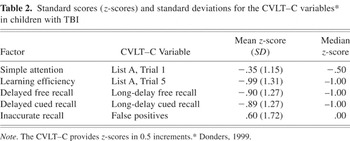
Consistent with previous reported literature, the children's scores across all memory measures were generally within the average to low average range at one year postinjury (Hoffman et al., 2000; Massagli et al., 1996). There was some variability in performance in the sample, with individual test scores ranging from the significantly impaired to above average ranges. The overall mean learning summary score for the group (List A, Trials 1–5) compared to the normative sample was a T-score of 40.25 (SD = 12.64). Mean group z-scores, standard deviations, and median scores for each of the five CVLT-C factors shown in Table 2.
Standard scores (z-scores) and standard deviations for the CVLT–C variables* in children with TBI

The Wechsler Intelligence Scale for Children–Third Edition (WISC-III) was used to measure general verbal intellectual ability (VIQ) (Wechsler, 1991). The verbal scale of the WISC-III was chosen as the outcome measure over the performance scale because it has been shown to be less sensitive to post-TBI deficits of motor control and response speed and therefore felt to be a more valid measure of intellectual ability in this population (Ewing-Cobbs et al., 1998). The group as a whole demonstrated overall verbal intellectual functioning in the low average range compared to age-norms, with variability in performance noted across the sample (M = 86.99, SD = 15.49; range = 59–126).
Predictor variables
Glasgow Coma Scale (GCS) score was used to classify injury severity (Teasdale & Jennett, 1974). The GCS is a standardized severity scale that predicts mortality and morbidity in the acute phase after brain injury and global outcome in the follow-up period (Zafonte et al., 1996). The initial GCS score on admission to the emergency room was used as the measure of injury severity (Massagli et al., 1996). Sixty-eight children sustained severe TBI (GCS = 3–8) and 8 children sustained moderate TBI (GCS = 9–12).
Socioeconomic status (SES) was assessed by obtaining marital status, maternal and paternal occupations, and years of education (Hollingshead Four Factor Index of Social Status, 1975). Scores range from 3 to 66. Lowest scores correspond to parents with less education and who are unskilled laborers. Highest scores correspond to parents with professional degrees working in skilled, professional jobs.
The diagnosis of preinjury Attention Deficit Hyperactivity Disorder (ADHD) was established by administration of the Diagnostic Interview for Children and Adolescents (DICA), a structured interview for children between 6 and 17 years old (Welner et al., 1987). The DICA-P, or parent version, was administered to the parent on the day of enrollment, to obtain information about preinjury ADHD. The 14 DICA criteria for ADHD conform to the Diagnostic and Statistical Manual of Mental Disorders, Third Edition, Revised (American Psychiatric Association, 1987).
Neuroimaging variables
Variables derived from the neuroimaging analysis and used as predictor variables included the volume of lesions in the following areas: frontal lobe, temporal lobe, frontal and temporal lobes (by combining the first two variables), and extra-frontotemporal regions (i.e., outside these two areas). Extra-frontotemporal volume was calculated by subtracting the total volume of lesions in frontal and temporal areas from the total lesion volume (whole brain) for each child, and therefore potentially represents both cortical and subcortical lesions; however, 60% of the extra-frontotemporal volume was comprised of lesions in the regions of the basal ganglia, corpus collusum, thalamus, brainstem, and cerebellum.
Log-transformed lesion volumes were calculated to normalize the data. In addition, the total number of lesions (across all brain areas) was calculated for each child. There were 62 children who had lesions in the frontal regions, 49 children had lesions in the temporal regions, and 56 children had lesions outside of these two brain areas (note, these groups are not mutually exclusive). Table 1 shows the distribution of lesions in frontal/temporal regions only, extra-frontotemporal only, or both in the sample.
Procedure
On the day of study enrollment, a board-certified child and adolescent psychiatrist (J.P.G.) conducted a structured psychiatric interview with the parent to assess preinjury ADHD. Enrollment typically occurred 1 to 3 weeks after injury. The parent was asked whether the child was receiving special education services prior to the injury. GCS scores were obtained through medical record review. All subjects had MRI scans performed approximately 3 months after injury to detect chronic lesions (Wilson, 1990). An initial neuropsychological evaluation was completed immediately following termination of posttraumatic amnesia, which occurred approximately 2 to 4 weeks after injury. A second neuropsychological evaluation and psychiatric interview was completed approximately one year from the date of injury, and included measures of memory, intellectual functioning, attention, and executive function. For purposes of this study, only results of the CVLT–C and WISC-III VIQ from the one-year neuropsychological evaluation are described.
Neuroimaging Methods
Magnetic resonance images were obtained using a 1.5 Tesla GE scanner, and required a total scan time of 18 minutes. Subjects were trained in a procedure to inhibit body movement through operant conditioning (Slifer et al., 1993). An axial T1-weighted, 3D volumetric sequence with 1.5 mm thick contiguous slices was obtained from the vertex to the foramen magnum [spoiled gradient recalled echo in steady state (SPGR): 35; 45; 1:TR:TE:NEX]. The images were displayed on a 1024 × 1024 pixel 3D workstation for evaluation by trained readers who were blind to any information except that the study was part of a TBI project. Two independent readers, an experienced neuroimaging technologist (C.W.) and a physician (J.P.G.), read each image. A senior board-certified radiologist with subspecialty training in neuroradiology (R.N.B.) adjudicated disagreement on each of the readings. All lesions were processed on an ISG Allegro workstation with measurement of lesion volumes and dimensions, using an automated threshold-based method (ISG Technologies, 1995).
Focal injuries were defined as hyper- or hypointense local signal abnormalities on 3D T1-weighted images. Only intraaxial abnormalities were considered, which included DAI, cortical contusions, intracerebral hematomas, and infarcts. A proprietary software program (ISG Technologies, 1995) was used to compute lesion volumes. Volumetric data were then converted to the Talairach stereotaxic reference frame (Talairach & Tournox, 1988). Lesion locations were determined using a standardized 3D map of approximated brain regions according to positions and dimensions defined in the Talairach atlas.
Volumetric measurement and lesion detection reliability were evaluated on 10 randomly selected cases by comparing the readings of 2 blind readers. Interrater reliability was determined by intraclass correlation coefficients (ICC). There was no tendency for systematic bias between the 2 readers. The ICC between Reader 1 and Reader 2 was 0.99 for adjusted total lesion volume per subject and for total number of lesions per subject.
Statistical Analysis
A correlation matrix was calculated for the neuroanatomic lesion variables to determine the degree of colinearity among these variables prior to conducting the multivariate regression analyses. Because there was a moderate correlation between the logs of the frontal lobe lesion volume and the temporal lobe lesion volume (.399, p < .001), we used only the combined variable (frontal/temporal lesion volume) in the regression analyses. The combined variable (log of frontal/temporal lesion volume) was not highly correlated (.08, p > .10) with the other lesion variable used in the models (log extra-frontotemporal lesion volume).
Hierarchical multiple linear regressions were performed to explore the relationship between each of the CVLT–C variables and the following predictor variables: age at injury was entered into the model first, followed by SES, preinjury ADHD status, preinjury special education status, injury severity (GCS), frontal/temporal lesion volume, and finally extra-frontotemporal lesion volume. The change in predictive power at each step was evaluated to examine the additional contribution of each variable to the model. The CVLT–C summary score from List A, Trials 1–5 was also examined in this way for comparison, because of the somewhat better reliability of this standardized score. In addition, the VIQ score from the WISC-III was examined in this way to determine if the same significant predictors of memory performance were also predictive of general verbal IQ. Collinearity diagnostics were examined carefully for all of the regressions, particularly regarding the frontal/temporal and extra-frontotemporal lesion volumes. None of the indicators suggest that the analyses violate the allowable levels of collinearity, and in fact, the diagnostics suggest a low chance of multicollinearity in the data. Tolerance levels for all of the predictors were close to 1 (ranging from .892 at the lowest, to .997). The VIF (Variance Inflation Factors) were low, ranging from 1.001 to 1.112.
To further examine the effects of lesion site after taking into account total lesion volume for each of the variables of interest, follow-up hierarchical regression analyses were performed. The log of the total lesion volume was entered into the model first, followed by the presence or absence of lesions in the frontal/temporal regions, then the presence or absence of extra-frontotemporal lesions. This was also repeated with total number of lesions in place of total lesion volume. Again, collinearity diagnostics were examined carefully for all of the regressions, and although the VIFs were slightly larger (1.001 to 1.6), they were still well below the threshold for allowable levels of collinearity.
RESULTS
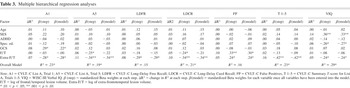
The results of the hierarchical regression analyses for each of the variables of interest are presented in Table 3. For each variable of interest, the Beta weight of the predictor variable and the incremental R2 at each step in the model is indicated in the table. In addition, the Beta weight for each predictor variable in the final model (with all variables entered) is also shown in the table.
Multiple hierarchical regression analyses

None of the preinjury demographic variables (i.e., age at injury, SES, preinjury ADHD, preinjury special education) contributed significant improvement in predictive power to the models for any of the 5 CVLT–C factors. After controlling for these variables, GCS added significant improvement only in the model for the Attention Span Factor (lower GCS was associated with worse performance). Frontal/temporal lesion volume added significant incremental prediction to the models for Learning Efficiency, Cued Delayed Recall, and Inaccurate Recall (greater lesion volume was associated with worse performance). After accounting for all of the above-mentioned variables, the log of the extra-frontotemporal lesion volume was uniquely and significantly associated with performance across all 5 of the CVLT–C variables, such that greater lesion volume was associated with worse performance.
Because the standardized scores for each of the 5 factors were obtained as rounded in increments of 0.5 from the normative data, we repeated the hierarchical regression procedure for the summary T-score, representing learning over the 5 repetition trials of list A. Notably, when variables were entered in the same order as outlined earlier, only the log of extra-frontotemporal lesion volume significantly contributed predictive power to the model.
Verbal IQ was evaluated in the same manner, but the results revealed different variables contributing significant predictive power to the model. Variables that added significant incremental prediction of VIQ included SES, preinjury special education placement, and finally the log of extra-frontotemporal lesion volume.
Once all of the predictor variables were entered into the model, the resultant Beta values for each predictor variable did not change substantially. The only statistical changes were that the predictive effect of frontal/temporal lesion volume on CVLT–C A5 and LDCR disappeared with the addition of extra-frontotemporal lesion volume. All other variables remained significant.
To further clarify whether the predictive value of lesion volume outside the frontal and temporal areas reflects the overall size and diffuseness of the injury, additional regression analyses were employed to examine the effects of lesion site on CVLT–C performance after taking into account total lesion volume. The results of these regression analyses are shown in Table 4.
Regression analyses exploring the impact of lesion location after accounting for total lesion volume

The log of the total lesion volume was predictive of 3 of the 5 CVLT–C factors (learning efficiency, cued delayed recall, and inaccurate recall), but was not predictive of attention span, free delayed recall, or the overall summary T-score. The presence of lesions in the frontal/temporal regions did not add predictive power to any of the models. Interestingly, the presence of lesions outside the frontal/temporal regions significantly contributed predictive power to the model above and beyond total lesion volume for all but the inaccurate recall factor. Total lesion volume did not remain significantly predictive of either the learning efficiency or inaccurate recall factors once all variables were entered into the models.
Finally, these analyses were repeated using total number of lesions (in place of total lesion volume) as the marker for diffuseness of injury. These results are presented in Table 5.
Regression analyses exploring the impact of lesion location after accounting for total number of lesions

In contrast to the total lesion volume, total number of lesions was predictive of performance on all 5 of the factors and the total summary T-score. The addition of the presence of lesions in the frontal/temporal regions did not add predictive power to any of the models. The addition of the presence of lesions outside the frontal/temporal regions significantly contributed predictive power to the model, above and beyond total number of lesions, for the learning efficiency factor and the total summary T-score only.
Once all variables were entered into the model, only the presence/absence of frontal/temporal lesions remained significant in predicting CVLT–C A1, only the presence/absence of extra-frontotemporal lesions remained significant in predicting CVLT–C A5 and the total summary T-score, none of the variables remained significant in predicting CVLT LDFR or FP, and only total number of lesions remained significant in predicting CVLT LDCR. Although the limit of tolerance for collinearity was not violated for these analyses, these changes may reflect the large overlap among total number of lesions and presence/absence of lesions in the brain regions of interest.
DISCUSSION
This study examined aspects of new verbal learning and memory in relation to brain lesions in a group of children with moderate to severe TBI using the CVLT–C. Overall, the results revealed that brain lesion volume in the frontal and/or temporal regions of the brain was predictive of memory performance at one year after injury. Notably, lesion volume in extra-frontal/temporal areas was also predictive of performance, even after controlling for subject variables and injury severity factors.
In contrast to the hypotheses, injury severity (GCS) was not predictive of CVLT–C performance for 4 of the 5 factors examined. This result may be related to the restricted severity range chosen for this study (i.e., moderate-severe only). Previous studies that have shown a relationship between initial GCS and neurobehavioral outcome included children with mild injuries in their samples (e.g., Jaffe et al., 1993; Levin et al., 2001).
For the factor of attention span, in contrast to the other 4 factors, injury severity (GCS) was independently predictive of performance. Other studies have found relatively spared attention span in TBI (e.g., Kauffman et al., 1993), in the context of impairments in other, more complex, aspects of attention such as sustained attention on a continuous performance test. It may be that a reduced attention span as measured by this variable is only seen in the most severely injured children (i.e., those with the very lowest GCS scores).
For 3 of the 5 CVLT–C factors (Learning Efficiency, Delayed Cued Recall, and Inaccurate Recall), the volume of brain lesions in the frontal and temporal regions of the brain was predictive of outcome, as hypothesized. However, while there is a significant volume of literature to suggest that frontal and temporal brain regions play an important role in memory ability, damage to these regions, at least in our group of children with moderate to severe injuries, does not appear to be the best predictor of memory ability at one year after injury.
Unexpectedly, the variable that provided the most predictive power in explaining variance in all of the CVLT–C factors included the volume of lesions outside these areas. One reason for this pattern of results may be that almost all of our participants had large frontal and temporal contusions, which made it difficult to assess the differential impact of frontal and temporal lobe lesions on the memory factors. Therefore, in this group of children with moderate to severe TBI and large frontal/temporal lesions, it appears to be the addition of other lesions outside of this area (i.e., extra-frontotemporal) that is most predictive of memory outcome.
Recent other studies have also shown that in children with severe TBI, both frontal and extra-frontal lesions may be independently predictive of cognitive performance on tests that are typically felt to be sensitive to frontal brain integrity (Levin et al., 1997; Slomine et al., 2002). In a sample of children from the present research project, Slomine and colleagues (2002) found that extra-frontal lesions were a better predictor of performance on one measure of executive functioning (Letter Fluency) than were frontal lesions. Moreover, frontal lesion volume was not predictive of performance on any measures of executive functioning.
These and other studies suggest that in individuals with severe injuries, diffuse brain lesions (e.g., Verger et al., 2001) or “deep” lesions, (e.g., Grados et al., 2001; Levin et al., 1988, 1997), rather than focal lesions, may be more predictive of outcome after TBI (Wilson, 1990). It may be that it is not damage to a particular brain region that is most likely to lead to impaired cognitive function, but rather multiple disconnections across multiple circuits that ultimately leads to the most dramatic disruption in cognitive processes (see Medana & Esiri, 2003 for a review). Along these lines, Donders and Minnema (2004) found that speed of information processing appears to mediate the impact of TBI on CVLT–C variables, suggesting that processing speed and allocation of cognitive resources, something particularly impacted by diffuse injury and DAI, is primarily responsible for learning difficulties on this test following TBI. The current study also suggests that in children with moderate to severe TBI, more diffuse injury, as measured by the extension of lesions outside the frontal and temporal brain areas, is associated with worse prognosis, particularly regarding memory performance.
Several adult TBI studies have suggested that DAI is the mechanism of injury most important in the development of prolonged coma or persistent vegetative states (Adams et al., 1999), and possibly in disruption of hippocampal circuits important for memory (Blumbergs et al., 1994). Additionally, Adams and colleagues (1989) reported that lesions consistent with DAI are found located sequentially deeper in the brain with increasing severity of injury. Taken together, the literature suggests that diffuse injury and/or DAI, particularly when it involves deep lesions, can be interpreted as a marker for severity of injury and a possible indicator for worse prognosis.
The results of the present study support this notion, in that a greater total number of brain lesions was predictive of worse performance on all of the CVLT–C variables. Additionally, the total number of lesions predicted performance on more of the memory factors than did total lesion volume. The presence of lesions outside of the frontal/temporal brain areas was associated with worse memory performance (with the exception of inaccurate recall) above and beyond the total lesion volume. Taken together, these findings suggest that diffuseness of injury (as opposed to overall size of the lesions) is most predictive of memory difficulty at one year postinjury. Interestingly, the presence of lesions outside the frontal/temporal regions was predictive of learning efficiency and the overall memory summary score above and beyond the total number of lesions across all brain areas. As at least 60% of these extra-frontotemporal lesions were not cortical, this may reflect “depth” of lesions. Grados and colleagues (2001) also found that total number of lesions and depth of lesions were more predictive of outcome than was lesion volume, and suggested that these lesions may be a marker for injury severity and provide an additional way to measure severity above and beyond GCS score in children with moderate to severe TBI.
It should be noted that many studies of the effects of TBI in children use samples that do not include children with preinjury difficulties, such as children with ADHD, learning disabilities, or children in special education programs prior to their brain injury. Because many children seen clinically for rehabilitation and evaluation after TBI have these premorbid characteristics (Gerring et al., 1998), we included these children in this study to allow us to investigate memory outcomes in a more typical TBI population. However, neither of these preinjury variables was significantly predictive of memory performance at one year. The current findings suggest that injury variables (more than premorbid learning difficulties) are more important in mediating performance on the CVLT–C after TBI.
Notably, when a more global, nonmemory measure was examined (Verbal IQ), receipt of preinjury special education services and SES were more predictive of score at one year post-TBI than was initial GCS, age, or lesions in the frontal/temporal regions. Although extra-frontotemporal lesions were also predictive of performance, substantial variance in score was explained by the two demographic variables. This finding supports previous studies that suggest that Verbal IQ may be a better “proxy” for preinjury ability than other test findings (Ewing-Cobbs et al., 1998).
These results should be interpreted in the context of several limitations. First, the children evaluated in our study are a somewhat restricted group when compared to children in other studies of moderate to severe TBI, in that our subjects had injuries severe enough to warrant admission to a pediatric rehabilitation inpatient facility. Second, because no data from control subjects were obtained, normative data were the basis for comparisons to same-aged peers. Normative data for the CVLT–C provides z-scores in 0.5 increments for most measures, which reduces the range of possible obtained values. Third, our sole measure of initial injury severity was GCS score on admission to the Emergency Department. Although it is commonly used as a variable in studies of TBI, the scale is ordinal in nature and thus its use in parametric statistical models is questionable. Unfortunately, other measures of injury severity (such as duration of coma or posttraumatic amnesia) were not systematically available for the study sample. Fourth, although attempts were made to take into account preinjury variables such as special education placement and attentional difficulties, more detailed classification of premorbid developmental difficulties would be helpful when examining the effects of other factors in predicting memory in pediatric TBI samples (Taylor & Allen, 1997). Additionally, non-brain injury factors not explored in the study, such as premorbid family characteristics, family resources, and participation in therapeutic and special education services following injury, may be relevant to memory recovery.
Several limitations related to the MRI procedures should be noted. First, MRIs were conducted at 3 months postinjury, whereas testing was completed at one year. Although the MRI scan is considered “chronic” and little change in lesions is expected (Wilson, 1990), correlations between memory and long-term neurological changes such as atrophy could not be examined because only a single scan was performed, not allowing for examination of volume changes over time (Blatter et al., 1997; Giedd et al., 1999). As the scans and testing were done at different times, the present results suggests that lesions at 3 months can offer prognostic prediction of memory performance at 1 year, but the study does not establish an association between specific brain regions and memory performance. In addition, the MRI data was not processed in a manner to allow us to classify different lesion types (e.g., contusion, DAI) or specify all lesion locations outside of the frontal and temporal regions (Auerbach, 1986).
More research is needed to examine the relationship between findings on neuroimaging, age, and memory in the developing brain following TBI. In addition, obtaining multiple neuropsychological and neuroimaging data points over a longer follow-up period would allow for the construction of growth curve analyses, to clarify the influence of age and neuroanatomic variables on the development and recovery of memory following TBI. Finally, the contribution of secondary lesions related to factors during the acute injury period, such as cerebral perfusion pressure and exitotoxicity, needs to be clarified in future studies.
ACKNOWLEDGMENTS
This work was supported by NIMH Grant #K20 MH-00997 and NIH/NCMRR Grant #5-T32-HD0741410.
References
REFERENCES
Adams, J.H.,
Doyle, D.,
Ford, I.,
Gennarelli, T.,
Graham, D.I., &
McLellan, D.R.
(1989).
Diffuse axonal injury in head injury: Definition, diagnosis and
grading.
Histopathology,
15,
49–59.Google Scholar
Adams, J.H.,
Jennett, B.,
McLellan, D.R.,
Murray, L.S., &
Graham, D.I.
(1999).
The neuropathology of the vegetative state after head injury.
Journal of Clinical Pathology,
52,
804–806.Google Scholar
Alexander, M.P.,
Stuss, D.T., &
Fansabedian, N.
(2003).
California Verbal Learning Test: Performance by patients with focal
frontal and non-frontal lesions.
Brain,
126,
1493–1503.Google Scholar
American Psychiatric Association
(1987).
Diagnostic and Statistical Manual of Mental Disorders
(Revised–3rd ed.).
Washington, DC:
American Psychiatric Association Press.
Auerbach, S.H.
(1986).
Neuroanatomical correlates of attention and memory disorders in
traumatic brain injury: An application of neurobehavioral subtypes.
Journal of Head Trauma Rehabilitation,
1,
1–12.Google Scholar
Blatter, D.D.,
Bigler, E.D.,
Gale, S.D.,
Johnson, S.C.,
Anderson, C.V., &
Burnett, B.M.
(1997).
MR-based brain and cerebrospinal fluid measurement after traumatic
brain injury: Correlation with neuropsychological outcome.
American Journal of Neuroradiology,
18,
1–10.Google Scholar
Blumbergs, P.C.,
Scott, G.,
Manavis, J.,
Wainwright, H.,
Simpson, D.A., &
McLean, A.
(1994).
Staining of amyloid precursor protein to study axonal damage in mild
head injury.
Lancet,
344,
1055–1056.Google Scholar
Catroppa, C. &
Anderson, V.
(2002).
Recovery in memory function in the first year following TBI in
children.
Brain Injury,
16,
369–384.Google Scholar
Delis, D.C.,
Kramer, J.H.,
Kaplan, E., &
Ober, B.A.
(1994).
California Verbal Learning Test–Children's
Version.
San Antonio, TX:
Psychological Corporation.
Di Stefano, G.,
Bachevalier, J.,
Levin, H.S.,
Song, J.X.,
Scheibel, R.S., &
Fletcher, J.M.
(2000).
Volume of focal brain lesions and hippocampal formation in relation
to memory function after closed head injury in children.
Journal of Neurology, Neurosurgery, and Psychiatry,
69,
210–216.Google Scholar
Donders, J.
(1999).
Structural equation analysis of the California Verbal Learning
Test–Children's Version in the standardization sample.
Developmental Neuropsychology,
15,
395–406.Google Scholar
Donders, J. &
Minnema, M.T.
(2004).
Performance discrepancies on the California Verbal Learning
Test–Children's Version (CVLT–C) in children with
traumatic brain injury.
Journal of the International Neuropsychological Society,
10,
482–488.Google Scholar
Eslinger, P.G. &
Damasio, A.R.
(1985).
Severe disturbance of higher cognition after frontal lobe ablation:
Patient EVR.
Neurology,
35,
1731–1741.Google Scholar
Ewing-Cobbs, L.,
Levin, H.S., &
Fletcher, J.M.
(1998).
Neuropsychological sequelae after pediatric traumatic brain
injury. In
M. Ylvisaker (Ed.),
Traumatic brain injury rehabilitation: Children and
adolescents
(2nd ed.) (pp.
11–26).
Boston:
Butterworth-Heinimann.
Ewing-Cobbs, L.,
Levin, H.S.,
Fletcher, T.M.,
Miner, M.E., &
Eisenberg, H.M.
(1990).
The Children's Orientation and Amnesia Test: Relationship to
severity of acute head injury and to recovery of memory.
Neurosurgery,
27,
683–691.Google Scholar
Geddes, J.F.,
Hackshaw, A.K.,
Vowles, G.H.,
Nickols, C.D., &
Whitwell, H.L.
(2001).
Neuropathology of inflicted head injury in children. I. Patterns of
brain damage.
Brain,
124,
1290–1298.Google Scholar
Gentry, L.R.,
Godersky, J.C., &
Thompson, B.
(1988).
MR imaging of head trauma: Review of the distribution and
radiopathologic features of traumatic lesions.
American Journal of Neuroradiology,
150,
663–672.Google Scholar
Gerring, J.,
Brady, K.,
Chen, A.,
Quinn, C.,
Herskovits, E.,
Bandeen-Roche, K.,
Denckla, M.B., &
Bryan, R.N.
(2000).
Neuroimaging variables related to development of secondary attention
deficit hyperactivity disorder after closed head injury in children and
adolescents.
Brain Injury,
14,
205–218.Google Scholar
Gerring, J.P.,
Brady, K.D.,
Chen, A.,
Vasa, R.,
Grados, M.,
Bandeen-Roche, K.J.,
Bryan, R.N., &
Denckla, M.B.
(1998).
Premorbid prevalence of ADHD and development of secondary ADHD after
closed head injury.
Journal of the American Academy of Child and Adolescent
Psychiatry,
37,
647–654.Google Scholar
Giedd, J.N.,
Blumenthal, J., &
Jeffries, N.O.
(1999).
Brain development during childhood and adolescence: A longitudinal
MRI study.
Nature Neuroscience,
2,
861–863.Google Scholar
Grados, M.A.,
Slomine, B.S.,
Gerring, J.P.,
Vasa, R.,
Bryan, N., &
Denckla, M.B.
(2001).
Depth of lesion model in children and adolescents with moderate to
severe traumatic brain injury: Use of SPGR MRI to predict severity and
outcome.
Journal of Neurology, Neurosurgery, and Psychiatry,
70,
350–358.Google Scholar
Hoffman, N.,
Donders, J., &
Thompson, E.H.
(2000).
Novel learning abilities after traumatic head injury in
children.
Archives of Clinical Neuropsychology,
1,
47–58.Google Scholar
Hollingshead, A.
(1975).
Four Factor Index of Social Status.
Unpublished manuscript,
Department of Sociology, Yale University.
ISG Technologies
(1995).
Allegro software.
Toronto, Canada:
ISG Technologies.
Jaffe, K.,
Fay, G.,
Polissar, N.L.,
Martin, K.,
Shurtleff, H.,
Rivara, J.B., &
Winn, H.R.
(1993).
Severity of pediatric traumatic brain injury and neurobehavioral
recovery at one year—A cohort study.
Archives of Physical Medicine and Rehabilitation,
74,
587–595.Google Scholar
Jaffe, K.M.,
Fay, G.C.,
Polissar, N.L.,
Martin, K.M.,
Shurtleff, H.,
Rivara, J., &
Winn, H.R.
(1992).
Severity of pediatric traumatic brain injury and neurobehavioral
recovery at one year—A cohort study.
Archives of Physical Medicine and Rehabilitation,
73,
540–547.Google Scholar
Jaffe, K.M.,
Polissar, N.L.,
Fay, G.C., &
Liao, S.
(1995).
Recovery trends over three years following pediatric traumatic brain
injury.
Archives of Physical Medicine and Rehabilitation,
76,
17–26.Google Scholar
Janowsky, J.S.,
Shimamura, A.P.,
Kritchevsky, M., &
Squire, L.R.
(1989).
Cognitive impairment following frontal lobe damage and its relevance
to human amnesia.
Behavioral Neuroscience,
103,
548–560.Google Scholar
Kauffman, P.M.,
Fletcher, J.M.,
Levin, H.S.,
Miner, M.E., &
Ewing-Cobbs, L.
(1993).
Attentional disturbance after pediatric closed head injury.
Journal of Child Neurology,
8,
348–353.Google Scholar
Levin, H.S.,
Amparo, E.G.,
Eisenberg, H.M.,
Miner, M.E.,
High, W.M.,
Ewing-Cobbs, L.,
Fletcher, J.M., &
Guinto, F.C.
(1989).
Magnetic resonance imaging after closed head injury in
children.
Neurosurgery,
24,
223–227.Google Scholar
Levin, H.S.,
Culhane, K.A.,
Fletcher, J.M.,
Mendelsohn, D.B.,
Lilly, M.A.,
Harward, H.,
Chapman, S.B.,
Bruce, D.A.,
Bertolino-Kusnerik, L., &
Eisenberg, H.M.
(1994).
Dissociation between delayed alternation and memory after pediatric
head injury: Relationship to MRI findings.
Journal of Child Neurology,
9,
81–89.Google Scholar
Levin, H.S.,
Culhane, K.A.,
Mendelsohn, D.,
Lilly, M.A.,
Bruce, D.,
Flethcher, J.M.,
Chapman, S.B.,
Harward, H., &
Eisenberg, H.M.
(1993).
Cognition in relation to magnetic resonance imaging in head-injured
children and adolescents.
Archives of Neurology,
50,
897–905.Google Scholar
Levin, H.S.,
Eisenberg, H.M.,
Wigg, N.R., &
Kobayashi, K.
(1982).
Memory and intellectual ability after head injury in children and
adolescents.
Neurosurgery,
11,
668–673.Google Scholar
Levin, H.S.,
Fletcher, J.M.,
Kufera, J.A.,
Harward, H.,
Lilly, M.A.,
Medelsohn, D.,
Bruce, D., &
Eisenberg, H.M.
(1996).
Dimensions of cognition measured by the Tower of London and other
cognitive tasks in head-injured children and adolescents.
Developmental Neuropsychology,
12,
17–34.Google Scholar
Levin, H.S.,
High, W.M.,
Ewing-Cobbs, L.,
Fletcher, J.M.,
Eisenberg, H.M.,
Miner, M.E., &
Goldstein, F.C.
(1988).
Memory functioning during the first year after closed head injury in
children and adolescents.
Neurosurgery,
22,
1043–1052.Google Scholar
Levin, H.S.,
Song, J.,
Ewing-Cobbs, L.,
Chapman, S.B., &
Mendelsohn, D.
(2001).
Word fluency in relation to severity of closed head injury,
associated frontal brain lesions, and age at injury in children.
Neuropsychologia,
39,
122–131.Google Scholar
Levin, H.S.,
Song, J.,
Scheibel, R.S.,
Fletcher, J.M.,
Harward, H.,
Lilly, M., &
Goldstein, F.
(1997).
Concept formation and problem-solving following closed head injury
in children.
Journal of the International Neuropsychological Society,
3,
598–607.Google Scholar
Mandzia, J.L.,
Black, S.E.,
McAndrews, M.P.,
Grady, C., &
Graham, S.
(2004).
fMRI differences in encoding and retrieval of pictures due to
encoding strategy in the elderly.
Human Brain Mapping,
21,
1–14.Google Scholar
Massagli, T.L.,
Michaud, L.J., &
Rivara, F.P.
(1996).
Association between injury indices and outcome after severe
traumatic brain injury in children.
Archives of Physical Medicine and Rehabilitation,
77,
125–132.Google Scholar
Medana, I.M. &
Esiri, M.M.
(2003).
Axonal damage: A key predictor of outcome in human CNS
diseases.
Brain,
126,
515–530.Google Scholar
Mendelsohn, D.,
Levin, H.S.,
Bruce, D.,
Lilly, M.,
Harward, H.,
Culhane, K.A., &
Eisenberg, H.M.
(1992).
Late MRI after head injury in children: Relationship to clinical
features and outcome.
Child's Nervous System,
8,
445–452.Google Scholar
Miller, L.J. &
Donders, J.
(2003).
Prediction of educational outcome after pediatric traumatic brain
injury.
Rehabilitation Psychology,
48,
237–241.Google Scholar
Roman, M.J.,
Delis, D.C.,
Willerman, L.,
Magulac, M.,
Demadura, T.L.,
de la Peña, J.L.,
Loftis, C. et al.
(1998).
Impact of pediatric traumatic brain injury on components of verbal
memory.
Journal of Clinical and Experimental Neuropsychology,
2,
245–258.Google Scholar
Slifer, K.J.,
Cataldo, M.F.,
Cataldo, M.D.,
Llorente, A.M., &
Gerson, A.C.
(1993).
Behavior analysis of motion control for pediatric
neuroimaging.
Journal of Applied Behavioral Analysis,
26,
469–470.Google Scholar
Slomine, B.S.,
Gerring, J.P.,
Grados, M.A.,
Vasa, R.,
Brady, K.D.,
Christensen, J.R., &
Denckla, M.B.
(2002).
Performance on measures of ‘executive function’
following pediatric traumatic brain injury.
Brain Injury,
16,
759–772.Google Scholar
Squire, L.R.,
Haist, F., &
Shimamura, A.P.
(1989).
The neurology of memory: Quantitative assessment of retrograde
amnesia in two groups of amnesic patients.
Journal of Neuroscience,
9,
828–839.Google Scholar
Stuss, D.T.,
Kaplan, E.F.,
Benson, D.F.,
Wier, W.S.,
Naeser, M.A., &
Levine, H.L.
(1981).
Long-term effects of prefrontal leucotomy: An overview of
neuropsychological residuals.
Journal of Clinical Neuropsychology,
3,
13–32.Google Scholar
Talairach, T. &
Tournox, P.
(1988)
Co-planar stereotaxic atlas of the human brain. Three dimensional
proportional system: An approach to cerebral imaging.
New York:
Thieme Medical Publishers.
Taylor, H.G. &
Allen, J.
(1997).
Age related differences in outcomes following childhood brain
insults: An introduction and overview.
Journal of the International Neuropsychological Society,
3,
555–567.Google Scholar
Teasdale, G. &
Jennett, B.
(1974).
Assessment of coma and impaired consciousness: A practical
scale.
Lancet,
2,
81–84.Google Scholar
Vasa, R.A.,
Grados, M.,
Slomine, B.,
Herskovits, E.H.,
Thompson, R.E.,
Salorio, C.,
Christensen, J. et al.
(2004).
Neuroimaging correlates of anxiety after pediatric traumatic brain
injury.
Biological Psychiatry,
55,
208–216.Google Scholar
Verger, K.,
Junqué, C.,
Levin, H.S.,
Jurado, M.A.,
Pérez-Gomez, M.,
Bartés-Faz, D.,
Barrios, M. et al.
(2001).
Correlation of atrophy measures on MRI with neuropsychological
sequelae in children and adolescents with traumatic brain injury.
Brain Injury,
15,
211–221.Google Scholar
Wechsler, D.
(1991).
Wechsler Intelligence Scale for Children
(3rd ed.).
San Antonio, TX:
Psychological Corporation.
Weis, S.,
Klaver, P.,
Reul, J.,
Elger, C., &
Fernandez, G.
(2004).
Temporal and cerebellar brain regions that support both declarative
memory formation and retrieval.
Cerebral Cortex,
14,
256–267.Google Scholar
Welner, Z.,
Reich, W.,
Herjanic, B.,
Jung, K.G., &
Amado, H.
(1987).
Reliability, validity, and parent–child agreement studies of
the Diagnostic Interview for Children and Adolescents (DICA).
Journal of the American Academy of Child and Adolescent
Psychiatry,
26,
649–653.Google Scholar
Wilson, J.T.
(1990)
Review: The relationship between neuropsychological function and
brain damage detected by neuroimaging after closed head injury.
Brain Injury,
4,
349–363.Google Scholar
Yeates, K.O.
(2000).
Closed-head injury. In
K.O. Yeates,
M.D. Ris, &
H.G. Taylor (Eds.),
Pediatric neuropsychology: Research, theory and practice (pp.
92–116).
New York:
Guilford.
Yeates, K.O.,
Blumenstein, E.,
Patterson, C.M., &
Delis, D.C.
(1995).
Verbal learning and memory following pediatric closed-head
injury.
Journal of the International Neuropsychological Society,
1,
78–87.Google Scholar
Yeates, K.O.,
Taylor, H.G.,
Wade, S.L.,
Drotar, D.,
Stancin, T., &
Minich, N.
(2002).
A prospective study of short- and long-term neuropsychological
outcomes after traumatic brain injury in children.
Neuropsychology,
16,
514–523.Google Scholar
Zafonte, R.D.,
Hammond, F.M.,
Mann, N.R,
Wood, D.L.,
Black, K.L, &
Millis, S.R.
(1996).
Relationship between Glasgow coma scale and functional
outcome.
American Journal of Physical Medicine and Rehabilitation,
75,
364–369.Google Scholar

Demographic and injury characteristics of children and adolescents with moderate to severe traumatic brain injury (N = 76)
Standard scores (z-scores) and standard deviations for the CVLT–C variables* in children with TBI
Multiple hierarchical regression analyses

Regression analyses exploring the impact of lesion location after accounting for total lesion volume

Regression analyses exploring the impact of lesion location after accounting for total number of lesions
 You have
Access
- 31
- Cited by