Popular Marian devotion played a vital role in the Catholic Church of Germany during the early modern period, especially during the “golden age of religious revival” experienced by post-Tridentine, baroque popular Catholicism.Footnote 1 For example, at least ninety-seven local Marian shrines scattered throughout the diocese of Augsburg attracted pilgrims in the seventeenth and eighteenth centuries. The most famous was certainly Andechs, which drew half a million visitors each year in the seventeenth century from all over the Holy Roman Empire.Footnote 2 In turn, Catholics from the diocese of Augsburg traveled beyond the bishopric's borders to major and minor shrines near and far, such as Altötting in Bavaria. Yet while major sites dedicated to the Virgin Mary such as Andechs and Altötting reflected the intensity of ongoing popular Marian devotions, the breadth of the Virgin Mary's cultural significance is signaled by the large number of Marian shrines within the diocese itself, such as Kobel or Violau, which were mostly small, local affairs that attracted primarily nearby populations as pilgrims and supplicants.
Occasionally popular enthusiasm for a Marian shrine roused the Catholic Church's concern. For example, in early January 1703, the bishop investigated reports of an image of the Virgin Mary housed in Ettenbeuren that purportedly began to cry. One skeptical episcopal inspector asserted that the tears either had been placed on the image to fool the parishioners intentionally or were a natural manifestation of local weather conditions.Footnote 3 Such reasoning reflects both a post-Tridentine policy of carefully monitoring local saints cults for their legitimacy and an emerging “Catholic Enlightenment” goal of rationalizing religious beliefs and practices. To counter the dismissive conclusions of the investigator, however, Ettenbeuren's local clergy began to catalog the miracles produced whenever supplicants called upon the image in an emergency. Thus, for example, the hearing of Adam Kayser's son had been restored, Christina Hoferin's chronic pain relieved, and Jörg Jorner's illness healed after each appealed to the Virgin of Ettenbeuren.Footnote 4
In other instances, however, various official agents of the Catholic Church attempted either to stimulate new or cultivate preexisting popular devotion to the cult of the Virgin Mary. The Jesuits, for example, propagated Marian devotion as a central component of its post-Tridentine piety, propaganda, and missionary work. Even secular authorities, such as the Bavarian Wittelsbachs and the Austrian Habsburgs, incorporated the cult of the Virgin Mary into their political iconography and appropriated Marian pilgrimage shrines such as Altötting into their Catholicized political geographies.
In Augsburg, the embattled pilgrimage to Violau exemplified these paradoxical tendencies. On the one hand, devotion to the Virgin of Violau developed a powerful hold on the loyalties of Catholic townsfolk, both lay and clerical, and yet, on the other hand, the post-Tridentine Church authorities attempted on several occasions to curb what they saw as the potential excesses of the communal pilgrimage to this nearby shrine.Footnote 5 For example, in 1755 the Dominican prior Vincentius Jerg, who was responsible for organizing the annual pilgrimage to Violau, condemned the men and women who had participated in the event in years past for their lack of proper devotion and their inappropriate sexual dalliances during the journey to and from the Marian shrine. Disappointed with the impious and disorderly behavior of his flock, Jerg banned the Augsburgers' pilgrimage to Violau. His singular act, although in line with broader reformist tendencies of the post-Tridentine Catholic Church, led to a decades-long conflict enjoining different Catholic parties in the city.
The Church's disciplining of Marian devotion attempted to impose its monopoly over religious norms and to restrict alternative, unofficial forms of piety and devotion. By calling into question a variety of religious works, rites, and practices, the Protestant Reformation had forced the Catholic Church to police more rigorously its own internal boundaries between sacred and profane, orthodoxy and error. In response, the centralizing program of Tridentine Catholic reform delimited acceptable norms from illegitimate beliefs and practices.Footnote 6 Thus, many popular techniques for accessing the invisible powers that saturated the material world—whether magical practices tied to lay cosmologies or superficially Christian practices appropriated from orthodox Church rites and rituals—had already begun to trouble the Catholic Church in the sixteenth and seventeenth centuries. It was not only Protestants who saw the vast and colorful variety of Catholic religious practices as inconsistent with a more pure and distilled Christian faith, for Catholic clergymen also made sporadic but repeated attempts to eradicate “superstition” (Aberglaube) and “error” (Irrglaube) among the laity.Footnote 7 The reform of quotidian religious culture and the policing of popular piety was not a uniquely Protestant agenda.
Yet, official reform impulses often exploded into power struggles between reform-minded clerics, on the one hand, and local priests and parishioners who clung to their community's religious culture and practices, on the other.Footnote 8 For example, the attempts to abolish the Violau pilgrimage turned into a complex process of compromise between the differing interests of Church authorities and the local community. Understanding Catholic reform projects as ongoing negotiations in which Church officials had to act within the parameters and constraints of local communal norms and interests cautions us against two oversimplifications. First, it avoids seeing Catholic religious reform as a simple top-down imposition. In the first half of the eighteenth century, the intensification of Marian devotion among the laity—characterized by the founding of countless new pilgrimages and brotherhoods—demonstrates that the post-Tridentine Church could not fully consolidate local religion under the umbrella of papal Rome or the regional bishop's see with absolute success.Footnote 9 Second, it avoids the temptation to interpret local resistance directed against ecclesiastical reform as a manifestation of a coherent popular culture consisting of shared, long-standing, and unchanging communal traditions. Indeed, new forms of Marian devotion or new defenses of older forms of reverence for the Virgin show that local religion was dynamic and that communities actively and creatively invented and reinvented their own traditions, even as they appealed to long-standing custom and tradition in their rhetoric.
By taking the communal context of Catholic reform seriously, we see that local and contingent peculiarities shaped the power relations among the actors engaged in the processes of religious negotiation. To analyze the conflicts and negotiations between the Church hierarchy and local communities, this article centers on the pilgrimage to the Marian shrine of Violau organized by the citizens of Augsburg, the largest free imperial city of southern Germany. Specifically, I investigate how the Church's general attempts to reform devotional practices during the eighteenth century, especially the restrictions placed on Marian pilgrimages, confronted and clashed with Catholic Augsburgers' loyalty to the Violau shrine. This particular moment of negotiation lays bare not only the limits of the Church's authority, but also some of the social dynamics of religious practice within the local community. At stake here was less the local Catholic community's sense of collective solidarity rooted in its own traditions of popular piety, but rather distinctions within the Catholic community that distinguished the privilege of male citizens, who were capable of making political claims on both church and state authorities, from women, whether citizens or not, and men of limited means and influence, often excluded from civic citizenship. In other words, the crisis between an aggressively reform-minded clerical faction bent on abolishing the Violau pilgrimage and those Augsburg Catholics dedicated to its preservation exposed other unstable hierarchies of power centered on status and gender.
Reform, Resistance, Reinvention: The Violau Pilgrimage
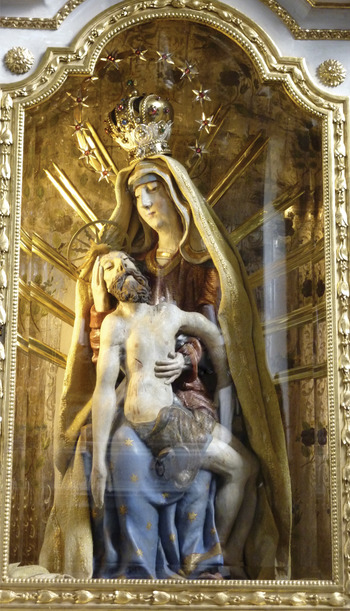
Violau's popularity as a pilgrimage center rested upon the miraculous tales surrounding the shrine's image of the Schmerzhaften Muttergottes, a wooden sculpture of Mary cradling her deceased son, a traditional Pietà (see Figure 1). Violau's church housed such an image since 1466, but the original had been damaged during the Thirty Years' War and was replaced in 1688.Footnote 10 In 1511, the Augsburg parish church St. Moritz recognized Violau's importance by instituting a weekly Friday mass on behalf of the shrine.Footnote 11 Starting in 1555, the Augsburg Catholics organized an annual communal pilgrimage to Violau, at first to give thanks for the end of a recent plague outbreak in the city. A miracle book from Violau with entries dating from 1641 through 1766 attests to the popularity of the shrine among Catholics in the region, who regularly called upon the Virgin of Violau for miraculous assistance in times of need. In return, such supplicants promised to undertake a personal pilgrimage to the shrine. The miracle book reports recoveries of people suffering from blindness, deafness, epilepsy, gout, fevers, and a score of other pains, illnesses, accidents, and even mental conditions. Perhaps more surprising are entries detailing how the Virgin of Violau protected people from theft or magic, helped the devout find their lost items or win their court cases, or restored the ailing livestock of faithful Catholics to health.Footnote 12 Over time, the shrine acquired additional images and relics, but pilgrims mainly came to visit the altar with the Pietà of Mary and Christ.
(Color online) The Schmerzhaften Muttergottes of Violau. Photo: G. Freihalter, Wikimedia Commons. Used under the terms of Creative Commons Attribution Share-Alike License.

What were the basic contours of the Augsburg communal pilgrimage to Violau? Starting in the mid-seventeenth century but prior to 1755, the year when the Dominican prior decided to ban the annual event, Catholic Augsburgers who belonged to the Confraternity of the Rosary (Rosenkranz) had organized an annual group procession (Kreuzgang) to Violau on or around the saint day of John the Baptist (June 24). The Rosenkranz confraternity was a lay sodality under the authority of the Dominicans with male and female members who had dedicated themselves to honoring the rosary. Their pilgrimage began at the church of St. Moritz with a mass, after which the pilgrims, along with representatives from the Dominican order, embarked on their journey carrying a cross as well as several flags.Footnote 13 I have found no textual description or visual representation of these flags, but they typically wove together symbols of the local community—perhaps a civic seal or an emblem representing the confraternity—along with religious images such as the Virgin Mary or the crucified Jesus. Upon reaching Violau, the pilgrims planted their cross just outside the town. Three local Violau clergymen met the pilgrims at this point and blessed the cross and the pilgrims, who then delivered an offering to the priests, perhaps one or more large candles, to secure the goodwill of Mary. The priests next led the Augsburgers to the church, accompanied by musicians performing a litany, where one of the clerics delivered a sermon.Footnote 14 Afterward, the Augsburgers would have undoubtedly flocked to a tavern for a meal and a drink. The pilgrimage to Violau lasted two days, which meant that the Augsburgers spent the night at or near the shrine, probably at one of three inns in the town, which included a guesthouse built around 1683 for the swelling waves of pilgrims.Footnote 15 The next morning, the clergy of Violau held a high mass at the altar that housed the miraculous image of Mary and Jesus. The pilgrims sang, prayed, and honored those in their sodality who had passed away in the past year in a series of highly scripted rituals. Once the various ceremonies were completed, the church bells rang and the three local clergymen escorted the pilgrims back to the sacred perimeter of the shrine. The group then began its march back home, where members of the confraternity and parish who were unable to join the pilgrims waited to welcome their comrades at St. Moritz for yet another mass to celebrate the conclusion of the pilgrimage.Footnote 16
Of course, this description is just a faint outline of the annual pilgrimage and by no means offers a complete picture of the procession to Violau. Did the pilgrims talk, gossip, sing, or argue along the way? How did women and men interact with one another? We do not know the answers to such questions. But if we accept the Dominican prior Vincentio Jerg's word, one significant detail emerges. During the journey and especially during the overnight stay in Violau, men and women in the group seized the opportunity to flirt, fraternize, and perhaps even fornicate. In fact, in 1755 Jerg dissolved the pilgrimage to Violau on these very grounds, wielding his authority as the clerical overseer of the Rosenkranz confraternity.Footnote 17 He acted, however, without consulting the bishop or members of the confraternity. Jerg had hoped to forestall any protest from the laity by permitting a pilgrimage to an alternative Marian Loreto shrine on Kobel Hill, a destination close enough to the city to not require an overnight stay. Nevertheless, his unilateral decision provoked an uproar among those citizens who had actively participated in the pilgrimage in former years.
The members of the confraternity selected four citizens to represent their protest to Anton Nikolaus Seitz, the vicar general of the diocese. The four men were Felix Joseph Chardon, a low-level civic official (a gate scribe, or Thorschreiber); Johann Baptista Haffner and Joseph Bleich, both master tailors; and Johann Gottlieb Entorffer, a master card maker (Kartenmacher). During their negotiations with Vicar General Seitz, fifty-seven citizens organized an independent, unofficial pilgrimage to Violau completely without clerical supervision.Footnote 18 In a somewhat surprising compromise, Seitz agreed with the Catholic parishioners that Jerg had no authority to abolish a long-standing devotional practice without consent from the bishop. But since some Catholic parishioners had already participated in the substitute pilgrimage to Kobel as well as an unofficial one to Violau, he refused to authorize a full-fledge procession to Violau that year. If the pilgrims really wanted to march to their favored Marian shrine, it would have to be without a cross, without flags, and with a priest to supervise their behavior. Furthermore, the vicar general agreed with the concerns of the Dominican prior: women ought not to participate in the pilgrimage. Finally, he promised that if the Augsburgers applied for permission to undertake the pilgrimage again the following year, he would accommodate them.
The members of the Rosenkranz confraternity agreed to the various limitations imposed by the vicar general with little further complaint. This authorized, but stripped-down pilgrimage to Violau took place on July 12, 1755, and attracted ninety-three men. These men first assembled for mass in the Church of the Holy Cross in Augsburg, rather than the traditional church of St. Moritz. They then traveled to Violau with Father Antonio Eder (a secular parish priest rather than a Dominican), but without cross and flags. When they arrived at the place outside Violau where they would normally have planted their cross and awaited a priest from the shrine, they were greeted by a musician sent by the local officials. The musician told the Augsburgers to wait patiently at this spot, and shortly thereafter a priest named Alphonso Pracher arrived carrying a cross and flags, which he gave to the Augsburgers so that they could participate in the usual rite of blessing before entering the church. The musician then performed the litany for the pilgrims as they completed their journey to the shrine.
Perhaps recognizing that Jerg had undermined their own dignity, the Violau clergymen who cared for the Marian shrine became willing participants in the resistance against reform by restoring the symbolic capital—cross and flags, music and litany—to the Augsburg pilgrims, despite the general vicar's prohibitions. One of the local priests at the shrine next delivered a sermon explicating a recent miracle produced by the Virgin of Violau to reconfirm the spiritual power and efficacy of the shrine and its Marian image. The sermon was apparently so moving that the Augsburgers resoundingly pledged to preserve and maintain their annual pilgrimage to Violau. After some additional ceremonies, the Augsburgers returned home, but rather than the usual concluding mass in St. Moritz, the pilgrims assembled the morning after the pilgrimage for a high mass in the Basilica of Saints Ulrich and Afra, a church affiliated with the Benedictine Order. Most certainly, the pilgrims' choice to begin their pilgrimage in the Church of the Holy Cross and end in the Basilica of Saints Ulrich and Afra reflected their own re-formation of the old tradition, so as to distance themselves socially and institutionally from the authority of the Dominicans.
The shape of the 1755 pilgrimage reflected the negotiated settlement reached between parishioners and the Catholic Church hierarchy, specifically the vicar general Anton Nikolaus Seitz. The compromise did not simply preserve a long-standing cultural tradition. It transformed and reinvented that tradition. The Catholic Augsburgers (or more precisely, a narrow subset of Catholic Augsburgers) took an active role in this reinvention of tradition, demonstrating that the contours of religious life were by no means dictated strictly from above. This fact is further demonstrated by events in 1756, when three Catholic Augsburgers including Johann Baptista Haffner, one of the coauthors of the 1755 petition to the vicar general, requested the privilege of renewing the annual collective pilgrimage to Violau. The bishop agreed, as long as (once again) only men undertook the journey. In addition, the petitioners asked to create a new confraternity to fulfill the spiritual duty of the annual communal pilgrimage to Violau. The petition from Franz Joseph Frölich (grocer), Johann Baptista Haffner (master tailor), and Nikolaus Entz (master baker) aimed to restore the annual pilgrimage on solid footing by removing it from the scrutiny of the Dominican prior who had tried to end the pilgrimage the year before.
The strength of the Augsburgers' earlier arguments for the preservation of the pilgrimage rested on the fact that the devotion was a centuries-old tradition. A newly founded confraternity would, however, lack the legitimacy of time-honored custom and hence might undermine the Augsburgers' own claims. A secular priest from St. Moritz, however, had coincidentally discovered an ancient charter for a confraternity that had been disbanded when Protestants temporarily controlled the city council in the early sixteenth century, the Brotherhood of the Crucified Jesus and his Sorrowful Mother Mary. With the backing of the priest, the petitioners represented this long-defunct confraternity as an ancient tradition unjustly dismantled by overly zealous Protestant reformers in their malicious attempts to exterminate Catholicism in Augsburg. Consequently, they did not depict the revived brotherhood, with which the pilgrims wished to replace the Rosenkranz confraternity, as an innovation, but as an old institution that had merely lain dormant for almost two centuries. Once the bishop agreed to reinstate this confraternity on these grounds, the parish priest of St. Moritz and the members of the new brotherhood organized a pilgrimage to Violau that took place on June 26, 1756. Thus, the Augsburgers masked fundamental changes in the traditional Violau pilgrimage through the illusion of an invented continuity. The priest of St. Moritz actively participated in this reinvention, most likely to bring the Violau pilgrimage back “home” to St. Mortiz, since the previous year's pilgrims had made use of two alternative churches.
Reinvented though it was, the Violau tradition remained strong, and renewed attempts in the 1780s to root out numerous local pilgrimages on the part of a new bishop deeply influenced by Enlightenment trends within the Catholic Church met once again with resistance from prominent Catholic residents in Augsburg. The proponents of the Violau pilgrimage once again won the day, and only in the first decade of the nineteenth century, with the secularization of monasteries and other church lands throughout the Holy Roman Empire, did the Violau pilgrimage finally succumb to the pressures of reform.
Power & Prestige: Interpreting the Limits of Local Resistance
Although neither examined the Violau pilgrimage specifically, two German historians, Rebekka Habermas and Werner Freitag, have provided excellent comprehensive treatments of early modern Catholic pilgrimage through the eighteenth century. Both Habermas and Freitag examined the cultural meanings and contexts of pilgrimage, as well as the Catholic Church's eighteenth-century reform movements aimed at reining in this expression of popular piety.Footnote 19 Both scholars referred to the seminal work of anthropologists Victor and Edith Turner. The Turners defined pilgrimage as a ritual act in which pilgrims become dislocated and released from the social constraints and hierarchies of their everyday lives.Footnote 20 Pilgrimage creates a moment of what they call “communitas,” in which individuals from disparate social positions come together in a symbolic and ritualistic affirmation of a unitary and shared communal identity. According to the Turners, the particular social interests of the individual pilgrims dissolve, and the pilgrimage temporarily erases social conflict within the community so that the communal collective as a whole can lay claim to the spiritual rewards acquired at the pilgrimage shrine. After completing the circuit of the pilgrimage, the pilgrims are reintegrated into their everyday lives, but through their collective experience, they bring back to the community a shared sense of the sacred in which all can share. Thus, the pilgrimage represents a kind of recurring communal rite of passage that forged bonds of solidarity in premodern Christian societies. By dissipating social division, hierarchy, and conflict, the pilgrimage helps to create social unity and harmony.
Both Rebekka Habermas and Werner Freitag engaged and appropriated (with important modifications) the Turners' functionalist model to interpret the social and cultural meanings of Marian pilgrimages in early modern Germany. In his analysis of pilgrimage in the diocese of Münster, Freitag gestured toward a critique of the Turners' model at several points. First, he noted that the pilgrimage, as a collective unit (Wallfahrtskollektiv), did not form a “uniform structure” (ein einheitliches Gebilde), but instead “reflected in its composition the corporate divisions” of the parish community as a whole. Clergy, civic officials, and commoners marched in socially differentiated groups, and the order and organization within the pilgrimages was also divided along gender lines. Nevertheless, Freitag's analysis at times closely approached the Turners' notion of communitas. He noted, for instance, that every group that took part in a communal pilgrimage had specific roles to play, each contributing to the event's overall sacralization. This division of sacral labor generated an inclusionary and integrative effect among the diverse pilgrims. The pilgrimage became an idealized microcosm of the parish community (Pfarrgemeinde). He also discussed the important role played by material objects such as banners and flags, which “symbolized the identity of the pilgrimage group, and often even of the entire parish community, including those members who remained at home.”Footnote 21 Other symbolically charged items that united the pilgrims into a collective body included candles, crucifixes, and saints' images.Footnote 22 The pilgrimage as a social form constituted a “collective act” (das kollektive Handeln) with a single, united “religious destination” (ein religiöses Ziel): the Marian image housed at the pilgrimage shrine.Footnote 23 When the pilgrims finally reached their destination, they offered a gift—often of candles—to the sacred image. For Freitag, this gift was a central moment of ritual transformation, when “the pilgrimage collective found itself together as a social and religious community.”Footnote 24
Freitag emphasized this “integrative function” of pilgrimage, but he also recognized other possibilities of social life erupting into the collective solidarity produced by sacred journeys to Marian shrines. Pilgrims could at times come into conflict with one another, or they might engage in relationships that existed outside the sacral dimensions of specifically religious rites and rituals. For example, pilgrims took advantage of being away from normal routines at home to go shopping, to eat and drink together in the inns and taverns, and perhaps even to court sexual partners.Footnote 25 But even his overarching argument in his book—that by the eighteenth century, popular and elite understandings of Marian pilgrimage more or less coincided—suggested the integrative power of pilgrimage over and above its potential for generating conflict and disruption.
Rebekka Habermas embraced the anthropological model of the Turners more enthusiastically than Freitag's ambivalent appropriations. For example, she described the early eighteenth-century procession to the Marian shrine of Hohenpeißenberg in Bavaria as a fundamentally “collective experience” (kollektives Erlebnis) that created a shared, “communal feeling” (Gemeinschaftgefühl) and “togetherness” (Zusammengehörigkeit), in which clergy, secular notables, farmers, day laborers, artisans, women, and men all participated as relative equals, “no matter what their gender or status” (gleich welchen Geschlechts oder Standes).Footnote 26 And in this collective, communal pilgrimage, “the normal bonds that structured the everyday and that perpetuated the social order were suspended.”Footnote 27 The very things that Freitag noted were expressions of social life beyond the narrowly religious contours of the pilgrimage—especially festive activities such as eating, drinking, and dancing—became in Habermas's analysis a central part of the pilgrimage's cultural dynamics that helped people forget their everyday hardships. In that sense, the festive character of pilgrimages, coupled with their devotional content, helped to dissolve normative social structures and hierarchies in precisely the sense that the Turners suggested. The end result was a cultural phenomenon in which people from all social status groups mixed and congregated, either in devotional or festive activities, so that “social boundaries began to be disregarded.”Footnote 28 All of this was evidence, according to Habermas, of the communitas that was generated by early modern Bavarian pilgrimages and processions.Footnote 29
Anthropologists themselves have criticized the structuralist and functionalist logics of the Turners' model for interpreting pilgrimage. For example, Michael Sallnow's research on pilgrimage in the Andes concluded that ethnic and social distinctions were maintained and even reinforced in the geography of pilgrimage. Within a group of pilgrims, social hierarchies became manifest in the selection of the leader of the pilgrimage, who “was the most respected person in the entourage. He was the principal officiant in all the rituals. . . . He was in charge of the logistics of the journey, deciding when to stop and start, making food and load allocations, laying arrangements for transport and accommodation, and so on. He was honoured by the group in various ways. He was always served first at mealtimes, and was given the first dram of rum when the party stopped for refreshment.”Footnote 30 Despite this leadership role, the pilgrimage fostered a spirit of egalitarianism, with the leader acting as primus inter pares. The internal solidarity of the pilgrims was offset, however, by the competitive nature among differing pilgrimage groups, which competed with each other to assert hierarchies among various local villages. The pilgrims' ritual dances and elaborate costumes became symbols of social differentiation, conflict, and competition with other groups as well as symbols of communitas within the pilgrimage group. Yet even within the pilgrimage, expressions of kinship and friendship could create social hierarchies that might manifest tensions and even resentments.Footnote 31
Other anthropologists have concurred. For example, Yorum Bilu argued that “Those experiences that are related to sentiments of fraternity and equality, the constituents of communitas, are part of the manifest side [of pilgrimages], reflecting the dominant, culturally endorsed atmosphere of the pilgrimage. Experiences that intensify sentiments of rivalry, envy, and self-aggrandizement are part of the latent aspect of the pilgrimage; more covert and subtle, however, they are not less integral a part of its texture.”Footnote 32 E. Alan Morinis's study of Hindu pilgrimage in West Bengal denied that pilgrimage exerts a socially integrating force, since the social castes of the Bengali pilgrims tended toward the “ritually and economically higher status groups.” As a consequence, pilgrimage did not produce a moment when “the structural bonds of the home community are sundered by a joyful, leveled communitas relationship among the participants.” In contrast, Morinis concluded that the pilgrim “does not totally divorce himself from his social structural roles and relationships. . . . The everyday bonds of social life carry over to the pilgrimage.”Footnote 33
Drawing upon such anthropological criticisms of the notion of communitas, I would interpret the events impacting the Augsburgers' pilgrimage to Violau in the 1750s differently than the Turners might. While the pilgrimage seemed to represent the community in microcosm, it did so (at least for Catholic Augsburgers confronted with institutional reforms in the mid-eighteenth century) by reframing and indeed reinventing the social hierarchies and division within the community rather than by fashioning social solidarities, suspending differences in status, or generating communitas. First, the very debate over banning the Violau pilgrimage reflected a conflict between and among community members—specifically, a particular local ecclesiastical authority (the Dominican Prior Jerg) and members of a lay sodality (the Confraternity of the Rosary). Some historians of the early modern era have argued convincingly that the imposition of post-Tridentine reform came not only from above, but more importantly from without, especially from episcopal agents often unfamiliar with local communities, who were thus perceived by those communities as “outsiders.”Footnote 34 Resistance to external reform reflected, in turn, the internal social cohesion of the local community.
Although persuasive in many contexts, this model of resistance to Tridentine reform presumes too much preexisting solidarity within the community when applied to the reactions of Augsburg Catholics in 1755–56. While the religious office of the reform-minded Dominican Prior Jerg positioned him in part as an outsider from the local lay community, he nevertheless lived within the geographic and social boundaries of the Catholic parish communities of Augsburg. He did not act as an external authority trying to impose reform upon the local community from afar, like those bishops who legislated church discipline for towns and villages from the comfort of their cathedrals or residential palaces. The stage upon which the initial conflict over Violau unfolded was largely a local one within Augsburg. In fact, in the struggle between Catholic parishioners and the Dominican prior, the Augsburgers successfully appealed to an external authority, the bishopric's vicar general residing in Dillingen, to mediate an internal dispute among competing civic actors.
Second and perhaps more importantly, the compromise reached between the parishioners and vicar general (and later again with the bishop himself) sacrificed communal solidarity to preserve and maintain a particular configuration of social and gender hierarchy. The citizens primarily responsible for organizing the protest belonged to Augsburg's middling to elite social ranks. These men, mostly citizens with formal civic rights and privileges or men aspiring to such status, willingly assented to the Church's demand that the pilgrimage exclude women in order to ensure their own continued participation in the event. The list of male citizens who participated in the 1755 pilgrimage belonged mostly to the middling or upper echelons of the social hierarchy. Out of the ninety-three pilgrims, eleven were masters in their trade or members of the merchant elite. Two other pilgrims were low-ranking civic officials. Many of the other participants were artisans belonging to one of the more affluent and prestigious trades, including clock makers, goldsmiths, and paper manufacturers. The one lesser trade represented in any significant numbers was weaving, with nine weavers total making the journey to Violau. This is not surprising, since weavers were one of the few artisanal groups in the city that possessed a Catholic majority among masters and journeyman.Footnote 35 As such, the weavers were a politically and socially important segment of the Catholic population, even if their position on the social hierarchy of honorable trades was comparatively low. But so were day laborers, since the majority of unskilled workers outside the guild system were Catholics from surrounding Catholic rural settlements, yet only one day laborer could be counted among the pilgrims who made the official trek to Violau in this year. The majority of the pilgrims listed as participants in the pilgrimage of 1755 seem to have been economically stable, socially rooted residents and citizens. Yet those who actively resisted Vincentio Jerg were also not the Catholic patricians of the city. They were not at the apex of the social hierarchy and so were among neither the most powerful nor the powerless of the city's Catholic populace.
In addition to the pilgrims themselves, the various men who led the petition campaigns in 1755 and 1756 also embodied this middling social demographic. To track the social world of the petitioners, I sifted through archival materials in the Augsburg city archive, where I found a few hints about the lives of some of the men involved in the defense of the Violau pilgrimage. Among those who took a leading role to protect the pilgrimage, several were involved in civic or guild administration, while others had some experience before or after the Violau protests engaging in the arena of public criticism. Felix Joseph Chardon was a scribe at one of the city's gates, an important if not particularly glamorous civic office. Marriage records note that Chardon had formerly been a grocer when he married in 1738.Footnote 36 His appointment as a scribe indicates that he was literate and familiar with formal types of official writing required of such an office. In addition, he was likely aware of such things as how to invoke the proper hierarchies of social precedence in his dealings with the city magistrates. Such skills likely proved invaluable in composing and presenting the pro-Violau petition to the bishop.
Nikolaus Entz's name appears on multiple documents related to the baker's guild. He coauthored at least one document (a list of employees in the guild's bake house) that included his signature, after which he is listed as guild foreman (Vorgeher).Footnote 37 In addition to serving as foreman, Entz had been nominated twice for an additional guild office (Geschworene) in 1753 and 1758, although only in 1753 did he fill that post. Finally, his name is listed on the roll of a guild vote taken by all the master bakers in the city regarding a proposal that outlined the procedures for journeymen to become masters.Footnote 38 From these records, it is clear that Entz took an active role in his vocational community, but in no way does he appear extraordinary in this. Nevertheless, during his time serving in guild offices, he undoubtedly learned how to draft and maintain official managerial and administrative documents. Furthermore, he had clearly gained experience with procedures to organize and express the interests of a collective, corporate body.
Johann Gottlieb Entorffer also showed some talent for writing. He composed a letter for the Augsburg magistrates in 1731 as a self-defense to counter aspersions cast upon him by Tobias Fetscher, his former master in Munich. In his letter he heroically defended the journeymen who worked under oppressive conditions for Fetscher, who according to Entorffer, did not give them enough food and drink. “As I myself experienced,” wrote Entorffer, Fetscher's journeymen “were therefore forced to give their own money to the innkeepers to [acquire their] necessary food and drink. In addition, he never greets his journeymen, but belittles them, berating them as rogues, and threatens to throw them out of his house over every little issue.” Entorffer noted that many journeymen “have secretly fled from him out of fear, like I myself have done, which he can only attribute to his own bad behavior and poor provisions, and if he does not treat his journeymen better in the future, then he will acquire few, if any more [workers].”Footnote 39 The letter was bold, assertive, and self-assured. We might imagine that news of Entorffer's stand against his former master circulated among his fellow journeymen at the time, and that years later, when the Catholic defenders of the Violau pilgrimage wanted to take their stand against the Dominican prior, Entorffer's peers may have recalled his daring and skillful way with words.
Some twenty years after his active participation with the pro-Violau faction in Augsburg, the grocer Franz Joseph Frölich resurfaced in his guild's records. In 1774, Frölich signed a petition complaining of the city council's decision to forbid all grocery stores (Cramläden) from opening before 10:00 in the morning on Sundays and other important holidays. The petitioners argued that the decree would especially harm the economic interests of smaller grocers. Customarily, larger grocers already closed their businesses on Sundays and holidays, giving smaller store owners a competition-free opportunity to sell their wares. Now, however, that small advantage would disappear. The petition also defended the interests of rural residents who shopped on the weekends, since they did not have the time to come into the city during the workweek. Shrinking the early hours of the smaller stores on Sundays would deter country folk from their city shopping, since they “would be forced to remain in the city until noontime.”Footnote 40 Even worse, rural residents might have no option but to shop in the stores of Jews. City residents, too, would be unable to stock up on “oil, pepper, spices, and other things they need.” The petitioners acknowledged that the purpose of the decree was to encourage “the duty of each and every Christian” to attend church services by “placing aside earthly business for the worship of God,” but they also asserted that Sunday shopping for basic needs would not interfere with Sunday mass, since people who attended early morning service between 7:00 and 9:00 a.m. would then visit the shops afterward.Footnote 41 The grocers' protest succeeded, and the city council decided to let the grocery stores open at 9:00 a.m.
I mention Frölich's later civic activism because his participation in petition writing, whether to preserve his beloved Catholic pilgrimage or to protect his business interests, reflects his self-understanding as an active, engaged citizen. It may even be the case that his involvement with the pro-Violau protest taught him the power of collective dissent, thus facilitating his future decision to speak out against the city magistrates. Yet there is a tension in his two positions: his early actions suggest he prioritized his Catholic piety over worldly concerns, while his later civic activism clearly ranked his personal, economic interests above the city council's attempts to promote good Christian behavior. Does his later civic activism suggest a discrepancy with his earlier participation in the Violau pilgrimage campaign? Perhaps not, if we believe that his interest in defending the pilgrimage was social as well as religious and if we recognize the pilgrimage as a symbolic practice that constituted social status hierarchies, while also promoting Catholic civic and religious identities. The contradictions in Frölich's activism can thus be resolved, since men such as Frölich probably imagined little tension between religious and social interests. It was precisely when those interests seemingly came into conflict, usually because of some act by a church or state authority, that Frölich backed public, collective dissent to restore the proper balance between his Catholic faith and his worldly, social position.
The active civic engagements of the core group of men involved in preserving the Violau pilgrimage highlight their social status and aspirations. So, too, do their material and symbolic investments in the pilgrimage. For example, in 1756, to defray the costs of the newly restored brotherhood and its pilgrimage to Violau, 349 Catholic men donated a total of seventy-eight gulden and twenty-eight kreuzer.Footnote 42 Over time, the brotherhood's endowment grew through additional donations, indicating that the most active members had money to spare.Footnote 43
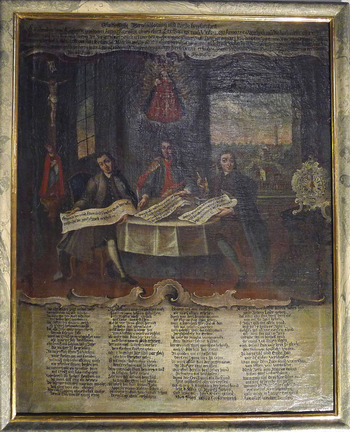
A quite different donation in 1756 made by the Augsburg defenders of the pilgrimage also signals the role that the public display of social status played in the defense of Violau.Footnote 44 To celebrate their success, the brotherhood commissioned a painting of the three citizens—Frölich, Haffner, and Entz—who had originally championed the pilgrimage (see Figure 2). In the painting, the three distinguished men sit around a table holding scrolls of paper, upon which are inscribed the following statements:
Despite the sin of Adam and Eve, God the all-knowing created the entire world.
Despite all instances of abuse, his papal holiness declared during the jubilee of 1751 the benefit to all sinners of all yearly processions around the world.
Despite Judas's betrayal of Holy Communion [at the Last Supper], the most providential God instituted the most Holy Sacrament of the Altar.
Votive painting of pilgrimage defenders, 1756. Image courtesy of Father Thomas Pfefferer, Altenmünster-Violau.

The (awkward) rhetorical parallelism of these three statements argues that the sins and failings of a few ought not negate the fundamental goodness of those things that God Himself had created or decreed, including processions and pilgrimages. Beyond the words themselves, the scrolls upon which these statements are inscribed, held in the hands of the three men, become visual metonymic substitutes for the petition that Frölich, Haffner, and Entz wrote and signed. The main text composed in verse underneath the image further confirms the heroic nature of the citizens' defense of Violau: “The procession was abolished / from one man all alone, / but when these citizens discovered this / they represented us united as one. / The answer was clear: What they wanted / was to help protect the procession, / [and] the honor of Mary from Violau / [which were] defended out of love.”Footnote 45 The text repeatedly represents this courageous defense of the pilgrimage as an action driven, not by an undifferentiated communal mass, but by the Catholic citizenry of the city: “The citizens showed their faith” and as a result the church “approved our demand.”Footnote 46 The fact that the painting honors the pilgrimage and its defenders by representing the three citizens who composed and submitted the demands to the vicar general—and not by reproducing an image of the Virgin of Violau or depicting a group of pilgrims en route to the shrine—demonstrates that its primary purpose was to memorialize the actions of these men, thus creating a form of social capital that helps to lay bare the pilgrimage as a marker of social status and hierarchies.
The evidence from 1755 and 1756 strongly suggests that the pilgrimage came to represent, by and large, a cross section of the established Catholic citizenry, with heavy representation from the middling sorts, and even some of the more prestigious elements of Augsburg's Catholic artisanal and merchant community, primarily because these were the social actors whose demands would be heard. In this sense, their successful attempt to speak on behalf of the entire community gave them a claim upon organizing the pilgrimage in the years to come.Footnote 47 Certainly, this seems to have been the case in 1761, when we know that the four prefects (Vorstehere) of the Brotherhood of the Crucified Jesus and his Sorrowful Mother Mary included three merchants—Johann Andern, Carl Joseph Pogliese, and Franz Xaver Antonius Pfisterer—and the familiar name of the grocer Franz Joseph Frölich.Footnote 48
The desire of these merchants, masters, and artisans to protect the pilgrimage also makes sense in terms of the investment that prominent Augsburgers had made in Violau, including commissions of art by local artisans and artists. For example, in the early part of the eighteenth century, the Augsburg goldsmith Michael Maier completed artwork for the pilgrimage shrine. In 1729 the Augsburg painter Johann Georg Bergmüller contributed an altar painting placed above the miraculous Pietà depicting the descent of Christ from the cross. Georg Dieffenbrunner, another Augsburg master, painted the ceiling frescos in 1751.Footnote 49 While such artwork was certainly part of commodified exchanges between artists and the clergy of Violau, they also functioned as a form of symbolic capital, a social investment in the pilgrimage shrine.Footnote 50
Given all that I have just described, we cannot understand the protest of these Augsburgers simply as an act of collective resistance based on a shared communal identity. It is very unlikely that the Catholic citizens who successfully rallied around the Violau pilgrimage did so to protect a shared communal experience that leveled social differences and divisions. Rather, resistance was spearheaded by a group of men who either possessed or desired to possess the social and cultural capital to exert influence in the civic community, a group of men who felt that the abolition of the pilgrimage threatened their particular interests. The interests of the entire community were secondary. If the citizens who lobbied for the preservation of the pilgrimage had valued the social leveling that supposedly accompanied earlier pilgrimages, why did they advocate a reformulated pilgrimage that produced hierarchies and, more importantly, exclusions based on social status and gender? If the pilgrimage functioned as a mechanism for creating social solidarity, then why would the leaders of the resistance to reform so quickly sacrifice the elements of a religious practice that helped to promote unity among disparate groups in the Catholic community?
The compromise between the pilgrimage's detractors and advocates rendered explicit some of the gendered social dynamics of the pilgrimage that had always been implicit in the Violau pilgrimages even before 1755. What these particular citizens valued so highly in the annual pilgrimage was not social leveling, but rather what I would describe as the public performance of male social prestige. Before 1755, participation in the communally organized pilgrimage to Violau represented a mark of distinction. For men of more humble status such as day laborers and journeymen, beholden to the paternal authority of their masters, and for women more generally, beholden to the patriarchal authority of fathers and husbands, that mark of distinction represented a chance to participate actively in the collective public life of the Catholic community. For participants from disenfranchised and subordinate social positions, this special occasion did indeed destabilize and transgress the social hierarchies of everyday life. But their participation in communal pilgrimage offered only temporary access to the symbolically charged practices that marked participants with a more recognizable badge of distinction. Those dependent men and women momentarily acquired a measure of social prestige, however fleeting.
In contrast, for men more established in the social hierarchy, the distinction of participating in the public performance of the pilgrimage did not elevate them radically above their everyday status. Such public performances were already a part of their everyday status, different from yet also continuous with the patriarchal authority of the civic officeholder, the artisanal master, and the independent householder. For both Catholic and Protestant masters, merchants, and civic officers who already possessed the status of citizenship in Augsburg, the most important public event in which they participated was the Oath Taking Day. The pilgrimage to Violau did not, in that sense, offer something new that they hadn't already experienced. Rather, participation in public forms of Catholic piety confirmed, reaffirmed, and reproduced their access to public spectacles of power and privilege. Perhaps the one thing that the pilgrimage offered to male Catholic citizens was one extra opportunity to ascend a public stage that excluded their Protestant equals and competitors. The Oath Taking Day was, for instance, a biconfessional recognition of civic belonging, but a pilgrimage increasingly restricted to socially established men, mostly citizens, distinguished them from their social inferiors, from their womenfolk, and from their Protestant rivals.
The Dominican prior's attempt to take away this public display of prestige eroded their store of symbolic capital and hence challenged the social interests of such men, who seem to have taken for granted the symbolic capital of the pilgrimage until the moment that it disappeared. In a sense, the compromise that the Augsburgers reached with the vicar general in 1755 revealed the ever- and already-present social divisions within the community. Before 1755, the pilgrimage encompassed a variety of social actors with unequal access to the symbols of public prestige. After 1755, that inequality became visible, as a particular cross section of the male Catholic hierarchy defended its privileges while formally jettisoning women from participation in the pilgrimage and informally limiting participation to men from a somewhat more narrowly defined social background. In this light, the pilgrimage should be read as a site of social tension rather than social harmony, of contestation rather than communitas.
Finally, the conflict and compromise that ensued from Jerg's reform efforts also laid bare the gender inequity with regard to sexuality, for the double standard of sexual honor structured the very nature of the compromise. Female sexual honor “cost” more than male sexual honor, since it was deemed much more fragile. Whenever a woman entered a public space, she put her sexual honor at risk. Thus, in a situation in which men and women might engage in illicit sexual activity, the woman risked far greater shame than the man. The Church's attempt to reform sexual behavior in the context of the Violau pilgrimage followed the cultural logic of this double standard. Since women and men were already treated unequally in terms of their sexual honor, then it is no wonder that they were treated differently in terms of the controls imposed to regulate their sexuality. Thus, the denial of female participation in the collective pilgrimage represents a form of male paternalism, rooted in the sexual double standard that coded female honor differently from male honor. Ironically, the Dominican prior Jerg was the only actor who rejected the double standard, for he held both male and female pilgrims accountable for their joint sexual improprieties. His attempt to regulate sexuality by canceling the pilgrimage altogether treated male and female sexual dishonor on equal footing, for pilgrims of both sexes had sinned and brought dishonor upon themselves, the Virgin Mary, and the Church. But for the bishop and the Catholic men who together carved out the final compromise, the solution to the problem of sexual licentiousness diagnosed by Jerg was not to jeopardize the public honor that accrued to male participants who undertook the Violau pilgrimage, but rather to safeguard female chastity by excluding the participation of women.
Reinvigorating Reform, Mobilizing Memory
If we now turn to the second attempt to dismantle the Violau pilgrimage, we see these same issues cropping up again. In 1780, Bishop Clemens Wenzeslaus issued a decree restricting the number of processions in the diocese to those held on St. Marcus's Day and during the week before Easter. The decree also limited the choice of destination for the remaining, authorized pilgrimages to shrines close enough so that all participants could return home by noon the same day. Smaller, local processions in spring to pray for a fruitful year and in fall to give thanks for the harvest could remain intact, but all remaining pilgrimages and processions were “expressly abolished and forbidden.”Footnote 51 Based on this episcopal decree, the Augsburgers' pilgrimage to Violau would count among those that the bishop had officially banned, but in addition, the decree formally ended three other beloved collective pilgrimages undertaken by Catholic residents of the city to the Marian shrines of Andechs, Kobel, and Klimmach.
Whereas in 1755, the bishop (indirectly represented through the mediation of his vicar general) had ultimately approved the Violau pilgrimage, Clemens Wenzeslaus clearly had a different agenda, in line with other mandates he issued to curb “superstitious” Catholic practices. For example, he also criticized a range of traditions such as ringing church bells to ward off storms.Footnote 52 Wenzeslaus also supported the reduction in church holidays during the year, in part to encourage Catholic workers to divide their time better between work and church attendance by discouraging frivolous festivities and entertainment.Footnote 53 Furthermore, whereas Jerg had targeted specifically the Violau pilgrimage for reform, Wenzeslaus had a much more general and programmatic approach, making Violau but one of many pilgrimages and processions he wished to end. In this sense, Wenzeslaus's reform agenda fit within the broader “Catholic Enlightenment” movement to discipline and curtail the potential excesses of popular religion. Indeed, Wenzeslaus's main argument for abolishing the majority of processions and pilgrimages in his diocese was founded upon his belief that the original piety expressed by communally organized pilgrimages and processions had, over the centuries, eroded and turned into impious superstitions or, quite tellingly, displays of political interest and worldly pride (auf politischen Vorzügen beruhender Stolz).Footnote 54
Responding immediately, those Augsburg Catholics committed to the preservation of the Violau pilgrimage composed a defense of their tradition. Their petition began by hearkening back to the pilgrimages of the Israelites, who themselves made pious journeys to the Ark of the Covenant to honor the relics it contained, including manna, the staff of Moses, and the tablets of the commandments.Footnote 55 To fashion a historical connection between contemporary Christian practices and the Old Testament rites of the Jews, the document notes anachronistically that the Israelites were commanded by God to undertake this pilgrimage at Easter time (Osterfeste). The petition also reported that the early Christian Church had instituted its own pilgrimages to lead people “to the throne of God's mercy” by bringing them to a recognition of their sins that would lead to contrition and conversion. In addition, pilgrimages helped to avert a variety of “tribulations, wars, plague, diseases, scarcity, and other evils” by assembling the faithful “all together with united hearts to direct their thoughts to God.” Here is one of the few moments when the defenders of the pilgrimage invoked a truly collective image to describe the purpose of pilgrimage.
The Augsburgers next narrated the specific history of their pilgrimage to Violau, which they recalled had begun in 1555 to thank God for ending the recent plague. They also named the various previous bishops, including Johann Otto von Gemmingen and Heinrich von Knöringen, who had acknowledged the legitimacy of Violau as a Marian pilgrimage site. Furthermore, in 1669, Bishop Johann Christoph von Freyberg had consecrated the altar of the pilgrimage church and himself given communion to 976 assembled Catholics.Footnote 56 The strategy here was to convince Bishop Wenzeslaus that his predecessors had acknowledged and even promoted the legitimacy of the Violau pilgrimage, but this rhetorical focus on the bishops had the subsidiary effect of reinforcing the maleness of Violau's patrons and participants. This male-centered narrative is explicitly emphasized by the petition's description of the events of 1756, when the pilgrimage was “renewed and confirmed for the masculine sex [auf den Sexum Masculinum], through a bishop's decree and graced with a letter of indulgence from his papal holiness.”Footnote 57
In addition to articulating a masculinized historical memory, the report defended the pilgrimage by noting that “not a single church service or children's catechism class would be neglected because of this pilgrimage, for it is not the parish, but rather the brotherhood, that will perform it.” This was not an event put on by the parish church, but solely an activity of the sodality. Here, the self-understanding of the Augsburg pilgrims contradicts the arguments of both Habermas and Freitag, who emphasized that Catholic pilgrims understood themselves to be representatives of the entire parish community. This passage sharply (if pragmatically) distinguishes the male pilgrims from the greater parish community. Rather than evidencing communitas, the defense of the pilgrimage reflected a conscious process of creating distinctions within the social community: between members of the brotherhood and nonmembers, between pilgrims and the parish community, between children needing catechism and adults already catechized, and of course between Catholic men and women. Furthermore, the petition explained that “we are equally incapable of interfering with fieldwork, since we have no fields [dan(n) wir haben keine Felder]. Art, industry, and handwork are our only plows [Pflug]; whoever among us does not want to miss a day of his work to earn his food can remain at home.”Footnote 58 To counter the bishop's claim that pilgrimages distracted people from work, the pilgrims denied this possibility with an argument that was implicitly based upon their relatively comfortable social status as distinguished from peasants who worked the fields and day laborers and artisans who could not afford to sacrifice a day of labor. This line of reasoning reflected the urban social hierarchies that implicitly defined participation in the Violau pilgrimage.
Following the organized lead of those who had defended the pilgrimage to Violau, the Catholic citizenry composed several additional petitions to protect a number of local processions and pilgrimages, including Andechs and Klimmach.Footnote 59 Even the Catholic magistrates actively supported this campaign, arguing that processions and pilgrimages encouraged Catholics in the city to express their faith over and against their Protestant rivals.Footnote 60 The Violau defenders had not only established a solid precedent for Catholic citizens to voice their demands against the Church, but they also provided experienced leadership in the petition drives of the 1780s, with Franz Joseph Frölich returning once again as an organizer and leader.Footnote 61 Once more, the demands of the Catholic citizenry were met. The bishop permitted several pilgrimages, including Violau, to continue as before, again explicitly stating the Church's demand that women remain excluded from the annual Violau observance.Footnote 62
That the Marian pilgrimage to Violau had political and social, as well as religious and theological, implications confirms David Luebke's point that historians need to treat a cultural practice such as pilgrimage in a broader analytical context. Luebke investigated the political meanings and uses of peasant pilgrimages from the Black Forest to the Swiss shrine of the Black Madonna in Einsiedeln in the 1730s.Footnote 63 Though the social strata of the pilgrims discussed here and in Luebke's work differed (urban citizens of Augsburg versus rural peasants from the Outer Austrian county of Hauenstein), the two situations shared one political dynamic: the pilgrimages in both localities offered a symbolic practice useful for oppositional politics, thus highlighting inner conflicts within the communities. In Hauenstein, one peasant faction united its collective pilgrimage to Einsiedeln with a diplomatic mission to Vienna to petition Emperor Charles VI to intervene in its local conflict with the Benedictine abbey of St. Blasien. The pilgrimage highlighted local divisions, not only between the pilgrims and the monks of St. Blasien, but also among rival factions of peasants in Hauenstein. In Augburg, communal divisions underscored by the Violau pilgrimage were social (in terms of status hierarchies), institutional (in terms of lay versus clerical interests, but also differing clerical blocs), political (in terms of citizen mobilization versus Church policy), and gendered (in terms of the continued exclusion of women from the pilgrimage). Significantly, in the symbolic politics of the Hauenstein peasantry, the leaders recruited 111 maidens from local villages for part of their pilgrimage, whereas in Augsburg, the conflict both began and ended with the exclusion of women from the pilgrimage. Thus, there are no necessary and fixed patterns when pilgrimages became a site for and a means of dissent and opposition. Yet consistently in both situations, pilgrimage did not primarily generate communitas, but rather became a cultural form useful for expressing alternative models of hierarchy, authority, agency, and power. Whether those models relaxed, reinforced, or simply reconfigured local power dynamics, these pilgrims both voiced opposition and reinforced exclusionary hierarchies as much as (and perhaps even more than) they expressed an encompassing sense of communal solidarity.
The Augsburgers' preservation of the Violau pilgrimage, substantially reconfigured as it was after 1755, expressed concern among especially middling and elite Catholics in the city that institutional authorities might erode some of the most important expressions of their privileged male social status, which included public performances of collective religious devotion. The social logic of the local, eighteenth-century resistance among Catholic burgers was so clear that it continued to shape Catholic historical memory long after the pilgrimage was formally abolished in the beginning of the nineteenth century. Anselm Mayer's brief historical account published in 1870 provided a mythologized and heroic version of the eighteenth-century defenders of Violau, by repeatedly referring to the “noble citizens and residents” (edle Bürger und Bewohner) or more generally the “noble citizenry” (edle Bürgerschaft) of Augsburg who protested first against Jerg and later against Wenzeslaus.Footnote 64 The traces of social distinction and privilege evident in the reconfigured post-1755 Violau pilgrimage retained its discursive force over a century later. This is somewhat ironic, since Mayer himself reported that the pilgrimage had yet again been revitalized just years before publishing his book, this time with 103 men and 245 women making the pilgrimage from Augsburg to Violau in 1864. Even with the restoration of women to the pilgrimage, the persistent language of status, citizenship, honor, and privilege suffused his representation of the eighteenth-century men who fought to preserve this cornerstone of Catholic piety in the city.Footnote 65
Collective vs. Personal Devotion: Some Speculative Conclusions
The Catholic Church's institutional critiques of pilgrimages and processions over the course of the early modern period arose from different sources. Tridentine Catholicism's centralizing impulse and its anxiety over Protestant accusations of superstitious error encouraged Catholic Church officials to rein in alternative, competing forms of lay piety and to assert their monopoly over the sacred. Eighteenth-century rationalist currents, part of a Catholic Enlightenment, reinvigorated skepticism toward some forms of popular piety, but the Church attempted to “rationalize” Catholic practices not by denying the miraculous altogether, but by taming its scope.Footnote 66 The miracles produced by saints' relics and Marian images were cataloged more systematically, and stricter standards were applied to confirm the efficacy of such miraculous objects. The communal and festive dimensions of Catholic piety were increasingly deemed distractions from both true Christian piety and productive citizenship, since pilgrimages, processions, and holidays—once sanctioned elements of the annual calendrical cycle of Christian life—took people away from their homes, workplaces, and churches. Good Christian women ought to be home with their families, good Christian men should be in their workshops or fields, and both should attend masses and sermons in their parish church on a regular basis.
But in addition to this broad context of post-Tridentine, enlightened Catholicism, I suggest another alternative interpretation of the cultural and social transformation of piety that took place within the context of eighteenth-century institutional reforms and communal resistance to such reforms. This speculative proposition centers on an apparent paradox. Throughout the eighteenth century, clerical elites targeted communal pilgrimages and processions, but they did not question personal devotion to the cult of the saints and the Virgin Mary, including personal pilgrimages to shrines, especially when such personalized practices directly submitted pious Christians to clerical oversight. Forms of piety that involved corporate groups produced greater concern because they eluded the control of the church, since collective action by early modern subjects so often straddled the boundary between ritualized uniformity and festive disorder. Communal pilgrimages also generated power struggles between the Church and the laity, precisely because they articulated and produced distinctions of honor and status, creating social effects that exceeded the religious goals, interests, and authority of the Church itself.
The Church authorities' contradictory responses to various Marian shrines—sometimes celebrating and promoting them, other times condemning them—makes more sense once we distinguish between modes of communal and personal devotion. Many clergymen recognized the potential disorder inherent in communal pilgrimage. But women and men of all social stations continued to call upon the intercession of saints and the Virgin Mary and to go on private pilgrimages to their shrines. Why then did private devotions and pilgrimages continue to flourish when communal forms of devotion were under siege? Catholic ecclesiastical authorities fashioned private pilgrimages into signs of personal piety rather than symbols intertwining collective piety with social capital, and hence the competition over public status and authority did not play as prominent a role in them as they did in collective pilgrimage. By diminishing the public expressions of privilege that even a private pilgrim might employ, the church was better able to discipline religious practice and practitioners. For example, in the 1780s, during the second wave of assaults on the Violau pilgrimage, Bishop Wenzeslaus explicitly permitted private pilgrimages, but when the individual pilgrim left the parish, the church could not ring its bells and the pilgrim could carry no crosses or flags.Footnote 67 Beyond eliminating such public spectacles from private pilgrimages, he showed no interest in imposing further limitations upon parishioners—whether women or men—from taking personal vows to journey to one of the many Marian and saint shrines in the region. Encouraging a regulated and disciplined form of private pilgrimage stripped of the spectacular symbols pilgrims might use as social capital actually complemented the abolition of communal pilgrimages so troubling to Church norms. The standards imposed on private pilgrimage, after all, demanded that the pilgrim submit to the bishop's oversight and authority rather than to the eyes (and ears) of the lay community. Perhaps to eighteenth-century Catholic reformers, the private pilgrimage was a potential alternative to the excesses they saw in collective, communal pilgrimages, which constantly threatened to collapse into festive amusement, social ostentation, or sexual impropriety. If this is the case, it suggests that the Church began to see highly personalized forms of Marian devotion as an increasingly dependable way to promote faithful but self-disciplined Catholics.
This was an internalized devotional piety, stripped of the collective and communal symbols used to define social status and focused more upon symbolic practices that intersected with the domestic sphere and the body. One example of the personalized devotion that proliferated in the eighteenth century, concurrent with the Church's attempts to rein in communal processions and pilgrimages, centered upon the Marian shrine in Dinkelsbühl. In 1729, a poster circulated in southern Germany announcing that an image of the Virgin Mary in Dinkelsbühl's parish church had healed hundreds of sick women and men.Footnote 68 In fact, this image was so efficacious that even a copy of the original could convey healing to the faithful. Thus, to demonstrate the original image's miraculous power, the poster included a woodcut reproduction of the painting, another Pietà depicting Mary embracing her deceased son. Owners of the poster needed only to hang it on a wall in their homes to protect themselves against illness and bad weather. The text that accompanied the woodcut image even suggested tearing off a piece of paper from the image, steeping it in water, and drinking it as a curative. The poster boldly asserted that its curative effects had received the official recognition of the Catholic Church with the phrase “It is approved” (Es ist approbirt).
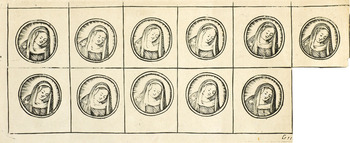
The approval of this particular local cult and the cultural products used to propagate it reflect the Church's continued support of Marian devotion, especially when it took on personal rather than communal and collective dimensions. The poster transplanted Marian devotion from the contested space of the public, civic community into the domestic sphere and, through ingestion, into the very body of the individual. This personal piety, which focused on particular bodies of individual believers rather than the collective bodies-in-motion of a larger community, blossomed in the eighteenth century. Increasingly popular were Marian Schluckbilder, small strips of paper with a row of squares containing an image of the Virgin Mary the size of a postage stamp (see Figure 3). The sick and despondent would cut individual squares from the strip and swallow them for curative effect. The eighteenth-century miracle book from Violau emphasized stories of the Virgin's miraculous interventions, culminating in individual promises to undertake a personal pilgrimage to the shrine. For example, in 1766, a priest gave a picture of the Violau Virgin to a sick parishioner—notably a woman—which she was to lay on her chest to heal her fever. In another case, a woman placed a similar image on the breast of her sick and dying husband. Despite his long suffering, at once “his soul was released from his body, and without any doubt, through the most faithful intercession of Mary, went to its creator in the blissful hereafter [in die glickseel. Ewigkeit].”Footnote 69 Though this story did not end with a miraculous cure, it does vividly depict the deep connection between domestic modes of Marian devotion and the body, for the wife's belief that the image of Mary could end her husband's physical suffering was confirmed by his peaceful death. Clearly much of this Marian devotion opened up spaces for women, since their participation in collective pilgrimages such as the one to Violau had come under clerical scrutiny. While such personal forms of piety did not exclude male participation, they certainly seem to have attracted large numbers of women.
Schluckbildchen. Photo by Michael Kowalski, courtesy of the German Museum for the History of Medicine, Ingolstadt.

Such private devotions to the Virgin Mary, while often centered on the home, the body, or other contexts separate from the immediate sphere of clerical influence, nevertheless offered the Church advantages over and above the collective piety of the communal pilgrimage. Regular, annual pilgrimages undertaken by lay parishioners ritually collapsed the boundary between the sacred spaces of the Church and otherwise profane spaces occupied by pilgrims in their everyday lives, such as the city squares, streets, or highways they traversed from home to shrine. By sacralizing the pilgrim collective, even with clergymen present in the mix, the communal pilgrimage shattered any absolute monopoly over the sacred possessed by the institutional Church. In contrast, private devotion involved pointing a person toward some specific sacred person, place, or object. The pilgrimage collective actively laid claim to the sacred, while individuals praying for intercession or swallowing a picture of the Virgin Mary submitted themselves to the sacred. Even when they undertook their private pilgrimages to a shrine, they did so not as a privilege, as the male Augsburgers described above did, but as a solemn duty to fulfill a promise. Private pilgrimages and personal devotional practices created forms of submission—to God, to Mary, to the saints. From the actual Marian shrines to the posters and pictures that reproduced her image for all to consume, the more personal modes of Marian devotion situated each pious devotee in a spiritually subordinate and dependent position, relying normally on the Church to decide what was approved, legitimate, and efficacious. Perhaps, by emphasizing individual piety, the Church thought it could inculcate a sense of religious duty and obligation that linked individuals to the Church on earth and the saints in Heaven, yet circumventing the competing authority of the local community. The promotion of personal piety coincided neatly with the Church's emerging view that communal traditions, dynamics, and loyalties were major obstacles for moral and spiritual reform.
The personal “self” became an alternative site for religious discipline within Catholicism, one more easily tempered and ordered than the community as a whole, or even socially divided and hierarchized subsets of the community. Of course, my argument throughout this article suggests that the difficulty faced by the Church in its attempts to control social collectives had less to do with the internal unity and solidarity of the “community.” Instead, the example of the Augsburg pilgrimage to Violau shows that the community was a fiction riddled with competing and fractured interests characterized by social and gender divisions. It was a fragmented yet dynamic social stage, upon which actors continuously competed to reproduce and restructure their relationships with one another and their particular place in the local hierarchies of power. It represented a site of negotiation and contestation, both among communal actors and, in situations of religious reforms, between the Church and the laity. Consequently, the community was unpredictable and unstable, and actors redefined themselves as members of that community with improvisational ingenuity, though often with the effect of asserting local versions of social hierarchy and patriarchy. The community was not bound to tradition; as the site of conflict, competition, and compromise, it invented tradition. The resistance to the abolition of the Violau pilgrimage does not point to an egalitarian cultural dynamic. The Catholic men in Augsburg who spoke on behalf of their community defended the Violau pilgrimage because its abolition would have disrupted one of the principle symbolic means available to masters, civic office holders, merchants, and householders to reproduce the gendered social hierarchy through the public performance of their social prestige. Set against this dynamic of communal power relations, the Church's redirection of Marian piety into more personal channels of devotion might reflect one way that the Church could circumvent the social interests of local actors who realized their influence over matters religious through collective action.