It is encouraging to see the diversity of sources cited in the top introductory textbooks in industrial-organizational (I-O) psychology. It is not surprising that the Journal of Applied Psychology (JAP) and Personnel Psychology are off the charts in terms of the two most-cited sources in these six textbooks. However, I would not have expected that in these books, “77% of the top-cited articles were published in cross-disciplinary journals” (Aguinis et al., Reference Aguinis, Ramani, Campbell, Bernal-Turnes, Drewry and Edgerton2017, p. 507). I wish to build on Aguinis et al. (Reference Aguinis, Ramani, Campbell, Bernal-Turnes, Drewry and Edgerton2017), with a focus on the relationship between I-O psychology and human resource development (HRD). I am the author of an HRD textbook (Werner, Reference Werner2017a). The journal I co-edit, Human Resource Development Quarterly, is one of those “cross-disciplinary journals” on Aguinis et al.’s list of most-cited sources (56th out of 110, 40th in academic journals), with 16 citations. Finally, my article on legal issues in performance appraisal was cited in five of the six textbooks (Werner & Bolino, Reference Werner and Bolino1997).
Human resource development is often viewed in terms of three primary areas of emphasis: training and development, career development, and organizational development (McLagan, Reference McLagan1989). Concerning these three topics, I-O psychologists have historically placed greatest emphasis on training and development, though also addressing issues of career and organizational development. The Society for Industrial and Organizational Psychology (SIOP) is considered the primary home for I-O psychologists. Similarly, the Academy of Human Resource Development (AHRD) would be home for the majority of HRD scholars. Historically, HRD scholars have been most likely to be affiliated with colleges of education, though similar to the trend for I-O psychologists, a greater number of AHRD members are now found in colleges of business.
In a recent study of I-O and HRD perspectives on training and development (Werner, Reference Werner and Brown2017b), I found that from 2005–2014, there were many articles in Human Resource Development Quarterly on the topics of career development (26 articles), organizational development (18), and informal learning (12), while in this same time span there were few articles in JAP on these topics (three, one, and zero, respectively). Conversely, there were 30 articles on assessment in JAP compared to two in HRDQ. Management and leadership development were studied far more often in JAP (44 articles) than in HRDQ (15), as were teams (36 articles in JAP compared to 20 in HRDQ). These are all topics that are relevant to I-O and HRD researchers, as well as researchers in management and other fields, so such discrepancies are noteworthy.
In other analyses, the amount of cross-referencing across I-O psychology and AHRD-affiliated journals was extremely limited. I referred to this as the “parallel universe” phenomenon, where similar topics are addressed by researchers of various backgrounds, as if the research from other fields were locked behind impenetrable firewalls (Werner, Reference Werner and Brown2017b). It is clearly the case that because of trends concerning the Internet in general, and especially concerning Google and open sourcing, physical access to academic journal content has never been greater. Whether it is from lack of time, desire, or knowledge of other fields, research silos remain an issue for I-O and HRD researchers alike.
As a textbook author, I can speak firsthand concerning the value of Google Scholar in finding potentially relevant citations for new editions (Zientek, Werner, Campuzano, & Nimon, Reference Zientek, Werner, Campuzano and Nimonin press). It is relatively easy to find a breadth of articles from both academic and practitioner sources, including those from outside one's own background or area of expertise. I can well imagine an author such as Paul Levy being pleased (as I am) to find and cite something from HR Magazine, the New York Times, or Harvard Business Review. It is not just a “push” from publishers to add new materials; students also respond positively to a mixture of academic and nonacademic sources. Further, there is also a moral element here, in that the addition of “meaningful,” current material provides another justification for authors to revise a textbook, beyond simply requiring a new book purchase—and avoiding the lost income (to publisher and authors) of used book sales.
The shift of many I-O psychologists to business schools is a clear case of “follow the money.” Thirty years ago, I was a PhD student in a management department in the Midwest. I was fortunate that several of my faculty were I-O psychologists with joint appointments in psychology and management. There was no question that my doctoral education was enhanced by the expertise and reputation of these outstanding researchers. It was only as I became a professor myself that I realized that it was the economics of the joint appointment that helped bring such individuals to a flat and frequently overcast city, with few of the big city amenities available at other research primary institutions.
A distinguishing feature of I-O psychology is the rigor of the quantitative research conducted by individuals trained as (or at least by) I-O psychologists. Distinguishing features of HRD research include the breadth of topics studied, as well as a greater breadth of methodologies employed, including qualitative, critical, and ethnographic methodologies (Anderson, Reference Anderson2017). There is neither a high likelihood, nor any necessity, to seek to merge these fields. Yet, greater boundary spanning and willingness to engage with others outside one's particular field of interest would benefit research done on topics of common interest.
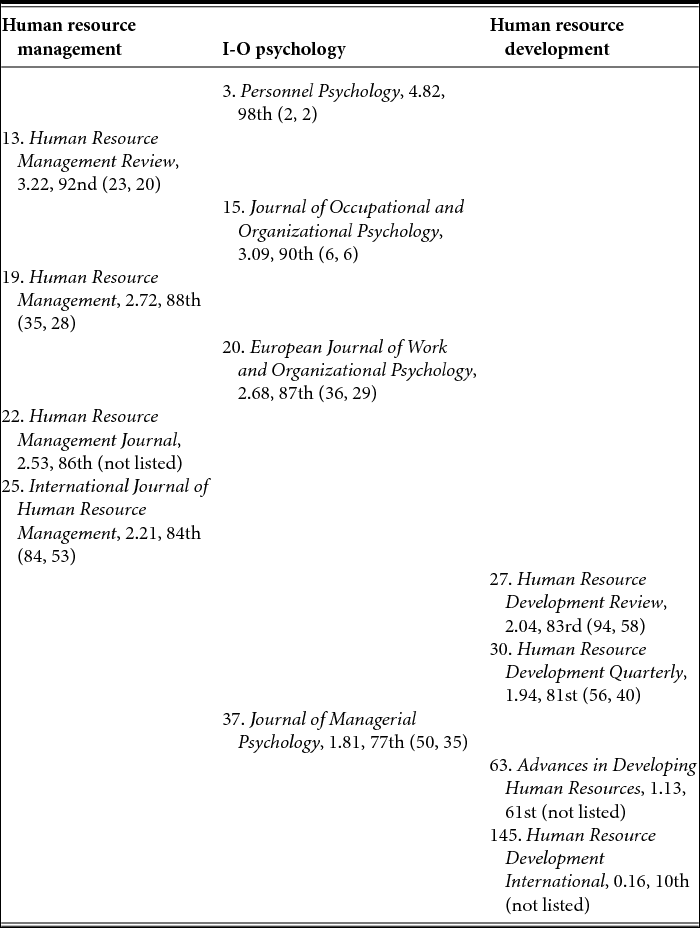
In May 2017, Scopus released its latest CiteScores. A CiteScore is a count of citations per journal using a window of the 3 prior years (the more commonly cited impact factor by Clarivate Analytics uses a 2-year window). One of the Scopus categories for journals is entitled “organizational behavior and human resource management”; there is a separate category for “applied psychology.” One would expect HRM-focused journals to do well in the category of OB and HRM. However, a question concerns how I-O and HRD journals fare in this category. Table 1 shows the top four journals in the OB and HRM category, separating them out as HRM, I-O psychology, or HRD journals (for the distinction between HRM and HRD, see Werner, Reference Werner, Poell, Rocco and Roth2014).
Table 1.
Some of the Most-Cited Journals in 2016 in the Category “Organizational Behavior and Human Resource Management,” Using Scopus CiteScore, for the Fields of Human Resource Management, I-O Psychology, and Human Resource Development (Top Four Journals in Each Field)
As expected, HRM-focused journals do well in this category of journals, ranging from 13th to 25th (out of 161 journals listed). I-O psychology journals also do well, with Personnel Psychology ranked as third in this category (it is also ranked third in the applied psychology category, followed immediately by JAP at 4). HRD journals do not do as well, yet have two journals ranked in the top 30. For comparison purposes, nine of the 12 journals listed in Table 1 were also among the top-110 most-cited sources in Aguinis et al. (Reference Aguinis, Ramani, Campbell, Bernal-Turnes, Drewry and Edgerton2017). Aguinis et al.’s rankings for all 110 sources, as well as among academic sources only, are shown in parentheses in Table 1. For this small sample of journals, there is a high degree of relationship between Scopus ranking and Aguinis et al.’s ranking of most-cited journals in I-O psychology introductory textbooks.
As mentioned by Aguinis et al. (Reference Aguinis, Ramani, Campbell, Bernal-Turnes, Drewry and Edgerton2017), the Academy of Management (AOM) is one place to gather diverse researchers, including those with backgrounds in I-O psychology and HRD. Three of the AOM divisions are organizational behavior, human resource management, and management education and development. Without losing respective strengths or identities, it is my hope that further collaboration across disciplines will occur in the future. Like a Second City comedy routine, we can build on the work of others with responses of “Yes, and . . .,” rather than silence, indifference, or “No, but . . .” (Leonard & Yorton, Reference Leonard and Yorton2015).




 You have
Access
It is encouraging to see the diversity of sources cited in the top introductory textbooks in industrial-organizational (I-O) psychology. It is not surprising that the Journal of Applied Psychology (JAP) and Personnel Psychology are off the charts in terms of the two most-cited sources in these six textbooks. However, I would not have expected that in these books, “77% of the top-cited articles were published in cross-disciplinary journals” (Aguinis et al., Reference Aguinis, Ramani, Campbell, Bernal-Turnes, Drewry and Edgerton2017, p. 507). I wish to build on Aguinis et al. (Reference Aguinis, Ramani, Campbell, Bernal-Turnes, Drewry and Edgerton2017), with a focus on the relationship between I-O psychology and human resource development (HRD). I am the author of an HRD textbook (Werner, Reference Werner2017a). The journal I co-edit, Human Resource Development Quarterly, is one of those “cross-disciplinary journals” on Aguinis et al.’s list of most-cited sources (56th out of 110, 40th in academic journals), with 16 citations. Finally, my article on legal issues in performance appraisal was cited in five of the six textbooks (Werner & Bolino, Reference Werner and Bolino1997).
Human resource development is often viewed in terms of three primary areas of emphasis: training and development, career development, and organizational development (McLagan, Reference McLagan1989). Concerning these three topics, I-O psychologists have historically placed greatest emphasis on training and development, though also addressing issues of career and organizational development. The Society for Industrial and Organizational Psychology (SIOP) is considered the primary home for I-O psychologists. Similarly, the Academy of Human Resource Development (AHRD) would be home for the majority of HRD scholars. Historically, HRD scholars have been most likely to be affiliated with colleges of education, though similar to the trend for I-O psychologists, a greater number of AHRD members are now found in colleges of business.
In a recent study of I-O and HRD perspectives on training and development (Werner, Reference Werner and Brown2017b), I found that from 2005–2014, there were many articles in Human Resource Development Quarterly on the topics of career development (26 articles), organizational development (18), and informal learning (12), while in this same time span there were few articles in JAP on these topics (three, one, and zero, respectively). Conversely, there were 30 articles on assessment in JAP compared to two in HRDQ. Management and leadership development were studied far more often in JAP (44 articles) than in HRDQ (15), as were teams (36 articles in JAP compared to 20 in HRDQ). These are all topics that are relevant to I-O and HRD researchers, as well as researchers in management and other fields, so such discrepancies are noteworthy.
In other analyses, the amount of cross-referencing across I-O psychology and AHRD-affiliated journals was extremely limited. I referred to this as the “parallel universe” phenomenon, where similar topics are addressed by researchers of various backgrounds, as if the research from other fields were locked behind impenetrable firewalls (Werner, Reference Werner and Brown2017b). It is clearly the case that because of trends concerning the Internet in general, and especially concerning Google and open sourcing, physical access to academic journal content has never been greater. Whether it is from lack of time, desire, or knowledge of other fields, research silos remain an issue for I-O and HRD researchers alike.
As a textbook author, I can speak firsthand concerning the value of Google Scholar in finding potentially relevant citations for new editions (Zientek, Werner, Campuzano, & Nimon, Reference Zientek, Werner, Campuzano and Nimonin press). It is relatively easy to find a breadth of articles from both academic and practitioner sources, including those from outside one's own background or area of expertise. I can well imagine an author such as Paul Levy being pleased (as I am) to find and cite something from HR Magazine, the New York Times, or Harvard Business Review. It is not just a “push” from publishers to add new materials; students also respond positively to a mixture of academic and nonacademic sources. Further, there is also a moral element here, in that the addition of “meaningful,” current material provides another justification for authors to revise a textbook, beyond simply requiring a new book purchase—and avoiding the lost income (to publisher and authors) of used book sales.
The shift of many I-O psychologists to business schools is a clear case of “follow the money.” Thirty years ago, I was a PhD student in a management department in the Midwest. I was fortunate that several of my faculty were I-O psychologists with joint appointments in psychology and management. There was no question that my doctoral education was enhanced by the expertise and reputation of these outstanding researchers. It was only as I became a professor myself that I realized that it was the economics of the joint appointment that helped bring such individuals to a flat and frequently overcast city, with few of the big city amenities available at other research primary institutions.
A distinguishing feature of I-O psychology is the rigor of the quantitative research conducted by individuals trained as (or at least by) I-O psychologists. Distinguishing features of HRD research include the breadth of topics studied, as well as a greater breadth of methodologies employed, including qualitative, critical, and ethnographic methodologies (Anderson, Reference Anderson2017). There is neither a high likelihood, nor any necessity, to seek to merge these fields. Yet, greater boundary spanning and willingness to engage with others outside one's particular field of interest would benefit research done on topics of common interest.
In May 2017, Scopus released its latest CiteScores. A CiteScore is a count of citations per journal using a window of the 3 prior years (the more commonly cited impact factor by Clarivate Analytics uses a 2-year window). One of the Scopus categories for journals is entitled “organizational behavior and human resource management”; there is a separate category for “applied psychology.” One would expect HRM-focused journals to do well in the category of OB and HRM. However, a question concerns how I-O and HRD journals fare in this category. Table 1 shows the top four journals in the OB and HRM category, separating them out as HRM, I-O psychology, or HRD journals (for the distinction between HRM and HRD, see Werner, Reference Werner, Poell, Rocco and Roth2014).
Some of the Most-Cited Journals in 2016 in the Category “Organizational Behavior and Human Resource Management,” Using Scopus CiteScore, for the Fields of Human Resource Management, I-O Psychology, and Human Resource Development (Top Four Journals in Each Field)
Key: CiteScore rank (out of 161 journals), journal title, CiteScore 2016, percentile, Aguinis et al. (Reference Aguinis, Ramani, Campbell, Bernal-Turnes, Drewry and Edgerton2017) rankings in parentheses.
Sources: Aguinis et al. (Reference Aguinis, Ramani, Campbell, Bernal-Turnes, Drewry and Edgerton2017); Scopus (2017). Personnel Psychology: Source details. Retrieved from https://www.scopus.com/sourceid/12817?origin=sourceInfo&zone=refpointrank#tabs=1.
As expected, HRM-focused journals do well in this category of journals, ranging from 13th to 25th (out of 161 journals listed). I-O psychology journals also do well, with Personnel Psychology ranked as third in this category (it is also ranked third in the applied psychology category, followed immediately by JAP at 4). HRD journals do not do as well, yet have two journals ranked in the top 30. For comparison purposes, nine of the 12 journals listed in Table 1 were also among the top-110 most-cited sources in Aguinis et al. (Reference Aguinis, Ramani, Campbell, Bernal-Turnes, Drewry and Edgerton2017). Aguinis et al.’s rankings for all 110 sources, as well as among academic sources only, are shown in parentheses in Table 1. For this small sample of journals, there is a high degree of relationship between Scopus ranking and Aguinis et al.’s ranking of most-cited journals in I-O psychology introductory textbooks.
As mentioned by Aguinis et al. (Reference Aguinis, Ramani, Campbell, Bernal-Turnes, Drewry and Edgerton2017), the Academy of Management (AOM) is one place to gather diverse researchers, including those with backgrounds in I-O psychology and HRD. Three of the AOM divisions are organizational behavior, human resource management, and management education and development. Without losing respective strengths or identities, it is my hope that further collaboration across disciplines will occur in the future. Like a Second City comedy routine, we can build on the work of others with responses of “Yes, and . . .,” rather than silence, indifference, or “No, but . . .” (Leonard & Yorton, Reference Leonard and Yorton2015).