




No CrossRef data available.
Abandoning the Middle: The Bush Tax Cuts and the Limits of Democratic Control
Published online by Cambridge University Press: 09 March 2005
Abstract
The 2001 and 2003 tax cuts represent dramatic legislative breakthroughs. Taken together, they have fundamentally reshaped the nation's fiscal landscape. In view of the voluminous and largely sanguine literature on American democratic responsiveness, one might assume that this policy turnaround was broadly consistent with voters' priorities. In this article, we show that—in contradiction to this prevailing view, as well as the claims of Larry Bartels in this issue—the substance of the tax cuts was in fact sharply at odds with public preferences. Tax policy was pulled radically off center, we argue, by the intersection of two forces: (1) the increasing incentives of political elites to cater to their partisan and ideological “base”; and (2) the increasing capacity of politicians who abandon the middle to escape political retribution. In accounting for these centrifugal forces, we stress, as others have, increasing partisanship and polarization, as well as the growing sophistication of political message-control. Yet we also emphasize a pivotal factor that is too often overlooked: the deliberate crafting of policy to distort public perceptions, set the future political agenda, and minimize the likelihood of voter backlash. By showing how politicians can engineer policy shifts that are at odds with majority public preferences, we hope to provoke a broader discussion of voters' capacity to protect their interests in America's representative democracy.Jacob S. Hacker is Peter Strauss Family Assistant Professor of Political Science at Yale University (jacob.hacker@yale.edu) and author of The Divided Welfare State: The Battle over Public and Private Social Benefits in the United States and The Road to Nowhere: The Genesis of President Clinton's Plan for Health Security. Paul Pierson is Professor of Political Science at the University of California, Berkeley (pierson@berkeley.edu), where he holds the Avice Saint Chair in Public Policy. He is the author of Politics in Time: History, Institutions and Social Analysis and Dismantling the Welfare State? Reagan, Thatcher, and the Politics of Retrenchment. The authors are grateful for the comments and suggestions of Akhil Amar, Daniel Carpenter, Peter Hall, Michael Heany, Jennifer Hochschild, Richard Kogan, Theodore Marmor, Andrew Martin, David Mayhew, Nolan McCarty, Bruce Nesmith, Peter Orszag, Eric Schickler, Theda Skocpol, Richard Vallely, Robert van Houweling, Joseph White, and three anonymous reviewers, as well as participants in a workshop at Harvard University sponsored by the Russell Sage Foundation. Rachel Goodman, Pearline Kyi, Joanne Lim, and Alan Schoenfeld provided able research assistance. A previous version of this paper was presented at the 2003 annual meeting of the American Political Science Association.
Information
- Type
- Research Article
- Information
- Copyright
- © 2005 American Political Science Association
On June 7, 2001, President George W. Bush signed into law the Economic Growth and Tax Relief Reconciliation Act of 2001. The largest tax cut in two decades (and the second largest in post-Vietnam history), the bill immediately cut federal receipts by half a percent of Gross Domestic Product (GDP). Within weeks, all taxpaying households began receiving rebate checks of up to $600. But the legislation's major provisions were not scheduled to take effect for years, as the law phased in reductions in income tax rates and gradually eliminated the estate tax. Initial estimates placed the ten-year cost as high as $2.1 trillion—a figure that was soon to be cast in stark relief by the sharp reversal of federal finances from record surpluses to mounting deficits.1
Equally striking, however, was the bill's distribution: 36 percent of the cuts accrued to the richest 1 percent of Americans—a share almost identical to that received by the bottom 80 percent.2As both a political victory and a policy shift, the bill was a dramatic breakthrough. It was not, however, an isolated accomplishment. In each of the next three years, President Bush and congressional Republicans successfully pushed for additional cuts—first for businesses in 2002, then for individuals in 2003, and then again for individuals in 2004. The biggest of these post-2001 bills, the tax revision of 2003, was the most notable of the three. Roughly as tilted toward the affluent as the 2001 bill, its potential price tag exceeded $1 trillion over ten years, according to some estimates—at a time when budget projections showed a mounting deficit.3
All told, if the 2001–2003 tax cuts are extended as advocates desire, they will cost more than $4 trillion through 2013. In that year, the revenue loss will exceed 2 percent of GDP.4 To put this staggering figure in perspective, the long-term cost of fixing the shortfall in Social Security—often described as catastrophically large—is under 0.75 percent of GDP.5According to the March Social Security Trustees' Report, the Social Security shortfall equals 0.72 percent of GDP over the next 75 years. Ibid., 1553.
The tax-cut legislation of 2001 is, in short, a remarkable and ongoing story. It is also puzzling. Most Americans received extremely modest direct benefits from the bill. Even taking into account the well-known skew in participation toward the affluent, the average voter did not reap substantial rewards. At the same time, the huge aggregate cost of the cut meant an inevitable clampdown on priorities that most voters said they supported, such as Medicare, Social Security, education, and reduction of the national debt. Credible estimates indicate that, once the long-term financing cost of the tax cuts is taken into account, “the bottom four-fifths of households … lose more than they gain from the tax cuts.”6
In a representative democracy that enshrines the principle of one person, one vote, what explains the passage of a highly salient policy that promises very modest benefits and very large long-term risks to the average voter? Put more bluntly: Why, when so many received so little, and so much that citizens valued was placed in jeopardy, did the Bush tax cuts pass?
This question reflects a concern with which political scientists have long grappled. Robert Dahl put it well more than forty years ago: “In a political system where nearly every adult may vote but where knowledge, wealth, social position, access to officials, and other resources are unequally distributed, who actually governs?”7
Dahl 1961, 1.
Far from representing popular wishes, the size, structure, and distribution of the tax cuts passed in 2001 were directly at odds with majority views. As the United States faced a new century, forecasts of large surpluses raised a fundamental question of priorities: How should these considerable but finite resources be allocated? It is possible, at least in broad strokes, to depict with some confidence voters' opinions on this issue. When voters were prompted to pay attention to the tradeoffs, tax cuts were assigned a very low priority. Even citizens who favored tax cuts offered little support for the massive scale or skewed distribution of the 2001 bill. The most striking characteristic of the tax cuts—the feature we seek to establish and explain—is how far a policy produced by elected officials diverged from the preferences of most voters.
This divergence of policy and opinion is not merely of substantive importance. It also carries important messages for our theories of American politics. For in running afoul of public opinion, the Bush tax cut also runs afoul of one of the most prominent and assertive veins of research on American politics, which we dub the “new pluralism.” The new pluralism is a complex web of intersecting research agendas—some focused on voters, others on public opinion, still others on “macro” political processes. All these strands, however, support the claim that, at least on big issues, voters have a tremendous capacity to get what they want. Voters elect politicians who do things they like, and punish politicians who do things they do not like. As a result, public policies and public preferences tend to be closely aligned over time.8
Bartels (2005) suggests that the whole emphasis on the congruence between public opinion and policy outputs rests on a “confused” conception of democratic theory. We are not sure how to square this critique with his own recent work (Bartels 2002) on the relative responsiveness of senators to citizens at different points on the income spectrum, which looks at the correspondence between public opinion and senators' roll-call votes on a range of policy issues. But even if Bartels's dismissal is warranted, the standard of responsiveness we evaluate (and find wanting) remains a mainstay of work on opinion, public policy, and the relationship between voters and elected officials. We share some of the underlying concerns about framing effects and the multiple dimensions of issues that lead Bartels to dismiss the notion of mass preferences as misguided (Bartels 2003). But we part company in two respects. First, we maintain that popular preferences on taxation are discernible. Indeed, in the case of taxes and budgets, survey researchers possess the capacity to ask voters to express their views about trade-offs, which diminishes the problems of inconsistent and nonexistent opinion that Bartels rightly emphasizes. Second, if such framing effects indeed powerfully influence opinion—a proposition with which we are in full accord—that suggests all the more strongly the limits of studies that evaluate “opinions” or “attitudes” about policies without any attempt to consider elite efforts to take advantage of citizens' cognitive vulnerabilities.
The new pluralism's claims are clear, logical, and arresting. They also fail to explain the high-profile legislative breakthrough of 2001. The 2001 tax cuts did not pass because ordinary voters wanted them. Instead, we argue, they passed because of two frequently neglected but central features of contemporary American politics: (1) the substantial incentives for politicians to reward their base—the partisans, activists, and moneyed interests that are their first line of support—and (2) the capacity of political elites, in certain circumstances, to manipulate the reception of their proposals through framing effects, agenda control, and policy design.9
On framing and persuasion, see Jacobs and Shapiro 2000.
We begin by laying out the key claims of the new pluralism, and their shortcomings. We then substantiate our argument that the tax cuts were at odds with ordinary voters' preferences. Next, we explain why politicians have increased incentives to focus on their base. Finally, we explore how proponents of the 2001 tax cut forestalled the activation of public preferences hostile to the cuts. The strongest evidence turns out to be the bill itself. Core features of the legislation show that its designers did not believe they were operating in the political world sketched by the new pluralism.
The new pluralism is correct to remind us that average Americans can, under the right conditions, have real influence. It is wrong to forget just how demanding those conditions are. In doing so, it risks painting a Panglossian portrait of American politics based on a systematic neglect of key dimensions of contemporary political life.
Does the Middle Hold? The New Pluralism and Its Critics
Efforts to establish an empirical basis for citizen control of government have come full circle over the past half century.10
For a more detailed survey and analysis of the Old and New Pluralism, see Pierson 2001.
These dismal findings about voters created a hole in the case for responsive democratic governance. Robert Dahl's famous solution—what we term the “old pluralism”—focused on interest groups.12
Dahl 1961. For a critical review of pluralist thought, see Lukes 1974.
Even as the old pluralism was under attack, however, assertions about the possibilities for citizen control were being reoriented and revitalized.14
Key works include Chong 2000; Ferejohn and Kuklinski 1990; Iyengar 1990; Lupia and McCubbins 1998; MacKuen, Erikson, and Stimson 2002; Page and Shapiro 1992; Sniderman, Brody, and Tetlock 1991.
Rather than exalt the attention or knowledge of average citizens, however, new pluralists have instead pursued two complementary lines of argument, both of which take citizens' limits as given. The first is that voters make surprisingly efficient use of the limited information they have. Effectively managing information and employing cognitive cues and shortcuts, voters can produce outcomes not so different from those of fully informed individuals.15
Sniderman, Brody, and Tetlock 1991, 12. See also Chong 2000; Ferejohn and Kuklinski 1990; Lupia, McCubbins, and Popkin, 2000.
Iyengar 1990, 160.
The second prominent line of argument developed by the new pluralism moves from the capacities of individual voters to the collective electorate. According to this vein of research, processes of social aggregation have strong rationalizing qualities that enhance the electorate's power. Much as the stock market may be an accurate store of widely dispersed information about the economy, aggregation of public views—in opinion surveys and voting outcomes—serves to filter out elements of cognitive weakness while magnifying areas of strength. At the macro level, idiosyncratic or faulty elements of individual views tend to cancel out, allowing the enduring, reasoned, and informed elements of public attitudes to emerge.
The new pluralism's arguments about the capacities of voters are powerful, creative, and often convincing. Yet they do not by themselves suffice to generate confidence about democratic control. What also needs to be shown is that these capacities impel elected officials to produce responsive policies. Here, the new pluralism is bolstered by several lines of research and theorizing that trumpet the political influence of the median voter.17
The seminal analysis is Downs 1957. Reviews of the median-voter framework and its application include Green and Shapiro 1994; Shepsle and Boncheck 1997.
This broad perspective has recently received its most encompassing and influential treatment in the impressive work of Robert Erikson, Michael MacKuen, and James Stimson.19
Emphasizing the rationalizing effects of aggregation they stress the “extraordinary sophistication of the collective electorate.”20 They link the collective electorate to policy making, suggesting that politicians have overwhelming incentives to obey public opinion. Based on extensive analyses of both the evolution of public “mood” and public policy, they conclude that “there exists about a one-to-one translation of preferences into policy.”21Ibid., 316.
Ibid., 374.
This new portrait of a collectively informed electorate harnessing the power of the vote to keep elected officials in line has major implications. It suggests that popular control remains viable even in a huge—and hugely complex—polity. And it offers strong reasons for thinking that what government does is generally close to what voters want it do.
And yet, the new pluralism, like the old, rests on some shaky foundations. Voters often lack important resources needed to exercise effective control over policy. Perhaps the most crucial resource is knowledge—knowledge of what politicians do, and of what their actions mean for citizens. As R. Douglas Arnold has argued, electoral retribution against incumbents for their policy choices requires at least three conditions: (1) effects must be discernible by voters, (2) effects must be traceable to policies, and (3) there must be accountability—voters must be able to determine who should be held responsible.23
These conditions are not easily filled, and in many cases, one or more of Arnold's three stages presents voters with formidable cognitive hurdles.24As numerous scholars have pointed out, elites possess the means to make their actions more or less prominent with regard to each of Arnold's three conditions required for electoral control.25
Discernibility, traceability, and accountability can vary independently of a policy's actual impact—in ways that politicians have major incentives to manipulate. For example, policy makers can affect the traceability of policies by varying what Arnold calls the “length of the causal chain.”26Arnold 1990, 15.
Indeed, each cognitive step that voters need to exercise control—discernibility, traceability, and accountability—is subject to potential manipulation through the design of policies. It is perhaps no accident that students of opinion and voting are generally optimistic about the prospects for citizen control, while scholars of policy are often skeptical. The world of policy making is a complex environment, in which control of information flows is crucial. On issues of great significance to average Americans, the presentation and design of policies confer significant resources on those most intimately involved. Whether or not citizens are mobilized and whom and what options they support frequently turn on the manner in which elites fashion the complex instruments of governance.
These instruments can be used, moreover, not only to exploit limitations in voter knowledge, but also to take advantage of asymmetries of knowledge. Indeed, this possibility strikes at a fundamental weakness of optimistic claims about opinion leaders and aggregation—namely, the assumption that “good” information will be relatively equally distributed among voters with differing preferences (even if particular individuals are likely to be ignorant). In a sense, then, the new pluralism has backed itself into the quandary that plagued the old pluralism: Is knowledge widely diffused and distributed differently from issue to issue, or do knowledge imbalances tend to accumulate and consistently heighten the influence of certain segments of the electorate?
Theory and evidence point toward the second possibility. Based on his reading of the literature on cognition, Converse persuasively argues that knowledge inequalities are cumulative: “With information as with wealth, ‘them that has gets,’ and there is no comforting system of progressive taxation on information to help redress the drift toward glaring inequalities.”27
Converse 1990, 373–74.
The tax cuts of 2001 strongly vindicate these concerns. Surveys on tax issues reveal that F. Scott Fitzgerald was right: the very rich are different—not just in their preferences regarding tax policy but, crucially, in their level of knowledge with respect to various dimensions of this complex issue. Knowledge of the tax code is sharply skewed by income. In a 2003 poll, for example, a majority of the richest 5 percent of Americans answered the knowledge questions correctly. Only a fifth of other Americans did, with knowledge lowest among the poor. Only half of the respondents even knew there had been a tax cut in 2001. Far fewer understood or supported a cut in the dividend tax or the idea of speeding up and making permanent the 2001 tax cuts—two issues prominent when the poll was conducted. Consistently, however, people on the top 5 percent of the income ladder not only supported these and other specific cuts but knew much more about them.29
In sum, voters have many ways to compensate for their perceptual and informational limitations, but elites have at least as many strategies to prey on those limitations. These strategies, we contend, had profound effects during the debate over tax cuts. Regarding a prominent piece of legislation whose distributional effects were, in principle, quite knowable, politicians repeatedly chose provisions that showered the bulk of their largesse on the attentive and well off. Rather than respond to public sentiments, they crafted their appeals and policies to exploit knowledge asymmetries and create political pressures in favor of the ends they supported—ends that abandoned the middle and raced to the base.
Abandoning the Middle
Perhaps we are too quick to see abandonment of the middle. Perhaps most of the public truly wanted the tax cuts that passed. This, after all, is the most obvious argument for why the tax cuts passed—and also the one most consistent with the new pluralism. Bartels puts the point strongly and clearly: “What is most remarkable is that this massive upward transfer of wealth was broadly supported by ordinary Americans…. [T]o the extent that [“public opinion” about tax policy] exists at all, it seems to be highly supportive of tax cuts along the lines pursued by President Bush.”30
Bartels 2005, 16, 21.
The main evidence in favor of this contention comes from polls that asked voters whether they favored “Bush's tax-cut proposal.” Table 1 presents the average results of the 25 surveys that we could find asking this question in early 2001. As the table shows, on average, between 50 and 60 percent of respondents said yes, lending surface plausibility to the public-supported-it position.
Table 1: Surface support for the Bush tax cut, January–May 2001

Yet, for determining voter preferences, these results are close to meaningless. Let us put aside the point of the last section and assume for the moment that these expressions of opinion did not reflect elite manipulation. It is still the case that these polls say almost nothing about what kind of tax cuts the public wanted and how much priority they gave them. In fact, by isolating the issue of tax cuts from any discussion of alternatives or tradeoffs, the polls fail completely to capture public opinion about policy priorities. Students of public opinion have long known that if respondents are asked, “Would you like to spend more, less, or the same on X?,” many spending programs will generate extremely high levels of support, usually much higher than those programs would garner if their financing or competing spending priorities were discussed. For this reason, as John Mark Hansen has argued, public views can not be understood without questions that tap into the “the essential aspect of the public budgeting problem: the tradeoffs inherent in establishing public priorities.”32
Hansen 1998, 514.
When we dig a little deeper, it becomes clear that support for the tax cut's actual provisions was narrow. To see this requires examining polls that capture the two distinguishing features of the 2001 tax cuts: their size and their distribution.33
These survey findings were obtained from the following sources: Bowman 2004; National Journal's Poll Track (http://nationaljournal.com); and PollingReport.com (http://www.pollingreport.com).
To begin with, taxes were not a burning concern for most Americans. Before 2001 virtually never did more than a tenth of respondents say that taxes were the nation's “most important problem.” When Bush entered office, the figure was just 5 percent.34
Bowman 2004, 10.
More fundamental is the fact that large majorities of Americans expressed clear hostility to the tax cut's size. The crucial issue in gauging public preferences is not how respondents answered isolated questions about support for tax cuts, but how voters weighed the tradeoff between tax cuts and other governing priorities. Although the federal government was running surpluses in 2000 and 2001, the looming retirement of the baby boom generation threatened future financial difficulties. Equally important, tax cuts were only one possible current use of federal funds. Education, Medicare, Social Security, environmental protection—all featured prominently in the 2000 race.
When asked about these competing uses, voters consistently saw tax cuts as a lower priority than plausible alternative uses of the forecasted surpluses. Table 2 summarizes the surveys that asked about possible alternatives. Versus Social Security, tax cuts lost by a 74 to 21 percent margin. Versus Medicare, the margin is 65 to 25 percent. Even when Social Security is taken out of consideration, 69 percent of respondents preferred using extra monies on “education, the environment, health care, crime-fighting, and military defense,” rather than a tax cut, which garnered just 22 percent support. These sentiments did not disappear when the tax cuts passed; even after benefits began to flow to voters, large majorities said they would be willing to forgo their continuation in favor of alternative uses of the funds. Immediately after the 2004 election, for example, a New York Times poll found that reducing the deficit trumped tax cuts as a public priority by more than a two-to-one margin.35
Table 2: Preferred uses of the budget surplus

Bartels disputes our use of this survey evidence, arguing that Americans' yes-or-no views on tax cuts, not their public finance priorities, are what really matters.36
We should emphasize that Bartels's rich and revealing analysis of survey data does not contradict our most fundamental point: that public opinion on tax cuts was deliberately shaped by political actors framing policy design to confuse voters, elevate surface support for tax cuts, and betray clearly expressed public priorities. Indeed, Bartels's analysis, by taking public opinion as the sole focus of analysis, provides a revealing indication of how little attention most studies of the opinion-policy linkage give to the role of elite manipulation. But even with regard to the survey data, Bartels is too quick to dismiss our results. The debate in 2000, after all, was about allocating finite resources among competing priorities, and on this issue, Americans were consistently biased against tax cuts. Figure 2 leaves little room for ambiguity: whatever the lineup of options, tax cuts end up at or near the bottom of the list. We certainly would not deny that there are elements of American opinion that support tax cuts. What we do deny is that it makes sense to say Americans “wanted” the 2001 tax cuts when there is ample evidence not only that they would have preferred other policy priorities and other sorts of tax cuts, but also that political elites deliberately set the agenda and designed key policy features to prevent voters from fully perceiving aspects of the tax cuts that they opposed.What about the second dimension of policy change—distribution? Public opinion was clearly and consistently hostile to the top-heavy skew of the Bush tax cut. Indeed, voters' leading concern about taxes in the years before the tax cuts passed was neither the tax code's staggering complexity nor the burdens they themselves faced. Rather, the top worry of Americans was that “the rich pay too little in taxes”—hardly the sentiment reflected in the 2001 cuts. Not surprisingly given this concern, large majorities of respondents consistently said that they wanted the legislation to distribute more of its benefits to middle- and lower-income Americans and less to the well off. Even in a poll conducted between House and Senate passage of the bill, the majority of respondents said that the tax cut should be either rejected (17 percent) or only passed with major changes (35 percent). And by a 53-point margin they wanted the plan adjusted so more of the tax cuts went to lower-income taxpayers.37
CNN/Gallup/USA Today, survey of March 9–11, 2001, retrieved from National Journal Poll Track database (http://nationaljournal.com).
Citizens also rejected the Bush administration's assertion that the benefits of tax cuts should be distributed in rough accordance with current income-tax liabilities, with high-income voters receiving the largest share of benefits. A survey of March 2001, for example, asked respondents to compare two generic plans—the first of which “would reduce federal income taxes across the board” and give “the largest share of this tax cut … to wealthier Americans, who currently pay the most in taxes”; the second of which would “take full effect this year, and would be aimed more at middle income Americans … [and] involve either credits or reductions in the payroll taxes that are deducted from people's paychecks.” Respondents preferred the second plan to the first by 73 to 20 percent. Similarly, when asked whether the “rich should get a bigger tax cut because they pay more in taxes” or whether “everyone should get the same level of tax cut,” 70 percent of voters chose the latter option and just 24 percent the former.38
ABC News/Washington Post, survey of September 6–9, 2001, retrieved from iPOLL Databank, Roper Center for Public Opinion Research, University of Connecticut (http://www.ropercenter.uconn.edu/ipoll.html).
Not surprisingly, Americans do not think that the economy or their own pocketbooks have benefited much from recent tax cuts. In August 2004, for instance, 63 percent of poll respondents believed that the tax cuts of 2001 and 2003 had either hurt the economy or not made much difference. Meanwhile, only a third said they had personally benefited from the tax cuts.39
Investor's Business Daily/Christian Science Monitor, survey of August 6–10, 2004, retrieved from National Journal Poll Track database (http://nationaljournal.com).
NBC News/Wall Street Journal, survey of March 6–8, 2004, retrieved from National Journal Poll Track database (http://nationaljournal.com).
It is important to emphasize, moreover, that the two dimensions of size and distribution of the tax cuts are distinct, so looking separately at each probably overstates support for the cuts. That is, of the 20–30 percent of respondents who said that tax cuts were a higher priority than other potential uses of the surplus, many probably did not favor the top-heavy distribution of the Bush proposal. The 20–30 percent range should therefore be viewed as the upper bound of support.
A final piece of evidence regarding public preferences comes from an unexpected source: the administration itself. Former Treasury Secretary Paul O'Neill has released an internal memo dating from the unveiling of the Bush administration's first round of tax cuts in 2001.41
Its author was Michele Davis, a top Treasury official and participant in daily meetings on the administration's communications strategy. Her memo, generated for a high-profile public appearance of the administration's top economic spokesman, undoubtedly reflects strategies developed at the highest level. It begins by asking O'Neill to plug tax cuts at a press event unveiling the president's budget. Then, however, Davis warns: “The public prefers spending on things like health care and education over cutting taxes.”42 In the picture of politics sketched by the new pluralism, this would prompt attentive office holders to scale back their ambitions. But to Davis, it is instead a reason to avoid talking about any tradeoffs tax cuts might entail. “It's crucial that you make clear that there are no trade-offs here,” she writes. “Roll-out events like this are the clearest examples of when staying on message is absolutely crucial. Any deviation … will change the way coverage plays out from tomorrow forward.”This internal memo, along with the poll results just reviewed, makes clear that the Bush-supported plan diverged sharply from popular views about scale and distribution of any tax cuts. Why, then, did advocates of the tax cuts believe they could enact them? The answer hinges on two sets of changes in the American political universe: those that have increased the benefits to politicians of departing from voters' preferences and those that have decreased the costs of such departures for politicians' fates.
The Race for the Base
In early 2003, Maine voters were exposed to TV ads that compared their senior senator, Olympia Snowe, to French President Jacques Chirac. The ads announced that when “President Bush courageously led the forces of freedom” against Iraq, “some so-called allies like France stood in the way.” Now that the president sought “bold job-creating tax cuts,” the ads continued, “some so-called Republicans like Olympia Snowe stand in the way.” Similar ads were run against Ohio Senator George Voinovich, a longtime Republican stalwart who also suggested that the new round of tax cuts in 2003 was too expensive.
These ads were run by a once-obscure conservative group, the Club for Growth. By the standards of mass-membership organizations, the Club is small, boasting around 10,000 members in 2003. Yet during the 2002 midterm elections, the organization's $10 million in contributions made it the leading source of campaign funds for Republicans outside of the GOP itself. Focusing on primaries and open-seat contests, the Club bundles donations from its wealthy members to fund conservative antitax candidates. Perhaps the most distinctive feature of the Club is that it sometimes targets for defeat not Democrats, but incumbent Republicans judged insufficiently fierce in their tax-cutting commitment. Club President Stephen Moore jokes that when he threatens a primary challenge against wayward Republicans (dismissively termed RINOs, or Republicans In Name Only), “they start wetting their pants.”43
Bai 2003, 24.
Carey 2002, 3128.
The strategy of the Club for Growth has dovetailed with the activities of another relatively recent antitax group: Grover Norquist's Americans for Tax Reform (ATR). Like Moore, Norquist is an antitax crusader: he describes his goal as a 50 percent reduction in spending and taxes as a share of GDP (“down to the size where you could drown [government] in the bathtub”). And like the Club for Growth, ATR has focused its energies on Republican members of Congress. Its central strategy has been to demand a written antitax pledge—currently signed by 216 representatives, 42 senators, and President Bush—to “oppose any and all efforts to increase the marginal income tax rates for individuals and/or businesses.”45
Some Republicans, mostly moderate incumbents, resisted the ATR pledge for a time. But the logic of contemporary Republican primaries is clear. For non-incumbents, agreement to these pledges has become a necessary component of any run for Congress.In their commitments and aims, the Club for Growth and ATR symbolize the tax-cutting fervor of a major activist wing of the GOP. And in their operation and influence, the Club and ATR are representative of many key trends in American politics today, from increasing partisan polarization to growing economic inequality to the increasingly prominent role of ideological and partisan forces in determining politicians' agendas and fates. Together, these trends have encouraged conservative politicians to abandon the middle on crucial policy issues, racing to the base represented by their most vocal and partisan supporters.
Political observers have long recognized the electoral tension between party activists and middle-of-the-road voters. Richard Fenno's classic 1970s study of members of Congress notes, for example, that politicians care disproportionately about their “primary constituency,” whose “loyalty and intensity of commitment” make them at once invaluable and potentially dangerous.46
Fenno 1977, 887.
Partisan polarization has increased dramatically since the 1970s. According to all available measures, the parties have moved sharply away from each other and now disagree far more consistently and deeply than before. What is less often noted is that this divergence is not symmetrical: Republicans have grown substantially more conservative, while Democrats have become only modestly more liberal. Sean Theriault has studied the transformation of the preferences of Republican and Democratic members of Congress over the past three decades using the ideological position measures computed by Keith Poole and Howard Rosenthal.47
He finds that over the 1970–2002 period, the Republican Party has become twice as conservative, while the Democratic Party has become about half again more liberal. Moreover, the increasing liberalism of the Democratic Party is accounted for almost entirely by the replacement of moderate Democrats in the South by conservative Republicans. Outside the South, the median Democrat is scarcely more liberal than he or she was thirty years ago. The same is not true of the Republican Party: even outside the South, Republican legislators are markedly more conservative today than in prior decades. This is particularly true of the Republican congressional leadership, which has been almost exclusively drawn from the GOP's conservative southern wing since the mid-1990s.Partisan polarization has progressed hand in hand with growing economic inequality.48
The parties are more divided along economic lines today than they have been for decades, and partisan conflict has increasingly focused on zero-sum distributional issues, particularly in tax policy debates.49Stonecash and Milstein 2001. By way of illustration, the first tax bill they consider, the 1950 Revenue Act, passed with the support of 98 percent of Democrats and 99 percent of Republicans. The last, a series of Republican tax cut bills eventually vetoed by President Clinton in 2000, gained support from 100 percent of Republicans and just 28 percent of Democrats. In the 1990s, indeed, the average gap between the parties in levels of support was almost 80 percentage points.
Rising partisan polarization has had two crucial effects. First, it has elevated (at the same time that it has reflected) the relevance of the base in electoral contests. Second, it has increased the incentives and capacities of party leaders in government to structure the agenda and use procedural strong-arm tactics. These two forces—one mostly electoral, the other mostly internal to Congress—converged in the early 2000s to produce off-center policies.
In the electoral realm, the major development is the growing relative importance of processes that precede the general election—the initial vetting of candidates by party leaders and allied groups, and the primary stage, in which party champions are selected. Thanks to geographic polarization and gerrymandering (in the House), the overwhelming majority of congressional districts are safe for one party or the other. This means, in turn, that the greatest electoral risk faced by many current or aspiring officeholders is likely to come in primaries. And in these races, marked by limited and partisan turnout, responsiveness to one's base becomes of paramount importance. Barry Burden estimates that a credible primary challenge pulls a typical congressional candidate a remarkable 10 points toward the ideological poles on a scale of zero to 100.51
Yet just the prospect of a primary challenge—especially if unmatched by comparable concern about assaults from the other side of the aisle—may be sufficient to push politicians closer to the party line.Whether or not primaries are the culprit, there is strong evidence that candidates' positions have become more congruent with their party's national doctrine than with median-voter sentiments in their districts. This has been especially true of Republicans.52
In fact, in ideological terms, there are now what Steven Ansolabehere, James Snyder, and Charles Stewart describe as two “pools” of candidates—“one Democratic and one Republican, and little overlap between the two.”53Ibid., 141.
Standard electoral theories suggest that as candidates move toward their base, they should be increasingly vulnerable to general election challenges. This does not seem to have happened. Although incumbency advantage may have eroded in the 1990s, any deterioration appears to be modest. Despite the very close overall partisan balance and candidates' apparent movement away from median voters in their districts, a record 99 percent of incumbents were reelected to the House in 2002. Few races are contested, and even contested races are typically noncompetitive, with only 15 races in 2002 decided by four points or less.
The race to the base has been propelled by electoral forces. Yet it appears to have gone even further than these trends would predict, especially on the Republican side. Adding to the puzzle, it seems so far to have generated little backlash. To understand why, it is necessary to turn from the electoral realm to the changing strategies of parties in government that have intensified the growing pull of the base.
The increasing prominence and aggressiveness of party leaders in Congress over the past few decades is undeniable. As John Aldrich and David Rohde have argued, heightened partisan polarization—both rising homogeneity within parties and the growing ideological distance between them—increases rank-and-file legislators' incentives to expand the authority of party leaders. Such leaders are, of course, perfectly positioned to deploy procedural, rhetorical, and agenda-setting strategies to reduce the prospect of median-voter backlash.
While few congressional observers dispute the growing prominence and capacity of party leaders, questions linger. Are party leaders simply “enablers” who allow members to enact their own preferences expeditiously, or are they “enforcers” who can effectively employ carrots and sticks to pressure backbenchers to do what leaders want? The two roles are difficult to disentangle, and elements of both are undoubtedly at work—especially when one recognizes that parties shape who gets elected as well as how legislators vote once in office.54
On the difficulties, see especially Fiorina 2001. If politicians move toward the base because of its growing role in reelection, then the actions of party leaders might be seen as simply enabling this shift. But if party leaders are active in strengthening that base and helping it bring pressure on rank-and-file members, then those leaders are playing an enforcement role as well.
The essential lever for pacifying the middle is agenda control—the framing of issues, determination of the policy agenda, and shaping of specific proposals (including crucial details of policy design) on which elected officials get the opportunity to vote. E. E. Schattschneider once said that the “definition of the alternatives is the supreme instrument of power,” eloquently expressing a proposition that social choice theory has since extensively confirmed. 55
Schattschneider 1960, 68.
A great deal of contemporary political science—especially spatial models of lawmaking that view politicians as having fixed ideal points—misses this simple insight because it fails to consider how issues and alternatives reach the agenda in the first place.56
Yet whether an issue gets to the agenda and how it presents itself for a vote may lead the same set of decision makers to endorse strikingly different policies. In many collective choice situations, as R. Kent Weaver argues, politicians' exact preferences are less critical than their “zones of acceptable outcomes”—“those outcomes that they will accept in a choice between the default position and that alternative,” which often include outcomes they consider distinctly second-best. Such zones of acceptance are usually much more fluid, amorphous, and permissive than politicians' ideal points, reflecting not just personal preferences but also shifting electoral and coalitional considerations that sometimes require difficult tradeoffs. Political leaders thus try to move onto the agenda acceptable and desirable options and to keep off less desirable options that they would nevertheless feel pressure to accept. They also use policy framing and design to expand other politicians' zones of acceptance. By placing alternatives within a larger frame that makes it difficult for fence-sitters to adopt a stance of public opposition (“protect and secure Medicare,” “welfare dependency vs. personal responsibility,” “tax cuts: yes or no?”), agenda setters can often create a significant amount of running room within which to craft policy details—especially when they are able to lessen the visibility or immediacy of the thorniest tradeoffs.Over the past two decades, party leaders have increased their control of the legislative agenda. They now exert tremendous influence over the issues that receive legislative consideration and the specific proposals that come to a vote. They largely control the often restrictive rules governing debate, which limit or prohibit consideration of alternatives. And they dictate the participants in conference committees, which in turn control the proposals that will be brought to the floors of the House and Senate for a final up or down vote. Robert Van Houweling (who sees party leaders as enablers rather than enforcers) has argued that interventions of this kind have increasingly had a specific purpose: to enable legislators to enact extreme policies without courting electoral backlash.57
Strategies of this sort are by no means limited to rhetorical framing and procedural legerdemain. Even more important is policy design—a subject that the new pluralism has neglected.58
But see Arnold 1990.
Our emphasis on the role of policy design sets our work apart not only from the new pluralism, but also from the important challenges to it that have already been launched. Lawrence Jacobs and Robert Shapiro, for instance, argue that contemporary politicians have the incentives and the means to depart from what middle-of-the-road voters desire.59
Yet for all the insights they offer, Jacobs and Shapiro draw too sharp a line between policy design and the selling of policies. They argue that politicians choose policies for their own reasons, then use what they call “crafted talk” to manipulate public opinion and enact them. This neglects the extent to which the design of policies is itself a crucial means of manipulation—one that was probably even more important than “crafted talk” in explaining the tax-cut breakthrough of 2001.That breakthrough represented the culmination of decades-long trends in American politics that have increased the incentives for politicians to appeal to the ideological extreme, particularly when the holders of these views are informed, affluent, and politically active. The tax cuts were at odds with voters' preferences. They were consistent with the views of the small minority of Americans that make up a crucial component of the Republicans' fundraising and electoral base. Advocates of tax cuts were cognizant of this profound preference divergence and the electoral risks it posed. Their reaction, however, was not to moderate their policy ambitions, but to doctor the plan's marketing and design in an attempt to sidestep and short-circuit public views.
Selling the Tax Cuts
Politicians twist facts. Still, in the run-up to the 2001 tax cuts, many analysts expressed surprise at the sheer volume of misleading and, at times, dishonest information released by the White House and congressional Republicans. The biggest splash was made by the May 21 cover of the left-leaning New Republic, which featured a picture of Bush alongside the headline “He's Lying.” Less colorful, but more powerful, was a nonpartisan indictment written by veteran tax analyst Martin Sullivan in the journal Tax Notes. Observing that Congress and the Treasury Department had ceased to produce analyses of the distributional effects of tax cuts, Sullivan complained that Treasury's analysis had by early 2001 become “so embarrassingly poor and so biased, we thought we had seen the last of its kind.” “If this continues,” Sullivan wryly complained, “the Treasury's Office of Tax Policy (OTP) may have to change its name to the Office of Tax Propaganda.”60
Sullivan 2003, 1872.
The widespread complaints of this character bear emphasis not so much because of the exact untruths that they unearth, but because of the consistent nature of the manipulations. For what supporters of the tax cuts said—and did not say—displayed an acute understanding of the key vulnerabilities of the legislation in the public mind.
Throughout the debate, the White House and its allies presented the tax cut in ways designed to forestall activation of hostile public opinion. Three strategies were central—each attuned to the tax cut's principal liabilities. First, unrealistic projections of federal surpluses and of the costs of the tax changes were used to justify the tax cuts and obscure their effects on competing priorities. Second, Republican leaders managed the legislative agenda to prevent consideration of the tax cuts' specific effects on valued programs. Third, tax cut advocates used misleading or false language and imagery to describe the distributional effects of the cuts, while curtailing independent and potentially competing analyses. In short, presentation of the tax cuts was precisely calibrated to navigate the hostile undercurrents of public opinion.
The administration and its allies came into office determined to overstate the surplus and understate the size of the tax cuts: hiding the true budgetary effects of the tax cuts would minimize the danger of the fiscal tradeoffs becoming salient. Budget estimates of the Congressional Budget Office (CBO) that overstated the surplus under any plausible scenario were a great help. The CBO was required by law to assume that Congress would abide by all the dictates of previous tax and spending legislation, even dictates that had been habitually overridden or had no chance of being observed in the future. Moreover, estimates of the available surplus included funds in the Medicare Part A trust fund, which, like the Social Security trust fund, representatives of both parties had vowed not to touch. And by overstating the amount of the surplus, CBO estimates also understated the cost of debt service.61
Congressional Budget Office 2001. See especially the discussion of “baseline concept” chap. 1, 5–7 (http://www.cbo.gov/showdoc.cfm?index=2727&sequence=2).
Yet, while these shortcomings in budgetary accounting were for the most part already established, the architects of the tax cut designed the proposal to exploit them fully. They then added in numerous unrealistic assumptions of their own. Most notably, supporters of the tax cut refrained from discounting revenues that were almost certain to dissipate. The key example is the Alternative Minimum Tax (AMT), a feature of the tax code originally inserted in 1969 (and substantially revised in 1986) to ensure that higher-income taxpayers did not use deductions, exemptions, and credits to avoid paying income taxes entirely. Because the AMT is not indexed for inflation, the share of Americans who must pay it is anticipated to rise from less than 2 percent in 2002 to roughly one-third in 2010. No one in 2001 believed this would come to pass—certainly not key members of the administration, who began to muse about the need for cutting the AMT down to size before the ink had dried on the 2001 tax legislation. Yet for the purposes of making estimates, the administration assumed that all revenues projected from a rapidly expanding AMT would flow into government coffers.
Moreover, as will also be discussed in more depth in the next section, the 2001 legislation included two kinds of provisions that served to understate its true costs: “phase-ins,” or delays in the implementation of legislated tax cuts until later years; and “sunsets,” or tax provisions that expire on a given date. Most tax cuts for higher-income earners, for example, were phased in slowly, mushrooming only in the later years. More notable, the entire package was slated to expire at the end of 2010, with all taxes affected by the cut reverting to their pre-2001 levels. These provisions have important implications for our understanding of the political strategy of tax-cut advocates. For now, we merely note that they served to reduce the official estimated cost of the tax cut.
The White House also exploited other baseline assumptions about taxes and spending. For example, where the CBO was legally compelled to assume that popular credits and spending initiatives, such as the investment tax credit or farm subsidies, were slated to expire, the administration refrained from stating that it would take contrary action, reaping those (highly unlikely) savings. The congressional budget resolution also failed to include funds for initiatives the president declared he would support, such as a broad Medicare prescription drug benefit and additional defense spending. And all these higher costs carried with them additional debt-service payments. All told, these distortions reduced the apparent cost of the tax cut by a minimum of 40 percent.62
Tax-cut advocates found it relatively easy to exploit budgetary procedures. The same might not have been expected with regard to distributional analyses of the bill. After all, the Joint Committee on Taxation and the Treasury Department's Office of Tax Analysis had routinely produced excellent distributional analyses in the past.63
Sullivan 2003, 1869.
As Sullivan reports, the few distributional analyses produced by Congress and the Treasury Department were designed to obscure and mislead. The Joint Tax Committee's estimates of the distributional impact of the 2001 tax cut, for example, went only through 2006, thus leaving out most of the phased-in benefits for high-income taxpayers. It excluded changes in the estate tax altogether.64
Ibid., 1871.
Ibid., 1873.
Tax cutters also worked hard to create the impression that the tax cut would shower huge benefits on median-income, and even lower-income, taxpayers. Few of the efforts were as transparently false as Bush's statement during the 2000 campaign (repeated again, in slightly altered form, during the final presidential debate of the 2004 race) that “by far the vast majority of my tax cuts go to the bottom end of the spectrum.”66
Instead, advocates crafted their appeals to imply—without ever quite saying outright—that the tax cuts would lavish rewards on middle-income Americans. They insisted, for example, that the cuts would help “all taxpayers”—ignoring the one-third or so of families that pay only payroll taxes. They also consistently conflated the average tax cut with the average family's tax cut, obscuring the fact that middle-income families would get much less than the mathematical average, because of the legislation's tilt toward the wealthy. They argued that eliminating the $20 income-tax burden of a family of four making $26,000 was a “100 percent cut in taxes,” even though that $20 represented less than 1 percent of the family's overall tax burden. Bush repeatedly cited the example of a waitress with two kids earning $22,000 a year, whose federal income tax would be eliminated—a waitress who likely had no income tax liability in any case. This language was backed up by a range of colorful media events at which, for example, business lobbyists donned hard hats—to appear as what one leaked congressional leadership memo called “real worker types.”67 At one event, a reporter, impressed by the large number of “average families” the White House had presented, asked who was there to represent the wealthy. President Bush assured the reporter that he was.68For all the tax cutters' creative efforts, most voters correctly believed that the biggest beneficiary of the tax cuts would be the rich.69
See Bowman 2004.
Bartels 2005, 15.
Designing the Tax Cuts
For an inquisitive tax analyst dropped to Earth from Mars in early 2001, many features of that year's tax legislation would have been puzzling. Consider the following thumbnail sketch of the tax treatment of estates. The 2001 legislation dictated incremental reductions in the estate tax between 2002 and 2009, culminating in total repeal in 2010. In 2011, however, the entire tax schedule that was in force before Bush came to office is set to be restored as the law “sunsets.” Paul Krugman has dubbed this the “throw momma from the train” design: If mom dies on December 30, 2010 her heirs will pay nothing. If she dies two days later, they will pay 50 percent.71
That politicians manipulate to achieve their ends is well recognized. But manipulation goes well beyond “crafted talk”; it also includes the design of policies themselves.72
Policy manipulation has two distinct purposes: to distort initial perceptions of policies in order to increase their appeal, and to shape the future political landscape in ways that favor policy designers' long-term interests.Of course, the long-term effects of the 2001 tax cut are unknown. But even now, two conclusions are clear: central features of the legislation will have a great and lasting impact on the contours of tax politics, and their inclusion in the legislation indicates that Republicans believed there was a good chance that these provisions would move policy closer to their ends. We consider three major examples of policy manipulation—phase-ins, sunsets, and “time bombs.” Each distorted elements of the tax-cut debate in 2001 and preconfigured the agenda for future debates in ways highly favorable to Republicans' aims.
Phase-ins
The phase-in features of the 2001 tax cut, which delay implementation of many of the cuts for almost a decade, are notable in part because they reverse the normal expectation that politicians frontload benefits. To take the most prominent examples, the top four income tax rates will be gradually reduced, with the largest cuts coming after 2004. The contribution limits for IRAs will be increased from $2,000 to $5,000, again mostly after 2004, and indexed to inflation in 2008. The estate tax will be reduced by a percentage point a year starting in 2003, with all but the biggest estates exempted in 2009, and then eliminated entirely in 2010—but only for a year, if the sunsets remain in effect. This unusual pattern can in part be understood as a way of reducing the total cost of the tax cut. Yet it also has the important political effect of creating expectations among (mostly affluent) constituents that they would receive ever greater tax cuts in the future.73
As Shapiro and Birney (2004) note, the decision to go for gradual-abolition-with-sunsets, rather than the considerable increase in the threshold for the estate tax proposed by Democrats, was a design that also benefited a tiny segment of the estate tax coalition—essentially the superrich. In other words, even among the richest 2 percent of Americans, the interests of the many were sacrificed to the concerns of the most privileged.
Indeed, perhaps the most striking feature of the phase-ins is how they affect the distribution of benefits across income classes over time. Almost without exception, the phased-in tax cuts are designed to benefit the richest Americans. As a result, the comparatively even distribution of tax breaks in their first few years belies the skew toward the rich that characterizes the legislation as a whole. This can be seen in figure 1, which shows that the share of the tax cuts received by the top 1 percent of Americans balloons between 2001 and 2010, while the share received by the bottom 80 percent plummets. Equally revealing is the proportion of the projected ten-year cost of the tax cuts received by different income groups in the legislation's first year. The lowest fifth of Americans, for example, received 85 percent of their total ten-year tax savings immediately, while the second fifth received 72 percent of their total savings and the middle fifth, 68 percent. By contrast, about two thirds of the ten-year tax cuts for the top fifth were set to be distributed after 2001, a figure that rises to 95 percent for the richest 1 percent of Americans.74

Figure 1: Share of Bush tax cuts received by top 1 percent and bottom 80 percent, 2001–10
The cartoon that leads Larry Bartels's article humorously makes the same point. Homer Simpson is an archetypal middle-class American, who does not recognize that he is being robbed. Happily celebrating his visible, immediate, but relatively modest benefits, he fails to see the much less visible, much less immediate, but much more generous rewards reaped by Mr. Burns. The very peculiar over-time features of the legislation's design make sense only if we take seriously differences in perception and power—and politicians' attempts to exploit them.
Sunsets
Writing in Tax Notes, two Brookings economists recently documented that the “2001 tax cut represented a dramatic departure” from past tax-code changes—one that has fundamentally changed the landscape of federal tax policy.75
Until 2001, sunsets were a relatively minor feature of the tax code, and their (usually routine) extension posed a quite minor cost. After 2001 that changed. If, for example, 2002 is used as the base year, extending all the expiring provisions placed in the code by the 2001 tax bill through the ten-year budget window would cost nearly 2 percent of GDP. Once the 2003 tax cut is taken into account, the figure rises to nearly 2.5 percent of GDP.As already noted, this policy design reduces the estimated cost of the tax cuts. Equally important, however, it means that future politicians will face a quandary: should they allow already enacted provisions of the tax code to expire, explicitly taking from (for the most part, wealthy) taxpayers benefits that they already enjoy, or should they extend these provisions, incurring the $4 trillion in lost revenue and additional debt service that all the sunset provisions of the 2001, 2002, and 2003 tax cuts represent? The scale of the sunset provisions creates an unprecedented new set of fiscal policy challenges.
Like the phase-ins, the sunset provisions show clearly that architects of the tax cut were thinking about the long-term political effects of their policy design. Tax cutters reasonably predict that the pressure to extend the tax cuts will be intense, not least because well-off beneficiaries of the big tax provisions that take effect just before the sunsets kick in will be unusually well poised to make their voices heard.76
In this belief they are backed up by recent studies of welfare state retrenchment, which show how difficult it is to take benefits away from citizens once they start receiving them. Hacker 2002; Pierson 1994; Weaver 1986.
Lindberg 2003, A17.
Time bombs
Another design feature also reveals the significant capacity of carefully crafted legislation to set the political agenda in years ahead: time bombs primed to detonate in a politically favorable way. The key example of this is the law's disposition of the Alternative Minimum Tax. We have already noted how the administration's projections of the future surplus failed to include the large cost of fixing the AMT. Yet policy designers did not simply ignore the AMT in 2001; as figure 2 shows, they made the problem worse. By slashing the income tax burden of higher-income Americans, the 2001 tax cut will cause the share of taxpayers facing the AMT after 2004 to explode. Since policy makers could have fixed the AMT problem in 2001 (at the cost of other tax cuts), this was a policy choice, presumably based on the reasonable assumption that this policy structure would compel future politicians to act as tax-cut advocates wanted them to. Responding to this time bomb, as the administration now says it plans to do, will require another big round of tax cuts: the cost of extending the 2004 AMT provisions just through 2013, for example, is almost $800 billion.78

Figure 2: Number of AMT taxpayers, 2001–12
The basic story is stark. On an unprecedented scale, phase-ins, sunsets, and time-bombs were used to give the 2001 tax cuts the most attractive public face possible in the short run, while structuring political agendas for the future. The legislation was loaded with features that make little sense as tax or economic policy, but tremendous sense for purposes of political manipulation.
Mainstream scholarship on American politics has little to say about these aspects of public policy. Policy is usually treated as a result of public preferences, mediated by electoral and governing institutions. Politicians responding to public sentiment act and perhaps overreach. Then the public reacts, pushing them back toward equilibrium. In this vision, policy is plastic, reshaped as the tastes and demands of the median voter evolve. Political representation operates in a self-correcting loop, with the preferences of the median voter serving as the central motor. The designers of the 2001 tax cut clearly did not believe they lived in such a world.
Rounding Up the Vote
For all the advantages Republicans enjoyed in 2001, including their control of the White House, the Senate, and the House, the passage of the tax cut in 2001 was not assured. Bush's standing in early 2001 was hardly secure, nor had the 2000 election delivered a clear verdict. In the Senate, Republicans emerged holding the slimmest of margins—only Vice-President Cheney's role as tie-breaker delivered Republicans control of the 50–50 chamber. On its face, this was not an auspicious moment for a policy adventure as large and controversial as Bush's tax-cut plan.
How, then, were Republicans able to win their prize, especially given the public's underlying concerns? We have already reviewed the main outlines of our argument. In this section, however, we consider the basic questions of how, and from where, Bush got the votes to pass his plan in a closely divided Congress.
Based on the pivotal politics framework introduced earlier, the simple answer to why the tax cut passed is that the White House changed hands, eliminating the veto threat that had been exercised repeatedly during the Clinton presidency. In this view, a congressional majority in favor of tax cuts existed prior to 2001, and Bush's impact was felt solely in the removal of the last obstacle to their achievement.
There is an element of truth to this view. Bush's election was indeed a prerequisite for the tax cut's passage. But that is not merely because his election shifted the “pivot.” The 2001 legislation requires explanation precisely because it represented a radical departure from the fiscal and tax policies established and maintained for two decades prior to its passage, as well as a clear contradiction of basic public sentiments. As we have shown, more was needed to engineer such an off-center reversal than a president unwilling to wield his veto pen.
One thing that was not needed, however, was 60 votes in the Senate—the three-fifths threshold that must be crossed to overcome a filibuster. Unlike most major policy reforms, tax cuts could be pursued through the budget reconciliation process, which is not subject to filibuster. There was, however, a catch. To use the reconciliation process, the tax cut was limited to the amount Republicans were willing to finance within their ten-year budget resolution outlining spending and revenue changes—an amount set at $1.38 trillion over ten years.79
The need to stay within the overall budget outline was not the only constraint imposed by the reconciliation process. Prominent Republicans have argued that the sunsets in the 2001 legislation were an unavoidable response to the so-called Byrd Rule. One provision of the Byrd Rule requires that all spending and revenue changes beyond the period of time covered by the budget—in this case ten years—be fully funded; otherwise, they are vulnerable to a Senate filibuster. Yet the Byrd Rule does not fully explain the Republicans' aggressive use of sunsets. First, Republicans could have specified offsetting receipts to fund the tax cuts. They did not, as we have argued, because outlining the necessary trade-offs would have made them wildly unpopular. Second, they could have risked a filibuster. They did not, as we have argued, because they did not have sufficient support to overcome one. Third, the Byrd Rule does not explain why the sunsets took effect in 2010, the year before the close of the ten-year budget window (2011). That provision can only be explained with reference to Republicans' efforts—revealed in a variety of design choices in addition to the sunsets—to disguise the true size and distribution of the tax cuts. Finally, the Byrd Rule cannot explain the other peculiar features of the tax cuts we have highlighted. On the Byrd Rule and the sunsets, see Gale and Orszag 2003.
Throughout the legislative process, the congressional leadership used its considerable resources and skills to maintain control of the agenda and frame the issue as one of support for, or opposition to, tax cuts, while diverting attention from the tax cut's enormous costs. In the House, where the majority party wields much greater power than in the Senate, Republicans played their advantages to the hilt, sending individual tax cuts to the floor without public testimony, without having yet passed a budget resolution, and at times without even specifying the details of cuts—all of which made it extremely difficult for opponents to focus attention on the tax cut's total costs.
Still, the size of the tax cut could not be avoided completely in a string of showdown votes in the House and Senate—over the budget resolution that specified (very roughly) how the tax cut would be financed, over each body's version of the tax bill, and, finally, over the legislation that ultimately emerged from the House-Senate conference committee. As the main actors all understood, the crucial vote was on the budget resolution itself, because it opened the door to the filibuster-proof reconciliation process. In the House, passage was assured by the Republicans' small but rock-solid majority. In the Senate, the balance of power was much closer. Although the resolution eventually passed, it did so only after the official cost of the tax cut over ten years had been reduced by $300 billion at the insistence of several centrist Democrats and Republicans. Given the capacities for design manipulation we have discussed, this reduction proved to have virtually no effect on the overall cost of the final bill. Rather than reducing the number or size of individual cuts, the new target was met by delaying implementation and adding sunsets. As a result, the estimated cost in the tax cut's second decade (that is, beyond the relevant horizon of the budget resolution) was unchanged from the original Bush proposals.80
When President Bush signed the tax cut, he credited “bipartisan leadership” and thanked “the members of Congress in both parties who made today possible.”81
Yet Democrats were almost non-players in the development of the tax cut. Having lost only two Republican votes in the Senate, the administration and its allies needed only two Democrats to support its proposal. Conservative Democrat Zell Miller, of Georgia, had signaled his strong support for the initiative from the outset. The bill's supporters thus had considerable leverage in seeking to peel off just one additional vote from the ranks of moderate Democrats.In achieving this, Republicans benefited from the same techniques that had quelled potential public discontent. Agenda control that put the issue of tradeoffs effectively off the table, combined with techniques to lower the perceived size of the tax cuts and mask its distributional effects, increased pressure on Senate Democrats in conservative states to support the proposed legislation.82
For a good analysis, focusing on the estate tax, which emphasizes the Democrats' tactical errors more than their strategic disadvantages, see Shapiro and Birney 2004.
Much ink has been spilled trying to figure out why a handful of Democrats crossed party lines to support the tax cuts in 2001. The stories are captivating, but they miss the bigger question raised by the near-unanimity of Republican support and the weakness of the “electoral connection”: How did Republicans limit the potential for defections by congressional moderates and mitigate the possibility of future electoral risks if Americans became fully aware of the legislation's characteristics and effects?83
This is the question we have sought to answer here. We have identified the increasing incentives for politicians to appeal to their base, and their growing capacity, on some issues, to do so at diminished risk. We have shown how the Republican leadership manipulated the framing and presentation of the tax cut to forestall activation of latent public sentiment against the cut, which might in turn have prompted greater resistance among moderates. And we have demonstrated that the legislation was designed to minimize the apparent size of the cut and confuse voters about its distribution.Once legislation became inevitable, and the final vote was framed as “tax cuts: yea or nay,” a small but nontrivial fraction of Democratic members (28 of 212 in the House and 11 of 50 in the Senate) voted in favor. More important, however, was the behavior of Republican moderates. Virtually without exception, they proved willing to endorse legislation that was remarkably distant from the policy preferences of most voters. As we have argued, these legislators faced strong incentives to swing to the right. Challenging the president on tax cuts would have meant risking the wrath of the leadership and key constituencies in the Republican base. Most ominously, it raised the specter of a primary challenge. But, crucially, these legislators could only race toward their conservative base if they believed their leadership had mitigated the prospect that voters would sour on the tax cuts. It was success on this critical score—the ability of the Republican leadership and Bush administration to give the tax cut as moderate a face as possible—that was at the heart of the tax cutters' victory.
Lessons Learned? The 2003 and 2004 Tax Cuts
One could object that this is just one piece of legislation, albeit an important one. Politicians occasionally overreach or make errors, but the reaction of the public brings them back in line. Politicians must learn, painfully, from their mistakes, and the ironic result of such episodes of overreach is to reinforce the hegemony of the median voter.
This is a plausible and reassuring line of reasoning. It is also mistaken. For while Republicans did indeed learn from the experience of the 2001 tax cuts, the lessons were not painful ones. If the tax cuts enacted two years later are any indication, Republicans had become even more confident about their capacity to make forays far afield from the median voter.
All the political dynamics on display in 2001 were even more evident in 2003, an especially striking result given the new backdrop of large projected budget deficits rather than surpluses. If there had been little popular demand for tax reductions in 2001, there was even less in 2003. As in 2001, the benefits of the 2003 tax reductions were skewed toward the wealthy. Once again, benefits for those with average incomes were front-loaded, while the much larger savings for the wealthy were back-loaded. Once again, middle-class Americans received checks within weeks. There was one big difference: Less affluent Americans received no new benefits in 2003—their checks reflected the acceleration of cuts already scheduled to take place. The new policies in 2003 were aimed at the well-to-do.
The strategies used to mask the true size of the tax cut in 2001 reappeared in 2003. As Congress took up the president's proposals, moderate Republicans in the Senate indicated that their concern with fiscal propriety would not allow them to vote for the president's $700 billion proposal. They committed themselves to a “ceiling” of $350 billion. The leadership responded to this challenge with a legislative design that employed sunsets even more aggressively than in 2001. The result was a tax cut advertised at $350 billion, but which would cost an additional $736 billion if its provisions were extended through 2013. During the debate over the tax cut, House Majority Leader Tom DeLay belittled even the official estimates of revenue loss: “The number … is meaningless.” After the 2003 legislation passed, Senate Republican leaders gathered at a press conference to celebrate passage of a cut that was formally far smaller than the one they had originally sought, but anticipated to cost far more. When a reporter skeptically inquired as to whether the tax cut just passed was “smoke and mirrors” designed to make a large tax cut smaller, Senator George Allen, of Virginia, said, “I hope so.” All the senators laughed.84
The effectiveness of this strategy is already evident. In 2004, despite a deficit of almost half a trillion dollars, provisions of the 2001 bill scheduled to expire were instead extended, by votes of 339–65 in the House and 92–3 in the Senate. It is not coincidental that the provisions of the 2001 and 2003 cuts least skewed toward the rich were set to expire right before the hotly contested election. Nor is it surprising that Republicans still managed to include new tax breaks for higher-income groups in the legislation. These developments suggest that Republicans have undermined the previous tax policy equilibrium. Indeed, when the 2004 legislation was under consideration, the tax cuts of the first Bush term had helped reduce personal and corporate income tax revenues to their lowest level as a share of GDP since 1942, and to their lowest level as a share of all federal taxes since 1941.85
Office of Management and Budget 2004. Data at http://www.gpoaccess.gov/usbudget/fy05/sheets/hist02z3.xls and http://www.gpoaccess.gov/usbudget/fy05/sheets/hist02z2.xls
Conclusion: Power, Preferences, and Public Policy
The issues at stake in the tax-cut debates of 2001 and 2003 were of the highest import, and who won and who lost can be established with unusual clarity. For these reasons, the politics of tax cuts shines a bright light on the fundamental question of who governs.
For those committed to core principles of democratic governance, the picture that emerges is unsettling. On the central questions of how large the tax cut should be and how its benefits should be distributed, the preferences of ordinary voters appear to have been systematically ignored. Far from ruling the polity, voters proved vulnerable to extensive manipulation. Sheltered by these efforts, policy makers rewarded a small minority of privileged citizens.
In a powerful metaphor that aptly captures the central vision of the new pluralism, Stimson and his colleagues describe the contemporary legislators as “keen to pick up the faintest signals in their political environment. Like an antelope in an open field, they cock their ears and focus their full attention on the slightest sign of danger.”86
We have little quarrel with this depiction. Where the new pluralism goes wrong is in treating one particular animal, the ordinary voter, as the most formidable of predators. Contemporary American politics suggests that politicians' fears, and their favors, are often directed elsewhere.A wag once paraphrased Lincoln by saying “You can fool some of the people all of the time, and all of the people some of the time—and if you think about it, those are pretty good odds.” The new pluralism vastly understates the challenges that ordinary citizens face in harnessing government to their own purposes. Agenda-setting powers can be used to frame discussions in ways that exploit the bounded nature of human rationality. Policy designs can be used to direct distinct signals to different target populations. V. O. Key was right to say that voters are not fools, but in certain settings, on certain issues, many of them can be fooled.
Voters are not powerless, but their capacity to make politicians respond to their desires varies greatly over time and in different contexts. There are fascinating questions, which we can not explore here, about the implications of our argument for other contemporary democracies and other periods in American political development. Our analysis does point to a number of recent changes in the American polity that have undercut responsiveness. We have suggested that the benefits of appealing to the highly mobilized but extreme elements of the political spectrum, as well as to the well-heeled, have increased markedly. We have also suggested an increase in the capacity of political elites to use agenda control, policy presentation, and legislation design to minimize public backlash against policies that cater to the base.
Yet even in today's political system not all matters lend themselves to the dynamic we have unearthed in this case. Not all issues make voters' eyes glaze over in the way that details of tax policy do. On matters such as abortion or the environment, extreme policy initiatives run up against opposition that is knowledge-rich, well organized, and poised to react.
With respect to economic and class issues, however, the situation is different. As the passage of the 2001 tax cut starkly displays, it is here that the political resources that voters need to ensure responsiveness have eroded the most. The decline of unions and locally rooted Democratic Party organizations, coupled with widespread disillusionment about the political process, has left lower- and middle-income citizens dependent on the media and a race-horse-obsessed discourse shorn of much content. It is now possible for policy makers to venture far from the average voter on important matters. But there is nothing random about the kinds of adventures that are possible, the types of voters most likely to benefit, or the citizens most likely to pay the price.
References
Americans for Tax Reform.
1986.
Questions and answers about the National Taxpayer Protection
Pledge.
http://www.atr.org/nationalpledge/index.html.
Ansolabehere, Stephen,
James M. Snyder Jr., and
Charles Stewart III
2001.
Candidate positioning in U.S. House elections.
American Journal of Political Science
45 (1):
136–59.Google Scholar
Arnold, R. Douglas.
1990.
The logic of congressional action.
New Haven:
Yale University Press.
Bai, Matt.
2003.
Fight club.
New York Times Magazine, August 10,
24–27.
Bartels, Larry M.
2002.
Economic inequality and political representation.
Paper read at the annual meeting of the American Political
Science Association, Boston, August.
Bartels, Larry M.
2003.
Is “popular rule” possible? Polls, political psychology,
and democracy.
Brookings Review
21 (3):
12–15.Google Scholar
Bartels, Larry M.
2005.
Homer gets a tax cut: Inequality and public policy in the American
mind.
Perspectives on Politics
3 (1):
15–31.Google Scholar
Bowman, Karlyn H.
2004.
Public opinion on taxes.
Washington, DC:
American Enterprise Institute.
http://www.aei.org/publications/pubID.16838/pub_detail.asp.
Brady, David W., and
Craig Volden.
1998.
Revolving gridlock: Politics and policy from Carter to
Clinton.
Boulder, CO:
Westview Press.
Burden, Barry.
2004.
Candidate positioning in U.S. congressional elections.
British Journal of Political Science
34 (2):
211–27.Google Scholar
Burman, Leonard,
William G. Gale, and
Jeff Rohaly.
2003.
The AMT: Problems and projections.
Tax Notes, July 7,
105–117.
Bush, George W.
2000.
Statements at Republican presidential debate, South Carolina,
February 15.
Campbell, Angus,
Philip E. Converse,
Warren E. Miller, and
Donald E. Stokes.
1960.
The American voter.
New York:
Wiley.
Carey, Eliza Newlin.
2002.
Moore's Club for Growth causing a stir in the GOP.
National Journal 3128.
October 26.Google Scholar
Chong, Dennis.
2000.
Rational lives: Norms and values in politics and society.
Chicago:
University of Chicago Press.
Citizens for Tax Justice.
2002.
Year-by-year analysis of the Bush tax cuts growing tilt to the very
rich.
http://www.ctj.org/html/gwb0602.htm.
Cohen, Jeffrey E.
1997.
Presidential responsiveness and public policy-making: The public and
the policies that presidents choose.
Ann Arbor:
University of Michigan Press.
Congressional Budget Office.
2001.
The budget and economic outlook: Fiscal years
2001–2010.
Washington, DC.
January.
http://www.cbo.gov/ftpdocs/27xx/doc2727/entire-report.pdf.
Converse, Philip E.
1964.
The nature of belief systems in mass publics. In
Ideology and discontent, ed.
D. Apter,
206–61.
New York:
Free Press of Glencoe.
Converse, Philip E.
1990.
Popular representation and the distribution of information.
In
Information and democratic processes, ed.
John A. Ferejohn and
James H. Kuklinski,
369–90.
Urbana:
University of Illinois.
Dahl, Robert.
1961.
Who governs? Democracy and power in an American city.
New Haven:
Yale University Press.
Davis, Michelle.
2004.
Tomorrow's press conference unveiling the budget
[memo].
February 27, 2001 [cited June 8, 2004].
http://thepriceofloyalty.ronsuskind.com/thebushfiles/archives/000058.html.
Downs, Anthony.
1957.
An economic theory of democracy.
New York:
Harper and Row.
Eilperin, Juliet, and
Dan Morgan.
2001.
Something borrowed, something blue: Memo enlists lobbyists to trade
white collars for hard hats at GOP tax cut rally.
Washington Post, March 9.
FactCheck.org.
2004.
New and recycled distortions at final presidential debate: Bush
claims most of his tax cuts went to low- and middle-income persons. Kerry
says Pell Grants were cut. Don't believe either.
October 14.
http://www.factcheck.org/article281.html.
Fenno, Richard F., Jr.
1977.
US House members in their constituencies.
American Political Science Review
71 (3):
883–917.Google Scholar
Ferejohn, John, and
James Kuklinski.
1990.
Information and democratic processes.
Chicago:
University of Illinois Press.
Fiorina, Morris P.
2001.
Keystone reconsidered. In
Congress reconsidered, ed.
L. C. Dodd and
B. I. Oppenheimer,
141–63.
Washington, DC:
CQ Press.
Friedman, Joel,
Richard Kogan, and
Robert Greenstein.
2001.
New tax-cut law ultimately costs as much as Bush plan: Gimmicks used
to camouflage $4.1 trillion cost in second decade.
Washington, DC:
Center for Budget and Policy Priorities.
http://www.cbpp.org/5-26-01tax.htm.
Gale, William G., and
Peter R. Orszag.
2003.
Sunsets in the tax code.
Tax Notes, June 9,
1553–61.
Gale, William G.,
Peter R. Orszag, and
Isaac Shapiro.
2004.
Distributional effects of the 2001 and 2003 tax cuts and their
financing.
Washington, DC:
Brookings Institution and Tax Policy Center.
http://www.brook.edu/views/papers/gale/20040603.htm.
Green, Donald P., and
Ian Shapiro.
1994.
Pathologies of rational choice theory: A critique of applications in
political science.
New Haven:
Yale University Press.
Greenstein, Robert,
Richard Kogan, and
Joel Friedman.
2003.
New tax cut law uses gimmicks to mask costs.
Washington DC:
Center on Budget and Policy Priorities.
http://www.cbpp.org/5-22-03tax.htm.
Hacker, Jacob S.
2002.
The divided welfare state: The battle over public and private social
benefits in the United States.
New York:
Cambridge University Press.
Hansen, John Mark.
1998.
Individuals, institutions, and public preferences over public
finance.
American Political Science Review
92 (3):
513–31.Google Scholar
Inskeep, Steve.
2003.
Tax bill Congress passed this week.
National Public Radio, May 24.
Iyengar, Shanto.
1990.
Shortcuts to political knowledge: Selective attention and the
accessibility bias. In
Information and democratic processes, ed.
John A. Ferejohn and
James H. Kuklinski,
160–85.
Champaign:
University of Illinois Press.
Jacobs, Lawrence, and
Robert Shapiro.
2000.
Politicians don't pander: Political manipulation and the loss
of democratic responsiveness.
Chicago:
University of Chicago Press.
Krehbiel, Keith.
1998.
Pivotal politics: A theory of US lawmaking.
Chicago:
University of Chicago Press.
Krugman, Paul.
2001.
Bad heir day.
New York Times, May 30.
Krugman, Paul.
2003.
The tax-cut con.
New York Times Magazine, September 14,
54–62.
Lindberg, Tod.
2003.
The Bush tax-cut record.
Washington Times, June 10.
http://www.washtimes.com/op-ed/20030609-104541-6263r.htm.
Lindblom, Charles E.
1977.
Politics and markets: The world's political economic
systems.
New York:
Basic Books.
Lukes, Steven.
1974.
Power: A radical view.
New York:
Macmillan.
Lupia, Arthur, and
Mathew D. McCubbins.
1998.
The democratic dilemma: Can citizens learn what they need to
know? Cambridge:
Cambridge University Press.
Lupia, Arthur,
Mathew D. McCubbins, and
Samuel L. Popkin, eds.
2000.
Elements of reason: Cognition, choice, and the bounds of
rationality.
New York:
Cambridge University Press.
MacKuen, Michael B.,
Robert S. Erikson, and
James A. Stimson.
2002.
The macro polity.
Cambridge:
Cambridge University Press.
Mayhew, David R.
1974.
Congress: The electoral connection.
New Haven:
Yale University Press.
McCarty, Nolan,
Keith T. Poole, and
Howard Rosenthal.
1997.
Income redistribution and the realignment of American
politics.
Washington DC:
AEI Press.
Nagourney, Adam, and
Janet Elder.
2004.
Americans show clear concerns on Bush agenda.
New York Times. November 23.
National Public Radio/Kaiser Family Foundation/Kennedy
School of Government.
2003.
National survey of Americans' views on taxes
[February 5–March 17, 2003].
April.
http://www.npr.org/news/specials/polls/taxes2003/20030415_taxes_survey.pdf.
For a summary of the results, see
http://www.kff.org/kaiserpolls/loader.cfm?url≠commonspot/security/getfile.cfm&PageID=14296.
Office of Management and Budget.
2004.
Historical tables: Budget of the United States government Fiscal
Year 2005.
Washington, DC:
Government Printing Office.
http://a255.g.akamaitech.net/7/255/2422/02feb20041242/www.gpoaccess.gov/usbudget/fy05/pdf/hist.pdf.
Olson, Mancur.
1965.
The logic of collective action: Public goods and the theory of
groups.
Cambridge:
Harvard University Press.
Orszag, Peter R.
2001.
The Bush tax cut is now about the same size as the Reagan tax
cuts. Washington DC:
Center on Budget and Policy Priorities.
http://www.cbpp.org/4-19-01tax.htm.
Page, Benjamin, and
Robert Shapiro.
1992.
The rational public: Fifty years of trends in Americans' policy
preferences.
Chicago:
University of Chicago Press.
Pierson, Paul.
1994.
Dismantling the welfare state? Reagan, Thatcher, and the politics of
retrenchment.
New York:
Cambridge University Press.
Pierson, Paul.
2001.
The problem of democratic control in an age of big
government. In
Politics at the turn of the century, ed.
Arthur M. Melzer,
Jerry Weinberger, and
M. Richard Zinman,
140–61.
Lanham, MD:
Rowman and Littlefield.
Rosenstone, Steven J., and
John Mark Hansen.
1993.
Mobilization, participation, and democracy in America.
New York:
MacMillan.
Schattschneider, E. E.
1960.
The semi-sovereign people: a realist's view of democracy in
America.
New York:
Holt, Rinehart, and Winston.
Shapiro, Ian, and
Mayling Birney.
2004.
Death or taxes? The estate tax repeal and American democracy.
Unpublished paper.
Shepsle, Kenneth, and
Mark S. Boncheck.
1997.
Analyzing politics: Rationality, behavior, and institutions.
New York:
W. W. Norton.
Skocpol, Theda.
2003.
Diminished democracy: From membership to management in American
civil life.
Norman:
University of Oklahoma Press.
Sniderman, Paul M,
Richard A. Brody, and
Philip E. Tetlock.
1991.
Reasoning and choice: Explorations in political psychology.
Cambridge:
Cambridge University Press.
Stimson, James A.,
Michael B. MacKuen, and
Robert S. Erikson.
1995.
Dynamic representation.
American Political Science Review
89 (3):
543–65.Google Scholar
Stonecash, Jeffrey M., and
Andrew E. Milstein.
2001.
Parties and taxes: The emergence of distributive divisions,
1950–2000.
Paper read at the Midwest Political Science Association Meeting,
Chicago, April.
Sullivan, Martin A.
2003.
The decline and fall of distribution analysis.
Tax Notes, June 27,
1869–73.
Suskind, Ron.
2004.
The price of loyalty: George W. Bush, the White House, and the
education of Paul O'Neill.
New York:
Simon and Schuster.
Theriault, Sean M.
2004.
Party polarization in Congress: Member replacement or member
adaptation?
Unpublished paper.
Van Houweling, Robert Parks.
2003.
Legislators' personal policy preferences and partisan
legislative organization.
PhD diss.,
Harvard University.
Weaver, Kent.
1986.
The politics of blame avoidance.
Journal of Public Policy
6 (4):
371–98.Google Scholar
White House, Office of the Press
Secretary.
2001a.
Remarks of the president on tax cut plan.
Washington, DC,
February 5.
http://www.whitehouse.gov/news/releases/20010205.html.
White House, Office of the Press
Secretary.
2001b.
Remarks by the president in tax cut bill signing ceremony.
Washington, DC.
June 7.
http://www.whitehouse.gov/infocus/tax-relief/.
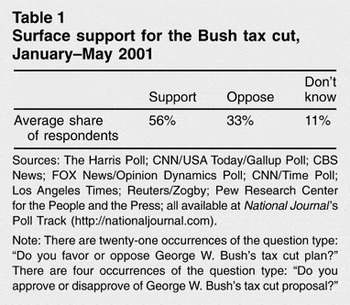
Table 1: Surface support for the Bush tax cut, January–May 2001
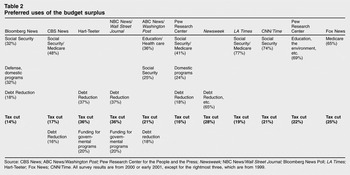
Table 2: Preferred uses of the budget surplus
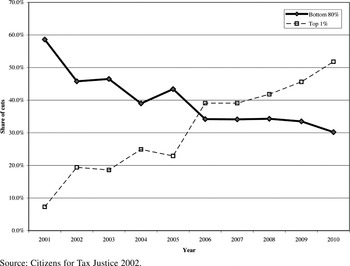
Figure 1: Share of Bush tax cuts received by top 1 percent and bottom 80 percent, 2001–10
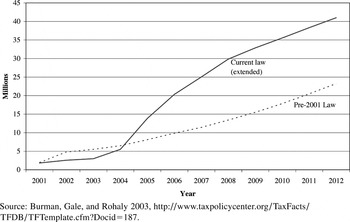
Figure 2: Number of AMT taxpayers, 2001–12
 You have
Access
- 87
- Cited by