Introduction
The work of Gough and Wood (Reference Gough, Wood, Barrientos, Bevan, Davis and Room2004) developed new analytical categories that captured the coexistence of formal and informal arrangements for guarding against insecurity: namely, welfare state regimes, informal security regimes and insecurity welfare regimes (see Roumpakis, Reference Roumpakis2020). In identifying ‘informal’ security regimes, Wood (Reference Wood, Gough and Wood2004) highlighted the importance of stable and informal family and community relationships both as a form of a social capital and for offering welfare provision. Given the importance attached to family and community relationships, there has been limited research exploring comparatively and internationally the gender implications of these – informal but crucial for welfare provision – arrangements (for exceptions see Franzoni, Reference Franzoni2008; Mínguez, Reference Mínguez2012; Razavi and Staab, Reference Razavi and Staab2012).
This article aims to revisit the work of Gough and Wood (Reference Gough, Wood, Barrientos, Bevan, Davis and Room2004) for two purposes. One is to reinvigorate the insights of this research and demonstrate how their argument and in particular their analytical focus on informal relationships should not be limited to Global SouthFootnote 1 welfare regimes alone. The article demonstrates how informality and informal aspects of everyday life, whether they are in the sphere of production (labour market) or social reproduction (e.g. care) remain crucial and relevant also for welfare state regimes.
Second, the article highlights that at the heart of informal practices there is a gendered division of paid (whether in formal or informal labour market) and unpaid work (care, domestic chores). Gender critiques on comparative welfare state research have so far predominantly focused on Organisation for Economic Cooperation and Development (OECD) countries; thus, it is important to consider the implications of these gendered divisions in countries across Africa, Asia and Latin America.
The article compares available data and opts to include both Global NorthFootnote 2 and South welfare regimes. In doing so, the article argues that the gendered divisions in informal paid and unpaid work are not unique to Global South welfare regimes, and simultaneously that informality is an embedded characteristic of all welfare regimes. Although, the article is not unique or the first to suggest the fruitfulness of comparing Global North and South welfare regimes (see review article, also Rudra, Reference Rudra2007; Böger and Öktem, Reference Böger and Öktem2019; Yörük et al., Reference Yörük, Öker, Yildirim and Yakut-Çakar2019), it does so for the purposes of illustrating the importance of gender and informal relationships for the analysis of welfare regimes globally. In this context, the article aims to contribute towards the call for closer collaboration between social policy and development studies (Midgley, Reference Midgley, Midgley, Surrender and Alfers2019; Surender, Reference Surender, Midgley, Surrender and Alfers2019).
Equally important is to explain what this article is not aiming to do. The article does not attempt to account for the causes, dynamics and politics of welfare regime development in Global South (see Tillin and Duckett, Reference Tillin and Duckett2017), and neither does it aim to propose a new classification. Instead the article aims to capture key trends and identify patterns of informality permeating selected cases (largely compromised by the availability of comparable data). In the next section, the article briefly reflects on how informality can be reconceptualised both in the sphere of production and social production across Global South and North welfare regimes.
Informality, gender and global welfare regimes: an analytical synthesis
Wood (Reference Wood, Gough and Wood2004: 50) defined the informal security regime as comprising ‘a set of conditions where people cannot reasonably expect to meet their security needs via accessing services from the state or via participation in open labour markets’. Informality is thus largely realised as not being able to formally participate in the labour market (upon which social insurance records can be built) and therefore not being able to access public welfare services, social benefits and protection. The latter could refer to the absence of these public services but also at times it could rely on negation of access to the existing public services resorting, among others, to relationships of clientelism. Welfare provision thus is far more likely to be organised and provided either at the family or community level. As recent comparative social policy scholarship identifies this is not unique to African, Asian or Latin American welfare regimes, but also could extend to East Asia and South Europe (Ferrera, Reference Ferrera2016; Papadopoulos and Roumpakis, Reference Papadopoulos and Roumpakis2017). Thus, many of the distinguished features that differentiate welfare regimes from the North and South need to be proven empirically.
In his global welfare regime classification, Gough (Reference Gough, Gough, Wood, Barrientos, Bevan, Davis and Room2004) operationalised ‘informal’ largely by exploring variables that capture (the low penetration of) formal public protection and (limited) access to formal labour markets. Interestingly, there were not any variables that captured informal activities per se. The most notable attempt to capture the dynamic development of informality was published in the joint work of Abu Sharkh and Gough (Reference Abu Sharkh and Gough2010). In their work they utilised a cluster analysis technique to establish groupings, but also change across time by comparing two points in time (i.e. 1990, 2000). Their results identify that regimes remain largely path dependent with the exception of the ‘informal security’ cluster. The latter grouping displays significant diversity with the authors opting to distinguish between ‘successful’ and ‘failing’ informal welfare regimes. The successful regime comprises countries achieving positive welfare outcomes combined with low public social spending and international aid (including remittances), with its membership however remaining diverse both geographically but also in terms of their scores. The failing clustering is split into further two sub-groups. The first is distinguished, among others, by high morbidity with membership comprising South and East Africa, and the second is distinguished by lower levels of literacy and female educational rates with membership largely comprising the Indian sub-continent. The variables that Abu Sharkh and Gough opted to operationalise represented a welcomed expansion and yet did not include key aspects of production (e.g. employment) and social reproduction (e.g. care).
Franzoni (Reference Franzoni2008) offered one of the first attempts to integrate gender into the global welfare regime debate as she incorporated variables that are similar to Gough but also extended her research to include indicators of decommodification, stratification and defamilisation. The cluster analysis identified three groupings; two in which the state assumes more responsibility (state-targeted and state-stratified regimes) and an ‘informal-familialist’ regime that resembles Gough and Wood’s ‘informal security welfare regime’. The ‘informal-familialist’ regime, which is also the most populous clusterFootnote 3, is characterised by few opportunities for women to access the formal labour market, with the majority of them being heavily represented in informal employment combined with high levels of unpaid domestic work.
In her work, Mínguez (Reference Mínguez2012) explored care arrangements and distribution of unpaid work in sixteen countries (including both Global North and South cases) and identified that despite significant growth of women’s participation in the formal labour market, unpaid care work remains heavily gendered. Mínguez highlighted the importance of externalising care responsibilities away from family and women as a policy priority for challenging economic inequalities and cultural mandates. Similar to Franzoni (Reference Franzoni2008), she utilised data around the turn of the century. This article opts to revisit some of these findings by using more up-to-date data on selected indicators that also extend the focus on gender divisions by analysing more cases.
Taking into consideration that the majority of Global South welfare regimes are not likely to have developed an extensive network of public (free or subsidised) care provisions since the turn of the century, it becomes important to explore care arrangements and the importance of domestic (unpaid) work that is not recognised (Budlender, Reference Budlender2007). As Kabeer (Reference Kabeer2015: 203) points out, women are in the ‘intersection between production and (social) reproduction’ – this observation is not unique to development studies and definitely not strange to comparative social policy literature. From the one hand, development studies identify the importance of informal activities, explore the appropriateness of interventions such as conditional cash transfers and micro-credit and how far they empower women (for a recent overview see Patel, Reference Patel, Midgley, Surrender and Alfers2019), while at the same time comparative social policy has produced a high-volume of research focusing on how far statutory provisions shift away care responsibilities from family and women (see debates in Chau et al., Reference Chau, Yu, Foster and Lau2017). The two literatures in this way focus on how far developmental or state interventions empower women, one retaining largely a statist approach and the other highlighting the role of non-statutory provisions, often funded by global organisations and remittances. It would be of interest therefore to explore how care arrangements within the family are organised across both Global South and North regimes. Is it more likely for women in welfare state regimes to have relinquished care responsibilities?
The other commonality among social policy and development studies is that both literatures have identified the importance of achieving social progress through investments in education, human capital development and promotion of female employment. Often women are realised as the ‘untapped resources’ upon which economic growth can be achieved by encouraging women to enter the labour market (Moser, Reference Moser2012) but at the same time these arguments ignore the gendered nature of caring responsibilities (Midtbøen and Teigen, Reference Midtbøen and Teigen2014) resulting often in a ‘double burden’ for women (see also Benería et al., Reference Benería, Berik and Floro2015). Additionally, in welfare state regimes, women are still facing significant pay gender gaps and obstacles for achieving both career progression and forming families while in the case of informal welfare regimes this might not be possible due to the constraints that apply as a result of limited formal employment opportunities. It is well established that labour markets play a key role in reproducing gender-based segmentation both in the sphere of production but also social reproduction (see Hassim and Razavi, Reference Hassim, Razavi and Razavi2006; Bakker and Silvey, Reference Bakker and Silvey2008) with many countries even in the OECD displaying significant gender inequalities in accessing labour market and social protection (Karamessini and Rubery, Reference Karamessini and Rubery2013). As women continue to face institutional barriers in paid work (Kabeer, Reference Kabeer2015), it is worth exploring whether women are more likely to be overrepresented in informal employment and also how they fare against men in formal labour markets in both Global South and Global North welfare regimes.
The United Nations (UN) vision for global development identified as part of its Sustainable Development Goals (SDGs) the need to ‘recognize and value unpaid care and domestic work through the provision of public services, infrastructure and social protection policies and the promotion of shared responsibility within the household and the family as nationally appropriate’ (Target 5.4) while at the same time Target 8 aims to promote ‘sustainable economic growth, full and productive employment and decent work for all’. However, it is not really clear how far the two aims can be reconciled (Rai et al., Reference Rai, Brown and Ruwanpura2019) without exploring two set of relations: one in the sphere of production and one in the sphere of social reproduction.
Next the article presents the variables and data available for operationalising the gender gap in both the sphere of production (gender gap in formal and informal employment) and social reproduction (gender gap in time spent for unpaid domestic work).
Operationalising the gender gap
The first part of the analysis explores comparative trends in formal and informal employment for both men and women across fifty-eight countries using available data from the International Labour Organisation (ILO, 2018). Informal employment data capture own-account workers, contributing family workers, and largely employees who are not subject to national labour legislation or covered by social protection. Formal employment data expresses the labour force as a per cent of the working-age population. It is important to note that data should be treated with cautionFootnote 4 and are only used in this article heuristically.
The second part of the analysis comparatively explores the gender gap in the proportion of time spent on unpaid domestic chores and care work (United Nations, 2020). The available data capture the average time spent on paid and unpaid work in a twenty-four-hour periodFootnote 5 as a percentage. Unless otherwise stated, the data presented in all tables refer to 2012, and capture both urban and rural areas, including those aged fifteen and over. In case data were not available for 2012, the closest time-point was selected.
Gender gap in formal and informal employment
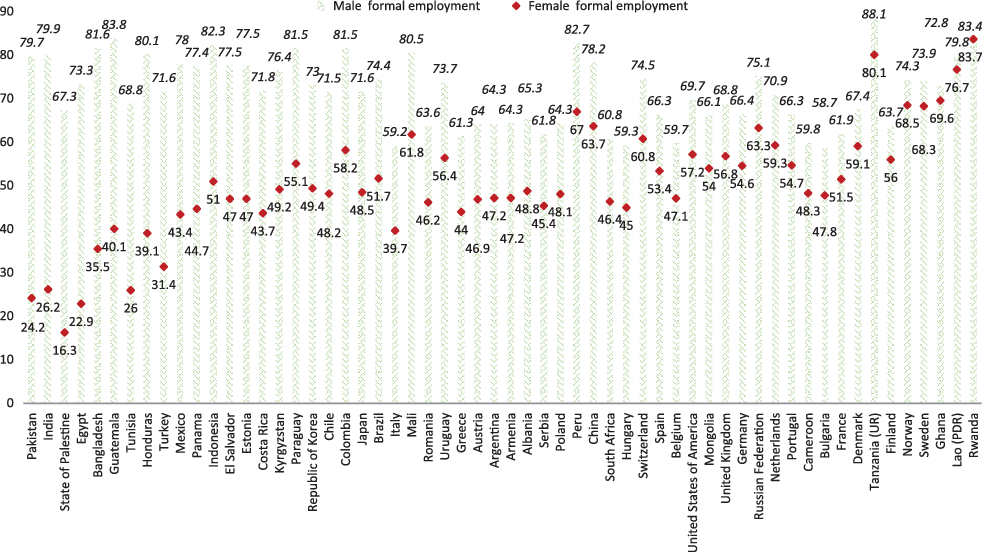
The first part of the analysis compares fifty-eight countries and maps the gender gaps both in formal and informal employment. Figure 1 and Figure 2 display the gender gap for formal and informal employment rates respectively. The diamond marker in Figure 1 and 2 depicts women’s employment rates while the column indicates men’s employment rates. The figures are ordered, from left-to-right, based on the gender gap in respective employment rates, i. e. the difference of female minus male rates. For example, in the case of Figure 1, Pakistan and India display the highest gender gaps in formal employment while the Nordic countries display the lowest gender gaps. Turkey and Mexico stand out as two countries which displayed significant gender gaps in formal employment. Similarly, countries in North Africa (Egypt, Tunisia) and Central America (Honduras, El Salvador, Guatemala) display low formal employment rates for women.
Gender gap in formal employment across selected 58 countries, 2012.

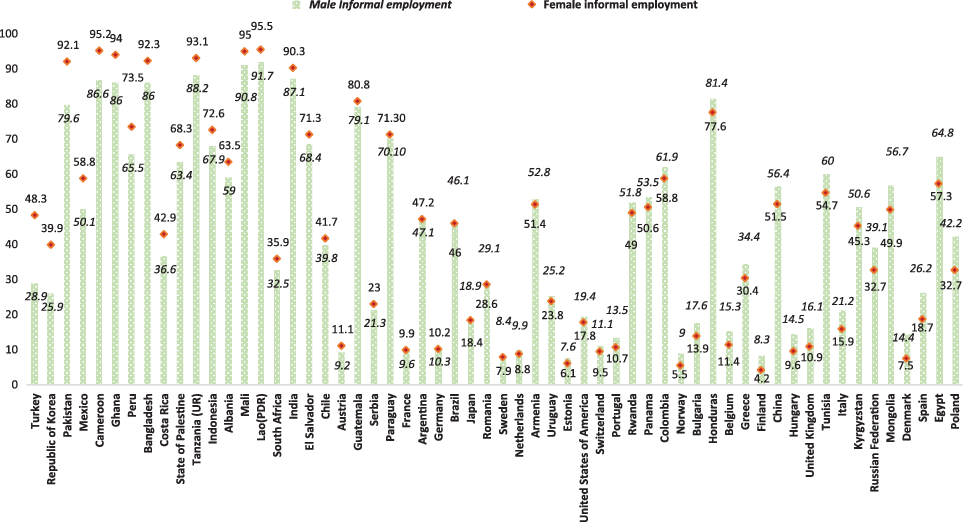
Gender gap in informal employment across selected 58 countries, 2010.

At the other end, the gender gap in formal employment rates is narrower in OECD countries with Japan, the Republic of Korea [hereafter Korea], Italy and Greece however displaying among the highest percentages of gender inequality in formal employment rates. Countries with high gender gap in formal employment rates signal that women are less likely to benefit from labour protection laws, ability to build individual social insurance or security rights. Women in these countries are thus more likely to rely on marriage or family for accessing welfare provision.
Figure 1 displays narrow gender gaps in many Global South countries but these rates might be overestimated by sampling measures. Upon closer inspection of ILO data in Ghana, Tanzania, Lao People’s Democratic Republic [hereafter Lao] and Cameroon, the percentage of population covered by at least one social protection benefit is higher in Ghana (16.9 per cent) and lowest in Lao (3 per cent). This effectively means that their formal employment rates reflect persons who engaged in economic activity for only one or a few hours4.
Finally, Rwanda is the only country where more women are formally employed than men. It is quite revealing that women’s formal employment rates are lower than men in all cases explored in Figure 1 but a country that faced serious ethnic tensions and is situated in a conflict-ridden regionFootnote 6. The next section will present and analyse data on informal employment offering thus a more detailed reflection on whether gender gaps are similar in formal and informal employment.
Figure 2 displays the gender gap in informal employment – the values presented above the diamond marker refer to women’s informal employment rates while the values of men’s informal employment rates are presented in italics. Once more there is a great divergence in the gender gap rates. Turkey and Korea stand out as the countries where women are significantly overrepresented in informal employment. Close next are countries in the Indian sub-continent (Pakistan, Bangladesh) but also many Latin American countries such as Mexico, Chile, Costa Rica, Guatemala, El Salvador and Paraguay. Overall these countries exhibited also high gender gap rates in formal employment rates which effectively means that they prescribe the most challenging conditions for women to enter formal employment while at the same time women are heavily overrepresented in informal employment. In contrast with Latin and Central American countries aforementioned, Colombia and in particular Uruguay display much better prospects for women entering formal employment and not relying on informal employment.
There are also many countries where men outnumber women in informal employment. These countries can be split into at least two groupings – one comprised by countries in north Africa (Egypt, Tunisia) and central America (Honduras, Panama) where men significantly outnumber women and another one, predominantly comprised by OECD countries (with the exception of women in Korea, and less so in Austria and France), where differences are small. The Nordic countries along with Switzerland, United Kingdom and United States of America [hereafter USA] display better prospects for women in entering formal employment and are simultaneously less likely to rely on informal employment. The Global South countries that displayed a limited gender gap in formal employment such as Cameroon, Ghana Tanzania, Lao display among the highest gender gaps in informal employment. The findings here suggest that a narrow gender gap in accessing formal employment does not really portray a convincing argument that women are in parity of achieving ‘decent work’.
Next, the article presents available data on the other key aspect of informality – that of unpaid domestic work – and explores how these differences are also evident when we couple paid and unpaid work.
Gender gap in unpaid work
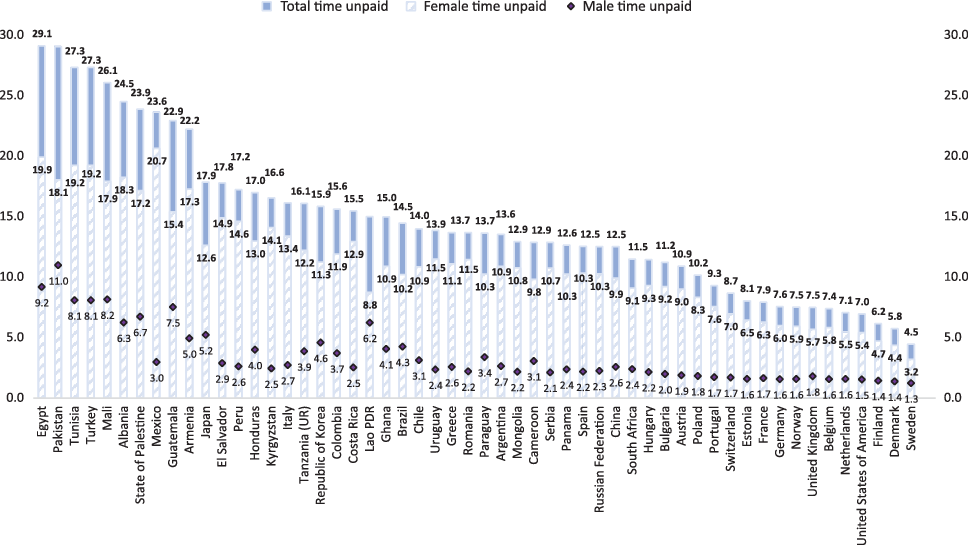
Figure 3 presents the proportion of time spent on unpaid domestic chores and care work by gender and location. The diamond marker displays the time spent by men, the gradient bar displays the proportion of time spent by women and the full colour bar represents the total (aggregate). In reflection of the findings of Figure 1 and 2 there are some interesting patterns emerging. From the one hand, the countries with the highest proportion of time spent on unpaid domestic work are the countries in which women were overrepresented in informal employment and underrepresented in formal employment such as Albania, Turkey, Pakistan, Mali, Mexico, El Salvador, Guatemala, and Korea. These are the countries where women are more likely to face substantive barriers both in accessing formal employment and welfare provision while at the same time the social reproduction of their national welfare regimes relies heavily on their unpaid domestic work. In these countries, women are likely to rely on their husband for accessing statutory welfare provisions reproducing thus inequalities emanating from patriarchal structures and related cultural mandates.
Unpaid time spent in domestic chores and care by gender and in total across 54 countries, 2010.

At the other end of the spectrum the countries that display the lowest proportion of time spent in unpaid domestic work are also the ones which displayed the lowest gender gap in formal employment and where women were underrepresented in informal employment. These countries are non other than the Nordic countries along with Switzerland, United Kingdom, USA and Netherlands. Still, men’s proportion of time spent in unpaid work is lower in all cases depicted in Figure 3. Among the OECD countries, Japan, Italy and Korea top the table in gender inequality in unpaid time spent for domestic and care work. In Japan women contribute 12.6 per cent of their time on unpaid domestic work with men contributing 5.2 per cent while in Italy women contribute 13.4 per cent of their time per day and men only 2.7 per cent. Korea, on the other hand, displays a large proportion of time spent in unpaid work with men offering the highest proportion of unpaid work among the OECD countries. Greece, Spain along with other major developing economies such as Argentina, Russia, China and South Africa display also high levels of gender inequality on unpaid time spent on domestic chores and care work.
African countries are located in the middle of the figure at large indicating moderate gender gaps with the exception of Mali, Egypt and Tunisia where gender inequalities are pronounced. Interestingly, Ghana and Cameroon display lower gender inequalities than many OECD countries in the gender distribution of domestic work. Mexico displays the most gender unequal distribution of time spent in unpaid work, with women spending 20.7 per cent of their day on unpaid domestic work; while for men this percentage is a minimal 3 per cent. Additionally, the gender gaps are large in Armenia, Albania, El Salvador, Peru, Tunisia, Turkey and Italy with men however displaying a much higher proportion of time spent in unpaid domestic and care work than Mexico.
The findings suggest that women with their unpaid domestic work and care are an integral part for the social reproduction of welfare regimes. Next we reflect on the implications of the evidence presented for gender analysis.
Implications for gender analysis
Overall, the analysis identified that across both Global North and South regimes informality (either in employment and domestic work) is not shared equally between men and women. For example, there is no country in which women enjoy higher formal employment rates or contribute with less unpaid time in domestic work than men. The implications of these findings are significant for women, as they are likely to continue to rely on family, including patriarchal structures and their husband, for accessing welfare while at the same time they are disproportionally contributing with their unpaid time towards the social reproduction of respective welfare regimes. The fact that women in some countries display lower rates of informal employment does not offer any consolation as it is not accompanied by a higher share of formal employment to men.
Reflecting on how these findings relate to global welfare regimes, the only clear grouping, also evident in Gough and Abu Sharkh, is the poor performance of the Indian sub-continentFootnote 7. Additionally, the gender gaps among Latin American countries do not resemble the classification of Franzoni (Reference Franzoni2008) – this could be down to the use of more recent data, a higher number of cases and finally that similarities in formal and informal employment patterns are exposed due to the removal of more variables. Overall the attempts to bring gender into global welfare regimes exposed the need to consider how gender and informality intersect. This was evident both in the examination of the gender gap in informal employment and even more so in the provision of care (Mínguez, Reference Mínguez2012). So far the majority of social policy research in developing contexts has focused on educational outcomes and formal employment. Reflecting back to the SDGs, there seems to be still a lot of work for recognising the value of unpaid care and involving men in more shared responsibility. Similarly, women are less likely to enjoy access to formal employment and therefore labour protection and access to welfare, while in some countries the levels of informal employment seriously question the achievement of ‘decent work’ for women.
At the same time, findings on total time spent on domestic work verify this and expose also how women are disproportionately contributing with their unpaid work towards the social reproduction of these welfare regimes. The findings therefore suggest that additional policy priorities should aim to tackle gender stereotypes, a challenge that continues to undermine women’s ability to choose how to use their time even among OECD countries. These inequalities are reproduced both in the sphere of production and social reproduction, and therefore policy initiatives should equally focus on enhancing women’s entry to the formal labour market but also additional recognition is needed for the unpaid care they provide.
Degrees of informality
As evidenced by Figure 3, Japan, Italy, Korea, Greece and Spain display the highest proportion of time spent on unpaid domestic chores and care work among the OECD, overtaking countries like China, Russia and South Africa which display lower percentages in the total proportion of time spent on domestic chores and care work among the Global South economies. It could be suggested that the countries with highest aggregate proportion of time spent on unpaid domestic chores and care work could reflect the low penetration of child and elderly statutory care services and thus capture what comparative social policy would conceptualise as ‘familisation’ of social risks. As recent scholarship indicates, the unpaid time spent on domestic work could also include householding practices of families such as the production of resources and goods for own consumption or reciprocal exchanges (Papadopoulos and Roumpakis, Reference Papadopoulos, Roumpakis, Heins, Rees and Needham2019). Similarly, low unpaid time spent on domestic work could signal the substantive penetration of formal arrangements, whether offered by state or market.
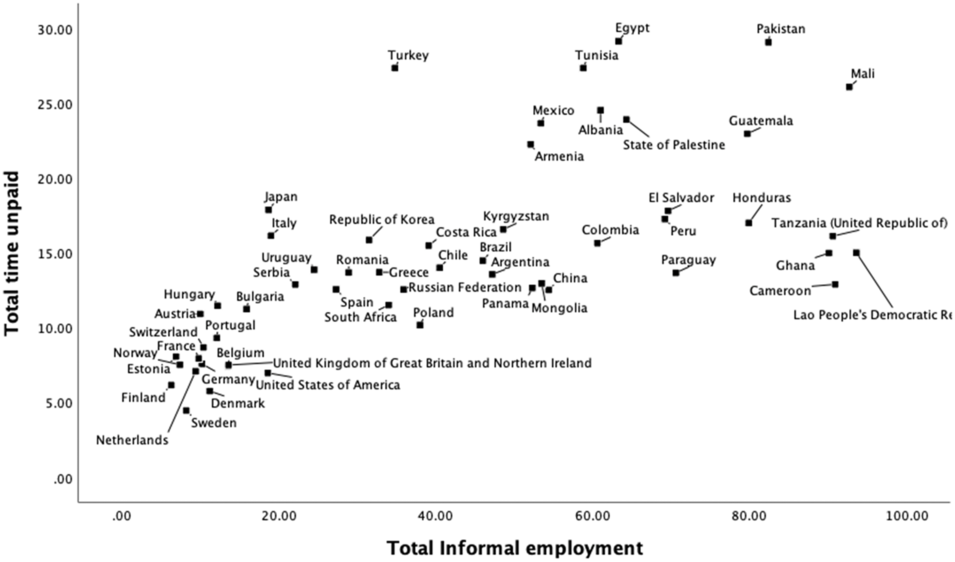
Figure 4 attempts to capture the degrees of informality by exploring the relationship between total time spent in domestic unpaid work with the total informal employment rates. The scatterplot shows that there is a positive correlation (.655**) between the two variables; however, any inference should be treated with caution as data points are not available for the same years. The levels that informality penetrates employment patterns is staggering among many African (e.g. Mali, Cameroon, Tanzania, Ghana), Southeast Asian (e.g. Lao, Indonesia), Indian sub-continent (e.g. India, Pakistan, Bangladesh) and Latin American (e.g. Honduras, Guatemala, Paraguay, El Salvador, Peru, Colombia) countries. Additionally, large economies such as China, Argentina, Brazil, Chile, Russia, Turkey and South Africa display significant volumes of informal employment rates. Among the OECD countries, Greece, Korea, Spain, Italy, Japan and USA display the highest proportion of informal employment signalling the importance of informality for their economies.
Total informal employment and unpaid domestic work and care across 54 countries, 2010.

At the bottom left corner of the scatterplot we identify the majority of the OECD countries. A second bloc of countries is also formed including Japan, Italy, Spain, Korea, Greece but also emerging economies such as Brazil, Russia, China and South Africa. A third and more loose grouping emerges at the top right corner with Mali and Pakistan displaying the highest volumes of informal activity. Turkey stands as an outlier, but data included here refer to different years.
Although data should be treated cautiously, the second and part of the third grouping resemble to a large extent the membership of the informal welfare regime (Gough, Reference Gough, Gough, Wood, Barrientos, Bevan, Davis and Room2004) with Pakistan, Guatemala, Honduras, Tanzania, Ghana, Cameroon and Lao as extreme cases of informality (see also, Martínez Franzoni and Sanchez-Ancochea, Reference Martínez Franzoni and Sánchez-Ancochea2018; Amoah, Reference Amoah2020). The stark difference, between the second grouping and Gough’s (Reference Gough, Gough, Wood, Barrientos, Bevan, Davis and Room2004) classification, is that once we focus on informal relationships, including both evidence from the sphere of production and social reproduction, we can identify the important role that informal relationships play in the regions of Southern Europe, East Asia (see Papadopoulos and Roumpakis, Reference Papadopoulos and Roumpakis2017) and among emerging economies including Argentina and Chile. As Papadopoulos and Roumpakis (Reference Papadopoulos and Roumpakis2017) argue, assigning family, and in particular women, more responsibility is not symptomatic but part of a political economy strategy for sustaining international competitiveness.
Conclusion
The argument put forward in this article suggests that informality retains a set of rich and fundamental properties for everyday life which are inherently important not only for welfare provision but also to the social reproduction of welfare capitalism such as care and domestic work. The article showed that informal activities (informal employment, domestic work) are extensive among many African, Asian, Latin American but also specific OECD welfare regimes. The findings also demonstrate that women offer more time towards unpaid domestic work and care while at the same time are underrepresented in formal employment across all cases examined here, irrespective of whether they belong to Global North or South welfare regimes. The article concludes by highlighting the importance of incorporating gender and informal relationships, and how the two intersect both in the sphere of production and social reproduction, for the comparative analysis of global welfare regimes.