The conventional view of contemporary lawyers and economists has been that standards of corporate governance that drove investor confidence in the massive recent expansion of stock markets were woefully absent everywhere before the legislative protections and regulatory bodies of the later twentieth century. The “law and finance” literature found that the United Kingdom, around 1900, had a relatively low antidirector rights index, pointing to a lack of protection of minority investors and the paradox that the extensive UK stock markets at that time coexisted with poor protection.Footnote 1 Numerous authors have recently challenged this view, arguing that some UK legislation mandated strong investor protection and, where it did not, quoted companies usually voluntarily adopted at least some antidirector provisions.Footnote 2 On the other hand, Timothy W. Guinnane, Ron Harris, and Naomi R. Lamoreaux, using samples of mostly private and relatively small firms spanning from 1892 to 1927, argue that UK directors chose to alter the articles of association of their companies to suit themselves rather than their shareholders.Footnote 3
The jury is still out on how to measure and compare shareholder rights. Our aim in this article is to go beyond this box-ticking of corporate governance rules to examine how British shareholders in practice used the theoretical powers in their corporate charters and bylaws (usually known in the United Kingdom as memoranda and articles of association).Footnote 4 We focus on the role of hitherto overlooked shareholder committees of investigation (COIs), particularly between 1888 and 1940, which, we argue, effectively disciplined (and in some cases wholly or partially replaced) incumbent boards in dozens of listed companies. They provided salutary warnings to many other company directors that ignoring reasoned shareholder views of shortcomings in their performance exposed them to some peril.
In the next section we assess the historical origins of COIs and chart their perhaps surprising and hitherto unrecognized survival well into the twentieth century. We then examine in more clinical detail the motivations, proceedings, and outcomes of shareholder interventions in fifty randomly chosen British COIs between 1888 and 1940 and discuss their impact during that period and possible reasons for their decline in importance after World War II. We compare the importance of British COIs with the fewer COIs that took place in the United States during the same period and relate our findings to contrasts between American and British corporate law.
Shareholder Power
The literature on rational apathy and the free-rider problem purports to explain why the COIs we describe generally should not exist. One view of the (by most standards extremely competitive) British economy before its 1930s adoption of protective tariffs and increased cartelization is that—given the power of creative destruction in a market economy—quoted corporations no more needed top-down intervention to improve management than any other firm.Footnote 5 With larger corporations and less competitive markets, the costs of waiting for bankruptcy to discipline incompetent managements would rise. Yet in corporations with widely dispersed holdings—and with no large holder with the ear of the board or obvious power to challenge them—who would undertake the task of ejecting incompetent management and transferring the assets to more skilled hands? Potential gains were there but they would accrue to all shareholders, including the passive. Any small holders who exerted themselves to improve things or ferret out more information via a COI would capture only a small portion of the gains.
A familiar trope is that whatever the formal powers of shareholders, joint-stock companies are effectively controlled by self-perpetuating boards of directors, whose own shareholdings may be small and who may pursue interests distinct from those of shareholders. Of course, there are limits to this “agency problem.” Corporate laws may compel shareholder-friendly behaviors and information sharing, and takeover bids may, if supported by a majority, succeed in replacing an incumbent board. However, the “free rider” problem generally inhibits shareholders from attempting to control boards. It requires considerable effort and expense to mount a challenge to the board of directors, but all shareholders benefit from any informed and effective intervention. The free-rider problem points to those who accurately foresee an impending loss, preferring to sell their shares and make a better investment rather than mounting an investigation.Footnote 6 Such “rational apathy” could be a powerful disincentive to initiating more time-consuming intervention, and contemporaries commented on the absence of shareholder activists and the general passivity of shareholders.Footnote 7
Rational apathy was often overcome in the eighteenth and early nineteenth centuries, when shareholders in hundreds of British and Irish companies were sometimes actively involved in drawing up the first charter or deed, monitoring promoters and boards, with direct access to company books and rights to appoint managers below the board. General meetings of shareholders—sometimes more frequent than today—also played a significant role in choosing boards and in some cases replaced incompetent directors. Such involvement was practicable given the relatively small numbers of shareholders, then usually only several dozen or a few hundred even in companies with traded shares.Footnote 8
Graeme G. Acheson, Gareth Campbell, and John D. Turner, using a sample of 890 firm years for the second half of the nineteenth century, found that, when stockholdings became more dispersed, many large shareholders did not have voting control, were not directors of the firms in which they invested, and can be considered passive rentiers, in common with smaller investors.Footnote 9 This presumably raised new governance problems, and there is some evidence of existing antidirector and transparency rights in quoted companies being extended and reinforced in the late nineteenth century. James Foreman-Peck and Leslie Hannah have drawn attention to the UK Companies Clauses Consolidation Act of 1845, prescribing governance clauses for most UK statutory and chartered companies.Footnote 10 This act mandated charter clauses that score highly on the antidirector rights index. The 1845 act primarily affected railways and other public utilities which dominated stock exchanges for much of the nineteenth century. However, from the 1880s, less heavily regulated registered companies in other sectors overtook statutory companies by value on the London Stock Exchange (LSE).Footnote 11 These, too, usually voluntarily adopted many of the antidirector rights with which British investors were already familiar from the statutory sector. Acheson, Campbell, and Turner, using broader tests of shareholder rights, confirm that a population of 483 quoted (and registered, not statutory) companies that formed between 1862 and 1899 usually adopted multiple shareholder-friendly provisions, even though the model clauses in the 1862 Companies Act specifying shareholder protections were purely voluntary.Footnote 12 Late twentieth-century reforms in UK corporate law mandating such protections, they conclude, largely codified what had long been common practice in UK corporate governance of quoted companies, through voluntary private contracting.
Others who have looked at listing requirements and professional behaviors conclude that investors enjoyed some protections against the agency problems that the divorce of ownership from control raised.Footnote 13 In addition, while there were clearly some fraudsters and tunnelers among directors, both their self-esteem and the professional standards of those they worked with meant that many directors aimed to do a good job: equity investors in the United Kingdom generally received a good return.Footnote 14 As Guinnane, Harris, and Lamoreaux note, “Returns were potentially higher because the investments were riskier. But they were also higher because of the knowledge and skills of the entrepreneurs running the companies, and shareholders seem to have been content to leave those men in charge. . .what stands out is the absence of conflict.”Footnote 15 Ethical behavior was not universal but it was the norm. Fabio Braggion and Lyndon Moore find little evidence of unscrupulous, albeit still legal, insider trading by British directors at this time.Footnote 16 Julian C. Franks, Colin Mayer, and Stefano Rossi approvingly cite the Economist: “Many things which are perfectly legal in this country are not the acts of a gentleman and are ‘just not cricket.’”Footnote 17
However, as the nineteenth century progressed, and in larger companies especially, there were signs of shareholder access being limited to summary (and often unrevealing) accounts at annual meetings and a trend toward smaller boards with longer terms of office, the power to fill casual vacancies without consulting shareholders, and the ability to manipulate proxies. Complaints of declining shareholder participation and of autocratic behavior by oligarchic and underperforming incumbent boards were already being heard. Railway Autocracy was written by the editor of the Railway Service Gazette, who had supported the ineffectual complaints of shareholders at their meetings in 1876.Footnote 18 He argued that railway directors were now a self-perpetuating oligarchy, inclined to treat shareholders as inconvenient nuisances and not as owners.
It was against this changing background that legislators devised the early steps in regulating corporations by statute. The 1862 Companies Act consolidating earlier legislation allowed in section 56 for the appointment of inspectors by the regulating government department (the Board of Trade), if holders of one-fifth of shares requested it, but this was a power rarely used; only in the most egregious cases would government get involved.Footnote 19 Instead, legislation encouraged shareholders to take action when boards exceeded their powers or engaged in fraud. They did so by setting up what were termed shareholder committees of investigation, inquiry, or inspection, which we term COIs. Although shareholder COIs had been conducted informally for well over a century, the Companies Act of 1862 formalized them by modeling their rights and duties on the law concerning inspections by the Board of Trade: “The Inspectors so appointed shall have the same Powers and perform the same Duties as Inspectors appointed by the Board of Trade, including the ability to request access to any books or documents required and to examine officers and agents under oath, with the duty to make their report to whomsoever the shareholders determined in general meeting.”Footnote 20 We now turn to a more systematic analysis of the use of COIs after their enshrinement in company law.
Shareholder Interventions in Practice
There has been little mention of COIs in the law and finance literature until recently. Guinnane, Harris, and Lamoreaux devote some attention to these committees, referring to three unsuccessful attempts by shareholders to hold the directors to account—including one failed attempt to set up a COI—and commenting on how newspapers such as the Economist frequently reported on directors’ misdemeanors and abuse of weak corporate governance rules.Footnote 21 By contrast, Roger Coates, in a study of four English and five American mid-nineteenth-century railway companies, notes significant shareholder activism via COIs on such aspects as promoting transparency, setting expectations as to how firms should be managed, and bearing down on conflicts of interest. Outcomes of COIs included preventing the sale of a company and removing directors. However, Coates suggests that the use of COIs in railway companies fell away after midcentury and is silent on the use of COIs in other sectors of the economy.Footnote 22 Our research extends this study by looking at a range of other sectors for the period up to 1940 with a much larger sample of fifty companies. We find many companies where shareholders actively proposed, voted on, and established investigative committees and made recommendations concerning the business and corporate governance that, in many cases, were then partially or fully implemented.
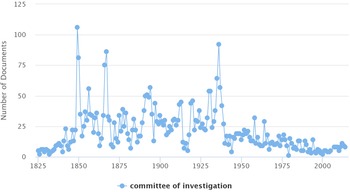
To explore the prevalence of COIs over the long term, we measured the frequency of use of the term “committee of investigation” in the Times newspaper archive for the period from 1825 to 2014.
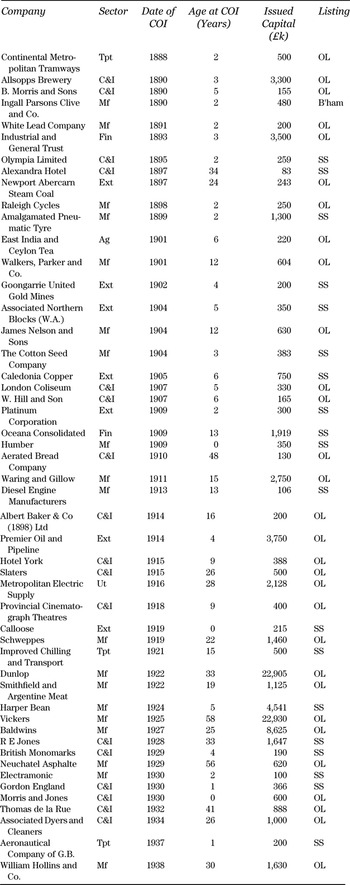
Figure 1 shows that the first peak in the use of this term was in the late 1840s, when there were many inquiries into railway company promotions. For example, the York, Newcastle and Berwick Railway's COI, aided by an accountant and an engineer, produced five reports in 1849 on the chairman's falsification of accounts, as well as temporarily acting as directors of the company.Footnote 23 The second peak was in the late 1860s, when banks, railways, and other companies suffered from the financial collapse of bill brokers Overend Gurney. The third—and most active and extended—period was from the 1890s to the 1930s, with a sustained fall after World War II. To explore this period in more depth, we concentrated our search for references to COIs in the Financial Times (hereafter FT), a more specialized business and finance source from its inception in 1888, identifying a random sample of fifty companies that experienced a shareholder COI between 1888 and 1940. Our sampling rationale and methodology are outlined in the appendix. Table 1 lists the fifty companies in the sample, in chronological order of COI, together with their sector, issued capital, and where they were listed.
Frequency chart for references to shareholder COIs in the Times (UK), 1825 to 2014. (Source: Gale Primary Sources.)

Sample of 50 companies which had shareholder COIs between 1888 and 1940 by date of COI.

Source: Our dataset.
Notes: Ag = Agriculture, B'ham = Birmingham stock exchange, C&I = Commercial and Industrial, Ext = Extractive, Fin = Finance, Mf = Manufacturing, OL = Official List, SS = Special Settlement, Tpt = Transport, Ut = Utility.
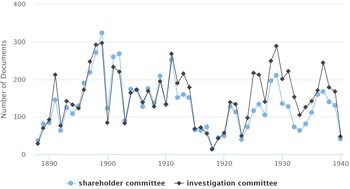
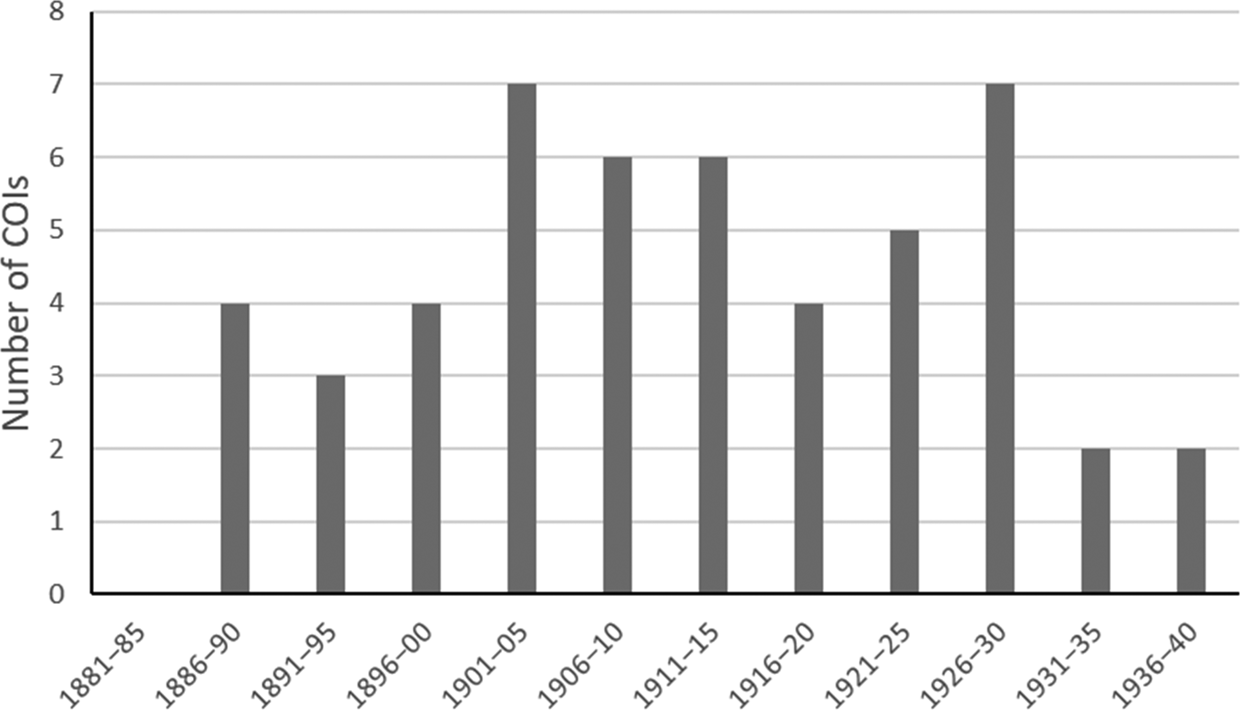
Figures 2 and 3 compare the frequency of mention of COIs with that of our COI sample: Figure 2 shows the frequency of use of the terms “shareholder committee” and “investigation committee” in the FT archive for the period from 1888 to 1940, and Figure 3 shows the spread across time of our fifty sample companies. Both figures show most activity around the end of the nineteenth century, peaking in the period from 1896 to 1900 with over three hundred mentions each for the two terms in 1898.Footnote 24 They also highlight another peak in COIs after the new-issue boom of the late 1920s. The sample thus appears to broadly track the chronology of COIs.
Frequency chart for FT references to shareholder COIs, 1888 to 1940. (Source: Gale Primary Sources.)

Frequency of sample COIs, 1881 to 1940. (Source: Gale Primary Sources.)

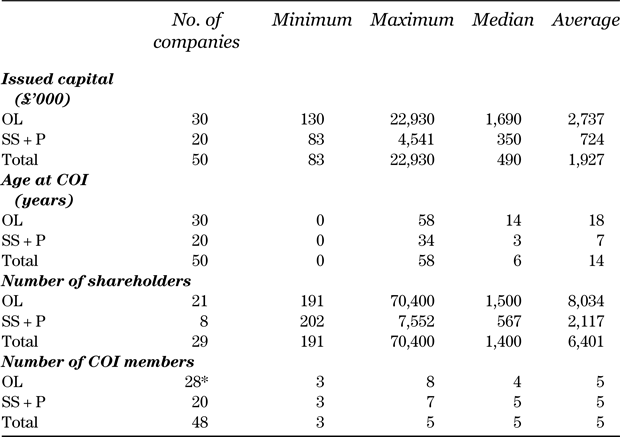
Table 2 summarizes the main characteristics of the sampled companies: where they were quoted; their age at the time of the COI; their size in terms of nominal value of issued capital; and, where available, their shareholder numbers. Of the fifty companies in the sample, thirty were quoted on the LSE official list (OL); nineteen were special settlements (SSs) (which was an LSE junior market with less stringent listing requirements than OL); and the shares of one company, Ingall, Parsons, Clive and Co., were quoted in Birmingham. The table highlights the wide range of companies in terms of age at COI, with an average of fourteen years, a maximum of fifty-eight, and a minimum of zero. Average size measured by issued capital was nearly £2 million (approximately $10 million at gold standard exchange rates), with a maximum approaching £23 million and a minimum of £83,000. The twenty-nine companies for which we found shareholder numbers averaged 6,401 shareholders, with a maximum of 70,400 and a minimum of 191.Footnote 25 SS companies tended to have less capital and fewer shareholders than their OL counterparts. They were also younger: just under half the companies had a COI less than five years after incorporation, but this figure is made up of one-third of OL companies and two-thirds of SS companies. By contrast, Table 1 shows that fourteen of the overall sample were more than twenty years old at their COIs, and of these, only two were SS.
Summary characteristics of sample of 50 companies with shareholder COIs.

* excluding two COIs with only large shareholders, number unknown.
Source: Our dataset.
Notes: OL = Official List, P = Provincial quotation, SS = Special Settlement.
COI sample companies engaged in a wide range of activities. The sector with the most COIs was manufacturing (19), followed by commercial (17), extractive (7), transport (3), finance (2), agriculture (1), and utilities (1). Some companies were well-established manufacturers, like the Neuchatel Asphalte Company, or well-established commercial enterprises, such as the Aerated Bread Company (which operated bakeries and tea shops) and Slaters (a restaurant and food shop chain). Some were in new sectors, such as the White Lead Company (which had patented a new, nontoxic method of production), Raleigh Cycles, Humber cars, Electramonic, and the Aeronautical Company of Great Britain. Others were in traditional sectors such as hospitality. The majority of companies in the sample operated mainly in the United Kingdom, but the sample also included (British-registered) Australian mines, Argentine beef, a Swiss asphalt manufacturer, and Indian tea plantations, all with similar corporate governance problems.Footnote 26 More importantly, wherever their center of operations lay, only four of these fifty companies held shareholder meetings outside London, with the vast majority taking place in the same central London hotels and meeting rooms. The Financial Times, based in London, doubtless found it easier to concentrate on companies that held meetings in London although COIs occurred in companies neither operating nor holding meetings in London and were reported in the provincial press.Footnote 27
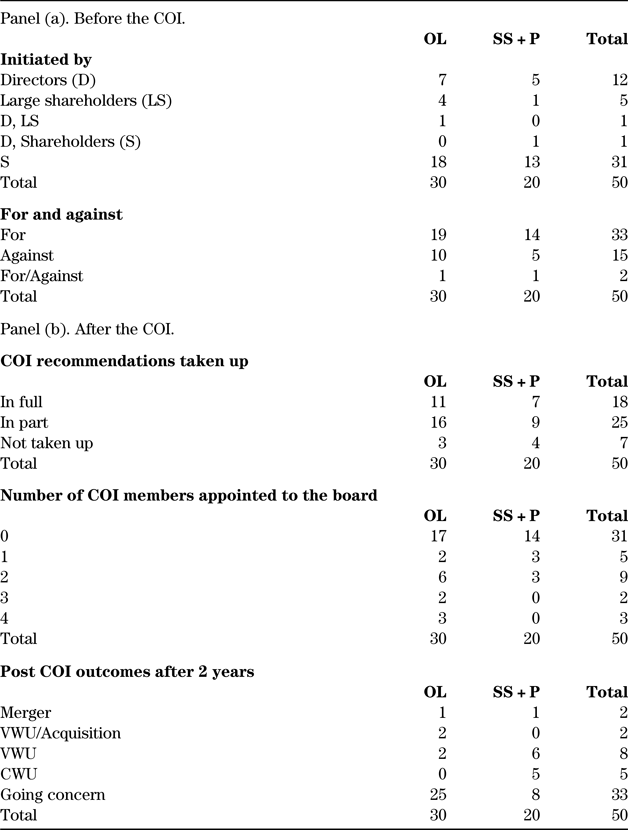
The first panel of Table 3 highlights the process behind the setting up of a COI. Twelve (24 percent) of the sample COIs were initiated by directors, and a further five by what were referred to specifically as “large” shareholders. Two COIs were proposed by directors and shareholders—one with large shareholders only and one with shareholders in general—but the majority (thirty-one, or 62 percent) were proposed by shareholders who did not necessarily have large holdings.
Process, impact and outcomes of shareholder COIs.

Source: Our dataset.
Notes: CWU = Compulsory Winding Up, D = Directors, LS = Large shareholders, OL = Official List, P = Provincial quotation, S = Shareholders, SS = Special Settlement, VWU = Voluntary Winding Up.
One would expect boards of directors to be against the setting up of a COI, and this was true for fifteen (30 percent) of our sample, as also shown in panel (a) of Table 3. Two more boards were initially against such a committee but changed their minds. But for two-thirds of the sample the boards of directors were in favor or, more commonly, did not oppose. In practice, even though a board might have votes of its own and “pockets full of proxies” previously sent, enough to overturn a show-of-hands vote at a shareholder meeting by demanding a formal poll (where votes were typically weighted by numbers of shares held), some directors accepted the setting up of a COI against their own wishes.Footnote 28 Meetings could be “lively,” “stormy,” “crowded,” and “uproarious,” with several hundred shareholders present, and the chairman could be booed or hissed. Under these conditions, it could take sangfroid on the part of the chairman to resist demands for a COI.Footnote 29 The board of the Alexandra Hotel, accused of replacing directors without a shareholder vote, resisted until advised by counsel to accede to the shareholders’ resolution.Footnote 30 The setting up of a COI might reflect years of shareholder action: investors in Slaters called for a COI for several years until one was set up in 1915.Footnote 31 COIs were quick and easy to set up: they could be authorized at a shareholder meeting without the need for a special resolution, by voting not to adopt the directors’ report and accounts and instead proposing an amendment that sought to establish a COI. This could then be immediately seconded and voted on, making it difficult for directors to resist. Some COIs included one or more directors or shareholders nominated by directors on the committee—although this was rare—usually due to recently appointed directors not having been on the board at the time of the events blamed for poor performance.Footnote 32
As shown in Table 2, the number of members of the COIs varied from three to eight with a mean and a median of five. Some COIs included shareholders with relevant expertise, such as in company law, accounting, or understanding of the business. Others were able to use the company's accountants and, less frequently, the company's lawyers to help in their investigation. In our sample, there are mentions of an accountant sitting on a COI or being appointed as adviser to a COI in the case of seventeen companies, with six mentions of a solicitor. COI members included known activist shareholders such as John McLaren, who was a director of other companies but held only fifty shares in Slaters when elected to the Slaters COI.Footnote 33 COIs might include larger shareholders, as with Mr. Schuster, with nearly two thousand shares (1 percent) in Albert Baker, Thomas Bickerton with nearly four thousand shares (1 percent) in Slaters, Mr. Conlon with fifty thousand shares (7 percent) in Caledonia Copper, or simply those who had proved their interest in the company by speaking up at meetings or by writing to shareholders beforehand to raise more general support—and proxies—for the formation of such a committee.Footnote 34 An example is Forestal Land Timber and Railways, operating in Argentina, which had recently acquired the Santa Fé Land Company. Two concerned shareholders distributed a circular entitled “A Plea for Information” to, among others, “the 1,820 lady shareholders and hundreds of clergymen” who had invested in the company.Footnote 35 COI members might be selected by geographic region, as it was common for those shareholders who lived some distance from London to delegate one of their number to speak for them at meetings and to use their proxies if necessary, such as Charles Yule, a Scottish shareholder at the Caledonia Copper meeting held in London in 1905.Footnote 36
Joining a COI was not undertaken lightly, members generally being diligent and producing a report on findings and recommendations for all shareholders in general meeting. Members might attend numerous meetings and might also inspect the business; the Slaters COI members, for example, visited all the company's shops and restaurants.Footnote 37 The free-rider problem was dealt with in a number of different ways. Some COIs were financed by activists asking fellow shareholders to contribute an amount per share, particularly when the committee was being set up prior to seeking approval at a shareholders’ meeting. For instance, the South American and Mexican Company COI raised £0.025 per share to fund negotiations with the Official Receiver and agree on a schedule of calls payable by the shareholders.Footnote 38 The COI members chose to ask questions themselves at the public hearing rather than use their lawyer, to save costs. This thrift allowed the COI to pay back one-third of the contributions as well as pay an ex gratia £100 to the secretary of the committee, John Samson.Footnote 39 Other COIs incurred costs and then, once the committee had been ratified by the shareholders, requested a shareholder vote on reimbursement by the company of the COI's costs. The COI of Caledonia Copper held nineteen meetings and then tabled a resolution for the company to pay £52.50 to the COI to be divided between the members of the committee with £78.75 for the solicitor.Footnote 40 Slaters’ COI incurred high costs of almost £500 (about $2,500), partly because of the substantial fees charged by the company's auditors, who wrote “voluminous” replies to any questions posed. Shareholders later voted for reimbursement of these costs.Footnote 41 Those committees approved by the board or put together at a shareholders’ meeting could include at the outset an amendment specifying reimbursement of certain costs. The R. E. Jones COI resolution gave members of the COI the power to employ “a firm of chartered accountants or other experts to assist them at the expense of the company” with members of the COI being paid ‘“only travelling and out-of-pocket expenses.”Footnote 42 As the FT acknowledged,
Committees formed from the main body of the shareholders of companies, sometimes on the suggestion of the Board, are apt to find themselves in a large amount of work. They frequently go without reward, save in kind, as is the traditional way of virtue, and it is but rarely that their pay is bargained for or in any way pre-arranged . . . Many shareholders elected to a place on an advisory or investigating committee and accepting the office do so content to gamble on whether the time and exertions to be spent in the task will be compensated by payment.Footnote 43
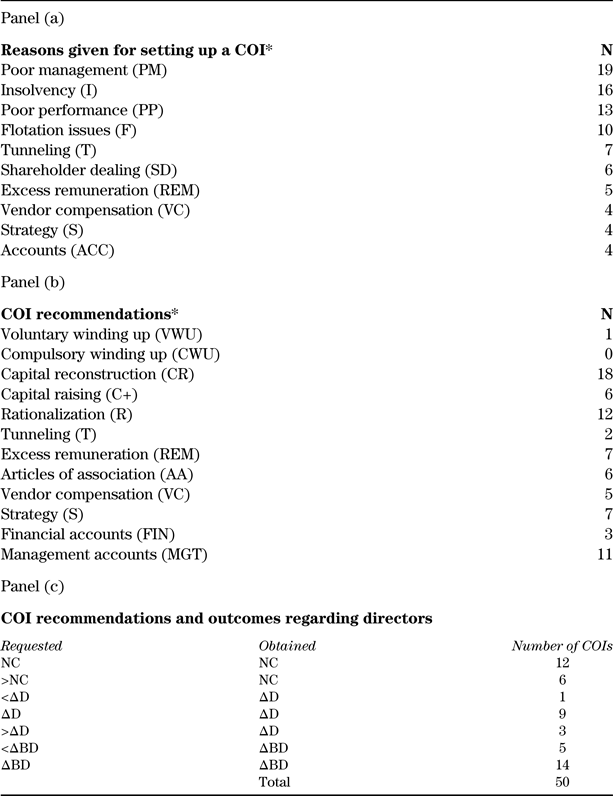
For the fifty companies in the sample, we identified the most common drivers behind demands for a COI, with more than one reason per company, and these are shown in panel (a) of Table 4, with panel (b) showing the topics covered in the subsequent COI report and recommendations. The most frequent driver behind the setting up of a COI was criticism of management or directors, given as a motivation for a COI in nineteen out of fifty cases. Many shareholders accused the directors of poor management and leadership; in the case of Schweppes, “a lack of grip and capacity on the part of the directors” was noted.Footnote 44 Boards usually rebutted these accusations at “lively” shareholders’ meetings: Slaters chairman Sir David Burnett, for example, counterattacked by accusing the members of the COI of being “without a particle of knowledge of the business.”Footnote 45 Directors were criticized for their lack of understanding of the industry or their inability to determine which parts of the business were viable and which were not.Footnote 46 The need for directors with expertise in the sector was commonly included in COI reports (in wholesale tobacco for Albert Baker & Co. or in hospitality for the Alexandra Hotel).Footnote 47 Some boards were criticized for not having a separate managing director or failing to add a level of management at the divisional level.Footnote 48 Criticisms were leveled at there being too many directors (an “unnecessary” seventeen in one case) and of too few.Footnote 49 There was also the issue of unnecessary sinecure positions for original vendors, with Spillers’ COI recommending the abolition of the roles of deputy chairman and vice chairman, and Dunlop deemed to have a superfluous president and vice president.Footnote 50
Reasons for COIs and recommendations of COIs.

* More than one reason and recommendation given per COI so total greater than 50.
Notes: NC = No change;
ΔD = Change some but not all directors, or additional directors, or both;
ΔBD = Change full board;
>NC = ΔD or ΔBD;
<ΔD = NC;
>ΔD = ΔBD;
<ΔBD = NC or ΔD.
Source: Our dataset.
The second most frequently cited reason for a COI was insolvency, mentioned in sixteen (32 percent) cases. For seven companies this was the sole mentioned reason. For some companies, shareholders recognized that liquidation of the company was inevitable but wished to protect shareholder interests against those of creditors or preference shareholders, or they sought to prevent directors from setting in motion a voluntary winding up (VWU), preferring instead a compulsory winding up (CWU) under the auspices of the Board of Trade.Footnote 51 The latter route involved a public inquiry—with evidence given under oath—into the company's failure and, potentially, prosecution for fraud of those responsible.Footnote 52 In such cases, it was useful for the COI to require evidence from witnesses to be given under oath (as laid out in section 60 of the 1862 Companies Act) so that the evidence could be used in any Board of Trade inquiry.Footnote 53 Failure to do so hampered the Harper Bean COI in its search for evidence of fraud.Footnote 54 Where there was some hope the company could survive, the COI might investigate the feasibility of a capital reconstruction or capital raising.Footnote 55 COIs were reluctant to recommend a winding up after the investigation, with only one COI in the sample doing so. After investigations were completed, there were eighteen mentions of a capital reconstruction, six of a capital raising, and twelve mentions of rationalization of the business in COI recommendations, as the second panel of Table 4 shows. The insolvency motivation for a COI was often linked to a past flotation of shares at an overoptimistic price and could lead to requests for compensation from the vendors, as happened in five cases. This desire for compensation also motivated shareholders not facing liquidation: for example, those in Continental Metropolitan Tramways and Ingall, Parsons Clive & Co. did obtain some compensation from the vendors, though Allsopps Brewery vendors refused compensation outright.Footnote 56
Shareholders were aware of agency costs relating to management. Directors were accused of feathering their nests in a variety of ways: conflicts of interest, fraudulent activities, exorbitant consultancy fees or commissions that destroyed company profitability, and excessive directors’ fees and salaries. As panel (a) of Table 4 shows, fraudulent share dealing, tunneling, and excessive remuneration were mentioned as reasons for a COI in a total of eighteen (36 percent) cases. For example, the chairman of Raleigh Cycles was accused of spending too much time on Gazelle, of which he was also chairman, with Gazelle then sold to Raleigh at a high price.Footnote 57 Insider trading of shares was alleged of the Cotton Seed Company, Industrial & General Trust, Associated Northern Blocks, and Oceana Consolidated.Footnote 58 There were accusations of overgenerous contracts to insiders for supplying products or services (“tunneling”) in the Alexandra Hotel, Dunlop, James Nelson, and East India & Ceylon Tea.Footnote 59 The COI report on one of these companies, Associated Northern Blocks, exonerated the directors concerned.Footnote 60 Changes to prevent such conflicts of interest might include alteration of the articles of association of the company, as was the case for six COIs. For example, the Smithfield and Argentine Meat Company COI criticized excessive commissions being paid to directors also acting as sole selling agents to the company, requiring a change to the articles of association to prevent this in the future. Six complaints related specifically to excessive director remuneration, and seven COIs made explicit recommendations on director pay. The B. Morris & Sons COI pointed out that the chairman took £400 more in salary per year than had been voted to him, as well as £200 in directors’ fees never voted to him at all. Also, directors’ fees at Newport Abercarn Steam Coal, R. E. Jones, and Smithfield and Argentine Meat were all reduced following COI investigations.Footnote 61
Poor performance of the shares was the third most frequently mentioned reason for setting up a COI; in thirteen cases, shareholders complained about the current share price—often much below the flotation price—and the lack of dividends or payment of dividends out of reserves. Value of the business was cited as a factor in seven COIs. Four COIs were also particularly concerned about poor accounting practices, such as companies making insufficient provision in their financial accounts for depreciation, failing to update valuations, paying dividends from recklessly overstated profits, or eating into reserves. These problems could often be traced back to the company flotation when the value of assets, patents, or goodwill had been overstated. Flotation issues were mentioned in ten cases as a reason for setting up a COI. Balance sheets were often too opaque or terse to reveal whether a company was a going concern. Given that the information available in the balance sheet and income and expenditure statement discussed at general meeting was often scanty or worse—for example, although against the law, the Goongarrie United Gold Mines balance sheet produced at a general meeting (only when pressed by shareholders) was a draft balance sheet, “part ink, part pencil”Footnote 62—a COI was the only way for shareholders to dig deeper into the financial and legal issues affecting the value of their shares. It allowed the COI members to identify which elements of the business were profitable and to consider—and recommend to the shareholders—appropriate solutions, such as closure of shops or factories or, more drastically, amalgamations, sale of the company, or a capital reconstruction to reduce “watering” of stock.Footnote 63 Three COIs in the sample had difficulty getting information from the company, with the chairman of Harper Bean, for example, withholding information on property leases.Footnote 64 The remaining COIs were able to access information not evident from the sketchy financial statements provided to shareholders.
Criticisms of management accounting practices came to the fore after the COIs had investigated the businesses, with COI members visiting company premises as well as studying financial documents. During these visits, COIs found that firms were unable to balance the books of shops, depots, or activities and thus were unable to determine which were profitable and which were not. Slaters’ COI, for example, reported antiquated management accounting systems, often with no centralized controls.Footnote 65 Findings like these led to criticisms of lack of awareness as to which elements of a business were profitable or not, inhibiting the formulation of corporate strategy. Strategy was mentioned in the setting up of four COIs, and seven COIs considered corporate strategy in their reports, with five making specific recommendations, such as on takeovers or, for larger, multidivisional companies, more generally on which elements of the business should be continued or discarded.Footnote 66
Impact on the Board of Directors
Potentially the most contentious issue was whether the current directors should continue in office. Only rarely did a board escape criticism. Many COIs recommended that all directors be removed from their posts; others were happy for directors with particular expertise to stay, such as in a new industry like the cinema, or to retain those who had not been on the board during the period under investigation.Footnote 67 Shareholders voted against the reelection of directors lacking what they believed to be necessary skills.Footnote 68 Where the COI report was accepted by shareholders, most chairmen resigned or said they awaited the formal decision of the shareholders to do so.Footnote 69 Some chairmen demanded a poll and won the vote, keeping their jobs as a result.Footnote 70 Burnett, chairman of Slaters, attempted to stay on the board by leaving the meeting before the vote on reelection of directors, but a court later agreed that COI members had been properly elected as directors, with counsel for the plaintiffs commenting that “it seemed as if Sir David Burnett had made up his mind to remain as Chairman of the company for the rest of his life.”
Panel (c) of Table 4 compares the recommendations relating to the board of directors with the actual outcomes. Twelve (24 percent) COIs made no suggestions concerning the board and in these cases the board was not changed. Six COIs were unsuccessful in asking for changes in the board. The remaining COIs had some measure of success, with nineteen (38 percent) complete board replacements and thirteen (26 percent) partial replacements. In six cases, the COI asked for the chairman as well as some or all of the directors to go but failed to achieve the removal of the chairman. In five cases, the COI asked only for certain director changes but the whole board resigned. Overall, thirty-two (64 percent) COIs led to some change in the constitution of the board.
Panel (b) of Table 3 looks at the reaction of the board to COI recommendations. Considering both general and board recommendations together, eighteen (36 percent) COIs had their requests met, twenty-five (50 percent) had some suggestions taken up, and seven (14 percent) COIs did not have their recommendations taken up. Of the latter seven, three were wound up against the recommendations of the COI; two did not implement the board changes requested; and two merged with other companies, also against the recommendations of the COI. Panel (b) of Table 3 also shows the state of the sample companies two years after the COIs had been set up, categorized as being involved in a merger or acquisition, being wound up, or being still a going concern. In line with the fears of insolvency behind the setting up of at least one-third of companies in the sample, and despite the preference for capital reconstruction in the reports, within two years of their COI report, thirteen companies were in the process of being—or had been—wound up, eight voluntarily, five compulsorily. The intervention of the COI had come too late to rescue these companies. Two firms had been acquired and a further two involved in a merger. However, thirty-three (66 percent) companies were still going concerns two years after the COI. Indeed, some companies had more than one COI during the period of this study, including, in our sample, Hotel York (1915 and 1922), William Hollins (1934 and 1938), and Allsopps (1890, 1900, and 1905).
Shareholders in some cases rewarded the members of their COI by voting them in as directors. As the FT commented, given the hard task that COIs faced, “it not infrequently happens that members of shareholder committees find their way to the Board if they are considered to have done useful work, and this furnishes a reward of sorts that is often very acceptable, and is deemed fully adequate.”Footnote 71 Panel (c) of Table 3 shows that shareholders of nineteen (38 percent) companies in the sample voted one or more COI members onto the board. Three companies elected four members and, in each case, the new directors had majority control of the board.Footnote 72 One of these COI members, chartered accountant John MacLaren, was a COI member of four companies in the sample—Albert Baker, Harper Bean, Slaters, and Schweppes—and became a director of all four.
The case in our sample with the highest profile was Dunlop Rubber. After reported 1920–1921 losses of £8.3 million, and pointed shareholder questions, the chairman revealed that president Sir Arthur du Cros and vice president George du Cros received fees from undisclosed contracts not statutorily disclosed of £12,000 per annum free of tax up to 25 percent and £2,500 not free of tax, respectively, with sixteen or seventeen years of the contracts still to run. Dunlop shareholders voted for a COI of three shareholders to be set up: Sir Josiah Stamp, who had recently moved from the civil service to join the senior management of Nobel Industries; James M. Thompson, who spoke at the meeting as one of a deputation of a committee of large Northern Irish shareholders; and F. Sobey, a shareholder from northern England with manufacturing expertise.Footnote 73 A professional accountant, Sir Arthur Whinney, was tasked with exploring the losses with the COI, involving 125 days, 92 of them taking evidence from thirty-seven witnesses. A 150-page report was produced in 1923, though not made public. Nonetheless, the controlling clique of the Du Cros family and the financier James White, guilty of speculative excesses and mismanagement, was ousted in an out-of-court settlement and a new chairman and managing director installed.Footnote 74 The company prospered thereafter, with operational changes and better financial and management accounting systems spearheaded by Whinney, together with an accounting professor, thereby improving transparency.Footnote 75 It is unsurprising that this success was later cited by others arguing for COIs.Footnote 76 In 1930, after reviewing the difficulties facing numerous shareholder committees then attempting to hold directors to account for the recent failings of initial public offerings in the 1929 boom, the FT suggested that they might do better, as had Dunlop's shareholders, to hire a reputable accountant rather than use shareholders to conduct an inquiry.Footnote 77 Some took this advice, with directors appointing accounting experts instead of waiting for a COI to be requested. The increased complexity of corporate groups and the opacity of those not adopting consolidated accounts made such expertise more necessary than it had been for smaller, simpler corporations before World War I. Similarly, the growing need for cost accounting methods for companies with different activities or multiple outlets was advice more readily available from accountants than amateur, albeit willing, shareholders. COIs, particularly from the 1920s, began to do so, as in the cases of Baldwins and Vickers.Footnote 78 Further evidence of the increasing importance of accountants was the number of professional accountants being elected to company boards.Footnote 79 Their presence was also useful when mergers or reorganizations were undertaken, as was increasingly common. Thus began the change from elected amateur shareholder COIs to appointed committees dominated by professional accountants.Footnote 80
Did these investor raids on incumbent boards really matter? Contemporary evaluations of COIs were generally supportive of their use, while not uncritical of those that fell short by being too soft on the directors.Footnote 81 In 1910 the Economist made a pessimistic assessment of shareholder powers and an ill-informed COI—perhaps unfairly - because three years later it was claimed that the COI had implemented reforms and put the company in a much better financial position.Footnote 82 We have identified multiple cases, and there were probably others with less publicity, but in any one year they constituted a small portion of extant investor-owned companies. In 1898 there were 9,000 (British and foreign) undertakings listed in Burdett's Official Intelligence and in 1939 its successor Stock Exchange Official Yearbook reported on the securities of 9,400 companies. Yet there were perhaps six hundred well-conducted committees with serious consequences between 1888 and 1940.Footnote 83 However, many of these involved large companies with London listings, while thousands of the companies appearing in the directories were smaller and more closely and/or locally held.Footnote 84 Plausibly, then, shareholders in smaller companies might use different pressures (less visible in the press) on underperforming boards through local networks.Footnote 85 Moreover, the lesson from studies of the effect of takeover bids is that frequency cannot adequately gauge effects. This is because a COI (like a takeover bid) not only had a direct effect but also influenced firms not directly targeted but still at risk. Many corporate headquarters were in London and annual meetings typically occurred in large venues there, easily accessible by fast suburban and intercity trains for most English shareholders and widely reported in the press.Footnote 86 Moreover, activist shareholders could exploit London's network of lawyers, accountants, and company directors for both technical expertise and potential replacement directors. They could communicate easily and quickly with a company's shareholders through the financial press or by using the company's shareholder lists—full lists of names, addresses, and shareholdings had to be provided by law—and thus quickly marshal opposition to an incumbent board.Footnote 87 In this distinctive culture of bourgeois activism, there was plausibly a widespread deterrent effect on boards considering slacking—or nefarious criminality—as well as a positive reinforcement effect on the (we suspect rather more numerous) boards that were broadly trying to do their best for business efficiency. Observers could not fail to notice that large, well-known companies such as Allsopps, Dunlop, Schweppes, and Vickers were not immune to COIs and even benefited from them. The pervasive threat of a COI meant there may not have been a strong correlation between profitability and COIs.Footnote 88
US Stockholder Committees
We outlined above the importance of COIs in the United Kingdom as a form of shareholder protection against poor corporate governance by management. Much of the law and finance literature emphasizes the differences between companies operating within a common-law system and those operating within a civil law framework. This literature is, however, less concerned with differences within the common-law system, including differences between the United Kingdom and the United States. It is of interest, therefore, to explore the importance of COIs in the United States and to compare with the United Kingdom as to their role in protecting minority shareholders as well as mitigating agency costs and the free-rider problem.
In the nineteenth-century United States, stockholder COIs existed that were very similar to those in the United Kingdom. However, in the standard work on US corporations, Robert Wright argues that they fell into disuse, as US boards of directors increasingly incorporated in jurisdictions with fewer investor protections from the 1890s.Footnote 89 He cites the Pujo Committee's 1913 claim that “no one—no one living, anyway—had ever heard of small stockholders overthrowing an existing management in any large corporation” or even securing “the investigation of an existing management of a corporation to ascertain whether it has been well or honestly managed.”Footnote 90 This claim could not reasonably have been made in the contemporary United Kingdom. In 1912, research conducted at Columbia University showed “how much more completely and carefully have England and the continental countries in general protected the interests of those financially interested in corporations than has the United States.”Footnote 91 However, Naomi Lamoreaux and Laura Phillips Sawyer have recently pointed to some states’ strengthening of minority shareholder protections by cumulative voting and inhibiting restriction of stockholder rights by voting trusts.Footnote 92 The United States shared some of the UK common law's historic respect for shareholder rights, and the difference between the two should not be exaggerated. As an example, a stockholder committee at Corn Products investigating dubious board practices met with opposition from company president Matthiesson, but its pressure appears to have contributed to his stepping down on a merger with other glucose manufacturers early in 1906.Footnote 93
The term “committee of investigation” became rare in US newspapers after 1900. Although numerous uses of the alternative term “protective committee”—increasingly favored in the United States—can be found, many of these press stories describe committees forlornly defending their interests in liquidations or struggling to organize; boards successfully resisting; or simply no concrete outcome being recorded.Footnote 94 In 1929 a corporate lawyer argued that “uniting with fellow stockholders and concerted action through committees are the efficient methods today,” apparently oblivious that this was the US norm in the previous century.Footnote 95 His failure to specify what he vaguely calls “instances of various kinds” suggests this was optimistically aspirational, as does the ample evidence he presents of the expense and difficulty of stockholder litigation and extensive investor apathy. Eight years later, a fuller study of US committees was undertaken by the Securities and Exchange Commission (SEC), whose advocates had been partly motivated by the need to emulate British investor protections. Its report noted that US reorganizations were normally driven by insider directors and bankers but nonetheless examined in detail 114 cases in railroads, utilities, and industrials of opposition by “outside groups,” some of which were initiated by stockholders. The SEC noted that “the odds against success are great, in view of the fact that, by and large, the reorganization system has been designed with the view toward, and has resulted in, protecting the position of vested interests.”Footnote 96
Some features of the British experience can nonetheless be detected, for example, the competitive solicitation of proxies and occasional success in replacing directors or changing policy.Footnote 97 Obvious differences were that a more frequent trigger was impending bankruptcy and bondholders were more often initiators than stockholders. Also, American committees resorted to newspaper advertisements to garner support, as access to investor lists (required by law in the United Kingdom) was refused.Footnote 98 Furthermore, activists were more likely to be branded by directors as troublemaking blackmailers and refused bank support or board acquiescence. In the United States, lawyers were more prominently involved; indeed, they often initiated committees rather than being brought in by stockholders (as experts were in the United Kingdom), and they sometimes solicited and accepted secret payoffs (of which the SEC disapproved) to quieten down. American committees appear to have incurred higher expenses and engaged more extensively in courtroom battles (sometimes with several rival committees).Footnote 99 Protective committees were more reactive to insider proposals rather than initiating governance and policy reforms based on careful examination of witnesses and auditors, facilitated by the less confrontational British annual general meeting (AGM)-authorized investigative process with power to call witnesses.Footnote 100 In conclusion, regarding the US cases, the SEC noted their “ineffectiveness on the constructive side,” recommending better regulation to prevent abuses and empower “the performance of their true functions.”Footnote 101
The UK/US Corporate Law Divide
Why were UK shareholders able to perpetuate such controls on corporate boards for longer than their US counterparts, more effectively bridging the period from the nineteenth century to the post-World War II era of takeover bids as an alternative reinforcement of shareholder rights? Such differences were possibly driven by differences in corporate law. American corporate law derived from state-based charters, whereas the origins of English company law derived from unincorporated partnerships based on the law of contract and mutual agreement. Lucian A. Bebchuk describes the US approach as “managerialist,” with the directors having the power to manage both on a day-to-day basis and with respect to major strategic decisions.Footnote 102 In practice, US stockholders were often limited to administrative and legislative checks on management.Footnote 103 By the 1820s, incorporation by special acts was more readily granted in the United States than in England, and when limited liability was introduced, it was the chartered corporation that legislators had in mind.Footnote 104 Although requirements varied by state, such charters generally insulated management from shareholder intervention. All major decisions had to be made or initiated by the board. Shareholders had a veto only on such matters as dissolution or mergers, and dividends were the sole prerogative of management.Footnote 105 The 1896 act of the (then dominant) US corporate law jurisdiction of New Jersey freed corporate boards to determine bylaws and internal governance with far less consideration of, or restraint from, stockholders (and was soon copied by Delaware, which replaced New Jersey as the favored state of incorporation).Footnote 106 Such interstate competition for corporate registrations omitted the more stringent shareholder protections of jurisdictions like Massachusetts, Illinois, and Pennsylvania. There is thus considerable evidence of companies with shareholder protections changing their bylaws to reduce protection in the late nineteenth and early twentieth centuries.Footnote 107
The only means by which US shareholders could assert themselves was either to change the corporate charter or to remove the board.Footnote 108 The first alternative was not really an option. Under the Delaware code, for example, shareholders were precluded from initiating changes to the corporate charter; although they could change the bylaws, no provision in the bylaws could be inconsistent with US state law or the corporate charter—a catch-22.Footnote 109 With respect to the alternative of removing directors, they could only be removed at the end of their term unless misconduct was proven.Footnote 110 With a high incidence of staggered boards, typically with only a third of directors changing at each annual election, US shareholders controlling a majority of shares might still have to wait several years to gain control.
In British companies, the legal framework was firmly based on partnership law and the law of contract, resulting in greater freedom and flexibility for participants themselves to allocate power between shareholders and directors within a company.Footnote 111 Fundamental common-law rights of shareholders to attend meetings and to vote were enshrined in the articles of association rather than in detailed legislation, as in the United States. The general meeting was central to the governance process.Footnote 112 Under the English system, companies were able to tailor their articles of association with respect to such matters as the size of a quorum or the choice of voting system.Footnote 113 Common-law traditions were reflected in the right to vote on the dividend proposed by directors and on the appointment of the auditors, as well as the right to put resolutions to an AGM. Shareholders with a relatively small percentage of the voting capital could require the directors to call an extraordinary general meeting to give any directions they wished to the board on such matters as reconstructions, acquisitions, liquidations, and the election or dismissal of directors. Special resolutions, such as the right to alter the articles of association, or extraordinary resolutions, such as to trigger voluntary liquidation or a request for the Official Receiver, required a 75 percent majority of those voting at the meeting and of proxies. When the Schweppes COI failed to get a three-quarters majority to remove the existing directors, it moved another resolution increasing the number of directors allowed and electing four directors from the COI. This required only a bare majority, was passed, and was soon followed by the resignation of the board of directors, who admitted defeat.Footnote 114
One key advantage for shareholders in the United Kingdom was access to the list of shareholders. In the United States, one often could not mail shareholders unless the directors were prepared to hand over the list or do the mailshot themselves, leaving only the possibility of a press advertisement. In contrast, beginning in 1844–1845, shareholder lists in the United Kingdom were legally required to be open to public inspection.Footnote 115 It was therefore a simple matter for any shareholders to circulate information to fellow shareholders before a general meeting. In the United States, stockholders of companies registered in Delaware or New Jersey, for example, had no such access to the shareholder lists, nor could they put resolutions on a wide range of issues to shareholders via the board and certainly not directly to shareholders. Other UK rules in the Companies Acts, or voluntarily adopted by quoted companies, required advance notice of resolutions and the circulation of accounts before the annual shareholder meeting, and generally permitted more shareholder initiative. Criminal law could also intervene in company affairs where larceny or fraud by directors was in question. Britain took a turn in the late nineteenth century toward prosecuting corporate fraudsters more assiduously (with criminal penalties of up to seven years hard labor).Footnote 116 It did not go unnoticed in the United States, from which some UK corporate fraudsters were extradited and sentenced to substantial jail terms, that similar rogues in America “walked in free air . . . lauded from the pulpits.”Footnote 117
Conclusion
This paper has highlighted a hitherto overlooked, though longstanding, element of UK corporate governance in the late nineteenth and early twentieth centuries: the shareholder committee of investigation or COI. The ability to establish a COI was enshrined in company law in 1862 but had long been used by shareholders of poorly performing British companies. They used shareholder meetings to vote for a COI, to report the results of a COI to shareholders, and to vote on recommendations made by the COI, leading in many cases to changes in corporate governance, such as the removal and replacement of some or all of the directors. This paper has shown that recourse to a COI was relatively common from the 1880s up to World War II and analysis of a random sample of 50 COIs mentioned in the Financial Times over that period points to a wide range of companies – in size, age, sector, and listing – being the subject of one – or in some cases more than one – COI. By contrast, a study of US newspaper archives for the same period does not reveal a similar use of COIs, even under the more usual name in the US of “protective committee.” We argue that the nature of the corporate charter as well as interstate competition for corporate registrations allowed weaker shareholder protection than did the English model derived from the law of contract and mutual agreement.
A number of factors can help to explain the gradual decline in use of the COI. By World War II, shareholder investigations required professional input rather than amateur investigators, as companies and their accounts became increasingly complex; as accountants broadened their skill sets to include management as well as financial accounting and corporate strategy as well as corporate structure; as larger numbers of individual shareholders in companies became more difficult to mobilize; as institutional investors began to form their own protection committees; and as takeovers (an easier form of “exit” or “voting with one's feet”) replaced the more arduous “voice” process of the COI.
Many disparate forces determine stock exchange dominance, and—despite its prominence in the literature—the quality of corporate governance perhaps had only a limited role. However, the shareholder activism described in the context of UK investigative committees before World War II goes some way toward explaining the continued importance of the LSE in the first half of the century, before (so some historians argue) the triumph of American professional managers able to ignore shareholder value yet achieve impressive results.Footnote 118 Such judgments about the alleged benefits of the United States’ quiescent shareholders and autocratic corporate boards raise broader questions for some core tenets of the “law and finance” literature than we can address here.
Appendix
Methodology and Sampling
We used the Gale Primary Sources (previously Artemis) archive. We first noted from a frequency distribution of the term “committee of investigation” for the Times archive (Figure 1) that, between 1825 and 2014, there were three periods when COIs were most frequent: the aftermath of the railway boom in the 1850s; the fallout from the financial crisis of the late 1860s; and a third period from the 1880s to the 1930s. We decided to concentrate on the third period. We searched for both terms “shareholder committee” and “investigation committee” in the seven newspaper and periodical archives in the Gale Primary Sources archive that mostly covered the period 1880 to 1940.Footnote 119 This generated 4,617 items. This total was made up of entries in the Times (1,123), Financial Times (FT) (990), Daily Telegraph (305), Economist (95), Daily Mail (86), Sunday Times (25), and British Library Newspapers (BLN) (1,959). On inspection, of the three archives that had the highest number of hits, we found that the Times had many entries that were nothing to do with investigation committees (due to their complex page layout) and the BLN archive had a high number of repeats—not surprising, given that it includes more than 160 publications. Neither problem affected the FT, so this archive was used to determine the sample. The FT began in 1888 so the period covered was 1888 to 1940 (Figure 2).
Fifty companies were selected, together with information on their sectors, issued capital, age, and type of stock exchange listing. Table 1 gives details of the sample in chronological order of their COI and Figure 3 shows the sample spread over the period under consideration. The companies were chosen by random sampling of cases generated by an algorithm prioritizing the more “relevant” cases reported in the press, so this outcome is not a random sample of all quoted companies.Footnote 120 London Stock Exchange (LSE) official list (OL) companies appear to be overrepresented, with thirty, or 60 percent of the sample, compared with fewer than a quarter of all firms appearing in contemporary stock exchange directories.Footnote 121 LSE special settlement (SS) (junior market) companies were underrepresented, while only one provincially listed company among thousands appears.Footnote 122 Since all of the companies sampled were British-registered, an obvious benchmark is Essex-Crosby's enumeration of all such companies (excluding domestic statutory and chartered companies and all companies incorporated abroad, even if mainly British-owned) in Burdett's Official Intelligence and its successor Stock Exchange Official Intelligence.Footnote 123 Essex-Crosby's 1884/1894/1914 capitalizations averaged £265,000 per company whilst ours before 1917 averaged £852,000.Footnote 124 Later, influenced by both war-induced inflation and marked increases in corporate sizes in the 1920s merger wave, Essex-Crosby's for 1935 averaged £646,000, while ours for 1917 to 1940 averaged £3,681,000.Footnote 125 So, it appears that larger companies are much more likely than other quoted companies to appear in our sample.
The categorization by sector is based on that used by Rutterford et al. in their study of shareholdings for approximately the same period: 1870 to 1935.Footnote 126 These are agriculture, commercial and industrial, extractive, finance, manufacturing, transport, and utility. The share capital was obtained from stock exchange directories at the date of the COI.Footnote 127 The shareholder numbers—available for only twenty-nine of the fifty—were obtained from one of three sources: ideally from the contemporary press articles; failing that, from the Investors’ Four Shilling Year Book, which gave 1911 shareholder numbers; or from the Balfour Committee, giving mid-1920s numbers, selecting the date closest to the COI.Footnote 128
The date of the COI and the date of the company's registration allowed us to estimate the company's age at the time of the COI, though some had existed in noncorporate form earlier. The FT archives (with occasional reference to other newspapers for clarification) gave us the number of shareholder members of a COI and how many members later became directors. They also allowed us to ascertain, from reports of shareholder meetings or of circulars to shareholders or from FT editorials, the reasons for requesting a COI, who initiated the request (shareholders, directors, or large shareholders), and whether the directors were for or against, or changed their minds about, the setting up of a COI. We then used the FT archives to determine the recommendations made by the COI and whether these recommendations were adopted and implemented, separating those relating to the board of directors from other issues tackled by the COI. Finally, by studying FT reports on companies in the years immediately following a COI, we were able to determine the state of the company concerned two to three years after its COI. These results are summarized in Tables 3 and 4.
We also explored the FT archive with respect to the number of repeats; the number of entries that did not, in practice, refer to committees of investigation; and the number of entries that were not relevant to our investigation. We looked at the years from 1898 and 1922 in detail. In 1898, the FT yielded fifty-seven results from our search, of which two were not relevant to COIs, and the remainder were linked to thirty-eight companies, of which three were in our sample. Of the thirty-eight companies, twenty-seven were single entries, with the remaining eleven companies having a total of twenty-eight entries. For 1922, the equivalent figures were as follows: sixteen items in total; seven items not relevant, leaving nine single-entry companies, of which two are in our sample. The FT archive produced 990 results for the period from 1888 to 1940. Using the data from the two sample years above, we assumed that one-tenth of the entries were not relevant, giving 900 results, and that the average number of entries per COI was 1.33. This gives a total number of COIs of around 675 spread over fifty-two years, or an average of 13 per year, compared with actuals of 38 in 1898 and 9 in 1922. The sample of fifty thus represents approximately 8 percent of the total in London between 1888 and 1940.