Introduction
Child health outcomes, as important indices for measuring socioeconomic development, are captured in Millennium Development Goal (MDG) 4, which seeks to reduce the mortality of under-five children as part of overall human development (Black et al., Reference Black, Allen, Bhutta, Caulfield, de Onis and Ezzati2008; Liu et al., Reference Liu, Johnson, Cousens, Perin, Scott, Lawn and Rudan2012; WHO, 2012). One measure that has become of interest in the discourse on child health outcomes is the nutritional status of under-five children, since poor nutrition among such children manifests itself in underweight, stunting and wasting. These dimensions of nutrition and childhood diseases have become global public health concerns, especially in low-income countries.
The proportions of children stunted, wasted and underweight, as well as suffering from some preventable childhood environmental diseases, have also emerged as important markers for measuring Target 1C in MDG-1, which aims to halve the incidence of extreme hunger (Black et al., Reference Black, Allen, Bhutta, Caulfield, de Onis and Ezzati2008). Of the 165 million stunted, 101 million underweight and 52 million wasted children (but not mutually exclusive) globally in 2011, between 70% and 90% live in Africa and Asia, two continents with a high prevalence of poverty (Black et al., Reference Black, Victoria and Walker2013). Available evidence suggests that about one-third of child deaths in low-income countries can be prevented through adequate nutrition and improved sanitation (Black et al., Reference Black, Allen, Bhutta, Caulfield, de Onis and Ezzati2008, Reference Black, Victoria and Walker2013; Liu et al., Reference Liu, Johnson, Cousens, Perin, Scott, Lawn and Rudan2012). Therefore, an understanding of the linkages between health outcomes among children and other underlying factors is important for policy and planning.
This paper first examines changes in living arrangements of children under age 5 in Ghana from 1993 to 2008. It further analyses levels of stunting, wasting and underweight among children under age 60 months (5 years), in various household arrangements, based on data from the 2008 Ghana Demographic and Health Survey (GDHS). Specifically, the study explores the implications of the dual effects of household composition and dependency on health outcomes of children under age 5. The view is that as societies undergo socioeconomic transformation, changes also occur in socio-demographic dynamics such as levels of fertility and trends in morbidity and mortality, as well as in the size and composition of households (Omran, Reference Omran1971; Caldwell, Reference Caldwell1982, 1998). Some of these changes have implications for household welfare, including the health of children (see Caldwell, Reference Caldwell1982; Hatton & Martin, Reference Hatton and Martin2009; Allendorf, Reference Allendorf2013).
The concept of nucleation is at the core of the paper. This term refers to the changing structure and composition of households, from highly extended with an associated socioeconomic system of production and reproduction, social behaviour and values, towards nuclear families, with a husband and wife and their children as the core (Goody, Reference Goody and Laslett1972; Laslett, Reference Laslett and Laslett1972; Oppong, Reference Oppong1981; Nukunya, Reference Nukunya2003). This process of nucleation, which includes both physical and emotional changes, has been associated with some aspects of demographic change, including fertility decline (Caldwell, Reference Caldwell1982). Axinn & Ghimire (Reference Axinn and Ghimire2013), expanding on the original theory of Caldwell, defined emotional nucleation as the bond between couples that contributes to creating an environment for discussion and adoption of strategies to improve family welfare – that is, ‘the process through which individuals' emotional bonds to their spouse grow stronger relative to their emotional ties to parents, siblings, and other relatives’ (Axinn & Ghimire, Reference Axinn and Ghimire2013, p. 3). Physical nucleation has been defined as a household arrangement that involves a couple and their biological under-age children. The process of physical nucleation is the transition from extended-family households to single-family (two-generation) households made up of a couple and their children (Macht, Reference Macht2008; du Toit et al., Reference Du Toit, Brown and Haggerty2013).
Social and economic considerations may determine household formation (Laslett, Reference Laslett and Laslett1972; Nukunya, Reference Nukunya2003; Titchit & Robette, Reference Titchit and Robette2008). Living arrangements could be dictated by social norms, including responsibilities towards different relations (e.g. parents of a couple) as well as choices made through marriage, for example. Also, family or non-family members may live together for economic reasons, to contribute to and maximize household resources (Freeman, Reference Freeman2005). A couple's parents, siblings, cousins and other family members could provide both tangible and intangible resources that improve the household's welfare, for instance contributing to childcare while the couple engage in other productive activities, particularly where the woman is engaged in non-familial economic activities (Griggs et al., Reference Griggs, Jo-Pei, Buchanan, Attar-Schwartz and Flouri2010). According to Caldwell (Reference Caldwell1982), the physical and emotional changes lead to rearrangements in household composition as well as in availability and use of resources. In the extended household structure, the flow of resources could be upwards (to parents), downwards (to own children, nephews and nieces) and/or lateral (to siblings). Caldwell postulated that in an extended family the net flow of resources is from children to parents. In a nucleated family the flow of resources is mainly from parents to children and, therefore, the net flow of resources in the household is directed to children's welfare. Furthermore, as couples live away from their parents, the probability of adopting new social values increases. With respect to fertility intentions and actual fertility, for instance, such couples could be predicted to have smaller family size compared with their parents and to give more attention to their children than they received from their own parents when they were young (Caldwell, Reference Caldwell1982). This rendition of the wealth-flow hypothesis has, however, been criticized. For instance, Wills (Reference Willis1982), argued that the direction of flow of resources has always been downwards (from parents to children) and not vice versa.
Available evidence on the links between household living arrangements and health outcomes for children is inconclusive. Griggs et al. (Reference Griggs, Jo-Pei, Buchanan, Attar-Schwartz and Flouri2010) demonstrated that in households where grandparents were involved in childcare, children fared better than in households where the involvement of grandparents was low or non-existent. Schnitzer & Ewigman (Reference Schnitzer and Ewigman2008) found that children in households with unrelated adults, step-parents or foster parents were more likely to experience unintentional injuries and maltreatment compared with children in households with biologically related members. In the United States, Casper & Bryson (Reference Casper and Bryson1998) observed negative health and emotional outcomes for children who were raised by their grandparents. Other studies in low-income countries generally have observed a link between large household size and negative outcomes for child health (Hampshire et al., Reference Hampshire, Casiday, Kilpatrick and Panter-Brick2008; Hatton & Martin, Reference Hatton and Martin2009).
Dependency and the trend towards nucleation are inherent in the quantity–quality trade-off hypothesis on the link between household size and child health outcomes (Becker & Lewis, Reference Becker and Lewis1973; Becker & Tomes, Reference Becker and Tomes1976; Klemp & Weisdorf, 2011). The negative relationship between levels of dependency, as measured by the size of household, and child health outcomes is premised on the view that high dependency depletes resources, both tangible and intangible, to the disadvantage of children. Households with many children are characterized by competition for care and resources. However, the effect of high child dependency can be compensated for by the number of adults in the household who are capable of providing care and resources for child welfare. The reverse is possible – that positive child health outcomes are associated with a low level of dependency, which is characteristic of nucleated households. The effect of household dependency, however, may not be uniform across different living arrangements of children, particularly in relation to age and gender. Where resources are limited, higher-order (older) children may be at more risk of poor health outcomes (Charmarbagwala et al. Reference Charmarbagwala, Ranger, Waddington and Howardno date). Similarly, especially in households where priority is given to male children, female children may experience worse outcomes, a circumstance Croll (Reference Croll2000) has characterized as ‘endangered daughters’.
Context
Researchers have long been interested in household composition, and various typologies have emerged to categorize living arrangements and their implications. Laslett (Reference Laslett and Laslett1972), for instance, provided a classification of household living arrangements with the basic nuclear family as core, and various combinations of nuclear and extended households. Extended family household structures include those with a nuclear family and either parent(s) of a couple, a couple with children, nieces or nephews or unrelated members, a couple with siblings (either male or female), children with or without related members, and others, which consist of various combinations of relationships with or without unrelated members by blood or marriage (Laslett, Reference Laslett and Laslett1972; Goody, Reference Goody and Laslett1972; Amoateng, Reference Amoateng2007). In this paper a modified version of the typology by Laslett (Reference Laslett and Laslett1972) has been adopted that defines nucleation as the movement towards living arrangements involving a couple and their children only, while non-nucleation refers to the other types of household arrangements, with various arrangements of related and non-related members.
Traditionally in Ghana, marriage did not necessarily lead to co-residence, and various living arrangements have existed and continue to exist among some ethnic groups. For instance, a duo-local system has characterized living arrangements in the Ga/Adangme areas of Ghana (Assimeng, Reference Assimeng1981; Pellow & Chazan, 1982; Manuh, Reference Manuh and Gwendolyn1997). Among the Ga/Adangme, married men and women could live in separate men's and women's households, rather than living together. Wives visited husbands at night in the men's houses, and children, irrespective of gender, spent their time in women's houses.
Among the matrilineal Akan, who account for about 50% of Ghana's population (Ghana Statistical Service, 2012), husbands and wives may live separately with members of their respective matriclan, or live together with the husband's maternal family (avunculocal). In rare cases the couple may co-reside with the woman's maternal family (Assimeng, Reference Assimeng1981; Oppong, Reference Oppong1981; Awusabo-Asare, Reference Awusabo-Asare1990).
In the northern half of the country, which consists mainly of the patrilineal Mole-Dagbani, young couples may live with the husband's parents. Under this arrangement, mothers-in-law are important in the household in a wide range of areas, including the care and upbringing of children (Goody, Reference Goody and Laslett1972; Rasheed, Reference Rasheed2013). Among the Mole-Dagbani, there is the belief that young parents are not necessarily the best people to bring up children (Oppong, Reference Oppong1981). In some areas of the country, such as among the Anlo Ewe and the Guan, couples may live with the husband's parents or live on their own (Nukunya, Reference Nukunya1969, Reference Nukunya2003; Assimeng Reference Assimeng1981; Pellow & Chazan, 1982; Manuh, Reference Manuh and Gwendolyn1997).
While there are various living arrangements, with varying types of household composition, changes are occurring in household living arrangements as Ghana experiences increasing urbanization, education and social and spatial mobility, leading to a process of nucleation (Twumasi-Ankrah, Reference Twumasi-Ankrah1995). The present study first examines the extent to which there have been changes in household composition towards nucleation over the last four GDHSs (1993–2008). Secondly, using data from the 2008 GDHS the effect of household composition on child health outcomes is examined, with an expectation that children in nucleated households will have better health outcomes than children in non-nucleated households. The transition from traditional extended families to nucleated household living arrangements is expected to lead to redirection of resources towards increased investment in good-quality education and child health (Caldwell, Reference Caldwell1982). Increasing nucleation should lead to a decline in the level of dependency, which would manifest itself in positive child health outcomes, as measured by levels of stunting, wasting and underweight. Alternatively, given the existing sociocultural setting, the extended family structure (non-nucleated households) could still be protective of child health by making available more physical and human resources for childcare.
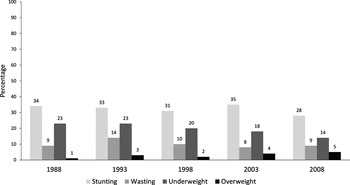
Results from the last three rounds of GDHS do not show significantly different patterns in child health outcomes, as measured by stunting, wasting and underweight. While the proportion of underweight children declined steadily, from 20% in 1998 to 14% in 2008, the proportions of children suffering from wasting fluctuated, decreasing by 2% between 1998 and 2003 and then increasing by 1% between 2003 and 2008. For stunting, the proportions have varied narrowly between 35% (2003) and 28% (2008) (Fig. 1). These rates have persisted in spite of various interventions, such as the healthier-happier home intervention by the Ghana Health Service to improve child health outcomes. The healthier-happier home (HE-HA-HO) is/was an intervention undertaken to provide mothers with skills in managing child health issues, focusing on home-based management of illnesses and nutrition under Integrated Management of Childhood Illness (IMCI) (WHO, 2002).
Trends of undernutrition in Ghana. The two earlier rounds of the GDHS (1988 and 1993) are excluded because anthropometric indicators were captured for children under age 36 months. In contrast, for the last three rounds (1998, 2003 and 2008) anthropometric indicators were collected for children under age 5 years.

Infant mortality declined from 77 deaths per 1000 live births in 1983–1987 to 50 deaths per 1000 in 2004–2008, while under-five mortality declined from 155 to 80 deaths per 1000 children (ICF Macro, 2010). Childhood mortality, although improved, has not translated into positive child health outcomes, as measured by nutritional status. This could partly explain the inability of Ghana to achieve the targeted 40 deaths per 1000 of under-five mortality (target 4A of MDG-4) compared with the current rate of 80 per 1000.
The focus of this paper, therefore, is to explain some of the driving forces underlying changes in child health beyond the socioeconomic factors such as education, residence, religion and ethnicity that other studies have used as explanatory variables (Gyimah, Reference Gyimah2006, Reference Gyimah2007; ICF Macro, 2010). Two hypotheses are tested: (1) household composition has changed in Ghana over time; and (2) among households with high dependency, those that are nucleated have children with better health outcomes than those that are non-nucleated.
Methods
Conceptual framework
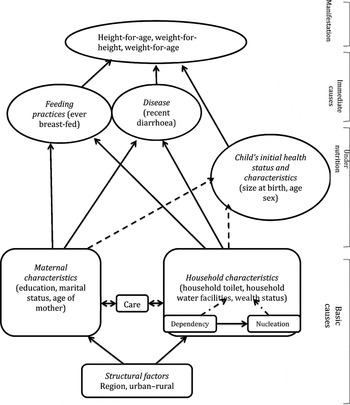
The study has adapted the UNICEF (1990) model for studying undernutrition to investigate three dimensions of child health outcomes: height-for-age (stunting), weight-for-height (underweight) and weight-for-age (wasting). According to the model, nutritional status is the outcome of the interplay among basic, underlying and immediate factors. The basic factors consist of structural characteristics (region, urban–rural residence and background (remote)) and household characteristics (nucleation and dependency, wealth index, sources of drinking water and toilet facilities), as well as maternal characteristics (education, marital status and age). These in turn indirectly influence the underlying factors of child-related variables, and directly influence the immediate factors that lead to nutritional status.
In the modified model, maternal characteristics replace parental characteristics in the original model because paternal characteristics inherently shape household variables such as wealth. The argument is that the role of the mother is critical, and that role can also be enhanced by marriage as the presence of a partner enhances available tangible and intangible support (Brown, Reference Brown2010). Availability of good drinking water and toilet facilities in the home are considered indicators of household protective factors for child health outcomes. The interaction among these factors is measured using the three health outcomes mentioned above: stunting, underweight and wasting (Fig. 2).
Conceptual framework on malnutrition.

Data
The paper is based on data from the 2008 Ghana Demographic and Health Survey (GDHS). In addition, data from the 1993, 1998, 2003 and 2008 GDHSs provide background and context for trends in household composition. The GDHS is a nationally representative survey of health, demographic and other related issues of importance to development, conducted among women age 15–49 and men age 15–59. Since 1988, five GDHS surveys have been conducted at five-year intervals. The surveys have been conducted by the Ghana Statistical Service and, occasionally, in collaboration with the Ghana Health Service and/or Noguchi Memorial Institute of Medical Research (NMIMR), with technical support from ICF Macro.
The household member and children's recode files (datasets) are used for the analysis. The household member dataset captures background information on all members of the household, while the children's file contains information on children under age 5 of interviewed women. These two files are used to generate the two main explanatory variables, that is, type of household composition based on children's living arrangement (nucleation) and dependency, based on the number of children under age 16 in the household. The household member dataset has information on child health outcomes but lacks other child-related variables, such as size at birth and disease (diarrhoea) status. To capture the data needed for child health outcomes and characteristics, the household and children's datasets are merged. The data are used to test the hypothesis that households with high dependency that are nucleated have more positive health outcomes for children under age 5 than households with high dependency that are non-nucleated.
Sample and unit of analysis
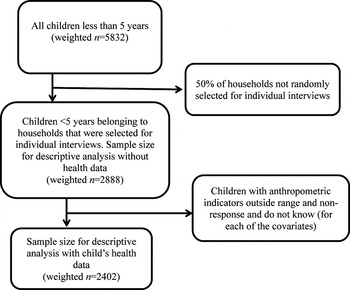
The sample for the study of family types (nucleation) consists of children under age 5 who were the usual residents of the sampled household at the time of the interview in 1993, 1998, 2003 and 2008. The sample for investigating the links among dependency, nucleation and child health outcomes is derived from the 2008 GDHS and based on the 50% of respondents in the household member data file who were selected for further interview. Therefore, the unweighted sample of children with detailed information on issues including child health outcomes and its correlates are the 3113 in the household member dataset and the 2992 in the children's dataset. The corresponding weighted sample of 2888 was used to describe the patterns of nucleation (see Fig. 3). Following data cleaning on issues such as children with anthropometric values outside the acceptable range, non-response/not applicable and ‘do not know’, and children whose parents do not include the head of household, the weighted samples obtained were 2402 for descriptive analysis on child health outcomes and 2026 for the regression analysis (Fig. 3).
Procedure for sample selection.

Measurement of key variables
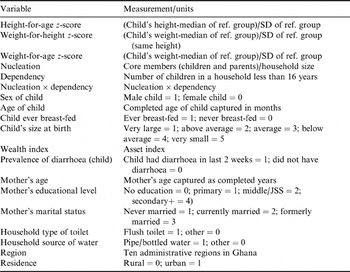
Measurements of the control variables are presented in Appendix Table A1. The key variables were as follows:
Household composition types based on children's living arrangements
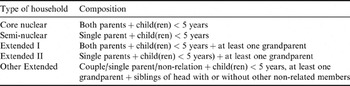
Based on the conceptualization of nucleation as children's living arrangements with parents, grandparents and others (both related and unrelated), a typology of household composition has been developed based on Laslett (Reference Laslett and Laslett1972) (Table 1). The living arrangements of under-five children of the head of household are categorized into five family types: (1) Core nuclear is a household where a child or children under age 5 live with both parents only; (2) Semi-nuclear is a household where a child or children under age 5 live with either the father or mother only; (3) Extended I is a household with a child or children under age 5 who live with both parents and at least one grandparent (parent/parent-in-law of the couple); (4) Extended II is a household with a child or children under age 5 who live with either a father or mother and at least one third/fourth generation member, e.g. grandparent(s), granduncle/aunt; (5) Other Extended is a household in which a child or children live with at least one parent and/or another adult other than parents or grandparents.
Typology of household composition based on children's living arrangements

The last category can be heterogeneous and may be one of the following: (a) child or children under age 5 who live with both parents and any another member who is not a third-generation member; (b) child or children under age 5 who live with a single parent, a third-generation member and any other member who may be related or not related to the head; (c) child or children under age 5 who live with a third-generation member and another member; (d) child or children under age 5 who live with a single parent and another member who is not a third-generation member; (e) child or children under age 5 who live with another member who is neither a parent nor a third-generation member; (f) child or children under age 5 who are not living with any of their biological parents but live with any other adult and a third-generation member.
Index of nucleation
The conceptualization of children's living arrangements is used to develop an index for nucleation, which ranges between 0 and 1. The index is calculated as the number of core members (parents and children; Core nuclear and Semi-nuclear categories in Table 1) in a household, divided by household size. Thus, the index will range from 0 to 1; the closer the value is to 1 the higher the level of nucleation, while the closer it is to 0 the higher the level of non-nucleation. The derived nucleation index is a continuous variable, as opposed to the nominal categorical variable of household composition (Table 1), and is used to calculate the effect of nucleation separately and its joint effect with dependency on child health outcomes.
Comparing the typology of households in Table 1 and the nucleation index, it is observed that Core nuclear and Semi-nuclear households will each have a value of 1. (This assumes that care and wealth distribution in Core nuclear and Semi-nuclear households are the same. Given that this is not entirely true, the authors are mindful of it and in the future will explore the use of weights to distinguish between Core nuclear and Semi-nuclear households.) For the other categories (Extended I, Extended II and Other Extended) the nucleation value will vary depending on the number of other members in the household. For instance, in a household with two grandparents and both parents and a child, the index will be a closer one compared to a household with both parents and all four grandparents. The above suggests that the index places a premium on the depth of extended family.
Index of dependency
Dependency in this paper is measured as the total number of children under age 16 in a household. In contrast to other papers that use the dependency ratio (number of children/household size), this paper uses number of children because household size is used in the computation of nucleation. Calculating a ratio using household size for both nucleation and dependency will amount to duplication in the interaction term. The concentration is on child dependency, hence this paper excludes other forms of dependency, such as the elderly and household members with chronic ailments, from the measure of dependency. The use of number of children as a measure of dependency is supported by the extant literature on the determinants of child nutrition (see Charmarbagwala et al., Reference Charmarbagwala, Ranger, Waddington and Howardno date). However, it is worth noting that this measure is not consistent with the theoretical measures of age dependency, that is number of children/number of adults and economic dependency ratio of non-working to working (or total) household members. In fertility studies the concept of dependency is defined to cover quantity and tempo, which is spacing (e.g. Schnaiberg, Reference Schnaiberg1973). This definition of dependency is not used in this paper since it would exclude children who are in non-nuclear households and are not children of the interviewed woman and therefore would distort the index. The focus is on quantity only, since the variable of interest is household dependency, which in the case of non-nuclear households might include other children under age 16. For the categorical variables, levels of dependency were classified into: 1–3 children under age 16 in the household (low dependency); 4–6 children (medium dependency); and 7+ children (high dependency).
Nucleation and dependency
The joint effect of dependency and nucleation is captured as an interactive term by multiplying values of dependency with the nucleation index. In this index, dependency is considered as the main determinant of child health outcome and the index for nucleation as the moderating explanatory variable.
Child health outcomes
Child health outcomes are measured using anthropometric indicators of height-for-age, weight-for-height and weight-for-age. The indicators are captured as z-scores with values in the range of ±6 and thresholds for classifying nutritional status (WHO, 2006). Children with z-scores less than −2 for height-for-age, weight-for-height and weight-for-age are classified, respectively, as stunted, wasted or underweight. In this paper the classifications are used for the descriptive analysis and the raw z-scores for the inferential analysis (linear least squares regression).
Estimation technique
The first objective – to examine changes in living arrangements of children under age 5 – is studied using chi-squared analysis. The research (alternative) hypothesis is that household composition types based on children's living arrangements have changed over time. The second objective – to investigate the links between dependency, nucleation and their independent or joint effect on child health outcomes – is analysed using a linear least squares regression model. Linear least squares regression is employed because the dependent variables (anthropometric indicators) are continuous. Using the raw z-scores for the regression analysis allows for assessment of changes across each of the observations rather than observing changes across categories. The use of the raw z-scores presents a counter argument in the case of the weight-related anthropometric indicators in that higher values are not necessarily desirable as they could also lead to overweight. However, in Ghana the proportion of children overweight in the 2008 GDHS is quite low (Fig. 1).
Two variants of linear least squares regression models have been employed. The first is a hierarchical model in which the predictors of child anthropometric outcomes are plugged into the model as: (a) nucleation alone; (b) dependency alone; (c) nucleation and dependency; (d) nucleation, dependency and wealth status; and (e) nucleation, dependency, wealth status and control variables. The second variant estimates a linear least squares model with the same variables as in (d) above, but in this case with an interactive term between dependency and nucleation to capture the joint effect on child health outcomes.
Results
Children's living arrangements
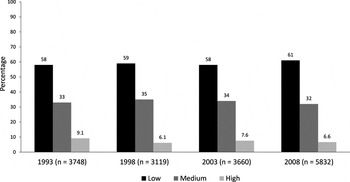
This section first provides results from the analysis of the last four GDHSs for trends in nucleation. It then shows the relationship between nucleation, dependency and their joint effect on child health outcomes based on data from the 2008 GDHS. Figure 4 presents trends in household dependency from 1993 to 2008. As a reminder, this paper classifies household dependency into three categories: low dependency (1–3 children under age 16), medium dependency (4–6 children) and high dependency (7+ children). While the proportion of households with low dependency increased over the 15-year period 1993 to 2008 (from 58% to 61%), the proportion of high-dependency households decreased over the same period (9.1% to 6.6%). The results suggest that households in Ghana are moving towards having fewer child dependants.
Trends of dependency in Ghana, 1993, 1998, 2003 and 2008.

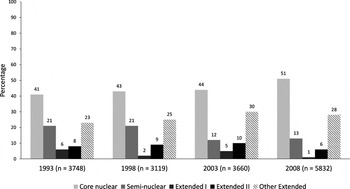
The proportion of under-five children who lived in Core nuclear households (both parents only) increased, from 41% in 1993 to 51% in 2008 (Fig. 5). The proportion of children in single-parent (Semi-nuclear) households (presence of either mother or father) declined, from 21% in 1993 to 12% in 2003 and 13% 2008. The presence of a third generation (grandparents) in households of children living with both parents (Extended I) also fell, from 6% in 1993 to 2% in 2008. In the case of children living with a single parent and a third-generation member in the household (Extended II), the proportions ranged between 6% and 10% over the period. The rest (between 23% and 30%) lived in various other forms of extended households. The 2008 GDHS shows that about half of children in Ghana lived with both parents, while only about one in every four children lived in a fully extended household (Fig. 5). From the results, it would appear that there has been a trend towards nucleation in household living arrangements over the past 15 years in Ghana, albeit the movement not being substantial.
Living arrangements among children in Ghana: 1993, 1998, 2003 and 2008.

As suggested earlier, the various ethnic groups in Ghana appear to have varying household living arrangements. The lowest proportion of children living with both parents alone (Core nuclear), 42%, is observed among the Ga/Adangme, a group which traditionally do not practise conjugal living arrangements, while the highest proportions are among the ‘Other’ category, at 66%, and the Mole-Dagbani (including other ethnic groups in the northern part of the country), at 61%.
By region of the country, the Northern region has the highest proportion (67%) of children living with both parents only (Core nuclear), followed by the Upper East region (62%) and the Greater Accra region (56%). The lowest proportion is between 42% and 44% in the Central, Volta, Ashanti and Upper West regions. In the Upper West region, the only region with a higher proportion of non-nucleated households than nucleated households, 44% of children live in Other Extended households, while the proportion in Core nuclear households is 42%. The chi-squared results show that the variation in living arrangements of children by region is statistically significant at 1%.
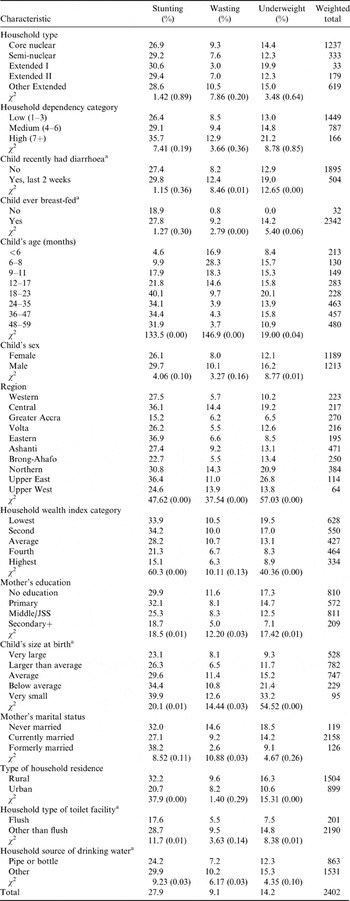
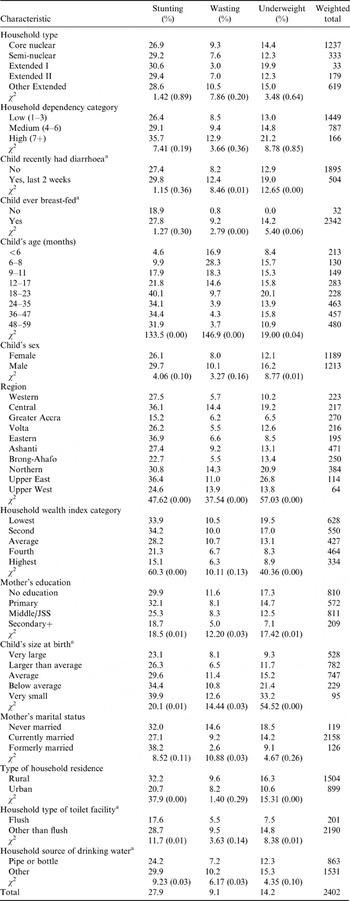
This section examines the extent to which child health outcomes vary by level of dependency, nucleation and interaction between the two variables. Table 2 shows patterns of undernutrition (stunting, underweight and wasting) by type of household and characteristics of children and mothers in the 2008 GDHS. The discussion focuses on correlates of child nutritional status that were not considered in the 2008 GDHS.
Levels of undernutrition among children aged less than 5 years by socio-demographic characteristics, Ghana 2008 (unweighted sample n=2460)
a Sample size less than 2402 (greatest difference is 30).
The results show a significant association between household type and child health outcomes, with underweight at 1%. Among children in Extended I households (a single parent, child(ren) and at least one grandparent) a higher proportion (20%) are underweight compared with other household types. Household dependency shows a significant association with underweight. Households with high dependency (seven or more children under age 16) show 36% stunting and 21% underweight. Among children who had recent diarrhoea, 12% are wasted and 19% are underweight. The results also show a significant association between mother's marital status and child wasting, with the highest level of wasting (15%) among children of never-married women.
There are also significant associations between all the three child health outcomes and the type of household toilet facility, as well as type of water used in household, with the exception of wasting in the context of type of toilet facility. About twice the proportion of children (14.8%) in households without flush toilet facilities are underweight, compared with 7.5% in households with flush toilet facilities. These two factors (types of water and toilet facility used in the household) have been found to provide basic environmental conditions for the health of children (Gordon et al., Reference Gordon, Nandy, Pantazis, Pemberton and Townsend2003).
Regression results
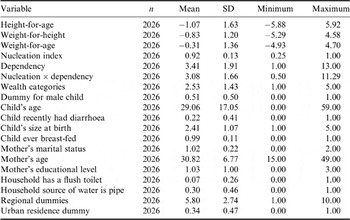
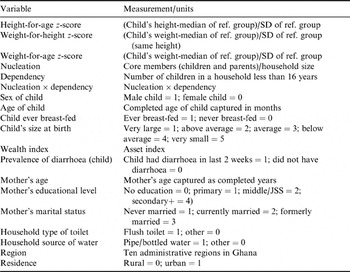
This section presents results from the hierarchical model and the least squares estimation with an interactive term of dependency and nucleation. The measurement and descriptive statistics for all the variables used for the regression analysis are presented as Appendix Tables A1 and A2, respectively, for cross-reference in interpreting the coefficients. The rationale for estimating a hierarchical and least squares model with an interactive term of dependency and nucleation is to provide a systematic assessment of the independence or the joint effect of dependency and nucleation on child health outcomes.
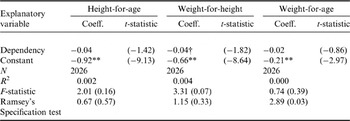
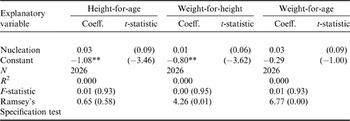
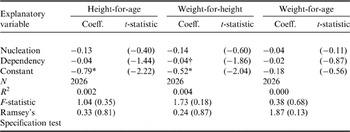
Table 3a presents the results of the effect of household dependency alone on child health outcomes, while Table 4b shows the effects of nucleation alone on child health outcomes. The results from the simple linear regression (Table 3a) show that dependency explains variation in weight-for-height but not variation in height-for-age and weight-for-age. Table 3b, which deals with the effect of nucleation on child health outcomes, shows that children's living arrangements fail to explain variation on all three indicators of child health. The post-estimation tests show that the predictive power (R
2) of the model (Table 3b) is nil, and also there is model misspecification in the case of the weight-for-height and weight-for-age models (Ramsey's Specification test). Ramsey (Reference Ramsey1969) proposed a test of linear relationship against a non-linear specification of a model. The approach provides an avenue to investigate the possibility of wrongly specifying the functional form of the relationship between the dependent and explanatory variables. The null hypothesis supporting the test posits that the model has ‘no omitted variables’. A rejection of the null hypotheses (p>0.05) suggests that the model has been correctly specified.
Simple linear regression results of the relationship between child health outcomes and dependency, Ghana 2008, Model 1 †p<0.10; *p<0.05; **p<0.01. Simple linear regression results of the relationship between child health outcomes and nucleation, Ghana 2008, Model 1 †p<0.10; *p<0.05; **p<0.01.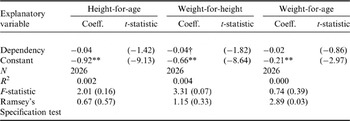

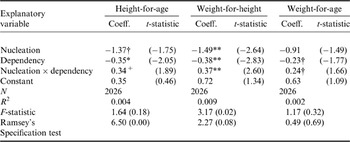
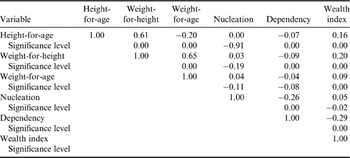
Table 4a shows results from multiple linear regressions with dependency and nucleation as the explanatory variables. The results indicate that households with a large number of child dependants, on average, have poor child health outcomes, with the coefficient of nucleation still insignificant, as shown in Table 3b. In Table 4a, however, the coefficients for nucleation for the three health outcomes are different from those in Table 4b. One possible reason is that in Table 4b the coefficient of nucleation could be biased as a result of omitting dependency from a child health model, pointing to the power of the relationship between nucleation and dependency in explaining child health outcomes. The correlation matrix in Appendix Table 3 shows that the inverse relationship between nucleation and dependency of −0.26 is statistically significant at 1%.
Linear regression results of the relationship between child health outcomes and nucleation and dependency, Ghana 2008, Model 2 †p<0.10; *p<0.05; **p<0.01. Linear regression results of the relationship between child health outcomes and nucleation and dependency, Ghana 2008, model with interaction †p<0.10; *p<0.05; **p<0.01.

Based on the hypothesized relationship of a joint effect between nucleation and dependency, Table 4b shows the effect of the interaction term. In this model there is a significant relationship between dependency and the interaction term (dependency and nucleation) in all three child health outcomes. Nucleation appears to be significant for height-for-age and weight-for-age in this model, but not in the model shown in Table 3b. The net effect of nucleation on height-for-age and weight-for-age takes into account the coefficients of nucleation and the interaction term as well as a statistic of dependency.
Using the average value of dependency (Appendix Table A2), the coefficient for nucleation is negative [−1.49+(0.37×3.41)=−0.23] for weight-for-height. However, in households with five or more dependants, the coefficient of nucleation changes to positive. With dependency, there is a negative effect (statistically significant) on height-for-age and weight-for-height if the household is nucleated [−0.35+(0.34×1)=−0.01].
This observation points to the relevance of both dependency and nucleation in child health outcome models. The nature of the relationship is either additive (independent) or joint in the estimation of the determinants of child health outcomes. The post-estimation results (last three rows) of Tables 4a and 4b have low predictive power (R 2) and joint effect (F-statistics) of the explanatory variables and in five of the six cases fail to explain changes in child health outcomes. Also, model misspecification remains an issue (Ramsey's Specification test), hence the need for re-specification and inclusion of other variables, as found in the determinants of child health outcomes (see Fig. 2).
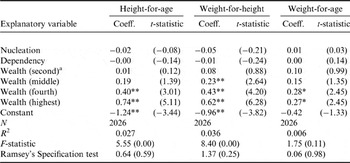
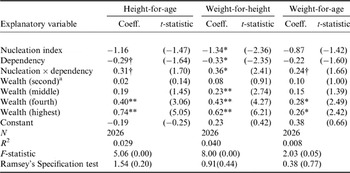
Household wealth status is included as an additional variable to nucleation and dependency in Tables 5a and 5b. In Table 5a nucleation and dependency are treated as independent variables, while in Table 5b an interaction between nucleation and dependency is introduced. In Table 5a children in the middle, fourth and highest household wealth quintiles have better health outcomes compared with the lowest and second household wealth quintiles. With the inclusion of household wealth status in Table 5a, both nucleation and dependency remain insignificant in explaining changes in child health outcomes. However, with the inclusion of an interaction between nucleation and dependency, as in Table 5b, dependency and the interaction term become significant for two of the three outcomes of child health, with nucleation being significant for only weight-for-height.
Linear regression results of the relationship between child health outcomes and nucleation, dependency and wealth, Ghana 2008, Model 3
a
Reference category: lowest wealth group. †p<0.10; *p<0.05; **p<0.01. Linear regression results of the relationship between child health outcomes and nucleation, dependency and wealth, Ghana 2008, with an interaction term of dependency and nucleation
a
Reference category: lowest wealth group. †p<0.10; *p<0.05; **p<0.01.

Furthermore, the effect of dependency in Table 5b is positive for all three child health outcomes, compared with the ‘no effect’ results in Table 4b. The results suggest either an independent or joint relationship between nucleation, dependency and wealth status in the modelling of the determinants of child health outcomes. The post-estimation results from Tables 4a and 5b (last three rows) suggest that the explanatory variables have a better predictive power (R 2) than in the earlier models (Tables 3 and 4), and jointly the predictors explain variations in child outcomes (F-statistics). Also, model specification, as verified by Ramsey's Specification test, supports the null hypothesis of ‘no omitted variables’ for all the models.
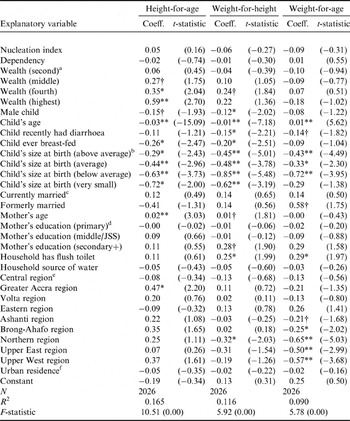
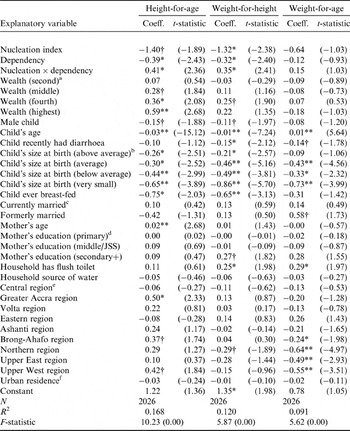
Tables 6a and 6b present results of the full model consisting of dependency, nucleation, wealth status and other correlates of child health outcomes, following the conceptual framework. Table 6a differs from Table 6b with the introduction of the interaction term, as in Tables 5a and 5b. Consistent with Tables 4a and 5a, nucleation and dependency remain insignificant. Household wealth status is significant for middle, fourth and highest wealth status categories in the case of height-for-age, and is significant only for the fourth category in the case of weight-for-height.
Linear regression results of the relationship between child health outcomes and nucleation, dependency and wealth and other covariates, Ghana 2008, Model 4 Reference groups: alowest wealth; bchild's size at birth very large; cnever married; dno education; eWestern region; frural residence. †p<0.10; *p<0.05; **p<0.01. Linear regression results of the relationship between child health outcomes and nucleation, dependency and wealth and other covariates, Ghana 2008, Model 5 (interaction) Reference groups: alowest wealth; bchild's size at birth very large; cnever married; dno education; eWestern region; frural residence. †p<0.10; *p<0.05; **p<0.01.
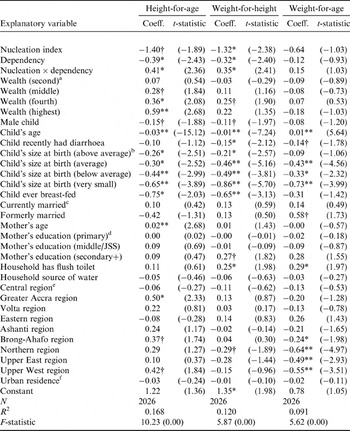
The results in Table 6b, with the joint effect of dependency and nucleation as an interaction term, indicate that in nucleated households with high dependency children have better health outcomes than in non-nucleated households with high dependency. The effect of dependency on child health outcomes could have two possible outcomes based on whether or not the household is nucleated. If the household is nucleated, the coefficient of dependency in the height-for-age model is 0.02[−0.39+(0.41×1)]. Also in the case of weight-for-height, a positive effect is observed, reinforcing the argument that households that are nucleated and have high dependency tend to have better child health outcomes. If the household is non-nucleated, the effect of high dependency on child health outcomes is negative compared with children in nucleated households with high dependency.
The effect of household wealth status on child health outcomes remains robust in the full model, with the exception of weight-for-age. Based on the UNICEF framework adapted for this paper, childhood disease is an important variable that has a direct effect on weight-for-height and weight-for-age. In the results, a recent bout of diarrhoea shows an association with weight-for-height (wasting) and weight-for-age (underweight), but not height-for-age (stunting), in both Table 6a and 6b. Because stunting is a measure of chronic malnourishment, it should not be affected by an episode of diarrhoea within the 2 weeks preceding the survey, whereas wasting is a measure of acute malnourishment, and underweight reflects both acute and chronic undernutrition.
Size of a child at birth and age show consistently significant results across all three indicators of child health outcomes. Child's size at birth (a proxy for initial health status) shows that children who are very small at birth tend to have poor health outcomes. Also, older children (those aged 1–4 years) tend to have poorer health outcomes than younger children (under age 1). This phenomenon of poor health outcomes among children age 1–4 was first described in the old cocoa-growing areas of the then Gold Coast, and was named Kwashiorkor (Williams, Reference William1935). In terms of maternal factors, older mothers have children with better height-for-age and weight-for-age z-scores than younger mothers. The expected positive effect of maternal education on child health outcomes is observed only in the case of mothers with at least secondary education. This is evident with weight-for-height and weight-for-age in the models.
In terms of sanitation, children in households with flush toilets have better weight-for-height and weight-for-age z-scores than children in households with other types of toilet facilities. The results on regional fixed effects are largely insignificant, with the exception of the coefficients for the three northern regions in the cases of weight-for-height and weight-for-age. Children in the three northern regions have poorer child health outcomes in the context of weight-for-height and weight-for-age compared with children in the Western region. These are three regions with consistently high poverty indicators over the past two decades (Ghana Statistical Service, 2000, 2007).
Discussion
Understanding the factors and channels that influence child health outcomes has become important in view of the short-term and long-term implications of good health, both for individuals and for national development (Black et al., Reference Black, Victoria and Walker2013). While household characteristics have been featured in models such as the quality–quantity debate on child health outcomes (Becker & Lewis, Reference Becker and Lewis1973; Becker & Tomes, Reference Becker and Tomes1976; Klemp & Weisdorf, Reference Klemp and Weisdorf2012), little attention has been given to the interaction of the nature of dependency and living arrangements of children (UNICEF, 1990).
Variations in household characteristics could influence child health outcomes in one or a combination of the following ways: (1) number of children and adults; (2) children's living arrangements – that is, the presence of parents or related and unrelated members in the household; (3) health and vulnerability status of household members; and (4) occupational status of older members in the household. These characteristics could influence the distribution of resources and care in the household in various ways, which in turn would affect child health outcomes. This paper has focused on the links through which the number of children under age 16 in a household (dependency) and household living arrangements (nucleation) influence child health, as measured by height-for-age, weight-for-height and weight-for-age among children under age 5.
The paper began with an examination of changes in household composition over time, from two perspectives: dependency and nucleation status of the household. The results show that the living arrangements of children under age 5 have changed over the study period. The proportion of children living with both parents without other adults present increased substantially, from 35% in 1993 to 50% in 2008, suggesting a movement away from extended families and towards nuclear households, although the trend is not linear.
To understand the possible reasons for this observed change towards nucleation, the study compared household composition status with structural factors, such as region, rural–urban residence and ethnicity. In Ghana these structural factors, especially ethnicity, show a long history of differences in living arrangement among couples and children. Across all three structural factors, there is evidence of association with household composition. Among the possible reasons for the changes in household living arrangements of children are migration, urbanization, increasing education and the effects of modernization generally. For instance, the proportion of the population in urban areas of the country has more than doubled in the past 50 years, from 23% in 1960 to 51% in 2010 (Ghana Statistical Service, 2013). As explored in this paper, these changes have implications for children's health outcomes, as well as many other consequences.
The observation that households with high dependency and that are nucleated have children with better health outcomes than those with high dependency but that are non-nucleated shows the implications of dependency, as measured by the number of children under age 16 in a household, for the health outcomes of children under age 5. The results also indicate that the significance of the effect of dependency by itself is not consistent across all three child health outcomes, and that nucleation on its own also fails to explain variations in the three indicators of child health. It is argued that nucleation, as moderated by dependency, influences child health outcomes. Therefore, the study's orientation is not a claim that nucleated households have children with better nutritional status. Rather, it is the interaction between nucleation and the number of children that is emphasized.
What emerge are the joint effects of dependency and nucleation on child health outcomes, with both being statistically significant, but with dependency exhibiting zero effect and nucleation a negative effect. The inclusion of household wealth status and the combined effect of nucleation and dependency, as well as the effect of dependency in the context of nucleation are positive in households with at least four dependants. The results for dependency and nucleation remain unchanged with the inclusion of all other possible correlates of child health outcomes.
The first set of results supports the evidence from the literature (Sahn, Reference Sahn1990; Madise et al., Reference Madise, Matthews and Margetts1999) that the effect of the number of young and older children in a household on child health outcomes is mixed. One of the possible reasons for the mixed results is the inconsistency in age cut-offs used for the studies. The choice of age cut-off has implications for competition for resources, economies of scale for large number of children and the distribution of resources and care. The first conclusion from this paper is that the effect of dependency on child health outcomes should be conceived as dependent on the characteristics of household members, such as the living arrangements of under-five children. One possibility is that in households with high dependency and households that are nucleated, older children may provide support for care of younger siblings. Perhaps, in non-nucleated households with high dependency, the tendency is for young children to compete for attention with older members (see Hampshire et al., Reference Hampshire, Casiday, Kilpatrick and Panter-Brick2008).
Conclusion
That nucleation, on its own, fails to explain variations in all three indicators of child health could be explained by the fact that, for nucleation to have an effect on child health outcomes, one would need to demonstrate the nature of resource distribution (household wealth status) and competition among members in the household. The results from the joint effect of nucleation and dependency provide an avenue for exploring the relationship of the nature of living arrangements for children and household composition. However, the evidence of ‘no’ and ‘negative’ effect for dependency and nucleation, respectively, and the positive effects of nucleation and dependency when wealth status is included, imply that the joint effects of these two variables can be realized when the wealth status of the household is taken into consideration. The effect of the number of children in a household on child anthropometric outcomes is mediated by household nucleation and conditioned on the wealth status of the household. Thus, the quantity–quality trade-off debates on child health outcomes should be extended to incorporate discussions on the nucleation status of the household. This is because the nucleation status provides avenues for focused distribution of resources. From a policy perspective, programmes for social protection and poverty reduction should consider focusing on household composition, such as nucleation status and number of dependants, as opposed to simply considering household size.
Appendix
Measurement of variables
Summary statistics of variables used for inferential statistics

Pearson correlation matrix for main variables of interest