Introduction
The FAO considers the donkey species in danger of extinction. The EU protects this species through different policies, thus providing financial incentives to raise donkeys. This species is tough and frugal and therefore destined to the redevelopment of marginal areas characterized by environmental constrains. The donkeys can be used in different ways, many of which are similar to those of the horse, like trekking, meat production, pet therapy and brain gym, which is a program of physical movements that enhance learning and performance in all areas (http://www.braingym.org/; Wolfsont, Reference Wolfsont2002). In this training program, horses and donkeys are supposed to be stimulating those brain centers controlling laterality, focalizing and centering through specific postures and movements on equine backs (Gamberini, 2005).
However, jennet milk production has recently become the main interest. Jennet milk has a chemical and nutritional composition very similar to human milk (Polidori, 1994; Salimei et al., Reference Salimei, Fantuz, Coppola, Chiofalo, Polidori and Varisco2004). Jennet milk as human food is hypoallergenic for patients affected by Cow Milk Protein Allergy and multiple food allergies. For these pathologies, jennet milk represents the best alternative to other types of milk (Iacono et al., Reference Iacono, Carroccio, Cavataio, Montalto, Soresi and Balsamo1992).
Nevertheless, the quantitative and qualitative characteristics of jennet milk during lactation are still not well known. Milk production in all mammals varies during lactation depending on different factors, like those related to physiology, yet understanding how environmental and management factors affect jennet milk during lactation can be very important in order to identify profitable management systems.
Therefore, an investigation during lactation in a Sicilian farming system was carried out on jennets milked twice a day. The productive parameters were related to the foaling seasons, the lactation phases and the production seasons. Considering the little information available for jennet milk producers, the auspice is that this study can promote further researches, helping the development of the jennet milk sector.
Materials and methods
The trial was carried out on an 18-month period on 24 pluriparous jennets, which derived from the Ragusana breed. The jennets were raised on a jennet farm situated near Milo (CT) at 550 m a.s.l.
On the 2nd or 3rd post-foaling month, the jennets were mated.
The jennets were housed in a large paddock provided with roofing and without access to pasture. The diet consisted of 5 kg/jennet per day of vetch and oat hay (DM 91.3%, CF 35.4%, CP 8.6%), which was individually fed once per day before the first milking, and 2.4 kg/jennet per day of fine bran and crushed concentrate (corn, barleycorn, bean and carob beans) mixed together, which were individually fed twice a day after the milkings. The ratio of fine bran and crushed concentrate was 1 : 1 (DM 89.0%, CF 6.5%, CP 15.2%). Fresh water was always available.
From the 28th post-foaling day, the jennets were machine-milked twice a day, at 1200 h and 1700 h, without the foals, according to farm practices. The foals did not induce milk ejection before machine milking.
From 0700 h to the end of the second milking, the foals were indeed penned separately but adjacently to the jennets, maintaining the visual and acoustic contact with the jennets. After the second milking the foals were housed with the jennets. From the 28th to the 90th post-foaling day, the foals received starter concentrate ad libitum, and, after the 90th post-foaling day, the same qualitative diet as the jennets.
A milking machine for sheep was adapted, changing the vacuum from 45 to 35 kPa, which pulsated 60 times per minute.
Every 3 weeks, the individual milk yields from each milking were recorded and individual milk samples were collected and analyzed mainly for the qualitative characteristics of the jennets’ milk. Analyses on milk samples concerned fat, protein and lactose contents, somatic cell count, through a Milkoscan machine. The Milkoscan machine was not specifically calibrated for jennet milk; therefore, it was calibrated before and during its use through laboratory analyses performed according to the ASPA (1995) procedures for ruminant milk, considering the high correlations between the different methods found by Doreau et al. (Reference Doreau, Boulot, Jeunet and Trin1985) on mare’s milk. The milk samples were also tested in laboratory for crude protein, casein and non-proteic nitrogen (NPN) contents (ASPA, 1995). The ASPA procedure was adapted to determine the casein content. Jennet milk indeed resulted in a pH value higher than cow, sheep and goat. Therefore, the acetic acid and acetate quantities suggested by the ASPA procedure were doubled. The bacteriological control was performed on mass samples, verifying the udder sanitary state. The Fleishman formula International Committee for animal recording (ICAR, 2003) was adopted to calculate the total milk production during lactation.
Data were processed through the GLM procedure of the SAS 6.09 using a linear model that included the foaling season (FS), the lactation stage (LS) and the residual error. The lactation stage was classified into 8 periods, considering the post-foaling days: from 30 to 60, from 61 to 90, from 91 to 120, from 121 to 150, from 151 to 180, from 181 to 240, from 241 to 300 and >300.
The model adopted to estimate the effect of the production season took in account the foaling season, the season of production and the lactation stage, which were divided into 4 phases (30 to 90 days, 91 to 150 days, 151 to 240 days, >240 post-foaling day).
The data are reported as least squares mean ± s.e.
The differences were determined using Student’s t-tests.
Results and discussion
The jennet is considered a seasonal polyestrous species, but during the trial the jennets foaled every season. The Sicilian latitude probably determines small photoperiod oscillations between the seasons; in these conditions, the jennets have a continuous reproductive cycle. Sheep in Sicily manifest the same behavior. Jennet milk could be available throughout the year by adequately planning the breeding seasons.
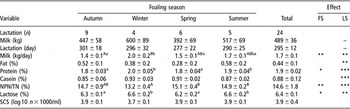
The jennets foaling in winter and in summer produced more milk than those foaling in the other seasons (Table 1).
Milk yield and chemical composition of milk across the different seasons (mean ± s.e.)

A,BP ⩽ 0.01; a,bP ⩽ 0.05; *P ⩽ 0.05; **P ⩽ 0.01; ***P ⩽ 0.001.
FS = foaling season (autumn, winter, spring and summer); LS = lactation stage (from 30 to 60, from 61 to 90, from 91 to 120, from 121 to 150, from 151 to 180, from 181 to 240, from 241 to 300 and >300); NPN = non-proteic nitrogen; TN = total nitrogen; SCS = somatic cell score.
The foaling season influenced the daily milk production (P ⩽ 0.01); the jennets foaling in winter produced more daily milk than those foaling in autumn (P ⩽ 0.01) and spring, respectively (P ⩽ 0.05). Moreover, the jennets foaling in winter and, with a minor incidence, in summer lactated in a period of better weather conditions. In particular, the first lactation stage, which is characterized by a high productive level, was in spring and in autumn, respectively, for the winter- and summer-foaling jennets. Instead, jennets foaling in autumn and in spring began lactation, respectively, when the cold and hot season were starting. Possibly, the aforementioned unfavorable climatic conditions could have negatively influenced milk production.
The fat content was low (0.44% average), as the one reported by Salimei et al. (Reference Salimei, Fantuz, Coppola, Chiofalo, Polidori and Varisco2004) equals to 0.38%. The foaling season did not influence fat percentage, even if the lowest fat value was recorded in spring. Fat content was between 0.01% and 1.8% (data not shown), with a variation range wider than the one found by Salimei et al. (Reference Salimei, Fantuz, Coppola, Chiofalo, Polidori and Varisco2004), from 0.1% to 1.4%. A wide variability in fat content was also observed by Guo et al. (Reference Guo, Pang, Zhang, Zhao, Chen, Dong and Ren2007). The protein content, which was equal to an average of 1.89%, was greater than the values found by Salimei et al. (Reference Salimei, Fantuz, Coppola, Chiofalo, Polidori and Varisco2004) equal to 1.72%. The protein content in the milk produced by jennets foaling in winter and summer was greater than the ones foaling in autumn and in spring (P ⩽ 0.05).
The casein content showed a 0.88% average – similar to the one found by Salimei et al. (Reference Salimei, Fantuz, Coppola, Chiofalo, Polidori and Varisco2004). The casein content was not influenced by the foaling season. The NPN/Total Nitrogen value was about 15% in all the seasons except winter, when a lower value, 13.22%, was recorded (P ⩽ 0.01).
The lactose content, with a 6.4% average, resulted in a value similar to the one found by Pinto et al. (1998), which was about 6.5%, and less than the value found by other authors (Chiofalo et al., 2004; Salimei et al., Reference Salimei, Fantuz, Coppola, Chiofalo, Polidori and Varisco2004), which was about 6.9%, and greater than the value found by Polidori (1994), which was equal to 6.23%.
The somatic cell score (SCS) showed low values, which were lower than 4 logarithms points. The lactation stage significantly influenced all the variables reported in Table 1, except for the somatic cell count.
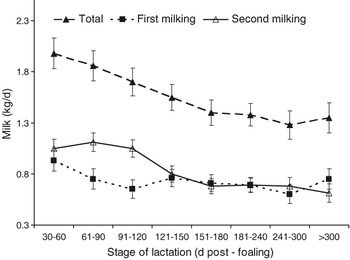
In agreement with the normal lactation tendency, a high daily milk production was found in the first lactation phases (Figure 1). From the 30th to the 120th post-foaling day, the milk produced by the first milking was 42% of the total daily amount. Other authors also observed that jennets (Chiofalo et al., 2004; Salimei et al., Reference Salimei, Fantuz, Coppola, Chiofalo, Polidori and Varisco2004) and mares (Doreau, Reference Doreau1991; Dell’Orto et al., Reference Dell’Orto, Salimei, Bontempo, Fantuz, Toppino, Contarini and Locci1994) produced more milk in the second milking than in the first one.
Daily milk yield at different stages of lactation.

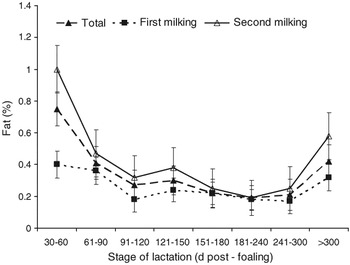
The fat content, as also observed by Malacarne et al. (Reference Malacarne, Martuzzi, Summer and Mariani2002) on mares, did not show an inverse tendency for milk production (Figure 2). This tendency in jennets differs from the one in ruminants. The particular fat tendency could be related to the jennet behavior during milking. Some jennets could prevent complete milking, reserving some of the milk for the foals.
Fat concentration in milk at different stages of lactation.

During lactation, milk yield is related to secretion and milk ejection. These two aspects are related. A neurological-endocrine reflex loosens the mammary glands. Foal suckling or milking causes the deformation of the mechanical nipple receptors determining the nervous impulse onset that is transmitted to the marrow, through the mammary nerves, up to the hypothalamus and to the cells synthesizing oxytocin.
The oxytocin-neurofisin complex, through the venous and arterial circulation, goes to the udder. In the udder, the hormone breaks off from neurofisin and ties to specific receptors of the myo-epithelial cells that contract. The mammary alveoli – wound by the myo-epithelium – are compressed. Contractions determine a considerable increase of the mammary pressure but without reaching the intensity necessary to overcome the sphincter resistance. Suction or milking is needed to overcome this resistance.
The oxytocin quantity is produced proportionally to the received stimulation. Moreover, the hormone concentration is extremely variable in the same animal and in animals of the same breed. Oxytocin circulation can be also conditioned by visual and acoustic stimulations (Aguggini et al., Reference Aguggini, Beghelli and Giulio1998).
Udder incomplete emptying would manifest more before the 120th post-foaling day, as observed in autochthonous cow breeds (Alabiso et al., 2000), and more in the first milking. Therefore it seems probable that the second milking could also give some milk, which was not milked in the first one. The first milking was indeed carried out after 5 h since foal separation, therefore after foal suckling, while the second after 5 h after machine milking. The foal suckling had probably emptied the udders more than the machine milking.
Moreover, between the 61st and the 120th post-foaling day another effect could probably increase the milk production difference between the first and the second milking: the hypothesis is that by decreasing the milk yield during the lactation, the jennets could prevent milk release more easily when the udder is not as full with milk. The milk unreleased in the first milking would determine a greater fat content in the second milking. In the first lactation stage, the difference in fat content between the first and the second milking was greater than in the other stages (Figure 2). In fact, the last part of the milk in the udder has indeed a high fat concentration. Therefore, increasing the daily milking times and/or milkings with the foal present would allow recording a greater milk fat content, which then could be milked out in the times following the first one.
Proteins also decreased but more regularly during lactation (Figure 3) as observed by Guo et al. (Reference Guo, Pang, Zhang, Zhao, Chen, Dong and Ren2007); the protein variation range was between 1.78% and 2.11%, similar to the range found by Salimei et al. (Reference Salimei, Fantuz, Coppola, Chiofalo, Polidori and Varisco2004). The same fat and protein tendencies during lactation were also found by Intrieri and Minieri (1969) and by Ullrey et al. (Reference Ullrey, Struthers, Hendricks and Brent1966) on mares, and therefore there could be physiological affinities in the lactation for the equines.
Protein concentration in milk at different stages of lactation.

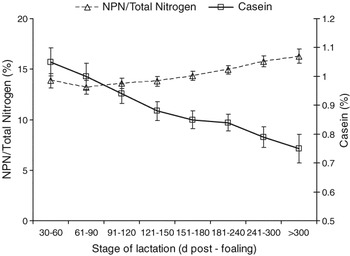
Casein showed the same tendency as the total protein content, while the NPN/Total Nitrogen had an opposite tendency (Figure 4). The undiversified feeding in the different physiological jennet phases could have caused the NPN/Total Nitrogen increase during the lactation; probably, during the last lactation period, the protein content in the feed ration exceeded the jennet protein requirements, ingested by the animals.
NPN/total nitrogen and casein concentrations in milk at different stages of lactation.

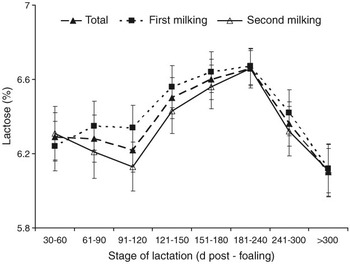
The lactose (Figure 5) content showed approximately a constant value, about 6.26%, until the 120th day of lactation. After the aforementioned time, the lactose content increased appreciably until the 180th day, reaching a peak equal to 6.66%. In the last lactation phase, the lactose content decreased. Intrieri and Minieri (1969) also reported the same results for the lactose content in mares.
Lactose concentration in milk at different stages of lactation.

The somatic cell count kept the same level during the lactation.
When looking at the production season (Table 2), spring generally showed the best qualitative and quantitative results. Bacteriological controls always resulted negative.
Effect of the production season on the main qualitative and quantitative variables

A,BP ⩽ 0.01; a,bP ⩽ 0.05.
Conclusion
Milking twice a day produced 489 ± 36 kg/jennet of milk in 295 ± 12 lactation days, and in Sicily foalings can be spread throughout the year. The milk variables showed variability. The jennet behavior during milking could have affected fat percentage. During lactation, the milk yield decreased in time and, unlike ruminants, fat and protein content also showed the same tendency. The lactose content increased for 180 post-foaling days and later decreased. Spring could be the season when the best quality milk is produced. These results show that jennet milk production can be improved, also by optimizing feeding according to the physiological requirements of the jennets. Furthermore, little information is available on how to milk. It would be important to better define the daily milkings and the in-between intervals, always respecting the animal welfare and the udder physiology. Producing jennet milk could be an interesting, profitable and alternative activity for farmers, mainly in marginal areas.