Introduction
Helicobacter pylori is a Gram-negative, microaerophilic bacterium that was first described in the human gastric mucosa. H pylori could be a major cause of gastritis, peptic ulcers and gastric malignancy,Reference Suerbaum and Michetti1 but has also been detected in other regions, such as dental plaque, saliva, adenoid tissue, tonsils and the middle ear.Reference Song, Lange, Spahr, Adler and Bode2–Reference Saki, Nikakhlagh and Ahmadi4 Studies of cases with chronic sinusitis and nasal polyps have demonstrated the presence of bacteria in specimens obtained from the nasal cavity and sinus mucosa,Reference Ozdek, Cirak, Samim, Bayiz, Safak and Turet5–Reference Kim, Dhong, Chung, Chung, Chung and Jang8 which suggests that body regions other than gastric mucosa could serve as a reservoir, or that bacteria could reach the nasal cavity through reflux mechanisms.Reference Ozdek, Cirak, Samim, Bayiz, Safak and Turet5, Reference Koç, Arikan, Atasoy and Aksoy6, Reference Dinis and Subtil9
The mucociliary transport system, as the main defence mechanism in the respiratory system, is related basically to the mucus properties and ciliary movement, and defects in the main elements of this system may cause chronic sinonasal inflammation.Reference Stevens, Lee, Schleimer and Cohen10 H pylori may also result in inflammatory and pathological changes, and disruptions of the nasal mucociliary clearance mechanisms upon reaching the nasal cavity, either directly or through reflux mechanisms. To our knowledge, there has been no research into the nasal mucociliary clearance times in patients with H pylori infection that could help fill this gap in the relevant literature. The present study aimed to evaluate the effects of H pylori infection on nasal mucociliary clearance times.
Materials and methods
This study was approved by the Clinical Research Ethics Committee (approval number: KAEK/2017.3.9), and written informed consent was obtained from the participants. The study was conducted in accordance with the principles of the Declaration of Helsinki.
The study group consisted of 50 patients aged 18–55 years who were newly diagnosed with H pylori infection using an endoscopic biopsy based method in the gastroenterology out-patient clinic, and who were scheduled to undergo medical therapy between March 2017 and December 2017. The control group comprised 50 healthy adults who were admitted to the otorhinolaryngology out-patient clinic. In both groups, smokers, drug users, and patients with acute or chronic infections, systemic autoimmune disorders, chronic diseases, allergic rhinitis, and septal deviation were excluded from the study.
After an otorhinolaryngological examination (anterior rhinoscopy and nasal endoscopic examination), the nasal mucociliary clearance time of each patient was calculated using the saccharine test. This test was originally described by Andersen et al.Reference Andersen, Camner, Jensen, Philipson and Proctor11 and then modified by other authors.Reference Rutland and Cole12 For the measurement of saccharine clearance time, a saccharine tablet was placed 0.5 cm behind the anterior end of the inferior concha, with the patient's head slightly extended. The time between placement of the pill and the perception of a sweet taste was recorded.Reference Rutland and Cole12
Statistical analyses were performed with SPSS software (version 22.0; SPSS, Chicago, Illinois, USA). The normality of distribution was checked initially with the Shapiro–Wilk test, and the Mann–Whitney U test and student's t-test were used to compare the parameters. The results were expressed as mean ± standard deviation, and a value of p < 0.05 was considered statistically significant.
Results
There were a total of 50 patients (29 female, 21 male) in the study group, with a mean age of 36.48 ± 9.42 years (range, 18–55 years). The control group comprised a total of 50 subjects (31 female, 19 male), with a mean age of 30.70 ± 8.42 years (range, 18–49 years) (Table 1).
Distribution of age and gender

SD = standard deviation
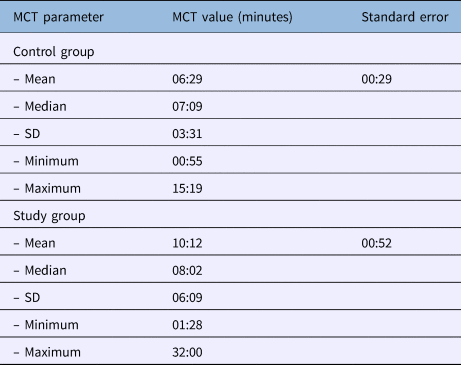
The mean mucociliary clearance time was 06:29 ± 03:31 minutes in the control group and 10:12 ± 06:09 minutes in the study group. Table 2 shows the descriptive statistics of mucociliary clearance time in the groups. A comparison of the two groups revealed a statistically significant difference (p = 0.002) (Table 3).
Descriptive statistics of mucociliary clearance time by group

MCT = mucociliary clearance time; SD = standard deviation
Mean comparison of mucociliary clearance time by group

MCT = mucociliary clearance time; SD = standard deviation
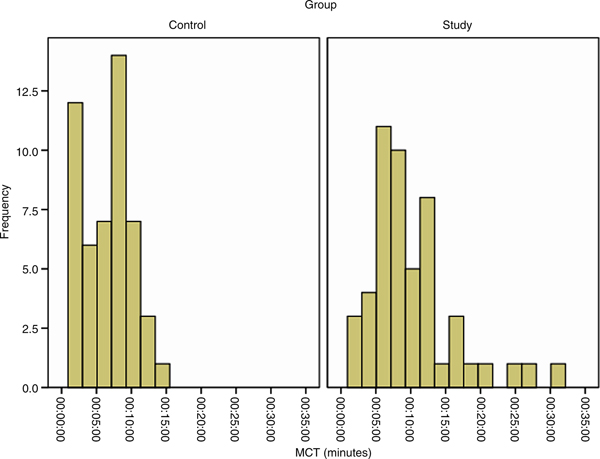
In the study group, mucociliary clearance time was above 10 minutes in 44 per cent of patients, and was above 20 minutes in 8 per cent. In the control group, only 14 per cent of subjects had a mucociliary clearance time above 10 minutes; no patients had a mucociliary clearance time above 20 minutes. Distributions of mucociliary clearance time by group are presented in Figure 1.
Distribution of mucociliary clearance time (MCT) by group.

Discussion
Nasal mucociliary clearance, which is responsible for the removal of inhaled particles and pathogens, is the most important defence mechanism for the airway.Reference Stevens, Lee, Schleimer and Cohen10 Mucus production and transport form the basis of mucociliary clearance. Upper airway surface fluid is made up of two layers: (1) a superficial ‘gel layer’, rich in antimicrobial mucus and composed of mucin, and produced by the goblet cells and submucosal glands; and (2) the underlying ‘periciliary layer’, which has lower viscosity and covers the epithelial cells of the airway, and allows ciliary movement.Reference Stevens, Lee, Schleimer and Cohen10 Mucin, which bonds to the surface of the ciliary cells, forms a fatty structure, and thereby separates mucous and periciliary layers and supports mucociliary clearance. A ciliary structure that has an appropriate beat frequency (approximately 8–15 Hz) transports the particles from the sinonasal cavity to the oropharynx, where they are swallowed or spat out.Reference Stevens, Lee, Schleimer and Cohen10
Changes in mucus production and the ciliary structure of the sinonasal epithelial cells, occurring as a result of genetic disorders or environmental and microbial toxins, may affect mucociliary clearance and may lead to upper airway infections.Reference Gudis and Cohen13, Reference Gudis, Zhao and Cohen14 Various pathogens are known to disrupt the co-ordination of ciliary movement.Reference Stevens, Lee, Schleimer and Cohen10 However, to our knowledge, there has not been any research evaluating the effects of H pylori Reference Ozdek, Cirak, Samim, Bayiz, Safak and Turet5–Reference Kim, Dhong, Chung, Chung, Chung and Jang8 on mucociliary clearance.
H pylori, which is known to be the most common cause of chronic infection in the world,Reference Taylor and Blaser15 has been previously detected in patients with chronic rhinosinusitisReference Ozdek, Cirak, Samim, Bayiz, Safak and Turet5, Reference Morinaka, Ichimiya and Nakamura7, Reference Kim, Dhong, Chung, Chung, Chung and Jang8 and nasal polyps.Reference Koç, Arikan, Atasoy and Aksoy6 In a study by Ozdek et al., H pylori was detected using a polymerase chain reaction assay in 33 per cent of the specimens obtained from the ethmoid sinus cells of patients with chronic rhinosinusitis who underwent endoscopic sinus surgery.Reference Ozdek, Cirak, Samim, Bayiz, Safak and Turet5 However, it is notable that their study did not investigate the presence of H pylori in the gastric mucosa, nor did it evaluate the symptoms of gastroesophageal reflux disease. Ozdek et al. suggested that the sinonasal cavity could serve as a reservoir for H pylori, or that H pylori may be transported from the stomach to the sinonasal cavity via gastroesophageal reflux. According to Ozdek et al., H pylori may be a direct cause of tissue damage or may predispose sinonasal mucosa to the colonisation of other pathogens that could lead to chronic rhinosinusitis.Reference Ozdek, Cirak, Samim, Bayiz, Safak and Turet5 Kim et al. reported a significantly higher rate of H pylori in the intranasal tissues of patients with chronic rhinosinusitis when compared to a control group, but found no correlation between rhinosinusitis symptoms and H pylori colonisation.Reference Kim, Dhong, Chung, Chung, Chung and Jang8 These studies support the relationship between chronic rhinosinusitis and H pylori infection, although they provide no clear data indicating how H pylori cause chronic rhinosinusitis.
In the present study, in both groups, we excluded smokers, and patients with rhinitis and chronic rhinosinusitis symptoms and findings, which are the common causes of nasal mucociliary clearance disruption. The study found that mucociliary clearance time was significantly prolonged in patients who tested positive for H pylori infection (through gastric biopsy based methods) than in the control group.
The saccharine clearance test, which is readily available, inexpensive and a practical screening tool for the measurement of mucociliary clearance time, was used in our study.Reference Deborah and Prathibha16 In the literature, various normal ranges have been reported for mucociliary clearance time.Reference Pandya and Tiwari17 Pandya and Tiwari evaluated healthy adults aged 18–60 years using the saccharine test, and reported a mean mucociliary clearance time of 9.5 minutes with a range of 5.6–13.4 minutes.Reference Pandya and Tiwari17 In another study, a normal mucociliary clearance time was defined as between 7 and 15 minutes; a mucociliary clearance time over 20 minutes was considered pathological.Reference Deborah and Prathibha16
In our study, mucociliary clearance time was longer than 10 minutes in 22 (44 per cent) of the 50 patients who were found to have H pylori in the gastric mucosa, whereas mucociliary clearance time was longer than 10 minutes in only 7 (14 per cent) of the 50 patients in the control group. The study group rate is considerably higher than that in healthy individuals. Among the patients who tested positive for H pylori infection, four (8 per cent) had a mucociliary clearance time longer than 20 minutes, whereas the longest mucociliary clearance time recorded in the control group was 15 minutes.
H pylori may cause changes in the viscoelastic structure of the mucous layer in the sinonasal cavity, and/or may disrupt ciliary structure or function. This may predispose the patient to frequent and resistant upper airway infections by disrupting the mucociliary clearance mechanism, which is one of the most important factors in the pathogenesis of chronic rhinosinusitis.
Previous studies have established a relationship between chronic rhinosinusitis and gastroesophageal reflux disease in adults.Reference El-Sarag and Sonnenberg18, Reference Ulualp, Toohill, Hoffmann and Shaker19 In a study by Delehaye et al., the mucociliary clearance times of 50 patients with gastroesophageal reflux disease were evaluated.Reference Delehaye, Dore, Bozzo, Mameli, Delitala and Meloni20 The patients were divided into two groups: those with gastroesophageal symptoms and those with extraesophageal symptoms. Their study found a significant correlation between gastroesophageal reflux disease and mucociliary clearance time. Gastric biopsies revealed H pylori infections in 63 per cent of patients with gastroesophageal symptoms and 44 per cent of patients with extraesophageal symptoms. This finding suggests that H pylori infections could be a co-factor that affects both gastroesophageal reflux disease and mucociliary clearance time.
The present study is limited, as gastroesophageal and/or laryngoesophageal symptoms were not investigated in our patients. Another limitation of our study is that the presence of H pylori in the nasal cavity was not evaluated in patients with H pylori infection diagnosed via a gastric biopsy.
• Nasal mucociliary clearance time was significantly increased in patients with Helicobacter pylori infection
• H pylori infection may have an unfavourable effect on nasal mucociliary clearance
In conclusion, the present study, to our knowledge, is the first to evaluate the association between H pylori infection and mucociliary clearance time. The results revealed that mucociliary clearance times were significantly longer in patients with H pylori in the gastric mucosa. Bacteria that reach the nasal cavity by way of reflux mechanisms or colonisation in the nasal reservoir may cause changes in the mucus structure and/or ciliary movement via chronic inflammation, and lead to disruption of the mucociliary clearance system. Further studies involving a larger number of patients are needed to evaluate the presence of bacteria in the nasal mucosa, with measurement of nasal mucociliary clearance times. This may provide clearer data on the relationship between H pylori and mucociliary clearance time.
Competing interests
None declared