Introduction
Many observational studies have shown that breastfeeding provides protection against childhood obesity. However, the exact extent of this effect is unclear. One of the largest metanalysesReference Yan, Liu, Zhu, Huang and Wang1 involving over 220,000 infants recruited to 17 different observational studies found that breastfeeding conferred an adjusted odds ratio for obesity of 0.78. Although a number of included papers adjusted their analysis for birth weight, none examined or controlled for body composition at birth. Breastfed infants are thought to experience a slower early growth rate compared to formula-fed infants, which may reduce their risk of later onset obesity. An alternative theory proposes that breastfeeding alters infant appetite, possibly through the action of leptin, which directly affects satiety, and is present in breastmilk but not infant formula.Reference Gridneva, Kugananthan and Rea2 It remains difficult to tease out the true effect of breastfeeding due to the significant confounding effects of maternal socio-economic status, maternal education, and other health, exercise, and nutritional habits.Reference Hajian Tilaki3, Reference Weng, Redsell, Swift, Yang and Glazebrook4 Although these confounding effects are often examined for their role on the post-natal environment of the infant, no previous studies have examined their pre-natal effect on the intra-uterine growth of the infant.Reference Toro-Ramos, Paley, Pi-Sunyer and Gallagher5
Thanks to decades of work in the field of the developmental origins of health and disease, we know that an infant’s intra-uterine growth has a direct and predictable effect on both early and long-term growth and metabolic risk.Reference Hales and Barker6, Reference Wells7 If the pre-natal environment of a breastfed infant is substantially different from that of a formula-fed infant, might any subsequent differences in post-natal growth occur irrespective of feeding method? There is clear evidence that breastfeeding mothers differ in dietary and lifestyle habits from mothers who choose not to breastfeed. Mothers that breastfeed generally have a lower body mass index (BMI) during pregnancy,Reference Campbell and Shackleton8 lower rates of smoking,Reference Brown, Dodds and Attenborough9 and diabetes.Reference Finkelstein, Keely, Feig, Tu, Yasseen and Walker10 All these factors, independently, have been shown to influence both birth weight and body composition at birth.Reference Regnault, Botton and Forhan11 We hypothesized that differences may exist between breastfed and formula-fed infants, at birth, prior to becoming “breastfed” or “formula-fed”.Reference Nommsen-Rivers and Dewey12, Reference Fomon13 The aim of our study was to compare the body composition of term infants at birth who were subsequently exclusively breast- or formula-fed for the first 2 months of life.
Methods
The study sample consisted of term (≥37+0 weeks’ gestation), singleton, infants born to primiparous women who were recruited between 2008 and 2011 to the Cork BASELINE Birth Cohort Study (Babies After SCOPE: Evaluating the Longitudinal Impact on Neurological and Nutritional Endpoints). This birth cohort was an extension of the SCOPE Ireland Study (Screening for Pregnancy Endpoints International Cohort Study). The methodology of the Cork BASELINE Birth Cohort Study (0–2 years) has previously been described in detail.Reference O’Donovan, Murray, Hourihane, Kenny, Irvine and Kiely14 The clinical research ethics committee of the Cork Teaching Hospitals Ethical provided ethical approval for the Cork BASELINE Birth Cohort Study (ref ECM5(9) 01/07/2008) and SCOPE Ireland Study (ref ECM5(10) 05/02/2008).
Body composition was assessed using air-displacement plethysmography (PEA POD® Infant Body Composition System, COSMED USA, Concord, CA) and density values from Fomon.Reference Fomon, Haschke, Ziegler and Nelson15 The PEA POD® Infant Body Composition System is the recommended method to capture the body composition of children under 2 years of age16 and divides the body mass into its fat mass (FM) and fat-free mass (FFM). The PEA POD’s® technical error of measurement for percentage FM is thought to be less than 1% and has shown good agreement with a gold-standard 4-Component measure of body composition.Reference Ellis, Yao, Shypailo, Urlando, Wong and Heird17 Prior to having their body composition measured, infants were weighed without clothing to the nearest 0.1 g using a tared digital scale, and length was measured to the nearest millimeter using a neonatometer. To measure head, mid-upper and abdominal circumference, a disposable tape measure that could not be stretched was used. For head circumference, the tape was wrapped around the widest possible circumference of the head. The mid-point between the tip of the shoulder and the tip of the elbow on the left arm was used to measure the mid-upper arm circumference, and the abdominal circumference was measured at the level of the navel. All mass measurements are reported as kilograms and head, mid-upper arm, and abdominal circumferences are reported in centimeters.
The SCOPE Ireland Study collected demographic data related to paternal and maternal history, information on pregnancy outcomes from the maternal medical records, and maternal and paternal anthropometric data were measured at 15 weeks’ gestation, with the exception of their self-reported birth weight. At 20 gestational weeks’ a fetal growth scan was performed and measured the fetus’s biparietal diameter, head and abdominal circumferences, and femur length (mm). Maternal education (completed tertiary education or not) and information on employment were captured at the first appointment with the Cork BASELINE Birth Cohort Study when the infants were 2 months old.
Maternal BMI was determined by dividing the recorded weight (kg) by height in meters squared. Body size classification was based on the World Health Organization BMI-based definitions for underweight (<18.5 kg/m2), normal weight (≥18.5 to <25 kg/m2), overweight (≥25 to <30 kg/m2), and obesity (≥30 kg/m2).18 The recruiting hospital’s guidelines classified obese mothers as being high risk for developing gestational diabetes mellitus (GDM)19 and were referred for GDM screening at around 28 weeks’ gestation. Gestational weight gain from 15 weeks’ gestation up to delivery was determined by subtracting the weight measured prior to labor from the weight recorded at 15 weeks’ gestation. The Institute of Medicine’s criteria was used to determine if mothers exceeded their recommended weight gain.20
Infants were categorized as either breast- or formula-fed based on medical reports from the maternity hospital and parental reports of infant feeding at 2 months of age. Only infants that were exclusively breastfed or formula-fed from birth to 2 months were included in the analysis. Our initial analysis of the data showed a gradient difference in anthropometric measurements and demographics between exclusively breastfed infants, infants that received both breastmilk and infant formula, and exclusively formula-fed infants. To reduce cross-over effect on the results we have excluded any infant that received both breastmilk and infant formula, either simultaneously or separately, at any stage in the first 2 months of life. We have provided supplementary data which include the characteristics, anthropologic, and body composition measurements of the mixed feeders (those that received both breastmilk and infant formula during the first 2 months of life).
As results from the Cork BASELINE Birth Cohort Study have found that male and female infants differ significantly in their body composition at birth, all analyses were stratified by infant sex.Reference Hawkes, Hourihane, Kenny, Irvine, Kiely and Murray21 Categorical variables were reported as absolute numbers and as percentages. Associations between categorical variables were examined using Pearson’s chi-square test. Continuous variables were described by their mean and standard deviation (SD), and differences between the feeding groups were tested using Student’s t-test. Multivariable analysis was undertaken using linear regression and all estimates are reported alongside 95% confidence intervals.
Results
Consent was obtained for 1,583 infants to participate in the Cork BASELINE Birth Cohort Study, and 1,132 had their body composition measured prior to discharge from the maternity hospital following delivery. Number of dropouts at delivery was 10 (0.88%) and 71 (6.27%) at 2 months, totaling 81 (7.15%) infants. Out of the remaining 1,051 participants, 24 were preterm (≤36 + 6 weeks’ gestation), 77 were missing method of feeding at 2 months, and 594 term infants had a feeding history that did not meet this study’s inclusion criteria due to mixed feeding. This left a final sample of 356 infants: 117 (32.9%) exclusively breastfed and 239 (67.1%) exclusively formula-fed. We did not find any differences in maternal BMI, reported rates of smoking in pregnancy, GDM, maternal employment or infant sex, and weight at birth between infants that did and did not have their body composition assessed following delivery. All but one infant (in the formula-feeding group) had their growth scan and all infants had their body composition assessed.
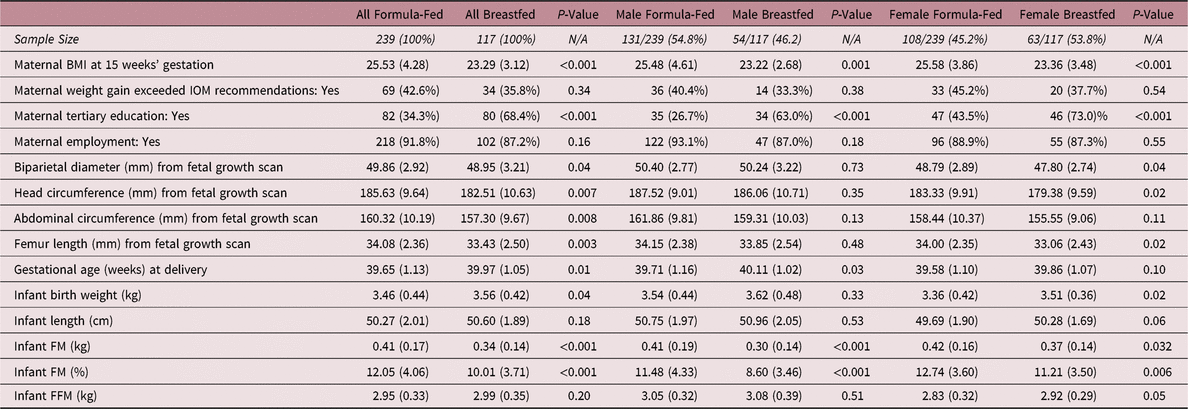
Mothers who breastfed differed significantly from those who formula-fed in several clinical variables (Table 1). Reported rates of smoking during pregnancy differed between mothers who breast- and formula-fed their infants (1.7 and 13.8% respectively; X2(1) = 12.97, N = 356, p < 0.001). Breastfeeding mothers had lower mean (SD) BMI at 15 weeks’ gestation compared to mothers who formula-fed their infants (23.29 (3.12) vs. 25.53 (4.28); t(351) = −4.97, p < 0.001). Nearly five times as many mothers who went on to exclusively formula-fed their infants required screening for GDM, based on their BMI at 15 weeks’ gestation, compared to breastfeeding mothers (17.2 and 3.5%, respectively; X2(1) = 13.18, N = 353, p < 0.001). At 15 weeks’ gestation formula-feeding mothers had larger waist (82.30 (9.80) vs. 77.22 (6.80) cm; t(354) = −5.04, p < 0.001) and hip circumferences (98.33 (8.91) vs. 94.22 (7.61) cm, t(353) = −4.28, p < 0.001) and higher systolic blood pressure (105.15 (10.08) vs. 103.11 (9.78) mmHg, respectively; t(354) = −2.70, p = 0.007).
Study sample characteristics
Socio-economic differences were also observed. Nearly twice as many breastfeeding mothers had a tertiary education compared to mothers who formula-fed their infants. Although rates of employment did not differ between the groups, 76.1% of breastfeeding mothers were classified as managers or professionals compared to 45.2% of formula-feeding mothers (X2(1) = 30.31, N = 356, p = <0.001).
In the ante-natal growth scan (Table 1), breastfed infants had a significantly smaller abdominal circumference compared to formula-fed infants (157.3 (9.67) vs. 160.3 (10.19) mm; t(355) = −2.66, p = 0.008).
At birth, for both sexes, infants who progressed to exclusive breastfeeding were heavier when compared to formula-fed infants. Female infants, in particular, were heavier than their formula-fed counterparts (3.51 (0.36) vs. 3.36 (0.42) kg; t(169) = 2.37, p = 0.02), while in males, the difference was not significant (3.62 (0.49) vs. 3.54 (0.44) kg, t(183) = 0.98, p = 0.33). Although breastfed infants were heavier at birth, they had significantly lower FM (0.34 (0.14) vs. 0.41 (0.17) kg; t(356) = −4.13, p < 0.001) and %FM (10.01 (3.71) vs. 12.05 (4.06)%; t(356) = −4.59, p < 0.001), compared to formula-fed infants. These differences remained when stratified by infant sex (Table 1).
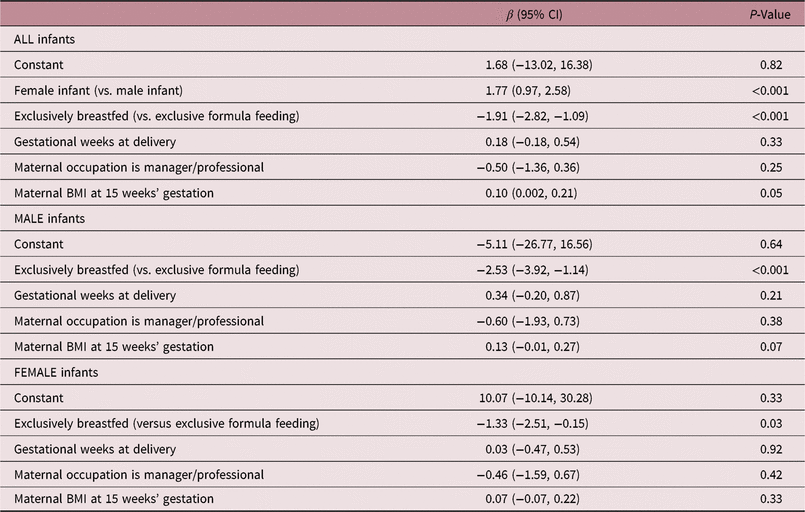
In multiple linear regression, being born to a mother that would go on to breastfeed, compared to a mother that progressed to formula feed, significantly reduced the %FM, for both male and female infants, when controlled for gestational weeks at delivery, maternal profession, and BMI at 15 weeks’ gestation (Table 2).
Multiple linear regression for neonatal %FM

Discussion
We have shown that body composition differences are present at birth between infants who progressed to exclusive breastfeeding compared to infants who were exclusively formula-fed from birth. Our results indicate that infants, based on their mothers’ method of infant feeding, do differ at birth. We have also shown that there are significant anthropometric and socioeconomic differences between breastfeeding and formula-feeding mothers. This is an important finding as it shows that differences exist prior to any exposure to formula milk. Subsequent early growth and later risk of obesity and metabolic dysfunction may be related to the pre-natal exposure of the infant, rather than the early feeding habit.
The implications of this finding are important to researchers studying the field of early growth and early nutrition. We know that lean body mass at birth bears a close relationship to adult height, later risk of obesity, and metabolic dysfunction.Reference Hales and Barker6, Reference Wells22 A greater lean body mass provides increased metabolic capacity to cope with subsequent metabolic load, conferring lifelong protection to the infant. We have shown that formula-fed infants have a lower birth weight and higher FM/lower lean mass at birth. They are set up to fail in the environment to which they are born and are least likely to cope with the additional metabolic load of formula milk. Researchers examining the early effects of breastfeeding need to take this into account. In the modern world of formula feeding, the balanced interaction of maternal/fetal pre-natal nutrition to post-natal lactation is disrupted and infants prepared for a nutrition-poor post-natal environment are provided with the opposite.Reference Wells7
The factors driving the differences seen are unclear but are likely to be a confluence of maternal diet, activity, and stress levels, affecting placental nutritional delivery and placental growth hormones. Why these differ in mothers who successfully breastfeed to 2 months compared to those who bottle feed from birth is also unclear but is likely to be a combination of health education and nutritional awareness. Our small study was not able to examine each of these factors in detail but raises important questions about when obesity intervention needs to begin. Should we define the birth weight/body composition of breastfed infants as the ideal? This would mean that body composition reference ranges would shift to almost 1.5% lower than those currently published when all feeding types are included.Reference Hawkes, Hourihane, Kenny, Irvine, Kiely and Murray21
Previous studies have shown that maternal smoking significantly reduces infant birth weight and FFM but not FM.Reference Harrod, Reynolds and Chasan-Taber23, Reference Harvey, Poole and Javaid24 We also found that maternal smoking significantly reduced infant body mass and FFM but did not affect FM. However, we could not explore the effect of maternal smoking, based on how the infants were fed, on infant body composition, as only two exclusively breastfeeding mothers reported smoking in pregnancy.
GDM screening in the SCOPE Ireland Study was based on the presence of one or more risk factors, including high BMI. Mothers whose clinicians placed them at high risk for GDM due to their BMI gave birth to infants with increased %FM, compared to mothers with a BMI that did not warrant GDM screening. Notably, one previous study has shown that the relationship between maternal BMI and neonatal body composition is negated if adjusted for the maternal glucose tolerance test and fasting glucose levels from 36 to 38 gestational weeks.Reference Josefson, Hoffmann and Metzger25 We were not able to explore the relative importance of these exposures as fasting blood glucose levels were not available in the cohort but only those screened for GDM.
Limitations to this study include that it is a secondary data analysis. The Cork BASELINE Birth Cohort Study was established to examine the body composition of infants but not based on method of feeding at 2 months of age. We did not collect data on maternal health beliefs and breastfeeding intentions. As with all observational studies, caution should be applied in interpreting the results due to risks of confounding and selection bias. Our study sample came from a large, prospective, population-based cohort which used reference methods to capture neonatal body composition. All eligible infants were included in this analysis. Our sample size was reduced as the Cork BASELINE Birth Cohort Study was established prior to the installation of the PEA POD® Infant Body Composition System. Due to this delay, over a fifth (27%) of the cohort did not have their body composition assessedReference O’Donovan, Murray, Hourihane, Kenny, Irvine and Kiely14 and were therefore ineligible for this paper.
Our paper did find that the birth weight and body composition of infants who are breastfed successfully by their mothers to 2 months differ significantly from that of infants exclusively formula fed from birth. Our analysis raises important questions about the true post-natal effect of breastfeeding as the intra-uterine environment of these infants may have a significant role to play. The differing obesity risk and early growth trajectory seen in breastfed infants may in part be due to differences in their intra-uterine exposures, irrespective of their early post-natal diet.
Author ORCIDs
Hazel Smith https://orcid.org/0000-0001-5538-0897
Acknowledgements
We would like to thank all the families involved in the SCOPE Ireland Study and the Cork BASELINE Birth Cohort Study. The results and publications would not have been possible without their support and participation in both studies. We would also like to acknowledge the Science Foundation Ireland Program Grant for INFANT (12/RC/2272) and National Children’s Research Centre, Ireland, for the funding provided to the SCOPE Ireland Study and the Cork BASELINE Birth Cohort Study, respectively.
Supplementary material
To view supplementary material for this article, please visit https://doi.org/10.1017/S2040174419000187